Deliver toUnited Arab Emirates
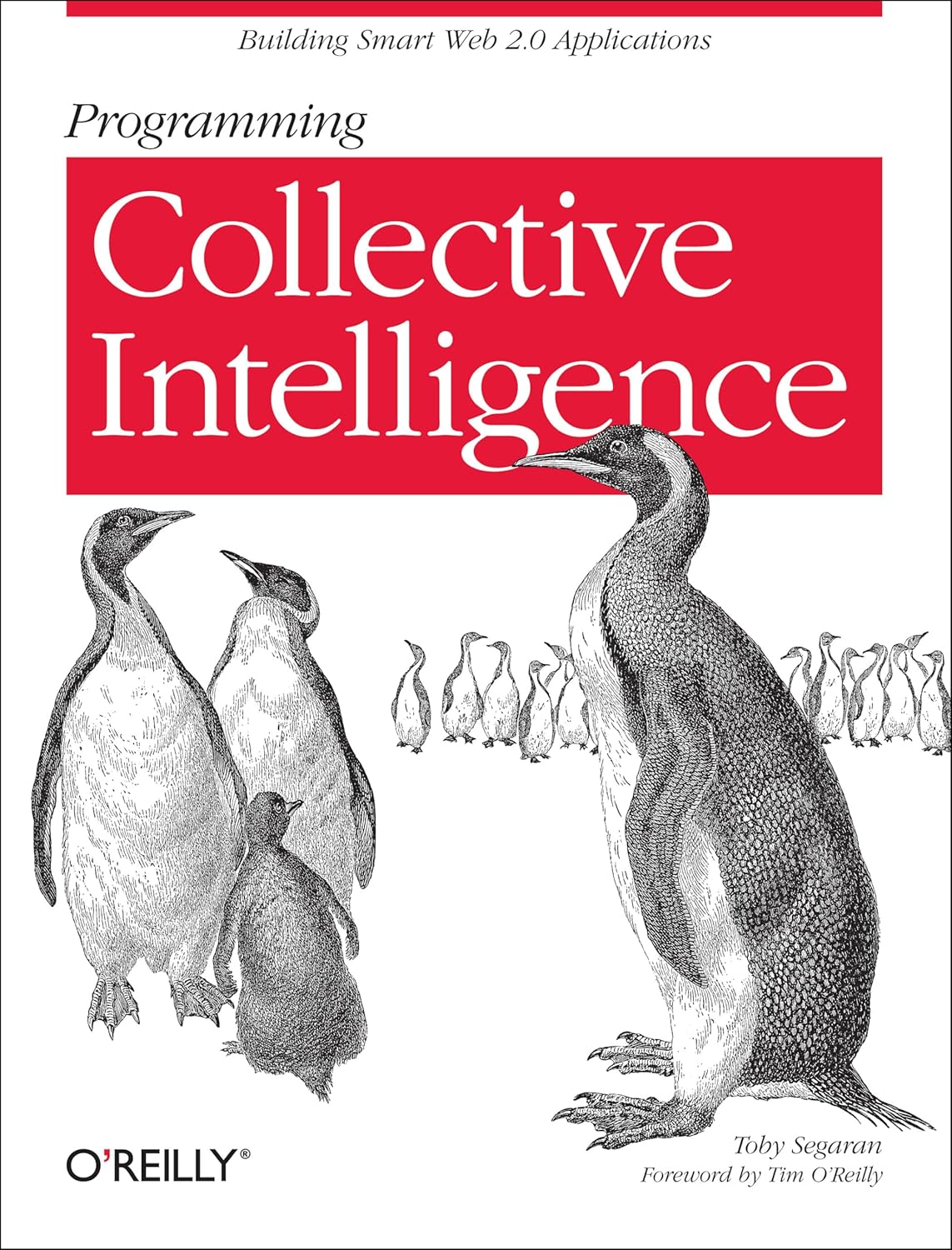
Programming Collective Intelligence: Building Smart Web 2.0 Applications

Description:

Want to tap the power behind search rankings, product recommendations, social bookmarking, and online matchmaking? This fascinating book demonstrates how you can build Web 2.0 applications to mine the enormous amount of data created by people on the Internet. With the sophisticated algorithms in this book, you can write smart programs to access interesting datasets from other web sites, collect data from users of your own applications, and analyze and understand the data once you've found it.

Programming Collective Intelligence takes you into the world of machine learning and statistics, and explains how to draw conclusions about user experience, marketing, personal tastes, and human behavior in general -- all from information that you and others collect every day. Each algorithm is described clearly and concisely with code that can immediately be used on your web site, blog, Wiki, or specialized application. This book explains:
  • Collaborative filtering techniques that enable online retailers to recommend products or media
  • Methods of clustering to detect groups of similar items in a large dataset
  • Search engine features -- crawlers, indexers, query engines, and the PageRank algorithm
  • Optimization algorithms that search millions of possible solutions to a problem and choose the best one
  • Bayesian filtering, used in spam filters for classifying documents based on word types and other features
  • Using decision trees not only to make predictions, but to model the way decisions are made
  • Predicting numerical values rather than classifications to build price models
  • Support vector machines to match people in online dating sites
  • Non-negative matrix factorization to find the independent features in a dataset
  • Evolving intelligence for problem solving -- how a computer develops its skill by improving its own code the more it plays a game
Each chapter includes exercises for extending the algorithms to make them more powerful. Go beyond simple database-backed applications and put the wealth of Internet data to work for you.

"Bravo! I cannot think of a better way for a developer to first learn these algorithms and methods, nor can I think of a better way for me (an old AI dog) to reinvigorate my knowledge of the details."

-- Dan Russell, Google

"Toby's book does a great job of breaking down the complex subject matter of machine-learning algorithms into practical, easy-to-understand examples that can be directly applied to analysis of social interaction across the Web today. If I had this book two years ago, it would have saved precious time going down some fruitless paths."

-- Tim Wolters, CTO, Collective Intellect


Editorial Reviews

About the Author

Toby Segaran is a software developer and manager at Genstruct, a computational systems biology company. He has written free web applications for his own use and put them online for others to try, including: tasktoy, a task management system; Lazybase, an online application that lets users design, create and share databases of anything they like; and Rosetta Blog, an online tool for practicing Spanish and French by reading blogs along with their translations and lists of common words. Each of these has several hundred regular users.

Reviews:

5.0 out of 5 stars A visionary book that illuminates the Internet

A.I.S. · October 21, 2008

This is a visionary book because it predicts a lot of what will happen to the Internet soon. How do we process information in the Internet age? Instead of reading magazines and newspapers we use blogs as our source of news. This is because blogs offer much more customized news feed. In a typical newspaper, how much of its content is of interest to a reader? I guess half is a big value but typically it is less than that.I start my working day with consuming two sweet drinks. One drink is a cup of coffee. Another is a virtual information soup made of 100 blogs. I glance over most of the stories quickly using Google Reader and select those that I am interested in. I might read them in greater detail later on during the day, in the evening, or on a weekend. I do not know which drink gives me more pleasure - the delicious cup of coffee or sweet virtual soup. I like the latter a lot because it is rich with media content - with bright images, cool videos, wow-type web pages.However, I often discover news that I wish I found out earlier. In other words, there are so many news sources that reading them all or just looking at the headlines of major blogs will take too much time. We need targeted information delivery service.This is the main idea of this book. In fact, it starts with explaining how to make recommendations given a set of preferences of a number of people and your own preferences. What are those cool things that you have not tried out yet but everybody else did? The example described in the book is applied to Delicious which does not offer recommendations yet.I often try to decide what my interests are. The blogs that I am reading might answer this question if one builds groups of them. In fact, I have done this manually, but I found out that this categorization is not perfect. The book answers this question in Chapter 3.After that the book deviates into a number of additional topics such as search, neural networks, discrete optimization. The author Toby Segaran has a great ability to explain difficult concepts using simple words and pictures. As most of the stuff was familiar to me I was wondering how easy a new concept seemed and how much time I spent originally understanding it.After that the main melody of the book is there again - the next chapter explains how to filter documents, for example to decide if a particular news story is interesting to you or not. Then the book deviates again into decision trees and building price models and even matching people on a dating site. However, there comes our melody again - this time it explains how to extract trends from a lot of news sources, that is decide what people are discussing today. This feature is similar to Google News except that the user has no control of news sources.I was surprised when I found out that Python is such a popular language in a scientific community. The book describes lots of libraries dealing with numerical data or displaying various charts. The book will serve as a great introduction to Python language even though there are lots of introductory books available. In fact, learning Python this way it easier and more enjoyable.After reading the book I definitely want to try out the tricks explained there and improve my information soup. This book is my virtual cookbook.

5.0 out of 5 stars A book for anyone wanting to tell a story

R. · March 2, 2014

There's a point every developer hits, that point where everything seems mundane, repetitive and not worth doing anymore. You might go on and try another language to spice up your life, but you then, again, realise same old, same old. You Grab something from the models, do some funky stuff in the business logic and then present. You know what to expect, your know how to do it.This book is for those who realise programming, no matter what language, can do amazing things once you understand some simple concepts to tell a story through data. It gets you out of the mind set of, "I have some data stored here, and I will present it here". Instead, "I have some data stored here, how do I show, create understanding, explore, wedge out, predict, recommend it here"Most of the topics presented in this book are not new in any sense, however they are not old either. They're tried and proven methods for creating meaning from datasets. They will be used for decades to come because they work! There are other books on the topics presented, like I said they are not new, however the simplicity of Python provides a frictionless entry for anyone wanting to get up and running with out a bloated IDE or framework to make it happen.Those who are thinking, "well it's Python, and Python can't do X", I say to you a language does not determine what can and can not do it is the developer. At the end of the day the capability of the developer determines what the language can and can't do. If it seriously can't do something then build an extension to the language! With this thinking you can port what is presented in this book to any language. Python was chosen for it's simple constructs and readability.If you're ever going to by a book on this topic buy this. Not the kindle, but the hard copy. The kindle version I've found doesn't present well for the code sections.Overall this book is a great reference and is also a great primer if wanting to go deeper. It will allow you to tackle your next project with a different mindset and allow your users to discover and learn new things about their online surroundings and themselves!

Auf Schatzsuche im Web 2.0

D. · March 25, 2008

Nachdem mich vor zwei Jahren Ruby on Rails in Wallung gebracht hat, fesselt mich zurzeit Collective Intelligence von Toby Segaran (Blog, Interview). Es wendet das eher trockene Thema Maschinelles Lernen mit spielerischer Leichtigkeit auf praktische Anwendungen im "Web 2.0" an. Auf jeweils wenigen Seiten stellt er einen Algorithmus direkt an einem praktischen Problem vor und liefert den Code gleich mit. Dabei spührt er auf Entdeckungsreise den von Internetbenutzern in Blogs, Lesezeichen, und Käufen preisgegeben Preferenzen nach:* Ähnliche Webseiten mit Hilfe von del.icio.us empfehlen* Blogs gruppieren und visualisieren* Eine Wikipedia-Suchmaschine im Google-Stil bauen* Reispläne mit Kayak Flugdaten optimieren* Interessante Blogeinträge filtern* Kriterien für Häuserpreise und Partnersuche finden* eBay Preis vorhersagen* Partner in Facebook suchen* Nachrichtentrends und ihren Einfluss auf Aktienpreise analysieren* Ausblick genetische ProgrammierungDas Buch hat meine Fantasie geweckt, selbst im Web 2.0 auf Schatzsuche zu gehen. Wissen in so einer Gelassenheit und erfrischenden Kürze anzuwenden wie Toby Segaran es in seinem mittlerweile auch in Deutsch erschienenen Buch tut ist eine hohe Kunst, in der ich mich ebenfalls mehr üben möchte.

Great for Understanding the absolute fundamentals of machine learning.

N.K.T. · April 29, 2019

This book shows practically by showing python code exactly how to implement a wide variety of problems - in Optimization, Clustering, Prediction,Building Recommender Systems, etc. It explains the basics of some backbones of Data Analytics like Kernel Machines. Highly recommended for everyone.

Excellent

j. · April 12, 2017

Book is in excellent condition and the book is very informative and interesting. I would recommned it to anyone who wants to learn machine learning.

Completo e chiaro

F. · July 13, 2013

Libro completissimo, con un ampio range di argomenti coperti, sempre descritti con massima chiarezza e con sorgenti (in Python 2) di facile comprensione e modifica. Decisamente consigliato per chi ha intenzione di capire come implementare motori di ricerca o sistemi che associno tra loro dati, etc...

Fascinating and inspiring

R.W. · March 13, 2011

This book covers algorithms that elsewhere are treated as artificial intelligence, but here are dealt with very rapidly and in a programmer's mindset. It's great to see ideas that have been considered "academic", such as neural networks, treated as no more frightening than other algorithms such as sorting. The description of how to use live web site APIs is also a great feature of this book.

Programming Collective Intelligence: Building Smart Web 2.0 Applications

Product ID: U0596529325
Condition: New

4.2

AED9499

Price includes VAT & Import Duties
Type: Paperback
Availability: In Stock

Quantity:

|

Order today to get by 7-14 business days

Delivery fee of AED 20. Free for orders above AED 200.

Returns & Warranty policies

Imported From: United States

At BOLO, we work hard to ensure the products you receive are new, genuine, and sourced from reputable suppliers.

BOLO is not an authorized or official retailer for most brands, nor are we affiliated with manufacturers unless specifically stated on a product page. Instead, we source verified sellers, authorized distributors or directly from the manufacturer.

Each product undergoes thorough inspection and verification at our consolidation and fulfilment centers to ensure it meets our strict authenticity and quality standards before being shipped and delivered to you.

If you ever have concerns regarding the authenticity of a product purchased from us, please contact Bolo Support. We will review your inquiry promptly and, if necessary, provide documentation verifying authenticity or offer a suitable resolution.

Your trust is our top priority, and we are committed to maintaining transparency and integrity in every transaction.

All product information, images, descriptions, and reviews originate from the manufacturer or from trusted sellers overseas. BOLO is not affiliated with, endorsed by, or an authorized retailer for most brands listed on our website unless stated otherwise.

While we strive to display accurate information, variations in packaging, labeling, instructions, or formulation may occasionally occur due to regional differences or supplier updates. For detailed or manufacturer-specific information, please contact the brand directly or reach out to BOLO Support for assistance.

Unless otherwise stated, all prices displayed on the product page include applicable taxes and import duties.

BOLO operates in accordance with the laws and regulations of United Arab Emirates. Any items found to be restricted or prohibited for sale within the UAE will be cancelled prior to shipment. We take proactive measures to ensure that only products permitted for sale in United Arab Emirates are listed on our website.

All items are shipped by air, and any products classified as “Dangerous Goods (DG)” under IATA regulations will be removed from the order and cancelled.

All orders are processed manually, and we make every effort to process them promptly once confirmed. Products cancelled due to the above reasons will be permanently removed from listings across the website.

Similar suggestions by Bolo

More from this brand

Similar items from “Intelligence & Semantics”

Programming Collective Intelligence: Building Smart Web 2.0 Applications

Product ID: U0596529325
Condition: New

4.2

Programming Collective Intelligence: Building Smart Web 2.0 Applications-0
Type: Paperback

AED9499

Price includes VAT & Import Duties
Availability: In Stock

Quantity:

|

Order today to get by 7-14 business days

Delivery fee of AED 20. Free for orders above AED 200.

Returns & Warranty policies

Imported From: United States

At BOLO, we work hard to ensure the products you receive are new, genuine, and sourced from reputable suppliers.

BOLO is not an authorized or official retailer for most brands, nor are we affiliated with manufacturers unless specifically stated on a product page. Instead, we source verified sellers, authorized distributors or directly from the manufacturer.

Each product undergoes thorough inspection and verification at our consolidation and fulfilment centers to ensure it meets our strict authenticity and quality standards before being shipped and delivered to you.

If you ever have concerns regarding the authenticity of a product purchased from us, please contact Bolo Support. We will review your inquiry promptly and, if necessary, provide documentation verifying authenticity or offer a suitable resolution.

Your trust is our top priority, and we are committed to maintaining transparency and integrity in every transaction.

All product information, images, descriptions, and reviews originate from the manufacturer or from trusted sellers overseas. BOLO is not affiliated with, endorsed by, or an authorized retailer for most brands listed on our website unless stated otherwise.

While we strive to display accurate information, variations in packaging, labeling, instructions, or formulation may occasionally occur due to regional differences or supplier updates. For detailed or manufacturer-specific information, please contact the brand directly or reach out to BOLO Support for assistance.

Unless otherwise stated, all prices displayed on the product page include applicable taxes and import duties.

BOLO operates in accordance with the laws and regulations of United Arab Emirates. Any items found to be restricted or prohibited for sale within the UAE will be cancelled prior to shipment. We take proactive measures to ensure that only products permitted for sale in United Arab Emirates are listed on our website.

All items are shipped by air, and any products classified as “Dangerous Goods (DG)” under IATA regulations will be removed from the order and cancelled.

All orders are processed manually, and we make every effort to process them promptly once confirmed. Products cancelled due to the above reasons will be permanently removed from listings across the website.

Description:

Want to tap the power behind search rankings, product recommendations, social bookmarking, and online matchmaking? This fascinating book demonstrates how you can build Web 2.0 applications to mine the enormous amount of data created by people on the Internet. With the sophisticated algorithms in this book, you can write smart programs to access interesting datasets from other web sites, collect data from users of your own applications, and analyze and understand the data once you've found it.

Programming Collective Intelligence takes you into the world of machine learning and statistics, and explains how to draw conclusions about user experience, marketing, personal tastes, and human behavior in general -- all from information that you and others collect every day. Each algorithm is described clearly and concisely with code that can immediately be used on your web site, blog, Wiki, or specialized application. This book explains:
  • Collaborative filtering techniques that enable online retailers to recommend products or media
  • Methods of clustering to detect groups of similar items in a large dataset
  • Search engine features -- crawlers, indexers, query engines, and the PageRank algorithm
  • Optimization algorithms that search millions of possible solutions to a problem and choose the best one
  • Bayesian filtering, used in spam filters for classifying documents based on word types and other features
  • Using decision trees not only to make predictions, but to model the way decisions are made
  • Predicting numerical values rather than classifications to build price models
  • Support vector machines to match people in online dating sites
  • Non-negative matrix factorization to find the independent features in a dataset
  • Evolving intelligence for problem solving -- how a computer develops its skill by improving its own code the more it plays a game
Each chapter includes exercises for extending the algorithms to make them more powerful. Go beyond simple database-backed applications and put the wealth of Internet data to work for you.

"Bravo! I cannot think of a better way for a developer to first learn these algorithms and methods, nor can I think of a better way for me (an old AI dog) to reinvigorate my knowledge of the details."

-- Dan Russell, Google

"Toby's book does a great job of breaking down the complex subject matter of machine-learning algorithms into practical, easy-to-understand examples that can be directly applied to analysis of social interaction across the Web today. If I had this book two years ago, it would have saved precious time going down some fruitless paths."

-- Tim Wolters, CTO, Collective Intellect


Editorial Reviews

About the Author

Toby Segaran is a software developer and manager at Genstruct, a computational systems biology company. He has written free web applications for his own use and put them online for others to try, including: tasktoy, a task management system; Lazybase, an online application that lets users design, create and share databases of anything they like; and Rosetta Blog, an online tool for practicing Spanish and French by reading blogs along with their translations and lists of common words. Each of these has several hundred regular users.

Reviews:

5.0 out of 5 stars A visionary book that illuminates the Internet

A.I.S. · October 21, 2008

This is a visionary book because it predicts a lot of what will happen to the Internet soon. How do we process information in the Internet age? Instead of reading magazines and newspapers we use blogs as our source of news. This is because blogs offer much more customized news feed. In a typical newspaper, how much of its content is of interest to a reader? I guess half is a big value but typically it is less than that.I start my working day with consuming two sweet drinks. One drink is a cup of coffee. Another is a virtual information soup made of 100 blogs. I glance over most of the stories quickly using Google Reader and select those that I am interested in. I might read them in greater detail later on during the day, in the evening, or on a weekend. I do not know which drink gives me more pleasure - the delicious cup of coffee or sweet virtual soup. I like the latter a lot because it is rich with media content - with bright images, cool videos, wow-type web pages.However, I often discover news that I wish I found out earlier. In other words, there are so many news sources that reading them all or just looking at the headlines of major blogs will take too much time. We need targeted information delivery service.This is the main idea of this book. In fact, it starts with explaining how to make recommendations given a set of preferences of a number of people and your own preferences. What are those cool things that you have not tried out yet but everybody else did? The example described in the book is applied to Delicious which does not offer recommendations yet.I often try to decide what my interests are. The blogs that I am reading might answer this question if one builds groups of them. In fact, I have done this manually, but I found out that this categorization is not perfect. The book answers this question in Chapter 3.After that the book deviates into a number of additional topics such as search, neural networks, discrete optimization. The author Toby Segaran has a great ability to explain difficult concepts using simple words and pictures. As most of the stuff was familiar to me I was wondering how easy a new concept seemed and how much time I spent originally understanding it.After that the main melody of the book is there again - the next chapter explains how to filter documents, for example to decide if a particular news story is interesting to you or not. Then the book deviates again into decision trees and building price models and even matching people on a dating site. However, there comes our melody again - this time it explains how to extract trends from a lot of news sources, that is decide what people are discussing today. This feature is similar to Google News except that the user has no control of news sources.I was surprised when I found out that Python is such a popular language in a scientific community. The book describes lots of libraries dealing with numerical data or displaying various charts. The book will serve as a great introduction to Python language even though there are lots of introductory books available. In fact, learning Python this way it easier and more enjoyable.After reading the book I definitely want to try out the tricks explained there and improve my information soup. This book is my virtual cookbook.

5.0 out of 5 stars A book for anyone wanting to tell a story

R. · March 2, 2014

There's a point every developer hits, that point where everything seems mundane, repetitive and not worth doing anymore. You might go on and try another language to spice up your life, but you then, again, realise same old, same old. You Grab something from the models, do some funky stuff in the business logic and then present. You know what to expect, your know how to do it.This book is for those who realise programming, no matter what language, can do amazing things once you understand some simple concepts to tell a story through data. It gets you out of the mind set of, "I have some data stored here, and I will present it here". Instead, "I have some data stored here, how do I show, create understanding, explore, wedge out, predict, recommend it here"Most of the topics presented in this book are not new in any sense, however they are not old either. They're tried and proven methods for creating meaning from datasets. They will be used for decades to come because they work! There are other books on the topics presented, like I said they are not new, however the simplicity of Python provides a frictionless entry for anyone wanting to get up and running with out a bloated IDE or framework to make it happen.Those who are thinking, "well it's Python, and Python can't do X", I say to you a language does not determine what can and can not do it is the developer. At the end of the day the capability of the developer determines what the language can and can't do. If it seriously can't do something then build an extension to the language! With this thinking you can port what is presented in this book to any language. Python was chosen for it's simple constructs and readability.If you're ever going to by a book on this topic buy this. Not the kindle, but the hard copy. The kindle version I've found doesn't present well for the code sections.Overall this book is a great reference and is also a great primer if wanting to go deeper. It will allow you to tackle your next project with a different mindset and allow your users to discover and learn new things about their online surroundings and themselves!

Auf Schatzsuche im Web 2.0

D. · March 25, 2008

Nachdem mich vor zwei Jahren Ruby on Rails in Wallung gebracht hat, fesselt mich zurzeit Collective Intelligence von Toby Segaran (Blog, Interview). Es wendet das eher trockene Thema Maschinelles Lernen mit spielerischer Leichtigkeit auf praktische Anwendungen im "Web 2.0" an. Auf jeweils wenigen Seiten stellt er einen Algorithmus direkt an einem praktischen Problem vor und liefert den Code gleich mit. Dabei spührt er auf Entdeckungsreise den von Internetbenutzern in Blogs, Lesezeichen, und Käufen preisgegeben Preferenzen nach:* Ähnliche Webseiten mit Hilfe von del.icio.us empfehlen* Blogs gruppieren und visualisieren* Eine Wikipedia-Suchmaschine im Google-Stil bauen* Reispläne mit Kayak Flugdaten optimieren* Interessante Blogeinträge filtern* Kriterien für Häuserpreise und Partnersuche finden* eBay Preis vorhersagen* Partner in Facebook suchen* Nachrichtentrends und ihren Einfluss auf Aktienpreise analysieren* Ausblick genetische ProgrammierungDas Buch hat meine Fantasie geweckt, selbst im Web 2.0 auf Schatzsuche zu gehen. Wissen in so einer Gelassenheit und erfrischenden Kürze anzuwenden wie Toby Segaran es in seinem mittlerweile auch in Deutsch erschienenen Buch tut ist eine hohe Kunst, in der ich mich ebenfalls mehr üben möchte.

Great for Understanding the absolute fundamentals of machine learning.

N.K.T. · April 29, 2019

This book shows practically by showing python code exactly how to implement a wide variety of problems - in Optimization, Clustering, Prediction,Building Recommender Systems, etc. It explains the basics of some backbones of Data Analytics like Kernel Machines. Highly recommended for everyone.

Excellent

j. · April 12, 2017

Book is in excellent condition and the book is very informative and interesting. I would recommned it to anyone who wants to learn machine learning.

Completo e chiaro

F. · July 13, 2013

Libro completissimo, con un ampio range di argomenti coperti, sempre descritti con massima chiarezza e con sorgenti (in Python 2) di facile comprensione e modifica. Decisamente consigliato per chi ha intenzione di capire come implementare motori di ricerca o sistemi che associno tra loro dati, etc...

Fascinating and inspiring

R.W. · March 13, 2011

This book covers algorithms that elsewhere are treated as artificial intelligence, but here are dealt with very rapidly and in a programmer's mindset. It's great to see ideas that have been considered "academic", such as neural networks, treated as no more frightening than other algorithms such as sorting. The description of how to use live web site APIs is also a great feature of this book.

Similar suggestions by Bolo

More from this brand

Similar items from “Intelligence & Semantics”