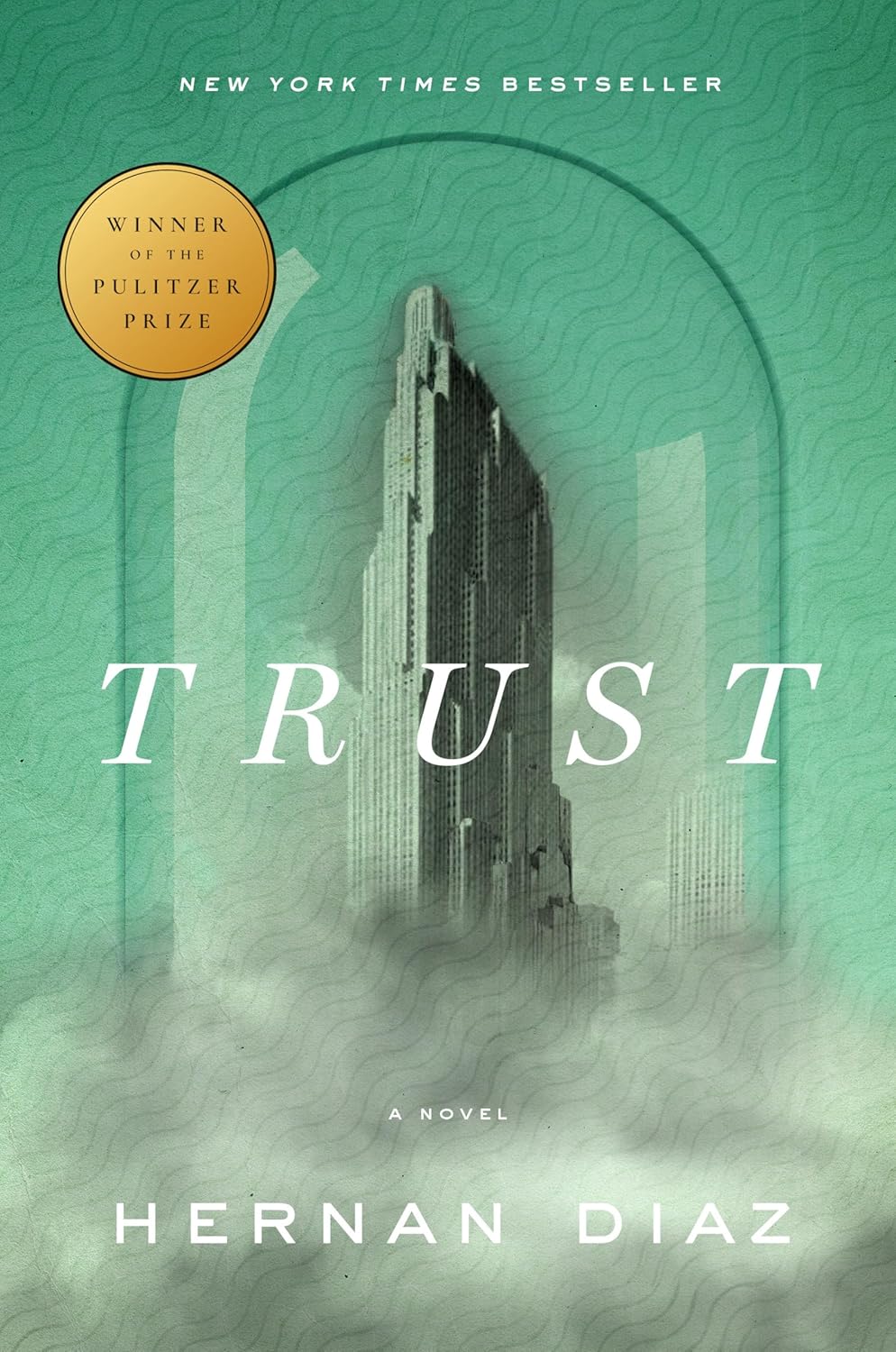
Description:
ONE OF THE NEW YORK TIMES’S 100 BEST BOOKS OF THE 21ST CENTURY
A NEW YORK TIMES BESTSELLER
ONE OF BARACK OBAMA'S FAVORITE BOOKS OF 2022
LONGLISTED FOR THE 2022 BOOKER PRIZE
“Buzzy and enthralling . . . A glorious novel about empires and erasures, husbands and wives, staggering fortunes and unspeakable misery . . . Fun as hell to read.” —Oprah Daily
"A genre-bending, time-skipping story about New York City’s elite in the roaring ’20s and Great Depression." —Vanity Fair
“A riveting story of class, capitalism, and greed.” —Esquire
"Exhilarating.” —New York Times
Even through the roar and effervescence of the 1920s, everyone in New York has heard of Benjamin and Helen Rask. He is a legendary Wall Street tycoon; she is the daughter of eccentric aristocrats. Together, they have risen to the very top of a world of seemingly endless wealth—all as a decade of excess and speculation draws to an end. But at what cost have they acquired their immense fortune? This is the mystery at the center of Bonds, a successful 1937 novel that all of New York seems to have read. Yet there are other versions of this tale of privilege and deceit.
Hernan Diaz’s TRUST elegantly puts these competing narratives into conversation with one another—and in tension with the perspective of one woman bent on disentangling fact from fiction. The result is a novel that spans over a century and becomes more exhilarating with each new revelation.
At once an immersive story and a brilliant literary puzzle, TRUST engages the reader in a quest for the truth while confronting the deceptions that often live at the heart of personal relationships, the reality-warping force of capital, and the ease with which power can manipulate facts.
Editorial Reviews
Review
“Intricate, cunning and consistently surprising…Much of the novel's pleasure derives from its unpredictabiility...Add Henry James to Wharton, and Thomas Mann too...Exhilarating and intelligent novel.” —New York Times
“Luminous… Masterful… The drama lies in trying to puzzle out where Diaz will take you next, what’s been hidden, and why.”—The New Yorker
“A rip-roaring, razor-sharp dissection of capitalism, class, greed, and the meaning of money itself that also manages to be a dazzling feat of storytelling on its own terms… Important and timely. But the uniquely brilliant way in which Diaz tells that story, as meticulously researched as it is narratively exhilarating, makes it a novel not just for the present age but for the ages.”—Vogue
“[A] riveting story of class, capitalism, and greed. The result is a mesmerizing metafictional alchemy of grand scope and even grander accomplishment.”—Esquire
“There is a dazzling intelligence behind this novel, which challenges us to rethink everything we know both about the institutions on which nations are built and the narratives by which stories are told. Sly, sophisticated, insistently questioning, Diaz writes with assurance, determined to rob us of every certainty.”—the Booker Prizes
"Literary fiction…is a fantastic commodity in which our best writers become criminals of the imagination, stealing our attention and our very desires. Diaz makes an artistic fortune in Trust. And we readers make out like bandits, too.”—Maureen Corrigan, NPR
“A buzzy and enthralling tour de force… a glorious novel about empires and erasures, husbands and wives, staggering fortunes and unspeakable misery…Mostly, though, Trust is a literary page-turner, with a wealth of puns and elegant prose, fun as hell to read.”—Oprah Daily
“A remarkably accessible treatise on the power of fiction. This unquestionably smart and sophisticated novel not only mirrors truth, but helps us to better understand it.”—The Boston Globe
"Ingenious...challenges conventional story lines of another favorite American theme: capitalism and the accumulation of vast wealth…Diaz employs his inventive structure to offer intriguing insights into the hidden roles played by subservient women." —Minneapolis Star Tribune
"The world of Trust feels very close to our own...This book is a reminder that wealth isn’t a treasure chest and the rich aren’t magical, no matter how dramatically they shape the world. It’s all just money, made by real people, with very real, often dangerous implications." —Vanity Fair
“Rich and prismatic…” —Wall Street Journal
“The only certainty here is Diaz’s brilliance and the value of his rewarding book…In execution it’s an elegant, irresistible puzzle.”—The Washington Post
“Wondrous… Diaz is brilliant at dissecting literary conventions and transforming them into something new.” —The New York Review of Books
“Through perfectly formed sentences and the skilful unpicking of certainties, Trust creates a great portrait of New York across an entire century of change . . . a work possessed of real power and purpose . . . It’s a testament to Diaz’s cunning abilities as a writer that you end his book thinking that— if truth is your goal —you might be better off relying on a novelist than a banker.”—Jonathan Lee, The Guardian (UK)
“Sharp and affecting . . . Diaz’s great subject is the scale of American mythmaking . . . It is in his ugly-beautiful portrait of great wealth that Diaz shows his brilliance . . . In this literary Rubik’s Cube, Diaz provides a viable, and hugely entertaining, argument that once a pen is put to paper an element of veracity is always lost. And when money is thrown into the mix, then the lies really multiply.”—Financial Times (UK)
“An absolutely brilliant novel… A wily jackalope of a novel — tame but prickly, a different beast from every angle…The setup is so shrewd and the writing so immaculate." —Los Angeles Times
“Hernan Diaz, one of the least derivative, most eccentrically ambitious fiction writers I’ve read in a long while.” —Jonathan Dee in Harper’s Magazine
“Trust proves that Diaz is a writer of singular talent. This book is a kaleidoscopic dazzler that works as both an engrossing literary mystery and a capitalistic takedown for the ages. Don’t miss it.”—Chicago Review of Books
"A multifaceted saga of class, wealth, and mythmaking that should resonate with today’s capitalism-questioning readers.”—The Philadelphia Inquirer
“A uniquely layered novel…Each page peels back another mystery, making for an utterly riveting read.” —Buzzfeed
“Like a tower of gifts waiting to be unwrapped, Trust offers a multitude of rewards to be discovered and enjoyed … [a] beautifully composed masterpiece."—BookPage, STARRED review
“For all its elegant complexity and brilliant construction, Diaz's novel is compulsively readable, and despite taking place in the early 1900s, the plot reads like an indictment of the start of the twenty-first century with its obsession with obscure financial instruments and unhinged capital accumulation. A captivating tour de force that will astound readers with its formal invention and contemporary relevance."—Booklist, STARRED review
“[A] kaleidoscope of capitalism run amok in the early 20th century . . . Grounded in history and formally ambitious, this succeeds on all fronts. Once again, Diaz makes the most of his formidable gifts.”—Publishers Weekly, STARRED Review
“A feat of literary gamesmanship [that] brilliantly weaves its multiple perspectives to create a symphony of emotional effects . . . [T]he collection of palimpsests makes for a thrilling experience ...A clever and affecting high-concept novel of high finance.”—Kirkus, STARRED review
“Hernan Diaz is a narrative genius whose work easily encompasses both a grand scope and the crisp and whiplike line. Trust builds its world and characters with subtle aplomb. What a radiant, profound and moving novel.”—Lauren Groff, New York Times bestselling author of Matrix
“Diaz understands, and deeply, how strange money is, as an omnipotent and imaginary substance that controls our lives. Trust glints with wonder and knowledge and mystery. Its plotlines are as etched and surreal as Art Deco geometry, while inside that architecture are people who feel appallingly real. This novel is very classical and very original: Balzac would be proud, but so would Borges.”—Rachel Kushner, New York Times bestselling author of The Mars Room
“That rare jewel of a book—jaw-dropping storytelling against the backdrop of beautiful writing. Amidst all the noise in the world, whole days found me curled up on the couch, lost inside Diaz’s brilliance.”—Jacqueline Woodson, National Book Award-winning author of Red at the Bone
“Though set in a historical New York, Trust speaks to matters of the most urgent significance to the present day. Money, power, class, marital and filial relations, the roles played by trust and betrayal in human affairs—Diaz’s development of his chosen themes is deeply insightful. Cleverly constructed and rich in surprises, this splendid novel offers serious ideas and serious pleasures on every beautifully composed page.” —Sigrid Nunez, National Book Award–winning author of The Friend
“Sublime, richly layered novel. A story within a story within a story. Elegantly written.”—Roxane Gay, bestselling author of Difficult Women
“The audacity and scope of Hernan Diaz’s extraordinary novel—a prism, a mystery, a revelation—are brilliantly matched by the quality of his prose.”—Jean Strouse, author of Morgan: American Financier
"What a joy this is to read, suspenseful at every turn, the work of a rare and impressive talent. Diaz has once again taken apart an American myth and pondered how we lie to ourselves.”—Joan Silber, National Book Critics Circle Award–winning author of Improvement
About the Author
Excerpt. © Reprinted by permission. All rights reserved.
ONE
Because he had enjoyed almost every advantage since birth, one of the few privileges denied to Benjamin Rask was that of a heroic rise: his was not a story of resilience and perseverance or the tale of an unbreakable will forging a golden destiny for itself out of little more than dross. According to the back of the Rask family Bible, in 1662 his father's ancestors had migrated from Copenhagen to Glasgow, where they started trading in tobacco from the Colonies. Over the next century, their business prospered and expanded to the extent that part of the family moved to America so they could better oversee their suppliers and control every aspect of production. Three generations later, Benjamin's father, Solomon, bought out all his relatives and outside investors. Under his sole direction, the company kept flourishing, and it did not take him long to become one of the most prominent tobacco traders on the Eastern Seaboard. It may have been true that his inventory was sourced from the finest providers on the continent, but more than in the quality of his merchandise, the key to Solomon's success lay in his ability to exploit an obvious fact: there was, of course, an epicurean side to tobacco, but most men smoked so that they could talk to other men. Solomon Rask was, therefore, a purveyor not only of the finest cigars, cigarillos, and pipe blends but also (and mostly) of excellent conversation and political connections. He rose to the pinnacle of his business and secured his place there thanks to his gregariousness and the friendships cultivated in the smoking room, where he was often seen sharing one of his figurados with some of his most distinguished customers, among whom he counted Grover Cleveland, William Zachary Irving, and John Pierpont Morgan.
At the height of his success, Solomon had a townhouse built on West 17th Street, which was finished just in time for Benjamin's birth. Yet Solomon was seldom to be seen at the New York family residence. His work took him from one plantation to another, and he was always supervising rolling rooms or visiting business associates in Virginia, North Carolina, and the Caribbean. He even owned a small hacienda in Cuba, where he passed the greater part of each winter. Rumors concerning his life on the island established his reputation as an adventurer with a taste for the exotic, which was an asset in his line of business.
Mrs. Wilhelmina Rask never set foot on her husband's Cuban estate. She, too, was absent from New York for long stretches, leaving as soon as Solomon returned and staying at her friends' summerhouses on the east bank of the Hudson or their cottages in Newport for entire seasons. The only visible thing she shared with Solomon was a passion for cigars, which she smoked compulsively. This being a very uncommon source of pleasure for a lady, she would only indulge in private, in the company of her girl-friends. But this was no impediment, since she was surrounded by them at all times. Willie, as those in her set called her, was part of a tightly knit group of women who seemed to constitute a sort of nomadic tribe. They were not only from New York but also from Washington, Philadelphia, Providence, Boston, and even as far as Chicago. They moved as a pack, visiting one another's houses and vacation homes according to the seasons-West 17th Street became the coterie's abode for a few months, starting in late September, when Solomon left for his hacienda. Still, no matter in what part of the country the ladies happened to dwell, the clique invariably kept to itself in an impenetrable circle.
Limited, for the most part, to his and his nursemaids' rooms, Benjamin had only a vague notion of the rest of the brownstone where he grew up. When his mother and her friends were there, he was kept away from the rooms where they smoked, played cards, and drank Sauternes well into the night; when they were gone, the main floors became a dim succession of shuttered windows, covered furniture, and chandeliers in ballooning shrouds. All of his nurses and governesses said he was a model child, and all of his tutors confirmed it. Manners, intelligence, and obedience had never been combined as harmoniously as in this sweet-tempered child. The only fault some of his caregivers could find after much searching was Benjamin's reluctance to associate with other children. When one of his tutors attributed his student's friendlessness to fear, Solomon waved his concerns away, saying the boy was just becoming a man of his own.
His lonely upbringing did not prepare him for boarding school. During the first term, he became the object of daily indignities and small cruelties. In time, however, his classmates discovered that his impassiveness made him a dissatisfying victim and left him alone. He kept to himself and excelled, dispassionately, in every subject. At the end of each year, after bestowing on him all available honors and distinctions, his teachers, without fail, would remind him that he was meant to bring much glory to the Academy.
During his senior year, his father died of heart failure. At the service, back in New York, relatives and acquaintances alike were impressed by Benjamin's composure, but the truth was that mourning simply had given the natural dispositions of his character a socially recognizable form. In a display of great precocity that baffled his father's attorneys and bankers, the boy requested to examine the will and all the financial statements related to it. Mr. Rask was a conscientious, tidy man, and his son found no fault with the documents. Having concluded this business and knowing what to expect once he came of age and into possession of his inheritance, he returned to New Hampshire to finish school.
His mother spent her brief widowhood with her friends in Rhode Island. She went in May, shortly before Benjamin's graduation, and by the end of the summer had died from emphysema. The family and friends who attended this second, much more subdued memorial barely knew how to speak to the young man orphaned in the course of a mere few months. Thankfully, there were many practical issues to discuss-trusts, executors, and the legal challenges in settling the estate.
Benjamin's experience as a college student was an amplified echo of his years as a schoolboy. All the same inadequacies and talents were there, but now he seemed to have acquired a cold sort of fondness for the former and a humble disdain for the latter. Some of the more salient traits of his lineage appeared to have come to an end with him. He could not have been more different from his father, who had owned every room he had walked into and made everyone in it gravitate around him, and he had nothing in common with his mother, who had probably never spent a day of her life alone. These discrepancies with his parents became even more accentuated after his graduation. He moved back from New England to the city and failed where most of his acquaintances thrived-he was an inept athlete, an apathetic clubman, an unenthusiastic drinker, an indifferent gambler, a lukewarm lover. He, who owed his fortune to tobacco, did not even smoke. Those who accused him of being excessively frugal failed to understand that, in truth, he had no appetites to repress.
*
The tobacco business could not have interested Benjamin less. He disliked both the product-the primitive sucking and puffing, the savage fascination with smoke, the bittersweet stench of rotten leaves-and the congeniality around it, which his father had enjoyed so much and exploited so well. Nothing disgusted him more than the misty complicities of the smoking room. Despite his most honest efforts, he could not argue, with any semblance of passion, for the virtue of a lonsdale over a diadema, and he was unable to sing, with the vigor that only firsthand knowledge can impart, the praise of the robustos from his Vuelta Abajo estate. Plantations, curing barns, and cigar factories belonged to a remote world he had no interest in getting to know. He would have been the first to admit he was an appalling ambassador for the company and therefore delegated daily operations to the manager who had served under his father for two faithful decades. It was against the advice of this manager that Benjamin, through agents he never met in person, undersold his father's Cuban hacienda and everything in it, without even taking an inventory. His banker invested the money in the stock market, together with the rest of his savings.
A few stagnant years went by, during which he made halfhearted attempts at starting different collections (coins, china, friends), dabbled in hypochondria, tried to develop an enthusiasm for horses, and failed to become a dandy.
Time became a constant itch.
Against his true inclinations, he started planning a trip to Europe. All that interested him about the Old Continent he had already learned through books; experiencing those things and places was of no importance to him. And he did not look forward to being confined on a ship with strangers for days on end. Still, he told himself that if he ever would leave, this would be the proper moment: the general atmosphere in New York City was rather glum as the result of a series of financial crises and the ensuing economic recession that had engulfed the country for the last two years. Because the downturn did not affect him directly, Benjamin was only vaguely aware of its causes-it had all started, he believed, with the burst of the railroad bubble, somehow linked to a subsequent silver crash, leading, in turn, to a run on gold, which, in the end, resulted in numerous bank failures in what came to be known as the panic of 1893. Whatever the actual chain of events might have been, he was not worried. He had a general notion that markets swung back and forth and was confident that today's losses would be tomorrow's gains. Rather than discouraging his European excursion, the financial crisis-the worst since the Long Depression, two decades earlier-was among the strongest encouragements he found to leave.
As he was about to set a date for his journey, his banker informed him that, through some of his "connections," he had been able to subscribe to bonds issued to restore the nation's gold reserves, whose depletion had driven so many banks to insolvency. The entire issue had sold out in a mere half hour, and he had turned a handsome profit within the week. Thus, unsolicited luck, in the form of favorable political shifts and market fluctuations, led to the sudden and seemingly spontaneous growth of Benjamin's respectable inheritance, which he had never cared to enlarge. But once chance had done it for him, he discovered a hunger at his core he did not know existed until it was given a bait big enough to stir it to life. Europe would have to wait.
Rask's assets were in the conservative care of J. S. Winslow & Co., the house that had always managed the family's business. The firm, founded by one of his father's friends, was now in the hands of John S. Winslow Jr., who had tried and failed to befriend Benjamin. As a result of this, the relationship between the two young men was somewhat uneasy. Still, they worked together closely-even if it was through messengers or over the telephone, either of which Benjamin preferred to redundant and laboriously genial face-to-face meetings.
Soon, Benjamin became adept at reading the ticker tape, finding patterns, intersecting them, and discovering hidden causal links between apparently disconnected tendencies. Winslow, realizing his client was a gifted learner, made things look more arcane than they truly were and dismissed his predictions. Even so, Rask started making his own decisions, usually against the firm's counsel. He was drawn to short-term investments and instructed Winslow to make high-risk trades in options, futures, and other speculative instruments. Winslow would always urge caution and protest against these reckless schemes: he refused to put Benjamin in a position to lose his capital in hazardous ventures. But more than worried about his client's assets, Winslow seemed to be concerned about appearances and eager to display a certain financial decorum-after all, as he once said, laughing shallowly at his own wit, he was, if anything, a bookkeeper, not a bookmaker, in charge of a finance house, not a gambling house. From his father, he had inherited a reputation for pursuing sound investments, and he intended to honor this legacy. Still, in the end, he always followed Rask's directives and kept his commissions.
Within a year, tired of his advisor's priggishness and ponderous pace, Rask decided to start trading on his own account and dismissed Winslow. Severing all ties with the family that had been so close to his for two generations was an added satisfaction to the feeling of true achievement Rask experienced, for the first time in his life, when he took the reins of his affairs.
*
The two lower floors of his brownstone became a makeshift office. This transformation was not the result of a plan but, rather, the effect of meeting unforeseen needs one by one, as they came, until, unexpectedly, there was something like a workspace filled with employees. It started with a messenger, whom Benjamin had running all over town with stock certificates, bonds, and other documents. A few days later, the boy let him know he had to have help. Together with an additional messenger, Benjamin got a telephone girl and a clerk, who soon informed him he was unable to cope on his own. Managing his people was taking vital time away from Benjamin's business, so he hired an assistant. And keeping books simply became too time-consuming, so he engaged an accountant. By the time his assistant got an assistant, Rask stopped keeping track of the new hires and no longer bothered to remember anyone's face or name.
The furniture that had remained untouched and under covers for years was now handled irreverently by secretaries and errand boys. A stock ticker had been installed on the walnut serving table; quote boards covered most of the gilt-embossed foliage wallpaper; piles of newspapers had stained the straw-yellow velvet of a settee; a typewriter had dented a satinwood bureau; black and red ink blotched the needlework upholstery of divans and sofas; cigarettes had burned the serpentine edges of a mahogany desk; hurried shoes had scuffed oak claw feet and soiled, forever, Persian runners. His parents' rooms were left intact. He slept on the top floor, which he had never even visited as a child.
It was not hard to find a buyer for his father's business. Benjamin encouraged a manufacturer from Virginia and a trading company from the United Kingdom to outbid each other. Wishing to distance himself from that part of his past, he was pleased to see the British prevail, thus sending the tobacco company whence it had come. But what truly gratified him was that with the profits from this sale he was able to work on a higher plane, manage a new level of risk, and finance long-term transactions he had been unable to consider in the past. Those around him were confused to see his possessions decrease in direct proportion to his wealth. He sold all remaining family properties, including the brownstone on West 17th Street, and everything in them. His clothes and papers fit into two trunks, which were sent to the Wagstaff Hotel, where he took a suite of rooms.
He became fascinated by the contortions of money—how it could be made to bend back upon itself to be force-fed its own body. The isolated, self-sufficient nature of speculation spoke to his character and was a source of wonder and an end in itself, regardless of what the increasing numbers represented or afforded him. Luxury was a vulgar burden. The access to new experiences was not something his sequestered spirit craved. Politics and the pursuit of power played no part in his unsocial mind. Games of strategy, like chess or bridge, had never interested him. If asked, Benjamin would probably have found it hard to explain what drew him to the world of finance. It was the complexity of it, yes, but also the fact that he viewed capital as an antiseptically living thing. It moves, eats, grows, breeds, falls ill, and may die. But it is clean. This became clearer to him in time. The larger the operation, the further removed he was from its concrete details. There was no need for him to touch a single banknote or engage with the things and people his transaction affected. All he had to do was think, speak, and, perhaps, write. And the living creature would be set in motion, drawing beautiful patterns on its way into realms of increasing abstraction, sometimes following appetites of its own that Benjamin never could have anticipated—and this gave him some additional pleasure, the creature trying to exercise its free will. He admired it and understood it, even when it disappointed him.
Details:
Visit the Riverhead Books Store
Trust (Pulitzer Prize Winner)
AED13488
Quantity:
Order today to get by 7-14 business days
Delivery fee of AED 20. Free for orders above AED 200.
 Imported From: United States
At BOLO, we work hard to ensure the products you receive are new, genuine, and sourced from reputable suppliers.
Every product in the BOLO catalogue is sourced through our Verified Global Supply Network of verified sellers, authorized distributors or directly from the manufacturer.
Each product undergoes thorough inspection and verification at our consolidation and fulfilment centers to ensure it meets our strict authenticity and quality standards before being shipped and delivered to you.
If you ever have concerns regarding the authenticity of a product purchased from us, please contact Bolo Support. We will review your inquiry promptly and, if necessary, provide documentation verifying authenticity or offer a suitable resolution.
Your trust is our top priority, and we are committed to maintaining transparency and integrity in every transaction.
While we strive to display accurate information, variations in packaging, labeling, instructions, or formulation may occasionally occur due to regional differences or supplier updates. For detailed or manufacturer-specific information, please contact the brand directly or reach out to BOLO Support for assistance.
Unless otherwise stated, all prices displayed on the product page include applicable taxes and import duties.
BOLO operates in accordance with the laws and regulations of United Arab Emirates. Any items found to be restricted or prohibited for sale within the United Arab Emirates will be cancelled prior to shipment. We take proactive measures to ensure that only products permitted for sale in United Arab Emirates are listed on our website.
All items are shipped by air, and any products classified as “Dangerous Goods (DG)” under IATA regulations will be removed from the order and cancelled.
All orders are processed manually, and we make every effort to process them promptly once confirmed. Products cancelled due to the above reasons will be permanently removed from listings across the website.
More from this brand
Similar items from “Biographical”
Share with
Or share with link
https://www.bolo.ae/products/U0593420314
Visit the Riverhead Books Store
Trust (Pulitzer Prize Winner)
AED13488
Quantity:
Order today to get by 7-14 business days
Delivery fee of AED 20. Free for orders above AED 200.
Imported From: United States
At BOLO, we work hard to ensure the products you receive are new, genuine, and sourced from reputable suppliers.
Every product in the BOLO catalogue is sourced through our Verified Global Supply Network of verified sellers, authorized distributors or directly from the manufacturer.
Each product undergoes thorough inspection and verification at our consolidation and fulfilment centers to ensure it meets our strict authenticity and quality standards before being shipped and delivered to you.
If you ever have concerns regarding the authenticity of a product purchased from us, please contact Bolo Support. We will review your inquiry promptly and, if necessary, provide documentation verifying authenticity or offer a suitable resolution.
Your trust is our top priority, and we are committed to maintaining transparency and integrity in every transaction.
While we strive to display accurate information, variations in packaging, labeling, instructions, or formulation may occasionally occur due to regional differences or supplier updates. For detailed or manufacturer-specific information, please contact the brand directly or reach out to BOLO Support for assistance.
Unless otherwise stated, all prices displayed on the product page include applicable taxes and import duties.
BOLO operates in accordance with the laws and regulations of United Arab Emirates. Any items found to be restricted or prohibited for sale within the United Arab Emirates will be cancelled prior to shipment. We take proactive measures to ensure that only products permitted for sale in United Arab Emirates are listed on our website.
All items are shipped by air, and any products classified as “Dangerous Goods (DG)” under IATA regulations will be removed from the order and cancelled.
All orders are processed manually, and we make every effort to process them promptly once confirmed. Products cancelled due to the above reasons will be permanently removed from listings across the website.
Description:
ONE OF THE NEW YORK TIMES’S 100 BEST BOOKS OF THE 21ST CENTURY
A NEW YORK TIMES BESTSELLER
ONE OF BARACK OBAMA'S FAVORITE BOOKS OF 2022
LONGLISTED FOR THE 2022 BOOKER PRIZE
“Buzzy and enthralling . . . A glorious novel about empires and erasures, husbands and wives, staggering fortunes and unspeakable misery . . . Fun as hell to read.” —Oprah Daily
"A genre-bending, time-skipping story about New York City’s elite in the roaring ’20s and Great Depression." —Vanity Fair
“A riveting story of class, capitalism, and greed.” —Esquire
"Exhilarating.” —New York Times
Even through the roar and effervescence of the 1920s, everyone in New York has heard of Benjamin and Helen Rask. He is a legendary Wall Street tycoon; she is the daughter of eccentric aristocrats. Together, they have risen to the very top of a world of seemingly endless wealth—all as a decade of excess and speculation draws to an end. But at what cost have they acquired their immense fortune? This is the mystery at the center of Bonds, a successful 1937 novel that all of New York seems to have read. Yet there are other versions of this tale of privilege and deceit.
Hernan Diaz’s TRUST elegantly puts these competing narratives into conversation with one another—and in tension with the perspective of one woman bent on disentangling fact from fiction. The result is a novel that spans over a century and becomes more exhilarating with each new revelation.
At once an immersive story and a brilliant literary puzzle, TRUST engages the reader in a quest for the truth while confronting the deceptions that often live at the heart of personal relationships, the reality-warping force of capital, and the ease with which power can manipulate facts.
Editorial Reviews
Review
“Intricate, cunning and consistently surprising…Much of the novel's pleasure derives from its unpredictabiility...Add Henry James to Wharton, and Thomas Mann too...Exhilarating and intelligent novel.” —New York Times
“Luminous… Masterful… The drama lies in trying to puzzle out where Diaz will take you next, what’s been hidden, and why.”—The New Yorker
“A rip-roaring, razor-sharp dissection of capitalism, class, greed, and the meaning of money itself that also manages to be a dazzling feat of storytelling on its own terms… Important and timely. But the uniquely brilliant way in which Diaz tells that story, as meticulously researched as it is narratively exhilarating, makes it a novel not just for the present age but for the ages.”—Vogue
“[A] riveting story of class, capitalism, and greed. The result is a mesmerizing metafictional alchemy of grand scope and even grander accomplishment.”—Esquire
“There is a dazzling intelligence behind this novel, which challenges us to rethink everything we know both about the institutions on which nations are built and the narratives by which stories are told. Sly, sophisticated, insistently questioning, Diaz writes with assurance, determined to rob us of every certainty.”—the Booker Prizes
"Literary fiction…is a fantastic commodity in which our best writers become criminals of the imagination, stealing our attention and our very desires. Diaz makes an artistic fortune in Trust. And we readers make out like bandits, too.”—Maureen Corrigan, NPR
“A buzzy and enthralling tour de force… a glorious novel about empires and erasures, husbands and wives, staggering fortunes and unspeakable misery…Mostly, though, Trust is a literary page-turner, with a wealth of puns and elegant prose, fun as hell to read.”—Oprah Daily
“A remarkably accessible treatise on the power of fiction. This unquestionably smart and sophisticated novel not only mirrors truth, but helps us to better understand it.”—The Boston Globe
"Ingenious...challenges conventional story lines of another favorite American theme: capitalism and the accumulation of vast wealth…Diaz employs his inventive structure to offer intriguing insights into the hidden roles played by subservient women." —Minneapolis Star Tribune
"The world of Trust feels very close to our own...This book is a reminder that wealth isn’t a treasure chest and the rich aren’t magical, no matter how dramatically they shape the world. It’s all just money, made by real people, with very real, often dangerous implications." —Vanity Fair
“Rich and prismatic…” —Wall Street Journal
“The only certainty here is Diaz’s brilliance and the value of his rewarding book…In execution it’s an elegant, irresistible puzzle.”—The Washington Post
“Wondrous… Diaz is brilliant at dissecting literary conventions and transforming them into something new.” —The New York Review of Books
“Through perfectly formed sentences and the skilful unpicking of certainties, Trust creates a great portrait of New York across an entire century of change . . . a work possessed of real power and purpose . . . It’s a testament to Diaz’s cunning abilities as a writer that you end his book thinking that— if truth is your goal —you might be better off relying on a novelist than a banker.”—Jonathan Lee, The Guardian (UK)
“Sharp and affecting . . . Diaz’s great subject is the scale of American mythmaking . . . It is in his ugly-beautiful portrait of great wealth that Diaz shows his brilliance . . . In this literary Rubik’s Cube, Diaz provides a viable, and hugely entertaining, argument that once a pen is put to paper an element of veracity is always lost. And when money is thrown into the mix, then the lies really multiply.”—Financial Times (UK)
“An absolutely brilliant novel… A wily jackalope of a novel — tame but prickly, a different beast from every angle…The setup is so shrewd and the writing so immaculate." —Los Angeles Times
“Hernan Diaz, one of the least derivative, most eccentrically ambitious fiction writers I’ve read in a long while.” —Jonathan Dee in Harper’s Magazine
“Trust proves that Diaz is a writer of singular talent. This book is a kaleidoscopic dazzler that works as both an engrossing literary mystery and a capitalistic takedown for the ages. Don’t miss it.”—Chicago Review of Books
"A multifaceted saga of class, wealth, and mythmaking that should resonate with today’s capitalism-questioning readers.”—The Philadelphia Inquirer
“A uniquely layered novel…Each page peels back another mystery, making for an utterly riveting read.” —Buzzfeed
“Like a tower of gifts waiting to be unwrapped, Trust offers a multitude of rewards to be discovered and enjoyed … [a] beautifully composed masterpiece."—BookPage, STARRED review
“For all its elegant complexity and brilliant construction, Diaz's novel is compulsively readable, and despite taking place in the early 1900s, the plot reads like an indictment of the start of the twenty-first century with its obsession with obscure financial instruments and unhinged capital accumulation. A captivating tour de force that will astound readers with its formal invention and contemporary relevance."—Booklist, STARRED review
“[A] kaleidoscope of capitalism run amok in the early 20th century . . . Grounded in history and formally ambitious, this succeeds on all fronts. Once again, Diaz makes the most of his formidable gifts.”—Publishers Weekly, STARRED Review
“A feat of literary gamesmanship [that] brilliantly weaves its multiple perspectives to create a symphony of emotional effects . . . [T]he collection of palimpsests makes for a thrilling experience ...A clever and affecting high-concept novel of high finance.”—Kirkus, STARRED review
“Hernan Diaz is a narrative genius whose work easily encompasses both a grand scope and the crisp and whiplike line. Trust builds its world and characters with subtle aplomb. What a radiant, profound and moving novel.”—Lauren Groff, New York Times bestselling author of Matrix
“Diaz understands, and deeply, how strange money is, as an omnipotent and imaginary substance that controls our lives. Trust glints with wonder and knowledge and mystery. Its plotlines are as etched and surreal as Art Deco geometry, while inside that architecture are people who feel appallingly real. This novel is very classical and very original: Balzac would be proud, but so would Borges.”—Rachel Kushner, New York Times bestselling author of The Mars Room
“That rare jewel of a book—jaw-dropping storytelling against the backdrop of beautiful writing. Amidst all the noise in the world, whole days found me curled up on the couch, lost inside Diaz’s brilliance.”—Jacqueline Woodson, National Book Award-winning author of Red at the Bone
“Though set in a historical New York, Trust speaks to matters of the most urgent significance to the present day. Money, power, class, marital and filial relations, the roles played by trust and betrayal in human affairs—Diaz’s development of his chosen themes is deeply insightful. Cleverly constructed and rich in surprises, this splendid novel offers serious ideas and serious pleasures on every beautifully composed page.” —Sigrid Nunez, National Book Award–winning author of The Friend
“Sublime, richly layered novel. A story within a story within a story. Elegantly written.”—Roxane Gay, bestselling author of Difficult Women
“The audacity and scope of Hernan Diaz’s extraordinary novel—a prism, a mystery, a revelation—are brilliantly matched by the quality of his prose.”—Jean Strouse, author of Morgan: American Financier
"What a joy this is to read, suspenseful at every turn, the work of a rare and impressive talent. Diaz has once again taken apart an American myth and pondered how we lie to ourselves.”—Joan Silber, National Book Critics Circle Award–winning author of Improvement
About the Author
Excerpt. © Reprinted by permission. All rights reserved.
ONE
Because he had enjoyed almost every advantage since birth, one of the few privileges denied to Benjamin Rask was that of a heroic rise: his was not a story of resilience and perseverance or the tale of an unbreakable will forging a golden destiny for itself out of little more than dross. According to the back of the Rask family Bible, in 1662 his father's ancestors had migrated from Copenhagen to Glasgow, where they started trading in tobacco from the Colonies. Over the next century, their business prospered and expanded to the extent that part of the family moved to America so they could better oversee their suppliers and control every aspect of production. Three generations later, Benjamin's father, Solomon, bought out all his relatives and outside investors. Under his sole direction, the company kept flourishing, and it did not take him long to become one of the most prominent tobacco traders on the Eastern Seaboard. It may have been true that his inventory was sourced from the finest providers on the continent, but more than in the quality of his merchandise, the key to Solomon's success lay in his ability to exploit an obvious fact: there was, of course, an epicurean side to tobacco, but most men smoked so that they could talk to other men. Solomon Rask was, therefore, a purveyor not only of the finest cigars, cigarillos, and pipe blends but also (and mostly) of excellent conversation and political connections. He rose to the pinnacle of his business and secured his place there thanks to his gregariousness and the friendships cultivated in the smoking room, where he was often seen sharing one of his figurados with some of his most distinguished customers, among whom he counted Grover Cleveland, William Zachary Irving, and John Pierpont Morgan.
At the height of his success, Solomon had a townhouse built on West 17th Street, which was finished just in time for Benjamin's birth. Yet Solomon was seldom to be seen at the New York family residence. His work took him from one plantation to another, and he was always supervising rolling rooms or visiting business associates in Virginia, North Carolina, and the Caribbean. He even owned a small hacienda in Cuba, where he passed the greater part of each winter. Rumors concerning his life on the island established his reputation as an adventurer with a taste for the exotic, which was an asset in his line of business.
Mrs. Wilhelmina Rask never set foot on her husband's Cuban estate. She, too, was absent from New York for long stretches, leaving as soon as Solomon returned and staying at her friends' summerhouses on the east bank of the Hudson or their cottages in Newport for entire seasons. The only visible thing she shared with Solomon was a passion for cigars, which she smoked compulsively. This being a very uncommon source of pleasure for a lady, she would only indulge in private, in the company of her girl-friends. But this was no impediment, since she was surrounded by them at all times. Willie, as those in her set called her, was part of a tightly knit group of women who seemed to constitute a sort of nomadic tribe. They were not only from New York but also from Washington, Philadelphia, Providence, Boston, and even as far as Chicago. They moved as a pack, visiting one another's houses and vacation homes according to the seasons-West 17th Street became the coterie's abode for a few months, starting in late September, when Solomon left for his hacienda. Still, no matter in what part of the country the ladies happened to dwell, the clique invariably kept to itself in an impenetrable circle.
Limited, for the most part, to his and his nursemaids' rooms, Benjamin had only a vague notion of the rest of the brownstone where he grew up. When his mother and her friends were there, he was kept away from the rooms where they smoked, played cards, and drank Sauternes well into the night; when they were gone, the main floors became a dim succession of shuttered windows, covered furniture, and chandeliers in ballooning shrouds. All of his nurses and governesses said he was a model child, and all of his tutors confirmed it. Manners, intelligence, and obedience had never been combined as harmoniously as in this sweet-tempered child. The only fault some of his caregivers could find after much searching was Benjamin's reluctance to associate with other children. When one of his tutors attributed his student's friendlessness to fear, Solomon waved his concerns away, saying the boy was just becoming a man of his own.
His lonely upbringing did not prepare him for boarding school. During the first term, he became the object of daily indignities and small cruelties. In time, however, his classmates discovered that his impassiveness made him a dissatisfying victim and left him alone. He kept to himself and excelled, dispassionately, in every subject. At the end of each year, after bestowing on him all available honors and distinctions, his teachers, without fail, would remind him that he was meant to bring much glory to the Academy.
During his senior year, his father died of heart failure. At the service, back in New York, relatives and acquaintances alike were impressed by Benjamin's composure, but the truth was that mourning simply had given the natural dispositions of his character a socially recognizable form. In a display of great precocity that baffled his father's attorneys and bankers, the boy requested to examine the will and all the financial statements related to it. Mr. Rask was a conscientious, tidy man, and his son found no fault with the documents. Having concluded this business and knowing what to expect once he came of age and into possession of his inheritance, he returned to New Hampshire to finish school.
His mother spent her brief widowhood with her friends in Rhode Island. She went in May, shortly before Benjamin's graduation, and by the end of the summer had died from emphysema. The family and friends who attended this second, much more subdued memorial barely knew how to speak to the young man orphaned in the course of a mere few months. Thankfully, there were many practical issues to discuss-trusts, executors, and the legal challenges in settling the estate.
Benjamin's experience as a college student was an amplified echo of his years as a schoolboy. All the same inadequacies and talents were there, but now he seemed to have acquired a cold sort of fondness for the former and a humble disdain for the latter. Some of the more salient traits of his lineage appeared to have come to an end with him. He could not have been more different from his father, who had owned every room he had walked into and made everyone in it gravitate around him, and he had nothing in common with his mother, who had probably never spent a day of her life alone. These discrepancies with his parents became even more accentuated after his graduation. He moved back from New England to the city and failed where most of his acquaintances thrived-he was an inept athlete, an apathetic clubman, an unenthusiastic drinker, an indifferent gambler, a lukewarm lover. He, who owed his fortune to tobacco, did not even smoke. Those who accused him of being excessively frugal failed to understand that, in truth, he had no appetites to repress.
*
The tobacco business could not have interested Benjamin less. He disliked both the product-the primitive sucking and puffing, the savage fascination with smoke, the bittersweet stench of rotten leaves-and the congeniality around it, which his father had enjoyed so much and exploited so well. Nothing disgusted him more than the misty complicities of the smoking room. Despite his most honest efforts, he could not argue, with any semblance of passion, for the virtue of a lonsdale over a diadema, and he was unable to sing, with the vigor that only firsthand knowledge can impart, the praise of the robustos from his Vuelta Abajo estate. Plantations, curing barns, and cigar factories belonged to a remote world he had no interest in getting to know. He would have been the first to admit he was an appalling ambassador for the company and therefore delegated daily operations to the manager who had served under his father for two faithful decades. It was against the advice of this manager that Benjamin, through agents he never met in person, undersold his father's Cuban hacienda and everything in it, without even taking an inventory. His banker invested the money in the stock market, together with the rest of his savings.
A few stagnant years went by, during which he made halfhearted attempts at starting different collections (coins, china, friends), dabbled in hypochondria, tried to develop an enthusiasm for horses, and failed to become a dandy.
Time became a constant itch.
Against his true inclinations, he started planning a trip to Europe. All that interested him about the Old Continent he had already learned through books; experiencing those things and places was of no importance to him. And he did not look forward to being confined on a ship with strangers for days on end. Still, he told himself that if he ever would leave, this would be the proper moment: the general atmosphere in New York City was rather glum as the result of a series of financial crises and the ensuing economic recession that had engulfed the country for the last two years. Because the downturn did not affect him directly, Benjamin was only vaguely aware of its causes-it had all started, he believed, with the burst of the railroad bubble, somehow linked to a subsequent silver crash, leading, in turn, to a run on gold, which, in the end, resulted in numerous bank failures in what came to be known as the panic of 1893. Whatever the actual chain of events might have been, he was not worried. He had a general notion that markets swung back and forth and was confident that today's losses would be tomorrow's gains. Rather than discouraging his European excursion, the financial crisis-the worst since the Long Depression, two decades earlier-was among the strongest encouragements he found to leave.
As he was about to set a date for his journey, his banker informed him that, through some of his "connections," he had been able to subscribe to bonds issued to restore the nation's gold reserves, whose depletion had driven so many banks to insolvency. The entire issue had sold out in a mere half hour, and he had turned a handsome profit within the week. Thus, unsolicited luck, in the form of favorable political shifts and market fluctuations, led to the sudden and seemingly spontaneous growth of Benjamin's respectable inheritance, which he had never cared to enlarge. But once chance had done it for him, he discovered a hunger at his core he did not know existed until it was given a bait big enough to stir it to life. Europe would have to wait.
Rask's assets were in the conservative care of J. S. Winslow & Co., the house that had always managed the family's business. The firm, founded by one of his father's friends, was now in the hands of John S. Winslow Jr., who had tried and failed to befriend Benjamin. As a result of this, the relationship between the two young men was somewhat uneasy. Still, they worked together closely-even if it was through messengers or over the telephone, either of which Benjamin preferred to redundant and laboriously genial face-to-face meetings.
Soon, Benjamin became adept at reading the ticker tape, finding patterns, intersecting them, and discovering hidden causal links between apparently disconnected tendencies. Winslow, realizing his client was a gifted learner, made things look more arcane than they truly were and dismissed his predictions. Even so, Rask started making his own decisions, usually against the firm's counsel. He was drawn to short-term investments and instructed Winslow to make high-risk trades in options, futures, and other speculative instruments. Winslow would always urge caution and protest against these reckless schemes: he refused to put Benjamin in a position to lose his capital in hazardous ventures. But more than worried about his client's assets, Winslow seemed to be concerned about appearances and eager to display a certain financial decorum-after all, as he once said, laughing shallowly at his own wit, he was, if anything, a bookkeeper, not a bookmaker, in charge of a finance house, not a gambling house. From his father, he had inherited a reputation for pursuing sound investments, and he intended to honor this legacy. Still, in the end, he always followed Rask's directives and kept his commissions.
Within a year, tired of his advisor's priggishness and ponderous pace, Rask decided to start trading on his own account and dismissed Winslow. Severing all ties with the family that had been so close to his for two generations was an added satisfaction to the feeling of true achievement Rask experienced, for the first time in his life, when he took the reins of his affairs.
*
The two lower floors of his brownstone became a makeshift office. This transformation was not the result of a plan but, rather, the effect of meeting unforeseen needs one by one, as they came, until, unexpectedly, there was something like a workspace filled with employees. It started with a messenger, whom Benjamin had running all over town with stock certificates, bonds, and other documents. A few days later, the boy let him know he had to have help. Together with an additional messenger, Benjamin got a telephone girl and a clerk, who soon informed him he was unable to cope on his own. Managing his people was taking vital time away from Benjamin's business, so he hired an assistant. And keeping books simply became too time-consuming, so he engaged an accountant. By the time his assistant got an assistant, Rask stopped keeping track of the new hires and no longer bothered to remember anyone's face or name.
The furniture that had remained untouched and under covers for years was now handled irreverently by secretaries and errand boys. A stock ticker had been installed on the walnut serving table; quote boards covered most of the gilt-embossed foliage wallpaper; piles of newspapers had stained the straw-yellow velvet of a settee; a typewriter had dented a satinwood bureau; black and red ink blotched the needlework upholstery of divans and sofas; cigarettes had burned the serpentine edges of a mahogany desk; hurried shoes had scuffed oak claw feet and soiled, forever, Persian runners. His parents' rooms were left intact. He slept on the top floor, which he had never even visited as a child.
It was not hard to find a buyer for his father's business. Benjamin encouraged a manufacturer from Virginia and a trading company from the United Kingdom to outbid each other. Wishing to distance himself from that part of his past, he was pleased to see the British prevail, thus sending the tobacco company whence it had come. But what truly gratified him was that with the profits from this sale he was able to work on a higher plane, manage a new level of risk, and finance long-term transactions he had been unable to consider in the past. Those around him were confused to see his possessions decrease in direct proportion to his wealth. He sold all remaining family properties, including the brownstone on West 17th Street, and everything in them. His clothes and papers fit into two trunks, which were sent to the Wagstaff Hotel, where he took a suite of rooms.
He became fascinated by the contortions of money—how it could be made to bend back upon itself to be force-fed its own body. The isolated, self-sufficient nature of speculation spoke to his character and was a source of wonder and an end in itself, regardless of what the increasing numbers represented or afforded him. Luxury was a vulgar burden. The access to new experiences was not something his sequestered spirit craved. Politics and the pursuit of power played no part in his unsocial mind. Games of strategy, like chess or bridge, had never interested him. If asked, Benjamin would probably have found it hard to explain what drew him to the world of finance. It was the complexity of it, yes, but also the fact that he viewed capital as an antiseptically living thing. It moves, eats, grows, breeds, falls ill, and may die. But it is clean. This became clearer to him in time. The larger the operation, the further removed he was from its concrete details. There was no need for him to touch a single banknote or engage with the things and people his transaction affected. All he had to do was think, speak, and, perhaps, write. And the living creature would be set in motion, drawing beautiful patterns on its way into realms of increasing abstraction, sometimes following appetites of its own that Benjamin never could have anticipated—and this gave him some additional pleasure, the creature trying to exercise its free will. He admired it and understood it, even when it disappointed him.
Details:
More from this brand
Similar items from “Biographical”
Share with
Or share with link
https://www.bolo.ae/products/U0593420314