Deliver toUnited Arab Emirates
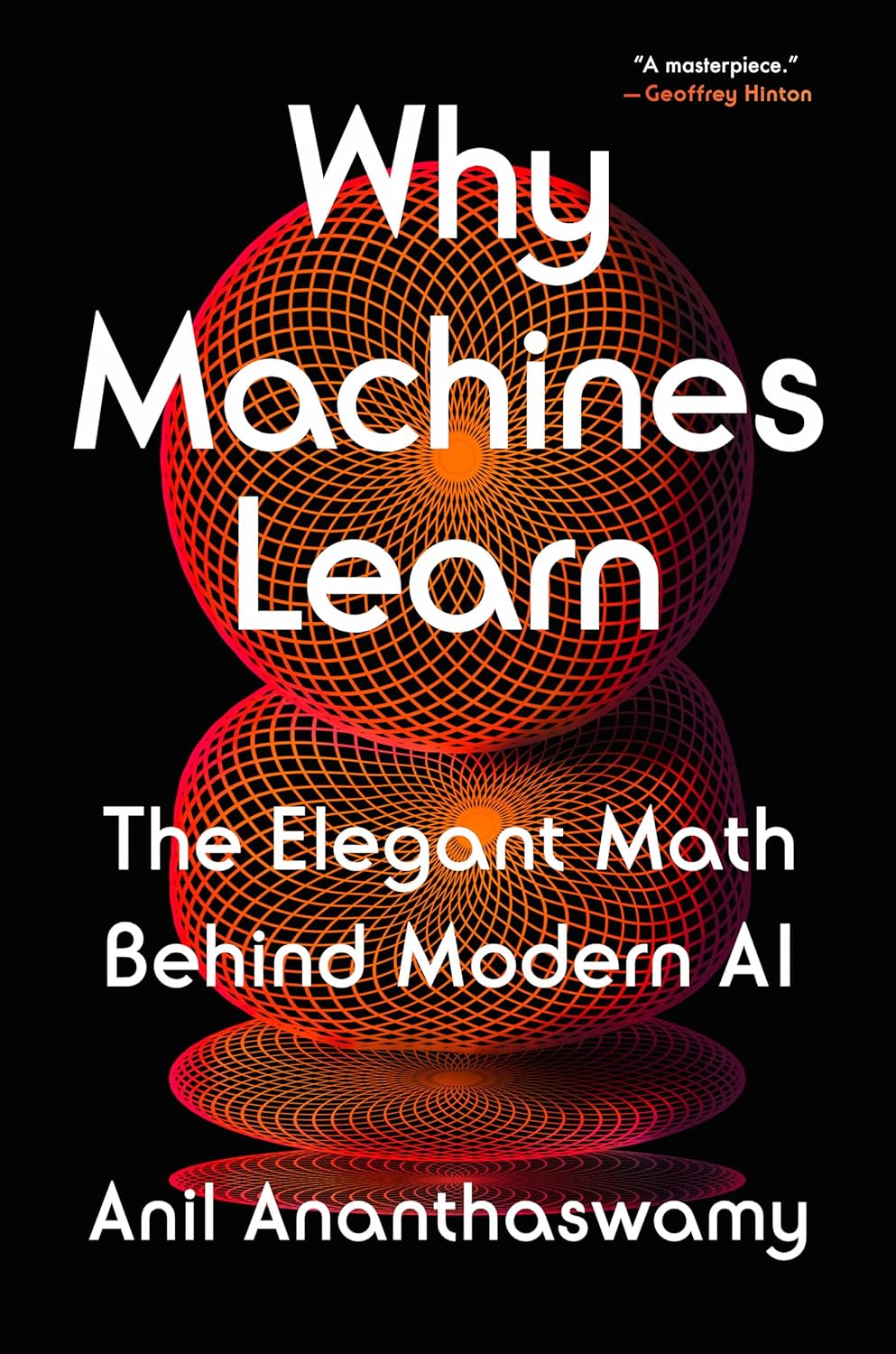
Why Machines Learn: The Elegant Math Behind Modern AI

Description:

A rich, narrative explanation of the mathematics that has brought us machine learning and the ongoing explosion of artificial intelligence

Machine learning systems are making life-altering decisions for us: approving mortgage loans, determining whether a tumor is cancerous, or deciding if someone gets bail. They now influence developments and discoveries in chemistry, biology, and physics—the study of genomes, extrasolar planets, even the intricacies of quantum systems. And all this before large language models such as ChatGPT came on the scene.

We are living through a revolution in machine learning-powered AI that shows no signs of slowing down. This technology is based on relatively simple mathematical ideas, some of which go back centuries, including linear algebra and calculus, the stuff of seventeenth- and eighteenth-century mathematics. It took the birth and advancement of computer science and the kindling of 1990s computer chips designed for video games to ignite the explosion of AI that we see today. In this enlightening book, Anil Ananthaswamy explains the fundamental math behind machine learning, while suggesting intriguing links between artificial and natural intelligence. Might the same math underpin them both?

As Ananthaswamy resonantly concludes, to make safe and effective use of artificial intelligence, we need to understand its profound capabilities and limitations, the clues to which lie in the math that makes machine learning possible.


Editorial Reviews

Review

A Next Big Idea Club Must-Read Title for July
One of The Information's 5 Best AI Books of 2024
A Winner of the Artificiality Book Awards 2024


"A deep look at the mathematical innovations that made the AI revolution possible. One of the most useful books on AI that I've ever read!"
Cal Newport, New York Times bestselling author of Slow Productivity and Deep Work, and Professor of Computer Science at Georgetown University

Why Machines Learn, by the award-winning science writer Anil Ananthaswamy, takes the reader on an entertaining journey into the mind of a machine… [The book] demystifies the underlying mechanisms behind machine learning, which may possibly lead to a better understanding of the learning process itself and the development of improved AI.”
Physics World

“A skillful primer makes sense of the mathematics beneath AI's hood.”
New Scientist

“Whether Ananthaswamy is talking of ML algorithms or manipulation of matrices, he maintains a lightness of language and invokes historical accounts to advance a compelling narrative… A must-read for anyone who is curious to understand 'the elegant math behind modern AI' [and] an inspirational guide for teachers of math and mathematical sciences who can adopt these techniques and methods to make classrooms lively.”
Shaastra, IIT-Madras

“Some books about the development of neural networks describe the underlying mathematics while others describe the social history. This book presents the mathematics in the context of the social history. It is a masterpiece. The author is very good at explaining the mathematics in a way that makes it available to people with only a rudimentary knowledge of the field, but he is also a very good writer who brings the social history to life.”
Geoffrey Hinton, Nobel Laureate, deep learning pioneer, Turing Award winner, former VP at Google, and Professor Emeritus at University of Toronto

“After just a few minutes of reading
Why Machines Learn, you’ll feel your own synaptic weights getting updated. By the end you will have achieved your own version of deep learning—with deep pleasure and insight along the way.”
Steven Strogatz, New York Times bestselling author of Infinite Powers and professor of mathematics at Cornell University

“If you were looking for a way to make sense of the AI revolution that is well underway, look no further. With this comprehensive yet engaging book, Anil Ananthaswamy puts it all into context, from the origin of the idea and its governing equations to its potential to transform medicine, quantum physics—and virtually every aspect of our life. An essential read for understanding both the possibilities and limitations of artificial intelligence.”
Sabine Hossenfelder, physicist and New York Times bestselling author of Existential Physics: A Scientist's Guide to Life's Biggest Questions

Why Machines Learn is a masterful work that explains—in clear, accessible, and entertaining fashion—the mathematics underlying modern machine learning, along with the colorful history of the field and its pioneering researchers. As AI has increasingly profound impacts in our world, this book will be an invaluable companion for anyone who wants a deep understanding of what’s under the hood of these often inscrutable machines.”
Melanie Mitchell, author of Artificial Intelligence and Professor at the Santa Fe Institute

“Generative AI, with its foundations in machine learning, is as fundamental an advance as the creation of the microprocessor, the Internet, and the mobile phone. But almost no one, outside of a handful of specialists, understands how it works. Anil Ananthaswamy has removed the mystery by giving us a gentle, intuitive, and human-oriented introduction to the math that underpins this revolutionary development.”
Peter E. Hart, AI pioneer, entrepreneur, and co-author of Pattern Classification

“Anil Ananthaswamy’s
Why Machines Learn embarks on an exhilarating journey through the origins of contemporary machine learning. With a captivating narrative, the book delves into the lives of influential figures driving the AI revolution while simultaneously exploring the intricate mathematical formalism that underpins it. As Anil traces the roots and unravels the mysteries of modern AI, he gently introduces the underlying mathematics, rendering the complex subject matter accessible and exciting for readers of all backgrounds.”
Björn Ommer, Professor at the Ludwig Maximilian University of Munich and leader of the original team behind Stable Diffusion

“An inspiring introduction to the mathematics of AI.”
Arthur I. Miller, author of The Artist in the Machine: The World of AI-Powered Creativity

"Will there be math? Oh, yes, there will be math. But Ananthaswamy is
the best guide you could ask for on such a perilous journey."
The Information

"This book is the ultimate explainer... What I love most is how [Ananthaswamy] threads history into the equations. You get why these methods matter, how they were discovered, and why they’ve stuck around. I felt like I was part of the journey, not just staring at some abstract formula. If you’re curious about how machines learn but feel like math is a wall you can’t climb, this book is your ladder. Highly recommended."
Helen Edwards, The Artificiality Institute

“[An] illuminating overview of how machine learning works.”
Kirkus Reviews

About the Author

Anil Ananthaswamy is an award-winning science writer and a former staff writer and deputy news editor for New Scientist. He is the author of several popular science books, including The Man Who Wasn’t There, which was longlisted for the PEN/E. O. Wilson Literary Science Writing Award. He was a 2019-20 MIT Knight Science Journalism Fellow and the recipient of the Distinguished Alum Award, the highest award given by IIT Madras to its graduates, for his contributions to science writing.

Reviews:

5.0 out of 5 stars History, Mathematics, Theory, and Philosophical aspects of ML, wrapped in compelling storytelling.

C.H. · July 19, 2024

Anil's storytelling added human faces to many names I was already familiar with, but only in an abstract way. That's the history part, written in a very personal and engaging way that only a good writer can do. At the same time the history of the development of ML theory is complete and expounded upon in enough detail that anyone with college level math abilities could follow along if so desired. (I expect many will skip some of those parts either because they know it or they don't need to know it. Perhaps those sections could be better sectioned to enable skipping.) Finally he asks very good questions about the nature of intelligence and how AI does or does not overlap with human intelligence, and well as the dangers it poses and benefits it may offer.The way the author maintains the big picture while leading the reader through a "live" minute-by-minute narration of compelling details reminds me of the style of VS Naipal, despite being a completely different genre.

5.0 out of 5 stars An Accessible and Beautifully Written Journey Through the Mathematics of AI

J.M. · June 13, 2025

Anil Ananthaswamy has done something truly special with Why Machines Learn. In a field often dominated by jargon and overwhelming technicality, he offers a remarkably elegant and readable exploration of the mathematical principles that underpin modern artificial intelligence. This book doesn’t just explain what machine learning is — it illuminates why it works, and it does so with clarity, depth, and a journalist’s gift for storytelling.What sets this book apart is its rare ability to blend rigorous concepts with intuitive explanations. Ananthaswamy takes readers through linear algebra, probability theory, optimization, and other foundational tools, not in isolation, but as they come alive within real-world AI applications. Whether he’s explaining how gradient descent mimics nature or demystifying neural networks, he makes complex ideas feel surprisingly accessible.This is not a textbook, and it’s not just for data scientists — it’s for anyone curious about the logic that powers today’s intelligent systems. If you’ve ever wanted to understand the beauty behind the algorithms shaping our world, this book is a must-read.Highly recommended for tech enthusiasts, students, and lifelong learners alike.

4.0 out of 5 stars Nice introduction to machine learning for non-experts that improves over the course of the book

A.M. · November 19, 2024

Given the increasing use of machine learning embedded within everyday software as well as its greater use in aiding decision making, an overview of the foundation for non-experts is a useful addition. The book goes through both the history as well as many of the main algorithmic ideas in a straightforward way that allows one to follow along irrespective of mathematical background. The criticism I have is merely that it starts out by assuming 0 knowledge to frame some basic mathematical notation and ideas and then eventually gets into topics which require some linear algebra and calculus to appreciate. This isn't in itself a bad thing but it ends up being an internal inconsistency of level of math in the book as it is highly unlikely a reader would be able to follow the details of the second half from having learnt the math from the first half.The book is split into 12 chapters going from basic math to neural networks. It discusses what the uses of machine learning are and its basic statistical nature of finding patterns in data through the use of computers. The field has a rich history crossing computer science, information theory and mathematical statistics. Starting out by going through the computer science and math the author and the ideas of feature space and linear algebra including PCA and eigenvectors. He then moves on to some early days when algorithms were being developed and discusses how the SVM algorithm was developed and his source interviews include Thomas Cover, the author of the main information theory textbook. He discusses Hopfield networks and how networks can store memory and then moves on to deep neural networks and the early work of Yan Le Cun and Geoffrey Hinton. This is where the book for me was most interesting as he discusses the puzzling nature of double descent and grokking in the training of large neural networks and some experts perspectives on these topics.Overall the book is readable but for me was slow to get started and then much more interesting in the latter half. I don't think one can learn the math for the second half from the first half as mentioned above and for that reason I found it a bit inconsistent in slow but the overall material was enjoyable to read think the book is a good effort on giving an overview of a field in the popular imagination.

5.0 out of 5 stars One of the Best Books on Machine Learning

S.f.H. · August 30, 2025

One of the best books you will find on AI and ML anywhere. I wanted to thank the author. Well written to cover the history and math behind AI. Beginners can skip the detailed math and proofs. I just hope a next edition gets more into attention networks and transformers.

5.0 out of 5 stars Best introduction to AI

S.C. · July 7, 2025

This is the best science book I have read in two decades. I have a mathematics background (MSc in Electrical Engineering and a doctorate heavy on structural equation modeling), which helps wehn reading the book.However, a modest knowledge of linear algebra and calculus will suffice. ML and LLM are not that complicated when taking a helicopter view of the AI field. The scale of what is being done, at speed, is what impresses me.The books is succinctly written. It is possible to skip the details in the matrix manipulations and only follow the main arguments.Overall, the best introduction to AI I know of.

5.0 out of 5 stars Instant AI Classic!

A.f.L. · October 17, 2025

Instant classic. Explains the why of AI (how it started and currently works) in a way people who suck at math can still grasp.

5.0 out of 5 stars Incredible and sensible read!

J.C.D. · July 22, 2025

This is an excellent book! It is insightful and revealing. I had read three other books on AI which focus on coding and that reference technical papers for the algorithms involved. However this book presents the math is a really intuitive form. It provides a perspective that is open to uncertainty and that provide a platform to include your interpretation while delving in the history that involve the intellectual giants that created all the bases for a now common used tools that are known superficially by a grand portions of users. This book is highly recommended!!

Math for AI

j.s. · October 30, 2024

Clear writing and excellent choice of topic for understanding the mathematical foundations of AI. Math matters.

Must read

C.A. · March 4, 2025

A jewel, a must read. We all loved it, even though for someone could be a bit too technical.

I was moved.

T. · August 25, 2025

Comprehensive explanation for AI's math.

A masterpiece

C. · November 17, 2024

Geoff Hinton is not wrong in calling this book a masterpiece. Few writers, like Ananthaswamy, have the gift of explaining intricate topics in such a clear and captivating way. Highly recommended regardless of your level of knowledge of machine learning, although you do need an undergraduate level mathematical background (vector calculus, matrix algebra, and statistics) to fully enjoy it.

A lire absolument

H.H. · August 2, 2025

Remarquable introduction au Machine learning.

Why Machines Learn: The Elegant Math Behind Modern AI

Product ID: U0593185749
Condition: New

4.7

AED16651

Price includes VAT & Import Duties
Type: Hardcover
Availability: In Stock

Quantity:

|

Order today to get by 7-14 business days

Delivery fee of AED 20. Free for orders above AED 200.

Returns & Warranty policies

Imported From: United States

At BOLO, we work hard to ensure the products you receive are new, genuine, and sourced from reputable suppliers.

BOLO is not an authorized or official retailer for most brands, nor are we affiliated with manufacturers unless specifically stated on a product page. Instead, we source verified sellers, authorized distributors or directly from the manufacturer.

Each product undergoes thorough inspection and verification at our consolidation and fulfilment centers to ensure it meets our strict authenticity and quality standards before being shipped and delivered to you.

If you ever have concerns regarding the authenticity of a product purchased from us, please contact Bolo Support. We will review your inquiry promptly and, if necessary, provide documentation verifying authenticity or offer a suitable resolution.

Your trust is our top priority, and we are committed to maintaining transparency and integrity in every transaction.

All product information, images, descriptions, and reviews originate from the manufacturer or from trusted sellers overseas. BOLO is not affiliated with, endorsed by, or an authorized retailer for most brands listed on our website unless stated otherwise.

While we strive to display accurate information, variations in packaging, labeling, instructions, or formulation may occasionally occur due to regional differences or supplier updates. For detailed or manufacturer-specific information, please contact the brand directly or reach out to BOLO Support for assistance.

Unless otherwise stated, all prices displayed on the product page include applicable taxes and import duties.

BOLO operates in accordance with the laws and regulations of United Arab Emirates. Any items found to be restricted or prohibited for sale within the UAE will be cancelled prior to shipment. We take proactive measures to ensure that only products permitted for sale in United Arab Emirates are listed on our website.

All items are shipped by air, and any products classified as “Dangerous Goods (DG)” under IATA regulations will be removed from the order and cancelled.

All orders are processed manually, and we make every effort to process them promptly once confirmed. Products cancelled due to the above reasons will be permanently removed from listings across the website.

Similar suggestions by Bolo

More from this brand

Similar items from “Computer Vision & Pattern Recognition”

Why Machines Learn: The Elegant Math Behind Modern AI

Product ID: U0593185749
Condition: New

4.7

Why Machines Learn: The Elegant Math Behind Modern AI-0
Type: Hardcover

AED16651

Price includes VAT & Import Duties
Availability: In Stock

Quantity:

|

Order today to get by 7-14 business days

Delivery fee of AED 20. Free for orders above AED 200.

Returns & Warranty policies

Imported From: United States

At BOLO, we work hard to ensure the products you receive are new, genuine, and sourced from reputable suppliers.

BOLO is not an authorized or official retailer for most brands, nor are we affiliated with manufacturers unless specifically stated on a product page. Instead, we source verified sellers, authorized distributors or directly from the manufacturer.

Each product undergoes thorough inspection and verification at our consolidation and fulfilment centers to ensure it meets our strict authenticity and quality standards before being shipped and delivered to you.

If you ever have concerns regarding the authenticity of a product purchased from us, please contact Bolo Support. We will review your inquiry promptly and, if necessary, provide documentation verifying authenticity or offer a suitable resolution.

Your trust is our top priority, and we are committed to maintaining transparency and integrity in every transaction.

All product information, images, descriptions, and reviews originate from the manufacturer or from trusted sellers overseas. BOLO is not affiliated with, endorsed by, or an authorized retailer for most brands listed on our website unless stated otherwise.

While we strive to display accurate information, variations in packaging, labeling, instructions, or formulation may occasionally occur due to regional differences or supplier updates. For detailed or manufacturer-specific information, please contact the brand directly or reach out to BOLO Support for assistance.

Unless otherwise stated, all prices displayed on the product page include applicable taxes and import duties.

BOLO operates in accordance with the laws and regulations of United Arab Emirates. Any items found to be restricted or prohibited for sale within the UAE will be cancelled prior to shipment. We take proactive measures to ensure that only products permitted for sale in United Arab Emirates are listed on our website.

All items are shipped by air, and any products classified as “Dangerous Goods (DG)” under IATA regulations will be removed from the order and cancelled.

All orders are processed manually, and we make every effort to process them promptly once confirmed. Products cancelled due to the above reasons will be permanently removed from listings across the website.

Description:

A rich, narrative explanation of the mathematics that has brought us machine learning and the ongoing explosion of artificial intelligence

Machine learning systems are making life-altering decisions for us: approving mortgage loans, determining whether a tumor is cancerous, or deciding if someone gets bail. They now influence developments and discoveries in chemistry, biology, and physics—the study of genomes, extrasolar planets, even the intricacies of quantum systems. And all this before large language models such as ChatGPT came on the scene.

We are living through a revolution in machine learning-powered AI that shows no signs of slowing down. This technology is based on relatively simple mathematical ideas, some of which go back centuries, including linear algebra and calculus, the stuff of seventeenth- and eighteenth-century mathematics. It took the birth and advancement of computer science and the kindling of 1990s computer chips designed for video games to ignite the explosion of AI that we see today. In this enlightening book, Anil Ananthaswamy explains the fundamental math behind machine learning, while suggesting intriguing links between artificial and natural intelligence. Might the same math underpin them both?

As Ananthaswamy resonantly concludes, to make safe and effective use of artificial intelligence, we need to understand its profound capabilities and limitations, the clues to which lie in the math that makes machine learning possible.


Editorial Reviews

Review

A Next Big Idea Club Must-Read Title for July
One of The Information's 5 Best AI Books of 2024
A Winner of the Artificiality Book Awards 2024


"A deep look at the mathematical innovations that made the AI revolution possible. One of the most useful books on AI that I've ever read!"
Cal Newport, New York Times bestselling author of Slow Productivity and Deep Work, and Professor of Computer Science at Georgetown University

Why Machines Learn, by the award-winning science writer Anil Ananthaswamy, takes the reader on an entertaining journey into the mind of a machine… [The book] demystifies the underlying mechanisms behind machine learning, which may possibly lead to a better understanding of the learning process itself and the development of improved AI.”
Physics World

“A skillful primer makes sense of the mathematics beneath AI's hood.”
New Scientist

“Whether Ananthaswamy is talking of ML algorithms or manipulation of matrices, he maintains a lightness of language and invokes historical accounts to advance a compelling narrative… A must-read for anyone who is curious to understand 'the elegant math behind modern AI' [and] an inspirational guide for teachers of math and mathematical sciences who can adopt these techniques and methods to make classrooms lively.”
Shaastra, IIT-Madras

“Some books about the development of neural networks describe the underlying mathematics while others describe the social history. This book presents the mathematics in the context of the social history. It is a masterpiece. The author is very good at explaining the mathematics in a way that makes it available to people with only a rudimentary knowledge of the field, but he is also a very good writer who brings the social history to life.”
Geoffrey Hinton, Nobel Laureate, deep learning pioneer, Turing Award winner, former VP at Google, and Professor Emeritus at University of Toronto

“After just a few minutes of reading
Why Machines Learn, you’ll feel your own synaptic weights getting updated. By the end you will have achieved your own version of deep learning—with deep pleasure and insight along the way.”
Steven Strogatz, New York Times bestselling author of Infinite Powers and professor of mathematics at Cornell University

“If you were looking for a way to make sense of the AI revolution that is well underway, look no further. With this comprehensive yet engaging book, Anil Ananthaswamy puts it all into context, from the origin of the idea and its governing equations to its potential to transform medicine, quantum physics—and virtually every aspect of our life. An essential read for understanding both the possibilities and limitations of artificial intelligence.”
Sabine Hossenfelder, physicist and New York Times bestselling author of Existential Physics: A Scientist's Guide to Life's Biggest Questions

Why Machines Learn is a masterful work that explains—in clear, accessible, and entertaining fashion—the mathematics underlying modern machine learning, along with the colorful history of the field and its pioneering researchers. As AI has increasingly profound impacts in our world, this book will be an invaluable companion for anyone who wants a deep understanding of what’s under the hood of these often inscrutable machines.”
Melanie Mitchell, author of Artificial Intelligence and Professor at the Santa Fe Institute

“Generative AI, with its foundations in machine learning, is as fundamental an advance as the creation of the microprocessor, the Internet, and the mobile phone. But almost no one, outside of a handful of specialists, understands how it works. Anil Ananthaswamy has removed the mystery by giving us a gentle, intuitive, and human-oriented introduction to the math that underpins this revolutionary development.”
Peter E. Hart, AI pioneer, entrepreneur, and co-author of Pattern Classification

“Anil Ananthaswamy’s
Why Machines Learn embarks on an exhilarating journey through the origins of contemporary machine learning. With a captivating narrative, the book delves into the lives of influential figures driving the AI revolution while simultaneously exploring the intricate mathematical formalism that underpins it. As Anil traces the roots and unravels the mysteries of modern AI, he gently introduces the underlying mathematics, rendering the complex subject matter accessible and exciting for readers of all backgrounds.”
Björn Ommer, Professor at the Ludwig Maximilian University of Munich and leader of the original team behind Stable Diffusion

“An inspiring introduction to the mathematics of AI.”
Arthur I. Miller, author of The Artist in the Machine: The World of AI-Powered Creativity

"Will there be math? Oh, yes, there will be math. But Ananthaswamy is
the best guide you could ask for on such a perilous journey."
The Information

"This book is the ultimate explainer... What I love most is how [Ananthaswamy] threads history into the equations. You get why these methods matter, how they were discovered, and why they’ve stuck around. I felt like I was part of the journey, not just staring at some abstract formula. If you’re curious about how machines learn but feel like math is a wall you can’t climb, this book is your ladder. Highly recommended."
Helen Edwards, The Artificiality Institute

“[An] illuminating overview of how machine learning works.”
Kirkus Reviews

About the Author

Anil Ananthaswamy is an award-winning science writer and a former staff writer and deputy news editor for New Scientist. He is the author of several popular science books, including The Man Who Wasn’t There, which was longlisted for the PEN/E. O. Wilson Literary Science Writing Award. He was a 2019-20 MIT Knight Science Journalism Fellow and the recipient of the Distinguished Alum Award, the highest award given by IIT Madras to its graduates, for his contributions to science writing.

Reviews:

5.0 out of 5 stars History, Mathematics, Theory, and Philosophical aspects of ML, wrapped in compelling storytelling.

C.H. · July 19, 2024

Anil's storytelling added human faces to many names I was already familiar with, but only in an abstract way. That's the history part, written in a very personal and engaging way that only a good writer can do. At the same time the history of the development of ML theory is complete and expounded upon in enough detail that anyone with college level math abilities could follow along if so desired. (I expect many will skip some of those parts either because they know it or they don't need to know it. Perhaps those sections could be better sectioned to enable skipping.) Finally he asks very good questions about the nature of intelligence and how AI does or does not overlap with human intelligence, and well as the dangers it poses and benefits it may offer.The way the author maintains the big picture while leading the reader through a "live" minute-by-minute narration of compelling details reminds me of the style of VS Naipal, despite being a completely different genre.

5.0 out of 5 stars An Accessible and Beautifully Written Journey Through the Mathematics of AI

J.M. · June 13, 2025

Anil Ananthaswamy has done something truly special with Why Machines Learn. In a field often dominated by jargon and overwhelming technicality, he offers a remarkably elegant and readable exploration of the mathematical principles that underpin modern artificial intelligence. This book doesn’t just explain what machine learning is — it illuminates why it works, and it does so with clarity, depth, and a journalist’s gift for storytelling.What sets this book apart is its rare ability to blend rigorous concepts with intuitive explanations. Ananthaswamy takes readers through linear algebra, probability theory, optimization, and other foundational tools, not in isolation, but as they come alive within real-world AI applications. Whether he’s explaining how gradient descent mimics nature or demystifying neural networks, he makes complex ideas feel surprisingly accessible.This is not a textbook, and it’s not just for data scientists — it’s for anyone curious about the logic that powers today’s intelligent systems. If you’ve ever wanted to understand the beauty behind the algorithms shaping our world, this book is a must-read.Highly recommended for tech enthusiasts, students, and lifelong learners alike.

4.0 out of 5 stars Nice introduction to machine learning for non-experts that improves over the course of the book

A.M. · November 19, 2024

Given the increasing use of machine learning embedded within everyday software as well as its greater use in aiding decision making, an overview of the foundation for non-experts is a useful addition. The book goes through both the history as well as many of the main algorithmic ideas in a straightforward way that allows one to follow along irrespective of mathematical background. The criticism I have is merely that it starts out by assuming 0 knowledge to frame some basic mathematical notation and ideas and then eventually gets into topics which require some linear algebra and calculus to appreciate. This isn't in itself a bad thing but it ends up being an internal inconsistency of level of math in the book as it is highly unlikely a reader would be able to follow the details of the second half from having learnt the math from the first half.The book is split into 12 chapters going from basic math to neural networks. It discusses what the uses of machine learning are and its basic statistical nature of finding patterns in data through the use of computers. The field has a rich history crossing computer science, information theory and mathematical statistics. Starting out by going through the computer science and math the author and the ideas of feature space and linear algebra including PCA and eigenvectors. He then moves on to some early days when algorithms were being developed and discusses how the SVM algorithm was developed and his source interviews include Thomas Cover, the author of the main information theory textbook. He discusses Hopfield networks and how networks can store memory and then moves on to deep neural networks and the early work of Yan Le Cun and Geoffrey Hinton. This is where the book for me was most interesting as he discusses the puzzling nature of double descent and grokking in the training of large neural networks and some experts perspectives on these topics.Overall the book is readable but for me was slow to get started and then much more interesting in the latter half. I don't think one can learn the math for the second half from the first half as mentioned above and for that reason I found it a bit inconsistent in slow but the overall material was enjoyable to read think the book is a good effort on giving an overview of a field in the popular imagination.

5.0 out of 5 stars One of the Best Books on Machine Learning

S.f.H. · August 30, 2025

One of the best books you will find on AI and ML anywhere. I wanted to thank the author. Well written to cover the history and math behind AI. Beginners can skip the detailed math and proofs. I just hope a next edition gets more into attention networks and transformers.

5.0 out of 5 stars Best introduction to AI

S.C. · July 7, 2025

This is the best science book I have read in two decades. I have a mathematics background (MSc in Electrical Engineering and a doctorate heavy on structural equation modeling), which helps wehn reading the book.However, a modest knowledge of linear algebra and calculus will suffice. ML and LLM are not that complicated when taking a helicopter view of the AI field. The scale of what is being done, at speed, is what impresses me.The books is succinctly written. It is possible to skip the details in the matrix manipulations and only follow the main arguments.Overall, the best introduction to AI I know of.

5.0 out of 5 stars Instant AI Classic!

A.f.L. · October 17, 2025

Instant classic. Explains the why of AI (how it started and currently works) in a way people who suck at math can still grasp.

5.0 out of 5 stars Incredible and sensible read!

J.C.D. · July 22, 2025

This is an excellent book! It is insightful and revealing. I had read three other books on AI which focus on coding and that reference technical papers for the algorithms involved. However this book presents the math is a really intuitive form. It provides a perspective that is open to uncertainty and that provide a platform to include your interpretation while delving in the history that involve the intellectual giants that created all the bases for a now common used tools that are known superficially by a grand portions of users. This book is highly recommended!!

Math for AI

j.s. · October 30, 2024

Clear writing and excellent choice of topic for understanding the mathematical foundations of AI. Math matters.

Must read

C.A. · March 4, 2025

A jewel, a must read. We all loved it, even though for someone could be a bit too technical.

I was moved.

T. · August 25, 2025

Comprehensive explanation for AI's math.

A masterpiece

C. · November 17, 2024

Geoff Hinton is not wrong in calling this book a masterpiece. Few writers, like Ananthaswamy, have the gift of explaining intricate topics in such a clear and captivating way. Highly recommended regardless of your level of knowledge of machine learning, although you do need an undergraduate level mathematical background (vector calculus, matrix algebra, and statistics) to fully enjoy it.

A lire absolument

H.H. · August 2, 2025

Remarquable introduction au Machine learning.

Similar suggestions by Bolo

More from this brand

Similar items from “Computer Vision & Pattern Recognition”