Description:
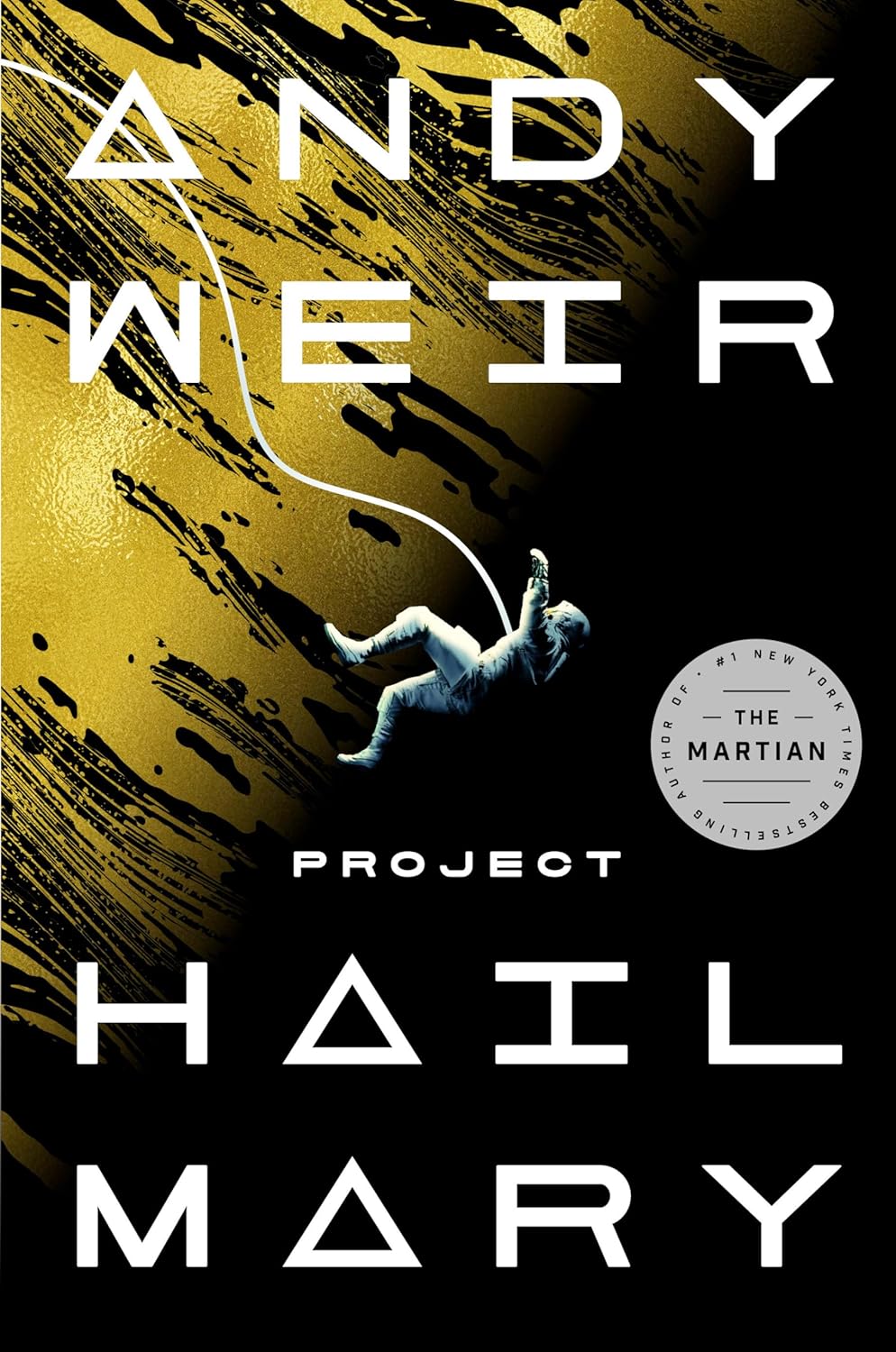
A lone astronaut must save the earth from disaster in this “propulsive” (Entertainment Weekly), cinematic thriller full of suspense, humor, and fascinating science—from the author of The Martian.
HUGO AWARD FINALIST • NEW YORK TIMES READER PICK: 100 BEST BOOKS OF THE 21ST CENTURY • ONE OF THE YEAR’S BEST BOOKS: Parade, Newsweek, New York Public Library, Polygon, Shelf Awareness, She Reads, Kirkus Reviews, Library Journal
Ryland Grace is the sole survivor on a desperate, last-chance mission—and if he fails, humanity and the earth itself will perish.
Except that right now, he doesn’t know that. He can’t even remember his own name, let alone the nature of his assignment or how to complete it.
All he knows is that he’s been asleep for a very, very long time. And he’s just been awakened to find himself millions of miles from home, with nothing but two corpses for company.
His crewmates dead, his memories fuzzily returning, Ryland realizes that an impossible task now confronts him. Hurtling through space on this tiny ship, it’s up to him to puzzle out an impossible scientific mystery—and conquer an extinction-level threat to our species.
And with the clock ticking down and the nearest human being light-years away, he’s got to do it all alone.
Or does he?
Hailed by USA Today as “an epic story of redemption, discovery, and cool speculative sci-fi,” Project Hail Mary is an irresistible interstellar adventure as only Andy Weir could deliver.
Amazon.com Review
Review
“An engaging space odyssey.”—The New York Times Book Review (Editors’ Choice)
“Dazzling.”—Vulture
“Funny, well plotted, and full of surprises.”—The Guardian
“A joy to read.”—Locus
“The ultimate page-turner.”—Daily Mail
“Weir spins a space yarn in a way only he can. Fans of his earlier works won’t be disappointed.”—Newsweek
“Andy Weir proves once again that he is a singular talent. Project Hail Mary is so fascinating and propulsive that it’s downright addictive. From the first page as Ryland wakes up not knowing who or where he is, I was hooked.”—Taylor Jenkins Reid, New York Times bestselling author of Daisy Jones & The Six
“Reading Project Hail Mary is like going on a field trip to outer space with the best science teacher you’ve ever had—and your class assignment is to save the world. This is one of the most original, compelling, and fun voyages I’ve ever taken.”—Ernest Cline, #1 New York Times bestselling author of Ready Player One
“Two worlds in peril, a competent (but flawed and human) man, a competent alien, unending scientific puzzles to unravel, with humanity itself at risk, this one has everything fans of old school SF (like me) love. If you like a lot of science in your science fiction, Andy Weir is the writer for you.”—George R. R. Martin, New York Times bestselling author of A Game of Thrones
“I loved The Martian, but I actually find Project Hail Mary to be Mr. Weir’s finest work to date. It’s somehow both exciting, yet also personal. I’m constantly amazed by how well Mr. Weir continues to write wonderfully accessible science fiction without compromising either the science or the fiction.”—Brandon Sanderson, New York Times bestselling author of the Stormlight Archive series
“Brilliantly funny and enjoyable . . . one of the most plausible science fiction books I’ve ever read.”—Tim Peake, ESA astronaut and internationally bestselling author of Limitless
“Thrilling doesn’t even begin to describe Project Hail Mary, which is undisputedly the best book I’ve read in a very, very long time . . . I cheered, I laughed (a lot), I cried, and when the twist arrived and the book revealed its true target, my jaw hit the floor. Mark my words: Project Hail Mary is destined to become a classic.”—Blake Crouch, New York Times bestselling author of Recursion and Dark Matter
“Readers may find themselves consuming this emotionally intense and thematically profound novel in one stay-up-all-night-until-your-eyes-bleed sitting. An unforgettable story of survival and the power of friendship—nothing short of a science fiction masterwork.”—Kirkus Reviews (starred review)
About the Author
Excerpt. © Reprinted by permission. All rights reserved.
“What’s two plus two?”
Something about the question irritates me. I’m tired. I drift back to sleep.
A few minutes pass, then I hear it again.
“What’s two plus two?”
The soft, feminine voice lacks emotion and the pronunciation is identical to the previous time she said it. It’s a computer. A computer is hassling me. I’m even more irritated now.
“Lrmln,” I say. I’m surprised. I meant to say “Leave me alone”—a completely reasonable response in my opinion—but I failed to speak.
“Incorrect,” says the computer. “What’s two plus two?”
Time for an experiment. I’ll try to say hello.
“Hlllch?” I say.
“Incorrect. What’s two plus two?”
What’s going on? I want to find out, but I don’t have much to work with. I can’t see. I can’t hear anything other than the computer. I can’t even feel. No, that’s not true. I feel something. I’m lying down. I’m on something soft. A bed.
I think my eyes are closed. That’s not so bad. All I have to do is open them. I try, but nothing happens.
Why can’t I open my eyes?
Open.
Aaaand . . . open!
Open, dang it!
Ooh! I felt a wiggle that time. My eyelids moved. I felt it.
Open!
My eyelids creep up and blinding light sears my retinas.
“Glunn!” I say. I keep my eyes open with sheer force of will. Everything is white with shades of pain.
“Eye movement detected,” my tormenter says. “What’s two plus two?”
The whiteness lessens. My eyes are adjusting. I start to see shapes, but nothing sensible yet. Let’s see . . . can I move my hands? No.
Feet? Also no.
But I can move my mouth, right? I’ve been saying stuff. Not stuff that makes sense, but it’s something.
“Fffr.”
“Incorrect. What’s two plus two?”
The shapes start to make sense. I’m in a bed. It’s kind of . . . oval-shaped.
LED lights shine down on me. Cameras in the ceiling watch my every move. Creepy though that is, I’m much more concerned about the robot arms.
The two brushed-steel armatures hang from the ceiling. Each has an assortment of disturbingly penetration-looking tools where hands should be. Can’t say I like the look of that.
“Ffff . . . oooh . . . rrrr,” I say. Will that do?
“Incorrect. What’s two plus two?”
Dang it. I summon all my willpower and inner strength. Also, I’m starting to panic a little. Good. I use that too.
“Fffoouurr,” I finally say.
“Correct.”
Thank God. I can talk. Sort of.
I breathe a sigh of relief. Wait—I just controlled my breathing. I take another breath. On purpose. My mouth is sore. My throat is sore. But it’s my soreness. I have control.
I’m wearing a breathing mask. It’s tight to my face and connected to a hose that goes behind my head.
Can I get up?
No. But I can move my head a little. I look down at my body. I’m naked and connected to more tubes than I can count. There’s one in each arm, one in each leg, one in my “gentlemen’s equipment,” and two that disappear under my thigh. I’m guessing one of them is up where the sun doesn’t shine.
That can’t be good.
Also, I’m covered with electrodes. The sensor-type stickers like for an EKG, but they’re all over the place. Well, at least they’re only on my skin instead of jammed into me.
“Wh—” I wheeze. I try again. “Where . . . am . . . I?”
“What’s the cube root of eight?” the computer asks.
“Where am I?” I say again. This time it’s easier.
“Incorrect. What’s the cube root of eight?”
I take a deep breath and speak slowly. “Two times e to the two-i-pi over three.”
“Incorrect. What’s the cube root of eight?”
But I wasn’t incorrect. I just wanted to see how smart the computer was. Answer: not very.
“Two,” I say.
“Correct.”
I listen for follow-up questions, but the computer seems satisfied.
I’m tired. I drift off to sleep again.
I wake up. How long was I out? It must have been a while because I feel rested. I open my eyes without any effort. That’s progress.
I try to move my fingers. They wiggle as instructed. All right. Now we’re getting somewhere.
“Hand movement detected,” says the computer. “Remain still.”
“What? Why—”
The robot arms come for me. They move fast. Before I know it, they’ve removed most of the tubes from my body. I didn’t feel a thing. Though my skin is kind of numb anyway.
Only three tubes remain: an IV in my arm, a tube up my butt, and a catheter. Those latter two are kind of the signature items I wanted removed, but okay.
I raise my right arm and let it fall back to the bed. I do the same for my left. They feel heavy as heck. I repeat the process a few times. My arms are muscular. That doesn’t make sense. I assume I’ve had some massive medical problem and been in this bed for a while. Otherwise, why would they have me hooked up to all the stuff? Shouldn’t there be muscle atrophy?
And shouldn’t there be doctors? Or maybe the sounds of a hospital? And what’s with this bed? It’s not a rectangle, it’s an oval and I think it’s mounted to the wall instead of the floor.
“Take . . .” I trail off. Still kind of tired. “Take the tubes out. . . .”
The computer doesn’t respond.
I do a few more arm lifts. I wiggle my toes. I’m definitely getting better.
I tilt my ankles back and forth. They’re working. I raise my knees up. My legs are well toned too. Not bodybuilder thick, but still too healthy for someone on the verge of death. I’m not sure how thick they should be, though.
I press my palms to the bed and push. My torso rises. I’m actually getting up! It takes all my strength but I soldier on. The bed rocks gently as I move. It’s not a normal bed, that’s for sure. As I raise my head higher up, I see the head and foot of the elliptical bed are attached to strong-looking wall mounts. It’s kind of a rigid hammock. Weird.
Soon, I’m sitting on my butt tube. Not the most comfortable sensation, but when is a tube up your butt ever comfortable?
I have a better view of things now. This is no ordinary hospital room. The walls look plastic and the whole room is round. Stark-white light comes from ceiling-mounted LED lights.
There are two more hammock-like beds mounted to the walls, each with their own patient. We are arranged in a triangle and the roof-mounted Arms of Harassment are in the center of the ceiling. I guess they take care of all three of us. I can’t see much of my compatriots—they’ve sunken into their bedding like I had.
There’s no door. Just a ladder on the wall leading to . . . a hatch? It’s round and has a wheel-handle in the center. Yeah, it’s got to be some kind of hatch. Like on a submarine. Maybe the three of us have a contagious disease? Maybe this is an airtight quarantine room? There are small vents here and there on the wall and I feel a little airflow. It could be a controlled environment.
I slide one leg off over the edge of my bed, which makes it wobble. The robot arms rush toward me. I flinch, but they stop short and hover nearby. I think they’re ready to grab me if I fall.
“Full-body motion detected,” the computer says. “What’s your name?”
“Pfft, seriously?” I ask.
“Incorrect. Attempt number two: What’s your name?”
I open my mouth to answer.
“Uh . . .”
“Incorrect. Attempt number three: What’s your name?”
Only now does it occur to me: I don’t know who I am. I don’t know what I do. I don’t remember anything at all.
“Um,” I say.
“Incorrect.”
A wave of fatigue grips me. It’s kind of pleasant, actually. The computer must have sedated me through the IV line.
“. . . waaaait . . .” I mumble.
The robot arms lay me gently back down to the bed.
Reviews:
Astonishing, Fun, Entertaining, Fantastic
I consider The Martian my favorite fictional novel of the last 15-20 years. The movie was incredible in that they actually followed the book closer than 99% of other films based on books. It remains my favorite movie of the last 15 years or so as well. I don't know anyone (personally) that loves either of them as much as I do.With that said, I was REALLY looking forward to Artemis. It was good...but, it was certainly not in the same caliber as The Martian was (at least not for me). I enjoyed it a lot, however and appreciated how author Andy Weir chose to go in a completely different direction and not just rehash another similar story, which I am certain would have been great as well.As a result, I was cautious regarding Project Hail Mary. It sounded a little too close to The Martian, but yet, also different in that the circumstances simply could not be more opposite and the stakes so much higher. I'm trying to figure out the best way to summarize without giving too much away from this utterly compelling novel. As I read several reviews, I noticed a recurring theme: SCIENCE. Lots and LOTS of science. Holy cow, they were right. Many years ago I read Apollo 13 and Jim Lovell and his co-writer, try as they might, simply could not dumb down Orbital Mechanics anywhere near enough for me to have even a minor clue as to what they were attempting to say...I just skipped 90% of it and hoped that the sentences written afterwards, would help to make sense of what I had just skimmed over. I'm a lot of things, but a math wizard is definitely not one of them. Michael Crichton (Jurassic Park) had an amazing talent for dumbing-down the science of what he was trying to explain in ways that genuinely made sense (most of the time). Not everyone has this talent, and I would say Andy Weir falls squarely in between. He's certainly better than Jim Lovell, but not quite as good as Crichton. But then again, outside of a science textbook, I haven't really read anything with quite as MUCH science as Project Hail Mary. So maybe he's just as good, but he just puts more science into his books than Crichton, maybe that's it...? Either way, be prepared for a lot of astonishingly interesting science within the pages of this novel...and I DO mean a LOT. I don't say this to make you wary or steer you away...on the contrary, Andy Weir has a special talent for making hard science truly entertaining.The book opens with an absolutely amazing and frightening premise: an astronaut awakes from an induced coma to find the only other two people on board have died at some point along their journey...but it gets worse. He has no idea who he is, or why he's on the ship, and oh yeah, they look to be a long way from home. A really, REALLY long way from home. In fact, the sun he sees isn't actually OUR sun at all. He's managed to leave our solar system entirely. And he has no idea why.((Minor Spoilers)) The book goes through some clever flash-backs, which set the stage for why the mission happens, and slowly, carefully explains how they managed to get so far away from earth in such a short amount of time. Basically, earth's sun seems to be dying. At the rate of decay, we have maybe 19 years left before the gradual cooling has catastrophic consequences resulting in the death of billions (best guess). Why the sun is dimming is quite the conundrum in the first place. Turns out it really isn't dying, it's being killed by an outside source...which turns out to be easily the greatest find in history. It's alien life, and they are using the sun for food, essentially. It's alien life, but not intelligent life. But still, wow! ALIENS, right???After this monumental discovery, and some tremendous research done by the most improbable scientist, the investigation into what is happening and why and what to do about it expands exponentially to other nations in order to pool all the resources possible to hopefully save the sun, and by extension, the human race as well. They learn. A LOT. A plan is put together, and with the help of the newly discovered microscopic alien life, which can also double as a power source (along with a few other nifty surprises), they begin to create one last, Hail Mary that could very well be the last chance we might have to save earth. It's audacious. It's dangerous, and it is absolutely critical that it succeed.As our astronaut's memory slowly unravels, so does his identity: Ryland Grace. He's a teacher on earth. Just a science teacher. Not even a college professor. He's amazingly smart, though. But he's no astronaut...and certainly not one who would volunteer to go on a one-way mission to another solar system to "try" and save humanity. Yet here he is. Alone. light years from earth, trying to solve the biggest riddle in all of human history. Ryland accepts his situation, such as it is, with relative indifference (for the most part). It doesn't matter HOW he got here. He's here now and he may as well use that time to be as productive as possible, right? Along the way, he unravels even more information regarding the microscopic alien life which is slowly dimming our sun during some additional flashbacks. The aliens, dubbed, "Astrophage" are quite the galactic plague as it turns out. Stars all over the galaxy are also losing their light, all due to the little buggers. All that is, except one particular star named, Tau Ceti. Now why would that one star be unaffected by Astrophage, when every single star around it has been affected to some degree. The plan is to go there and figure it out and send the information back, hopefully in time to save the sun before the damage to earth is beyond repair.There is an incredible amount of stuff going on. The story switches from Tau Ceti to flashbacks of how the whole mission was planned and implemented (which is VERY entertaining, especially Director Stratt, who may actually be my favorite character in the entire novel). Weir is becoming quite adept at building tension, and abruptly switching the story from Tau Ceti back to earth and building more of the backstory then switching back to Tau Ceti. Keeping it all in check and most importantly, interesting all while mixing in a healthy dose of science, which I am to understand is pretty much all genuine, is quite the juggling act. I have long known science can be astronomically entertaining (see what I did there?) when done right...but unfortunately very few people in a position to teach science actually know the best way to create that interest in others. I can say without reservation, Andy Weir definitely knows how to do it...at least in written form.There is so much I want to say more regarding this truly phenomenal story, but I simply cannot without ruining a lot of the fun and surprises revealed along the way...and it is killing me to keep it locked in. Though I labeled a spoiler warning earlier, I don't think it gave away any more than what the author himself has revealed in interviews he has done regarding the book, and what you can glean from reading the summary here and just a couple other reviews. Tying all of that science together is truly astonishing to me. The creativity to put it into a novel that is remarkably exciting to read is nothing more than incredible talent. Kudo's to Andy Weir for not just hitting a home run, Project Hail Mary is a Grand Slam all the way. I truly did not want this story to end. By the way, I enjoyed the ending quite a bit. I don't know if everyone will. But it was fine for me. I think the ending screams "sequel" at some point too. A lot was left open-ended (IMO) and I wouldn't mind reading a follow-up to this. It doesn't HAVE to happen, but there are a lot of ways where the story could go if Andy chose to do it. Just sayin'.Just run out and buy this book.
A satisfying sci-fi novel that will appeal to a wide readership
Andy Weir’s latest novel continues a theme of blending scientific knowledge to solve problems and the perils of outer space exploration. In this tale, a middle-school science teacher, Ryland Grace, is faced with a seemingly insurmountable task, saving earth from a cooling sun. Long before he became a science teacher, he wrote a paper about the possibility of the existence of life forms that don’t need water to survive. At the time, his analysis was widely rejected and ridiculed. Now, because it appears that life forms are responsible for draining the sun, he has become a visionary and is tasked with working with a group of international scientists to find a solution for a what could be a global catastrophe.Through scientific experiments, Grace and his team determine that the microscopic organisms he calls “astrophages” are a threat to humankind and must be stopped. But how? After a series of tragedies and misadventures, Grace wakes up years later in a space-craft. His memory slowly returns as he has been placed in an induced coma with robots and computers tending his biological functions. The most incredible and fantastic event occurs when he meets another being with the same objective he has.The story goes back and forth in time showing how Grace ended up in the space-craft and his current dilemma of finding a way of counteracting the astrophages. The novel incorporates a wealth of scientific knowledge along with generously placed doses of humor. This is a book that will appeal to a wide readership, from teens interested in science, to adults intrigued by sci-fi and adventure. It’s a satisfying and enjoyable read and creates a feeling of wonder.
Wake up and smell the terrestrial crisis!
Many people can relate to the experience of waking up and having a Jumanji-esque "what year is it" existential crisis - which of course is usually in jest, or quickly passes. For Ryland Grace, waking up is an altogether cataclysmic experience - he can't remember his own name, or what he's supposed to be doing, or why there's two corpses and a robot in the room with him. With time, his memory's return in the hazy way a dandelion's seeds float on the wind - and he's slowly reacquainted with the impossible nature of his task. Alone and hurtling through deep space on a veritable chimera of a ship fueled by every government agency on the planet, he's humanity's last hope against an extinction-level event taking place back at home. And with the unexpected help of an ally, the odds may just be in his favor.I walked into this book fairly blind - it was my book club's choice ahead of the movie adaptation coming out this year, and I missed out on "The Martian" when it was popular, so I was pleasantly surprised with how much fun (and anxiety) I had while reading about Ryland Grace (main character name if I ever saw one) and his schoolteacher smarts fighting it out at the brink of the universe. The book did a good job in slow-baking a lot of nebulous concepts into something the average reader could parse out and enjoy, which I think can be difficult for science fiction books - and while I doubt much of the science will stand up to proper scrutiny, this isn't one of those books that's diving into realism. You're here to have fun, and maybe review some of what you've forgotten from high school or entry-level college courses, and that's okay.I think the book did a great job in capturing the desperation of what the internet cryptids would call an "XK Class End-Of-The-World Scenario" and took a good stab in imagining what that might look like from a world government/cooperation standpoint, if with heavy liberties towards how maturely some world leaders would act. I think the humanistic and scientific facets of the mission, which was revealed in piecemeal as Grace's memory catches up, worked really well from a pacing and storytelling perspective, and while there were loose ends I really wanted follow-up on that were never tied up properly, I don't think this necessarily ruined my enjoyment of the story overall. I'll be looking forward to seeing how this one plays out on the big screen since there's a lot of internalization and explanation from a reader standpoint, but overall I'd be up to reading more Andy Weir stories in the future.
Visit the Ballantine Books Store
Project Hail Mary: A Novel
AED16924
Quantity:
Order today to get by 7-14 business days
Delivery fee of AED 20. Free for orders above AED 200.
Imported From: United States
At BOLO, we work hard to ensure the products you receive are new, genuine, and sourced from reputable suppliers.
BOLO is not an authorized or official retailer for most brands, nor are we affiliated with manufacturers unless specifically stated on a product page. Instead, we source verified sellers, authorized distributors or directly from the manufacturer.
Each product undergoes thorough inspection and verification at our consolidation and fulfilment centers to ensure it meets our strict authenticity and quality standards before being shipped and delivered to you.
If you ever have concerns regarding the authenticity of a product purchased from us, please contact Bolo Support. We will review your inquiry promptly and, if necessary, provide documentation verifying authenticity or offer a suitable resolution.
Your trust is our top priority, and we are committed to maintaining transparency and integrity in every transaction.
All product information, images, descriptions, and reviews originate from the manufacturer or from trusted sellers overseas. BOLO is not affiliated with, endorsed by, or an authorized retailer for most brands listed on our website unless stated otherwise.
While we strive to display accurate information, variations in packaging, labeling, instructions, or formulation may occasionally occur due to regional differences or supplier updates. For detailed or manufacturer-specific information, please contact the brand directly or reach out to BOLO Support for assistance.
Unless otherwise stated, all prices displayed on the product page include applicable taxes and import duties.
BOLO operates in accordance with the laws and regulations of United Arab Emirates. Any items found to be restricted or prohibited for sale within the UAE will be cancelled prior to shipment. We take proactive measures to ensure that only products permitted for sale in United Arab Emirates are listed on our website.
All items are shipped by air, and any products classified as “Dangerous Goods (DG)” under IATA regulations will be removed from the order and cancelled.
All orders are processed manually, and we make every effort to process them promptly once confirmed. Products cancelled due to the above reasons will be permanently removed from listings across the website.
More from this brand
Similar items from “Mystery, Thriller & Suspense”
Share with
Or share with link
https://www.bolo.ae/products/U0593135202
Visit the Ballantine Books Store
Project Hail Mary: A Novel

AED16924
Quantity:
Order today to get by 7-14 business days
Delivery fee of AED 20. Free for orders above AED 200.
Imported From: United States
At BOLO, we work hard to ensure the products you receive are new, genuine, and sourced from reputable suppliers.
BOLO is not an authorized or official retailer for most brands, nor are we affiliated with manufacturers unless specifically stated on a product page. Instead, we source verified sellers, authorized distributors or directly from the manufacturer.
Each product undergoes thorough inspection and verification at our consolidation and fulfilment centers to ensure it meets our strict authenticity and quality standards before being shipped and delivered to you.
If you ever have concerns regarding the authenticity of a product purchased from us, please contact Bolo Support. We will review your inquiry promptly and, if necessary, provide documentation verifying authenticity or offer a suitable resolution.
Your trust is our top priority, and we are committed to maintaining transparency and integrity in every transaction.
All product information, images, descriptions, and reviews originate from the manufacturer or from trusted sellers overseas. BOLO is not affiliated with, endorsed by, or an authorized retailer for most brands listed on our website unless stated otherwise.
While we strive to display accurate information, variations in packaging, labeling, instructions, or formulation may occasionally occur due to regional differences or supplier updates. For detailed or manufacturer-specific information, please contact the brand directly or reach out to BOLO Support for assistance.
Unless otherwise stated, all prices displayed on the product page include applicable taxes and import duties.
BOLO operates in accordance with the laws and regulations of United Arab Emirates. Any items found to be restricted or prohibited for sale within the UAE will be cancelled prior to shipment. We take proactive measures to ensure that only products permitted for sale in United Arab Emirates are listed on our website.
All items are shipped by air, and any products classified as “Dangerous Goods (DG)” under IATA regulations will be removed from the order and cancelled.
All orders are processed manually, and we make every effort to process them promptly once confirmed. Products cancelled due to the above reasons will be permanently removed from listings across the website.
Description:
A lone astronaut must save the earth from disaster in this “propulsive” (Entertainment Weekly), cinematic thriller full of suspense, humor, and fascinating science—from the author of The Martian.
HUGO AWARD FINALIST • NEW YORK TIMES READER PICK: 100 BEST BOOKS OF THE 21ST CENTURY • ONE OF THE YEAR’S BEST BOOKS: Parade, Newsweek, New York Public Library, Polygon, Shelf Awareness, She Reads, Kirkus Reviews, Library Journal
Ryland Grace is the sole survivor on a desperate, last-chance mission—and if he fails, humanity and the earth itself will perish.
Except that right now, he doesn’t know that. He can’t even remember his own name, let alone the nature of his assignment or how to complete it.
All he knows is that he’s been asleep for a very, very long time. And he’s just been awakened to find himself millions of miles from home, with nothing but two corpses for company.
His crewmates dead, his memories fuzzily returning, Ryland realizes that an impossible task now confronts him. Hurtling through space on this tiny ship, it’s up to him to puzzle out an impossible scientific mystery—and conquer an extinction-level threat to our species.
And with the clock ticking down and the nearest human being light-years away, he’s got to do it all alone.
Or does he?
Hailed by USA Today as “an epic story of redemption, discovery, and cool speculative sci-fi,” Project Hail Mary is an irresistible interstellar adventure as only Andy Weir could deliver.
Amazon.com Review
Review
“An engaging space odyssey.”—The New York Times Book Review (Editors’ Choice)
“Dazzling.”—Vulture
“Funny, well plotted, and full of surprises.”—The Guardian
“A joy to read.”—Locus
“The ultimate page-turner.”—Daily Mail
“Weir spins a space yarn in a way only he can. Fans of his earlier works won’t be disappointed.”—Newsweek
“Andy Weir proves once again that he is a singular talent. Project Hail Mary is so fascinating and propulsive that it’s downright addictive. From the first page as Ryland wakes up not knowing who or where he is, I was hooked.”—Taylor Jenkins Reid, New York Times bestselling author of Daisy Jones & The Six
“Reading Project Hail Mary is like going on a field trip to outer space with the best science teacher you’ve ever had—and your class assignment is to save the world. This is one of the most original, compelling, and fun voyages I’ve ever taken.”—Ernest Cline, #1 New York Times bestselling author of Ready Player One
“Two worlds in peril, a competent (but flawed and human) man, a competent alien, unending scientific puzzles to unravel, with humanity itself at risk, this one has everything fans of old school SF (like me) love. If you like a lot of science in your science fiction, Andy Weir is the writer for you.”—George R. R. Martin, New York Times bestselling author of A Game of Thrones
“I loved The Martian, but I actually find Project Hail Mary to be Mr. Weir’s finest work to date. It’s somehow both exciting, yet also personal. I’m constantly amazed by how well Mr. Weir continues to write wonderfully accessible science fiction without compromising either the science or the fiction.”—Brandon Sanderson, New York Times bestselling author of the Stormlight Archive series
“Brilliantly funny and enjoyable . . . one of the most plausible science fiction books I’ve ever read.”—Tim Peake, ESA astronaut and internationally bestselling author of Limitless
“Thrilling doesn’t even begin to describe Project Hail Mary, which is undisputedly the best book I’ve read in a very, very long time . . . I cheered, I laughed (a lot), I cried, and when the twist arrived and the book revealed its true target, my jaw hit the floor. Mark my words: Project Hail Mary is destined to become a classic.”—Blake Crouch, New York Times bestselling author of Recursion and Dark Matter
“Readers may find themselves consuming this emotionally intense and thematically profound novel in one stay-up-all-night-until-your-eyes-bleed sitting. An unforgettable story of survival and the power of friendship—nothing short of a science fiction masterwork.”—Kirkus Reviews (starred review)
About the Author
Excerpt. © Reprinted by permission. All rights reserved.
“What’s two plus two?”
Something about the question irritates me. I’m tired. I drift back to sleep.
A few minutes pass, then I hear it again.
“What’s two plus two?”
The soft, feminine voice lacks emotion and the pronunciation is identical to the previous time she said it. It’s a computer. A computer is hassling me. I’m even more irritated now.
“Lrmln,” I say. I’m surprised. I meant to say “Leave me alone”—a completely reasonable response in my opinion—but I failed to speak.
“Incorrect,” says the computer. “What’s two plus two?”
Time for an experiment. I’ll try to say hello.
“Hlllch?” I say.
“Incorrect. What’s two plus two?”
What’s going on? I want to find out, but I don’t have much to work with. I can’t see. I can’t hear anything other than the computer. I can’t even feel. No, that’s not true. I feel something. I’m lying down. I’m on something soft. A bed.
I think my eyes are closed. That’s not so bad. All I have to do is open them. I try, but nothing happens.
Why can’t I open my eyes?
Open.
Aaaand . . . open!
Open, dang it!
Ooh! I felt a wiggle that time. My eyelids moved. I felt it.
Open!
My eyelids creep up and blinding light sears my retinas.
“Glunn!” I say. I keep my eyes open with sheer force of will. Everything is white with shades of pain.
“Eye movement detected,” my tormenter says. “What’s two plus two?”
The whiteness lessens. My eyes are adjusting. I start to see shapes, but nothing sensible yet. Let’s see . . . can I move my hands? No.
Feet? Also no.
But I can move my mouth, right? I’ve been saying stuff. Not stuff that makes sense, but it’s something.
“Fffr.”
“Incorrect. What’s two plus two?”
The shapes start to make sense. I’m in a bed. It’s kind of . . . oval-shaped.
LED lights shine down on me. Cameras in the ceiling watch my every move. Creepy though that is, I’m much more concerned about the robot arms.
The two brushed-steel armatures hang from the ceiling. Each has an assortment of disturbingly penetration-looking tools where hands should be. Can’t say I like the look of that.
“Ffff . . . oooh . . . rrrr,” I say. Will that do?
“Incorrect. What’s two plus two?”
Dang it. I summon all my willpower and inner strength. Also, I’m starting to panic a little. Good. I use that too.
“Fffoouurr,” I finally say.
“Correct.”
Thank God. I can talk. Sort of.
I breathe a sigh of relief. Wait—I just controlled my breathing. I take another breath. On purpose. My mouth is sore. My throat is sore. But it’s my soreness. I have control.
I’m wearing a breathing mask. It’s tight to my face and connected to a hose that goes behind my head.
Can I get up?
No. But I can move my head a little. I look down at my body. I’m naked and connected to more tubes than I can count. There’s one in each arm, one in each leg, one in my “gentlemen’s equipment,” and two that disappear under my thigh. I’m guessing one of them is up where the sun doesn’t shine.
That can’t be good.
Also, I’m covered with electrodes. The sensor-type stickers like for an EKG, but they’re all over the place. Well, at least they’re only on my skin instead of jammed into me.
“Wh—” I wheeze. I try again. “Where . . . am . . . I?”
“What’s the cube root of eight?” the computer asks.
“Where am I?” I say again. This time it’s easier.
“Incorrect. What’s the cube root of eight?”
I take a deep breath and speak slowly. “Two times e to the two-i-pi over three.”
“Incorrect. What’s the cube root of eight?”
But I wasn’t incorrect. I just wanted to see how smart the computer was. Answer: not very.
“Two,” I say.
“Correct.”
I listen for follow-up questions, but the computer seems satisfied.
I’m tired. I drift off to sleep again.
I wake up. How long was I out? It must have been a while because I feel rested. I open my eyes without any effort. That’s progress.
I try to move my fingers. They wiggle as instructed. All right. Now we’re getting somewhere.
“Hand movement detected,” says the computer. “Remain still.”
“What? Why—”
The robot arms come for me. They move fast. Before I know it, they’ve removed most of the tubes from my body. I didn’t feel a thing. Though my skin is kind of numb anyway.
Only three tubes remain: an IV in my arm, a tube up my butt, and a catheter. Those latter two are kind of the signature items I wanted removed, but okay.
I raise my right arm and let it fall back to the bed. I do the same for my left. They feel heavy as heck. I repeat the process a few times. My arms are muscular. That doesn’t make sense. I assume I’ve had some massive medical problem and been in this bed for a while. Otherwise, why would they have me hooked up to all the stuff? Shouldn’t there be muscle atrophy?
And shouldn’t there be doctors? Or maybe the sounds of a hospital? And what’s with this bed? It’s not a rectangle, it’s an oval and I think it’s mounted to the wall instead of the floor.
“Take . . .” I trail off. Still kind of tired. “Take the tubes out. . . .”
The computer doesn’t respond.
I do a few more arm lifts. I wiggle my toes. I’m definitely getting better.
I tilt my ankles back and forth. They’re working. I raise my knees up. My legs are well toned too. Not bodybuilder thick, but still too healthy for someone on the verge of death. I’m not sure how thick they should be, though.
I press my palms to the bed and push. My torso rises. I’m actually getting up! It takes all my strength but I soldier on. The bed rocks gently as I move. It’s not a normal bed, that’s for sure. As I raise my head higher up, I see the head and foot of the elliptical bed are attached to strong-looking wall mounts. It’s kind of a rigid hammock. Weird.
Soon, I’m sitting on my butt tube. Not the most comfortable sensation, but when is a tube up your butt ever comfortable?
I have a better view of things now. This is no ordinary hospital room. The walls look plastic and the whole room is round. Stark-white light comes from ceiling-mounted LED lights.
There are two more hammock-like beds mounted to the walls, each with their own patient. We are arranged in a triangle and the roof-mounted Arms of Harassment are in the center of the ceiling. I guess they take care of all three of us. I can’t see much of my compatriots—they’ve sunken into their bedding like I had.
There’s no door. Just a ladder on the wall leading to . . . a hatch? It’s round and has a wheel-handle in the center. Yeah, it’s got to be some kind of hatch. Like on a submarine. Maybe the three of us have a contagious disease? Maybe this is an airtight quarantine room? There are small vents here and there on the wall and I feel a little airflow. It could be a controlled environment.
I slide one leg off over the edge of my bed, which makes it wobble. The robot arms rush toward me. I flinch, but they stop short and hover nearby. I think they’re ready to grab me if I fall.
“Full-body motion detected,” the computer says. “What’s your name?”
“Pfft, seriously?” I ask.
“Incorrect. Attempt number two: What’s your name?”
I open my mouth to answer.
“Uh . . .”
“Incorrect. Attempt number three: What’s your name?”
Only now does it occur to me: I don’t know who I am. I don’t know what I do. I don’t remember anything at all.
“Um,” I say.
“Incorrect.”
A wave of fatigue grips me. It’s kind of pleasant, actually. The computer must have sedated me through the IV line.
“. . . waaaait . . .” I mumble.
The robot arms lay me gently back down to the bed.
Reviews:
Astonishing, Fun, Entertaining, Fantastic
I consider The Martian my favorite fictional novel of the last 15-20 years. The movie was incredible in that they actually followed the book closer than 99% of other films based on books. It remains my favorite movie of the last 15 years or so as well. I don't know anyone (personally) that loves either of them as much as I do.With that said, I was REALLY looking forward to Artemis. It was good...but, it was certainly not in the same caliber as The Martian was (at least not for me). I enjoyed it a lot, however and appreciated how author Andy Weir chose to go in a completely different direction and not just rehash another similar story, which I am certain would have been great as well.As a result, I was cautious regarding Project Hail Mary. It sounded a little too close to The Martian, but yet, also different in that the circumstances simply could not be more opposite and the stakes so much higher. I'm trying to figure out the best way to summarize without giving too much away from this utterly compelling novel. As I read several reviews, I noticed a recurring theme: SCIENCE. Lots and LOTS of science. Holy cow, they were right. Many years ago I read Apollo 13 and Jim Lovell and his co-writer, try as they might, simply could not dumb down Orbital Mechanics anywhere near enough for me to have even a minor clue as to what they were attempting to say...I just skipped 90% of it and hoped that the sentences written afterwards, would help to make sense of what I had just skimmed over. I'm a lot of things, but a math wizard is definitely not one of them. Michael Crichton (Jurassic Park) had an amazing talent for dumbing-down the science of what he was trying to explain in ways that genuinely made sense (most of the time). Not everyone has this talent, and I would say Andy Weir falls squarely in between. He's certainly better than Jim Lovell, but not quite as good as Crichton. But then again, outside of a science textbook, I haven't really read anything with quite as MUCH science as Project Hail Mary. So maybe he's just as good, but he just puts more science into his books than Crichton, maybe that's it...? Either way, be prepared for a lot of astonishingly interesting science within the pages of this novel...and I DO mean a LOT. I don't say this to make you wary or steer you away...on the contrary, Andy Weir has a special talent for making hard science truly entertaining.The book opens with an absolutely amazing and frightening premise: an astronaut awakes from an induced coma to find the only other two people on board have died at some point along their journey...but it gets worse. He has no idea who he is, or why he's on the ship, and oh yeah, they look to be a long way from home. A really, REALLY long way from home. In fact, the sun he sees isn't actually OUR sun at all. He's managed to leave our solar system entirely. And he has no idea why.((Minor Spoilers)) The book goes through some clever flash-backs, which set the stage for why the mission happens, and slowly, carefully explains how they managed to get so far away from earth in such a short amount of time. Basically, earth's sun seems to be dying. At the rate of decay, we have maybe 19 years left before the gradual cooling has catastrophic consequences resulting in the death of billions (best guess). Why the sun is dimming is quite the conundrum in the first place. Turns out it really isn't dying, it's being killed by an outside source...which turns out to be easily the greatest find in history. It's alien life, and they are using the sun for food, essentially. It's alien life, but not intelligent life. But still, wow! ALIENS, right???After this monumental discovery, and some tremendous research done by the most improbable scientist, the investigation into what is happening and why and what to do about it expands exponentially to other nations in order to pool all the resources possible to hopefully save the sun, and by extension, the human race as well. They learn. A LOT. A plan is put together, and with the help of the newly discovered microscopic alien life, which can also double as a power source (along with a few other nifty surprises), they begin to create one last, Hail Mary that could very well be the last chance we might have to save earth. It's audacious. It's dangerous, and it is absolutely critical that it succeed.As our astronaut's memory slowly unravels, so does his identity: Ryland Grace. He's a teacher on earth. Just a science teacher. Not even a college professor. He's amazingly smart, though. But he's no astronaut...and certainly not one who would volunteer to go on a one-way mission to another solar system to "try" and save humanity. Yet here he is. Alone. light years from earth, trying to solve the biggest riddle in all of human history. Ryland accepts his situation, such as it is, with relative indifference (for the most part). It doesn't matter HOW he got here. He's here now and he may as well use that time to be as productive as possible, right? Along the way, he unravels even more information regarding the microscopic alien life which is slowly dimming our sun during some additional flashbacks. The aliens, dubbed, "Astrophage" are quite the galactic plague as it turns out. Stars all over the galaxy are also losing their light, all due to the little buggers. All that is, except one particular star named, Tau Ceti. Now why would that one star be unaffected by Astrophage, when every single star around it has been affected to some degree. The plan is to go there and figure it out and send the information back, hopefully in time to save the sun before the damage to earth is beyond repair.There is an incredible amount of stuff going on. The story switches from Tau Ceti to flashbacks of how the whole mission was planned and implemented (which is VERY entertaining, especially Director Stratt, who may actually be my favorite character in the entire novel). Weir is becoming quite adept at building tension, and abruptly switching the story from Tau Ceti back to earth and building more of the backstory then switching back to Tau Ceti. Keeping it all in check and most importantly, interesting all while mixing in a healthy dose of science, which I am to understand is pretty much all genuine, is quite the juggling act. I have long known science can be astronomically entertaining (see what I did there?) when done right...but unfortunately very few people in a position to teach science actually know the best way to create that interest in others. I can say without reservation, Andy Weir definitely knows how to do it...at least in written form.There is so much I want to say more regarding this truly phenomenal story, but I simply cannot without ruining a lot of the fun and surprises revealed along the way...and it is killing me to keep it locked in. Though I labeled a spoiler warning earlier, I don't think it gave away any more than what the author himself has revealed in interviews he has done regarding the book, and what you can glean from reading the summary here and just a couple other reviews. Tying all of that science together is truly astonishing to me. The creativity to put it into a novel that is remarkably exciting to read is nothing more than incredible talent. Kudo's to Andy Weir for not just hitting a home run, Project Hail Mary is a Grand Slam all the way. I truly did not want this story to end. By the way, I enjoyed the ending quite a bit. I don't know if everyone will. But it was fine for me. I think the ending screams "sequel" at some point too. A lot was left open-ended (IMO) and I wouldn't mind reading a follow-up to this. It doesn't HAVE to happen, but there are a lot of ways where the story could go if Andy chose to do it. Just sayin'.Just run out and buy this book.
A satisfying sci-fi novel that will appeal to a wide readership
Andy Weir’s latest novel continues a theme of blending scientific knowledge to solve problems and the perils of outer space exploration. In this tale, a middle-school science teacher, Ryland Grace, is faced with a seemingly insurmountable task, saving earth from a cooling sun. Long before he became a science teacher, he wrote a paper about the possibility of the existence of life forms that don’t need water to survive. At the time, his analysis was widely rejected and ridiculed. Now, because it appears that life forms are responsible for draining the sun, he has become a visionary and is tasked with working with a group of international scientists to find a solution for a what could be a global catastrophe.Through scientific experiments, Grace and his team determine that the microscopic organisms he calls “astrophages” are a threat to humankind and must be stopped. But how? After a series of tragedies and misadventures, Grace wakes up years later in a space-craft. His memory slowly returns as he has been placed in an induced coma with robots and computers tending his biological functions. The most incredible and fantastic event occurs when he meets another being with the same objective he has.The story goes back and forth in time showing how Grace ended up in the space-craft and his current dilemma of finding a way of counteracting the astrophages. The novel incorporates a wealth of scientific knowledge along with generously placed doses of humor. This is a book that will appeal to a wide readership, from teens interested in science, to adults intrigued by sci-fi and adventure. It’s a satisfying and enjoyable read and creates a feeling of wonder.
Wake up and smell the terrestrial crisis!
Many people can relate to the experience of waking up and having a Jumanji-esque "what year is it" existential crisis - which of course is usually in jest, or quickly passes. For Ryland Grace, waking up is an altogether cataclysmic experience - he can't remember his own name, or what he's supposed to be doing, or why there's two corpses and a robot in the room with him. With time, his memory's return in the hazy way a dandelion's seeds float on the wind - and he's slowly reacquainted with the impossible nature of his task. Alone and hurtling through deep space on a veritable chimera of a ship fueled by every government agency on the planet, he's humanity's last hope against an extinction-level event taking place back at home. And with the unexpected help of an ally, the odds may just be in his favor.I walked into this book fairly blind - it was my book club's choice ahead of the movie adaptation coming out this year, and I missed out on "The Martian" when it was popular, so I was pleasantly surprised with how much fun (and anxiety) I had while reading about Ryland Grace (main character name if I ever saw one) and his schoolteacher smarts fighting it out at the brink of the universe. The book did a good job in slow-baking a lot of nebulous concepts into something the average reader could parse out and enjoy, which I think can be difficult for science fiction books - and while I doubt much of the science will stand up to proper scrutiny, this isn't one of those books that's diving into realism. You're here to have fun, and maybe review some of what you've forgotten from high school or entry-level college courses, and that's okay.I think the book did a great job in capturing the desperation of what the internet cryptids would call an "XK Class End-Of-The-World Scenario" and took a good stab in imagining what that might look like from a world government/cooperation standpoint, if with heavy liberties towards how maturely some world leaders would act. I think the humanistic and scientific facets of the mission, which was revealed in piecemeal as Grace's memory catches up, worked really well from a pacing and storytelling perspective, and while there were loose ends I really wanted follow-up on that were never tied up properly, I don't think this necessarily ruined my enjoyment of the story overall. I'll be looking forward to seeing how this one plays out on the big screen since there's a lot of internalization and explanation from a reader standpoint, but overall I'd be up to reading more Andy Weir stories in the future.
More from this brand
Similar items from “Mystery, Thriller & Suspense”
Share with
Or share with link
https://www.bolo.ae/products/U0593135202