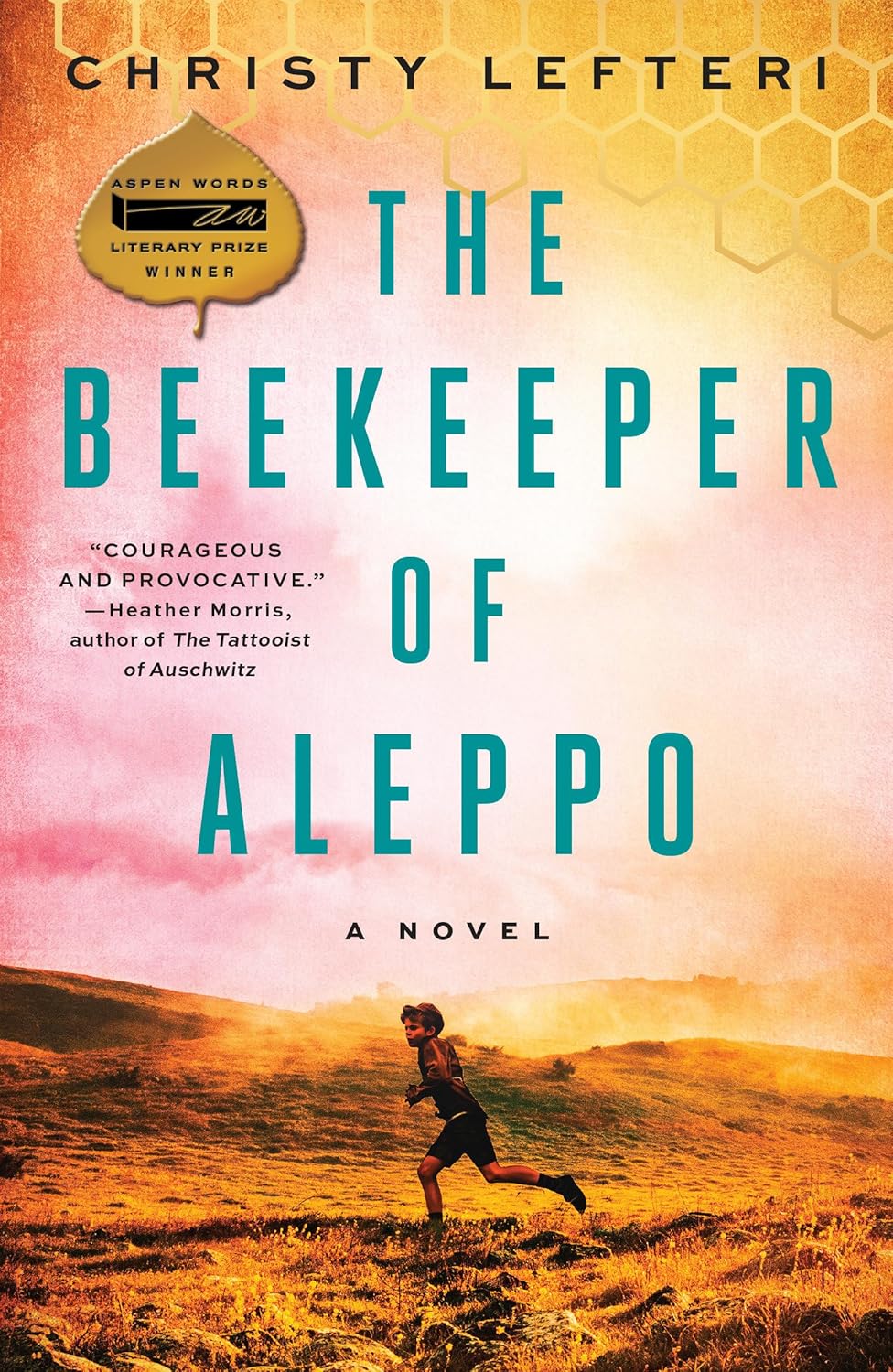
Description:
Review
“With the first sentence, we enter a world too visible for the protagonists who can’t, nevertheless, turn away. The Beekeeper of Aleppo demands that we contemplate the way we humans process the horror around us, the senseless violence, the loss of what we hold dearest.”—Esmeralda Santiago, Aspen Words Literary Prize head judge
“Beekeeper Nuri and his wife, Afra, are devastated by the Syrian civil war. After violence claims their child and Afra’s eyesight, the couple is forced to flee Aleppo and make the fraught journey to Britain—and an uncertain future.”—USA Today (5 Books Not to Miss)
“In recounting the daily brutality as well as the glimmers of beauty, this novel humanizes the terrifying refugee stories we read about in the news. Lefteri explores questions of trust and portrays what trauma and loss can do to individuals and their relationships. . . . A beautiful rumination on seeing what is right in front of us—both the negative and the positive.”—The Boston Globe (Pick of the Week)
“Great for book club . . . a powerful story about the refugee experience, hope, and love.”—Real Simple
“Nuri's story rings with authenticity, from the vast, impersonal cruelties of war to the tiny kindnesses that help people survive it. . . . A well-crafted structure and a troubled but engaging narrator power this moving story of Syrian refugees.”—Kirkus Reviews (starred review)
“A haunting and resonant story of Syrian war refugees undertaking a treacherous journey . . . Readers will find this deeply affecting for both its psychological intensity and emotional acuity.”—Publishers Weekly
“In fluid, forthright language, Lefteri brings us humbly closer to the refugee experience as beekeeper Nuri and his wife, an artist named Afra who has gone blind form the horrors she’s witnessed, escape Aleppo and travel dangerously to Great Britain. . . . There’s no overloading the deck with drama; this story tells itself, absorbingly and heartrendingly.” —Library Journal
About the Author
Excerpt. © Reprinted by permission. All rights reserved.
I am scared of my wife’s eyes. She can’t see out and no one can see in. Look, they are like stones, gray stones, sea stones. Look at her. Look how she is sitting on the edge of the bed, her nightgown on the floor, rolling Mohammed’s marble around in her fingers and waiting for me to dress her. I am taking my time putting on my shirt and trousers, because I am so tired of dressing her. Look at the folds of her stomach, the color of desert honey, darker in the creases, and the fine, fine silver lines on the skin of her breasts, and the tips of her fingers with the tiny cuts, where the ridges and valley patterns once were stained with blue or yellow or red paint. Her laughter was gold once, you would have seen as well as heard it. Look at her, because I think she is disappearing.
“I had a night of scattered dreams,” she says. “They filled the room.” Her eyes are fixed a little to the left of me. I feel sick.
“What does that mean?”
“They were broken. My dreams were everywhere. And I didn’t know if I was awake or asleep. There were so many dreams, like bees in a room, like the room was full of bees. And I couldn’t breathe. And I woke up and thought, please don’t let me be hungry.”
I look at her face, confused. There is still no expression. I don’t tell her that I dream only of murder now, always the same dream; it’s only me and the man, and I’m holding the bat and my hand is bleeding; the others aren’t there in the dream, and he is on the ground with the trees above him and he says something to me that I can’t hear.
“And I have pain,” she says.
“Where?”
“Behind my eyes. Really sharp pain.”
I kneel down in front of her and look into her eyes. The blank emptiness in them terrifies me. I take my phone out of my pocket, shine the light of the flashlight into them. Her pupils dilate.
“Do you see anything at all?” I say.
“No.”
“Not even a shadow, a change of tone or color?”
“Just black.”
I put the phone in my pocket and step away from her. She’s been worse since we got here. It’s like her soul is evaporating.
“Can you take me to the doctor?” she says. “Because the pain is unbearable.”
“Of course,” I say. “Soon.”
“When?”
“As soon as we get the papers.”
I’m glad Afra can’t see this place. She would like the seagulls though, the crazy way they fly. In Aleppo we were far from the sea. I’m sure she would like to see these birds and maybe even the coast, because she was raised by the sea. I am from eastern Aleppo, where the city meets the desert.
When we got married and she came to live with me, Afra missed the sea so much that she started to paint water, wherever she found it. Throughout the arid plateau region of Syria there are oases and streams and rivers that empty into swamps and small lakes. Before we had Sami, we would follow the water, and she would paint it in oils. There is one painting of the Queiq I wish I could see again. She made the river look like a storm-water drain running through the city park. Afra had this way of seeing truth in landscapes. The measly river in the painting reminded me of a struggle to stay alive. Thirty or so kilometers south of Aleppo, the river gives up the struggle of the harsh Syrian steppe and evaporates into the marshes.
I am scared of her eyes, but these damp walls, and the wires in the ceiling, and the billboards—I’m not sure how she would deal with all this, if she could see it. The billboard just outside says that there are too many of us, that this island will break under our weight. I’m glad she’s blind. I know what that sounds like! If I could give her a key that opened a door into another world, then I would wish for her to see again. But it would have to be a world very different from this one. A place where the sun is just rising, touching the walls around the ancient city and, outside those walls, the cell-like quarters and the houses and apartments and hotels and narrow alleys and open-air market where a thousand hanging necklaces shine with that first light, and, further away, across the desert land, gold on gold and red on red.
Sami would be there, smiling and running along those alleys with his scuffed sneakers, change in his hand, on his way to the store to get milk. I try not to think about Sami. But Mohammed? I’m still waiting for him to find the letter and money I left under the jar of Nutella. I think one morning there will be a knock at the door, and when I open it he will be standing there and I will say, “But how did you get all the way here, Mohammed? How did you know where to find us?”
Yesterday I saw a boy in the steamed-up mirror of the shared bathroom. He was wearing a black T-shirt, but when I turned around it was the man from Morocco, sitting on the toilet, pissing. “You should lock the door,” he said in his own Arabic.
I can’t remember his name, but I know that he is from a village near Taza, beneath the Rif mountains. He told me last night that they might send him to the detention center in a place called Yarl’s Wood—the social worker thinks there’s a chance they will. It’s my turn to meet her this afternoon. The Moroccan man says she’s very beautiful, that she looks like a dancer from Paris who he once made love to in a hotel in Rabat, long before he married his wife. He asked me about life in Syria. I told him about my beehives in Aleppo.
In the evenings the landlady brings us tea with milk. The Moroccan man is old, maybe eighty or even ninety. He looks and smells like he’s made of leather. He reads How to Be a Brit, and sometimes smirks to himself. He has his phone on his lap, and pauses at the end of each page to glance down at it, but no one ever calls. I don’t know who he’s waiting for and I don’t know how he got here and I don’t know why he has made such a journey so late in his life, because he seems like a man who is waiting to die. He hates the way the non-Muslim men stand up to piss.
There are about ten of us in this run-down B and B by the sea, all of us from different places, all of us waiting. They might keep us, they might send us away, but there is not much to decide anymore. Which road to take, whom to trust, whether to raise the bat again and kill a man. These things are in the past. They will evaporate soon, like the river.
I take Afra’s abaya from the hanger in the wardrobe. She hears it and stands, lifting her arms. She looks older now, but acts younger, like she has turned into a child. Her hair is the color and texture of sand since we dyed it for the photos, bleached out the Arabic. I tie it into a bun and wrap her hijab around her head, securing it with hairpins while she guides my fingers like she always does.
The social worker will be here at 1:00 p.m., and all meetings take place in the kitchen. She will want to know how we got here and she will be looking for a reason to send us away. But I know that if I say the right things, if I convince her that I’m not a killer, then we will get to stay here because we are the lucky ones, because we have come from the worst place in the world. The Moroccan man isn’t so lucky; he will have more to prove. He is sitting in the living room now by the glass doors, holding a bronze pocket watch in both of his hands, nestling it in his palms like it’s a hatching egg. He stares at it, waiting. What for? When he sees that I’m standing here, he says, “It doesn’t work, you know. It stopped in a different time.” He holds it up in the light by its chain and swings it, gently, this frozen watch made of
bronze
was the color of the city far below. We lived in a two-bedroom bungalow on a hill. From so high up we could see all the unorganized architecture and the beautiful domes and minarets, and far in the distance the citadel peeking through.
It was pleasant to sit on the veranda in the spring; we could smell the soil from the desert and see the red sun setting over the land. In the summer, though, we would be inside with a fan running and wet towels on our heads, and our feet in a bowl of cold water because the heat was an oven.
In July, the earth was parched, but in our garden we had apricot and almond trees and tulips and irises and fritillaries. When the river dried up, I would go down to the irrigation pond to collect water for the garden to keep it alive. By August, it was like trying to resuscitate a corpse, so I watched it all die and melt into the rest of the land. When it was cooler we would take a walk and watch the falcons flying across the sky to the desert.
I had four beehives in the garden, piled one on top of the other, but the rest were in a field on the outskirts of eastern Aleppo. I hated to be away from the bees. In the mornings, I would wake up early, before the sun, before the muezzin called out for prayer. I would drive the thirty miles to the apiaries and arrive as the sun was just rising, fields full of light, the humming of the bees a single pure note.
Details:
Visit the Ballantine Books Store
The Beekeeper of Aleppo: A Novel
AED6653
Quantity:
Order today to get by 7-14 business days
Delivery fee of AED 20. Free for orders above AED 200.
 Imported From: United States
At BOLO, we work hard to ensure the products you receive are new, genuine, and sourced from reputable suppliers.
Every product in the BOLO catalogue is sourced through our Verified Global Supply Network of verified sellers, authorized distributors or directly from the manufacturer.
Each product undergoes thorough inspection and verification at our consolidation and fulfilment centers to ensure it meets our strict authenticity and quality standards before being shipped and delivered to you.
If you ever have concerns regarding the authenticity of a product purchased from us, please contact Bolo Support. We will review your inquiry promptly and, if necessary, provide documentation verifying authenticity or offer a suitable resolution.
Your trust is our top priority, and we are committed to maintaining transparency and integrity in every transaction.
While we strive to display accurate information, variations in packaging, labeling, instructions, or formulation may occasionally occur due to regional differences or supplier updates. For detailed or manufacturer-specific information, please contact the brand directly or reach out to BOLO Support for assistance.
Unless otherwise stated, all prices displayed on the product page include applicable taxes and import duties.
BOLO operates in accordance with the laws and regulations of United Arab Emirates. Any items found to be restricted or prohibited for sale within the United Arab Emirates will be cancelled prior to shipment. We take proactive measures to ensure that only products permitted for sale in United Arab Emirates are listed on our website.
All items are shipped by air, and any products classified as “Dangerous Goods (DG)” under IATA regulations will be removed from the order and cancelled.
All orders are processed manually, and we make every effort to process them promptly once confirmed. Products cancelled due to the above reasons will be permanently removed from listings across the website.
More from this brand
Similar items from “Cultural Heritage”
Share with
Or share with link
https://www.bolo.ae/products/U0593128176
Visit the Ballantine Books Store
The Beekeeper of Aleppo: A Novel
AED6653
Quantity:
Order today to get by 7-14 business days
Delivery fee of AED 20. Free for orders above AED 200.
Imported From: United States
At BOLO, we work hard to ensure the products you receive are new, genuine, and sourced from reputable suppliers.
Every product in the BOLO catalogue is sourced through our Verified Global Supply Network of verified sellers, authorized distributors or directly from the manufacturer.
Each product undergoes thorough inspection and verification at our consolidation and fulfilment centers to ensure it meets our strict authenticity and quality standards before being shipped and delivered to you.
If you ever have concerns regarding the authenticity of a product purchased from us, please contact Bolo Support. We will review your inquiry promptly and, if necessary, provide documentation verifying authenticity or offer a suitable resolution.
Your trust is our top priority, and we are committed to maintaining transparency and integrity in every transaction.
While we strive to display accurate information, variations in packaging, labeling, instructions, or formulation may occasionally occur due to regional differences or supplier updates. For detailed or manufacturer-specific information, please contact the brand directly or reach out to BOLO Support for assistance.
Unless otherwise stated, all prices displayed on the product page include applicable taxes and import duties.
BOLO operates in accordance with the laws and regulations of United Arab Emirates. Any items found to be restricted or prohibited for sale within the United Arab Emirates will be cancelled prior to shipment. We take proactive measures to ensure that only products permitted for sale in United Arab Emirates are listed on our website.
All items are shipped by air, and any products classified as “Dangerous Goods (DG)” under IATA regulations will be removed from the order and cancelled.
All orders are processed manually, and we make every effort to process them promptly once confirmed. Products cancelled due to the above reasons will be permanently removed from listings across the website.
Description:
Review
“With the first sentence, we enter a world too visible for the protagonists who can’t, nevertheless, turn away. The Beekeeper of Aleppo demands that we contemplate the way we humans process the horror around us, the senseless violence, the loss of what we hold dearest.”—Esmeralda Santiago, Aspen Words Literary Prize head judge
“Beekeeper Nuri and his wife, Afra, are devastated by the Syrian civil war. After violence claims their child and Afra’s eyesight, the couple is forced to flee Aleppo and make the fraught journey to Britain—and an uncertain future.”—USA Today (5 Books Not to Miss)
“In recounting the daily brutality as well as the glimmers of beauty, this novel humanizes the terrifying refugee stories we read about in the news. Lefteri explores questions of trust and portrays what trauma and loss can do to individuals and their relationships. . . . A beautiful rumination on seeing what is right in front of us—both the negative and the positive.”—The Boston Globe (Pick of the Week)
“Great for book club . . . a powerful story about the refugee experience, hope, and love.”—Real Simple
“Nuri's story rings with authenticity, from the vast, impersonal cruelties of war to the tiny kindnesses that help people survive it. . . . A well-crafted structure and a troubled but engaging narrator power this moving story of Syrian refugees.”—Kirkus Reviews (starred review)
“A haunting and resonant story of Syrian war refugees undertaking a treacherous journey . . . Readers will find this deeply affecting for both its psychological intensity and emotional acuity.”—Publishers Weekly
“In fluid, forthright language, Lefteri brings us humbly closer to the refugee experience as beekeeper Nuri and his wife, an artist named Afra who has gone blind form the horrors she’s witnessed, escape Aleppo and travel dangerously to Great Britain. . . . There’s no overloading the deck with drama; this story tells itself, absorbingly and heartrendingly.” —Library Journal
About the Author
Excerpt. © Reprinted by permission. All rights reserved.
I am scared of my wife’s eyes. She can’t see out and no one can see in. Look, they are like stones, gray stones, sea stones. Look at her. Look how she is sitting on the edge of the bed, her nightgown on the floor, rolling Mohammed’s marble around in her fingers and waiting for me to dress her. I am taking my time putting on my shirt and trousers, because I am so tired of dressing her. Look at the folds of her stomach, the color of desert honey, darker in the creases, and the fine, fine silver lines on the skin of her breasts, and the tips of her fingers with the tiny cuts, where the ridges and valley patterns once were stained with blue or yellow or red paint. Her laughter was gold once, you would have seen as well as heard it. Look at her, because I think she is disappearing.
“I had a night of scattered dreams,” she says. “They filled the room.” Her eyes are fixed a little to the left of me. I feel sick.
“What does that mean?”
“They were broken. My dreams were everywhere. And I didn’t know if I was awake or asleep. There were so many dreams, like bees in a room, like the room was full of bees. And I couldn’t breathe. And I woke up and thought, please don’t let me be hungry.”
I look at her face, confused. There is still no expression. I don’t tell her that I dream only of murder now, always the same dream; it’s only me and the man, and I’m holding the bat and my hand is bleeding; the others aren’t there in the dream, and he is on the ground with the trees above him and he says something to me that I can’t hear.
“And I have pain,” she says.
“Where?”
“Behind my eyes. Really sharp pain.”
I kneel down in front of her and look into her eyes. The blank emptiness in them terrifies me. I take my phone out of my pocket, shine the light of the flashlight into them. Her pupils dilate.
“Do you see anything at all?” I say.
“No.”
“Not even a shadow, a change of tone or color?”
“Just black.”
I put the phone in my pocket and step away from her. She’s been worse since we got here. It’s like her soul is evaporating.
“Can you take me to the doctor?” she says. “Because the pain is unbearable.”
“Of course,” I say. “Soon.”
“When?”
“As soon as we get the papers.”
I’m glad Afra can’t see this place. She would like the seagulls though, the crazy way they fly. In Aleppo we were far from the sea. I’m sure she would like to see these birds and maybe even the coast, because she was raised by the sea. I am from eastern Aleppo, where the city meets the desert.
When we got married and she came to live with me, Afra missed the sea so much that she started to paint water, wherever she found it. Throughout the arid plateau region of Syria there are oases and streams and rivers that empty into swamps and small lakes. Before we had Sami, we would follow the water, and she would paint it in oils. There is one painting of the Queiq I wish I could see again. She made the river look like a storm-water drain running through the city park. Afra had this way of seeing truth in landscapes. The measly river in the painting reminded me of a struggle to stay alive. Thirty or so kilometers south of Aleppo, the river gives up the struggle of the harsh Syrian steppe and evaporates into the marshes.
I am scared of her eyes, but these damp walls, and the wires in the ceiling, and the billboards—I’m not sure how she would deal with all this, if she could see it. The billboard just outside says that there are too many of us, that this island will break under our weight. I’m glad she’s blind. I know what that sounds like! If I could give her a key that opened a door into another world, then I would wish for her to see again. But it would have to be a world very different from this one. A place where the sun is just rising, touching the walls around the ancient city and, outside those walls, the cell-like quarters and the houses and apartments and hotels and narrow alleys and open-air market where a thousand hanging necklaces shine with that first light, and, further away, across the desert land, gold on gold and red on red.
Sami would be there, smiling and running along those alleys with his scuffed sneakers, change in his hand, on his way to the store to get milk. I try not to think about Sami. But Mohammed? I’m still waiting for him to find the letter and money I left under the jar of Nutella. I think one morning there will be a knock at the door, and when I open it he will be standing there and I will say, “But how did you get all the way here, Mohammed? How did you know where to find us?”
Yesterday I saw a boy in the steamed-up mirror of the shared bathroom. He was wearing a black T-shirt, but when I turned around it was the man from Morocco, sitting on the toilet, pissing. “You should lock the door,” he said in his own Arabic.
I can’t remember his name, but I know that he is from a village near Taza, beneath the Rif mountains. He told me last night that they might send him to the detention center in a place called Yarl’s Wood—the social worker thinks there’s a chance they will. It’s my turn to meet her this afternoon. The Moroccan man says she’s very beautiful, that she looks like a dancer from Paris who he once made love to in a hotel in Rabat, long before he married his wife. He asked me about life in Syria. I told him about my beehives in Aleppo.
In the evenings the landlady brings us tea with milk. The Moroccan man is old, maybe eighty or even ninety. He looks and smells like he’s made of leather. He reads How to Be a Brit, and sometimes smirks to himself. He has his phone on his lap, and pauses at the end of each page to glance down at it, but no one ever calls. I don’t know who he’s waiting for and I don’t know how he got here and I don’t know why he has made such a journey so late in his life, because he seems like a man who is waiting to die. He hates the way the non-Muslim men stand up to piss.
There are about ten of us in this run-down B and B by the sea, all of us from different places, all of us waiting. They might keep us, they might send us away, but there is not much to decide anymore. Which road to take, whom to trust, whether to raise the bat again and kill a man. These things are in the past. They will evaporate soon, like the river.
I take Afra’s abaya from the hanger in the wardrobe. She hears it and stands, lifting her arms. She looks older now, but acts younger, like she has turned into a child. Her hair is the color and texture of sand since we dyed it for the photos, bleached out the Arabic. I tie it into a bun and wrap her hijab around her head, securing it with hairpins while she guides my fingers like she always does.
The social worker will be here at 1:00 p.m., and all meetings take place in the kitchen. She will want to know how we got here and she will be looking for a reason to send us away. But I know that if I say the right things, if I convince her that I’m not a killer, then we will get to stay here because we are the lucky ones, because we have come from the worst place in the world. The Moroccan man isn’t so lucky; he will have more to prove. He is sitting in the living room now by the glass doors, holding a bronze pocket watch in both of his hands, nestling it in his palms like it’s a hatching egg. He stares at it, waiting. What for? When he sees that I’m standing here, he says, “It doesn’t work, you know. It stopped in a different time.” He holds it up in the light by its chain and swings it, gently, this frozen watch made of
bronze
was the color of the city far below. We lived in a two-bedroom bungalow on a hill. From so high up we could see all the unorganized architecture and the beautiful domes and minarets, and far in the distance the citadel peeking through.
It was pleasant to sit on the veranda in the spring; we could smell the soil from the desert and see the red sun setting over the land. In the summer, though, we would be inside with a fan running and wet towels on our heads, and our feet in a bowl of cold water because the heat was an oven.
In July, the earth was parched, but in our garden we had apricot and almond trees and tulips and irises and fritillaries. When the river dried up, I would go down to the irrigation pond to collect water for the garden to keep it alive. By August, it was like trying to resuscitate a corpse, so I watched it all die and melt into the rest of the land. When it was cooler we would take a walk and watch the falcons flying across the sky to the desert.
I had four beehives in the garden, piled one on top of the other, but the rest were in a field on the outskirts of eastern Aleppo. I hated to be away from the bees. In the mornings, I would wake up early, before the sun, before the muezzin called out for prayer. I would drive the thirty miles to the apiaries and arrive as the sun was just rising, fields full of light, the humming of the bees a single pure note.
Details:
More from this brand
Similar items from “Cultural Heritage”
Share with
Or share with link
https://www.bolo.ae/products/U0593128176