Deliver toUnited Arab Emirates
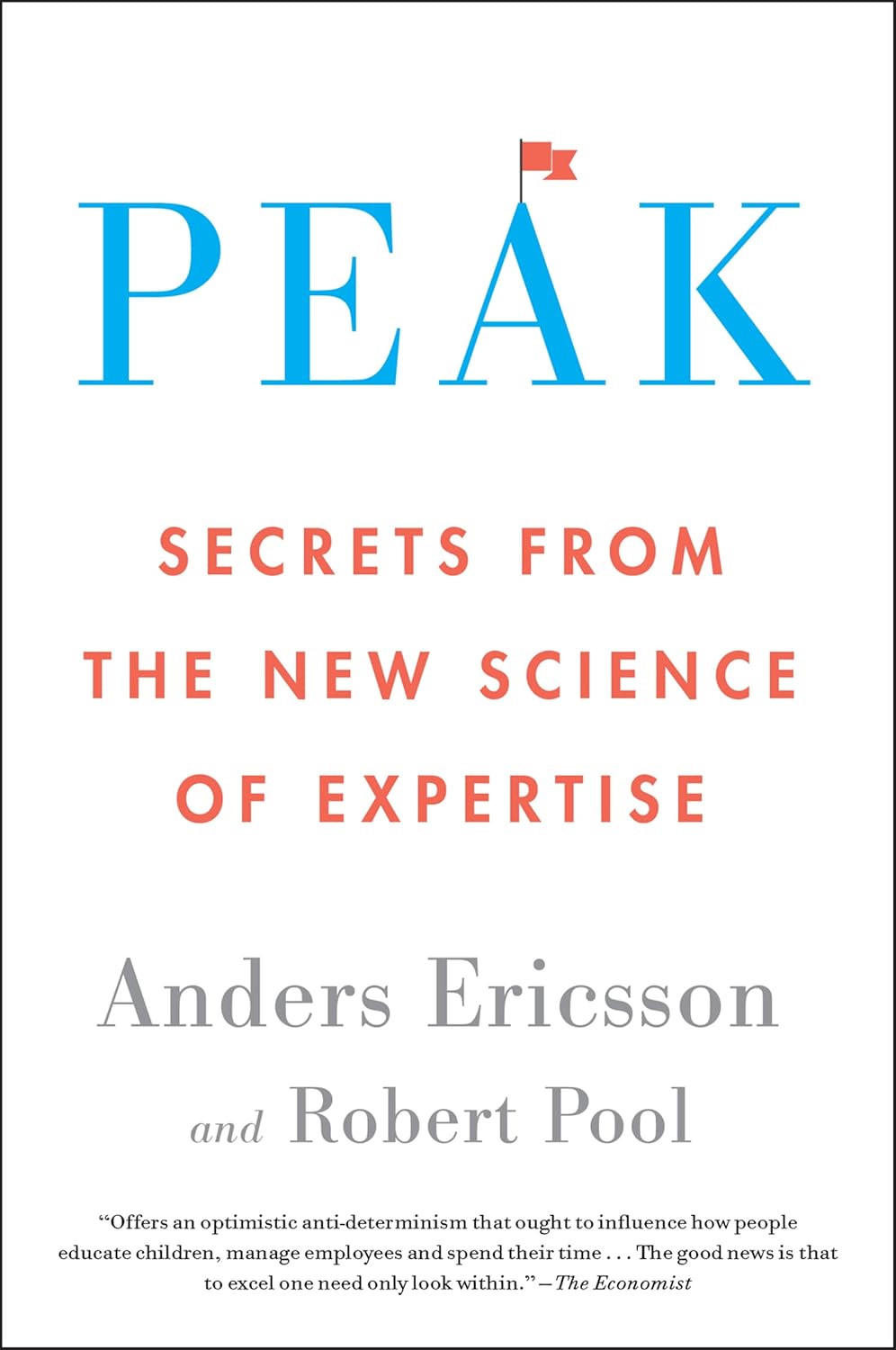
Peak: Secrets from the New Science of Expertise

Description:

“This book is a breakthrough, a lyrical, powerful, science-based narrative that actually shows us how to get better (much better) at the things we care about.”—Seth Godin, author of Linchpin

“Anyone who wants to get better at anything should read [
Peak]. Rest assured that the book is not mere theory. Ericsson’s research focuses on the real world, and he explains in detail, with examples, how all of us can apply the principles of great performance in our work or in any other part of our lives.”—Fortune

Anders Ericsson has made a career studying chess champions, violin virtuosos, star athletes, and memory mavens.
Peak distills three decades of myth-shattering research into a powerful learning strategy that is fundamentally different from the way people traditionally think about acquiring new abilities. Whether you want to stand out at work, improve your athletic or musical performance, or help your child achieve academic goals, Ericsson’s revolutionary methods will show you how to improve at almost any skill that matters to you.
 
“The science of excellence can be divided into two eras: before Ericsson and after Ericsson. His groundbreaking work, captured in this brilliantly useful book, provides us with a blueprint for achieving the most important and life-changing work possible: to become a little bit better each day.”—Dan Coyle, author of The Talent Code
 

“Ericsson’s research has revolutionized how we think about human achievement. If everyone would take the lessons of this book to heart, it could truly change the world.”—Joshua Foer, author of Moonwalking with Einstein


Editorial Reviews

Review

 “This book is a breakthrough, a lyrical, powerful, science-based narrative that actually shows us how to get better (much better) at the things we care about.” —Seth Godin, author of Linchpin   “Most ‘important’ books aren’t much fun to read. Most fun books aren’t very important. But with Peak, Anders Ericsson (with great work from Robert Pool) has hit the daily double. After all, who among us doesn’t want to learn how to get better at life? A remarkable distillation of a remarkable lifetime of work.” —Stephen J. Dubner, coauthor of Freakonomics and Superfreakonomics   “Ericsson’s research has revolutionized how we think about human achievement. He has found that what separates the best of us from the rest is not innate talent but simply the right kind of training and practice. If everyone would take the lessons of this book to heart, it could truly change the world.” —Joshua Foer, author of Moonwalking with Einstein   “The science of excellence can be divided into two eras: before Ericsson and after Ericsson. His groundbreaking work, captured in this brilliantly useful book, provides us with a blueprint for achieving the most important and life-changing work possible: to become a little bit better each day.” —Dan Coyle, author of The Talent Code   “Wonderful. I can’t think of a better book for a popular audience written on any topic in psychology.” —Daniel Willigham, professor of psychology at the University of Virginia and author of Why Don’t Students Like School? “[Peak] offers an optimistic anti-determinism that ought to influence how people educate children, manage employees, and spend their time. The good news is that to excel one need only look within.” – The Economist “All good leaders want to get better, and anyone who wants to get better at anything should read [Peak]. Rest assured that the book is not mere theory. Ericsson’s research focuses on the real world, and he explains in detail, with examples, how all of us can apply the principles of great performance in our work or in any other part of our lives.” – Fortune “This is an empowering, encouraging work that will challenge readers to reach for excellence.” —Publishers Weekly   “[Ericsson] makes a strong case that success in today’s world requires a focus on practical performance, not just the accumulation of information. Especially informative for parents and educators in preparing children for the challenges ahead.” —Kirkus Reviews   —

About the Author

K. ANDERS ERICSSON, PhD, is Conradi Eminent Scholar and professor of psychology at Florida State University. He studies expert performance in domains such as music, chess, medicine, and sports. His groundbreaking work has been cited in bestsellers from Moonwalking with Einstein to Outliers to How Children Succeed. He lives in Florida.

ROBERT POOL, PhD, is a science writer living and working in Tallahassee, Florida. He has worked at some of the world’s most prestigious science publications, including
Science and Nature, and his work has appeared in many others, including Discover and Technology Review. He has written three books, including Eve’s Rib: Searching for the Biological Roots of Sex Differences and Beyond Engineering: How Society Shapes Technology.    

Reviews:

5.0 out of 5 stars Get the Full Story of Ericsson's Research from Ericsson Himself

W.B. · October 19, 2016

Let’s cut right to the chase on this one. If you’ve read anything about Ericsson’s work, especially the concept of “deliberate practice,” and you want to understand it, you should buy and read Peak: Secrets from the New Science of Expertise at least a couple of times.The fact is that most of the stuff out there about Ericsson’s work is incomplete and imprecise. I think we have Ericsson to blame for most of that.Most commentators have based their understanding and perceptions on Ericsson’s interviews and academic writing. Those were sometimes works in progress and sometimes incomplete, but this book is different. This time, Ericsson used a professional writer, Robert Pool. I’m biased, of course, since I do the same kind of work that Pool does, but I think his participation in the book makes the book more comprehensive, more coherent, and more understandable.The book begins with a review of things we’ve been learning from psychologists for the last 20 years or so. It’s all about how the brain isn’t a fixed thing but is very plastic and changes based on experience. Ericsson outlines his part in some of the research that’s led us to the “plasticity” conclusion.The message is clear. Despite what you may have learned growing up (as I did), abilities and talents are not generally fixed at birth. We can improve our performance in almost any area if we work at it. But wait, there’s more.It’s not enough to just work at it. Simply practicing your golf swing over and over will not make you a better golfer. There are specific ways to improve, and Ericsson presents us with two of them.“Purposeful practice” is the first one. That’s a term you may not have become familiar with from other people’s writings about Ericsson’s work. Ericsson sums up purposeful practice this way.“So, here we have purposeful practice in a nutshell: get outside your comfort zone but do it in a focused way, with clear goals, a plan for reaching those goals, and a way to monitor your progress. Oh, and figure out a way to maintain your motivation.”Deliberate practice is a subset of purposeful practice. Deliberate practice requires two things. First, it must be part of a field in which excellent performance has been observed and delineated and, second, there must be teachers who can provide practice activities designed to help the student improve performance. That’s a fairly limited range of domains.Ericsson is very clear that you can only do true deliberate practice in a few fields. He’s talking about musical performance, chess, dance, gymnastics and other similar domains. In other words, if you’re in those domains get an expert teacher and don’t try this at home. What if you’re not, though?Don’t despair. If you’re a manager or a practitioner of some other kind of field and you’d like to get better with some kind of purposeful practice, this book has a lot of guidance about how to do it well. I’ll speak about business managers because that’s the group that I write for.Let’s say that you’re a business manager and you want to get really good at what you do. Ericsson says you should start with good “mental representations.” Mental representations are a key to getting things right if you’re not in a field where you can do deliberate practice. Here’s how it works.In the beginning, you need to learn what effective work looks like. That matches what I’ve found in research into great bosses. Most of them had a boss early in their career who was an excellent role model. In other words, they could see from their first boss or two what good work looked like.It helps if you get regular feedback from people who know more than you do about the craft. That’s one reason I encourage companies and managers to create peer support groups. Once the role models and feedback have given you a good idea of what good performance is, you can set up systems where you give yourself feedback.Again, my own experience supports Ericsson’s assertions. In training, we would first have people develop an idea of what being a good boss looks like based on their personal experience of working for one. For the rest of the time we had together, we would keep referring back to that model. As we came to the end of the training, we would talk about what Ericsson would call “purposeful practice.” We’d discuss how you can grade your own performance.That’s necessary because a manager’s most important work doesn’t have immediate feedback. The results show up down the road. So you have to have your own, more timely, feedback based on your mental model of great performance.Bottom LineMany writers have attempted to explain the implications of Anders Ericsson’s concept of deliberate practice. In Peak: Secrets from the New Science of Expertise you’ll learn that deliberate practice is a subset of purposeful practice. You learn that true deliberate practice is limited to a very specific list of disciplines. Most important, you also learn how you can apply the principles of purposeful practice to just about any domain where you want to improve your performance. This book is worth buying and reading, more than once, as you apply the lessons of purposeful practice to your own life, work, and career.

5.0 out of 5 stars This is the best book I've read in a really long time...

O.R. · December 3, 2016

This is the best book I've read in a really long time..I'm a big fan of "self improvement" books and it's so rare these days to find a genuine, original work with breakthrough ideas that are actually backed up by real academic research. The data and research described in this book are really fresh, some of it from mid 2015.The findings in this book about learning, practicing, studying a new skill - are so powerful that I honestly think this is the type of books that can really change the course of one's life, if you choose to act on the wisdom and lessons of this book.First this book destroys the false belief that we all have natural talent for some skills (like playing music) and we DON'T have natural talent for others like sing or dance. The author brings strong and convincing data to proof that this "natural talent" just a myth and nothing more.Yes, if you take 50 people and teach them a new skill, like playing the piano, after the first 100 hours, some of them will do better than others - that's the main reason why we all think there is such a thing as "natural talent" or "gift". However, it turns out that once each person can pass the "beginner" phase if he will practice enough, and even if it takes you twice as many hours as the guy next to you, once you pass that first phase and aim to be at the top, or one of the best in that skill - it's all about practicing and working hard, really hard, "natural talent" has nothing to do with it.I really liked chapters (5) and (6) which describe in detail how one should practice when he\she wants to learn a new skill, or to improve a specific skill one is already familiar with. Let's say you have 8 hours a week to work on a certain skill, it turns out that there are a few principles which together are called "deliberate practice" and if you'll follow them, the effectiveness of your practice will be so much more than just practicing without giving these principles any thought.Having a coach is extremely important when learning a new skill. after reading this book you'll be convinced too. Also it's important to make sure you give your full attention when you practice and not think about other, not related, things. You need to give your full effort during practice.Many people think that if they just repeat what they do and know, it's called practice. The best example in the book is with doctors who think they have "20 years of practice in field X", which is actually just repeating for 20 years the same steps over and over again, without learning anything new, without improving the weak points, without getting any feedback from some expert who watch the doctor act. It turns out that just repeating will actually make the skill go backwards, not forward, thus studies have shown that younger doctors just out of school usually perform better, because they have the knowledge from school fresh.Every chapter in this book is mind opening, surprising, full with interesting real life stories, examples and anecdotes. I learned so much from this book and enjoyed every moment of it. Even more important, the author convinced me that at the age of 32 I can learn and be really good at almost any skill I choose, even if I never done it before. The author wants to break the myth that if you didn't do X while you were a child, it means that you can't do it, or that it's too late. I really believe I can learn how to cook, swim, play tennis, maybe even sing, and I plan to ACTUALLY do it.I want to take the opportunity to say thank you for the authors of this book who have done an amazing amazing work.

Bastante obvio.. pero muy bueno para recordar y profundizar.

A.M.L. · September 9, 2018

Existe la falsa creencia generalizada de que los que llegan a dominar una materia, o llegan a ser grandes expertos en algo tienen un don para ese algo. Gran error pensar asi. Esa manera de pensar invita a uno/a a autodescartarse para perseguir el sueño de ser muy bueno en algo que a uno le apasiona. Vemos Everests inalcanzables, donde si son alcanzables. El profesor Anders Ericson, después de muchos estudios y analisis, explica, con muy buenos ejemplos, algo que para mi es obico, pero que me ha ido bien recordar, profundizar y entener mejor: que a la maestría en cualquier disciplina se llega, no solo después de muchas horas de práctica, sino de un entrenamiento enfocado a resultados. Entre otras cosas mas que no puedo resumir aqui... Super interesante, esperanzador y motivador. En definitiva.. y esto ya es cosecha mia propia: En youtube hay tutoriales gratis para aprender casi de todo. ¿ En que queremos ser expertos?.. Solo es cuestión de tener esto claro y, luego, de una manera inteligente, ponerle muchas horas de pasión y dedicación a la matería. RECOMENDABLE. MOTIVA A PERSEGUIR TUS SUEÑOS.

Really amazing book with lots of very useful tips

Z. · January 27, 2020

It actually helped me to understand why my German language group courses haven't been producing much results and why I need to go for one-on-one courses instead.

A game changer

M.B. · July 5, 2017

This is probably the second-best book I have ever read in this genre (the best is, and probably always will be, 'Getting Things Done' by David Allen).Why did I love it? Because I read a LOT of books of this kind (self-help, psychology, business, etc.) and while lots of others provide good ideas or insights, this book provides a completely new way of looking at the world. That's why it's a game changer for me. From the way I am learning to dance to the way I work at my desk, the principles highlighted in this book are relevant and applicable. They say there are two tests for a good book: 1. Will I remember it in a month? and 2. Does it change the way I think about the world? This book is a resounding yes.

Muy bueno

J.P.A. · August 29, 2022

Se exponen casos de éxito desde distintos escenarios y queda muy clara la recomendación de lo necesario para convertirse en experto

PeaKED

P. · August 25, 2021

Uma jóia. Cheio de de informações bem fundamentadas em pesquisas. E o mais legal, aplicável !

Peak: Secrets from the New Science of Expertise

Product ID: U0544947223
Condition: New

4.6

AED7935

Price includes VAT & Import Duties
Type: Paperback
Availability: In Stock

Quantity:

|

Order today to get by 7-14 business days

Delivery fee of AED 20. Free for orders above AED 200.

Returns & Warranty policies

Imported From: United States

At BOLO, we work hard to ensure the products you receive are new, genuine, and sourced from reputable suppliers.

BOLO is not an authorized or official retailer for most brands, nor are we affiliated with manufacturers unless specifically stated on a product page. Instead, we source verified sellers, authorized distributors or directly from the manufacturer.

Each product undergoes thorough inspection and verification at our consolidation and fulfilment centers to ensure it meets our strict authenticity and quality standards before being shipped and delivered to you.

If you ever have concerns regarding the authenticity of a product purchased from us, please contact Bolo Support. We will review your inquiry promptly and, if necessary, provide documentation verifying authenticity or offer a suitable resolution.

Your trust is our top priority, and we are committed to maintaining transparency and integrity in every transaction.

All product information, images, descriptions, and reviews originate from the manufacturer or from trusted sellers overseas. BOLO is not affiliated with, endorsed by, or an authorized retailer for most brands listed on our website unless stated otherwise.

While we strive to display accurate information, variations in packaging, labeling, instructions, or formulation may occasionally occur due to regional differences or supplier updates. For detailed or manufacturer-specific information, please contact the brand directly or reach out to BOLO Support for assistance.

Unless otherwise stated, all prices displayed on the product page include applicable taxes and import duties.

BOLO operates in accordance with the laws and regulations of United Arab Emirates. Any items found to be restricted or prohibited for sale within the UAE will be cancelled prior to shipment. We take proactive measures to ensure that only products permitted for sale in United Arab Emirates are listed on our website.

All items are shipped by air, and any products classified as “Dangerous Goods (DG)” under IATA regulations will be removed from the order and cancelled.

All orders are processed manually, and we make every effort to process them promptly once confirmed. Products cancelled due to the above reasons will be permanently removed from listings across the website.

Similar suggestions by Bolo

More from this brand

Similar items from “Guides”

Peak: Secrets from the New Science of Expertise

Product ID: U0544947223
Condition: New

4.6

Peak: Secrets from the New Science of Expertise-0
Type: Paperback

AED7935

Price includes VAT & Import Duties
Availability: In Stock

Quantity:

|

Order today to get by 7-14 business days

Delivery fee of AED 20. Free for orders above AED 200.

Returns & Warranty policies

Imported From: United States

At BOLO, we work hard to ensure the products you receive are new, genuine, and sourced from reputable suppliers.

BOLO is not an authorized or official retailer for most brands, nor are we affiliated with manufacturers unless specifically stated on a product page. Instead, we source verified sellers, authorized distributors or directly from the manufacturer.

Each product undergoes thorough inspection and verification at our consolidation and fulfilment centers to ensure it meets our strict authenticity and quality standards before being shipped and delivered to you.

If you ever have concerns regarding the authenticity of a product purchased from us, please contact Bolo Support. We will review your inquiry promptly and, if necessary, provide documentation verifying authenticity or offer a suitable resolution.

Your trust is our top priority, and we are committed to maintaining transparency and integrity in every transaction.

All product information, images, descriptions, and reviews originate from the manufacturer or from trusted sellers overseas. BOLO is not affiliated with, endorsed by, or an authorized retailer for most brands listed on our website unless stated otherwise.

While we strive to display accurate information, variations in packaging, labeling, instructions, or formulation may occasionally occur due to regional differences or supplier updates. For detailed or manufacturer-specific information, please contact the brand directly or reach out to BOLO Support for assistance.

Unless otherwise stated, all prices displayed on the product page include applicable taxes and import duties.

BOLO operates in accordance with the laws and regulations of United Arab Emirates. Any items found to be restricted or prohibited for sale within the UAE will be cancelled prior to shipment. We take proactive measures to ensure that only products permitted for sale in United Arab Emirates are listed on our website.

All items are shipped by air, and any products classified as “Dangerous Goods (DG)” under IATA regulations will be removed from the order and cancelled.

All orders are processed manually, and we make every effort to process them promptly once confirmed. Products cancelled due to the above reasons will be permanently removed from listings across the website.

Description:

“This book is a breakthrough, a lyrical, powerful, science-based narrative that actually shows us how to get better (much better) at the things we care about.”—Seth Godin, author of Linchpin

“Anyone who wants to get better at anything should read [
Peak]. Rest assured that the book is not mere theory. Ericsson’s research focuses on the real world, and he explains in detail, with examples, how all of us can apply the principles of great performance in our work or in any other part of our lives.”—Fortune

Anders Ericsson has made a career studying chess champions, violin virtuosos, star athletes, and memory mavens.
Peak distills three decades of myth-shattering research into a powerful learning strategy that is fundamentally different from the way people traditionally think about acquiring new abilities. Whether you want to stand out at work, improve your athletic or musical performance, or help your child achieve academic goals, Ericsson’s revolutionary methods will show you how to improve at almost any skill that matters to you.
 
“The science of excellence can be divided into two eras: before Ericsson and after Ericsson. His groundbreaking work, captured in this brilliantly useful book, provides us with a blueprint for achieving the most important and life-changing work possible: to become a little bit better each day.”—Dan Coyle, author of The Talent Code
 

“Ericsson’s research has revolutionized how we think about human achievement. If everyone would take the lessons of this book to heart, it could truly change the world.”—Joshua Foer, author of Moonwalking with Einstein


Editorial Reviews

Review

 “This book is a breakthrough, a lyrical, powerful, science-based narrative that actually shows us how to get better (much better) at the things we care about.” —Seth Godin, author of Linchpin   “Most ‘important’ books aren’t much fun to read. Most fun books aren’t very important. But with Peak, Anders Ericsson (with great work from Robert Pool) has hit the daily double. After all, who among us doesn’t want to learn how to get better at life? A remarkable distillation of a remarkable lifetime of work.” —Stephen J. Dubner, coauthor of Freakonomics and Superfreakonomics   “Ericsson’s research has revolutionized how we think about human achievement. He has found that what separates the best of us from the rest is not innate talent but simply the right kind of training and practice. If everyone would take the lessons of this book to heart, it could truly change the world.” —Joshua Foer, author of Moonwalking with Einstein   “The science of excellence can be divided into two eras: before Ericsson and after Ericsson. His groundbreaking work, captured in this brilliantly useful book, provides us with a blueprint for achieving the most important and life-changing work possible: to become a little bit better each day.” —Dan Coyle, author of The Talent Code   “Wonderful. I can’t think of a better book for a popular audience written on any topic in psychology.” —Daniel Willigham, professor of psychology at the University of Virginia and author of Why Don’t Students Like School? “[Peak] offers an optimistic anti-determinism that ought to influence how people educate children, manage employees, and spend their time. The good news is that to excel one need only look within.” – The Economist “All good leaders want to get better, and anyone who wants to get better at anything should read [Peak]. Rest assured that the book is not mere theory. Ericsson’s research focuses on the real world, and he explains in detail, with examples, how all of us can apply the principles of great performance in our work or in any other part of our lives.” – Fortune “This is an empowering, encouraging work that will challenge readers to reach for excellence.” —Publishers Weekly   “[Ericsson] makes a strong case that success in today’s world requires a focus on practical performance, not just the accumulation of information. Especially informative for parents and educators in preparing children for the challenges ahead.” —Kirkus Reviews   —

About the Author

K. ANDERS ERICSSON, PhD, is Conradi Eminent Scholar and professor of psychology at Florida State University. He studies expert performance in domains such as music, chess, medicine, and sports. His groundbreaking work has been cited in bestsellers from Moonwalking with Einstein to Outliers to How Children Succeed. He lives in Florida.

ROBERT POOL, PhD, is a science writer living and working in Tallahassee, Florida. He has worked at some of the world’s most prestigious science publications, including
Science and Nature, and his work has appeared in many others, including Discover and Technology Review. He has written three books, including Eve’s Rib: Searching for the Biological Roots of Sex Differences and Beyond Engineering: How Society Shapes Technology.    

Reviews:

5.0 out of 5 stars Get the Full Story of Ericsson's Research from Ericsson Himself

W.B. · October 19, 2016

Let’s cut right to the chase on this one. If you’ve read anything about Ericsson’s work, especially the concept of “deliberate practice,” and you want to understand it, you should buy and read Peak: Secrets from the New Science of Expertise at least a couple of times.The fact is that most of the stuff out there about Ericsson’s work is incomplete and imprecise. I think we have Ericsson to blame for most of that.Most commentators have based their understanding and perceptions on Ericsson’s interviews and academic writing. Those were sometimes works in progress and sometimes incomplete, but this book is different. This time, Ericsson used a professional writer, Robert Pool. I’m biased, of course, since I do the same kind of work that Pool does, but I think his participation in the book makes the book more comprehensive, more coherent, and more understandable.The book begins with a review of things we’ve been learning from psychologists for the last 20 years or so. It’s all about how the brain isn’t a fixed thing but is very plastic and changes based on experience. Ericsson outlines his part in some of the research that’s led us to the “plasticity” conclusion.The message is clear. Despite what you may have learned growing up (as I did), abilities and talents are not generally fixed at birth. We can improve our performance in almost any area if we work at it. But wait, there’s more.It’s not enough to just work at it. Simply practicing your golf swing over and over will not make you a better golfer. There are specific ways to improve, and Ericsson presents us with two of them.“Purposeful practice” is the first one. That’s a term you may not have become familiar with from other people’s writings about Ericsson’s work. Ericsson sums up purposeful practice this way.“So, here we have purposeful practice in a nutshell: get outside your comfort zone but do it in a focused way, with clear goals, a plan for reaching those goals, and a way to monitor your progress. Oh, and figure out a way to maintain your motivation.”Deliberate practice is a subset of purposeful practice. Deliberate practice requires two things. First, it must be part of a field in which excellent performance has been observed and delineated and, second, there must be teachers who can provide practice activities designed to help the student improve performance. That’s a fairly limited range of domains.Ericsson is very clear that you can only do true deliberate practice in a few fields. He’s talking about musical performance, chess, dance, gymnastics and other similar domains. In other words, if you’re in those domains get an expert teacher and don’t try this at home. What if you’re not, though?Don’t despair. If you’re a manager or a practitioner of some other kind of field and you’d like to get better with some kind of purposeful practice, this book has a lot of guidance about how to do it well. I’ll speak about business managers because that’s the group that I write for.Let’s say that you’re a business manager and you want to get really good at what you do. Ericsson says you should start with good “mental representations.” Mental representations are a key to getting things right if you’re not in a field where you can do deliberate practice. Here’s how it works.In the beginning, you need to learn what effective work looks like. That matches what I’ve found in research into great bosses. Most of them had a boss early in their career who was an excellent role model. In other words, they could see from their first boss or two what good work looked like.It helps if you get regular feedback from people who know more than you do about the craft. That’s one reason I encourage companies and managers to create peer support groups. Once the role models and feedback have given you a good idea of what good performance is, you can set up systems where you give yourself feedback.Again, my own experience supports Ericsson’s assertions. In training, we would first have people develop an idea of what being a good boss looks like based on their personal experience of working for one. For the rest of the time we had together, we would keep referring back to that model. As we came to the end of the training, we would talk about what Ericsson would call “purposeful practice.” We’d discuss how you can grade your own performance.That’s necessary because a manager’s most important work doesn’t have immediate feedback. The results show up down the road. So you have to have your own, more timely, feedback based on your mental model of great performance.Bottom LineMany writers have attempted to explain the implications of Anders Ericsson’s concept of deliberate practice. In Peak: Secrets from the New Science of Expertise you’ll learn that deliberate practice is a subset of purposeful practice. You learn that true deliberate practice is limited to a very specific list of disciplines. Most important, you also learn how you can apply the principles of purposeful practice to just about any domain where you want to improve your performance. This book is worth buying and reading, more than once, as you apply the lessons of purposeful practice to your own life, work, and career.

5.0 out of 5 stars This is the best book I've read in a really long time...

O.R. · December 3, 2016

This is the best book I've read in a really long time..I'm a big fan of "self improvement" books and it's so rare these days to find a genuine, original work with breakthrough ideas that are actually backed up by real academic research. The data and research described in this book are really fresh, some of it from mid 2015.The findings in this book about learning, practicing, studying a new skill - are so powerful that I honestly think this is the type of books that can really change the course of one's life, if you choose to act on the wisdom and lessons of this book.First this book destroys the false belief that we all have natural talent for some skills (like playing music) and we DON'T have natural talent for others like sing or dance. The author brings strong and convincing data to proof that this "natural talent" just a myth and nothing more.Yes, if you take 50 people and teach them a new skill, like playing the piano, after the first 100 hours, some of them will do better than others - that's the main reason why we all think there is such a thing as "natural talent" or "gift". However, it turns out that once each person can pass the "beginner" phase if he will practice enough, and even if it takes you twice as many hours as the guy next to you, once you pass that first phase and aim to be at the top, or one of the best in that skill - it's all about practicing and working hard, really hard, "natural talent" has nothing to do with it.I really liked chapters (5) and (6) which describe in detail how one should practice when he\she wants to learn a new skill, or to improve a specific skill one is already familiar with. Let's say you have 8 hours a week to work on a certain skill, it turns out that there are a few principles which together are called "deliberate practice" and if you'll follow them, the effectiveness of your practice will be so much more than just practicing without giving these principles any thought.Having a coach is extremely important when learning a new skill. after reading this book you'll be convinced too. Also it's important to make sure you give your full attention when you practice and not think about other, not related, things. You need to give your full effort during practice.Many people think that if they just repeat what they do and know, it's called practice. The best example in the book is with doctors who think they have "20 years of practice in field X", which is actually just repeating for 20 years the same steps over and over again, without learning anything new, without improving the weak points, without getting any feedback from some expert who watch the doctor act. It turns out that just repeating will actually make the skill go backwards, not forward, thus studies have shown that younger doctors just out of school usually perform better, because they have the knowledge from school fresh.Every chapter in this book is mind opening, surprising, full with interesting real life stories, examples and anecdotes. I learned so much from this book and enjoyed every moment of it. Even more important, the author convinced me that at the age of 32 I can learn and be really good at almost any skill I choose, even if I never done it before. The author wants to break the myth that if you didn't do X while you were a child, it means that you can't do it, or that it's too late. I really believe I can learn how to cook, swim, play tennis, maybe even sing, and I plan to ACTUALLY do it.I want to take the opportunity to say thank you for the authors of this book who have done an amazing amazing work.

Bastante obvio.. pero muy bueno para recordar y profundizar.

A.M.L. · September 9, 2018

Existe la falsa creencia generalizada de que los que llegan a dominar una materia, o llegan a ser grandes expertos en algo tienen un don para ese algo. Gran error pensar asi. Esa manera de pensar invita a uno/a a autodescartarse para perseguir el sueño de ser muy bueno en algo que a uno le apasiona. Vemos Everests inalcanzables, donde si son alcanzables. El profesor Anders Ericson, después de muchos estudios y analisis, explica, con muy buenos ejemplos, algo que para mi es obico, pero que me ha ido bien recordar, profundizar y entener mejor: que a la maestría en cualquier disciplina se llega, no solo después de muchas horas de práctica, sino de un entrenamiento enfocado a resultados. Entre otras cosas mas que no puedo resumir aqui... Super interesante, esperanzador y motivador. En definitiva.. y esto ya es cosecha mia propia: En youtube hay tutoriales gratis para aprender casi de todo. ¿ En que queremos ser expertos?.. Solo es cuestión de tener esto claro y, luego, de una manera inteligente, ponerle muchas horas de pasión y dedicación a la matería. RECOMENDABLE. MOTIVA A PERSEGUIR TUS SUEÑOS.

Really amazing book with lots of very useful tips

Z. · January 27, 2020

It actually helped me to understand why my German language group courses haven't been producing much results and why I need to go for one-on-one courses instead.

A game changer

M.B. · July 5, 2017

This is probably the second-best book I have ever read in this genre (the best is, and probably always will be, 'Getting Things Done' by David Allen).Why did I love it? Because I read a LOT of books of this kind (self-help, psychology, business, etc.) and while lots of others provide good ideas or insights, this book provides a completely new way of looking at the world. That's why it's a game changer for me. From the way I am learning to dance to the way I work at my desk, the principles highlighted in this book are relevant and applicable. They say there are two tests for a good book: 1. Will I remember it in a month? and 2. Does it change the way I think about the world? This book is a resounding yes.

Muy bueno

J.P.A. · August 29, 2022

Se exponen casos de éxito desde distintos escenarios y queda muy clara la recomendación de lo necesario para convertirse en experto

PeaKED

P. · August 25, 2021

Uma jóia. Cheio de de informações bem fundamentadas em pesquisas. E o mais legal, aplicável !

Similar suggestions by Bolo

More from this brand

Similar items from “Guides”