Deliver toUnited Arab Emirates
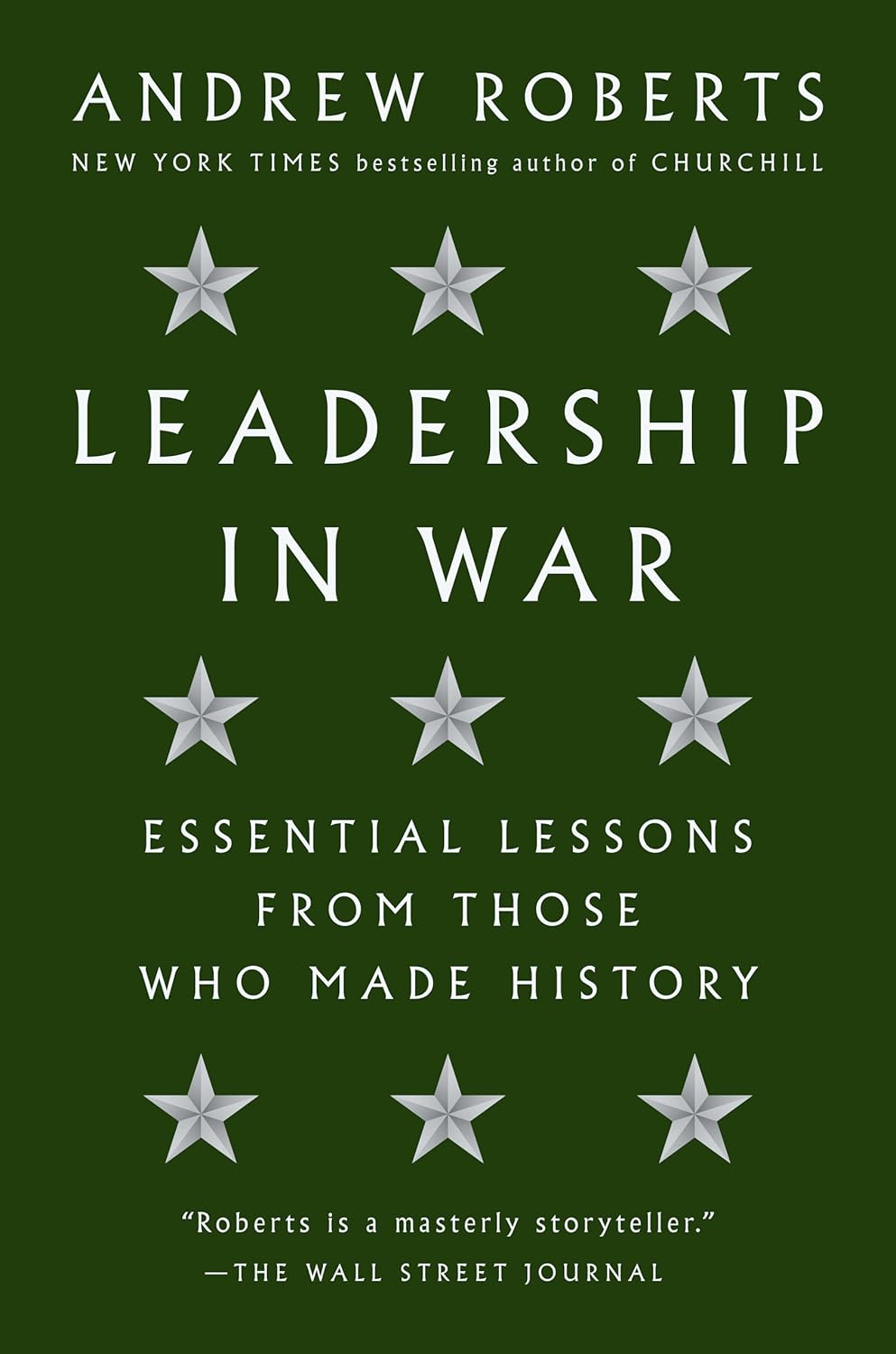
Leadership in War: Essential Lessons from Those Who Made History

Description:

A comparison of nine leaders who led their nations through the greatest wars the world has ever seen and whose unique strengths—and weaknesses—shaped the course of human history, from the bestselling, award-winning author of Churchill and Napoleon

“Has the enjoyable feel of a lively dinner table conversation with an opinionated guest.” —The New York Times Book Review

Taking us from the French Revolution to the Cold War, Andrew Roberts presents a bracingly honest and deeply insightful look at nine major figures in modern history: Napoleon Bonaparte, Horatio Nelson, Winston Churchill, Adolf Hitler, Joseph Stalin, George C. Marshall, Charles de Gaulle, Dwight D. Eisenhower, and Margaret Thatcher.

Each of these leaders fundamentally shaped the outcome of the war in which their nation was embroiled. Is war leadership unique, or did these leaders have something in common, traits and techniques that transcend time and place and can be applied to the essential nature of conflict?

Meticulously researched and compellingly written,
Leadership in War presents readers with fresh, complex portraits of leaders who approached war with different tactics and weapons, but with the common goal of success in the face of battle. Both inspiring and cautionary, these portraits offer important lessons on leadership in times of struggle, unease, and discord. With his trademark verve and incisive observation, Roberts reveals the qualities that doom even the most promising leaders to failure, as well as the traits that lead to victory.


Editorial Reviews

Review

An understated treasure . . . [that] distills some of the insights Roberts has developed in more than a dozen classic works of history and biography, all in a slim volume that might be read over an afternoon. . . . Roberts’s chapter on Hitler is a tour de force of historical portraiture.” 
—The National Review

Roberts is superbly well-qualified to write about these extraordinary leaders. . . . Roberts’s description offers vivid detail, spare prose, immortal rhetoric, and a touch of humor. His chapters offer masterly, magnificent portraits of what it takes to steer an army or a nation through a crisis. . . . Every reader can be grateful for such a thrilling and succinct account of leadership.”
The New Criterion

“Andrew Roberts provides lovely overviews of the careers of both Marshall and Eisenhower, among others. . . . [
Leadership in War] has the enjoyable feel of a lively dinner table conversation with an opinionated guest.” 
—The New York Times Book Review

“Andrew Roberts is a remarkably gifted writer of vivid narrative prose, and a talented, popular historian. . . . Reading his work is always a pleasure and often a source of fresh insights.”
—The Washington Times

“Roberts delves into the experiences of wartime leaders to produce lessons for heads of business. . . . illuminating . . . These portrayals were originally delivered as lectures by Roberts, a prolific historian of World War II and biographer of Napoleon and Churchill. The profiles of Napoleon and Dwight D. Eisenhower are the most salient for business readers, but it is not difficult to find insight in nearly all of them.”
—Strategy+Business

“Meticulously researched and full of revelations, this is a fascinating read.”

The Sun (Pick of the Week)

“Roberts has a gift for finding the anecdote or quotation which reveals an essential truth about his subject.”
History Today

“Roberts provides many valuable insights into the nature of high command in war.”
Military History Matters
 
“Roberts has written acclaimed biographies of several of his chosen leaders and is a master of his material. Future generations of military leaders will have cause to be grateful to Andrew Roberts for distilling the findings of his meticulous research into such an accessible and engaging analysis.”
The House Magazine

“[Roberts] is a master storyteller. It is impossible to get bored reading him.”
Law & Liberty

About the Author

Andrew Roberts is the bestselling author of Churchill: Walking with Destiny, winner of the the Council on Foreign Relations Arthur Ross Book Award; The Storm of War: A New History of the Second World War; Masters and Commanders: How Four Titans Won the War in the West, 1941-1945; Waterloo: Napoleon's Last Gamble; and Napoleon: A Life, winner of the Los Angeles Times Book Prize for biography. He has won many other prizes, including the Wolfson History Prize and the British Army Military Book of the Year. He is the Roger and Martha Mertz Visiting Fellow at the Hoover Institution at Stanford University, a Lehrman Institute Distinguished Fellow at the New-York Historical Society, and a visiting professor in the Department of War Studies at King's College London.

Reviews:

5.0 out of 5 stars Andrew Roberts surveys military leaderships from the Olympian heights of high command

C. · December 12, 2019

This is an enjoyable, interesting and engaging book from the ever-reliable Andrew Roberts.The book derives from a series of lectures on the military leadership of nine critical historical figures: Napoleon, Nelson, Churchill, Hitler, Stalin, Marshall, De Gaulle, Eisenhower, and Mrs. Thatcher.In each case Roberts provides an insightful overview, and several unique or interesting insights.For example, with regard to Marshall, Roberts speculates that the incessant insistence on an early Second Front, which would likely not have succeeded before its actual launch date in 1944, was more a matter of Marshall pushing to maintain momentum and focus, and that Marshall knew an early second front in France was not practical. This can never be confirmed, but given Marshall’s professionalism and knowledge of the actual factors in play, this seems correct. (As an aside, I have long held to a similarly unprovable notion that FDR held Marshall back from commanding Overlord, because if it failed, Eisenhower would be sacked, and Marshall would be the only person with the prestige and standing to rally a defeated army and make a second try.  Of course FDR confided in no one, so we will remain forever in the dark about his motives and thinking to an exceptional degree for a person of his public and historical stature.)Roberts provides a point-by-point rebuttal of various critiques of Eisenhower, which is nicely done.  Eisenhower in fact made very few mistakes and accomplished everything he needed to do.  Panache and dash were not necessary, and as we now know, Eisenhower was a deeper and more ruthless figure than he was believed to be in his own lifetime. Roberts’ discussion of De Gaulle is balanced and fair, and shows the mix of exasperation and respect De Gaulle has always justifiably provoked. Roberts quotes Enoch Powell about Margaret Thatcher as the Iron Lady, in a passage which was unfamiliar to me. This is one of several such novel details in the book, which deals with very well known figures. Yet there is always more to learn about even such titans as these.  Having now read five books by Roberts, I can recommend anything by him with confidence.

4.0 out of 5 stars Great Book

P.S. · April 28, 2022

A very good book with nice and succinct leadership lessons from nine captivating and polarizing leaders from the last couple centuries. My one knock on it is that a few of the nine subjects don't get their "fair" and objective look at their leadership skills and, rather, the author only talks about their personal and professional flaws instead of how they achieved power.

5.0 out of 5 stars What Makes a Great Wartime Leader?

7. · November 16, 2019

Each chapter of this book is superbly crafted. Professor Roberts writes about human motivations, which can be conflicting and difficult to discern. He does so clearly and concisely. He humanizes each leader, illustrating each one’s strengths and weaknesses, all the while extracting lessons for effective leadership in war.One thing that particularly struck me was the author’s theory as to why General Marshall did not waver on his insistence that a second front be created in northern France. I had never read this before. It is interesting to see historical dots connected in new ways. To find out what the theory is, buy the book.

5.0 out of 5 stars A Classic for Leadership Studies

f.k. · August 18, 2021

Andrew Roberts is not simply a great historian. He is a keen observer of leadership, plumbing the depths of the characteristics and events that make a great leader such as Churchill and Nelson - or, as this slim little classic includes horrid evil leaders such as Hitler who entranced a nation into committing collective genocide. To become a leader, to find a leader - a good leader possessing virtue and courage - we must know how to look for one and identify those who are likely to ride to the occasion (or not as in the case of Hitler). This was a fun read and one in which I learned a lot. Hope you enjoy it as much as I did.

5.0 out of 5 stars Insightful

B.J.F. · March 20, 2020

I have read Roberts' last book on world war 2 which was touted as a new take on the war. After reading I concluded that he pulled it off, overcoming my initial skepticism. This book is a wonderful read, with insightful portraits of many key leaders. I especially liked the chapter on DeGaulle, perhaps because I don't know much about him. Roberts' has a wonderfully easy to read writing style and I plan to read more of his books. The Brits know history!

4.0 out of 5 stars World view development

C.M. · February 22, 2025

Chock full of insights gained by long study. I’d like to read more by this author. I consider the observation that what statesmen experience of the international world in early teens ( age 12-14) is significant to the world view they take on in life. Margaret Thatcher remembers Churchill, Napoleon came of age during the American Revolution. I pause to consider what I impacted me at age 13 and how that colors my view of the world. True for each person we work with.“Those years up to early teenage are very important in the political makeup of a statesman, indeed far more so than the late-teenage years that biographers tend to concentrate upon much more. For it is then when international events first impinge on the young consciousness, and lessons are consciously or subconsciously learned. “

5.0 out of 5 stars Napoleon did not lose the battle of Waterloo

F.V. · November 27, 2019

Having recently read the excellent book by Andrew Roberts “Leadership in War”, one part of his description of the loss of Napoleon’s battle of Waterloo surprises me. In my readings I had learned that Napoleon was confined to his bed during the battle because of his illness. His generals would come to him for instructions which he readily gave them. But his timid generals did not follow his advice. For example, when the British troops were pinned against the large trees of the wilderness, his timid generals rejected his advice to attack. The British were then able to extricate themselves and win the battle. His generals, not Napoleon, lost the battle through timidity. The author does not mention this.

3.0 out of 5 stars Not bad

A.A. · June 16, 2020

The sequence is good and the book is simple with good information. Useful information . The beginning of the book is interesting.

Exvellent book

J.v.R. · January 28, 2020

I thoroughly enjoyed reading this book. Lots of interesting information and also pleasant to read. The author makes astute observations and taught me many things I did not know. Highly recommended!

Recomendo

M. · October 15, 2025

Foi rápida entrega. Em ótimas condiçõesO meu filho está a gostar da leitura

Great general introduction to the concept

M.G.L. · August 13, 2025

Excellent overview of war leadership, drawing parallels and seeking out characteristics in common. Covers a number of significant people in leadership positions and, if you're curious, gives you the incentive to seek out further historical information on several people and historical subjects.

Take me to your leader

F. · September 26, 2022

Excellent brief accounts of nine wartime leaders - almost a Bluffers' Guide to figures such as Napoleon, Nelson, Hitler ( David Icke with a moustache ) , Churchill and Marshall etc.Being English, I naturally resent the presence of that Anglophobic Gallic goon, Charles de Gaulle,whose leadership amounted to running away to London, spending four years insulting his hosts, and then strutting through Paris absurdly proclaiming it had been liberated by itself !

Nine War Time leaders

P.S. · July 22, 2020

Roberts reviews the wartime leadership of nine different people. The list includes; Napoleon, Nelson, Churchill, Hitler, Stalin, George Marshall, Charles De Gaulle, Eisenhower, and Margret Thatcher. Roberts lays out a brief biography of each person and explains their military leadership. Most historically minded readers, will enjoy the descriptions of the armed conflicts. Roberts also outlines the important characteristics of military leaders.The weak area of the book, rides on the selection of wartime leaders. The two chapters on Hitler and Stalin will leave the reader with a lot of questions. Why did Roberts include leaders, that do not provide good examples of leadership? And in the long list of human conflicts, most historians would rank the Falklands War, near the bottom of the list.Readers will approve of this quick read. However, Roberts could have easily delivered, a much stronger list of military leaders.

Leadership in War: Essential Lessons from Those Who Made History

Product ID: U0525522387
Condition: New

4.4

AED8926

Price includes VAT & Import Duties
Type: Hardcover
Availability: In Stock

Quantity:

|

Order today to get by 7-14 business days

Delivery fee of AED 20. Free for orders above AED 200.

Returns & Warranty policies

Imported From: United States

At BOLO, we work hard to ensure the products you receive are new, genuine, and sourced from reputable suppliers.

BOLO is not an authorized or official retailer for most brands, nor are we affiliated with manufacturers unless specifically stated on a product page. Instead, we source verified sellers, authorized distributors or directly from the manufacturer.

Each product undergoes thorough inspection and verification at our consolidation and fulfilment centers to ensure it meets our strict authenticity and quality standards before being shipped and delivered to you.

If you ever have concerns regarding the authenticity of a product purchased from us, please contact Bolo Support. We will review your inquiry promptly and, if necessary, provide documentation verifying authenticity or offer a suitable resolution.

Your trust is our top priority, and we are committed to maintaining transparency and integrity in every transaction.

All product information, images, descriptions, and reviews originate from the manufacturer or from trusted sellers overseas. BOLO is not affiliated with, endorsed by, or an authorized retailer for most brands listed on our website unless stated otherwise.

While we strive to display accurate information, variations in packaging, labeling, instructions, or formulation may occasionally occur due to regional differences or supplier updates. For detailed or manufacturer-specific information, please contact the brand directly or reach out to BOLO Support for assistance.

Unless otherwise stated, all prices displayed on the product page include applicable taxes and import duties.

BOLO operates in accordance with the laws and regulations of United Arab Emirates. Any items found to be restricted or prohibited for sale within the UAE will be cancelled prior to shipment. We take proactive measures to ensure that only products permitted for sale in United Arab Emirates are listed on our website.

All items are shipped by air, and any products classified as “Dangerous Goods (DG)” under IATA regulations will be removed from the order and cancelled.

All orders are processed manually, and we make every effort to process them promptly once confirmed. Products cancelled due to the above reasons will be permanently removed from listings across the website.

Similar suggestions by Bolo

More from this brand

Similar items from “General”

Leadership in War: Essential Lessons from Those Who Made History

Product ID: U0525522387
Condition: New

4.4

Leadership in War: Essential Lessons from Those Who Made History-0
Type: Hardcover

AED8926

Price includes VAT & Import Duties
Availability: In Stock

Quantity:

|

Order today to get by 7-14 business days

Delivery fee of AED 20. Free for orders above AED 200.

Returns & Warranty policies

Imported From: United States

At BOLO, we work hard to ensure the products you receive are new, genuine, and sourced from reputable suppliers.

BOLO is not an authorized or official retailer for most brands, nor are we affiliated with manufacturers unless specifically stated on a product page. Instead, we source verified sellers, authorized distributors or directly from the manufacturer.

Each product undergoes thorough inspection and verification at our consolidation and fulfilment centers to ensure it meets our strict authenticity and quality standards before being shipped and delivered to you.

If you ever have concerns regarding the authenticity of a product purchased from us, please contact Bolo Support. We will review your inquiry promptly and, if necessary, provide documentation verifying authenticity or offer a suitable resolution.

Your trust is our top priority, and we are committed to maintaining transparency and integrity in every transaction.

All product information, images, descriptions, and reviews originate from the manufacturer or from trusted sellers overseas. BOLO is not affiliated with, endorsed by, or an authorized retailer for most brands listed on our website unless stated otherwise.

While we strive to display accurate information, variations in packaging, labeling, instructions, or formulation may occasionally occur due to regional differences or supplier updates. For detailed or manufacturer-specific information, please contact the brand directly or reach out to BOLO Support for assistance.

Unless otherwise stated, all prices displayed on the product page include applicable taxes and import duties.

BOLO operates in accordance with the laws and regulations of United Arab Emirates. Any items found to be restricted or prohibited for sale within the UAE will be cancelled prior to shipment. We take proactive measures to ensure that only products permitted for sale in United Arab Emirates are listed on our website.

All items are shipped by air, and any products classified as “Dangerous Goods (DG)” under IATA regulations will be removed from the order and cancelled.

All orders are processed manually, and we make every effort to process them promptly once confirmed. Products cancelled due to the above reasons will be permanently removed from listings across the website.

Description:

A comparison of nine leaders who led their nations through the greatest wars the world has ever seen and whose unique strengths—and weaknesses—shaped the course of human history, from the bestselling, award-winning author of Churchill and Napoleon

“Has the enjoyable feel of a lively dinner table conversation with an opinionated guest.” —The New York Times Book Review

Taking us from the French Revolution to the Cold War, Andrew Roberts presents a bracingly honest and deeply insightful look at nine major figures in modern history: Napoleon Bonaparte, Horatio Nelson, Winston Churchill, Adolf Hitler, Joseph Stalin, George C. Marshall, Charles de Gaulle, Dwight D. Eisenhower, and Margaret Thatcher.

Each of these leaders fundamentally shaped the outcome of the war in which their nation was embroiled. Is war leadership unique, or did these leaders have something in common, traits and techniques that transcend time and place and can be applied to the essential nature of conflict?

Meticulously researched and compellingly written,
Leadership in War presents readers with fresh, complex portraits of leaders who approached war with different tactics and weapons, but with the common goal of success in the face of battle. Both inspiring and cautionary, these portraits offer important lessons on leadership in times of struggle, unease, and discord. With his trademark verve and incisive observation, Roberts reveals the qualities that doom even the most promising leaders to failure, as well as the traits that lead to victory.


Editorial Reviews

Review

An understated treasure . . . [that] distills some of the insights Roberts has developed in more than a dozen classic works of history and biography, all in a slim volume that might be read over an afternoon. . . . Roberts’s chapter on Hitler is a tour de force of historical portraiture.” 
—The National Review

Roberts is superbly well-qualified to write about these extraordinary leaders. . . . Roberts’s description offers vivid detail, spare prose, immortal rhetoric, and a touch of humor. His chapters offer masterly, magnificent portraits of what it takes to steer an army or a nation through a crisis. . . . Every reader can be grateful for such a thrilling and succinct account of leadership.”
The New Criterion

“Andrew Roberts provides lovely overviews of the careers of both Marshall and Eisenhower, among others. . . . [
Leadership in War] has the enjoyable feel of a lively dinner table conversation with an opinionated guest.” 
—The New York Times Book Review

“Andrew Roberts is a remarkably gifted writer of vivid narrative prose, and a talented, popular historian. . . . Reading his work is always a pleasure and often a source of fresh insights.”
—The Washington Times

“Roberts delves into the experiences of wartime leaders to produce lessons for heads of business. . . . illuminating . . . These portrayals were originally delivered as lectures by Roberts, a prolific historian of World War II and biographer of Napoleon and Churchill. The profiles of Napoleon and Dwight D. Eisenhower are the most salient for business readers, but it is not difficult to find insight in nearly all of them.”
—Strategy+Business

“Meticulously researched and full of revelations, this is a fascinating read.”

The Sun (Pick of the Week)

“Roberts has a gift for finding the anecdote or quotation which reveals an essential truth about his subject.”
History Today

“Roberts provides many valuable insights into the nature of high command in war.”
Military History Matters
 
“Roberts has written acclaimed biographies of several of his chosen leaders and is a master of his material. Future generations of military leaders will have cause to be grateful to Andrew Roberts for distilling the findings of his meticulous research into such an accessible and engaging analysis.”
The House Magazine

“[Roberts] is a master storyteller. It is impossible to get bored reading him.”
Law & Liberty

About the Author

Andrew Roberts is the bestselling author of Churchill: Walking with Destiny, winner of the the Council on Foreign Relations Arthur Ross Book Award; The Storm of War: A New History of the Second World War; Masters and Commanders: How Four Titans Won the War in the West, 1941-1945; Waterloo: Napoleon's Last Gamble; and Napoleon: A Life, winner of the Los Angeles Times Book Prize for biography. He has won many other prizes, including the Wolfson History Prize and the British Army Military Book of the Year. He is the Roger and Martha Mertz Visiting Fellow at the Hoover Institution at Stanford University, a Lehrman Institute Distinguished Fellow at the New-York Historical Society, and a visiting professor in the Department of War Studies at King's College London.

Reviews:

5.0 out of 5 stars Andrew Roberts surveys military leaderships from the Olympian heights of high command

C. · December 12, 2019

This is an enjoyable, interesting and engaging book from the ever-reliable Andrew Roberts.The book derives from a series of lectures on the military leadership of nine critical historical figures: Napoleon, Nelson, Churchill, Hitler, Stalin, Marshall, De Gaulle, Eisenhower, and Mrs. Thatcher.In each case Roberts provides an insightful overview, and several unique or interesting insights.For example, with regard to Marshall, Roberts speculates that the incessant insistence on an early Second Front, which would likely not have succeeded before its actual launch date in 1944, was more a matter of Marshall pushing to maintain momentum and focus, and that Marshall knew an early second front in France was not practical. This can never be confirmed, but given Marshall’s professionalism and knowledge of the actual factors in play, this seems correct. (As an aside, I have long held to a similarly unprovable notion that FDR held Marshall back from commanding Overlord, because if it failed, Eisenhower would be sacked, and Marshall would be the only person with the prestige and standing to rally a defeated army and make a second try.  Of course FDR confided in no one, so we will remain forever in the dark about his motives and thinking to an exceptional degree for a person of his public and historical stature.)Roberts provides a point-by-point rebuttal of various critiques of Eisenhower, which is nicely done.  Eisenhower in fact made very few mistakes and accomplished everything he needed to do.  Panache and dash were not necessary, and as we now know, Eisenhower was a deeper and more ruthless figure than he was believed to be in his own lifetime. Roberts’ discussion of De Gaulle is balanced and fair, and shows the mix of exasperation and respect De Gaulle has always justifiably provoked. Roberts quotes Enoch Powell about Margaret Thatcher as the Iron Lady, in a passage which was unfamiliar to me. This is one of several such novel details in the book, which deals with very well known figures. Yet there is always more to learn about even such titans as these.  Having now read five books by Roberts, I can recommend anything by him with confidence.

4.0 out of 5 stars Great Book

P.S. · April 28, 2022

A very good book with nice and succinct leadership lessons from nine captivating and polarizing leaders from the last couple centuries. My one knock on it is that a few of the nine subjects don't get their "fair" and objective look at their leadership skills and, rather, the author only talks about their personal and professional flaws instead of how they achieved power.

5.0 out of 5 stars What Makes a Great Wartime Leader?

7. · November 16, 2019

Each chapter of this book is superbly crafted. Professor Roberts writes about human motivations, which can be conflicting and difficult to discern. He does so clearly and concisely. He humanizes each leader, illustrating each one’s strengths and weaknesses, all the while extracting lessons for effective leadership in war.One thing that particularly struck me was the author’s theory as to why General Marshall did not waver on his insistence that a second front be created in northern France. I had never read this before. It is interesting to see historical dots connected in new ways. To find out what the theory is, buy the book.

5.0 out of 5 stars A Classic for Leadership Studies

f.k. · August 18, 2021

Andrew Roberts is not simply a great historian. He is a keen observer of leadership, plumbing the depths of the characteristics and events that make a great leader such as Churchill and Nelson - or, as this slim little classic includes horrid evil leaders such as Hitler who entranced a nation into committing collective genocide. To become a leader, to find a leader - a good leader possessing virtue and courage - we must know how to look for one and identify those who are likely to ride to the occasion (or not as in the case of Hitler). This was a fun read and one in which I learned a lot. Hope you enjoy it as much as I did.

5.0 out of 5 stars Insightful

B.J.F. · March 20, 2020

I have read Roberts' last book on world war 2 which was touted as a new take on the war. After reading I concluded that he pulled it off, overcoming my initial skepticism. This book is a wonderful read, with insightful portraits of many key leaders. I especially liked the chapter on DeGaulle, perhaps because I don't know much about him. Roberts' has a wonderfully easy to read writing style and I plan to read more of his books. The Brits know history!

4.0 out of 5 stars World view development

C.M. · February 22, 2025

Chock full of insights gained by long study. I’d like to read more by this author. I consider the observation that what statesmen experience of the international world in early teens ( age 12-14) is significant to the world view they take on in life. Margaret Thatcher remembers Churchill, Napoleon came of age during the American Revolution. I pause to consider what I impacted me at age 13 and how that colors my view of the world. True for each person we work with.“Those years up to early teenage are very important in the political makeup of a statesman, indeed far more so than the late-teenage years that biographers tend to concentrate upon much more. For it is then when international events first impinge on the young consciousness, and lessons are consciously or subconsciously learned. “

5.0 out of 5 stars Napoleon did not lose the battle of Waterloo

F.V. · November 27, 2019

Having recently read the excellent book by Andrew Roberts “Leadership in War”, one part of his description of the loss of Napoleon’s battle of Waterloo surprises me. In my readings I had learned that Napoleon was confined to his bed during the battle because of his illness. His generals would come to him for instructions which he readily gave them. But his timid generals did not follow his advice. For example, when the British troops were pinned against the large trees of the wilderness, his timid generals rejected his advice to attack. The British were then able to extricate themselves and win the battle. His generals, not Napoleon, lost the battle through timidity. The author does not mention this.

3.0 out of 5 stars Not bad

A.A. · June 16, 2020

The sequence is good and the book is simple with good information. Useful information . The beginning of the book is interesting.

Exvellent book

J.v.R. · January 28, 2020

I thoroughly enjoyed reading this book. Lots of interesting information and also pleasant to read. The author makes astute observations and taught me many things I did not know. Highly recommended!

Recomendo

M. · October 15, 2025

Foi rápida entrega. Em ótimas condiçõesO meu filho está a gostar da leitura

Great general introduction to the concept

M.G.L. · August 13, 2025

Excellent overview of war leadership, drawing parallels and seeking out characteristics in common. Covers a number of significant people in leadership positions and, if you're curious, gives you the incentive to seek out further historical information on several people and historical subjects.

Take me to your leader

F. · September 26, 2022

Excellent brief accounts of nine wartime leaders - almost a Bluffers' Guide to figures such as Napoleon, Nelson, Hitler ( David Icke with a moustache ) , Churchill and Marshall etc.Being English, I naturally resent the presence of that Anglophobic Gallic goon, Charles de Gaulle,whose leadership amounted to running away to London, spending four years insulting his hosts, and then strutting through Paris absurdly proclaiming it had been liberated by itself !

Nine War Time leaders

P.S. · July 22, 2020

Roberts reviews the wartime leadership of nine different people. The list includes; Napoleon, Nelson, Churchill, Hitler, Stalin, George Marshall, Charles De Gaulle, Eisenhower, and Margret Thatcher. Roberts lays out a brief biography of each person and explains their military leadership. Most historically minded readers, will enjoy the descriptions of the armed conflicts. Roberts also outlines the important characteristics of military leaders.The weak area of the book, rides on the selection of wartime leaders. The two chapters on Hitler and Stalin will leave the reader with a lot of questions. Why did Roberts include leaders, that do not provide good examples of leadership? And in the long list of human conflicts, most historians would rank the Falklands War, near the bottom of the list.Readers will approve of this quick read. However, Roberts could have easily delivered, a much stronger list of military leaders.

Similar suggestions by Bolo

More from this brand

Similar items from “General”