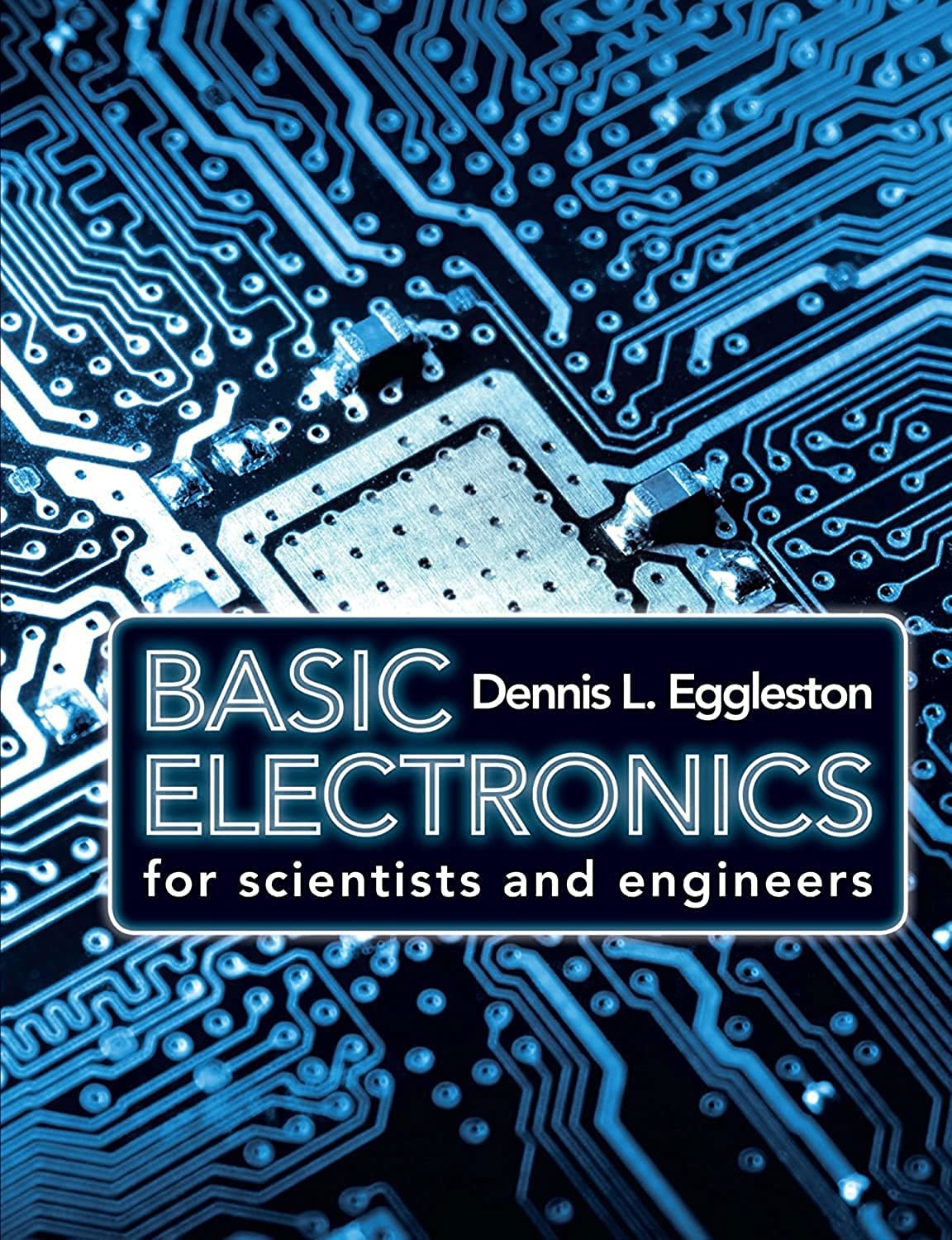
Description:
Editorial Reviews
Reviews:
5.0 out of 5 stars the first 60 pages are excellent. This is the only electronics text I've ever ...
So far, the first 60 pages are excellent. This is the only electronics text I've ever read. So I'm not sure if it's "missing" a lot of material. But the material that is presented is presented in good fashion. Easy to follow along.Problems are at the end of each chapter. And there are odd answers in the back of the book.All around nice text. Not too expensive either.
5.0 out of 5 stars Good textbook for a physics electronics course
I've been looking for a while for a good undergraduate electronics textbook for use in a physics majors class. I've been making do with Horowitz and Hill and lots of notes, but this book is fantastic. It is brief but includes the explanations that are absent in H&H. The subject matter fits neatly into a semester. Fantastic.
4.0 out of 5 stars Quick way to learn electronics
Well written and clear. The problems at the end of each chapter reinforce the material. My only complaint is that few of the problems have answers in the back of the book.
5.0 out of 5 stars Excellent Book for Single Semester Electronics for Scientists Course
I use this text for a single-semester electronics course for physicists. I have reviewed a number of texts attempting to find one appropriate for my intended audience. This is the only book I could find that is concise yet provides adequate depth to be useful to scientists working in a typical undergraduate research lab. It has a few issues, e.g. a dearth of exercises and the occasional typo, but overall it was the best text I found. As a companion to this text, I use the Tsividis lab manual and a fair amount of supplemental material from classic engineering texts like Alexander/Sadiku and Sedra/Smith. In the future, I may add some of the content from the Arduino Cookbook to give students an introduction to data acquisition with microcontrollers.Other books I have reviewed for a single semester electronics course and brief commentary on each:~Basic Electronics by Curtis Meyer -- looks like an excellent book, but too advanced for the class I teach.~Practical Electronics For Inventors by Paul Scherz -- good book for beginners, but the format is not suited to a lecture style course...no exercises, for example.~The Art of Electronics by Horowitz and Hill -- encyclopedic text that's a little dated (though I hear there's a 3rd ed. coming?!), text is not always written in a didactic manner.~Foundations of Analog and Digital Electronic Circuits by Agarwal -- another great book that approaches the subject in a novel manner...I just couldn't come to grips with teaching FET and opamp circuits before getting to the pn junction diode (which is the last chapter? bizarre).~Electronics with Discrete Components by Galvez-- another new single-semester electronics text, the book is well organized, but the writing I believe to be of poor quality.~Grob's Basic Electronics, Meade, etc. -- for technical schools.
1.0 out of 5 stars I would pass on this book
I used this book as a refresher, to better remember the material I learned when I took electronics in my physics bachelors degree program (the original softcover textbook that I used for that course, which was a different book from this one, fell apart a long time ago). I found, however, that I often simply did not understand what the author was saying and why a certain electronics device works the way the author says it works. I have read a lot of Physics textbooks on my own, without help from a teacher, and I often am able to understand the book without help from an instructor. In this case, however, I found that I couldn't learn the material from this textbook. The author wasn't clear enough. I would pass on this book.
3.0 out of 5 stars Fails to fit the Criteria Stated in Preface
I am using this book for my electronics class as a student. Some positives about the book are a nice quality of print and good explanation of band gap theory from electronics perspective.The negatives:- extreme brevity(you will need to consult 3-4 other texts to get a general understanding of a topic as simple as LRC filters)- total lack of exercises (for instance, chapter 4 introduces 3 major transistor topics. There are a total of 9 exercises at then end.)- Chatty, David-Griffiths-like tone (if you have taken E&M and Quantum Mech using his books, you will know what I mean) that often times is put in place as an attempt to redeem an otherwise poor explanation. In other words, the chatty tone is used to say "please, agree with me" or "please believe me."- Some graphs are confusing because they lack scale or relevant important markers.- Outrageously expensive for the value you get.This review is valid based on my experience up to Chapter 4.
2.0 out of 5 stars This Book Sucks
The prose in this book is really complicated and hard to understand. Everything is explained in a complex way when simplifications would be appropriate. There's also a lot of stuff it doesn't cover, like impedance matching. Everyone in my undergraduate electronics course failed the first midterm using this book.
Visit the Cambridge University Press Store
Basic Electronics for Scientists and Engineers
AED39704
Quantity:
Order today to get by 7-14 business days
This item qualifies for free delivery
Imported From: United States
At BOLO, we work hard to ensure the products you receive are new, genuine, and sourced from reputable suppliers.
BOLO is not an authorized or official retailer for most brands, nor are we affiliated with manufacturers unless specifically stated on a product page. Instead, we source verified sellers, authorized distributors or directly from the manufacturer.
Each product undergoes thorough inspection and verification at our consolidation and fulfilment centers to ensure it meets our strict authenticity and quality standards before being shipped and delivered to you.
If you ever have concerns regarding the authenticity of a product purchased from us, please contact Bolo Support. We will review your inquiry promptly and, if necessary, provide documentation verifying authenticity or offer a suitable resolution.
Your trust is our top priority, and we are committed to maintaining transparency and integrity in every transaction.
All product information, images, descriptions, and reviews originate from the manufacturer or from trusted sellers overseas. BOLO is not affiliated with, endorsed by, or an authorized retailer for most brands listed on our website unless stated otherwise.
While we strive to display accurate information, variations in packaging, labeling, instructions, or formulation may occasionally occur due to regional differences or supplier updates. For detailed or manufacturer-specific information, please contact the brand directly or reach out to BOLO Support for assistance.
Unless otherwise stated, all prices displayed on the product page include applicable taxes and import duties.
BOLO operates in accordance with the laws and regulations of United Arab Emirates. Any items found to be restricted or prohibited for sale within the UAE will be cancelled prior to shipment. We take proactive measures to ensure that only products permitted for sale in United Arab Emirates are listed on our website.
All items are shipped by air, and any products classified as “Dangerous Goods (DG)” under IATA regulations will be removed from the order and cancelled.
All orders are processed manually, and we make every effort to process them promptly once confirmed. Products cancelled due to the above reasons will be permanently removed from listings across the website.
Similar suggestions by Bolo
More from this brand
Similar items from “Circuits”
Share with
Or share with link
https://www.bolo.ae/products/U0521154308
Visit the Cambridge University Press Store
Basic Electronics for Scientists and Engineers

AED39704
Quantity:
Order today to get by 7-14 business days
This item qualifies for free delivery
Imported From: United States
At BOLO, we work hard to ensure the products you receive are new, genuine, and sourced from reputable suppliers.
BOLO is not an authorized or official retailer for most brands, nor are we affiliated with manufacturers unless specifically stated on a product page. Instead, we source verified sellers, authorized distributors or directly from the manufacturer.
Each product undergoes thorough inspection and verification at our consolidation and fulfilment centers to ensure it meets our strict authenticity and quality standards before being shipped and delivered to you.
If you ever have concerns regarding the authenticity of a product purchased from us, please contact Bolo Support. We will review your inquiry promptly and, if necessary, provide documentation verifying authenticity or offer a suitable resolution.
Your trust is our top priority, and we are committed to maintaining transparency and integrity in every transaction.
All product information, images, descriptions, and reviews originate from the manufacturer or from trusted sellers overseas. BOLO is not affiliated with, endorsed by, or an authorized retailer for most brands listed on our website unless stated otherwise.
While we strive to display accurate information, variations in packaging, labeling, instructions, or formulation may occasionally occur due to regional differences or supplier updates. For detailed or manufacturer-specific information, please contact the brand directly or reach out to BOLO Support for assistance.
Unless otherwise stated, all prices displayed on the product page include applicable taxes and import duties.
BOLO operates in accordance with the laws and regulations of United Arab Emirates. Any items found to be restricted or prohibited for sale within the UAE will be cancelled prior to shipment. We take proactive measures to ensure that only products permitted for sale in United Arab Emirates are listed on our website.
All items are shipped by air, and any products classified as “Dangerous Goods (DG)” under IATA regulations will be removed from the order and cancelled.
All orders are processed manually, and we make every effort to process them promptly once confirmed. Products cancelled due to the above reasons will be permanently removed from listings across the website.
Description:
Editorial Reviews
Reviews:
5.0 out of 5 stars the first 60 pages are excellent. This is the only electronics text I've ever ...
So far, the first 60 pages are excellent. This is the only electronics text I've ever read. So I'm not sure if it's "missing" a lot of material. But the material that is presented is presented in good fashion. Easy to follow along.Problems are at the end of each chapter. And there are odd answers in the back of the book.All around nice text. Not too expensive either.
5.0 out of 5 stars Good textbook for a physics electronics course
I've been looking for a while for a good undergraduate electronics textbook for use in a physics majors class. I've been making do with Horowitz and Hill and lots of notes, but this book is fantastic. It is brief but includes the explanations that are absent in H&H. The subject matter fits neatly into a semester. Fantastic.
4.0 out of 5 stars Quick way to learn electronics
Well written and clear. The problems at the end of each chapter reinforce the material. My only complaint is that few of the problems have answers in the back of the book.
5.0 out of 5 stars Excellent Book for Single Semester Electronics for Scientists Course
I use this text for a single-semester electronics course for physicists. I have reviewed a number of texts attempting to find one appropriate for my intended audience. This is the only book I could find that is concise yet provides adequate depth to be useful to scientists working in a typical undergraduate research lab. It has a few issues, e.g. a dearth of exercises and the occasional typo, but overall it was the best text I found. As a companion to this text, I use the Tsividis lab manual and a fair amount of supplemental material from classic engineering texts like Alexander/Sadiku and Sedra/Smith. In the future, I may add some of the content from the Arduino Cookbook to give students an introduction to data acquisition with microcontrollers.Other books I have reviewed for a single semester electronics course and brief commentary on each:~Basic Electronics by Curtis Meyer -- looks like an excellent book, but too advanced for the class I teach.~Practical Electronics For Inventors by Paul Scherz -- good book for beginners, but the format is not suited to a lecture style course...no exercises, for example.~The Art of Electronics by Horowitz and Hill -- encyclopedic text that's a little dated (though I hear there's a 3rd ed. coming?!), text is not always written in a didactic manner.~Foundations of Analog and Digital Electronic Circuits by Agarwal -- another great book that approaches the subject in a novel manner...I just couldn't come to grips with teaching FET and opamp circuits before getting to the pn junction diode (which is the last chapter? bizarre).~Electronics with Discrete Components by Galvez-- another new single-semester electronics text, the book is well organized, but the writing I believe to be of poor quality.~Grob's Basic Electronics, Meade, etc. -- for technical schools.
1.0 out of 5 stars I would pass on this book
I used this book as a refresher, to better remember the material I learned when I took electronics in my physics bachelors degree program (the original softcover textbook that I used for that course, which was a different book from this one, fell apart a long time ago). I found, however, that I often simply did not understand what the author was saying and why a certain electronics device works the way the author says it works. I have read a lot of Physics textbooks on my own, without help from a teacher, and I often am able to understand the book without help from an instructor. In this case, however, I found that I couldn't learn the material from this textbook. The author wasn't clear enough. I would pass on this book.
3.0 out of 5 stars Fails to fit the Criteria Stated in Preface
I am using this book for my electronics class as a student. Some positives about the book are a nice quality of print and good explanation of band gap theory from electronics perspective.The negatives:- extreme brevity(you will need to consult 3-4 other texts to get a general understanding of a topic as simple as LRC filters)- total lack of exercises (for instance, chapter 4 introduces 3 major transistor topics. There are a total of 9 exercises at then end.)- Chatty, David-Griffiths-like tone (if you have taken E&M and Quantum Mech using his books, you will know what I mean) that often times is put in place as an attempt to redeem an otherwise poor explanation. In other words, the chatty tone is used to say "please, agree with me" or "please believe me."- Some graphs are confusing because they lack scale or relevant important markers.- Outrageously expensive for the value you get.This review is valid based on my experience up to Chapter 4.
2.0 out of 5 stars This Book Sucks
The prose in this book is really complicated and hard to understand. Everything is explained in a complex way when simplifications would be appropriate. There's also a lot of stuff it doesn't cover, like impedance matching. Everyone in my undergraduate electronics course failed the first midterm using this book.
Similar suggestions by Bolo
More from this brand
Similar items from “Circuits”
Share with
Or share with link
https://www.bolo.ae/products/U0521154308