Deliver toUnited Arab Emirates
Railways

Description:

Exquisite drawings of locomotives, carriages, and stations offering unparalleled insight into the history, design and operation of the railway.

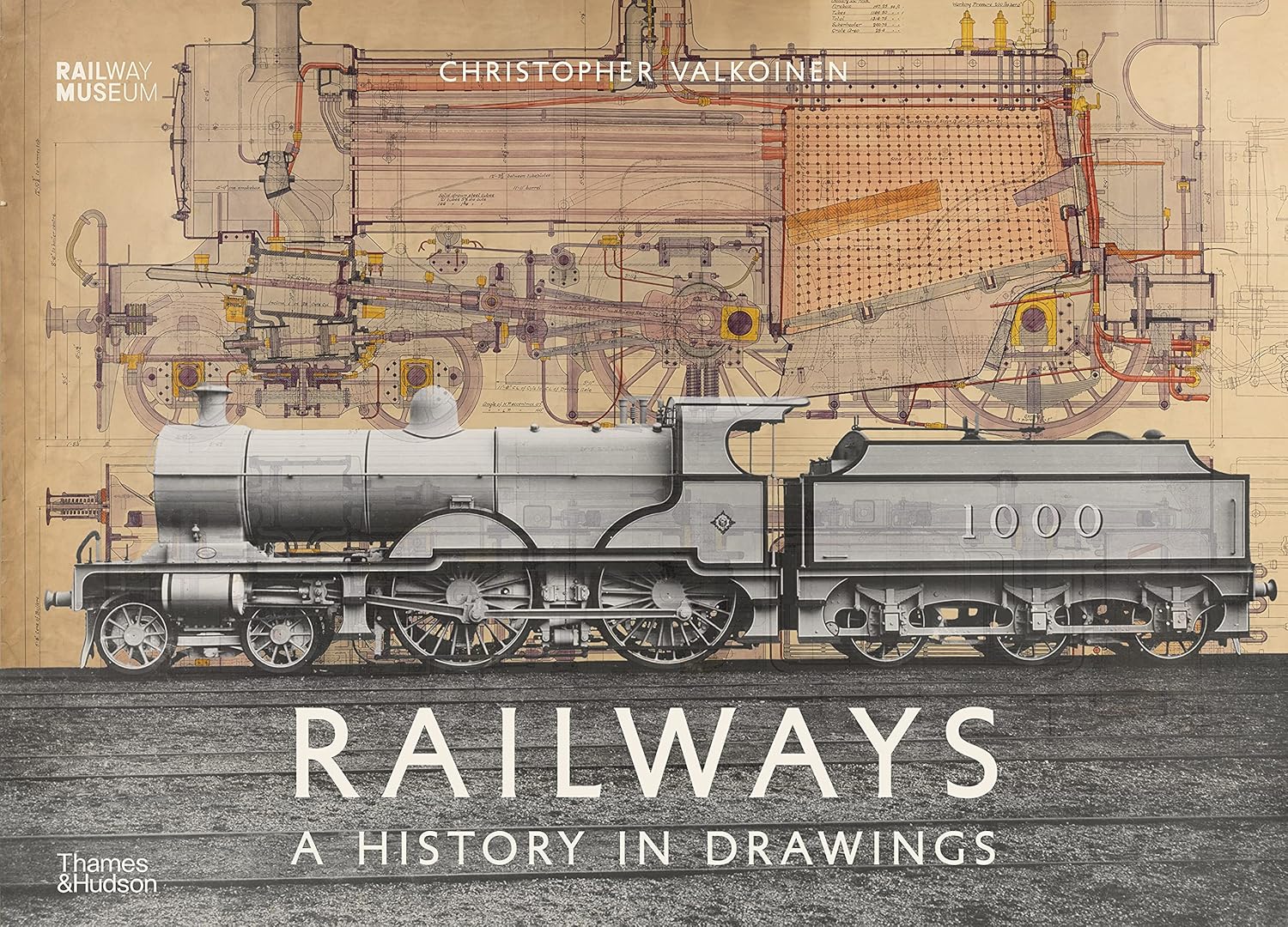
At the beginning of the nineteenth century, the first railway was established in Great Britain, contributing to the country’s dramatic social and economic revolution. Detailed plans were created of locomotives, carriages, wagons, stations, bridges, and tunnels to facilitate the manufacturing process and maintenance of the railway network. Miraculously, about one million of these exquisite drawings have survived and are housed at the National Railway Museum, York. In Railways: A History in Drawings, Christopher Valkoinen has selected over 130 examples from the museum’s collection that illustrate the innovative history of Britain’s railway.

Accompanied by lively and insightful commentary, as well as contemporary photographs and posters, featured plans range from Queen Victoria’s royal saloon, Stephenson’s Rocket, and the Flying Scotsman to the boiler for the famous John Bull―the oldest surviving steam locomotive in the United States―and modern experiments with hovertrains. Perfect for train and engineering enthusiasts and anyone interested in British history, this compendium of drawings gives unparalleled insight into all aspects of the design and operation of the British railway system from the early nineteenth century to the 1970s.

300 illustrations


Editorial Reviews

About the Author

Christopher Valkoinen works in the Search Engine library and archives at the National Railway Museum in York, England where he manages the digitization of engineering drawings and other materials. He is also a qualified steam locomotive fireman.

Reviews:

5.0 out of 5 stars Gorgeous pictures

R.E. · March 19, 2022

A beautiful book even if you don't particularly care for steam engines.

5.0 out of 5 stars On the right lines

R. · September 18, 2021

A wonderful book that visually celebrates the achievements of Britain's railways. One reason I particularly like the book is the editorial format, the seven chapters are divided into themed spreads, 108 in all, though a few run over to another spread. The first 107 pages are devoted to schematic engineering drawing of locomotives from the first non-steam railway, in 1825, the Stockton and Darlington goods wagons pulled by a horse. Robert Stephenson's 'Rocket' from 1829, wasn't really the first steam engine but it completed trials against other engines and then ran on the Liverpool and Manchester Railway.Some of the engineering drawings are quite stunning to look at. Obviously full of precise technical detail but also colored and shaded to show depth. Page thirty-five has a remarkable drawing of a tank engine from 1870 that would make an excellent framed picture. Famous engines like The Flying Scotsman, Coronation Scot, or the Golden Arrow have their profiles revealed but also the ordinary tank engines that were scattered across the country's rail yards. Steam faded out in the late forties and diesels took over, especially English Electric 'Deltic' class then electrification provided a completely different engine for speed. It seems a huge problem was the railway's tight corners, Victorian trains rarely exceeded 50mph, hopelessly slow by modern standards so British Rail tried out the APT-E in 1972, to travel at 155mph on tracks designed for 100mph passenger trains. It was not a success and the engines were withdrawn in 1985.The following chapters look at the rail industry, at passenger comfort (or in the early years a lack of it) freight, rail workers, rail during both world wars, railways in other countries, building the railways with aerial schematics of mainline stations and their buildings. The passenger chapter has an intriguing detail. In 1874 the Midland Railway imported some Pullman sleeping cars (pictured on page 129) but they were too wide for the tracks in Scotland so the train had a group of workers to move the tracks. In 1913 the industry suffered 30,000 injuries and 460 deaths on page 175, in the rail workers chapter, there is a diagram of an artificial leg. London and North Western railway made these in their Crewe works for their injured workers.The book is landscape shaped, with three hundred pictures and a delight to look through and I liked the way it was written in everyday English. Books from the transport press are notorious for heavy use of abbreviations and long paragraphs. 'Railways: A history in drawings' will appeal to engineers and obviously railfans. You can look inside the book at Westread Book Reviews then click 2021 and September.

4.0 out of 5 stars Gorgeous book with some minor issues

D.C. · March 5, 2022

Trying to encompass the entire 220-year history of British railway development into a single coffee table book using mainly original technical diagrams and illustrations seems like a fool's errand, but Christopher Valkoinen and the staff at the National Railway Museum in York have largely succeeded. The author is currently in charge of digitizing the museum's enormous collection of engineering drawings, and all of the illustrations come from its archives. It's divided into seven thematic segments, each presented in chronological order:"Two Centuries of Locomotion" (36 spreads) focuses on historic and iconic British locomotives (such as Stephenson's Rocket, the LMSR's 4-4-0 compound, the LNER A1 class "Flying Scotsman," the Coronation class, "Mallard," etc.) along with a couple of unbuilt prototypes, unique one-offs, and ignoble failures."The Railway Passenger" (14 spreads) looks at a variety of passenger cars, ranging from a wagon-topped third-class carriage to a first-class dining car, Queen Victoria's royal saloon, and a hearse carriage for London's necropolis railway."Freight on the Railways" (9 spreads) includes a small sampling of the huge variety of rolling stock that began to proliferate on English railways during the industrial revolution, including cars for transporting slate, fish, cattle, and newspapers, and even a mobile kennel."Railway Workers" (8 spreads) is where things start to go off the rails...in a good way! This chapter is a bit of a grab bag, including illustrations of a director's saloon car, a bridge signal box, a hand-powered trolley, and even an artificial leg designed by the LNWR and manufactured at the locomotive works in Crewe."The Railway Workshop of the World" (12 spreads) looks at a number of locomotives built in Britain for sale to foreign governments, such as a unique rack and pinion locomotive for Australian use and a bizarre "off-rails" vehicle designed to pull trains of sleighs in Russia, along with the Lake Titicaca steamboat "Ollanta.""Railways at War" (9 spreads) shows a number of ways the railroads adapted to wartime needs, including simple mass-produced locomotives, ambulance cars, air raid shelters, civil defense control centers, as well as vehicles built by locomotive works for military needs, including tractors and LCMs (Landing Craft Mechanized)."Building the Railways" (21 spreads) covers the enormous amount of infrastructure incorporated into the British railway system, including stations, tunnels, bridges, and locomotive works, along with a number of survey maps.Since a previous reviewer provided a very extensive photographic preview, I'll avoid talking TOO much about the visual aspects of this book. Although they could have taken a basic "art book" approach and just presented the illustrations without any context, the accompanying text is surprisingly detailed and readable, providing a lot of historical and technical context that the drawings alone couldn't provide. Although it only covers British railways, it's fascinating to learn just how similar the impact the railroads had on national development was to our own. Most spreads also include at least one photograph of the subject, and many of them also include period sketches, paintings, or woodcuts.Despite the large format, it's hard to enjoy this book properly without good lighting and a proper magnifying glass. The original drawings were frequently produced at an extremely large scale (1/16 or even 1/12 scale for most steam locomotives) and reducing them to fit a single page result in frequently jumbled details. Some of the older (pre-1830) illustrations are a ragged mess and interesting only from a historical perspective. I know the NRM needs funding to preserve its collection, but considering the $75 price tag, I'm not sure why they were included.Although it's rather pricey and the format can be a bit frustrating, "Railways" is a fun book for anyone who loves trains and could spend hours of quiet contentment studying sectional views of boilers. It's very British, but I can't see that getting in the way of enjoyment for serious railroad enthusiasts.

Railway book of 2021!

A. · October 11, 2021

There are very few books which describe history through original engineering and architectural drawings. With Britain's long and distinguished history of engineering achievements, from land, sea and in the air, this is a much neglected aspect of the combining of technology and culture; often two inseparable aspects of Britain's past. This book proves that this omission needs to be addressed if only to make accessible rare and unique collections of engineering draughtsmanship and their important and necessary relevance in Britain's development. In summary, this book is likely to be recognised as THE railway book of the year, if not the decade! Not only are the contents excellent and varied, but the design and production complements the book almost perfectly! The author, Christopher Valkoinen, is to be congratulated on an outstanding publication.The title might be misleading, for it covers not just railways, but many of the subsidiary aspects of designing, building and running a railway, including the necessary infrastructure for the same. The book also covers aspects of railway engineering design and technology often ignored in other studies, such as workers, building railways for other countries and railways at war, and much else besides.The sub title - A History in Drawings - sums up this book. And it is through the numerous drawings that make this book what it is, supported by an informative text and numerous photographs. The quality of draughtsmanship is exquisite and demonstrates without doubt that current computer-generated drawings will never compare favourably with hand-rendered drawings, many tinted with watercolour washes, making many of these works of art in their own right. Indeed, a close examination of any of these drawings show a skill level that is no longer expected - or indeed taught - in today's boringly dull equivalents. How many modern 'draughtsmen' are able to apply watercolour washes? How many could handle traditional drawing instruments? Sadly, very few, if any!What is further evident through a vast majority of the drawings reproduced in this book, supported by many of the detail photographs, is the quality of workmanship, be it a steam locomotive, a passenger carriage, a war department hospital carriage for wounded soldiers, or a station master's house. And this quality of workmanship is evident in the smallest of detail. Compare with today's reliance on mass-produced plastic with no regard to quality, and even less regard to pride in one's work, assuming of course that today's joiners, plumbers, et al, have the skills to compete with those prior to 1970. So-called 'modern apprenticeships' are nothing more than a political sham when compared to the in-depth training that was accepted as the norm during much of the period covered by this book. And the starting point for much of this quality of workmanship was through the skill of the draughtsmen.No book can ever be perfect. One gripe is having double-page spreads where parts of drawings disappear in the gutter. This is not the fault of the author, but of the publisher's designers. One day publisher's might actually listen to this oft cited issue with books of this nature. However, the large landscape format of this book does help alleviate this commonly-found problem. And although this is a valid criticism, it does not invalidate the quality of the contents of this book.This book comes highly recommended - not just for railway historians, enthusiasts and model makers, but also anyone interested in engineering and technological history. I would even suggest that some art and design students will find much of interest and inspiration in the pages of this book, if they had the lateral inclination to examine in detail some of the drawings in this book!Hopefully this book will be so successful that it will inspire the National Railway Museum, in York, to publish further studies based on its unique collection of railway drawings (and photographs).This book deserves ten stars!

Sehr interessant

G.K. · October 3, 2025

Eine sehr interessante Zusammenstellung mit außergewöhnlichen Zeichnungen.

Great book

D.D. · November 4, 2022

Very to to read and very good drawings

If you're a rail fan you want this book

N.S. · August 12, 2022

Well written, beautifully illustrated. Worth the price in my opinion, and an excellent addition to my railway library.

Amazon's warehouse handling of items needs to improve

M.W. · April 23, 2023

The book content is excellent. A wealth of knowledge.The handling of this book was terrible.A corner of the book was crushed, and some of the internal pages were pushed in.This book was wrapped in plastic, so it probably got dropped onto something, while being handled.The shipping of this book was OK.No damage there, so no indication of any damage.Until, the book was unwrapped, then - surprise !This book was not cheap !I hope this is not the new norm.

Railways

Product ID: U0500021678
Condition: New

4.8

AED42485

Price includes VAT & Import Duties
Type: Hardcover
Availability: In Stock

Quantity:

|

Order today to get by 7-14 business days

This item qualifies for free delivery

Returns & Warranty policies

Imported From: United States

At BOLO, we work hard to ensure the products you receive are new, genuine, and sourced from reputable suppliers.

BOLO is not an authorized or official retailer for most brands, nor are we affiliated with manufacturers unless specifically stated on a product page. Instead, we source verified sellers, authorized distributors or directly from the manufacturer.

Each product undergoes thorough inspection and verification at our consolidation and fulfilment centers to ensure it meets our strict authenticity and quality standards before being shipped and delivered to you.

If you ever have concerns regarding the authenticity of a product purchased from us, please contact Bolo Support. We will review your inquiry promptly and, if necessary, provide documentation verifying authenticity or offer a suitable resolution.

Your trust is our top priority, and we are committed to maintaining transparency and integrity in every transaction.

All product information, images, descriptions, and reviews originate from the manufacturer or from trusted sellers overseas. BOLO is not affiliated with, endorsed by, or an authorized retailer for most brands listed on our website unless stated otherwise.

While we strive to display accurate information, variations in packaging, labeling, instructions, or formulation may occasionally occur due to regional differences or supplier updates. For detailed or manufacturer-specific information, please contact the brand directly or reach out to BOLO Support for assistance.

Unless otherwise stated, all prices displayed on the product page include applicable taxes and import duties.

BOLO operates in accordance with the laws and regulations of United Arab Emirates. Any items found to be restricted or prohibited for sale within the UAE will be cancelled prior to shipment. We take proactive measures to ensure that only products permitted for sale in United Arab Emirates are listed on our website.

All items are shipped by air, and any products classified as “Dangerous Goods (DG)” under IATA regulations will be removed from the order and cancelled.

All orders are processed manually, and we make every effort to process them promptly once confirmed. Products cancelled due to the above reasons will be permanently removed from listings across the website.

Similar suggestions by Bolo

More from this brand

Similar items from “History”

Railways

Product ID: U0500021678
Condition: New

4.8

Railways-0
Type: Hardcover

AED42485

Price includes VAT & Import Duties
Availability: In Stock

Quantity:

|

Order today to get by 7-14 business days

This item qualifies for free delivery

Returns & Warranty policies

Imported From: United States

At BOLO, we work hard to ensure the products you receive are new, genuine, and sourced from reputable suppliers.

BOLO is not an authorized or official retailer for most brands, nor are we affiliated with manufacturers unless specifically stated on a product page. Instead, we source verified sellers, authorized distributors or directly from the manufacturer.

Each product undergoes thorough inspection and verification at our consolidation and fulfilment centers to ensure it meets our strict authenticity and quality standards before being shipped and delivered to you.

If you ever have concerns regarding the authenticity of a product purchased from us, please contact Bolo Support. We will review your inquiry promptly and, if necessary, provide documentation verifying authenticity or offer a suitable resolution.

Your trust is our top priority, and we are committed to maintaining transparency and integrity in every transaction.

All product information, images, descriptions, and reviews originate from the manufacturer or from trusted sellers overseas. BOLO is not affiliated with, endorsed by, or an authorized retailer for most brands listed on our website unless stated otherwise.

While we strive to display accurate information, variations in packaging, labeling, instructions, or formulation may occasionally occur due to regional differences or supplier updates. For detailed or manufacturer-specific information, please contact the brand directly or reach out to BOLO Support for assistance.

Unless otherwise stated, all prices displayed on the product page include applicable taxes and import duties.

BOLO operates in accordance with the laws and regulations of United Arab Emirates. Any items found to be restricted or prohibited for sale within the UAE will be cancelled prior to shipment. We take proactive measures to ensure that only products permitted for sale in United Arab Emirates are listed on our website.

All items are shipped by air, and any products classified as “Dangerous Goods (DG)” under IATA regulations will be removed from the order and cancelled.

All orders are processed manually, and we make every effort to process them promptly once confirmed. Products cancelled due to the above reasons will be permanently removed from listings across the website.

Description:

Exquisite drawings of locomotives, carriages, and stations offering unparalleled insight into the history, design and operation of the railway.

At the beginning of the nineteenth century, the first railway was established in Great Britain, contributing to the country’s dramatic social and economic revolution. Detailed plans were created of locomotives, carriages, wagons, stations, bridges, and tunnels to facilitate the manufacturing process and maintenance of the railway network. Miraculously, about one million of these exquisite drawings have survived and are housed at the National Railway Museum, York. In Railways: A History in Drawings, Christopher Valkoinen has selected over 130 examples from the museum’s collection that illustrate the innovative history of Britain’s railway.

Accompanied by lively and insightful commentary, as well as contemporary photographs and posters, featured plans range from Queen Victoria’s royal saloon, Stephenson’s Rocket, and the Flying Scotsman to the boiler for the famous John Bull―the oldest surviving steam locomotive in the United States―and modern experiments with hovertrains. Perfect for train and engineering enthusiasts and anyone interested in British history, this compendium of drawings gives unparalleled insight into all aspects of the design and operation of the British railway system from the early nineteenth century to the 1970s.

300 illustrations


Editorial Reviews

About the Author

Christopher Valkoinen works in the Search Engine library and archives at the National Railway Museum in York, England where he manages the digitization of engineering drawings and other materials. He is also a qualified steam locomotive fireman.

Reviews:

5.0 out of 5 stars Gorgeous pictures

R.E. · March 19, 2022

A beautiful book even if you don't particularly care for steam engines.

5.0 out of 5 stars On the right lines

R. · September 18, 2021

A wonderful book that visually celebrates the achievements of Britain's railways. One reason I particularly like the book is the editorial format, the seven chapters are divided into themed spreads, 108 in all, though a few run over to another spread. The first 107 pages are devoted to schematic engineering drawing of locomotives from the first non-steam railway, in 1825, the Stockton and Darlington goods wagons pulled by a horse. Robert Stephenson's 'Rocket' from 1829, wasn't really the first steam engine but it completed trials against other engines and then ran on the Liverpool and Manchester Railway.Some of the engineering drawings are quite stunning to look at. Obviously full of precise technical detail but also colored and shaded to show depth. Page thirty-five has a remarkable drawing of a tank engine from 1870 that would make an excellent framed picture. Famous engines like The Flying Scotsman, Coronation Scot, or the Golden Arrow have their profiles revealed but also the ordinary tank engines that were scattered across the country's rail yards. Steam faded out in the late forties and diesels took over, especially English Electric 'Deltic' class then electrification provided a completely different engine for speed. It seems a huge problem was the railway's tight corners, Victorian trains rarely exceeded 50mph, hopelessly slow by modern standards so British Rail tried out the APT-E in 1972, to travel at 155mph on tracks designed for 100mph passenger trains. It was not a success and the engines were withdrawn in 1985.The following chapters look at the rail industry, at passenger comfort (or in the early years a lack of it) freight, rail workers, rail during both world wars, railways in other countries, building the railways with aerial schematics of mainline stations and their buildings. The passenger chapter has an intriguing detail. In 1874 the Midland Railway imported some Pullman sleeping cars (pictured on page 129) but they were too wide for the tracks in Scotland so the train had a group of workers to move the tracks. In 1913 the industry suffered 30,000 injuries and 460 deaths on page 175, in the rail workers chapter, there is a diagram of an artificial leg. London and North Western railway made these in their Crewe works for their injured workers.The book is landscape shaped, with three hundred pictures and a delight to look through and I liked the way it was written in everyday English. Books from the transport press are notorious for heavy use of abbreviations and long paragraphs. 'Railways: A history in drawings' will appeal to engineers and obviously railfans. You can look inside the book at Westread Book Reviews then click 2021 and September.

4.0 out of 5 stars Gorgeous book with some minor issues

D.C. · March 5, 2022

Trying to encompass the entire 220-year history of British railway development into a single coffee table book using mainly original technical diagrams and illustrations seems like a fool's errand, but Christopher Valkoinen and the staff at the National Railway Museum in York have largely succeeded. The author is currently in charge of digitizing the museum's enormous collection of engineering drawings, and all of the illustrations come from its archives. It's divided into seven thematic segments, each presented in chronological order:"Two Centuries of Locomotion" (36 spreads) focuses on historic and iconic British locomotives (such as Stephenson's Rocket, the LMSR's 4-4-0 compound, the LNER A1 class "Flying Scotsman," the Coronation class, "Mallard," etc.) along with a couple of unbuilt prototypes, unique one-offs, and ignoble failures."The Railway Passenger" (14 spreads) looks at a variety of passenger cars, ranging from a wagon-topped third-class carriage to a first-class dining car, Queen Victoria's royal saloon, and a hearse carriage for London's necropolis railway."Freight on the Railways" (9 spreads) includes a small sampling of the huge variety of rolling stock that began to proliferate on English railways during the industrial revolution, including cars for transporting slate, fish, cattle, and newspapers, and even a mobile kennel."Railway Workers" (8 spreads) is where things start to go off the rails...in a good way! This chapter is a bit of a grab bag, including illustrations of a director's saloon car, a bridge signal box, a hand-powered trolley, and even an artificial leg designed by the LNWR and manufactured at the locomotive works in Crewe."The Railway Workshop of the World" (12 spreads) looks at a number of locomotives built in Britain for sale to foreign governments, such as a unique rack and pinion locomotive for Australian use and a bizarre "off-rails" vehicle designed to pull trains of sleighs in Russia, along with the Lake Titicaca steamboat "Ollanta.""Railways at War" (9 spreads) shows a number of ways the railroads adapted to wartime needs, including simple mass-produced locomotives, ambulance cars, air raid shelters, civil defense control centers, as well as vehicles built by locomotive works for military needs, including tractors and LCMs (Landing Craft Mechanized)."Building the Railways" (21 spreads) covers the enormous amount of infrastructure incorporated into the British railway system, including stations, tunnels, bridges, and locomotive works, along with a number of survey maps.Since a previous reviewer provided a very extensive photographic preview, I'll avoid talking TOO much about the visual aspects of this book. Although they could have taken a basic "art book" approach and just presented the illustrations without any context, the accompanying text is surprisingly detailed and readable, providing a lot of historical and technical context that the drawings alone couldn't provide. Although it only covers British railways, it's fascinating to learn just how similar the impact the railroads had on national development was to our own. Most spreads also include at least one photograph of the subject, and many of them also include period sketches, paintings, or woodcuts.Despite the large format, it's hard to enjoy this book properly without good lighting and a proper magnifying glass. The original drawings were frequently produced at an extremely large scale (1/16 or even 1/12 scale for most steam locomotives) and reducing them to fit a single page result in frequently jumbled details. Some of the older (pre-1830) illustrations are a ragged mess and interesting only from a historical perspective. I know the NRM needs funding to preserve its collection, but considering the $75 price tag, I'm not sure why they were included.Although it's rather pricey and the format can be a bit frustrating, "Railways" is a fun book for anyone who loves trains and could spend hours of quiet contentment studying sectional views of boilers. It's very British, but I can't see that getting in the way of enjoyment for serious railroad enthusiasts.

Railway book of 2021!

A. · October 11, 2021

There are very few books which describe history through original engineering and architectural drawings. With Britain's long and distinguished history of engineering achievements, from land, sea and in the air, this is a much neglected aspect of the combining of technology and culture; often two inseparable aspects of Britain's past. This book proves that this omission needs to be addressed if only to make accessible rare and unique collections of engineering draughtsmanship and their important and necessary relevance in Britain's development. In summary, this book is likely to be recognised as THE railway book of the year, if not the decade! Not only are the contents excellent and varied, but the design and production complements the book almost perfectly! The author, Christopher Valkoinen, is to be congratulated on an outstanding publication.The title might be misleading, for it covers not just railways, but many of the subsidiary aspects of designing, building and running a railway, including the necessary infrastructure for the same. The book also covers aspects of railway engineering design and technology often ignored in other studies, such as workers, building railways for other countries and railways at war, and much else besides.The sub title - A History in Drawings - sums up this book. And it is through the numerous drawings that make this book what it is, supported by an informative text and numerous photographs. The quality of draughtsmanship is exquisite and demonstrates without doubt that current computer-generated drawings will never compare favourably with hand-rendered drawings, many tinted with watercolour washes, making many of these works of art in their own right. Indeed, a close examination of any of these drawings show a skill level that is no longer expected - or indeed taught - in today's boringly dull equivalents. How many modern 'draughtsmen' are able to apply watercolour washes? How many could handle traditional drawing instruments? Sadly, very few, if any!What is further evident through a vast majority of the drawings reproduced in this book, supported by many of the detail photographs, is the quality of workmanship, be it a steam locomotive, a passenger carriage, a war department hospital carriage for wounded soldiers, or a station master's house. And this quality of workmanship is evident in the smallest of detail. Compare with today's reliance on mass-produced plastic with no regard to quality, and even less regard to pride in one's work, assuming of course that today's joiners, plumbers, et al, have the skills to compete with those prior to 1970. So-called 'modern apprenticeships' are nothing more than a political sham when compared to the in-depth training that was accepted as the norm during much of the period covered by this book. And the starting point for much of this quality of workmanship was through the skill of the draughtsmen.No book can ever be perfect. One gripe is having double-page spreads where parts of drawings disappear in the gutter. This is not the fault of the author, but of the publisher's designers. One day publisher's might actually listen to this oft cited issue with books of this nature. However, the large landscape format of this book does help alleviate this commonly-found problem. And although this is a valid criticism, it does not invalidate the quality of the contents of this book.This book comes highly recommended - not just for railway historians, enthusiasts and model makers, but also anyone interested in engineering and technological history. I would even suggest that some art and design students will find much of interest and inspiration in the pages of this book, if they had the lateral inclination to examine in detail some of the drawings in this book!Hopefully this book will be so successful that it will inspire the National Railway Museum, in York, to publish further studies based on its unique collection of railway drawings (and photographs).This book deserves ten stars!

Sehr interessant

G.K. · October 3, 2025

Eine sehr interessante Zusammenstellung mit außergewöhnlichen Zeichnungen.

Great book

D.D. · November 4, 2022

Very to to read and very good drawings

If you're a rail fan you want this book

N.S. · August 12, 2022

Well written, beautifully illustrated. Worth the price in my opinion, and an excellent addition to my railway library.

Amazon's warehouse handling of items needs to improve

M.W. · April 23, 2023

The book content is excellent. A wealth of knowledge.The handling of this book was terrible.A corner of the book was crushed, and some of the internal pages were pushed in.This book was wrapped in plastic, so it probably got dropped onto something, while being handled.The shipping of this book was OK.No damage there, so no indication of any damage.Until, the book was unwrapped, then - surprise !This book was not cheap !I hope this is not the new norm.

Similar suggestions by Bolo

More from this brand

Similar items from “History”