Description:
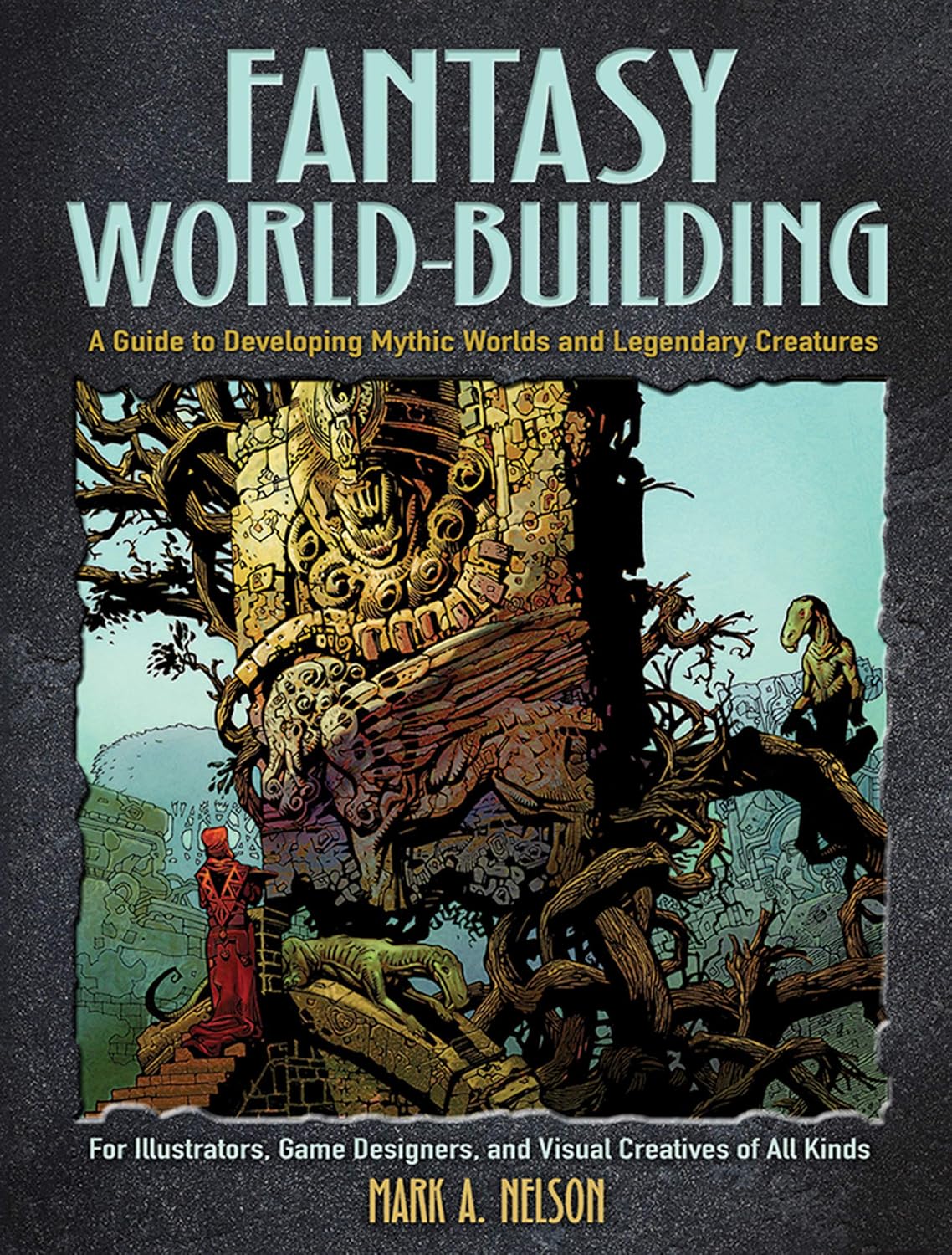
Nelson discusses how to find ideas and borrow from history to add the strength of realism to a fantasy world. In describing the best ways to establish a habitat, he offers specifics about climate, terrain, flora, and wildlife. He shares insights into founding societies in terms of their means of survival, manner of warfare, spiritual practices, style of dress, and levels of technology. All visual creatives who work with imaginative material — illustrators, comic artists, and writers — will take a lively interest in this source of inspiration and practical knowledge.
"In sixteen breezy-yet-surprisingly-concise chapters he covers everything from visual problem solving to spirituality to warfare to transportation, not with the idea of giving the reader lessons to copy by rote but rather as prompts to develop their own original concepts. If I were suggesting three books every budding artist should have at their fingertips they would be Figure Drawing for All It's Worth by Andrew Loomis, Imaginative Realism: How to Paint What Doesn't Exist by James Gurney, and, most definitely, Mark's Fantasy World-Building." — Muddy Colors
About the Author
Excerpt. © Reprinted by permission. All rights reserved.
Fantasy World-Building
A Guide to Developing Mythic Worlds and Legendary Creatures
By Mark A. NelsonDover Publications, Inc.
Copyright © 2019 Mark A. NelsonAll rights reserved.
ISBN: 978-0-486-82865-7
Contents
Foreword by Todd Lockwood,1. Visual Problem Solver,
2. Ideas,
3. Habitats,
4. Animals,
5. Birds,
6. Fish,
7. Insects,
8. Survival,
9. Warfare,
10. Spirit,
11. Wardrobe,
12. Architecture,
13. Tech Industry,
14. Transportation,
15. Otherworldly,
16. Putting It All Together,
Acknowledgments,
CHAPTER 1
VISUAL PROBLEM SOLVER
Working as a visual problem solver is what most artists do. We develop or are presented with a series of descriptions and ideas to create worlds, characters, and stories. It is our hope that we do this in believable scenarios in the form of finished artwork.
Sometimes you work within a set of parameters set by the project. Other times you set these considerations yourself. When you are dealing with licensed properties, you have to work within provided guidelines. This by no means should stifle your creativity. In fact, you can find many ways of working and creating outlooks within these guidelines.
I have worked on many licensed properties and have designed buildings, creatures, spaceships, rooms, interiors, and costumes that ranged from the humorous to the dark. I have drawn funny animals to terrifying ones, hard sci-fi to horror, and realistic settings to the fantastic. Each represented a new answer within this world, an avenue for me to conquer as an artist and grow my skill set. I try to look at it all as a challenge. What can I do to bring it to life with a set of visuals in an interesting way, a new way, or build upon the existing world and add my personal touch? When do we start talking worlds? You get to fill them with everything, and I do mean everything! This includes your favorite habitats, rocks, grass, trees, critters, buildings. The list goes on and on. It is a rather daunting challenge, but here is where the seeds of this book came from.
SOMEONE SETS A PROBLEM: A SWORD.
Just what does this mean?
The mind starts: short sword, broadsword, two-handed battle sword, more than one blade, etc.
What type of pommel? Grip? Cross guard or rain guard? Leather grip or bone grip?
Type of metal? The finish? Damascus steel? Engraved? Flutes? Is it old and rusty? New and highly polished? Does it have decorations or engraving? And so on.
And if the character has a very well-defined sword, you can always practice your skills in drawing and/or painting metal and researching the method of how it was made, with the hope of adding more believability to your finished product.
RESEARCH, RESEARCH, RESEARCH
I am a huge proponent of research. When I started doing illustration, there was no Internet. If you wanted to find things, you went to the library, checked out books, pored over magazines and other periodicals for reference. As you collected images, you put them into file folders and labeled them. You created what was called a "morgue." When illustrators died, their morgues often were passed on or sold. They were rich depictions of periods in time, examples of work by other illustrators, and amazing collections of images. Needless to say, it was a lot of paper, file cabinets, and weight to move.
Nowadays, the Internet has given us a worldwide morgue of images, but I still have reference files on my hard drive. The digital camera has added another file-gathering tool. I have shot many different references with my camera and smartphone. The information highway is just a touch away, and your information gathering has never been easier. The morgue is an old habitat. It allows you to place materials where you need them, find images quickly, and forces you to organize photos and references.
CHARACTER
Model sheets, FBS (front-back-side), or character design sheets is where we start. Everything is worked out by height, body shape, and clothing. Then the character is rotated to the side and back, and the drawing is finished. Sometimes a three-quarter shot is added for a mild action pose. Occasionally, when deadlines are imminent, I will do a three-quarter shot of a spaceship or other element and the modeler will finish the 3-D sculpture of it.
THE STORY
Whether you are working on a single page, a series of images, or a sequential set of pages, the story is the main driving factor. It can be as simple as drinking a cup of tea or as complex as the battlefield of life. You, as the artist, have many tools at your disposal. How do you use your camera? How are you going to establish the space, character introductions, reactions to one another, action scenes, quiet moments, mood, time of day?
When I was working on a comic series, I used a model to portray a major character and shot a whole series of her as I tried to capture her unique body language: holding a coffee cup; leaning forward and talking; cradling the cup with one hand, then two; looking over the top of the cup. Storyboards for movies and comics share common terms and visuals. The difference is movie storyboards stay within a horizontal orientation and comics are vertical. But all the principles and terms of establishing a close-up shot, medium shot, long shot, POV (point of view), eye level, horizon line, birds-eye, and worms-eye are the same.
When I am watching a movie, there are many ideas running through my head:
1. Entertainment
2. Storytelling and how the camera is being used
3. Body language and the reactions of characters
4. Does the story hold together?
5. Is it believable within the parameters established by the director/editor/writers?
Idea: The story can be told partially by a tapestry on the wall and the reaction of the character.
CHAPTER 2IDEAS
Ideas can come from anywhere. They can be simple, complex, or fill any conceptual need. They are the foundation to build upon.
So let's look at the creation of an idea from an object. I have bones and skulls in my studio. One of my favorite bones is a vertebra from a bison hump. The vertebra has the usual hole for the spinal cord, and one of its transverse processes (a small bony projection off the right and left sides of the vertebra) helps support the fat hump. So the two transverse processes are short, and the spinal cord hole is extended at different lengths as you move along the length of the spine.
First thought: Could this be a formation that we adapt for residing in? The Great Backbone City? The residents could add on structures like tents for more room as the family grows.
The first part is working up some blue-pencil drawings of various shapes derived from the bison bone. I'm trying to keep the long shape and the compact feeling of the vertebra.
Next: value studies in Photoshop in gray scale to develop the different surfaces and textures.
Finally: color studies to create the final look.
At this point, I try as many different things and variations as time allows. You can make a clean ship or one that is rusted and worn, brightly colored or subtle. It really is decided by how you want each one to look.
Third thought: high-tech building. A skyscraper made with panels, interior rooms, and wind fans.
So this can become a springboard. What about a mushroom city? A city built on the back of a large animal?
Or, perhaps, all the answers lay with the Giant Shelled Cephalopod.
A note: Bones have incredible shapes and provide for us an interior structure to support our muscles and organs. They need to have ridges, bends, and valleys into which the tendons and muscles fit. Each bone has a unique shape and function. The main difference between us and insects is our skeleton is on the inside covered with muscles and flesh (endoskeleton) and their skeleton is on the outside (exoskeleton), like a suit of armor, and all the muscles are inside.
HISTORY
My grandmother was born in 1904 and died in 1997, just before her ninety-third birthday. She told me of how she rode a horse to school and lived on a farm. To think about what she experienced is amazing! World War I and World War II, the Korean War, the Vietnam War, and all the other wars. She saw the development of the phonograph, the record player, mono and stereo sound, and the radio; the evolution of film from the silents to the talkies and from black-and-white to color; and the invention of cassette tapes, CDs, DVDs, the television, remote control, flat screens, and computers. She witnessed numerous medical advances: the cure for polio, heart transplants, mechanical hearts, the growth of microsurgery, cataract surgery, hip and knee replacements, and more. The Chicago area was her home, so she was there in the time of Prohibition and gangsters, along with the rise of the museums, the Art Institute, and all the other huge cultural features. And that's just the tip of the iceberg.
History is a giant smorgasbord. It has everything. You want appetizers, salads, main courses, and dessert? It is all there! From spicy to bland, sweet to sour, happy to sad, and any other composition you want to make.
Pick a time frame and look at everything in and around it. What interests you? The Civil War did not have lasers, but what it did have was just as deadly. Over 51,000 people died at Gettysburg in two days of conflict. As a world culture, we have designed tools to kill and others to save lives. We have shown great compassion and total disregard. We are complex yet simple. We have a single or group dynamic constantly at odds or getting along. There are so many stories within all these factors. We can have stories about invention, growth, or outlook to new worlds, or we can stay here and live life in a ten-by-ten-foot cube.
History gives us stories. Not to be aware of them and not to research means you miss out on life. You can become the world builder.
CHAPTER 3HABITATS
One of the first key elements is to think of the habitat or environment. In what part of this world are we? Each area has its distinct characteristics and comes with a range of plant life, animal inhabitants, and geology that will become the raw material for creating our own environments and cultures. This includes building materials, metals and ores for weapons, farming, hunter-gathering, nomadic lifestyles, clothing, and goods for trade.
Habitats may blend into one another and can have a range of soils, vegetation, altitudes, and temperatures. Example: plains to mountains.
HABITAT TYPES
Temperate, subtropical, tropical, polar
TERRESTRIAL VEGETATION TYPES
Forest, steppe, grassland, semiarid, or desert
FRESHWATER HABITATS
Marshes, streams, rivers, lakes, ponds, and estuaries
MARINE HABITATS
Salt marshes, the coast, the intertidal zone, reefs, bays, the open sea, the seabed, deepwater and submarine vents
The geology of an area can be incredibly varied. You can have soft strata that wear away when they are windblown, creating arches and curving pathways. Sometimes the underlying stratum is harder and is left behind. This leaves cooled molten shapes to create another range of forms and surfaces. Crystalline forms created by saturation and dripping can have wonderful geometric shapes with softer edges.
Strata also can range in color. The Badlands in South Dakota have a color range from soft ocher to purple. The Petrified Forest in Arizona has trees that absorbed different materials and became crystal. Here, the range of color and translucency is stunning. The red earth in the Carolinas versus the green of the vegetation and trees is another wonderful contrast.
FLORA
Plant life also can be varied. This includes types of (a) cacti, (b) mushrooms, (c) mosses, (d) bushes, (e) pod shapes, and (f) fruit-bearing bushes or trees. Each could have its own miniuniverse or symbiotic relationships with other life forms. They can have their own means of protection: spikes, poisonous fruit, or excreted irritants (such as poison ivy and oak).
WHAT ARE THEY USED FOR?
Food: vegetables, spices, and livestock feed.
Raw material: plant fibers woven into clothing, healing herbs, poisonous herbs, wind barriers, and protective barriers. They can and have played a huge part in stopping conquests. The plains of the Midwest were known as the green sea. They were flat and had very few distinguishing elements. The Spanish conquistadores wrote that it was just a green field for as far as the eye could see.
Trees have wonderful canopies and shapes. I've included some sketchbook studies (blue), which always get the process started. But I do like canopy trees. In the top drawings, there is a vine-wrapped stalk. The bottom left ink drawing is derived from the African baobab tree, but the trunk is thin and straight. The last ink drawing on the bottom right is a bat-wing canopy, complete with a cactus and a giant lizard.
The idea here is a desert sea of moving sand, where there are islands of hard rock and tree roots that life has inhabited. Living in this one tree forest is a race that captures giant dragonflies. This tribe can travel to different areas of the desert, creating trade routes within this world.
POLAR HABITAT
Here, cold would reign supreme. Snowfall would cover the trees and the ground. Spring and summer may be short.
Houses could be built of snow, ice, or materials brought in. You would need to have protection from the weather, a way to store food, and a means to get food. Fishing through the ice? Local beasts? A short time to gather plants?
DESERT HABITAT
The desert can be very hot and very cold. During the day, the heat is unbearable, and at night it cools quickly. Shaded areas will be cooler than sunny spots. Here in Texas where I live, the shadowed area of my porch is almost ten degrees cooler than in the sun.
The top panels show the heat and dusty feel of the desert. The third panel was colored to show the coolness in the shade and the transition into the hotness of the day.
The bottom drawing shows the start of sunset with the coolness creeping in. But the heat still burns on the horizon.
WEATHER AND SEASONS
Weather and seasons will affect your work.
Here I took the same scene and colored it in three different ways.
IDEA
Let's mix things up. Here is a mash-up of environmental elements.
Trees and land become animated objects, the frog wears its forest, and the forest can eat, share, and talk with other animals. The living forest is a myth that goes way back in the history of many cultures. It hearkens to a time when animals talked to one another and weather gods played games with humans. (But that is another story.)
When you look around, do you ask where certain things come from? Spices are from around the world. Some grow in arid areas; others in swampy places, heavily temperate forests, tropical forests, mountains, and low grassland prairies. The spice trade was a huge business. What other things do we pay for that come from other parts of the world?
Economies were built up in Holland around the tulip trade. So how do the riches of one area account for the growth of industry, trade, and interaction with other countries and cultures? Many interlocking elements have pulled cultures together and pushed them apart.
CHAPTER 4ANIMALS
Ceatures are my favorite things to design and draw. Here, the smorgasbord is unending.
My drawing process starts with a simple gesture line. I think of it as a wire frame to get the interior skeleton structure. The second stage is to build up the basic forms. This includes the shape of the head, rib cage, legs, arms, and feet. Third, I tighten up the line work, clean up the forms, and add some details. Now I can refine the roughs and do a finished pencil.
There are so many wonderful things to play with when creating animals: types of hair, scales, camouflage, patterns, and putting them into situations they might not usually be part of.
How do they groom as a social act or get directions from a mouse riding a raven? What are the reactions of a sick dinosaur? Or if your ink takes on a life of its own, what you can bring to life is endless!
When you are creating a character, what can you do to make it unique?
1. The Warrior Bear: I drew two types of eyes (one blind), streaks of white hair, and a moustache. The hair on its muzzle is short and gets longer and flowing as we move away from the face. The clothing is very low tech, with plate armor, a leather belt, a sword with a large grip guard for its giant pawlike hands, and a canteen. All these articles are aged and worn. Finally, a companion was added. I used a brown pencil to try and give the art an older feel.
2. Winged Mouse Study: I tried to keep a soft feel to this drawing, hoping to give it a more contemplative feel. The focus is completely on the face, and everything else fades away. Once again, giving it longer hair and a moustache adds to the character age-wise.
(Continues...)Excerpted from Fantasy World-Building by Mark A. Nelson. Copyright © 2019 Mark A. Nelson. Excerpted by permission of Dover Publications, Inc..
All rights reserved. No part of this excerpt may be reproduced or reprinted without permission in writing from the publisher.
Excerpts are provided by Dial-A-Book Inc. solely for the personal use of visitors to this web site.
Details:
Visit the Dover Publications Store
Fantasy World-Building: A Guide to Developing Mythic Worlds and Legendary Creatures (Dover Art Instruction)
AED18801
Quantity:
Order today to get by 7-14 business days
Delivery fee of AED 20. Free for orders above AED 200.
 Imported From: United States
At BOLO, we work hard to ensure the products you receive are new, genuine, and sourced from reputable suppliers.
Every product in the BOLO catalogue is sourced through our Verified Global Supply Network of verified sellers, authorized distributors or directly from the manufacturer.
Each product undergoes thorough inspection and verification at our consolidation and fulfilment centers to ensure it meets our strict authenticity and quality standards before being shipped and delivered to you.
If you ever have concerns regarding the authenticity of a product purchased from us, please contact Bolo Support. We will review your inquiry promptly and, if necessary, provide documentation verifying authenticity or offer a suitable resolution.
Your trust is our top priority, and we are committed to maintaining transparency and integrity in every transaction.
While we strive to display accurate information, variations in packaging, labeling, instructions, or formulation may occasionally occur due to regional differences or supplier updates. For detailed or manufacturer-specific information, please contact the brand directly or reach out to BOLO Support for assistance.
Unless otherwise stated, all prices displayed on the product page include applicable taxes and import duties.
BOLO operates in accordance with the laws and regulations of United Arab Emirates. Any items found to be restricted or prohibited for sale within the United Arab Emirates will be cancelled prior to shipment. We take proactive measures to ensure that only products permitted for sale in United Arab Emirates are listed on our website.
All items are shipped by air, and any products classified as “Dangerous Goods (DG)” under IATA regulations will be removed from the order and cancelled.
All orders are processed manually, and we make every effort to process them promptly once confirmed. Products cancelled due to the above reasons will be permanently removed from listings across the website.

When artists and designers explore or create a fictional setting, the milieu must be completely fleshed out, explained, and designed. Comics and gaming art veteran Mark Nelson explores and demonstrates his methods for fashioning visually stunning, believable environments for fantasy creatures and characters. Scores of images and step-by-step examples illustrate how variation and experimentation lead to fresh, original designs for otherworldly beings and their environments and stories.
More from this brand
Similar items from “Illustration”
Share with
Or share with link
https://www.bolo.ae/products/U0486828654
Visit the Dover Publications Store
Fantasy World-Building: A Guide to Developing Mythic Worlds and Legendary Creatures (Dover Art Instruction)
AED18801
Quantity:
Order today to get by 7-14 business days
Delivery fee of AED 20. Free for orders above AED 200.
Imported From: United States
At BOLO, we work hard to ensure the products you receive are new, genuine, and sourced from reputable suppliers.
Every product in the BOLO catalogue is sourced through our Verified Global Supply Network of verified sellers, authorized distributors or directly from the manufacturer.
Each product undergoes thorough inspection and verification at our consolidation and fulfilment centers to ensure it meets our strict authenticity and quality standards before being shipped and delivered to you.
If you ever have concerns regarding the authenticity of a product purchased from us, please contact Bolo Support. We will review your inquiry promptly and, if necessary, provide documentation verifying authenticity or offer a suitable resolution.
Your trust is our top priority, and we are committed to maintaining transparency and integrity in every transaction.
While we strive to display accurate information, variations in packaging, labeling, instructions, or formulation may occasionally occur due to regional differences or supplier updates. For detailed or manufacturer-specific information, please contact the brand directly or reach out to BOLO Support for assistance.
Unless otherwise stated, all prices displayed on the product page include applicable taxes and import duties.
BOLO operates in accordance with the laws and regulations of United Arab Emirates. Any items found to be restricted or prohibited for sale within the United Arab Emirates will be cancelled prior to shipment. We take proactive measures to ensure that only products permitted for sale in United Arab Emirates are listed on our website.
All items are shipped by air, and any products classified as “Dangerous Goods (DG)” under IATA regulations will be removed from the order and cancelled.
All orders are processed manually, and we make every effort to process them promptly once confirmed. Products cancelled due to the above reasons will be permanently removed from listings across the website.
Description:
Nelson discusses how to find ideas and borrow from history to add the strength of realism to a fantasy world. In describing the best ways to establish a habitat, he offers specifics about climate, terrain, flora, and wildlife. He shares insights into founding societies in terms of their means of survival, manner of warfare, spiritual practices, style of dress, and levels of technology. All visual creatives who work with imaginative material — illustrators, comic artists, and writers — will take a lively interest in this source of inspiration and practical knowledge.
"In sixteen breezy-yet-surprisingly-concise chapters he covers everything from visual problem solving to spirituality to warfare to transportation, not with the idea of giving the reader lessons to copy by rote but rather as prompts to develop their own original concepts. If I were suggesting three books every budding artist should have at their fingertips they would be Figure Drawing for All It's Worth by Andrew Loomis, Imaginative Realism: How to Paint What Doesn't Exist by James Gurney, and, most definitely, Mark's Fantasy World-Building." — Muddy Colors
About the Author
Excerpt. © Reprinted by permission. All rights reserved.
Fantasy World-Building
A Guide to Developing Mythic Worlds and Legendary Creatures
By Mark A. NelsonDover Publications, Inc.
Copyright © 2019 Mark A. NelsonAll rights reserved.
ISBN: 978-0-486-82865-7
Contents
Foreword by Todd Lockwood,1. Visual Problem Solver,
2. Ideas,
3. Habitats,
4. Animals,
5. Birds,
6. Fish,
7. Insects,
8. Survival,
9. Warfare,
10. Spirit,
11. Wardrobe,
12. Architecture,
13. Tech Industry,
14. Transportation,
15. Otherworldly,
16. Putting It All Together,
Acknowledgments,
CHAPTER 1
VISUAL PROBLEM SOLVER
Working as a visual problem solver is what most artists do. We develop or are presented with a series of descriptions and ideas to create worlds, characters, and stories. It is our hope that we do this in believable scenarios in the form of finished artwork.
Sometimes you work within a set of parameters set by the project. Other times you set these considerations yourself. When you are dealing with licensed properties, you have to work within provided guidelines. This by no means should stifle your creativity. In fact, you can find many ways of working and creating outlooks within these guidelines.
I have worked on many licensed properties and have designed buildings, creatures, spaceships, rooms, interiors, and costumes that ranged from the humorous to the dark. I have drawn funny animals to terrifying ones, hard sci-fi to horror, and realistic settings to the fantastic. Each represented a new answer within this world, an avenue for me to conquer as an artist and grow my skill set. I try to look at it all as a challenge. What can I do to bring it to life with a set of visuals in an interesting way, a new way, or build upon the existing world and add my personal touch? When do we start talking worlds? You get to fill them with everything, and I do mean everything! This includes your favorite habitats, rocks, grass, trees, critters, buildings. The list goes on and on. It is a rather daunting challenge, but here is where the seeds of this book came from.
SOMEONE SETS A PROBLEM: A SWORD.
Just what does this mean?
The mind starts: short sword, broadsword, two-handed battle sword, more than one blade, etc.
What type of pommel? Grip? Cross guard or rain guard? Leather grip or bone grip?
Type of metal? The finish? Damascus steel? Engraved? Flutes? Is it old and rusty? New and highly polished? Does it have decorations or engraving? And so on.
And if the character has a very well-defined sword, you can always practice your skills in drawing and/or painting metal and researching the method of how it was made, with the hope of adding more believability to your finished product.
RESEARCH, RESEARCH, RESEARCH
I am a huge proponent of research. When I started doing illustration, there was no Internet. If you wanted to find things, you went to the library, checked out books, pored over magazines and other periodicals for reference. As you collected images, you put them into file folders and labeled them. You created what was called a "morgue." When illustrators died, their morgues often were passed on or sold. They were rich depictions of periods in time, examples of work by other illustrators, and amazing collections of images. Needless to say, it was a lot of paper, file cabinets, and weight to move.
Nowadays, the Internet has given us a worldwide morgue of images, but I still have reference files on my hard drive. The digital camera has added another file-gathering tool. I have shot many different references with my camera and smartphone. The information highway is just a touch away, and your information gathering has never been easier. The morgue is an old habitat. It allows you to place materials where you need them, find images quickly, and forces you to organize photos and references.
CHARACTER
Model sheets, FBS (front-back-side), or character design sheets is where we start. Everything is worked out by height, body shape, and clothing. Then the character is rotated to the side and back, and the drawing is finished. Sometimes a three-quarter shot is added for a mild action pose. Occasionally, when deadlines are imminent, I will do a three-quarter shot of a spaceship or other element and the modeler will finish the 3-D sculpture of it.
THE STORY
Whether you are working on a single page, a series of images, or a sequential set of pages, the story is the main driving factor. It can be as simple as drinking a cup of tea or as complex as the battlefield of life. You, as the artist, have many tools at your disposal. How do you use your camera? How are you going to establish the space, character introductions, reactions to one another, action scenes, quiet moments, mood, time of day?
When I was working on a comic series, I used a model to portray a major character and shot a whole series of her as I tried to capture her unique body language: holding a coffee cup; leaning forward and talking; cradling the cup with one hand, then two; looking over the top of the cup. Storyboards for movies and comics share common terms and visuals. The difference is movie storyboards stay within a horizontal orientation and comics are vertical. But all the principles and terms of establishing a close-up shot, medium shot, long shot, POV (point of view), eye level, horizon line, birds-eye, and worms-eye are the same.
When I am watching a movie, there are many ideas running through my head:
1. Entertainment
2. Storytelling and how the camera is being used
3. Body language and the reactions of characters
4. Does the story hold together?
5. Is it believable within the parameters established by the director/editor/writers?
Idea: The story can be told partially by a tapestry on the wall and the reaction of the character.
CHAPTER 2IDEAS
Ideas can come from anywhere. They can be simple, complex, or fill any conceptual need. They are the foundation to build upon.
So let's look at the creation of an idea from an object. I have bones and skulls in my studio. One of my favorite bones is a vertebra from a bison hump. The vertebra has the usual hole for the spinal cord, and one of its transverse processes (a small bony projection off the right and left sides of the vertebra) helps support the fat hump. So the two transverse processes are short, and the spinal cord hole is extended at different lengths as you move along the length of the spine.
First thought: Could this be a formation that we adapt for residing in? The Great Backbone City? The residents could add on structures like tents for more room as the family grows.
The first part is working up some blue-pencil drawings of various shapes derived from the bison bone. I'm trying to keep the long shape and the compact feeling of the vertebra.
Next: value studies in Photoshop in gray scale to develop the different surfaces and textures.
Finally: color studies to create the final look.
At this point, I try as many different things and variations as time allows. You can make a clean ship or one that is rusted and worn, brightly colored or subtle. It really is decided by how you want each one to look.
Third thought: high-tech building. A skyscraper made with panels, interior rooms, and wind fans.
So this can become a springboard. What about a mushroom city? A city built on the back of a large animal?
Or, perhaps, all the answers lay with the Giant Shelled Cephalopod.
A note: Bones have incredible shapes and provide for us an interior structure to support our muscles and organs. They need to have ridges, bends, and valleys into which the tendons and muscles fit. Each bone has a unique shape and function. The main difference between us and insects is our skeleton is on the inside covered with muscles and flesh (endoskeleton) and their skeleton is on the outside (exoskeleton), like a suit of armor, and all the muscles are inside.
HISTORY
My grandmother was born in 1904 and died in 1997, just before her ninety-third birthday. She told me of how she rode a horse to school and lived on a farm. To think about what she experienced is amazing! World War I and World War II, the Korean War, the Vietnam War, and all the other wars. She saw the development of the phonograph, the record player, mono and stereo sound, and the radio; the evolution of film from the silents to the talkies and from black-and-white to color; and the invention of cassette tapes, CDs, DVDs, the television, remote control, flat screens, and computers. She witnessed numerous medical advances: the cure for polio, heart transplants, mechanical hearts, the growth of microsurgery, cataract surgery, hip and knee replacements, and more. The Chicago area was her home, so she was there in the time of Prohibition and gangsters, along with the rise of the museums, the Art Institute, and all the other huge cultural features. And that's just the tip of the iceberg.
History is a giant smorgasbord. It has everything. You want appetizers, salads, main courses, and dessert? It is all there! From spicy to bland, sweet to sour, happy to sad, and any other composition you want to make.
Pick a time frame and look at everything in and around it. What interests you? The Civil War did not have lasers, but what it did have was just as deadly. Over 51,000 people died at Gettysburg in two days of conflict. As a world culture, we have designed tools to kill and others to save lives. We have shown great compassion and total disregard. We are complex yet simple. We have a single or group dynamic constantly at odds or getting along. There are so many stories within all these factors. We can have stories about invention, growth, or outlook to new worlds, or we can stay here and live life in a ten-by-ten-foot cube.
History gives us stories. Not to be aware of them and not to research means you miss out on life. You can become the world builder.
CHAPTER 3HABITATS
One of the first key elements is to think of the habitat or environment. In what part of this world are we? Each area has its distinct characteristics and comes with a range of plant life, animal inhabitants, and geology that will become the raw material for creating our own environments and cultures. This includes building materials, metals and ores for weapons, farming, hunter-gathering, nomadic lifestyles, clothing, and goods for trade.
Habitats may blend into one another and can have a range of soils, vegetation, altitudes, and temperatures. Example: plains to mountains.
HABITAT TYPES
Temperate, subtropical, tropical, polar
TERRESTRIAL VEGETATION TYPES
Forest, steppe, grassland, semiarid, or desert
FRESHWATER HABITATS
Marshes, streams, rivers, lakes, ponds, and estuaries
MARINE HABITATS
Salt marshes, the coast, the intertidal zone, reefs, bays, the open sea, the seabed, deepwater and submarine vents
The geology of an area can be incredibly varied. You can have soft strata that wear away when they are windblown, creating arches and curving pathways. Sometimes the underlying stratum is harder and is left behind. This leaves cooled molten shapes to create another range of forms and surfaces. Crystalline forms created by saturation and dripping can have wonderful geometric shapes with softer edges.
Strata also can range in color. The Badlands in South Dakota have a color range from soft ocher to purple. The Petrified Forest in Arizona has trees that absorbed different materials and became crystal. Here, the range of color and translucency is stunning. The red earth in the Carolinas versus the green of the vegetation and trees is another wonderful contrast.
FLORA
Plant life also can be varied. This includes types of (a) cacti, (b) mushrooms, (c) mosses, (d) bushes, (e) pod shapes, and (f) fruit-bearing bushes or trees. Each could have its own miniuniverse or symbiotic relationships with other life forms. They can have their own means of protection: spikes, poisonous fruit, or excreted irritants (such as poison ivy and oak).
WHAT ARE THEY USED FOR?
Food: vegetables, spices, and livestock feed.
Raw material: plant fibers woven into clothing, healing herbs, poisonous herbs, wind barriers, and protective barriers. They can and have played a huge part in stopping conquests. The plains of the Midwest were known as the green sea. They were flat and had very few distinguishing elements. The Spanish conquistadores wrote that it was just a green field for as far as the eye could see.
Trees have wonderful canopies and shapes. I've included some sketchbook studies (blue), which always get the process started. But I do like canopy trees. In the top drawings, there is a vine-wrapped stalk. The bottom left ink drawing is derived from the African baobab tree, but the trunk is thin and straight. The last ink drawing on the bottom right is a bat-wing canopy, complete with a cactus and a giant lizard.
The idea here is a desert sea of moving sand, where there are islands of hard rock and tree roots that life has inhabited. Living in this one tree forest is a race that captures giant dragonflies. This tribe can travel to different areas of the desert, creating trade routes within this world.
POLAR HABITAT
Here, cold would reign supreme. Snowfall would cover the trees and the ground. Spring and summer may be short.
Houses could be built of snow, ice, or materials brought in. You would need to have protection from the weather, a way to store food, and a means to get food. Fishing through the ice? Local beasts? A short time to gather plants?
DESERT HABITAT
The desert can be very hot and very cold. During the day, the heat is unbearable, and at night it cools quickly. Shaded areas will be cooler than sunny spots. Here in Texas where I live, the shadowed area of my porch is almost ten degrees cooler than in the sun.
The top panels show the heat and dusty feel of the desert. The third panel was colored to show the coolness in the shade and the transition into the hotness of the day.
The bottom drawing shows the start of sunset with the coolness creeping in. But the heat still burns on the horizon.
WEATHER AND SEASONS
Weather and seasons will affect your work.
Here I took the same scene and colored it in three different ways.
IDEA
Let's mix things up. Here is a mash-up of environmental elements.
Trees and land become animated objects, the frog wears its forest, and the forest can eat, share, and talk with other animals. The living forest is a myth that goes way back in the history of many cultures. It hearkens to a time when animals talked to one another and weather gods played games with humans. (But that is another story.)
When you look around, do you ask where certain things come from? Spices are from around the world. Some grow in arid areas; others in swampy places, heavily temperate forests, tropical forests, mountains, and low grassland prairies. The spice trade was a huge business. What other things do we pay for that come from other parts of the world?
Economies were built up in Holland around the tulip trade. So how do the riches of one area account for the growth of industry, trade, and interaction with other countries and cultures? Many interlocking elements have pulled cultures together and pushed them apart.
CHAPTER 4ANIMALS
Ceatures are my favorite things to design and draw. Here, the smorgasbord is unending.
My drawing process starts with a simple gesture line. I think of it as a wire frame to get the interior skeleton structure. The second stage is to build up the basic forms. This includes the shape of the head, rib cage, legs, arms, and feet. Third, I tighten up the line work, clean up the forms, and add some details. Now I can refine the roughs and do a finished pencil.
There are so many wonderful things to play with when creating animals: types of hair, scales, camouflage, patterns, and putting them into situations they might not usually be part of.
How do they groom as a social act or get directions from a mouse riding a raven? What are the reactions of a sick dinosaur? Or if your ink takes on a life of its own, what you can bring to life is endless!
When you are creating a character, what can you do to make it unique?
1. The Warrior Bear: I drew two types of eyes (one blind), streaks of white hair, and a moustache. The hair on its muzzle is short and gets longer and flowing as we move away from the face. The clothing is very low tech, with plate armor, a leather belt, a sword with a large grip guard for its giant pawlike hands, and a canteen. All these articles are aged and worn. Finally, a companion was added. I used a brown pencil to try and give the art an older feel.
2. Winged Mouse Study: I tried to keep a soft feel to this drawing, hoping to give it a more contemplative feel. The focus is completely on the face, and everything else fades away. Once again, giving it longer hair and a moustache adds to the character age-wise.
(Continues...)Excerpted from Fantasy World-Building by Mark A. Nelson. Copyright © 2019 Mark A. Nelson. Excerpted by permission of Dover Publications, Inc..
All rights reserved. No part of this excerpt may be reproduced or reprinted without permission in writing from the publisher.
Excerpts are provided by Dial-A-Book Inc. solely for the personal use of visitors to this web site.
Details:
When artists and designers explore or create a fictional setting, the milieu must be completely fleshed out, explained, and designed. Comics and gaming art veteran Mark Nelson explores and demonstrates his methods for fashioning visually stunning, believable environments for fantasy creatures and characters. Scores of images and step-by-step examples illustrate how variation and experimentation lead to fresh, original designs for otherworldly beings and their environments and stories.
More from this brand
Similar items from “Illustration”
Share with
Or share with link
https://www.bolo.ae/products/U0486828654