Description:
Editorial Reviews
About the Author
Excerpt. © Reprinted by permission. All rights reserved.
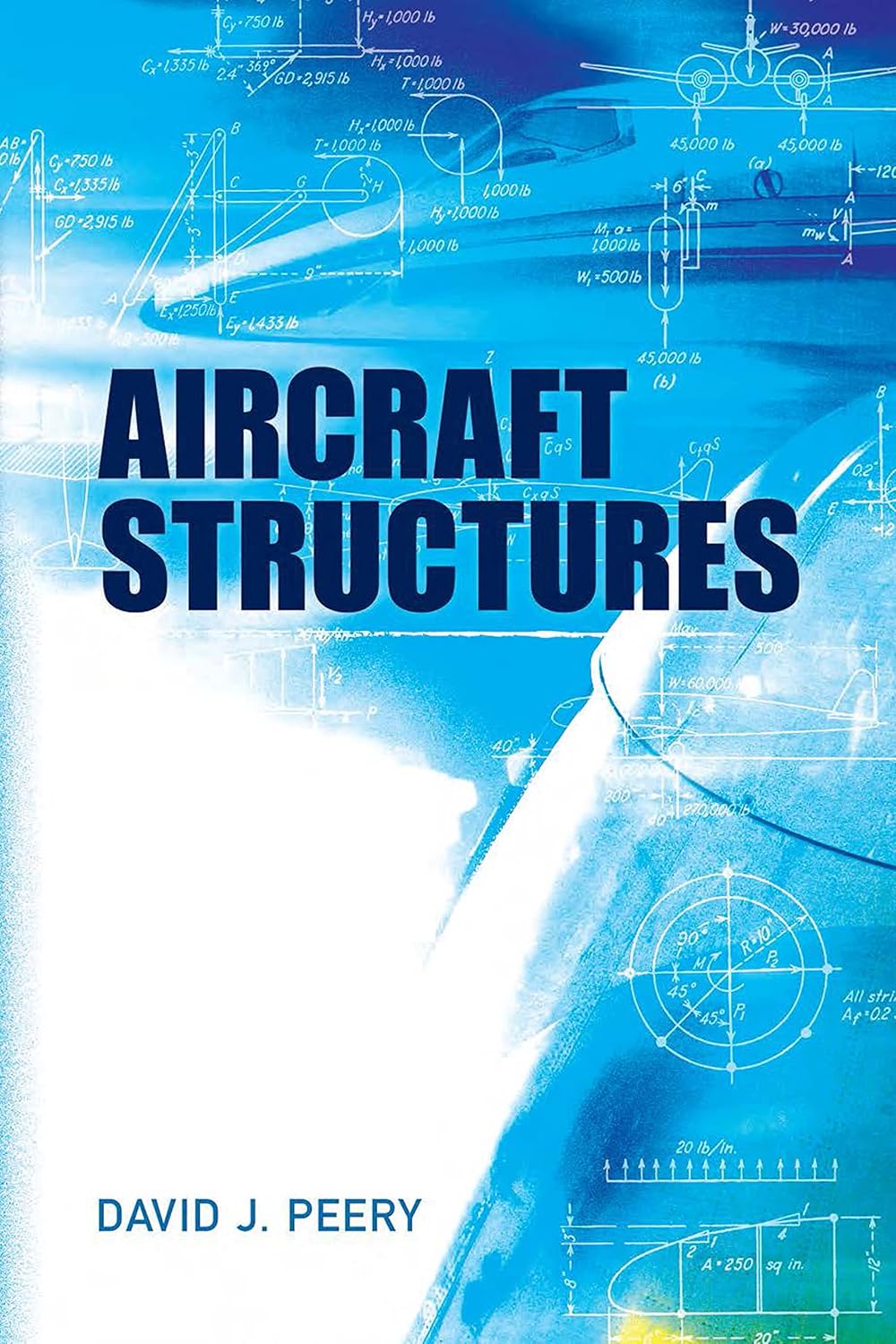
AIRCRAFT STRUCTURES
By David J. PeeryDover Publications, Inc.
Copyright © 2014 Dover Publications, Inc.All rights reserved.
ISBN: 978-0-486-48580-5
Contents
PREFACE,1. EQUILIBRIUM OF FORCES,
2. SPACE STRUCTURES,
3. INERTIA FORCES AND LOAD FACTORS,
4. MOMENTS OF INERTIA, MOHR'S CIRCLE,
5. SHEAR AND BENDING-MOMENT DIAGRAMS,
6. SHEAR AND BENDING STRESSES IN SYMMETRICAL BEAMS,
7. BEAMS WITH UNSYMMETRICAL CROSS SECTIONS,
8. ANALYSIS OF TYPICAL MEMBERS OF SEMIMONOCOQUE STRUCTURES,
9. SPANWISE AIR-LOAD DISTRIBUTION,
10. EXTERNAL LOADS ON THE AIRPLANE,
11. MECHANICAL PROPERTIES OF AIRCRAFT MATERIALS,
12. JOINTS AND FITTINGS,
13. DESIGN OF MEMBERS IN TENSION, BENDING, OR TORSION,
14. DESIGN OF COMPRESSION MEMBERS,
15. DESIGN OF WEBS IN SHEAR,
16. DEFLECTIONS OF STRUCTURES,
17. STATICALLY INDETERMINATE STRUCTURES,
18. SPECIAL METHODS OF ANALYSIS,
APPENDIX,
INDEX,
CHAPTER 1
EQUILIBRIUM OF FORCES
1.1. Equations of Equilibrium. One of the first steps in the design of a machine or structure is the determination of the loads acting on each member. The loads acting on an airplane may occur in various landing or flight conditions. The loads may be produced by ground reactions on the wheels, by aerodynamic forces on the wings and other surfaces, or by forces exerted on the propeller. The loads are resisted by the weight or inertia of the various parts of the airplane. Several loading conditions must be considered, and each member must be designed for the combination of conditions which produces the highest stress in the member. For practically all members of the airplane structure the maximum loads occur when the airplane is in an accelerated flight or landing condition and the external loads are not in equilibrium. If, however, the inertia loads are also considered, they will form a system of forces which are in equilibrium with the external loads. In the design of any member it is necessary to find all the forces acting on the member, including inertia forces. Where these forces are in the same plane, as is often the case, the following equations of static equilibrium apply to any isolated portion of the structure:
[MATHEMATICAL EXPRESSION NOT REPRODUCIBLE IN ASCII] (1.1)
The terms [summation]Fx and [summation]Fy represent the summations of the components of forces along x and y axes, which may be taken in any two arbitrary directions. The term [summation]M represents the sum of the moments of all forces about any arbitrarily chosen point in the plane. Each of these equations may be set up in an infinite number of ways for any problem, since the directions of the axes and the center of moments may be chosen arbitrarily. Only three independent equations exist for any free body, however, and only three unknown forces may be found from the equations. If, for example, an attempt is made to find four unknown forces by using the two force equations and moment equations about two points, the four equations cannot be solved because they are not independent, i.e., one of the equations can be derived from the other three. The following equations cannot be solved for the numerical values of the three unknowns because they are not independent.
x + y + z = 3
x + y + 2z = 4
2x + 2y + 3z = 7
The third equation may be obtained by adding the first two equations, and consequently does not represent an independent condition.
In the analysis of a structure containing several members it is necessary to draw a free-body diagram for each member, showing all the forces acting on that member. It is not possible to show these forces on a composite sketch of the entire structure, since equal and opposite forces act at all joints and an attempt to designate the correct direction of the force on each member will be confusing. In applying the equations of statics it is desirable to choose the axes and centers of moments so that only one unknown appears in each equation.
Many structural joints are made with a single bolt or pin. Such joints are assumed to have no resistance to rotation. The force at such a joint must pass through the center of the pin, as shown in Fig. 1.1, since the moment about the center of the pin must be zero. The force at the pin joint has two unknown quantities, the magnitude F and the direction θ. It is usually more convenient to find the two unknown components, Fx and Fy, from which F and θ can be found by the equations:
F = √ F2x + F2y (1.2)
tan θ = Fy/Fx (1.3)
The statics problem is considered as solved when the components Fx and Fy at each joint are obtained.
1.2. Two-force Members. When a structural member has forces acting at only two points, these forces must be equal and opposite, as shown in Fig. 1.2. Since moments about point A must be zero, the force FB must pass through point A. Similarly the force FA must pass through point B for moments about point B to be zero. From a summation of forces, the forces FB and FA must have equal magnitudes but opposite directions. Two-force members are frequently used in aircraft and other structures, since simple tension or compression members are usually the lightest members for transmitting forces. Where possible, two-force members are straight, rather than curved as shown in Fig. 1.2. Structures made up entirely of two-force members are called trusses and are frequently used in fuselages, engine mounts, and other aircraft structures, as well as in bridge and building structures. Trusses represent an important special type of structure and will be treated in detail in the following articles.
Many structures contain some two-force members, as well as some members which resist more than two forces. These structures must first be examined carefully in order to determine which members are two-force members. Students frequently make the serious mistake of assuming that forces act in the direction of a member, when the member resists forces at three or more points. In the case of curved two-force members such as shown in Fig. 1.2, it is important to assume that the forces act along the line between pins, rather than along the axis of the members.
While Eqs. 1.1 are simple and well known, it is very important for a student to acquire proficiency in the application of these equations to various types of structures. A typical structure will be analyzed as an example problem.
Example. Find the forces acting at all joints of the structure shown in Fig. 1.3.
Solution. First draw free-body diagrams of all members, as shown in Fig. 1.4. Since AB and GD are two-force members, the forces in these members are along the line joining the pin joints of these members, and free-body diagrams of these members are not shown. The directions of forces are assumed, but care must be taken to show the forces at any joint in opposite directions on the two members, that is, Cx is assumed to act to the right on the horizontal member, and therefore must act to the left on the vertical member. If forces are assumed in the wrong direction, the calculated magnitudes will be negative.
For the pulley,
[MATHEMATICAL EXPRESSION NOT REPRODUCIBLE IN ASCII]
Once the numerical values of these forces are obtained, they are shown on the free-body diagram. Subsequent equations contain the known numerical values rather than the algebraic symbols for the forces.
For member CGH,
[MATHEMATICAL EXPRESSION NOT REPRODUCIBLE IN ASCII]
Since Cx and Cy are negative, the directions of the vectors on the free-body diagrams are changed. Such changes are made by crossing out the original arrows rather than by erasing, in order that the analysis may be checked conveniently by the original designer or by others. Extreme care must be observed in using the proper direction of known forces.
For member BCDE,
[MATHEMATICAL EXPRESSION NOT REPRODUCIBLE IN ASCII]
All forces have now been obtained without the use of the entire structure as a free body. The solution will be checked by using all three equations of equilibrium for the entire structure.
Check using entire structure as free body,
[summation]Fx = 1,250 - 1,000 - 500 cos 60° = 0
[summation]Fy = 1,433 - 1,000 - 500 sin 60° = 0
[summation]FE = 1,000 x 9 - 1,000 x 7 - 500 x 4 = 0
This check should be made wherever possible in order to detect errors in computing moment arms or forces.
PROBLEMS
1.1. A 5,000-lb airplane is in a steady glide with the flight path at an angle θ below the horizontal. The drag force in the direction of the flight path is 750 lb. Find the lift force L normal to the flight path and the angle θ.
1.2. A jet-propelled airplane in steady flight has forces acting as shown. Find the jet thrust T, lift L, and tail load P.
1.3. A wind-tunnel model of an airplane wing is suspended as shown. Find the loads in members B, C, and E if the forces at A are L = 43.8 lb, D = 3.42 lb, and M = -20.6 in-lb.
1.4. For the model of Prob. 1.3 find the forces L, D, and M at a point A, if the measured forces are B = 40.2 lb, C = 4.16 lb, and E = 3.74 lb.
1.5. Find the horizontal and vertical components of the forces at all joints. The reaction at point B is vertical. Check results by using the three remaining equations of statics.
1.6. Find the horizontal and vertical components of the forces at all joints. The reaction at point B is horizontal. Check results by three equations.
1.7. Find the horizontal and vertical components of the forces at all joints. The reaction at point B is vertical. Check results by three equations.
1.8. Find the forces at all joints of the structure. Check results by three equations.
1.9. Find the forces on all members of the biplane structure shown. Check results by considering equilibrium of entire structure as a free body.
1.10. Find the forces at points A and B of the landing gear shown.
1.11. Find the forces at points A, B, and C of the structure of the bracedwing monoplane shown.
1.12. Find the forces V and M at the cut cross section of the beam.
1.3. Truss Structures. A truss has been defined as a structure which is composed entirely of two-force members. In some cases the members have a single bolt or pin connection at each end, and the external loads are applied only at the pin joints. In other cases the members are welded or riveted at the ends, but are assumed to be pin-connected in the analysis because it has been found that such an analysis yields approximately the correct values for the forces in the members. The trusses considered in this chapter are assumed to be coplanar; the loads resisted by the truss and the axes of all of the truss members lie in the same plane.
Trusses may be classified as statically determinate and statically indeterminate. The forces in all of the members of a statically determinate truss may be obtained from the equations of statics. In a statically indeterminate truss, there are more unknown forces than the number of independent equations of statics, and the forces cannot be determined from the equations of statics. If a rigid structure is supported in such a manner that three nonparallel, nonconcurrent reaction components are developed, the three reaction forces may be obtained from the three equations of statics for the entire structure as a free body. If more than three support reactions are developed, the structure is statically indeterminate externally.
Trusses which have only three reaction force components, but which contain more members than required, are statically indeterminate internally. Trusses are normally formed of a series of triangular frames. The first triangle contains three members and three joints. Additional triangles are each formed by adding two members and one joint. The number of members m has the following relationship to the number of joints j.
m - 3 = 2(j - 3)
or
m = 2j - 3 (1.4)
If a truss has one less member than the number specified by Eq. 1.4, it becomes a linkage or mechanism, with one degree of freedom. A linkage is not capable of resisting loads, and is classified as an unstable structure. If a truss has one more member than the number specified by Eq. 1.4, it is statically indeterminate internally.
If each pin joint of a truss is considered as a free body, the two statics equations [summation]Fx = 0 and [summation]Fy = 0 may be applied. The equation [summation]M = 0 does not apply, since all forces act through the pin, and the moments about the pin will be zero regardless of the magnitudes of the forces. Thus, for a truss with j joints, there are 2j independent equations of statics. The equations for the equilibrium of the entire structure are not independent of the equations for the joints, since they can be derived from the equations of equilibrium for the joints. For example, the equation [summation]Fx = 0 for the entire structure may be obtained by adding all the equations [summation]Fx = 0 for the individual joints. The equations [summation]Fy = 0 and [summation]M = 0 for the entire truss may similarly be obtained from the equations for the joints. Equation 1.4 may therefore be derived in another manner by equating the number of unknown forces for m members and three reactions to the number of independent equations 2j, or m + 3 = 2j.
It is necessary to apply Eq. 1.4 with care. The equation is applicable for the normal truss which contains a series of triangular frames and has three external reactions, such as the truss shown in Fig. 1.5(a). For other trusses it is necessary to determine by inspection that all parts of the structure are stable. The truss shown in Fig. 1.5(b) satisfies Eq. 1.4; yet the left panel is unstable, while the right panel has one more diagonal than is necessary. The truss shown in Fig. 1.5(c) is stable and statically determinate, even though it is not constructed entirely of triangular frames.
Some trusses may have more than three external reactions, and fewer members than are specified by Eq. 1.4, and be stable and statically determinate. The number of reactions r may be substituted for the three in Eq. 1.4.
m = 2j - r (1.4a)
The number of independent equations, 2j, is therefore sufficient to obtain the m + r unknown forces for the members and the reactions. An example of a stable and statically determinate truss which has four reactions may be obtained from the truss of Fig. 1.5(a) by adding a horizontal reaction at the upper left-hand corner and removing the right-hand diagonal member.
1.4. Truss Analysis by Method of Joints. In the analysis of a truss by the method of joints, the two equations of static equilibrium, [summation]Fx = 0 and [summation]Fy = 0, are applied for each joint as a free body. Two unknown forces may be obtained for each joint. Since each member is a two-force member, it exerts equal and opposite forces on the joints at its ends. The joints of a truss must be analyzed in sequence by starting at a joint which has only two members with unknown forces. After finding the forces in these two members, an adjacent joint at the end of one of these members will have only two unknown forces. The joints are then analyzed in the proper sequence until all joints have been considered.
In most structures it is necessary to determine the three external reactions from the equations of equilibrium for the entire structure, in order to have only two unknown forces at each joint. These three equations are used in addition to the 2j equations at the joints. Since there are only 2j unknown forces, three of the equations are not necessary for finding the unknowns, but should always be used for checking the numerical work. The analysis of a truss by the method of joints will be illustrated by a numerical example.
Example. Find the loads in all the members of the truss shown in Fig. 1.6.
Solution. Draw a free-body diagram for the entire structure and for each joint, as shown in Fig. 1.7. Since all loads in the two-force members act along the members, it is possible to show all forces on a sketch of the truss, as shown in Fig. 1.7, if the forces are specified as acting on the joints. Care must be used in the directions of the vectors, since at every point there is always a force acting on the member which is equal and opposite to the force acting on the joint. If a structure contains any members which are not two-force members, it is always necessary to make separate free-body sketches of these members, as shown in Fig. 1.4.
(Continues...)Excerpted from AIRCRAFT STRUCTURES by David J. Peery. Copyright © 2014 Dover Publications, Inc.. Excerpted by permission of Dover Publications, Inc..
All rights reserved. No part of this excerpt may be reproduced or reprinted without permission in writing from the publisher.
Excerpts are provided by Dial-A-Book Inc. solely for the personal use of visitors to this web site.
Details:
Visit the Dover Publications Store
Aircraft Structures (Dover Books on Aeronautical Engineering)
AED24360
Quantity:
Order today to get by 7-14 business days
This item qualifies for free delivery
 Imported From: United States
At BOLO, we work hard to ensure the products you receive are new, genuine, and sourced from reputable suppliers.
Every product in the BOLO catalogue is sourced through our Verified Global Supply Network of verified sellers, authorized distributors or directly from the manufacturer.
Each product undergoes thorough inspection and verification at our consolidation and fulfilment centers to ensure it meets our strict authenticity and quality standards before being shipped and delivered to you.
If you ever have concerns regarding the authenticity of a product purchased from us, please contact Bolo Support. We will review your inquiry promptly and, if necessary, provide documentation verifying authenticity or offer a suitable resolution.
Your trust is our top priority, and we are committed to maintaining transparency and integrity in every transaction.
While we strive to display accurate information, variations in packaging, labeling, instructions, or formulation may occasionally occur due to regional differences or supplier updates. For detailed or manufacturer-specific information, please contact the brand directly or reach out to BOLO Support for assistance.
Unless otherwise stated, all prices displayed on the product page include applicable taxes and import duties.
BOLO operates in accordance with the laws and regulations of United Arab Emirates. Any items found to be restricted or prohibited for sale within the United Arab Emirates will be cancelled prior to shipment. We take proactive measures to ensure that only products permitted for sale in United Arab Emirates are listed on our website.
All items are shipped by air, and any products classified as “Dangerous Goods (DG)” under IATA regulations will be removed from the order and cancelled.
All orders are processed manually, and we make every effort to process them promptly once confirmed. Products cancelled due to the above reasons will be permanently removed from listings across the website.
Similar suggestions by Bolo
More from this brand
Similar items from “Aerodynamics”
Share with
Or share with link
https://www.bolo.ae/products/U0486485803
Visit the Dover Publications Store
Aircraft Structures (Dover Books on Aeronautical Engineering)
AED24360
Quantity:
Order today to get by 7-14 business days
This item qualifies for free delivery
Imported From: United States
At BOLO, we work hard to ensure the products you receive are new, genuine, and sourced from reputable suppliers.
Every product in the BOLO catalogue is sourced through our Verified Global Supply Network of verified sellers, authorized distributors or directly from the manufacturer.
Each product undergoes thorough inspection and verification at our consolidation and fulfilment centers to ensure it meets our strict authenticity and quality standards before being shipped and delivered to you.
If you ever have concerns regarding the authenticity of a product purchased from us, please contact Bolo Support. We will review your inquiry promptly and, if necessary, provide documentation verifying authenticity or offer a suitable resolution.
Your trust is our top priority, and we are committed to maintaining transparency and integrity in every transaction.
While we strive to display accurate information, variations in packaging, labeling, instructions, or formulation may occasionally occur due to regional differences or supplier updates. For detailed or manufacturer-specific information, please contact the brand directly or reach out to BOLO Support for assistance.
Unless otherwise stated, all prices displayed on the product page include applicable taxes and import duties.
BOLO operates in accordance with the laws and regulations of United Arab Emirates. Any items found to be restricted or prohibited for sale within the United Arab Emirates will be cancelled prior to shipment. We take proactive measures to ensure that only products permitted for sale in United Arab Emirates are listed on our website.
All items are shipped by air, and any products classified as “Dangerous Goods (DG)” under IATA regulations will be removed from the order and cancelled.
All orders are processed manually, and we make every effort to process them promptly once confirmed. Products cancelled due to the above reasons will be permanently removed from listings across the website.
Description:
Editorial Reviews
About the Author
Excerpt. © Reprinted by permission. All rights reserved.
AIRCRAFT STRUCTURES
By David J. PeeryDover Publications, Inc.
Copyright © 2014 Dover Publications, Inc.All rights reserved.
ISBN: 978-0-486-48580-5
Contents
PREFACE,1. EQUILIBRIUM OF FORCES,
2. SPACE STRUCTURES,
3. INERTIA FORCES AND LOAD FACTORS,
4. MOMENTS OF INERTIA, MOHR'S CIRCLE,
5. SHEAR AND BENDING-MOMENT DIAGRAMS,
6. SHEAR AND BENDING STRESSES IN SYMMETRICAL BEAMS,
7. BEAMS WITH UNSYMMETRICAL CROSS SECTIONS,
8. ANALYSIS OF TYPICAL MEMBERS OF SEMIMONOCOQUE STRUCTURES,
9. SPANWISE AIR-LOAD DISTRIBUTION,
10. EXTERNAL LOADS ON THE AIRPLANE,
11. MECHANICAL PROPERTIES OF AIRCRAFT MATERIALS,
12. JOINTS AND FITTINGS,
13. DESIGN OF MEMBERS IN TENSION, BENDING, OR TORSION,
14. DESIGN OF COMPRESSION MEMBERS,
15. DESIGN OF WEBS IN SHEAR,
16. DEFLECTIONS OF STRUCTURES,
17. STATICALLY INDETERMINATE STRUCTURES,
18. SPECIAL METHODS OF ANALYSIS,
APPENDIX,
INDEX,
CHAPTER 1
EQUILIBRIUM OF FORCES
1.1. Equations of Equilibrium. One of the first steps in the design of a machine or structure is the determination of the loads acting on each member. The loads acting on an airplane may occur in various landing or flight conditions. The loads may be produced by ground reactions on the wheels, by aerodynamic forces on the wings and other surfaces, or by forces exerted on the propeller. The loads are resisted by the weight or inertia of the various parts of the airplane. Several loading conditions must be considered, and each member must be designed for the combination of conditions which produces the highest stress in the member. For practically all members of the airplane structure the maximum loads occur when the airplane is in an accelerated flight or landing condition and the external loads are not in equilibrium. If, however, the inertia loads are also considered, they will form a system of forces which are in equilibrium with the external loads. In the design of any member it is necessary to find all the forces acting on the member, including inertia forces. Where these forces are in the same plane, as is often the case, the following equations of static equilibrium apply to any isolated portion of the structure:
[MATHEMATICAL EXPRESSION NOT REPRODUCIBLE IN ASCII] (1.1)
The terms [summation]Fx and [summation]Fy represent the summations of the components of forces along x and y axes, which may be taken in any two arbitrary directions. The term [summation]M represents the sum of the moments of all forces about any arbitrarily chosen point in the plane. Each of these equations may be set up in an infinite number of ways for any problem, since the directions of the axes and the center of moments may be chosen arbitrarily. Only three independent equations exist for any free body, however, and only three unknown forces may be found from the equations. If, for example, an attempt is made to find four unknown forces by using the two force equations and moment equations about two points, the four equations cannot be solved because they are not independent, i.e., one of the equations can be derived from the other three. The following equations cannot be solved for the numerical values of the three unknowns because they are not independent.
x + y + z = 3
x + y + 2z = 4
2x + 2y + 3z = 7
The third equation may be obtained by adding the first two equations, and consequently does not represent an independent condition.
In the analysis of a structure containing several members it is necessary to draw a free-body diagram for each member, showing all the forces acting on that member. It is not possible to show these forces on a composite sketch of the entire structure, since equal and opposite forces act at all joints and an attempt to designate the correct direction of the force on each member will be confusing. In applying the equations of statics it is desirable to choose the axes and centers of moments so that only one unknown appears in each equation.
Many structural joints are made with a single bolt or pin. Such joints are assumed to have no resistance to rotation. The force at such a joint must pass through the center of the pin, as shown in Fig. 1.1, since the moment about the center of the pin must be zero. The force at the pin joint has two unknown quantities, the magnitude F and the direction θ. It is usually more convenient to find the two unknown components, Fx and Fy, from which F and θ can be found by the equations:
F = √ F2x + F2y (1.2)
tan θ = Fy/Fx (1.3)
The statics problem is considered as solved when the components Fx and Fy at each joint are obtained.
1.2. Two-force Members. When a structural member has forces acting at only two points, these forces must be equal and opposite, as shown in Fig. 1.2. Since moments about point A must be zero, the force FB must pass through point A. Similarly the force FA must pass through point B for moments about point B to be zero. From a summation of forces, the forces FB and FA must have equal magnitudes but opposite directions. Two-force members are frequently used in aircraft and other structures, since simple tension or compression members are usually the lightest members for transmitting forces. Where possible, two-force members are straight, rather than curved as shown in Fig. 1.2. Structures made up entirely of two-force members are called trusses and are frequently used in fuselages, engine mounts, and other aircraft structures, as well as in bridge and building structures. Trusses represent an important special type of structure and will be treated in detail in the following articles.
Many structures contain some two-force members, as well as some members which resist more than two forces. These structures must first be examined carefully in order to determine which members are two-force members. Students frequently make the serious mistake of assuming that forces act in the direction of a member, when the member resists forces at three or more points. In the case of curved two-force members such as shown in Fig. 1.2, it is important to assume that the forces act along the line between pins, rather than along the axis of the members.
While Eqs. 1.1 are simple and well known, it is very important for a student to acquire proficiency in the application of these equations to various types of structures. A typical structure will be analyzed as an example problem.
Example. Find the forces acting at all joints of the structure shown in Fig. 1.3.
Solution. First draw free-body diagrams of all members, as shown in Fig. 1.4. Since AB and GD are two-force members, the forces in these members are along the line joining the pin joints of these members, and free-body diagrams of these members are not shown. The directions of forces are assumed, but care must be taken to show the forces at any joint in opposite directions on the two members, that is, Cx is assumed to act to the right on the horizontal member, and therefore must act to the left on the vertical member. If forces are assumed in the wrong direction, the calculated magnitudes will be negative.
For the pulley,
[MATHEMATICAL EXPRESSION NOT REPRODUCIBLE IN ASCII]
Once the numerical values of these forces are obtained, they are shown on the free-body diagram. Subsequent equations contain the known numerical values rather than the algebraic symbols for the forces.
For member CGH,
[MATHEMATICAL EXPRESSION NOT REPRODUCIBLE IN ASCII]
Since Cx and Cy are negative, the directions of the vectors on the free-body diagrams are changed. Such changes are made by crossing out the original arrows rather than by erasing, in order that the analysis may be checked conveniently by the original designer or by others. Extreme care must be observed in using the proper direction of known forces.
For member BCDE,
[MATHEMATICAL EXPRESSION NOT REPRODUCIBLE IN ASCII]
All forces have now been obtained without the use of the entire structure as a free body. The solution will be checked by using all three equations of equilibrium for the entire structure.
Check using entire structure as free body,
[summation]Fx = 1,250 - 1,000 - 500 cos 60° = 0
[summation]Fy = 1,433 - 1,000 - 500 sin 60° = 0
[summation]FE = 1,000 x 9 - 1,000 x 7 - 500 x 4 = 0
This check should be made wherever possible in order to detect errors in computing moment arms or forces.
PROBLEMS
1.1. A 5,000-lb airplane is in a steady glide with the flight path at an angle θ below the horizontal. The drag force in the direction of the flight path is 750 lb. Find the lift force L normal to the flight path and the angle θ.
1.2. A jet-propelled airplane in steady flight has forces acting as shown. Find the jet thrust T, lift L, and tail load P.
1.3. A wind-tunnel model of an airplane wing is suspended as shown. Find the loads in members B, C, and E if the forces at A are L = 43.8 lb, D = 3.42 lb, and M = -20.6 in-lb.
1.4. For the model of Prob. 1.3 find the forces L, D, and M at a point A, if the measured forces are B = 40.2 lb, C = 4.16 lb, and E = 3.74 lb.
1.5. Find the horizontal and vertical components of the forces at all joints. The reaction at point B is vertical. Check results by using the three remaining equations of statics.
1.6. Find the horizontal and vertical components of the forces at all joints. The reaction at point B is horizontal. Check results by three equations.
1.7. Find the horizontal and vertical components of the forces at all joints. The reaction at point B is vertical. Check results by three equations.
1.8. Find the forces at all joints of the structure. Check results by three equations.
1.9. Find the forces on all members of the biplane structure shown. Check results by considering equilibrium of entire structure as a free body.
1.10. Find the forces at points A and B of the landing gear shown.
1.11. Find the forces at points A, B, and C of the structure of the bracedwing monoplane shown.
1.12. Find the forces V and M at the cut cross section of the beam.
1.3. Truss Structures. A truss has been defined as a structure which is composed entirely of two-force members. In some cases the members have a single bolt or pin connection at each end, and the external loads are applied only at the pin joints. In other cases the members are welded or riveted at the ends, but are assumed to be pin-connected in the analysis because it has been found that such an analysis yields approximately the correct values for the forces in the members. The trusses considered in this chapter are assumed to be coplanar; the loads resisted by the truss and the axes of all of the truss members lie in the same plane.
Trusses may be classified as statically determinate and statically indeterminate. The forces in all of the members of a statically determinate truss may be obtained from the equations of statics. In a statically indeterminate truss, there are more unknown forces than the number of independent equations of statics, and the forces cannot be determined from the equations of statics. If a rigid structure is supported in such a manner that three nonparallel, nonconcurrent reaction components are developed, the three reaction forces may be obtained from the three equations of statics for the entire structure as a free body. If more than three support reactions are developed, the structure is statically indeterminate externally.
Trusses which have only three reaction force components, but which contain more members than required, are statically indeterminate internally. Trusses are normally formed of a series of triangular frames. The first triangle contains three members and three joints. Additional triangles are each formed by adding two members and one joint. The number of members m has the following relationship to the number of joints j.
m - 3 = 2(j - 3)
or
m = 2j - 3 (1.4)
If a truss has one less member than the number specified by Eq. 1.4, it becomes a linkage or mechanism, with one degree of freedom. A linkage is not capable of resisting loads, and is classified as an unstable structure. If a truss has one more member than the number specified by Eq. 1.4, it is statically indeterminate internally.
If each pin joint of a truss is considered as a free body, the two statics equations [summation]Fx = 0 and [summation]Fy = 0 may be applied. The equation [summation]M = 0 does not apply, since all forces act through the pin, and the moments about the pin will be zero regardless of the magnitudes of the forces. Thus, for a truss with j joints, there are 2j independent equations of statics. The equations for the equilibrium of the entire structure are not independent of the equations for the joints, since they can be derived from the equations of equilibrium for the joints. For example, the equation [summation]Fx = 0 for the entire structure may be obtained by adding all the equations [summation]Fx = 0 for the individual joints. The equations [summation]Fy = 0 and [summation]M = 0 for the entire truss may similarly be obtained from the equations for the joints. Equation 1.4 may therefore be derived in another manner by equating the number of unknown forces for m members and three reactions to the number of independent equations 2j, or m + 3 = 2j.
It is necessary to apply Eq. 1.4 with care. The equation is applicable for the normal truss which contains a series of triangular frames and has three external reactions, such as the truss shown in Fig. 1.5(a). For other trusses it is necessary to determine by inspection that all parts of the structure are stable. The truss shown in Fig. 1.5(b) satisfies Eq. 1.4; yet the left panel is unstable, while the right panel has one more diagonal than is necessary. The truss shown in Fig. 1.5(c) is stable and statically determinate, even though it is not constructed entirely of triangular frames.
Some trusses may have more than three external reactions, and fewer members than are specified by Eq. 1.4, and be stable and statically determinate. The number of reactions r may be substituted for the three in Eq. 1.4.
m = 2j - r (1.4a)
The number of independent equations, 2j, is therefore sufficient to obtain the m + r unknown forces for the members and the reactions. An example of a stable and statically determinate truss which has four reactions may be obtained from the truss of Fig. 1.5(a) by adding a horizontal reaction at the upper left-hand corner and removing the right-hand diagonal member.
1.4. Truss Analysis by Method of Joints. In the analysis of a truss by the method of joints, the two equations of static equilibrium, [summation]Fx = 0 and [summation]Fy = 0, are applied for each joint as a free body. Two unknown forces may be obtained for each joint. Since each member is a two-force member, it exerts equal and opposite forces on the joints at its ends. The joints of a truss must be analyzed in sequence by starting at a joint which has only two members with unknown forces. After finding the forces in these two members, an adjacent joint at the end of one of these members will have only two unknown forces. The joints are then analyzed in the proper sequence until all joints have been considered.
In most structures it is necessary to determine the three external reactions from the equations of equilibrium for the entire structure, in order to have only two unknown forces at each joint. These three equations are used in addition to the 2j equations at the joints. Since there are only 2j unknown forces, three of the equations are not necessary for finding the unknowns, but should always be used for checking the numerical work. The analysis of a truss by the method of joints will be illustrated by a numerical example.
Example. Find the loads in all the members of the truss shown in Fig. 1.6.
Solution. Draw a free-body diagram for the entire structure and for each joint, as shown in Fig. 1.7. Since all loads in the two-force members act along the members, it is possible to show all forces on a sketch of the truss, as shown in Fig. 1.7, if the forces are specified as acting on the joints. Care must be used in the directions of the vectors, since at every point there is always a force acting on the member which is equal and opposite to the force acting on the joint. If a structure contains any members which are not two-force members, it is always necessary to make separate free-body sketches of these members, as shown in Fig. 1.4.
(Continues...)Excerpted from AIRCRAFT STRUCTURES by David J. Peery. Copyright © 2014 Dover Publications, Inc.. Excerpted by permission of Dover Publications, Inc..
All rights reserved. No part of this excerpt may be reproduced or reprinted without permission in writing from the publisher.
Excerpts are provided by Dial-A-Book Inc. solely for the personal use of visitors to this web site.
Details:
Similar suggestions by Bolo
More from this brand
Similar items from “Aerodynamics”
Share with
Or share with link
https://www.bolo.ae/products/U0486485803