Deliver toUnited Arab Emirates
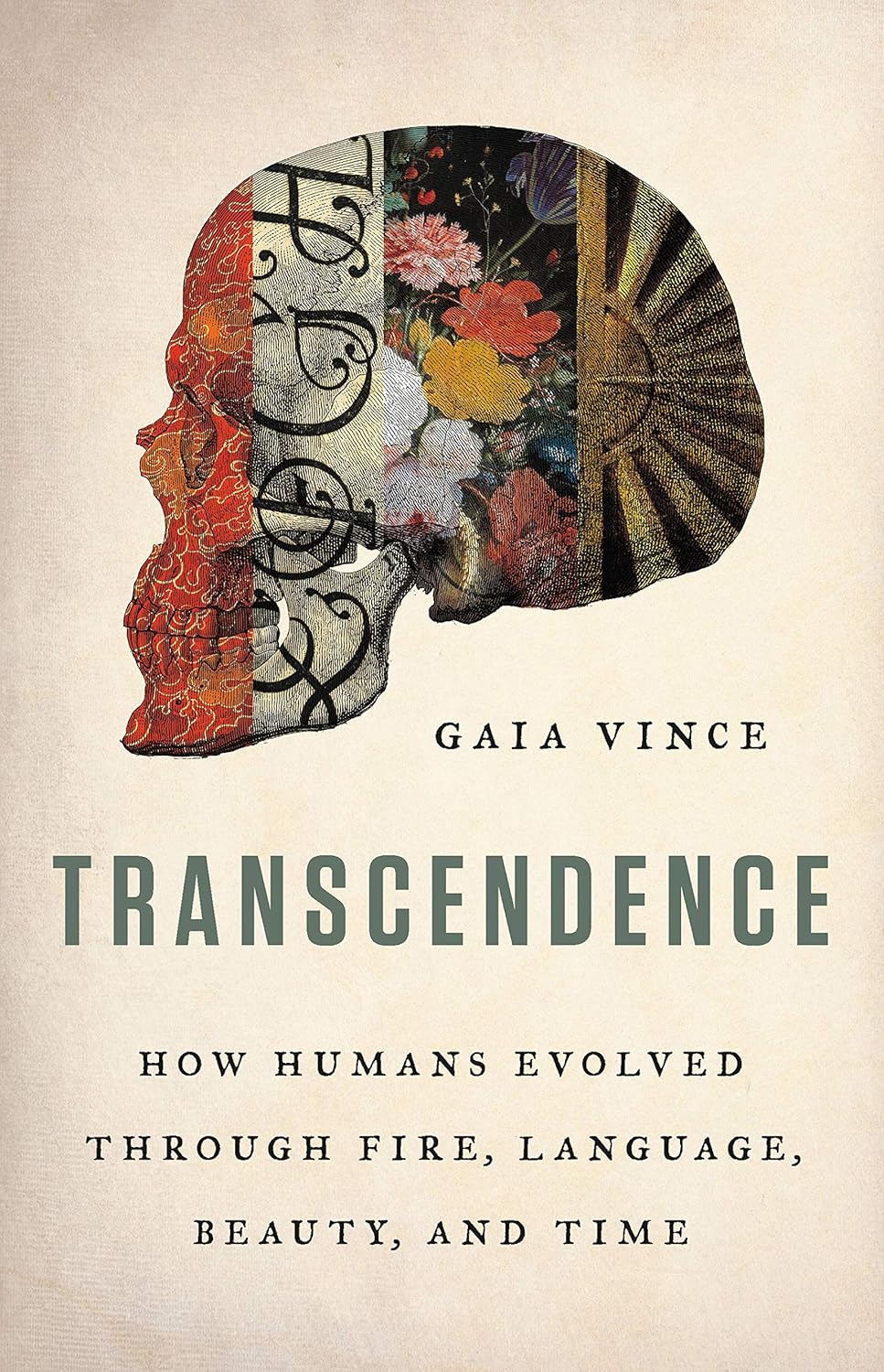
Transcendence: How Humans Evolved through Fire, Language, Beauty, and Time

Description:


In the tradition of Guns, Germs, and Steel and Sapiens, a winner of the Royal Society Prize for Science Books shows how four tools enabled has us humans to control the destiny of our species


"A wondrous, visionary work." --Tim Flannery, scientist and author of the bestselling The Weather Makers


What enabled us to go from simple stone tools to smartphones? How did bands of hunter-gatherers evolve into multinational empires? Readers of
Sapiens will say a cognitive revolution -- a dramatic evolutionary change that altered our brains, turning primitive humans into modern ones -- caused a cultural explosion. In Transcendence, Gaia Vince argues instead that modern humans are the product of a nuanced coevolution of our genes, environment, and culture that goes back into deep time. She explains how, through four key elements -- fire, language, beauty, and time -- our species diverged from the evolutionary path of all other animals, unleashing a compounding process that launched us into the Space Age and beyond. Provocative and poetic, Transcendence shows how a primate took dominion over nature and turned itself into something marvelous.


Editorial Reviews

Review

A best book of the year (Times of London)

"History doesn't get much bigger than this epic sweep through human progress....Vince takes dizzying leaps, making connections between archaeology, anthropology, genetics, and psychology."―
Tom Whipple, Times of London

"Any story that begins with the words '14 billion years ago' is bound to be epic, and
Transcendence is no exception... An impressive breadth of research from paleoarchaeology to genetics to anthropology."―M.R. O'Connor, Undark

"A hugely enjoyable sprint through human evolutionary history... and a good story."―
Tim Radford, Nature

"Captivating... A provocative, highly readable take on our astonishing emergence from the primordial soup."―
Kirkus Reviews (starred review)

"A wondrous, visionary work."―
Tim Flannery, scientist and authorof The Weather Makers

"
Transcendence is a beautifully imaginative overview of the biological and cultural evolution of humans. Richly informed by the latest research, Vince's colorful survey fizzes like a zip-wire as it tours our species' story from the Big Bang to the coming age of hyper-cooperation."―Richard Wrangham, professor of biological anthropology at HarvardUniversity and author of The Goodness Paradox

"An imaginative and inspiring adventure into the origins and evolution of what we hold most dear: our human culture."―
Uta Frith, emeritus professor of cognitive development UCL

"This book goes from the Big Bang to the Hundred Thousand Genome Project to make a convincing case that
Homo sapiens has become a super-organism. I learned a lot from it and so will you."―Steve Jones, Emeritus Professor of HumanGenetics UCL and author of Here Comes the Sun

"Science writer Vince looks at human evolution in terms of four elements -- dubbed Fire, Word, Beauty, and Time -- in this stimulating account... Even those broadly familiar with humanity's story will find new information and insights in Vince's fascinating study."
Publishers Weekly

"An engaging, well-researched book for anyone curious about the development of humanity as approached through a social lens."―
Library Journal

About the Author


Gaia Vince is a science writer and broadcaster. In 2015, she was the first woman to win the Royal Society Insight Investment Science Book prize solo for her debut, Adventures in the Anthropocene. She has held senior editorial posts at Nature and New Scientist, and writes for Science, the Guardian, and others. She lives in London.

Reviews:

5.0 out of 5 stars Easy to Read, Fascinating Content

S.S. · July 27, 2020

With an eye toward possible futures, our strategic foresight team is reading Transcendence: How Humans Evolved Through Fire, Language, Beauty, and Time by Gaia Vince. We read on nights and weekends and then hold a one-hour book club meeting. Transcendence chronicles human evolution by sharing stores reinforced by the latest scientific research. It is part fact sharing and imagination — just the stuff that strategic foresight practitioners consider. I enjoyed this book as much as any book I have ever read. From a form standpoint, there are short chapters that provide immediate gratification as I completed them quickly. Vince presents complex ideas in very simple, straightforward terms. And what subject matter could be more compelling — how and why we are the way we are.

5.0 out of 5 stars A wonderfully curated journey across humanity

D. · March 10, 2022

The author does a great job of taking the reader through key milestones of humanity and assembling them as the result of a three pronged “stew” that progressed us from simple isolated beings to an astonishingly powerful global species. The scope it covers prevents it from being granular about any one topic but the theories it posits are intriguing and the journey was an enjoyable one. Would recommend this book to anyone who stumbles upon it here and is curious enough to read the reviews. You’re here for a reason.

5.0 out of 5 stars Immensely Intriguing

A. · July 31, 2022

I started the book wanting to highlight everything I found interesting and I found my pages completely covered in my yellow highlighter. The book is broken up to the four sections (fire,word,beauty,time) in which she believes was most influential to our revolution as humans. A wonderful read that truly causes me to see the world in a different way.

4.0 out of 5 stars Interesting bits but overall no transcendence

W.S.J. · October 24, 2020

Each chapter has lots of interesting bits that show the wealth of reading the author has managed to keep up on but apart from the progression through the topics I never reached a sense of transcendence.

5.0 out of 5 stars One of the best history books I have ever read

K.C. · May 31, 2021

I loved this book. It was well-written and easy to read. I recommended it to all of my friends and gave it to several people as a gift. It is packed with information that expanded my world view in surprising ways. I love books that challenge me to grow, and this book did.

3.0 out of 5 stars Wordy and Political but worth my time

A.G. · June 26, 2022

I love the history of human kind from our earliest hominid ancestors to todays modern humans so I bought this book. Gaia’s wordy prose was frustrating at times. I consistently had to reread sentences. Made the 280ish actual pages a bit of a slow read. But there was a lot of good information to be gleaned albeit nothing I haven’t read before. It was an amalgamation of others works, discoveries and insights into a book that she present as her own. Fair enough, she cited everything, but there was not an original thought in there besides her disdain of American politics. Of which her bias was showing. She has a watered down understanding of pretty much everything in this book. Read Yuval’s book and skip this one unless you are interested in this topic.

5.0 out of 5 stars When I finished it I wanted to read it again

M.M. · May 22, 2020

I learned (and learned to appreciate) so much!This book is the perfect blend of history, science, culture, technology, archaeology, anthropology, and philosophy, weaving threads from each and showing how they influence one another so deeply that you lose track of which is which. Reading it becomes an altogether new experience, not just a collection of strands but something larger and more sublime. Something transcendent.

5.0 out of 5 stars Amazing

M. · March 12, 2020

The scope of this book is truly amazing. There is virtually no aspect of the development of the human animal that is not addressed. I'm a prolific reader of nonfiction science, and this is one of the best books I've encountered. Well written and thoroughly researched - highly recommended.

Bel libro, pessime condizioni

F. · May 3, 2023

Il libro è molto bello e interessante e scritto in modo che mi ha catturato. Le condizioni del volume erano pessime, sembrava rovinato, come se fosse stato esposto in libreria per alcuni anni.

Big book with big ideas - fascinating

J.D. · January 24, 2022

‘Transcendence’ by Gaia Vincent looks at how man and Homo sapiens originated and came onto this planet. It's a big book that covers how managing fire, developing language, creating meaning and tribal identity through beauty and the passing and understanding of time have made us the humans we are today. Here are a few things that I found interesting.- The first part of the book looks at fire and how we leant to make, control and create enough energy to make things like metals from the rocks just by creating enough heat. Fire burnt wood but when we learnt to make it hotter we moved from the stone age into the bronze and iron ages.- The book looks at the power of the mind and how placebos work which is always fascinating to me. And how we use narrative to explain events in our life as well as also triggering medical responses for example through the placebo which will change the biochemical reactions within the body. Narratives change how we are and feel. Our self is embedded into our narrative and if we believe something will work we can change the actual chemical structure of what is going on inside our body to make healing occur. However, different narratives in different cultures and countries can impact and change the way a placebo might actually work. Another interesting thing is that even when people know they have been given a placebo it can still change how we feel, behave and cure ourselves and others. Even the colour of a placebo pill will impact how that placebo will work on our nervous system that helps the healing process. If you believe that something might harm you or kill you it will impact on the longevity of your life. The belief systems and different cultures impact on the way the body heals and responds to the chemical system already within it. There is also an alternative to the placebo called the nocebo effect where if you think something can harm you, it really can.- Evolution teaches us that if you have a bird that doesn't need to fly, for example on an island where there are no longer any predators or a fish in a lagoon that doesn't need to see; the bird will become flightless and lose the power of flight (we need a lot of energy to fly) and the fish will become blind because it doesn't need to see (the brain uses a lot of energy and space to see). We evolve and adapt to the environment we are within.- But how did a member of the ape family learn to develop language and learn to talk? The apparatus of the larynx means that we are at greater risk of choking on food than any other animal, although babies can feed, breathe and swallow at the same time but at three months the apparatus of the swallow process changes and allows humans the ability to learn to talk. We've also learnt to recall information by writing it down.- We don't know when speech emerged and it certainly wasn't invented but evolved (unlike writing) but there is the possibility that it may well have been able to talk to Neanderthals because they possess the same voice box and the same language gene. Worth noting that most words for father and mother around the world are ‘papa’ or ‘mama’ or ‘dada’ - some of the first sounds to emerge from an infant's mouth. Maybe that’s how spoken words began to occur.- Prior to speech babies can communicate at an intentional level by using eye gaze with mum and an object that they might want but that then moves on to pointing which is an incredibly complex and unique human ability to communicate with someone else. No other animal has the skill.- Our language is always evolving and changing, once upon a time ‘nice’ meant ‘bad’ and now it means ‘polite’ and ‘good’ but it can also mean for some people ‘dull’ or ‘bad’. Depending upon the context and how we use our spoken language, the rules and grammar show changes ever evolving and the more people who speak the language the more it will tend to change and evolve.- There are more than 7000 different spoken languages in the world. Language can influence and change our state in different cultures' perceptions of the world. Most languages have a shade of light and dark such as black and white and then if other languages have a third colour, it will always be the colour ‘red’, but many languages don’t have blue so different languages and cultures have different ways of perceiving the world through the language that they know.- The book then goes on to describe beauty from the moment we began to make paintings on caves to the evolution of different fashions in the clothes we wear and the buildings we have built.- The book also explores how cultural influences and biological changes in a single lifetime can change how we behave, how we act and also genetically change characteristics such as people in certain countries being able to see much better underwater or those who live in high altitudes have different oxygen levels in their blood. It also explains nationalism and how culturally shared stories can influence behaviour.- 7000 years ago from genetic information it was determined that most people had dark skin and dark hair but then a remarkable set of people who came in from the Caucasian area and invented the wheel and managed horses had their skin change to allow better absorption of vitamin D (lack of this can cause rickets and developmental problems) as they had less access to sunlight. These were the first people to also invent the wheel and work the horse and learn horse management. This nomadic tribe is known as the Yamnaya’s.- Because these genetic variations are changed and survived and carried on in subsequent generations it now means that 98% of all Europeans can now tolerate drinking milk from that with lactose well into adulthood. This is something only humans have achieved as most animals cannot tolerate milk once they are no longer babies.- The Chinese discovered how to make silk from silkworms and manufactured in far greater numbers which ended up creating a pathway or a silk Road which included trade between Europe and China but also along with this trade came the bubonic plague which wiped out 2/3 of the population of the world. In England, towns were decimated and people must have thought it was the end of days.- The other commodity that was also given value by humans along with silk was spices which is what allowed Christopher Columbus to explore the seas to try and find a route and just discovered the Americas. However what he brought there was not only cruelty but he also brought guns and germs which wiped out many of the American people.- Beauty begins as something to distinguish tribes from other tribes with clothes and how they present themselves. Beyond fashion and cultural garbs, others began to give meaning by building cities and monuments that gave beauty to all who came across them.- During ice ages and low carbon monoxide in the atmosphere humans were basically spent over 190,000 years as nomad gatherers, hunting as they moved around the planet. And then 10,000 years ago, when weather patterns became more stable, they began to domesticate crops so that the majority of what we each come from three different types of crop: wheat, maize and rice but also domesticated animals so that they could be used to plough the land.- The air was warmed by changes in drifts in the atmosphere which made the ice melt and created warmer climates which allowed far greater amounts of agriculture to develop. Man could not settle until he was able to use agriculture to allow him to become settled. The settled farmland then became cities and eventually this is where the majority of humans would end up living. Usually be a source of water, and usually a river.- Over the last many thousands of years of genetic changes, for example taking the ability to select a great difference in genetic makeup between now and a man from 5000 years ago that we have undergone many changes.- However, in the early days of farming and building cities, life was hard. Most people lived short lives, an average age for women and men was about 28 and over 75% of all children would die either in childbirth or early years.- The book then goes on to discuss time and as it passes we have developed greater and greater skills and understanding ourselves in the world we live in and the universe we are within. However there is an interesting caveat in that times when there was religious intolerance of others produced reduced creative and scientific thinking. Religion is the idea of having faith which basically means to believe in something without any tangible proof of its existence, which results in doubt over anything else and the ability to question and reason is reduced.- It's interesting to note and I have always noticed how forward thinking and scientific in its nature and inquiry the Islamic world once was. For 7000 years the language of science was Arabic but lost in Europe as we were so ruled by religious dogma that we had the dark ages and the lack of forward thinking. However with the invention of the printing press in the 1500s on paper and more scientific thinking (when not burning or persecuting people for being witches) which had been originally discovered by the Chinese, Europeans then became much more forward thinking whilst Arabic cultures began to lose their once knowledgeable wisdom of mathes and scientific enquiry.- The book also discusses how personalities and behaviours can influence our voting patterns. For example children who have larger amygdala (a small, almond shaped part of the brain that elicits our fear response) are more prone to fear will have greater tendency later on in life to be more conservative in their voting patterns and ideologies. Even people who might have more of a socialist ideology when experiencing fear tend to revert more to Conservative belief systems.- Although we feel we are rational in our thinking, the way we emotionally respond to things such as germs or sanitiser can change whether we are more conservative or liberal in our thinking. Clearing hands makes us more conservative in our view points on a subject than if we hadn’t sanitised our hands. Our emotions can influence our decision-making as much as rational thought and sometimes more so, and much of this is subconscious.- Liberals tend to be more prone to being artistic and showing creative thinking. We also tend to be more driven by creating greater technology changes when we are more liberal in the culture that we live in. Republicans who tend to believe in climate change not being real not because they follow the evidence or rational based decision-making that because they are they are swayed by their leaders of their current ideology belief systems which makes them think these people are more rational. If a man comes to a decision that is made through this way of thinking, then this shows that their decision-making is not rational and we are often swayed by others. More people are influenced by others in their social tribal group than by rational thought. This occurs at a subconscious level.- The book ends on how man has come from being a part of an ape family to dominate in the world. We have become the largest mass animal population of the world, seconded only by the animals that it uses to breed and feed and make clothes from. We now live in a time when the world and the temperature should be absolutely perfect for mankind to further develop but we are also causing catastrophic global change and littering the world with a wide array of plastic waste everywhere.- Alongside this, most of us have access to all the food we could want but over recent times, there are high levels of malnutrition just as their have been greater numbers of people being obese. We should be living in a golden age where weather and climate are perfect for life and stability and yet we are warming the planet at an incredibly fast rate.- Despite the fact that the human population now produces more food and its safety in numbers and the percentage of people dying in wars has greatly dropped than at any other time in history yet we still create division in our world.- This is a wonderful book, full of interesting stories. Something remarkable to learn on every page.

Great Content

C.P. · November 8, 2020

I heard about this book on the radio and pre-ordered it. The content is insightful and well worth the reading.Must say that the quality of printing could be a little better. Buy it read it, and get on the path to discovering what makes us who we are.

Wonderful!

M. · February 15, 2020

Such a wonderful, beautifully written book about how humans evolved. There is an immense depth of research and a style that makes this a joy to read and I highly recommend it. I rarely write reviews but absolutely loved this book!

Outstanding!

D.G. · January 27, 2021

This is utterly superb! Deeply informative, well-written and highly engaging. I could not put it down from the minute I picked it up. Strongly recommended!

Transcendence: How Humans Evolved through Fire, Language, Beauty, and Time

Product ID: U0465094902
Condition: New

4.6

AED22728

Price includes VAT & Import Duties
Type: Hardcover
Availability: In Stock

Quantity:

|

Order today to get by 7-14 business days

This item qualifies for free delivery

Returns & Warranty policies

Imported From: United States

At BOLO, we work hard to ensure the products you receive are new, genuine, and sourced from reputable suppliers.

BOLO is not an authorized or official retailer for most brands, nor are we affiliated with manufacturers unless specifically stated on a product page. Instead, we source verified sellers, authorized distributors or directly from the manufacturer.

Each product undergoes thorough inspection and verification at our consolidation and fulfilment centers to ensure it meets our strict authenticity and quality standards before being shipped and delivered to you.

If you ever have concerns regarding the authenticity of a product purchased from us, please contact Bolo Support. We will review your inquiry promptly and, if necessary, provide documentation verifying authenticity or offer a suitable resolution.

Your trust is our top priority, and we are committed to maintaining transparency and integrity in every transaction.

All product information, images, descriptions, and reviews originate from the manufacturer or from trusted sellers overseas. BOLO is not affiliated with, endorsed by, or an authorized retailer for most brands listed on our website unless stated otherwise.

While we strive to display accurate information, variations in packaging, labeling, instructions, or formulation may occasionally occur due to regional differences or supplier updates. For detailed or manufacturer-specific information, please contact the brand directly or reach out to BOLO Support for assistance.

Unless otherwise stated, all prices displayed on the product page include applicable taxes and import duties.

BOLO operates in accordance with the laws and regulations of United Arab Emirates. Any items found to be restricted or prohibited for sale within the UAE will be cancelled prior to shipment. We take proactive measures to ensure that only products permitted for sale in United Arab Emirates are listed on our website.

All items are shipped by air, and any products classified as “Dangerous Goods (DG)” under IATA regulations will be removed from the order and cancelled.

All orders are processed manually, and we make every effort to process them promptly once confirmed. Products cancelled due to the above reasons will be permanently removed from listings across the website.

Similar suggestions by Bolo

More from this brand

Similar items from “Civilization & Culture”

Transcendence: How Humans Evolved through Fire, Language, Beauty, and Time

Product ID: U0465094902
Condition: New

4.6

Transcendence: How Humans Evolved through Fire, Language, Beauty, and Time-0
Type: Hardcover

AED22728

Price includes VAT & Import Duties
Availability: In Stock

Quantity:

|

Order today to get by 7-14 business days

This item qualifies for free delivery

Returns & Warranty policies

Imported From: United States

At BOLO, we work hard to ensure the products you receive are new, genuine, and sourced from reputable suppliers.

BOLO is not an authorized or official retailer for most brands, nor are we affiliated with manufacturers unless specifically stated on a product page. Instead, we source verified sellers, authorized distributors or directly from the manufacturer.

Each product undergoes thorough inspection and verification at our consolidation and fulfilment centers to ensure it meets our strict authenticity and quality standards before being shipped and delivered to you.

If you ever have concerns regarding the authenticity of a product purchased from us, please contact Bolo Support. We will review your inquiry promptly and, if necessary, provide documentation verifying authenticity or offer a suitable resolution.

Your trust is our top priority, and we are committed to maintaining transparency and integrity in every transaction.

All product information, images, descriptions, and reviews originate from the manufacturer or from trusted sellers overseas. BOLO is not affiliated with, endorsed by, or an authorized retailer for most brands listed on our website unless stated otherwise.

While we strive to display accurate information, variations in packaging, labeling, instructions, or formulation may occasionally occur due to regional differences or supplier updates. For detailed or manufacturer-specific information, please contact the brand directly or reach out to BOLO Support for assistance.

Unless otherwise stated, all prices displayed on the product page include applicable taxes and import duties.

BOLO operates in accordance with the laws and regulations of United Arab Emirates. Any items found to be restricted or prohibited for sale within the UAE will be cancelled prior to shipment. We take proactive measures to ensure that only products permitted for sale in United Arab Emirates are listed on our website.

All items are shipped by air, and any products classified as “Dangerous Goods (DG)” under IATA regulations will be removed from the order and cancelled.

All orders are processed manually, and we make every effort to process them promptly once confirmed. Products cancelled due to the above reasons will be permanently removed from listings across the website.

Description:


In the tradition of Guns, Germs, and Steel and Sapiens, a winner of the Royal Society Prize for Science Books shows how four tools enabled has us humans to control the destiny of our species


"A wondrous, visionary work." --Tim Flannery, scientist and author of the bestselling The Weather Makers


What enabled us to go from simple stone tools to smartphones? How did bands of hunter-gatherers evolve into multinational empires? Readers of
Sapiens will say a cognitive revolution -- a dramatic evolutionary change that altered our brains, turning primitive humans into modern ones -- caused a cultural explosion. In Transcendence, Gaia Vince argues instead that modern humans are the product of a nuanced coevolution of our genes, environment, and culture that goes back into deep time. She explains how, through four key elements -- fire, language, beauty, and time -- our species diverged from the evolutionary path of all other animals, unleashing a compounding process that launched us into the Space Age and beyond. Provocative and poetic, Transcendence shows how a primate took dominion over nature and turned itself into something marvelous.


Editorial Reviews

Review

A best book of the year (Times of London)

"History doesn't get much bigger than this epic sweep through human progress....Vince takes dizzying leaps, making connections between archaeology, anthropology, genetics, and psychology."―
Tom Whipple, Times of London

"Any story that begins with the words '14 billion years ago' is bound to be epic, and
Transcendence is no exception... An impressive breadth of research from paleoarchaeology to genetics to anthropology."―M.R. O'Connor, Undark

"A hugely enjoyable sprint through human evolutionary history... and a good story."―
Tim Radford, Nature

"Captivating... A provocative, highly readable take on our astonishing emergence from the primordial soup."―
Kirkus Reviews (starred review)

"A wondrous, visionary work."―
Tim Flannery, scientist and authorof The Weather Makers

"
Transcendence is a beautifully imaginative overview of the biological and cultural evolution of humans. Richly informed by the latest research, Vince's colorful survey fizzes like a zip-wire as it tours our species' story from the Big Bang to the coming age of hyper-cooperation."―Richard Wrangham, professor of biological anthropology at HarvardUniversity and author of The Goodness Paradox

"An imaginative and inspiring adventure into the origins and evolution of what we hold most dear: our human culture."―
Uta Frith, emeritus professor of cognitive development UCL

"This book goes from the Big Bang to the Hundred Thousand Genome Project to make a convincing case that
Homo sapiens has become a super-organism. I learned a lot from it and so will you."―Steve Jones, Emeritus Professor of HumanGenetics UCL and author of Here Comes the Sun

"Science writer Vince looks at human evolution in terms of four elements -- dubbed Fire, Word, Beauty, and Time -- in this stimulating account... Even those broadly familiar with humanity's story will find new information and insights in Vince's fascinating study."
Publishers Weekly

"An engaging, well-researched book for anyone curious about the development of humanity as approached through a social lens."―
Library Journal

About the Author


Gaia Vince is a science writer and broadcaster. In 2015, she was the first woman to win the Royal Society Insight Investment Science Book prize solo for her debut, Adventures in the Anthropocene. She has held senior editorial posts at Nature and New Scientist, and writes for Science, the Guardian, and others. She lives in London.

Reviews:

5.0 out of 5 stars Easy to Read, Fascinating Content

S.S. · July 27, 2020

With an eye toward possible futures, our strategic foresight team is reading Transcendence: How Humans Evolved Through Fire, Language, Beauty, and Time by Gaia Vince. We read on nights and weekends and then hold a one-hour book club meeting. Transcendence chronicles human evolution by sharing stores reinforced by the latest scientific research. It is part fact sharing and imagination — just the stuff that strategic foresight practitioners consider. I enjoyed this book as much as any book I have ever read. From a form standpoint, there are short chapters that provide immediate gratification as I completed them quickly. Vince presents complex ideas in very simple, straightforward terms. And what subject matter could be more compelling — how and why we are the way we are.

5.0 out of 5 stars A wonderfully curated journey across humanity

D. · March 10, 2022

The author does a great job of taking the reader through key milestones of humanity and assembling them as the result of a three pronged “stew” that progressed us from simple isolated beings to an astonishingly powerful global species. The scope it covers prevents it from being granular about any one topic but the theories it posits are intriguing and the journey was an enjoyable one. Would recommend this book to anyone who stumbles upon it here and is curious enough to read the reviews. You’re here for a reason.

5.0 out of 5 stars Immensely Intriguing

A. · July 31, 2022

I started the book wanting to highlight everything I found interesting and I found my pages completely covered in my yellow highlighter. The book is broken up to the four sections (fire,word,beauty,time) in which she believes was most influential to our revolution as humans. A wonderful read that truly causes me to see the world in a different way.

4.0 out of 5 stars Interesting bits but overall no transcendence

W.S.J. · October 24, 2020

Each chapter has lots of interesting bits that show the wealth of reading the author has managed to keep up on but apart from the progression through the topics I never reached a sense of transcendence.

5.0 out of 5 stars One of the best history books I have ever read

K.C. · May 31, 2021

I loved this book. It was well-written and easy to read. I recommended it to all of my friends and gave it to several people as a gift. It is packed with information that expanded my world view in surprising ways. I love books that challenge me to grow, and this book did.

3.0 out of 5 stars Wordy and Political but worth my time

A.G. · June 26, 2022

I love the history of human kind from our earliest hominid ancestors to todays modern humans so I bought this book. Gaia’s wordy prose was frustrating at times. I consistently had to reread sentences. Made the 280ish actual pages a bit of a slow read. But there was a lot of good information to be gleaned albeit nothing I haven’t read before. It was an amalgamation of others works, discoveries and insights into a book that she present as her own. Fair enough, she cited everything, but there was not an original thought in there besides her disdain of American politics. Of which her bias was showing. She has a watered down understanding of pretty much everything in this book. Read Yuval’s book and skip this one unless you are interested in this topic.

5.0 out of 5 stars When I finished it I wanted to read it again

M.M. · May 22, 2020

I learned (and learned to appreciate) so much!This book is the perfect blend of history, science, culture, technology, archaeology, anthropology, and philosophy, weaving threads from each and showing how they influence one another so deeply that you lose track of which is which. Reading it becomes an altogether new experience, not just a collection of strands but something larger and more sublime. Something transcendent.

5.0 out of 5 stars Amazing

M. · March 12, 2020

The scope of this book is truly amazing. There is virtually no aspect of the development of the human animal that is not addressed. I'm a prolific reader of nonfiction science, and this is one of the best books I've encountered. Well written and thoroughly researched - highly recommended.

Bel libro, pessime condizioni

F. · May 3, 2023

Il libro è molto bello e interessante e scritto in modo che mi ha catturato. Le condizioni del volume erano pessime, sembrava rovinato, come se fosse stato esposto in libreria per alcuni anni.

Big book with big ideas - fascinating

J.D. · January 24, 2022

‘Transcendence’ by Gaia Vincent looks at how man and Homo sapiens originated and came onto this planet. It's a big book that covers how managing fire, developing language, creating meaning and tribal identity through beauty and the passing and understanding of time have made us the humans we are today. Here are a few things that I found interesting.- The first part of the book looks at fire and how we leant to make, control and create enough energy to make things like metals from the rocks just by creating enough heat. Fire burnt wood but when we learnt to make it hotter we moved from the stone age into the bronze and iron ages.- The book looks at the power of the mind and how placebos work which is always fascinating to me. And how we use narrative to explain events in our life as well as also triggering medical responses for example through the placebo which will change the biochemical reactions within the body. Narratives change how we are and feel. Our self is embedded into our narrative and if we believe something will work we can change the actual chemical structure of what is going on inside our body to make healing occur. However, different narratives in different cultures and countries can impact and change the way a placebo might actually work. Another interesting thing is that even when people know they have been given a placebo it can still change how we feel, behave and cure ourselves and others. Even the colour of a placebo pill will impact how that placebo will work on our nervous system that helps the healing process. If you believe that something might harm you or kill you it will impact on the longevity of your life. The belief systems and different cultures impact on the way the body heals and responds to the chemical system already within it. There is also an alternative to the placebo called the nocebo effect where if you think something can harm you, it really can.- Evolution teaches us that if you have a bird that doesn't need to fly, for example on an island where there are no longer any predators or a fish in a lagoon that doesn't need to see; the bird will become flightless and lose the power of flight (we need a lot of energy to fly) and the fish will become blind because it doesn't need to see (the brain uses a lot of energy and space to see). We evolve and adapt to the environment we are within.- But how did a member of the ape family learn to develop language and learn to talk? The apparatus of the larynx means that we are at greater risk of choking on food than any other animal, although babies can feed, breathe and swallow at the same time but at three months the apparatus of the swallow process changes and allows humans the ability to learn to talk. We've also learnt to recall information by writing it down.- We don't know when speech emerged and it certainly wasn't invented but evolved (unlike writing) but there is the possibility that it may well have been able to talk to Neanderthals because they possess the same voice box and the same language gene. Worth noting that most words for father and mother around the world are ‘papa’ or ‘mama’ or ‘dada’ - some of the first sounds to emerge from an infant's mouth. Maybe that’s how spoken words began to occur.- Prior to speech babies can communicate at an intentional level by using eye gaze with mum and an object that they might want but that then moves on to pointing which is an incredibly complex and unique human ability to communicate with someone else. No other animal has the skill.- Our language is always evolving and changing, once upon a time ‘nice’ meant ‘bad’ and now it means ‘polite’ and ‘good’ but it can also mean for some people ‘dull’ or ‘bad’. Depending upon the context and how we use our spoken language, the rules and grammar show changes ever evolving and the more people who speak the language the more it will tend to change and evolve.- There are more than 7000 different spoken languages in the world. Language can influence and change our state in different cultures' perceptions of the world. Most languages have a shade of light and dark such as black and white and then if other languages have a third colour, it will always be the colour ‘red’, but many languages don’t have blue so different languages and cultures have different ways of perceiving the world through the language that they know.- The book then goes on to describe beauty from the moment we began to make paintings on caves to the evolution of different fashions in the clothes we wear and the buildings we have built.- The book also explores how cultural influences and biological changes in a single lifetime can change how we behave, how we act and also genetically change characteristics such as people in certain countries being able to see much better underwater or those who live in high altitudes have different oxygen levels in their blood. It also explains nationalism and how culturally shared stories can influence behaviour.- 7000 years ago from genetic information it was determined that most people had dark skin and dark hair but then a remarkable set of people who came in from the Caucasian area and invented the wheel and managed horses had their skin change to allow better absorption of vitamin D (lack of this can cause rickets and developmental problems) as they had less access to sunlight. These were the first people to also invent the wheel and work the horse and learn horse management. This nomadic tribe is known as the Yamnaya’s.- Because these genetic variations are changed and survived and carried on in subsequent generations it now means that 98% of all Europeans can now tolerate drinking milk from that with lactose well into adulthood. This is something only humans have achieved as most animals cannot tolerate milk once they are no longer babies.- The Chinese discovered how to make silk from silkworms and manufactured in far greater numbers which ended up creating a pathway or a silk Road which included trade between Europe and China but also along with this trade came the bubonic plague which wiped out 2/3 of the population of the world. In England, towns were decimated and people must have thought it was the end of days.- The other commodity that was also given value by humans along with silk was spices which is what allowed Christopher Columbus to explore the seas to try and find a route and just discovered the Americas. However what he brought there was not only cruelty but he also brought guns and germs which wiped out many of the American people.- Beauty begins as something to distinguish tribes from other tribes with clothes and how they present themselves. Beyond fashion and cultural garbs, others began to give meaning by building cities and monuments that gave beauty to all who came across them.- During ice ages and low carbon monoxide in the atmosphere humans were basically spent over 190,000 years as nomad gatherers, hunting as they moved around the planet. And then 10,000 years ago, when weather patterns became more stable, they began to domesticate crops so that the majority of what we each come from three different types of crop: wheat, maize and rice but also domesticated animals so that they could be used to plough the land.- The air was warmed by changes in drifts in the atmosphere which made the ice melt and created warmer climates which allowed far greater amounts of agriculture to develop. Man could not settle until he was able to use agriculture to allow him to become settled. The settled farmland then became cities and eventually this is where the majority of humans would end up living. Usually be a source of water, and usually a river.- Over the last many thousands of years of genetic changes, for example taking the ability to select a great difference in genetic makeup between now and a man from 5000 years ago that we have undergone many changes.- However, in the early days of farming and building cities, life was hard. Most people lived short lives, an average age for women and men was about 28 and over 75% of all children would die either in childbirth or early years.- The book then goes on to discuss time and as it passes we have developed greater and greater skills and understanding ourselves in the world we live in and the universe we are within. However there is an interesting caveat in that times when there was religious intolerance of others produced reduced creative and scientific thinking. Religion is the idea of having faith which basically means to believe in something without any tangible proof of its existence, which results in doubt over anything else and the ability to question and reason is reduced.- It's interesting to note and I have always noticed how forward thinking and scientific in its nature and inquiry the Islamic world once was. For 7000 years the language of science was Arabic but lost in Europe as we were so ruled by religious dogma that we had the dark ages and the lack of forward thinking. However with the invention of the printing press in the 1500s on paper and more scientific thinking (when not burning or persecuting people for being witches) which had been originally discovered by the Chinese, Europeans then became much more forward thinking whilst Arabic cultures began to lose their once knowledgeable wisdom of mathes and scientific enquiry.- The book also discusses how personalities and behaviours can influence our voting patterns. For example children who have larger amygdala (a small, almond shaped part of the brain that elicits our fear response) are more prone to fear will have greater tendency later on in life to be more conservative in their voting patterns and ideologies. Even people who might have more of a socialist ideology when experiencing fear tend to revert more to Conservative belief systems.- Although we feel we are rational in our thinking, the way we emotionally respond to things such as germs or sanitiser can change whether we are more conservative or liberal in our thinking. Clearing hands makes us more conservative in our view points on a subject than if we hadn’t sanitised our hands. Our emotions can influence our decision-making as much as rational thought and sometimes more so, and much of this is subconscious.- Liberals tend to be more prone to being artistic and showing creative thinking. We also tend to be more driven by creating greater technology changes when we are more liberal in the culture that we live in. Republicans who tend to believe in climate change not being real not because they follow the evidence or rational based decision-making that because they are they are swayed by their leaders of their current ideology belief systems which makes them think these people are more rational. If a man comes to a decision that is made through this way of thinking, then this shows that their decision-making is not rational and we are often swayed by others. More people are influenced by others in their social tribal group than by rational thought. This occurs at a subconscious level.- The book ends on how man has come from being a part of an ape family to dominate in the world. We have become the largest mass animal population of the world, seconded only by the animals that it uses to breed and feed and make clothes from. We now live in a time when the world and the temperature should be absolutely perfect for mankind to further develop but we are also causing catastrophic global change and littering the world with a wide array of plastic waste everywhere.- Alongside this, most of us have access to all the food we could want but over recent times, there are high levels of malnutrition just as their have been greater numbers of people being obese. We should be living in a golden age where weather and climate are perfect for life and stability and yet we are warming the planet at an incredibly fast rate.- Despite the fact that the human population now produces more food and its safety in numbers and the percentage of people dying in wars has greatly dropped than at any other time in history yet we still create division in our world.- This is a wonderful book, full of interesting stories. Something remarkable to learn on every page.

Great Content

C.P. · November 8, 2020

I heard about this book on the radio and pre-ordered it. The content is insightful and well worth the reading.Must say that the quality of printing could be a little better. Buy it read it, and get on the path to discovering what makes us who we are.

Wonderful!

M. · February 15, 2020

Such a wonderful, beautifully written book about how humans evolved. There is an immense depth of research and a style that makes this a joy to read and I highly recommend it. I rarely write reviews but absolutely loved this book!

Outstanding!

D.G. · January 27, 2021

This is utterly superb! Deeply informative, well-written and highly engaging. I could not put it down from the minute I picked it up. Strongly recommended!

Similar suggestions by Bolo

More from this brand

Similar items from “Civilization & Culture”