Deliver toUnited Arab Emirates
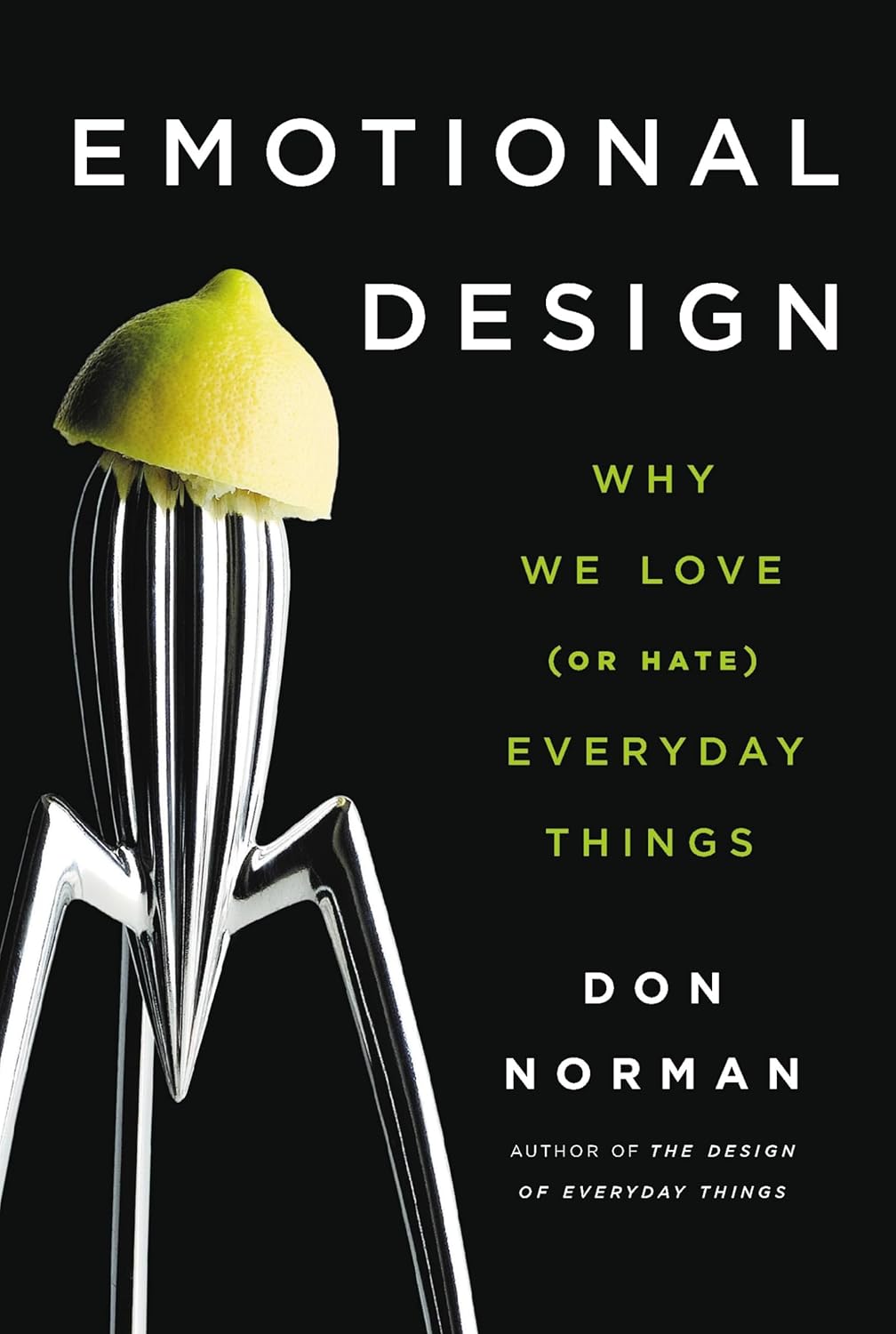
Emotional Design: Why We Love (or Hate) Everyday Things

Description:

"You'll never see housewares the same way again" (Wired) – Why attractive things work better and other crucial insights into human-centered design
 
Emotions are inseparable from how we humans think, choose, and act. In
Emotional Design, cognitive scientist Don Norman shows how the principles of human psychology apply to the invention and design of new technologies and products. Building on his previous work in The Design of Everyday Things, Norman takes his thinking several steps farther, showing that successful design must incorporate not just what users need, but must address our minds by attending to our visceral reactions, to our behavioral choices, and to the stories we want the things in our lives to tell others about ourselves. Good human-centered design isn't just about making effective tools that are straightforward to use; it's about making affective tools that mesh well with our emotions and help us express our identities and support our social lives. From roller coasters to robots, sports cars to smart phones, attractive things work better. Whether designer or consumer, user or inventor, this book is the definitive guide to making Norman's insights work for you.


Editorial Reviews

Review

“The book pops with fresh paradigms, applying scientific rigor to our romance with the inanimate. You'll never see housewares the same way again.”―Wired

“Norman’s analysis of people’s emotional reactions to material objects is a delightful process…His readers will take away insights galore about why shoppers say, ‘I want that.’”―
Booklist

“Norman's analysis of the design elements in products such as automobiles, watches and computers will pique the interest of many readers, not just those in the design or technology fields.”―
Publishers Weekly

“Donald Norman’s relentless and exacting exploration of the universe of everyday objects has brought him to the final frontier of design: emotions. His exquisite psychological analysis provides a solid and reliable reference and a most valuable tool.” ―
Paola Antonelli, Senior Curator of Architecture and Design, Museum of Modern Art

“Don Norman does it again! He asks the important questions and gives the right answers. I wish this insightful book had been available forty years ago so that I could have done a much better job as a designer.”―
Dr. Robert Blaich, former Senior Vice President of Corporate Design, Royal Philips Electronics

“This is a valuable book... It will help the design world to do great work.” ―
Patrick Whitney, Director, Institute of Design, Illinois Institute of Technology

“Amazing…Norman does a wonderful job making these ideas come alive.”―
Daniel Bobrow, Research Fellow, Palo Alto Research Center

About the Author

Don Norman is a co-founder of the Nielsen Norman Group, and holds graduate degrees in both engineering and psychology. His many books include The Design of Everyday Things, The Design of Future Things, and Living with Complexity. He lives in Silicon Valley, California.

Reviews:

5.0 out of 5 stars An absolute classic

M.S. · October 1, 2025

One of my all time favorite books on product design. I highly recommend it.

5.0 out of 5 stars Simple, wonderful, insightful, great book by a great thinker and scientist. See other resources, too.

D.H.P.P.P. · November 11, 2006

I've been thumbing through this book for the last month, and I have to say that I love it.I've admired Donald Norman, one of the greatest living cognitive scientists, from afar for over 20 years. He was seemingly afforded "guru" status when he visited the University of Colorado's Institute of Cognitive Science in the mid `80s - an esteemed, accessible and entertaining cognitive/computer scientist (and also a cantankerous one) who had pioneered the human factors movement. His entertaining and friendly style was informed by creative, deep, empirical, theoretical work in cognitive science. I came to trust his insights whenever I dabbled in "usability" and "human factors" issues. (Trust me--there are plenty of people who think they understand these things, but Norman is the real deal who delivers the necessary stuff... Check out his masterpiece, "The Design of Everyday Things."). By the time I arrived at UCSD in the late 90s, he had already left our university for Apple Computer, but he seems to have left an indelible, positive stamp on the place. His photo hangs outside of our Francis Crick Conference Room as one of the great scientists who worked here.The current book shows that "attractive things work better" (which is the title of one of Norman's classic essays). Norman dabbles in cognitive, emotional, behavioral and neural science as he makes his key points, showing that "works better" is a multifaceted psychological, emotional, and neural concept. The thesis is much like the ones that permeate clinical psychology in the form of Cognitive-Behavioral therapies (e.g., Beck & Ellis). However, the ideas contained herein inform product design, product choice, and product ownership.The chapter on "three levels of behavioral design: visceral, behavioral, and reflective" is at the heart of this book (as described by other reviewers), and the one that sticks with me the most. If you are interested in a quick tour of "emotional design", read that chapter and look at the striking yet simple pictures throughout the book. Read some of Norman's amusing stories about objects that he owns... Then, if you are hooked, read the whole book.I recommend that readers check out some of Norman's interviews and podcasts that coincide with the release of the book. On Norman's website, there is a section titled interviews. Follow the link for NPR's WHYY interview - it is great stuff. Or watch brief the video accompanying the Benjamin Franklin award in Computer and Cogntive Science. Or watch one of the podcasts. Any of these things will help to bring the key design concepts, and Norman's insightful universe, to life. I use these things in the Cognitive Psychology courses that I teach, and I find that they get students talking, and excited, about the interface between congnition, emotion and design.Great book!

4.0 out of 5 stars Great book, good read

H. · November 19, 2004

This book is for the most part, a very good distillation of what is good and bad about product design of all kinds. It's subtly humorous and very detailed in its dissection of what makes up a user experience. It ties in very well actually with Alan Cooper's book on software design and vice versa. It's well thought out and adequately concise for the range of topics it covers.The only problem I really had with this book, was Norman's obsession with robots. The robot section gets a little agonizing to read through, especially with his unsubstantiated claim that they must have human-like emotions. Though his definition of 'robot emotions' technically drifts from that of our own, calling it that is just too close to the general term.If there's one thing I don't need, it's an angry robot.Otherwise though, I found it helpful to my work and enjoyable to read.

5.0 out of 5 stars Such a refreshing read!

R.J. · July 8, 2023

Compelling and full of imagination - animating in a whole new way the ordinary objects that occupy my everyday space. Such a refreshing read.

5.0 out of 5 stars Loved it

T.C. · April 9, 2013

If you are a design junky this should be required reading. Much of this also applies to art making. Being an artist myself, this sounded interesting. Talks mainly about the discussion of form vs. function and how our emotions play a role in what we perceive to be a well-designed object. Kind of changed my perspective on the objects around me and why I liked certain objects I used on a regular basis and why some I didn't like as much. If you need a reason to understand why you love your favorite teapot or despise the only can opener in your house, this book may help...and may make you buy a new can opener.

5.0 out of 5 stars Don Norman Strikes Again

M.R. · December 29, 2022

I love Don Norman. He is great at taking high level concepts and bringing them down so even someone without design experience can enjoy and learn from them. He has a slide in his house… must I say more?

3.0 out of 5 stars Easy read, but repetetive

B.B. · April 5, 2005

Donald Norman has always written "usable" books. Easy to read and full of anecdotes and examples that nearly everyone can relate to. His classic work, The Design of Everyday Things, still sits proundly on my bookshelf; I pull it down a couple times a year when I need a mental refreshment.This book, like its predecessors, is a fast read. It is written at a low level and nothing in it is too hard to grasp. However, it is too long. I found myself skipping whole paragraphs simply because Normas was repeating something he had written just a few sentences back. I feel the book could be half its length and not lose any content.It's also not as inspirational as his previous books. There were none of the "a ha!" insights that permeated The Design of Everyday Things or Turn Signals Are the Facial Expressions of Automobiles.Still, it's a good read. The next time I'm in the store, I'll be more cognizant of the reasons why I prefer one brand over another of otherwise identical products.

Amazon book

J.d. · January 26, 2022

I love it

Very good book for students of Product Design Innovation

A.K. · June 8, 2025

Very good book for students of Product Design Innovation. My highly recommended!

One of the best design books I've come across.

A.C. · January 8, 2018

When I read The Design of Everyday Things (Also by Donald Norman), I thought I discovered design gold. This book, then is a design gold mine. It deals with what Norman calls the final frontier of design - Emotion. The book is extremely enjoyable to read and connects to the human parts of the reader - not the one that does the thinking, but the one that does the feeling. It's interesting to know how we are affected by the objects we surround ourselves with and also how our brains function while choosing which objects to surround ourselves with.Norman presents three levels of processing of our brains- the visceral, the behavioral and the reflective and how they all are interconnected and involved in our decisions and choices and in the way we perceive the world. The first five chapters of the book are very enjoyable to read and know, not just for designers, but also for anyone who is interested in knowing the way they function in life. The sixth and seventh chapter are somewhat different and feel slightly disconnected from the overall context of the book - why we love or hate everyday things. These chapters discuss whether or not machines and robots should have emotions or not. It feels that way because probably we aren't used to imagining machines or robots that have emotions on an everyday basis. It still seems to far out in the future.The research is fantastic, the writing and structuring of the book is brilliant. Though I wish there were more photographs of things mentioned in the book. It is one of those books which I would be re-reading again and again because it pulls my design-heart-strings.[I ordered a paperback 2005 edition of this book by Basic Books, the printing and binding were good, the pages slightly yellowed, and the corners bent while shipping (I assume).]

Güzel içerik - kötü baskı

y. · May 3, 2022

Her tasarımcının faydalanması ve kütüphanesinde bulundurması gereken bu kitabı baskı kalitesinin epey kötü olmasından dolayı iade ettim. Ciltli kapak ya da kuşe kağıda bir baskı tabii ki beklemiyordum ama saman gibi kağıda bu kadar kötü bir baskı ve kesim hiç hoş olmamış.

Go get this

M.B.O. · April 12, 2014

Its was a super deal and the product look fine. A bunch of year then im looking for this book. Thanks a lot!

Emotional Design: Why We Love (or Hate) Everyday Things

Product ID: U0465051367
Condition: New

4.5

AED7374

Price includes VAT & Import Duties
Type: Paperback
Availability: In Stock

Quantity:

|

Order today to get by 7-14 business days

Delivery fee of AED 20. Free for orders above AED 200.

Returns & Warranty policies

Imported From: United States

At BOLO, we work hard to ensure the products you receive are new, genuine, and sourced from reputable suppliers.

BOLO is not an authorized or official retailer for most brands, nor are we affiliated with manufacturers unless specifically stated on a product page. Instead, we source verified sellers, authorized distributors or directly from the manufacturer.

Each product undergoes thorough inspection and verification at our consolidation and fulfilment centers to ensure it meets our strict authenticity and quality standards before being shipped and delivered to you.

If you ever have concerns regarding the authenticity of a product purchased from us, please contact Bolo Support. We will review your inquiry promptly and, if necessary, provide documentation verifying authenticity or offer a suitable resolution.

Your trust is our top priority, and we are committed to maintaining transparency and integrity in every transaction.

All product information, images, descriptions, and reviews originate from the manufacturer or from trusted sellers overseas. BOLO is not affiliated with, endorsed by, or an authorized retailer for most brands listed on our website unless stated otherwise.

While we strive to display accurate information, variations in packaging, labeling, instructions, or formulation may occasionally occur due to regional differences or supplier updates. For detailed or manufacturer-specific information, please contact the brand directly or reach out to BOLO Support for assistance.

Unless otherwise stated, all prices displayed on the product page include applicable taxes and import duties.

BOLO operates in accordance with the laws and regulations of United Arab Emirates. Any items found to be restricted or prohibited for sale within the UAE will be cancelled prior to shipment. We take proactive measures to ensure that only products permitted for sale in United Arab Emirates are listed on our website.

All items are shipped by air, and any products classified as “Dangerous Goods (DG)” under IATA regulations will be removed from the order and cancelled.

All orders are processed manually, and we make every effort to process them promptly once confirmed. Products cancelled due to the above reasons will be permanently removed from listings across the website.

Similar suggestions by Bolo

More from this brand

Similar items from “Design History & Criticism”

Emotional Design: Why We Love (or Hate) Everyday Things

Product ID: U0465051367
Condition: New

4.5

Emotional Design: Why We Love (or Hate) Everyday Things-0
Type: Paperback

AED7374

Price includes VAT & Import Duties
Availability: In Stock

Quantity:

|

Order today to get by 7-14 business days

Delivery fee of AED 20. Free for orders above AED 200.

Returns & Warranty policies

Imported From: United States

At BOLO, we work hard to ensure the products you receive are new, genuine, and sourced from reputable suppliers.

BOLO is not an authorized or official retailer for most brands, nor are we affiliated with manufacturers unless specifically stated on a product page. Instead, we source verified sellers, authorized distributors or directly from the manufacturer.

Each product undergoes thorough inspection and verification at our consolidation and fulfilment centers to ensure it meets our strict authenticity and quality standards before being shipped and delivered to you.

If you ever have concerns regarding the authenticity of a product purchased from us, please contact Bolo Support. We will review your inquiry promptly and, if necessary, provide documentation verifying authenticity or offer a suitable resolution.

Your trust is our top priority, and we are committed to maintaining transparency and integrity in every transaction.

All product information, images, descriptions, and reviews originate from the manufacturer or from trusted sellers overseas. BOLO is not affiliated with, endorsed by, or an authorized retailer for most brands listed on our website unless stated otherwise.

While we strive to display accurate information, variations in packaging, labeling, instructions, or formulation may occasionally occur due to regional differences or supplier updates. For detailed or manufacturer-specific information, please contact the brand directly or reach out to BOLO Support for assistance.

Unless otherwise stated, all prices displayed on the product page include applicable taxes and import duties.

BOLO operates in accordance with the laws and regulations of United Arab Emirates. Any items found to be restricted or prohibited for sale within the UAE will be cancelled prior to shipment. We take proactive measures to ensure that only products permitted for sale in United Arab Emirates are listed on our website.

All items are shipped by air, and any products classified as “Dangerous Goods (DG)” under IATA regulations will be removed from the order and cancelled.

All orders are processed manually, and we make every effort to process them promptly once confirmed. Products cancelled due to the above reasons will be permanently removed from listings across the website.

Description:

"You'll never see housewares the same way again" (Wired) – Why attractive things work better and other crucial insights into human-centered design
 
Emotions are inseparable from how we humans think, choose, and act. In
Emotional Design, cognitive scientist Don Norman shows how the principles of human psychology apply to the invention and design of new technologies and products. Building on his previous work in The Design of Everyday Things, Norman takes his thinking several steps farther, showing that successful design must incorporate not just what users need, but must address our minds by attending to our visceral reactions, to our behavioral choices, and to the stories we want the things in our lives to tell others about ourselves. Good human-centered design isn't just about making effective tools that are straightforward to use; it's about making affective tools that mesh well with our emotions and help us express our identities and support our social lives. From roller coasters to robots, sports cars to smart phones, attractive things work better. Whether designer or consumer, user or inventor, this book is the definitive guide to making Norman's insights work for you.


Editorial Reviews

Review

“The book pops with fresh paradigms, applying scientific rigor to our romance with the inanimate. You'll never see housewares the same way again.”―Wired

“Norman’s analysis of people’s emotional reactions to material objects is a delightful process…His readers will take away insights galore about why shoppers say, ‘I want that.’”―
Booklist

“Norman's analysis of the design elements in products such as automobiles, watches and computers will pique the interest of many readers, not just those in the design or technology fields.”―
Publishers Weekly

“Donald Norman’s relentless and exacting exploration of the universe of everyday objects has brought him to the final frontier of design: emotions. His exquisite psychological analysis provides a solid and reliable reference and a most valuable tool.” ―
Paola Antonelli, Senior Curator of Architecture and Design, Museum of Modern Art

“Don Norman does it again! He asks the important questions and gives the right answers. I wish this insightful book had been available forty years ago so that I could have done a much better job as a designer.”―
Dr. Robert Blaich, former Senior Vice President of Corporate Design, Royal Philips Electronics

“This is a valuable book... It will help the design world to do great work.” ―
Patrick Whitney, Director, Institute of Design, Illinois Institute of Technology

“Amazing…Norman does a wonderful job making these ideas come alive.”―
Daniel Bobrow, Research Fellow, Palo Alto Research Center

About the Author

Don Norman is a co-founder of the Nielsen Norman Group, and holds graduate degrees in both engineering and psychology. His many books include The Design of Everyday Things, The Design of Future Things, and Living with Complexity. He lives in Silicon Valley, California.

Reviews:

5.0 out of 5 stars An absolute classic

M.S. · October 1, 2025

One of my all time favorite books on product design. I highly recommend it.

5.0 out of 5 stars Simple, wonderful, insightful, great book by a great thinker and scientist. See other resources, too.

D.H.P.P.P. · November 11, 2006

I've been thumbing through this book for the last month, and I have to say that I love it.I've admired Donald Norman, one of the greatest living cognitive scientists, from afar for over 20 years. He was seemingly afforded "guru" status when he visited the University of Colorado's Institute of Cognitive Science in the mid `80s - an esteemed, accessible and entertaining cognitive/computer scientist (and also a cantankerous one) who had pioneered the human factors movement. His entertaining and friendly style was informed by creative, deep, empirical, theoretical work in cognitive science. I came to trust his insights whenever I dabbled in "usability" and "human factors" issues. (Trust me--there are plenty of people who think they understand these things, but Norman is the real deal who delivers the necessary stuff... Check out his masterpiece, "The Design of Everyday Things."). By the time I arrived at UCSD in the late 90s, he had already left our university for Apple Computer, but he seems to have left an indelible, positive stamp on the place. His photo hangs outside of our Francis Crick Conference Room as one of the great scientists who worked here.The current book shows that "attractive things work better" (which is the title of one of Norman's classic essays). Norman dabbles in cognitive, emotional, behavioral and neural science as he makes his key points, showing that "works better" is a multifaceted psychological, emotional, and neural concept. The thesis is much like the ones that permeate clinical psychology in the form of Cognitive-Behavioral therapies (e.g., Beck & Ellis). However, the ideas contained herein inform product design, product choice, and product ownership.The chapter on "three levels of behavioral design: visceral, behavioral, and reflective" is at the heart of this book (as described by other reviewers), and the one that sticks with me the most. If you are interested in a quick tour of "emotional design", read that chapter and look at the striking yet simple pictures throughout the book. Read some of Norman's amusing stories about objects that he owns... Then, if you are hooked, read the whole book.I recommend that readers check out some of Norman's interviews and podcasts that coincide with the release of the book. On Norman's website, there is a section titled interviews. Follow the link for NPR's WHYY interview - it is great stuff. Or watch brief the video accompanying the Benjamin Franklin award in Computer and Cogntive Science. Or watch one of the podcasts. Any of these things will help to bring the key design concepts, and Norman's insightful universe, to life. I use these things in the Cognitive Psychology courses that I teach, and I find that they get students talking, and excited, about the interface between congnition, emotion and design.Great book!

4.0 out of 5 stars Great book, good read

H. · November 19, 2004

This book is for the most part, a very good distillation of what is good and bad about product design of all kinds. It's subtly humorous and very detailed in its dissection of what makes up a user experience. It ties in very well actually with Alan Cooper's book on software design and vice versa. It's well thought out and adequately concise for the range of topics it covers.The only problem I really had with this book, was Norman's obsession with robots. The robot section gets a little agonizing to read through, especially with his unsubstantiated claim that they must have human-like emotions. Though his definition of 'robot emotions' technically drifts from that of our own, calling it that is just too close to the general term.If there's one thing I don't need, it's an angry robot.Otherwise though, I found it helpful to my work and enjoyable to read.

5.0 out of 5 stars Such a refreshing read!

R.J. · July 8, 2023

Compelling and full of imagination - animating in a whole new way the ordinary objects that occupy my everyday space. Such a refreshing read.

5.0 out of 5 stars Loved it

T.C. · April 9, 2013

If you are a design junky this should be required reading. Much of this also applies to art making. Being an artist myself, this sounded interesting. Talks mainly about the discussion of form vs. function and how our emotions play a role in what we perceive to be a well-designed object. Kind of changed my perspective on the objects around me and why I liked certain objects I used on a regular basis and why some I didn't like as much. If you need a reason to understand why you love your favorite teapot or despise the only can opener in your house, this book may help...and may make you buy a new can opener.

5.0 out of 5 stars Don Norman Strikes Again

M.R. · December 29, 2022

I love Don Norman. He is great at taking high level concepts and bringing them down so even someone without design experience can enjoy and learn from them. He has a slide in his house… must I say more?

3.0 out of 5 stars Easy read, but repetetive

B.B. · April 5, 2005

Donald Norman has always written "usable" books. Easy to read and full of anecdotes and examples that nearly everyone can relate to. His classic work, The Design of Everyday Things, still sits proundly on my bookshelf; I pull it down a couple times a year when I need a mental refreshment.This book, like its predecessors, is a fast read. It is written at a low level and nothing in it is too hard to grasp. However, it is too long. I found myself skipping whole paragraphs simply because Normas was repeating something he had written just a few sentences back. I feel the book could be half its length and not lose any content.It's also not as inspirational as his previous books. There were none of the "a ha!" insights that permeated The Design of Everyday Things or Turn Signals Are the Facial Expressions of Automobiles.Still, it's a good read. The next time I'm in the store, I'll be more cognizant of the reasons why I prefer one brand over another of otherwise identical products.

Amazon book

J.d. · January 26, 2022

I love it

Very good book for students of Product Design Innovation

A.K. · June 8, 2025

Very good book for students of Product Design Innovation. My highly recommended!

One of the best design books I've come across.

A.C. · January 8, 2018

When I read The Design of Everyday Things (Also by Donald Norman), I thought I discovered design gold. This book, then is a design gold mine. It deals with what Norman calls the final frontier of design - Emotion. The book is extremely enjoyable to read and connects to the human parts of the reader - not the one that does the thinking, but the one that does the feeling. It's interesting to know how we are affected by the objects we surround ourselves with and also how our brains function while choosing which objects to surround ourselves with.Norman presents three levels of processing of our brains- the visceral, the behavioral and the reflective and how they all are interconnected and involved in our decisions and choices and in the way we perceive the world. The first five chapters of the book are very enjoyable to read and know, not just for designers, but also for anyone who is interested in knowing the way they function in life. The sixth and seventh chapter are somewhat different and feel slightly disconnected from the overall context of the book - why we love or hate everyday things. These chapters discuss whether or not machines and robots should have emotions or not. It feels that way because probably we aren't used to imagining machines or robots that have emotions on an everyday basis. It still seems to far out in the future.The research is fantastic, the writing and structuring of the book is brilliant. Though I wish there were more photographs of things mentioned in the book. It is one of those books which I would be re-reading again and again because it pulls my design-heart-strings.[I ordered a paperback 2005 edition of this book by Basic Books, the printing and binding were good, the pages slightly yellowed, and the corners bent while shipping (I assume).]

Güzel içerik - kötü baskı

y. · May 3, 2022

Her tasarımcının faydalanması ve kütüphanesinde bulundurması gereken bu kitabı baskı kalitesinin epey kötü olmasından dolayı iade ettim. Ciltli kapak ya da kuşe kağıda bir baskı tabii ki beklemiyordum ama saman gibi kağıda bu kadar kötü bir baskı ve kesim hiç hoş olmamış.

Go get this

M.B.O. · April 12, 2014

Its was a super deal and the product look fine. A bunch of year then im looking for this book. Thanks a lot!

Similar suggestions by Bolo

More from this brand

Similar items from “Design History & Criticism”