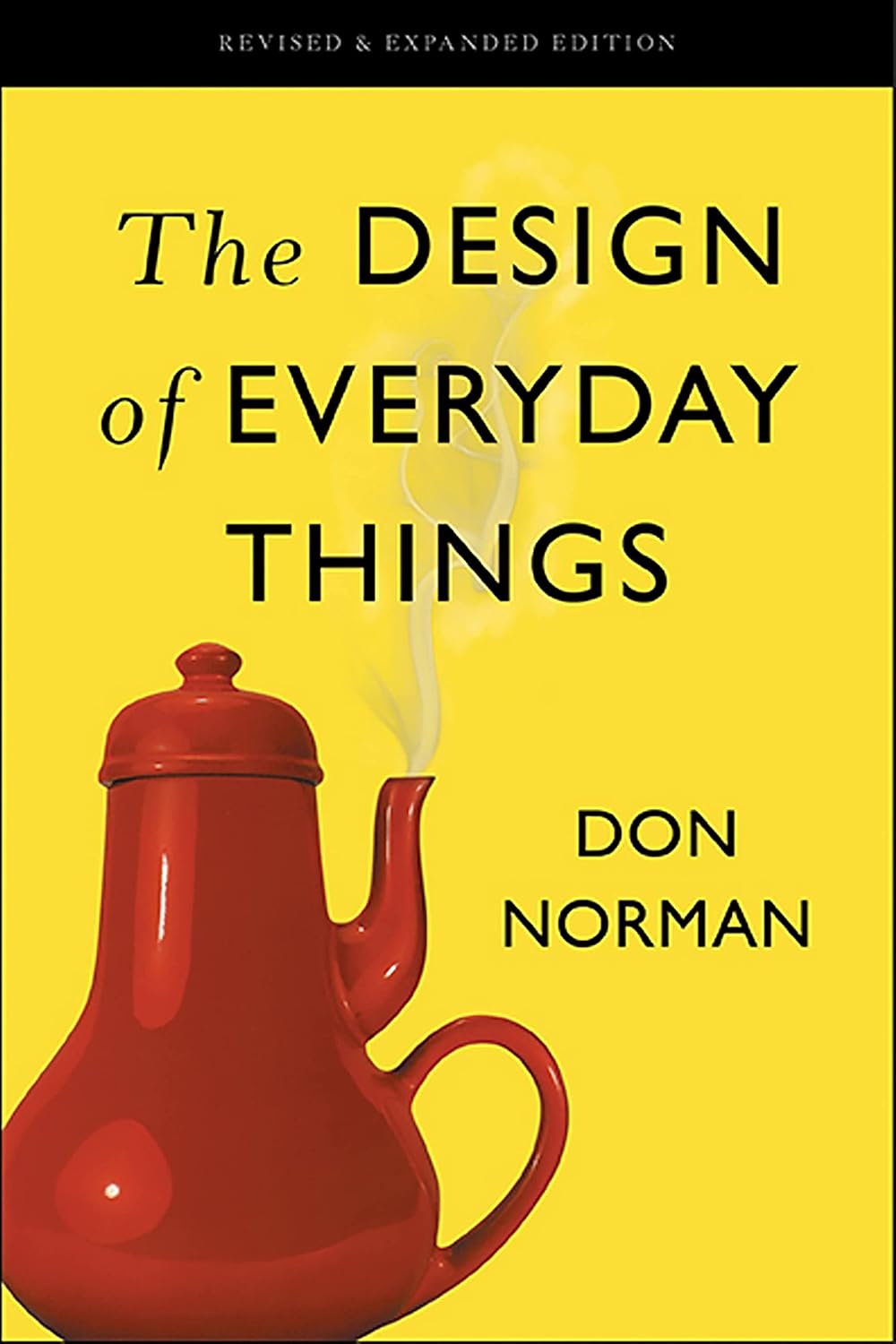
Description:
Even the smartest among us can feel inept as we fail to figure out which light switch or oven burner to turn on, or whether to push, pull, or slide a door.
The fault, argues this ingenious -- even liberating -- book, lies not in ourselves, but in product design that ignores the needs of users and the principles of cognitive psychology. The problems range from ambiguous and hidden controls to arbitrary relationships between controls and functions, coupled with a lack of feedback or other assistance and unreasonable demands on memorization.
The Design of Everyday Things shows that good, usable design is possible. The rules are simple: make things visible, exploit natural relationships that couple function and control, and make intelligent use of constraints. The goal: guide the user effortlessly to the right action on the right control at the right time.
The Design of Everyday Things is a powerful primer on how -- and why -- some products satisfy customers while others only frustrate them.
Review
"This book changed the field of design. As the pace of technological change accelerates, the principles in this book are increasingly important. The new examples and ideas about design and product development make it essential reading."―Patrick Whitney, Dean, Institute of Design, and Steelcase/Robert C. Pew Professor of Design, Illinois Institute of Technology
"Twenty-five years ago The Design of Everyday Things was instrumental in orienting my approach to design. With this latest revised and expanded edition, Don Norman has given me a host of new ideas to explore as well as reminding me of the fundamental principles of great and meaningful design. Part operating manual for designers and part manifesto on the power of designing for people, The Design of Everyday Things is even more relevant today than it was when first published."―Tim Brown, CEO, IDEO, and author of Change by Design
"Design may be our top competitive edge. This book is a joy--fun and of the utmost importance."―Tom Peters, author of the national best-seller In Search of Excellence
About the Author
Reviews:
It's great, just stop calling it 'the UX Bible'
A lot of people voice their disappointment with this book, because they expect it to be an in-depth, authoritative guide written for professional designers, and it turns out to be something else. Let me tell you a little secret, design people: it's not "the design bible", it's not "the UX bible", it's not anything bible. It's more of a religious pamphlet aimed at laymen who don't normally think about design in their everyday work, to bring them the gospel of good design practices in an extremely condensed form.Developers love this book, because it's good (duh!) and also because it comes with recommendations from several luminaries in the field, most notably Jeff Atwood, the co-founder of StackOverflow. I'm no exception. It helped shift my focus from making software that does its job well, to making software that helps its users do their jobs well. It explains in very simple terms why you should care about how users experience and interact with the things you make and how to start thinking about making their interactions more satisfying and rewarding. It also walks you through the typical interaction cycle, from the idea of action that user wants to perform, to the interpretation of feedback they receive; it is a tremendous help when you are trying to 'debug' the interactions and figure out the exact reason why users find your design distracting, irritating or counter-intuitive.There are sections clarifying the terms you might have heard elsewhere but don't know exactly what they mean (A/B testing, root cause analysis, iterative vs. waterfall approach) or how they might help you improve your design. There is a particularly illuminating chapter explaining why fridge controls and stove controls (among many other things) come in so many different and incompatible designs, how companies are trying to solve this problem with standardization and why standards sometimes create more problems than they solve.What else? It's also short, well-written and entertaining. The jokes are rare, poignant, and usually delivered with a deadpan snark. To give you an example,"The typewriter was a radical innovation that had a dramatic impact upon office and home writing. It helped provide a role for women in offices as typists and secretaries, which led to the redefinition of the job of secretary to be a dead end rather than the first step toward an executive position".Nice, huh?To summarize: buy this book if you want to know more about design in general and/or become a better designer to complement your other skills. Don't buy this book if you expect a huge how-to manual or a cookbook aimed at experienced designers.
Great intro to Design Thinking
Another great book for the year 4.5 out of 5 stars. While popular among designers (especially the UX/UI community), I’d say the design and psychological concepts presented have a wide range of applicability to any industry and for consumers/users of anything and thus I hope more people read it. As someone with a background in healthcare and who has been reading broadly on self-help and global issues, I found many conceptual ties between the design concepts in the book and each of these topics that people tend to treat as separate silos. For instance, are the treatment plans therapists create fully useable from the patient’s perspective? We like to write that we sent the patient home with their home exercise plan(HEP) and patient was able to verbalize (and sometimes return demonstrate) understanding but how likely are the patients to recall what was taught once home? If they don’t recall what is available to help them recall what terms mean and what the exercise looks and feels like? And better yet, how can we improve the delivery of the HEP to improve adherence to the program?Beyond healthcare, how are we designing whole industries and systems?Design thinking differs from the thought processes in other areas of study yet I see some possible applicability/laterally transferable aspects to processes such as differential diagnosis in science. Overall this is a great intro on the process and a great addition to anyone’s mental toolbox.Content aside: Norman can be dry at times (or maybe it was the subject?). Some sections feel a touch too brief (likely because he had to edit it down to a manageable book size). The book’s look and feel (size, matte finish, page quality, use of font sizes and alignments) were delightful except for the black and white photos that needed more contrast (or color) to illustrate their point.
Visit the Basic Books Store
The Design of Everyday Things: Revised and Expanded Edition
AED7836
Quantity:
Order today to get by 7-14 business days
Delivery fee of AED 20. Free for orders above AED 200.
Imported From: United States
At BOLO, we work hard to ensure the products you receive are new, genuine, and sourced from reputable suppliers.
BOLO is not an authorized or official retailer for most brands, nor are we affiliated with manufacturers unless specifically stated on a product page. Instead, we source verified sellers, authorized distributors or directly from the manufacturer.
Each product undergoes thorough inspection and verification at our consolidation and fulfilment centers to ensure it meets our strict authenticity and quality standards before being shipped and delivered to you.
If you ever have concerns regarding the authenticity of a product purchased from us, please contact Bolo Support. We will review your inquiry promptly and, if necessary, provide documentation verifying authenticity or offer a suitable resolution.
Your trust is our top priority, and we are committed to maintaining transparency and integrity in every transaction.
All product information, images, descriptions, and reviews originate from the manufacturer or from trusted sellers overseas. BOLO is not affiliated with, endorsed by, or an authorized retailer for most brands listed on our website unless stated otherwise.
While we strive to display accurate information, variations in packaging, labeling, instructions, or formulation may occasionally occur due to regional differences or supplier updates. For detailed or manufacturer-specific information, please contact the brand directly or reach out to BOLO Support for assistance.
Unless otherwise stated, all prices displayed on the product page include applicable taxes and import duties.
BOLO operates in accordance with the laws and regulations of United Arab Emirates. Any items found to be restricted or prohibited for sale within the UAE will be cancelled prior to shipment. We take proactive measures to ensure that only products permitted for sale in United Arab Emirates are listed on our website.
All items are shipped by air, and any products classified as “Dangerous Goods (DG)” under IATA regulations will be removed from the order and cancelled.
All orders are processed manually, and we make every effort to process them promptly once confirmed. Products cancelled due to the above reasons will be permanently removed from listings across the website.
More from this brand
Similar items from “Industrial & Product Design”
Share with
Or share with link
https://www.bolo.ae/products/U0465050654
Visit the Basic Books Store
The Design of Everyday Things: Revised and Expanded Edition

AED7836
Quantity:
Order today to get by 7-14 business days
Delivery fee of AED 20. Free for orders above AED 200.
Imported From: United States
At BOLO, we work hard to ensure the products you receive are new, genuine, and sourced from reputable suppliers.
BOLO is not an authorized or official retailer for most brands, nor are we affiliated with manufacturers unless specifically stated on a product page. Instead, we source verified sellers, authorized distributors or directly from the manufacturer.
Each product undergoes thorough inspection and verification at our consolidation and fulfilment centers to ensure it meets our strict authenticity and quality standards before being shipped and delivered to you.
If you ever have concerns regarding the authenticity of a product purchased from us, please contact Bolo Support. We will review your inquiry promptly and, if necessary, provide documentation verifying authenticity or offer a suitable resolution.
Your trust is our top priority, and we are committed to maintaining transparency and integrity in every transaction.
All product information, images, descriptions, and reviews originate from the manufacturer or from trusted sellers overseas. BOLO is not affiliated with, endorsed by, or an authorized retailer for most brands listed on our website unless stated otherwise.
While we strive to display accurate information, variations in packaging, labeling, instructions, or formulation may occasionally occur due to regional differences or supplier updates. For detailed or manufacturer-specific information, please contact the brand directly or reach out to BOLO Support for assistance.
Unless otherwise stated, all prices displayed on the product page include applicable taxes and import duties.
BOLO operates in accordance with the laws and regulations of United Arab Emirates. Any items found to be restricted or prohibited for sale within the UAE will be cancelled prior to shipment. We take proactive measures to ensure that only products permitted for sale in United Arab Emirates are listed on our website.
All items are shipped by air, and any products classified as “Dangerous Goods (DG)” under IATA regulations will be removed from the order and cancelled.
All orders are processed manually, and we make every effort to process them promptly once confirmed. Products cancelled due to the above reasons will be permanently removed from listings across the website.
Description:
Even the smartest among us can feel inept as we fail to figure out which light switch or oven burner to turn on, or whether to push, pull, or slide a door.
The fault, argues this ingenious -- even liberating -- book, lies not in ourselves, but in product design that ignores the needs of users and the principles of cognitive psychology. The problems range from ambiguous and hidden controls to arbitrary relationships between controls and functions, coupled with a lack of feedback or other assistance and unreasonable demands on memorization.
The Design of Everyday Things shows that good, usable design is possible. The rules are simple: make things visible, exploit natural relationships that couple function and control, and make intelligent use of constraints. The goal: guide the user effortlessly to the right action on the right control at the right time.
The Design of Everyday Things is a powerful primer on how -- and why -- some products satisfy customers while others only frustrate them.
Review
"This book changed the field of design. As the pace of technological change accelerates, the principles in this book are increasingly important. The new examples and ideas about design and product development make it essential reading."―Patrick Whitney, Dean, Institute of Design, and Steelcase/Robert C. Pew Professor of Design, Illinois Institute of Technology
"Twenty-five years ago The Design of Everyday Things was instrumental in orienting my approach to design. With this latest revised and expanded edition, Don Norman has given me a host of new ideas to explore as well as reminding me of the fundamental principles of great and meaningful design. Part operating manual for designers and part manifesto on the power of designing for people, The Design of Everyday Things is even more relevant today than it was when first published."―Tim Brown, CEO, IDEO, and author of Change by Design
"Design may be our top competitive edge. This book is a joy--fun and of the utmost importance."―Tom Peters, author of the national best-seller In Search of Excellence
About the Author
Reviews:
It's great, just stop calling it 'the UX Bible'
A lot of people voice their disappointment with this book, because they expect it to be an in-depth, authoritative guide written for professional designers, and it turns out to be something else. Let me tell you a little secret, design people: it's not "the design bible", it's not "the UX bible", it's not anything bible. It's more of a religious pamphlet aimed at laymen who don't normally think about design in their everyday work, to bring them the gospel of good design practices in an extremely condensed form.Developers love this book, because it's good (duh!) and also because it comes with recommendations from several luminaries in the field, most notably Jeff Atwood, the co-founder of StackOverflow. I'm no exception. It helped shift my focus from making software that does its job well, to making software that helps its users do their jobs well. It explains in very simple terms why you should care about how users experience and interact with the things you make and how to start thinking about making their interactions more satisfying and rewarding. It also walks you through the typical interaction cycle, from the idea of action that user wants to perform, to the interpretation of feedback they receive; it is a tremendous help when you are trying to 'debug' the interactions and figure out the exact reason why users find your design distracting, irritating or counter-intuitive.There are sections clarifying the terms you might have heard elsewhere but don't know exactly what they mean (A/B testing, root cause analysis, iterative vs. waterfall approach) or how they might help you improve your design. There is a particularly illuminating chapter explaining why fridge controls and stove controls (among many other things) come in so many different and incompatible designs, how companies are trying to solve this problem with standardization and why standards sometimes create more problems than they solve.What else? It's also short, well-written and entertaining. The jokes are rare, poignant, and usually delivered with a deadpan snark. To give you an example,"The typewriter was a radical innovation that had a dramatic impact upon office and home writing. It helped provide a role for women in offices as typists and secretaries, which led to the redefinition of the job of secretary to be a dead end rather than the first step toward an executive position".Nice, huh?To summarize: buy this book if you want to know more about design in general and/or become a better designer to complement your other skills. Don't buy this book if you expect a huge how-to manual or a cookbook aimed at experienced designers.
Great intro to Design Thinking
Another great book for the year 4.5 out of 5 stars. While popular among designers (especially the UX/UI community), I’d say the design and psychological concepts presented have a wide range of applicability to any industry and for consumers/users of anything and thus I hope more people read it. As someone with a background in healthcare and who has been reading broadly on self-help and global issues, I found many conceptual ties between the design concepts in the book and each of these topics that people tend to treat as separate silos. For instance, are the treatment plans therapists create fully useable from the patient’s perspective? We like to write that we sent the patient home with their home exercise plan(HEP) and patient was able to verbalize (and sometimes return demonstrate) understanding but how likely are the patients to recall what was taught once home? If they don’t recall what is available to help them recall what terms mean and what the exercise looks and feels like? And better yet, how can we improve the delivery of the HEP to improve adherence to the program?Beyond healthcare, how are we designing whole industries and systems?Design thinking differs from the thought processes in other areas of study yet I see some possible applicability/laterally transferable aspects to processes such as differential diagnosis in science. Overall this is a great intro on the process and a great addition to anyone’s mental toolbox.Content aside: Norman can be dry at times (or maybe it was the subject?). Some sections feel a touch too brief (likely because he had to edit it down to a manageable book size). The book’s look and feel (size, matte finish, page quality, use of font sizes and alignments) were delightful except for the black and white photos that needed more contrast (or color) to illustrate their point.
More from this brand
Similar items from “Industrial & Product Design”
Share with
Or share with link
https://www.bolo.ae/products/U0465050654