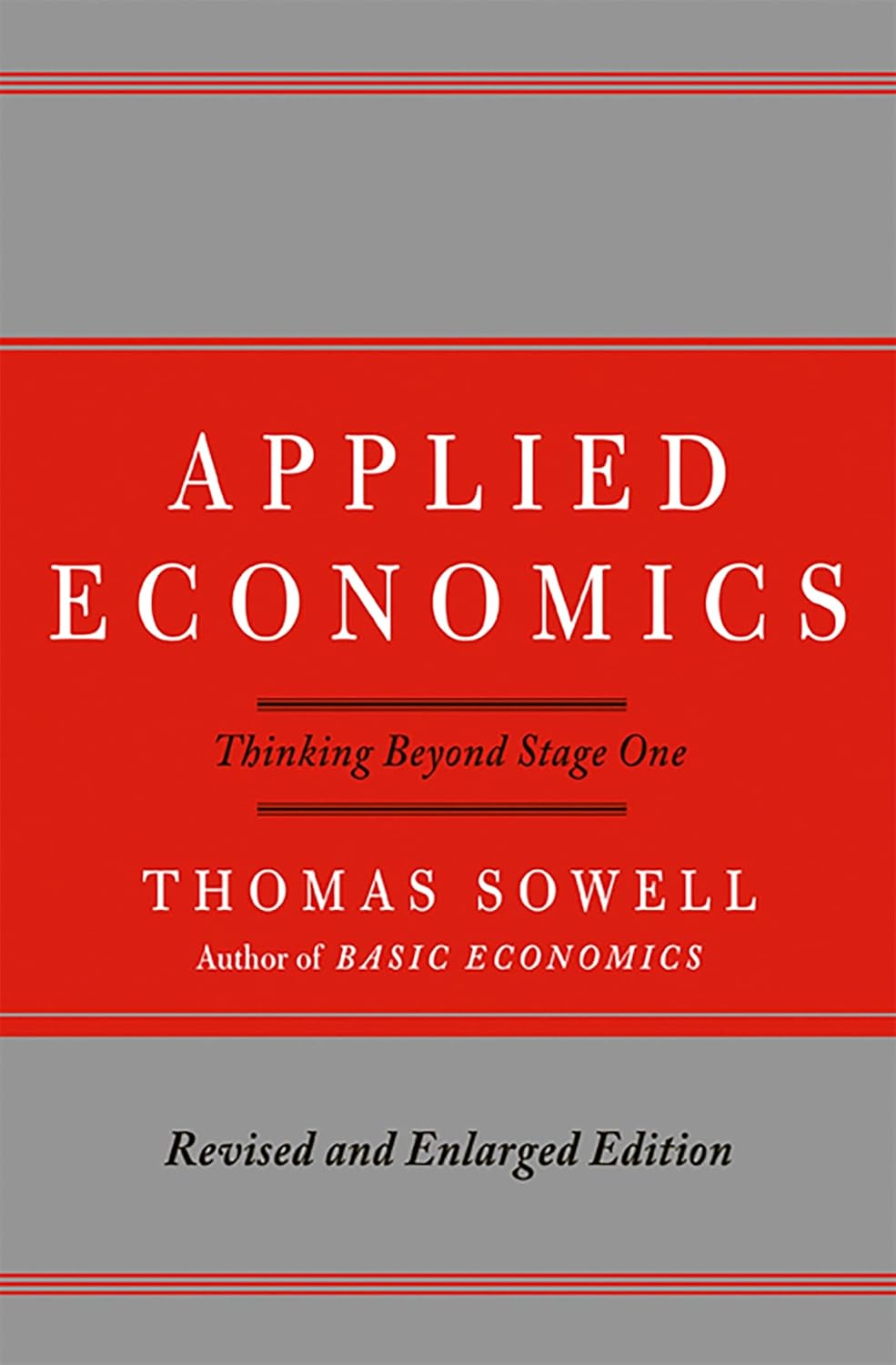
Description:
Editorial Reviews
Review
"Thomas Sowell is one of the fine scholars of our time."
About the Author
Reviews:
5.0 out of 5 stars Insightful and rich account of the differences between political and economic decisionmaking
Sowell's main thesis is that political decision-makers, which include both politicians, administrative agencies, and large government bureaucracies, often are rewarded for what he calls "stage one" thinking. In other words, because a politician's main objective is to get re-elected, policies which are popular and appear to, or do, have short-term benefits are often pursued without regard to the policy's long-term consequences. Ultimately, the politician will not be rewarded for the benefits that accrue in 10 or 20 years from the superior policy, but may be voted out of office for his unpopular stance.The basic claim of Applied Economics is that political policies must be analyzed, not based on their avowed goals, but rather on their foreseeable short AND long-term consequences. By considering the incentive policies such as rent control create, it is easy to see how policies that sound good, and are therefore popular, may have disastrous results, often for precisely those persons whom the policy is designed to protect. To establish this point, Sowell amasses significant historical and empirical evidence to back up his claims in a variety of topics. His analysis of the economics of housing, immigration, and insurance are particularly excellent.Free and Unfree Labor:The first topical discussion begins with a history lesson, providing an eye-opening account of the many forms of unfree labor. Americans tend to think of labor as either being free (wage labor) or unfree (slavery), but in fact, there were many forms of labor that fell somewhere in between these poles. Sowell's economic analysis explains why white Irish immigrants rather than black slaves performed some of the most dangerous manual labor, why slave plantations overseen by owners resulted in less brutal behavior than those overseen by third parties, and why the south developed a self-sustaining population of slaves while other colonies and nations did not. Ultimately, Sowell provides strong evidence for the fact that slavery not only exacted a massive human toll, but also led to the wasteful allocation of human capital, and thus resulted in the South's inferior economic stature.Economics of Housing:I found this section to be the most interesting. Sowell convincingly shows how land use restrictions such as zoning have led to massive increases in land prices in CA and elsewhere, resulting in astronomical housing prices, and horrid traffic as a result of the need for middle-class workers to live farther and farther from their place of work. Rather than focusing on anecdotes, Sowell cites to empirical research which has established that zoning restrictions, rather than responding to escalating land and home prices, have rather caused such increases. He also shows how "rent control" has resulted in a reduction, rather than an increase in housing for the poor.Discrimination:Unlike many authors, Sowell begins by careful defining his terms - prejudice, bias, and discrimination. He explains the difference between reliance on general group attributes (elsewhere referred to as statistical discrimination) and prejudice (prejudgment). He explains how such discrimination may in fact be highly rational.Sowell differentiates between "taste discrimination" - a preference for one group over others, versus discrimination based on a group's perceived inferiority.Most importantly, Sowell discusses what is so often ignored - that discrimination imposes costs not only on those who are discriminated against - but also on those who discriminate. He uses economic analysis to explain why an individual or organization's racist preferences don't always result in more discrimination. Because racists, like anyone else, respond to incentives, economic realities often discouraged organizations from acting on their racist beliefs. Sowell asserts that blacks were allowed in the entertainment business in the 1920s, despite rampant racism, because the cost of exclusion in the highly competitive business was high. In contrast, where costs were low - for example in government (the army, public universities etc.) and in government-created monopolies such as AT&T - NO blacks were allowed until several decades later.In addition, Sowell describes how anti-discrimination laws may in fact result in greater discrimination. For example, empirical evidence suggests that the ADA (Americans with Disabilities Act) resulted in REDUCED hiring of disabled persons because the "reasonable accomodations" required by the statute were so costly that employers chose to stop hiring disabled persons rather than comply. Because of the small number of disabled persons in the labor market, it is very difficult if not impossible, to establish statistical evidence of discrimination. Presented with a remote chance of liability for discrimination and very high costs of compliance, many companies have simply not hired disabled persons. Thus, the ADA has largely harmed rather than helped the group that it sought to protect.Despite these excellent sections, I found Sowell's analysis of the health care system to be deeply flawed. While he raises many valid points, he fails to address the benefits of socialized medicine. Universal coverage encourages preventative care, which like insurance generally, reduces the total cost of preventing harm. Uninsured persons often allow conditions to worsen, and only then report to the E.R. at which point the cost of treatment is dramatically higher. This imposes needless human and economic costs on society. Preventative treatment often yields LESS harm and LOWER cost. There is substantial empirical evidence to this affect, yet Sowell ignores the area entirely. He simply mentions that uninsured persons can always go to an E.R. He also ignores the fact that the E.R. can do nothing about chronic illnesses which require surgery or alternative treatment.Sowell still makes many valid points, the most important of which is the need to allow financial contributions to organ donors. Steve Levitt makes the very same argument in SuperFreakonomics: Global Cooling, Patriotic Prostitutes, and Why Suicide Bombers Should Buy Life Insurance. Others such as Richard Posner and Prof. Becker have done so as well. Unfortunately, while such a policy could eradicate the waiting periods for organ transplants and thus save tens of thousands of lives a year, it will almost certainly be rejected due to political considerations for the general reasons Sowell discusses.Overall, I found Applied Economics to be a very thought-provoking and insightful text. I learned a great deal from Sowell's historical account of immigration and slavery, as well as his discussion of the economics of housing. While I did not agree with all of his claims (reflected by the nearly 200 notes I took in my Kindle :P), the book made me think a great deal, which is always a positive attribute. Highly recommended.Kindle Specific: The book is properly formatted, and the Table of Contents provide links not merely to the main chapters but to the various subchapters. Endnotes are hyperlinks, and therefore, it is easy to navigate from the main body of the text to the endnotes. I quite enjoyed reading this book on my Kindle as I found it easy to navigate, annotate, and highlight.
5.0 out of 5 stars Can our politics ever get beyond stage one thinking?
I've lost track of the number of Dr. Sowell's books I have read. He always provides straightforward explanations of each topic in language that is simple for the layman but respects basic economic principles.This book is no exception, in Thomas Sowell's hands the "dismal science" brightens up a bit and shows its importance in explaining human affairs. I suppose it is too much to hope that a significant number of political types will read this book and start "Thinking Beyond Stage One." The few politicians that do, must be supported by unusually intelligent constituents that look beyond claimed legislative goals to the real incentives presented and their effects.Dr. Sowell clearly explains the contrasting incentives that drive most politicians and their constituents. Living in the Bay Area he has numerous examples of the extreme form of this pathology. My friends in his area who do evaluate incentives, and do the numbers, are appalled by the stage one thinking that so dominates public affairs.The author's chapter on free labor and slavery and all the variations between is clear and informed. He has spent a lifetime studying this issue and he presents the economics in a very robust form with excellent examples from his wide studies of many human societies.His chapters on medical care and housing should be read by everyone interested in current affairs.His treatment of risk and insurance and the perverse effects caused by government agencies is wide ranging and clear. He also describes private individuals who make a living by promoting costly conclusions based on "Stage One" thinking.With the inclusion of chapters on immigration, discrimination, and the economic development of nations, Dr. Sowell has given us a wide-ranging sample of competent economic thinking applied to the real world. One could only wish our politics took better account of economic incentives. We would be immeasurably better off.I will save this book as a reference for its broad and careful discussion of each topic with its many points and illustrations. Well worth reading again!
:) Great book and it came fast :)
Excellent basic economics
This is the follow up of another seminal book by Sowell. He is clear, straight forward, and helps you to see the whole picture. A must for everybody and should be compulsory reading (specially for politicians...) and Fed chairmen.
More of the same
It has not added much. Same old stuff, in my opinion. Weak section on development. Well-known discussions about market solutions to economic shortcomings.
Common Sense Education
Dr. Sowell's books are always a delight to read. He distills the concepts down to layman's terms and everyday examples that demonstrate economics in real life.
Great read on general Economics
This book is one of my favourites since it addresses issues that are often debated in politics. For someone interested in economics, law and politics this book will be an enjoyable and informative read.
Visit the Basic Books Store
Applied Economics: Thinking Beyond Stage One
AED24600
Quantity:
Order today to get by 7-14 business days
This item qualifies for free delivery
Imported From: United States
At BOLO, we work hard to ensure the products you receive are new, genuine, and sourced from reputable suppliers.
BOLO is not an authorized or official retailer for most brands, nor are we affiliated with manufacturers unless specifically stated on a product page. Instead, we source verified sellers, authorized distributors or directly from the manufacturer.
Each product undergoes thorough inspection and verification at our consolidation and fulfilment centers to ensure it meets our strict authenticity and quality standards before being shipped and delivered to you.
If you ever have concerns regarding the authenticity of a product purchased from us, please contact Bolo Support. We will review your inquiry promptly and, if necessary, provide documentation verifying authenticity or offer a suitable resolution.
Your trust is our top priority, and we are committed to maintaining transparency and integrity in every transaction.
All product information, images, descriptions, and reviews originate from the manufacturer or from trusted sellers overseas. BOLO is not affiliated with, endorsed by, or an authorized retailer for most brands listed on our website unless stated otherwise.
While we strive to display accurate information, variations in packaging, labeling, instructions, or formulation may occasionally occur due to regional differences or supplier updates. For detailed or manufacturer-specific information, please contact the brand directly or reach out to BOLO Support for assistance.
Unless otherwise stated, all prices displayed on the product page include applicable taxes and import duties.
BOLO operates in accordance with the laws and regulations of United Arab Emirates. Any items found to be restricted or prohibited for sale within the UAE will be cancelled prior to shipment. We take proactive measures to ensure that only products permitted for sale in United Arab Emirates are listed on our website.
All items are shipped by air, and any products classified as “Dangerous Goods (DG)” under IATA regulations will be removed from the order and cancelled.
All orders are processed manually, and we make every effort to process them promptly once confirmed. Products cancelled due to the above reasons will be permanently removed from listings across the website.
Similar suggestions by Bolo
More from this brand
Similar items from “Theory”
Share with
Or share with link
https://www.bolo.ae/products/U0465003451
Visit the Basic Books Store
Applied Economics: Thinking Beyond Stage One

AED24600
Quantity:
Order today to get by 7-14 business days
This item qualifies for free delivery
Imported From: United States
At BOLO, we work hard to ensure the products you receive are new, genuine, and sourced from reputable suppliers.
BOLO is not an authorized or official retailer for most brands, nor are we affiliated with manufacturers unless specifically stated on a product page. Instead, we source verified sellers, authorized distributors or directly from the manufacturer.
Each product undergoes thorough inspection and verification at our consolidation and fulfilment centers to ensure it meets our strict authenticity and quality standards before being shipped and delivered to you.
If you ever have concerns regarding the authenticity of a product purchased from us, please contact Bolo Support. We will review your inquiry promptly and, if necessary, provide documentation verifying authenticity or offer a suitable resolution.
Your trust is our top priority, and we are committed to maintaining transparency and integrity in every transaction.
All product information, images, descriptions, and reviews originate from the manufacturer or from trusted sellers overseas. BOLO is not affiliated with, endorsed by, or an authorized retailer for most brands listed on our website unless stated otherwise.
While we strive to display accurate information, variations in packaging, labeling, instructions, or formulation may occasionally occur due to regional differences or supplier updates. For detailed or manufacturer-specific information, please contact the brand directly or reach out to BOLO Support for assistance.
Unless otherwise stated, all prices displayed on the product page include applicable taxes and import duties.
BOLO operates in accordance with the laws and regulations of United Arab Emirates. Any items found to be restricted or prohibited for sale within the UAE will be cancelled prior to shipment. We take proactive measures to ensure that only products permitted for sale in United Arab Emirates are listed on our website.
All items are shipped by air, and any products classified as “Dangerous Goods (DG)” under IATA regulations will be removed from the order and cancelled.
All orders are processed manually, and we make every effort to process them promptly once confirmed. Products cancelled due to the above reasons will be permanently removed from listings across the website.
Description:
Editorial Reviews
Review
"Thomas Sowell is one of the fine scholars of our time."
About the Author
Reviews:
5.0 out of 5 stars Insightful and rich account of the differences between political and economic decisionmaking
Sowell's main thesis is that political decision-makers, which include both politicians, administrative agencies, and large government bureaucracies, often are rewarded for what he calls "stage one" thinking. In other words, because a politician's main objective is to get re-elected, policies which are popular and appear to, or do, have short-term benefits are often pursued without regard to the policy's long-term consequences. Ultimately, the politician will not be rewarded for the benefits that accrue in 10 or 20 years from the superior policy, but may be voted out of office for his unpopular stance.The basic claim of Applied Economics is that political policies must be analyzed, not based on their avowed goals, but rather on their foreseeable short AND long-term consequences. By considering the incentive policies such as rent control create, it is easy to see how policies that sound good, and are therefore popular, may have disastrous results, often for precisely those persons whom the policy is designed to protect. To establish this point, Sowell amasses significant historical and empirical evidence to back up his claims in a variety of topics. His analysis of the economics of housing, immigration, and insurance are particularly excellent.Free and Unfree Labor:The first topical discussion begins with a history lesson, providing an eye-opening account of the many forms of unfree labor. Americans tend to think of labor as either being free (wage labor) or unfree (slavery), but in fact, there were many forms of labor that fell somewhere in between these poles. Sowell's economic analysis explains why white Irish immigrants rather than black slaves performed some of the most dangerous manual labor, why slave plantations overseen by owners resulted in less brutal behavior than those overseen by third parties, and why the south developed a self-sustaining population of slaves while other colonies and nations did not. Ultimately, Sowell provides strong evidence for the fact that slavery not only exacted a massive human toll, but also led to the wasteful allocation of human capital, and thus resulted in the South's inferior economic stature.Economics of Housing:I found this section to be the most interesting. Sowell convincingly shows how land use restrictions such as zoning have led to massive increases in land prices in CA and elsewhere, resulting in astronomical housing prices, and horrid traffic as a result of the need for middle-class workers to live farther and farther from their place of work. Rather than focusing on anecdotes, Sowell cites to empirical research which has established that zoning restrictions, rather than responding to escalating land and home prices, have rather caused such increases. He also shows how "rent control" has resulted in a reduction, rather than an increase in housing for the poor.Discrimination:Unlike many authors, Sowell begins by careful defining his terms - prejudice, bias, and discrimination. He explains the difference between reliance on general group attributes (elsewhere referred to as statistical discrimination) and prejudice (prejudgment). He explains how such discrimination may in fact be highly rational.Sowell differentiates between "taste discrimination" - a preference for one group over others, versus discrimination based on a group's perceived inferiority.Most importantly, Sowell discusses what is so often ignored - that discrimination imposes costs not only on those who are discriminated against - but also on those who discriminate. He uses economic analysis to explain why an individual or organization's racist preferences don't always result in more discrimination. Because racists, like anyone else, respond to incentives, economic realities often discouraged organizations from acting on their racist beliefs. Sowell asserts that blacks were allowed in the entertainment business in the 1920s, despite rampant racism, because the cost of exclusion in the highly competitive business was high. In contrast, where costs were low - for example in government (the army, public universities etc.) and in government-created monopolies such as AT&T - NO blacks were allowed until several decades later.In addition, Sowell describes how anti-discrimination laws may in fact result in greater discrimination. For example, empirical evidence suggests that the ADA (Americans with Disabilities Act) resulted in REDUCED hiring of disabled persons because the "reasonable accomodations" required by the statute were so costly that employers chose to stop hiring disabled persons rather than comply. Because of the small number of disabled persons in the labor market, it is very difficult if not impossible, to establish statistical evidence of discrimination. Presented with a remote chance of liability for discrimination and very high costs of compliance, many companies have simply not hired disabled persons. Thus, the ADA has largely harmed rather than helped the group that it sought to protect.Despite these excellent sections, I found Sowell's analysis of the health care system to be deeply flawed. While he raises many valid points, he fails to address the benefits of socialized medicine. Universal coverage encourages preventative care, which like insurance generally, reduces the total cost of preventing harm. Uninsured persons often allow conditions to worsen, and only then report to the E.R. at which point the cost of treatment is dramatically higher. This imposes needless human and economic costs on society. Preventative treatment often yields LESS harm and LOWER cost. There is substantial empirical evidence to this affect, yet Sowell ignores the area entirely. He simply mentions that uninsured persons can always go to an E.R. He also ignores the fact that the E.R. can do nothing about chronic illnesses which require surgery or alternative treatment.Sowell still makes many valid points, the most important of which is the need to allow financial contributions to organ donors. Steve Levitt makes the very same argument in SuperFreakonomics: Global Cooling, Patriotic Prostitutes, and Why Suicide Bombers Should Buy Life Insurance. Others such as Richard Posner and Prof. Becker have done so as well. Unfortunately, while such a policy could eradicate the waiting periods for organ transplants and thus save tens of thousands of lives a year, it will almost certainly be rejected due to political considerations for the general reasons Sowell discusses.Overall, I found Applied Economics to be a very thought-provoking and insightful text. I learned a great deal from Sowell's historical account of immigration and slavery, as well as his discussion of the economics of housing. While I did not agree with all of his claims (reflected by the nearly 200 notes I took in my Kindle :P), the book made me think a great deal, which is always a positive attribute. Highly recommended.Kindle Specific: The book is properly formatted, and the Table of Contents provide links not merely to the main chapters but to the various subchapters. Endnotes are hyperlinks, and therefore, it is easy to navigate from the main body of the text to the endnotes. I quite enjoyed reading this book on my Kindle as I found it easy to navigate, annotate, and highlight.
5.0 out of 5 stars Can our politics ever get beyond stage one thinking?
I've lost track of the number of Dr. Sowell's books I have read. He always provides straightforward explanations of each topic in language that is simple for the layman but respects basic economic principles.This book is no exception, in Thomas Sowell's hands the "dismal science" brightens up a bit and shows its importance in explaining human affairs. I suppose it is too much to hope that a significant number of political types will read this book and start "Thinking Beyond Stage One." The few politicians that do, must be supported by unusually intelligent constituents that look beyond claimed legislative goals to the real incentives presented and their effects.Dr. Sowell clearly explains the contrasting incentives that drive most politicians and their constituents. Living in the Bay Area he has numerous examples of the extreme form of this pathology. My friends in his area who do evaluate incentives, and do the numbers, are appalled by the stage one thinking that so dominates public affairs.The author's chapter on free labor and slavery and all the variations between is clear and informed. He has spent a lifetime studying this issue and he presents the economics in a very robust form with excellent examples from his wide studies of many human societies.His chapters on medical care and housing should be read by everyone interested in current affairs.His treatment of risk and insurance and the perverse effects caused by government agencies is wide ranging and clear. He also describes private individuals who make a living by promoting costly conclusions based on "Stage One" thinking.With the inclusion of chapters on immigration, discrimination, and the economic development of nations, Dr. Sowell has given us a wide-ranging sample of competent economic thinking applied to the real world. One could only wish our politics took better account of economic incentives. We would be immeasurably better off.I will save this book as a reference for its broad and careful discussion of each topic with its many points and illustrations. Well worth reading again!
:) Great book and it came fast :)
Excellent basic economics
This is the follow up of another seminal book by Sowell. He is clear, straight forward, and helps you to see the whole picture. A must for everybody and should be compulsory reading (specially for politicians...) and Fed chairmen.
More of the same
It has not added much. Same old stuff, in my opinion. Weak section on development. Well-known discussions about market solutions to economic shortcomings.
Common Sense Education
Dr. Sowell's books are always a delight to read. He distills the concepts down to layman's terms and everyday examples that demonstrate economics in real life.
Great read on general Economics
This book is one of my favourites since it addresses issues that are often debated in politics. For someone interested in economics, law and politics this book will be an enjoyable and informative read.
Similar suggestions by Bolo
More from this brand
Similar items from “Theory”
Share with
Or share with link
https://www.bolo.ae/products/U0465003451