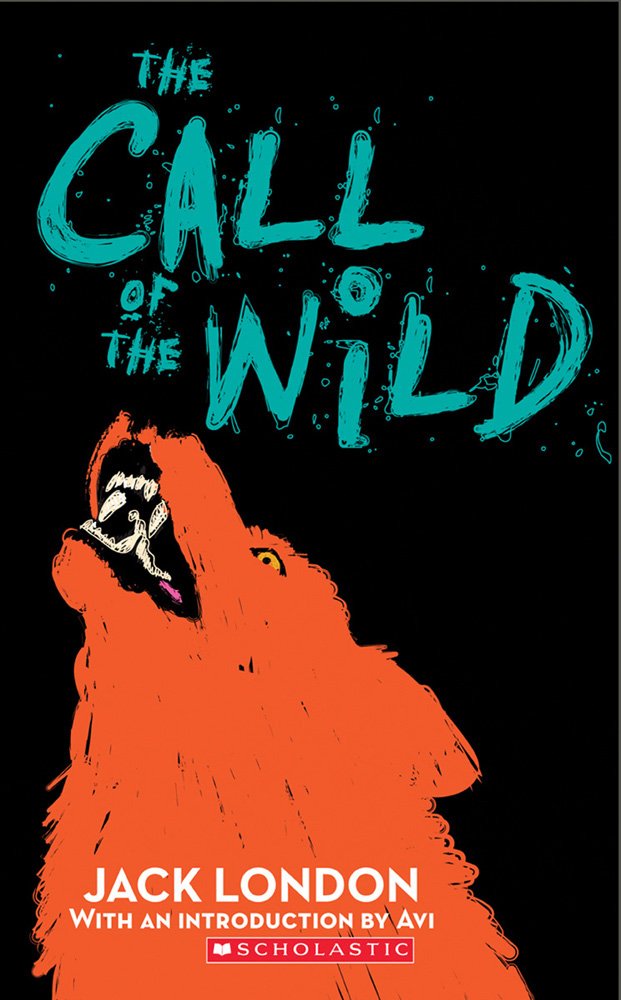
Description:
Editorial Reviews
About the Author
Excerpt. © Reprinted by permission. All rights reserved.
Chapter One: Into the Primitive
"Old longings nomadic leap,
Chafing at custom's chain;
Again from its brumal sleep
Wakens the ferine strain."
Buck did not read the newspapers, or he would have known that trouble was brewing, not alone for himself, but for every tidewater dog, strong of muscle and with warm, long hair, from Puget Sound to San Diego. Because men, groping in the Arctic darkness, had found a yellow metal, and because steamship and transportation companies were booming the find, thousands of men were rushing into the Northland. These men wanted dogs, and the dogs they wanted were heavy dogs, with strong muscles by which to toil, and furry coats to protect them from the frost.
Buck lived at a big house in the sun-kissed Santa Clara Valley. Judge Miller's place, it was called. It stood back from the road, half hidden among the trees, through which glimpses could be caught of the wide cool veranda that ran around its four sides. The house was approached by gravelled driveways which wound about through wide-spreading lawns and under the interlacing boughs of tall poplars. At the rear things were on even a more spacious scale than at the front. There were great stables, where a dozen grooms and boys held forth, rows of vine-clad servants' cottages, an endless and orderly array of outhouses, long grape arbors, green pastures, orchards, and berry patches. Then there was the pumping plant for the artesian well, and the big cement tank where Judge Miller's boys took their morning plunge and kept cool in the hot afternoon.
And over this great demesne Buck ruled. Here he was born, and here he had lived the four years of his life. It was true, there were other dogs. There could not but be other dogs on so vast a place, but they did not count. They came and went, resided in the populous kennels, or lived obscurely in the recesses of the house after the fashion of Toots, the Japanese pug, or Ysabel, the Mexican hairless - strange creatures that rarely put nose out of doors or set foot to ground. On the other hand, there were the fox terriers, a score of them at least, who yelped fearful promises at Toots and Ysabel looking out of the windows at them and protected by a legion of housemaids armed with brooms and mops.
But Buck was neither house-dog nor kennel dog. The whole realm was his. He plunged into the swimming tank or went hunting with the Judge's sons; he escorted Mollie and Alice, the Judge's daughters, on long twilight or early morning rambles; on wintry nights he lay at the Judge's feet before the roaring library fire; he carried the Judge's grandsons on his back, or rolled them in the grass, and guarded their footsteps through wild adventures down to the fountain in the stable yard, and even beyond, where the paddocks were, and the berry patches. Among the terriers he stalked imperiously, and Toots and Ysabel he utterly ignored, for he was king - king over all creeping, crawling, flying things of Judge Miller's place, humans included.
His father, Elmo, a huge St. Bernard, had been the Judge's inseparable companion, and Buck bid fair to follow in the way of his father. He was not so large - he weighed only one hundred and forty pounds - for his mother, Shep, had been a Scotch shepherd dog. Nevertheless, one hundred and forty pounds, to which was added the dignity that comes of good living and universal respect, enabled him to carry himself in right royal fashion. During the four years since his puppyhood he had lived the life of a sated aristocrat; he had a fine pride in himself, was ever a trifle egotistical, as country gentlemen sometimes become because of their insular situation. But he had saved himself by not becoming a mere pampered house-dog. Hunting and kindred outdoor delights had kept down the fat and hardened his muscles; and to him, as to the cold-tubbing races, the love of water had been a tonic and a health preserver.
And this was the manner of dog Buck was in the fall of 1897, when the Klondike strike dragged men from all the world into the frozen North. But Buck did not read the newspapers, and he did not know that Manuel, one of the gardener's helpers, was an undesirable acquaintance. Manuel had one besetting sin. He loved to play Chinese lottery. Also, in his gambling, he had one besetting weakness - faith in a system; and this made his damnation certain. For to play a system requires money, while the wages of a gardener's helper do not lap over the needs of a wife and numerous progeny.
The Judge was at a meeting of the Raisin Growers' Association, and the boys were busy organizing an athletic club, on the memorable night of Manuel's treachery. No one saw him and Buck go off through the orchard on what Buck imagined was merely a stroll. And with the exception of a solitary man, no one saw them arrive at the little flag station known as College Park. This man talked with Manuel, and money chinked between them.
"You might wrap up the goods before you deliver 'm," the stranger said gruffly, and Manuel doubled a piece of stout rope around Buck's neck under the collar.
"Twist it, an' you'll choke 'm plentee," said Manuel, and the stranger grunted a ready affirmative.
Buck had accepted the rope with quiet dignity. To be sure, it was an unwonted performance: but he had learned to trust in men he knew, and to give them credit for a wisdom that outreached his own. But when the ends of the rope were placed in the stranger's hands, he growled menacingly. He had merely intimated his displeasure, in his pride believing that to intimate was to command. But to his surprise the rope tightened around his neck, shutting off his breath. In quick rage he sprang at the man, who met him halfway, grappled him close by the throat, and with a deft twist threw him over on his back. Then the rope tightened mercilessly, while Buck struggled in a fury, his tongue lolling out of his mouth and his great chest panting futilely. Never in all his life had he been so vilely treated, and never in all his life had he been so angry. But his strength ebbed, his eyes glazed, and he knew nothing when the train was flagged and the two men threw him into the baggage car.
The next he knew, he was dimly aware that his tongue was hurting and that he was being jolted along in some kind of a conveyance. The hoarse shriek of a locomotive whistling a crossing told him where he was. He had travelled too often with the Judge not to know the sensation of riding in a baggage car. He opened his eyes, and into them came the unbridled anger of a kidnapped king. The man sprang for his throat, but Buck was too quick for him. His jaws closed on the hand, nor did they relax till his senses were choked out of him once more.
"Yep, has fits," the man said, hiding his mangled hand from the baggageman, who had been attracted by the sounds of struggle. "I'm takin' 'm up for the boss to 'Frisco. A crack dog-doctor there thinks that he can cure 'm."
Concerning that night's ride, the man spoke most eloquently for himself, in a little shed back of a saloon on the San Francisco water front.
"All I get is fifty for it," he grumbled; "an' I wouldn't do it over for a thousand, cold cash."
His hand was wrapped in a bloody handkerchief, and the right trouser leg was ripped from knee to ankle.
"How much did the other mug get?" the saloon-keeper demanded.
"A hundred," was the reply. "Wouldn't take a sou less, so help me."
"That makes a hundred and fifty," the saloon-keeper calculated; "and he's worth it, or I'm a squarehead."
The kidnapper undid the bloody wrappings and looked at his lacerated hand. "If I don't get the hydrophoby - "
"It'll be because you was born to hang," laughed the saloon-keeper. "Here lend me a hand before you pull your freight," he added.
Dazed, suffering intolerable pain from throat and tongue, with the life half throttled out of him, Buck attempted to face his tormentors. But he was thrown down and choked repeatedly, till they succeeded in filing the heavy brass collar from off his neck. Then the rope was removed, and he was flung into a cagelike crate.
There he lay for the remainder of the weary night, nursing his wrath and wounded pride. He could not understand what it all meant. What did they want with him, these strange men? Why were they keeping him pent up in this narrow crate? He did not know why, but he felt oppressed by the vague sense of impending calamity. Several times during the night he sprang to his feet when the shed door rattled open, expecting to see the Judge, or the boys at least. But each time it was the bulging face of the saloon-keeper that peered in at him by the sickly light of a tallow candle. And each time the joyful bark that trembled in Buck's throat was twisted into a savage growl.
But the saloon-keeper let him alone, and in the morning four men entered and picked up the crate. More tormentors, Buck decided, for they were evil-looking creatures, ragged and unkempt; and he stormed and raged at them through the bars. They only laughed and poked sticks at him, which he promptly assailed with his teeth till he realized that that was what they wanted. Whereupon he lay down sullenly and allowed the crate to be lifted into a wagon. Then he, and the crate in which he was imprisoned, began a passage through many hands. Clerks in the express office took charge of him; he was carted about in another wagon; a truck carried him, with an assortment of boxes and parcels, upon a ferry steamer; he was trucked off the steamer into a great railway depot, and finally he was deposited in an express car.
For two days and nights this express car was dragged along at the tail of shrieking locomotives; and for two days and nights Buck neither ate nor drank. In his anger he had met the first advances of the express messengers with growls, and they had retaliated by teasing him. When he flung himself against the bars, quivering and frothing, they laughed at him and taunted him. They growled and barked like detestable dogs, mewed, and flapped their arms and crowed. It was all very silly, he knew; but therefore the more outrage to his dignity, and his anger waxed and waxed. He did not mind the hunger so much, but the lack of water caused him severe suffering and fanned his wrath to fever-pitch. For that matter, high-strung and finely sensitive, the ill treatment had flung him into a fever, which was fed by the inflammation of his parched and swollen throat and tongue.
He was glad for one thing: the rope was off his neck. That had given them an unfair advantage; but now that it was off, he would show them. They would never get another rope around his neck. Upon that he was resolved. For two days and nights he neither ate nor drank, and during those two days and nights of torment, he accumulated a fund of wrath that boded ill for whoever first fell foul of him. His eyes turned blood-shot, and he was metamorphosed into a raging fiend. So changed was he that the Judge himself would not have recognized him; and the express messengers breathed with relief when they bundled him off the train at Seattle.
Four men gingerly carried the crate from the wagon into a small, high-walled back yard. A stout man, with a red sweater that sagged generously at the neck, came out and signed the book for the driver. That was the man, Buck divined, the next tormentor, and he hurled himself savagely against the bars. The man smiled grimly, and brought a hatchet and a club.
"You ain't going to take him out now?" the driver asked.
"Sure," the man replied, driving the hatchet into the crate for a pry.
There was an instantaneous scattering of the four men who had carried it in, and from safe perches on top the wall they prepared to watch the performance.
Buck rushed at the splintering wood, sinking his teeth into it, surging and wrestling with it. Wherever the hatchet fell on the outside, he was there on the inside, snarling and growling, as furiously anxious to get out as the man in the red sweater was calmly intent on getting him out.
"Now, you red-eyed devil," he said, when he had made an opening sufficient for the passage of Buck's body. At the same time he dropped the hatchet and shifted the club to his right hand.
And Buck was truly a red-eyed devil, as he drew himself together for the spring, hair bristling, mouth foaming, a mad glitter in his blood-shot eyes. Straight at the man he launched his one hundred and forty pounds of fury, surcharged with the pent passion of two days and nights. In mid air, just as his jaws were about to close on the man, he received a shock that checked his body and brought his teeth together with an agonizing clip. He whirled over, fetching the ground on his back and side. He had never been struck by a club in his life, and did not understand. With a snarl that was part bark and more scream he was again on his feet and launched into the air. And again the shock came and he was brought crushingly to the ground. This time he was aware that it was the club, but his madness knew no caution. A dozen times he charged, and as often the club broke the charge and smashed him down.
After a particularly fierce blow he crawled to his feet, too dazed to rush. He staggered limply about, the blood flowing from nose and mouth and ears, his beautiful coat sprayed and flecked with bloody slaver. Then the man advanced and deliberately dealt him a frightful blow on the nose. All the pain he had endured was as nothing compared with the exquisite agony of this. With a roar that was almost lionlike in its ferocity, he again hurled himself at the man. But the man, shifting the club from right to left, coolly caught him by the under jaw, at the same time wrenching downward and backward. Buck described a complete circle in the air, and half of another, then crashed to the ground on his head and chest.
For the last time he rushed. The man struck the shrewd blow he had purposely withheld for so long, and Buck crumpled up and went down, knocked utterly senseless.
"He's no slouch at dog-breakin', that's wot I say," one of the men on the wall cried enthusiastically.
"Druther break cayuses any day, and twice on Sundays," was the reply of the driver, as he climbed on the wagon and started the horses.
Buck's senses came back to him, but not his strength. He lay where he had fallen, and from there he watched the man in the red sweater.
"'Answers to the name of Buck,'" the man soliloquized, quoting from the saloon-keeper's letter which had announced the consignment of the crate and contents. "Well, Buck, my boy," he went on in a genial voice, "we've had our little ruction, and the best thing we can do is to let it go at that. You've learned your place, and I know mine. Be a good dog and all 'll go well and the goose hang high. Be a bad dog, and I'll whale the stuffin' outa you. Understand?"
As he spoke he fearlessly patted the head he had so mercilessly pounded, and though Buck's hair involuntarily bristled at touch of the hand, he endured it without protest.
Continues...
Excerpted from Call of the Wildby Jack London Copyright © 2000 by Jack London. Excerpted by permission.
All rights reserved. No part of this excerpt may be reproduced or reprinted without permission in writing from the publisher.
Excerpts are provided by Dial-A-Book Inc. solely for the personal use of visitors to this web site.Copyright © 2000 Jack London
All right reserved.
Details:
Visit the Scholastic Paperbacks Store
The Call Of The Wild
AED6317
Quantity:
Order today to get by 7-14 business days
Delivery fee of AED 20. Free for orders above AED 200.
 Imported From: United States
At BOLO, we work hard to ensure the products you receive are new, genuine, and sourced from reputable suppliers.
Every product in the BOLO catalogue is sourced through our Verified Global Supply Network of verified sellers, authorized distributors or directly from the manufacturer.
Each product undergoes thorough inspection and verification at our consolidation and fulfilment centers to ensure it meets our strict authenticity and quality standards before being shipped and delivered to you.
If you ever have concerns regarding the authenticity of a product purchased from us, please contact Bolo Support. We will review your inquiry promptly and, if necessary, provide documentation verifying authenticity or offer a suitable resolution.
Your trust is our top priority, and we are committed to maintaining transparency and integrity in every transaction.
While we strive to display accurate information, variations in packaging, labeling, instructions, or formulation may occasionally occur due to regional differences or supplier updates. For detailed or manufacturer-specific information, please contact the brand directly or reach out to BOLO Support for assistance.
Unless otherwise stated, all prices displayed on the product page include applicable taxes and import duties.
BOLO operates in accordance with the laws and regulations of United Arab Emirates. Any items found to be restricted or prohibited for sale within the United Arab Emirates will be cancelled prior to shipment. We take proactive measures to ensure that only products permitted for sale in United Arab Emirates are listed on our website.
All items are shipped by air, and any products classified as “Dangerous Goods (DG)” under IATA regulations will be removed from the order and cancelled.
All orders are processed manually, and we make every effort to process them promptly once confirmed. Products cancelled due to the above reasons will be permanently removed from listings across the website.
More from this brand
Similar items from “Survival Stories”
Share with
Or share with link
https://www.bolo.ae/products/U0439227143
Visit the Scholastic Paperbacks Store
The Call Of The Wild
AED6317
Quantity:
Order today to get by 7-14 business days
Delivery fee of AED 20. Free for orders above AED 200.
Imported From: United States
At BOLO, we work hard to ensure the products you receive are new, genuine, and sourced from reputable suppliers.
Every product in the BOLO catalogue is sourced through our Verified Global Supply Network of verified sellers, authorized distributors or directly from the manufacturer.
Each product undergoes thorough inspection and verification at our consolidation and fulfilment centers to ensure it meets our strict authenticity and quality standards before being shipped and delivered to you.
If you ever have concerns regarding the authenticity of a product purchased from us, please contact Bolo Support. We will review your inquiry promptly and, if necessary, provide documentation verifying authenticity or offer a suitable resolution.
Your trust is our top priority, and we are committed to maintaining transparency and integrity in every transaction.
While we strive to display accurate information, variations in packaging, labeling, instructions, or formulation may occasionally occur due to regional differences or supplier updates. For detailed or manufacturer-specific information, please contact the brand directly or reach out to BOLO Support for assistance.
Unless otherwise stated, all prices displayed on the product page include applicable taxes and import duties.
BOLO operates in accordance with the laws and regulations of United Arab Emirates. Any items found to be restricted or prohibited for sale within the United Arab Emirates will be cancelled prior to shipment. We take proactive measures to ensure that only products permitted for sale in United Arab Emirates are listed on our website.
All items are shipped by air, and any products classified as “Dangerous Goods (DG)” under IATA regulations will be removed from the order and cancelled.
All orders are processed manually, and we make every effort to process them promptly once confirmed. Products cancelled due to the above reasons will be permanently removed from listings across the website.
Description:
Editorial Reviews
About the Author
Excerpt. © Reprinted by permission. All rights reserved.
Chapter One: Into the Primitive
"Old longings nomadic leap,
Chafing at custom's chain;
Again from its brumal sleep
Wakens the ferine strain."
Buck did not read the newspapers, or he would have known that trouble was brewing, not alone for himself, but for every tidewater dog, strong of muscle and with warm, long hair, from Puget Sound to San Diego. Because men, groping in the Arctic darkness, had found a yellow metal, and because steamship and transportation companies were booming the find, thousands of men were rushing into the Northland. These men wanted dogs, and the dogs they wanted were heavy dogs, with strong muscles by which to toil, and furry coats to protect them from the frost.
Buck lived at a big house in the sun-kissed Santa Clara Valley. Judge Miller's place, it was called. It stood back from the road, half hidden among the trees, through which glimpses could be caught of the wide cool veranda that ran around its four sides. The house was approached by gravelled driveways which wound about through wide-spreading lawns and under the interlacing boughs of tall poplars. At the rear things were on even a more spacious scale than at the front. There were great stables, where a dozen grooms and boys held forth, rows of vine-clad servants' cottages, an endless and orderly array of outhouses, long grape arbors, green pastures, orchards, and berry patches. Then there was the pumping plant for the artesian well, and the big cement tank where Judge Miller's boys took their morning plunge and kept cool in the hot afternoon.
And over this great demesne Buck ruled. Here he was born, and here he had lived the four years of his life. It was true, there were other dogs. There could not but be other dogs on so vast a place, but they did not count. They came and went, resided in the populous kennels, or lived obscurely in the recesses of the house after the fashion of Toots, the Japanese pug, or Ysabel, the Mexican hairless - strange creatures that rarely put nose out of doors or set foot to ground. On the other hand, there were the fox terriers, a score of them at least, who yelped fearful promises at Toots and Ysabel looking out of the windows at them and protected by a legion of housemaids armed with brooms and mops.
But Buck was neither house-dog nor kennel dog. The whole realm was his. He plunged into the swimming tank or went hunting with the Judge's sons; he escorted Mollie and Alice, the Judge's daughters, on long twilight or early morning rambles; on wintry nights he lay at the Judge's feet before the roaring library fire; he carried the Judge's grandsons on his back, or rolled them in the grass, and guarded their footsteps through wild adventures down to the fountain in the stable yard, and even beyond, where the paddocks were, and the berry patches. Among the terriers he stalked imperiously, and Toots and Ysabel he utterly ignored, for he was king - king over all creeping, crawling, flying things of Judge Miller's place, humans included.
His father, Elmo, a huge St. Bernard, had been the Judge's inseparable companion, and Buck bid fair to follow in the way of his father. He was not so large - he weighed only one hundred and forty pounds - for his mother, Shep, had been a Scotch shepherd dog. Nevertheless, one hundred and forty pounds, to which was added the dignity that comes of good living and universal respect, enabled him to carry himself in right royal fashion. During the four years since his puppyhood he had lived the life of a sated aristocrat; he had a fine pride in himself, was ever a trifle egotistical, as country gentlemen sometimes become because of their insular situation. But he had saved himself by not becoming a mere pampered house-dog. Hunting and kindred outdoor delights had kept down the fat and hardened his muscles; and to him, as to the cold-tubbing races, the love of water had been a tonic and a health preserver.
And this was the manner of dog Buck was in the fall of 1897, when the Klondike strike dragged men from all the world into the frozen North. But Buck did not read the newspapers, and he did not know that Manuel, one of the gardener's helpers, was an undesirable acquaintance. Manuel had one besetting sin. He loved to play Chinese lottery. Also, in his gambling, he had one besetting weakness - faith in a system; and this made his damnation certain. For to play a system requires money, while the wages of a gardener's helper do not lap over the needs of a wife and numerous progeny.
The Judge was at a meeting of the Raisin Growers' Association, and the boys were busy organizing an athletic club, on the memorable night of Manuel's treachery. No one saw him and Buck go off through the orchard on what Buck imagined was merely a stroll. And with the exception of a solitary man, no one saw them arrive at the little flag station known as College Park. This man talked with Manuel, and money chinked between them.
"You might wrap up the goods before you deliver 'm," the stranger said gruffly, and Manuel doubled a piece of stout rope around Buck's neck under the collar.
"Twist it, an' you'll choke 'm plentee," said Manuel, and the stranger grunted a ready affirmative.
Buck had accepted the rope with quiet dignity. To be sure, it was an unwonted performance: but he had learned to trust in men he knew, and to give them credit for a wisdom that outreached his own. But when the ends of the rope were placed in the stranger's hands, he growled menacingly. He had merely intimated his displeasure, in his pride believing that to intimate was to command. But to his surprise the rope tightened around his neck, shutting off his breath. In quick rage he sprang at the man, who met him halfway, grappled him close by the throat, and with a deft twist threw him over on his back. Then the rope tightened mercilessly, while Buck struggled in a fury, his tongue lolling out of his mouth and his great chest panting futilely. Never in all his life had he been so vilely treated, and never in all his life had he been so angry. But his strength ebbed, his eyes glazed, and he knew nothing when the train was flagged and the two men threw him into the baggage car.
The next he knew, he was dimly aware that his tongue was hurting and that he was being jolted along in some kind of a conveyance. The hoarse shriek of a locomotive whistling a crossing told him where he was. He had travelled too often with the Judge not to know the sensation of riding in a baggage car. He opened his eyes, and into them came the unbridled anger of a kidnapped king. The man sprang for his throat, but Buck was too quick for him. His jaws closed on the hand, nor did they relax till his senses were choked out of him once more.
"Yep, has fits," the man said, hiding his mangled hand from the baggageman, who had been attracted by the sounds of struggle. "I'm takin' 'm up for the boss to 'Frisco. A crack dog-doctor there thinks that he can cure 'm."
Concerning that night's ride, the man spoke most eloquently for himself, in a little shed back of a saloon on the San Francisco water front.
"All I get is fifty for it," he grumbled; "an' I wouldn't do it over for a thousand, cold cash."
His hand was wrapped in a bloody handkerchief, and the right trouser leg was ripped from knee to ankle.
"How much did the other mug get?" the saloon-keeper demanded.
"A hundred," was the reply. "Wouldn't take a sou less, so help me."
"That makes a hundred and fifty," the saloon-keeper calculated; "and he's worth it, or I'm a squarehead."
The kidnapper undid the bloody wrappings and looked at his lacerated hand. "If I don't get the hydrophoby - "
"It'll be because you was born to hang," laughed the saloon-keeper. "Here lend me a hand before you pull your freight," he added.
Dazed, suffering intolerable pain from throat and tongue, with the life half throttled out of him, Buck attempted to face his tormentors. But he was thrown down and choked repeatedly, till they succeeded in filing the heavy brass collar from off his neck. Then the rope was removed, and he was flung into a cagelike crate.
There he lay for the remainder of the weary night, nursing his wrath and wounded pride. He could not understand what it all meant. What did they want with him, these strange men? Why were they keeping him pent up in this narrow crate? He did not know why, but he felt oppressed by the vague sense of impending calamity. Several times during the night he sprang to his feet when the shed door rattled open, expecting to see the Judge, or the boys at least. But each time it was the bulging face of the saloon-keeper that peered in at him by the sickly light of a tallow candle. And each time the joyful bark that trembled in Buck's throat was twisted into a savage growl.
But the saloon-keeper let him alone, and in the morning four men entered and picked up the crate. More tormentors, Buck decided, for they were evil-looking creatures, ragged and unkempt; and he stormed and raged at them through the bars. They only laughed and poked sticks at him, which he promptly assailed with his teeth till he realized that that was what they wanted. Whereupon he lay down sullenly and allowed the crate to be lifted into a wagon. Then he, and the crate in which he was imprisoned, began a passage through many hands. Clerks in the express office took charge of him; he was carted about in another wagon; a truck carried him, with an assortment of boxes and parcels, upon a ferry steamer; he was trucked off the steamer into a great railway depot, and finally he was deposited in an express car.
For two days and nights this express car was dragged along at the tail of shrieking locomotives; and for two days and nights Buck neither ate nor drank. In his anger he had met the first advances of the express messengers with growls, and they had retaliated by teasing him. When he flung himself against the bars, quivering and frothing, they laughed at him and taunted him. They growled and barked like detestable dogs, mewed, and flapped their arms and crowed. It was all very silly, he knew; but therefore the more outrage to his dignity, and his anger waxed and waxed. He did not mind the hunger so much, but the lack of water caused him severe suffering and fanned his wrath to fever-pitch. For that matter, high-strung and finely sensitive, the ill treatment had flung him into a fever, which was fed by the inflammation of his parched and swollen throat and tongue.
He was glad for one thing: the rope was off his neck. That had given them an unfair advantage; but now that it was off, he would show them. They would never get another rope around his neck. Upon that he was resolved. For two days and nights he neither ate nor drank, and during those two days and nights of torment, he accumulated a fund of wrath that boded ill for whoever first fell foul of him. His eyes turned blood-shot, and he was metamorphosed into a raging fiend. So changed was he that the Judge himself would not have recognized him; and the express messengers breathed with relief when they bundled him off the train at Seattle.
Four men gingerly carried the crate from the wagon into a small, high-walled back yard. A stout man, with a red sweater that sagged generously at the neck, came out and signed the book for the driver. That was the man, Buck divined, the next tormentor, and he hurled himself savagely against the bars. The man smiled grimly, and brought a hatchet and a club.
"You ain't going to take him out now?" the driver asked.
"Sure," the man replied, driving the hatchet into the crate for a pry.
There was an instantaneous scattering of the four men who had carried it in, and from safe perches on top the wall they prepared to watch the performance.
Buck rushed at the splintering wood, sinking his teeth into it, surging and wrestling with it. Wherever the hatchet fell on the outside, he was there on the inside, snarling and growling, as furiously anxious to get out as the man in the red sweater was calmly intent on getting him out.
"Now, you red-eyed devil," he said, when he had made an opening sufficient for the passage of Buck's body. At the same time he dropped the hatchet and shifted the club to his right hand.
And Buck was truly a red-eyed devil, as he drew himself together for the spring, hair bristling, mouth foaming, a mad glitter in his blood-shot eyes. Straight at the man he launched his one hundred and forty pounds of fury, surcharged with the pent passion of two days and nights. In mid air, just as his jaws were about to close on the man, he received a shock that checked his body and brought his teeth together with an agonizing clip. He whirled over, fetching the ground on his back and side. He had never been struck by a club in his life, and did not understand. With a snarl that was part bark and more scream he was again on his feet and launched into the air. And again the shock came and he was brought crushingly to the ground. This time he was aware that it was the club, but his madness knew no caution. A dozen times he charged, and as often the club broke the charge and smashed him down.
After a particularly fierce blow he crawled to his feet, too dazed to rush. He staggered limply about, the blood flowing from nose and mouth and ears, his beautiful coat sprayed and flecked with bloody slaver. Then the man advanced and deliberately dealt him a frightful blow on the nose. All the pain he had endured was as nothing compared with the exquisite agony of this. With a roar that was almost lionlike in its ferocity, he again hurled himself at the man. But the man, shifting the club from right to left, coolly caught him by the under jaw, at the same time wrenching downward and backward. Buck described a complete circle in the air, and half of another, then crashed to the ground on his head and chest.
For the last time he rushed. The man struck the shrewd blow he had purposely withheld for so long, and Buck crumpled up and went down, knocked utterly senseless.
"He's no slouch at dog-breakin', that's wot I say," one of the men on the wall cried enthusiastically.
"Druther break cayuses any day, and twice on Sundays," was the reply of the driver, as he climbed on the wagon and started the horses.
Buck's senses came back to him, but not his strength. He lay where he had fallen, and from there he watched the man in the red sweater.
"'Answers to the name of Buck,'" the man soliloquized, quoting from the saloon-keeper's letter which had announced the consignment of the crate and contents. "Well, Buck, my boy," he went on in a genial voice, "we've had our little ruction, and the best thing we can do is to let it go at that. You've learned your place, and I know mine. Be a good dog and all 'll go well and the goose hang high. Be a bad dog, and I'll whale the stuffin' outa you. Understand?"
As he spoke he fearlessly patted the head he had so mercilessly pounded, and though Buck's hair involuntarily bristled at touch of the hand, he endured it without protest.
Continues...
Excerpted from Call of the Wildby Jack London Copyright © 2000 by Jack London. Excerpted by permission.
All rights reserved. No part of this excerpt may be reproduced or reprinted without permission in writing from the publisher.
Excerpts are provided by Dial-A-Book Inc. solely for the personal use of visitors to this web site.Copyright © 2000 Jack London
All right reserved.
Details:
More from this brand
Similar items from “Survival Stories”
Share with
Or share with link
https://www.bolo.ae/products/U0439227143