Description:
Editorial Reviews
About the Author
Helen Goh was born in Malaysia and migrated with her family to Australia at the age of ten. Co-author of Sweet, she has worked closely with Yotam for over ten years, drawing widely on Asian, Western, and Middle Eastern influences in her cooking. Helen’s recipes appear in the Sydney Morning Herald, Guardian and Observer.
Tara Wigley worked in publishing for the best part of a decade before switching to food and writing in 2010. She trained at the Ballymaloe cooking school in Ireland before starting work with Yotam in 2011. Tara co-authored Ottolenghi Simple and Falastin. Her first solo book, How to Butter Toast, a collection of rhymes about recipes, was published in 2023.
Verena Lochmuller is a recipe and product developer. She was born in Germany, grew up in Scotland, and studied pastry and baking arts in New York City. She has been at Ottolenghi since 2015, and has contributed recipes to two Ottolenghi Test Kitchen books—Shelf Love and Extra Good Things. She is now Head of Food Quality and Product Development at the Ottolenghi Test Kitchen.
Excerpt. © Reprinted by permission. All rights reserved.
When it comes to cooking and eating, what does “comfort” mean? At first glance, we might think of it as the food we make and eat at home, after a tough day. It’s the food we make without thinking too much. It might also be the recipes we grew up on, which remind us of being a kid and being cared for. Or the food we eat too much of, unable to resist its ability to hit the spot.
Nurture, convenience, nostalgia, indulgence: agreeing on the notion of comfort food is fairly straightforward. What’s harder to pin down, though, are the actual dishes that hit these proverbial spots. One person’s idea of comfort food might be the next person’s idea of challenging. It’s so personal, so tied up with home, with family, with memory, even with the random idiosyncrasies of human taste.
It’s culturally specific, as well. One kid’s grilled cheese sandwich dream is the next kid’s nightmare. Ditto the adult who then makes that same sandwich, years down the line, to remind them of the kid they once were. Mac ’n’ cheese, chicken ramen, schnitzel, sausages and mash, pizza, chicken noodle soup, lentils and rice, dal, dumplings—the definitive comfort food for many, certainly, but there is no one-comfort-food-fits-all. Trying to pin down a specific set of comfort food recipes is as slippery as a bowl of noodles.
And yet those noodles, however novel they might be, will always feel somehow nostalgic. It’s this—the ability of a dish to be nostalgic and novel at once—that’s at the heart of our interpretation of comfort. In this book we offer dishes that are both comfortable and creative, familiar and fresh, reassuring and revelatory.
It is also very much about the personal journeys we’ve been on, and all the stories these journeys contain. In Comfort, rather than trying to take in a whole sweep of comfort food, we’re staying on firmer ground, that which we’ve trodden ourselves. Among the four of us—Yotam, Helen, Verena, and Tara—it’s a fair bit of global ground. Yotam’s takes in Italy and Germany (from his parents), Jerusalem to Amsterdam (where he lived and ate his body weight in croquettes), to London. Helen’s stretches from China (from her grandparents) to Malaysia to Melbourne (where she was raised) to west London. Verena’s trodden ground takes in Germany and Scotland, to New York (where she trained), to now London. Tara’s more London through and through, but the amount of tahini, eggplants, lemons, feta, and olive oil she’s cooked with over the past twenty years means she’s pretty good on the subject of Levantine food.
Looking at the ground the four of us had trodden showed us the link between comfort food and movement, between comfort food and immigration. When we move somewhere new, we do two things. We take on (and take in) the culture and cuisine of the place we have moved to and we keep hold of and preserve the culture and cuisine of the place we have left.
Practicalities also play a part. We can’t lug around our childhood bedroom, or sofa, or favorite spot we used to go to for a family picnic. If we are missing the chicken soup, the lentils and rice, or the pasta bake our mother or father used to make for us when we needed a hug as a kid, though, we can try to re-create these dishes. They’re edible transitional objects, and nothing will fast-track us back to that hug years down the line more than making that soup, or those lentils, or that pasta bake.
We don’t cook or eat in a vacuum, so once this dish is made, it’s usually shared with someone else: with our new family or friend or neighbor. That’s when the ripple effects are felt. What started off as a metaphorical hug becomes a recipe that someone then asks for, makes for themselves, and goes on to share with a whole new group.
This process is happening the world over. It’s why a single curious cook can eat their way around the world from their own kitchen table. It’s why Italian food is so tied up with American food. It’s why we can all buy sushi and seaweed, pizza and pasta, chana dal and curry leaves from the same supermarket.
When done with awareness, acknowledgment, relish, and respect, this is, for us, cultural appreciation, not appropriation. That’s what comfort food means to us. It’s about our journeys and all the stories contained in them. This book is a celebration of that: of movement, of immigration, of family, of home—of people.
Other ways to define comfort, none mutually exclusive, can also be about a certain type of food, for example: the face-planting comfort of carbs, maybe, or the inherently soothing nature of soup. It might also be about the situation in which food is eaten: the comfort of sitting around with friends, perhaps, or the very opposite—the comfort of quietly eating alone, with the world shut out. Very often, it’s about the combination of right food and right time and right place. That explains why an ice cream eaten on a hot day on a park bench can be as comforting as a glass of red wine and a plate of roasted chicken inside on a cold day, when the kitchen windows are blocked out with steam.
What makes food comforting can be about where and how we eat, why we eat, and who we eat with as much as what we’re eating in the first place. Something to think about, if you like, as you choose the recipes to try out and make your own. We hope they bring you comfort, in whatever form that comfort may come.
Details:
Visit the Ten Speed Press Store
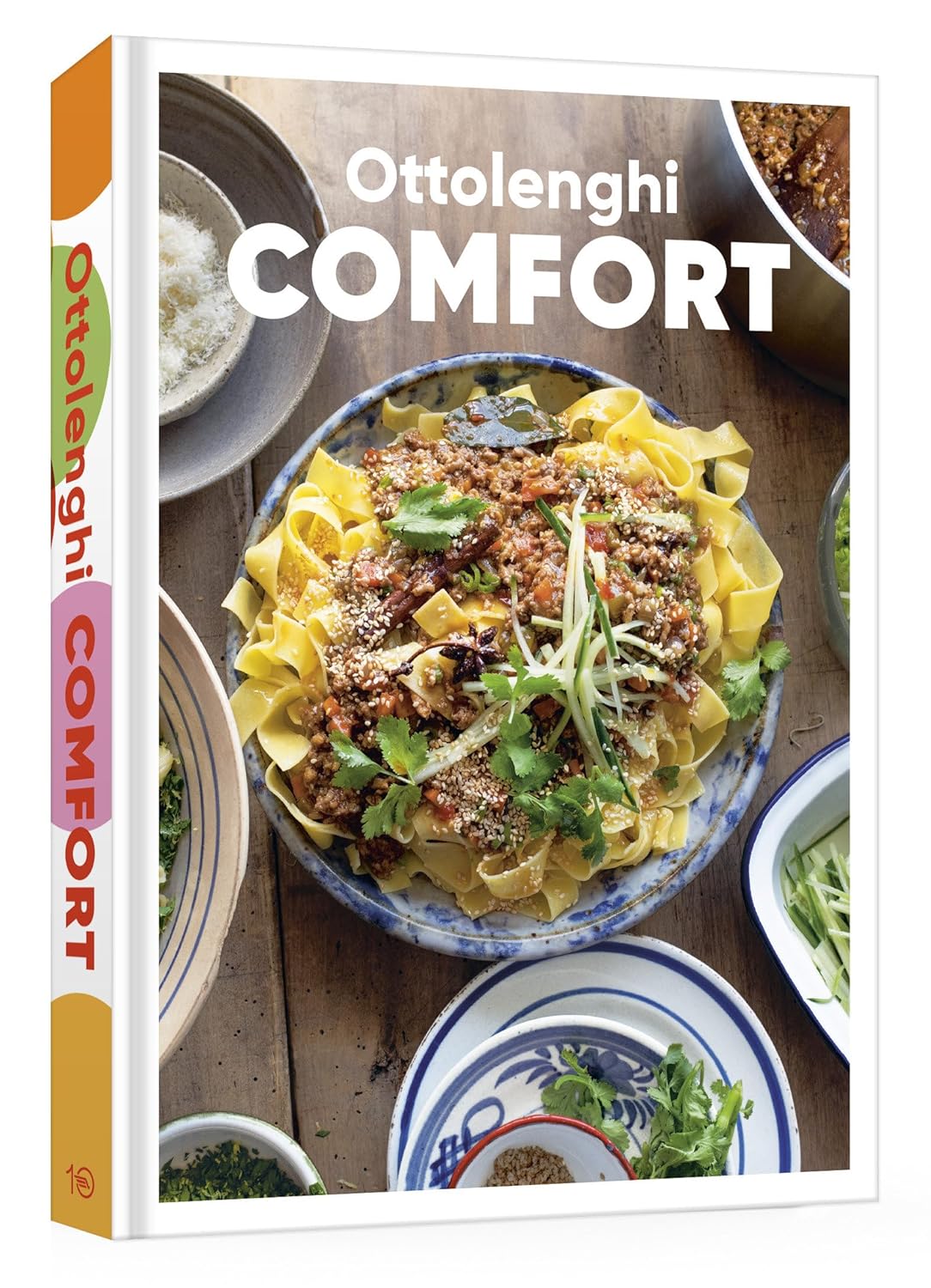
Ottolenghi Comfort: A Cookbook
AED16452
Quantity:
Order today to get by 7-14 business days
Delivery fee of AED 20. Free for orders above AED 200.
 Imported From: United States
At BOLO, we work hard to ensure the products you receive are new, genuine, and sourced from reputable suppliers.
Every product in the BOLO catalogue is sourced through our Verified Global Supply Network of verified sellers, authorized distributors or directly from the manufacturer.
Each product undergoes thorough inspection and verification at our consolidation and fulfilment centers to ensure it meets our strict authenticity and quality standards before being shipped and delivered to you.
If you ever have concerns regarding the authenticity of a product purchased from us, please contact Bolo Support. We will review your inquiry promptly and, if necessary, provide documentation verifying authenticity or offer a suitable resolution.
Your trust is our top priority, and we are committed to maintaining transparency and integrity in every transaction.
While we strive to display accurate information, variations in packaging, labeling, instructions, or formulation may occasionally occur due to regional differences or supplier updates. For detailed or manufacturer-specific information, please contact the brand directly or reach out to BOLO Support for assistance.
Unless otherwise stated, all prices displayed on the product page include applicable taxes and import duties.
BOLO operates in accordance with the laws and regulations of United Arab Emirates. Any items found to be restricted or prohibited for sale within the United Arab Emirates will be cancelled prior to shipment. We take proactive measures to ensure that only products permitted for sale in United Arab Emirates are listed on our website.
All items are shipped by air, and any products classified as “Dangerous Goods (DG)” under IATA regulations will be removed from the order and cancelled.
All orders are processed manually, and we make every effort to process them promptly once confirmed. Products cancelled due to the above reasons will be permanently removed from listings across the website.
Similar suggestions by Bolo
More from this brand
Similar items from “Middle Eastern”
Share with
Or share with link
https://www.bolo.ae/products/U0399581774
Visit the Ten Speed Press Store
Ottolenghi Comfort: A Cookbook
AED16452
Quantity:
Order today to get by 7-14 business days
Delivery fee of AED 20. Free for orders above AED 200.
Imported From: United States
At BOLO, we work hard to ensure the products you receive are new, genuine, and sourced from reputable suppliers.
Every product in the BOLO catalogue is sourced through our Verified Global Supply Network of verified sellers, authorized distributors or directly from the manufacturer.
Each product undergoes thorough inspection and verification at our consolidation and fulfilment centers to ensure it meets our strict authenticity and quality standards before being shipped and delivered to you.
If you ever have concerns regarding the authenticity of a product purchased from us, please contact Bolo Support. We will review your inquiry promptly and, if necessary, provide documentation verifying authenticity or offer a suitable resolution.
Your trust is our top priority, and we are committed to maintaining transparency and integrity in every transaction.
While we strive to display accurate information, variations in packaging, labeling, instructions, or formulation may occasionally occur due to regional differences or supplier updates. For detailed or manufacturer-specific information, please contact the brand directly or reach out to BOLO Support for assistance.
Unless otherwise stated, all prices displayed on the product page include applicable taxes and import duties.
BOLO operates in accordance with the laws and regulations of United Arab Emirates. Any items found to be restricted or prohibited for sale within the United Arab Emirates will be cancelled prior to shipment. We take proactive measures to ensure that only products permitted for sale in United Arab Emirates are listed on our website.
All items are shipped by air, and any products classified as “Dangerous Goods (DG)” under IATA regulations will be removed from the order and cancelled.
All orders are processed manually, and we make every effort to process them promptly once confirmed. Products cancelled due to the above reasons will be permanently removed from listings across the website.
Description:
Editorial Reviews
About the Author
Helen Goh was born in Malaysia and migrated with her family to Australia at the age of ten. Co-author of Sweet, she has worked closely with Yotam for over ten years, drawing widely on Asian, Western, and Middle Eastern influences in her cooking. Helen’s recipes appear in the Sydney Morning Herald, Guardian and Observer.
Tara Wigley worked in publishing for the best part of a decade before switching to food and writing in 2010. She trained at the Ballymaloe cooking school in Ireland before starting work with Yotam in 2011. Tara co-authored Ottolenghi Simple and Falastin. Her first solo book, How to Butter Toast, a collection of rhymes about recipes, was published in 2023.
Verena Lochmuller is a recipe and product developer. She was born in Germany, grew up in Scotland, and studied pastry and baking arts in New York City. She has been at Ottolenghi since 2015, and has contributed recipes to two Ottolenghi Test Kitchen books—Shelf Love and Extra Good Things. She is now Head of Food Quality and Product Development at the Ottolenghi Test Kitchen.
Excerpt. © Reprinted by permission. All rights reserved.
When it comes to cooking and eating, what does “comfort” mean? At first glance, we might think of it as the food we make and eat at home, after a tough day. It’s the food we make without thinking too much. It might also be the recipes we grew up on, which remind us of being a kid and being cared for. Or the food we eat too much of, unable to resist its ability to hit the spot.
Nurture, convenience, nostalgia, indulgence: agreeing on the notion of comfort food is fairly straightforward. What’s harder to pin down, though, are the actual dishes that hit these proverbial spots. One person’s idea of comfort food might be the next person’s idea of challenging. It’s so personal, so tied up with home, with family, with memory, even with the random idiosyncrasies of human taste.
It’s culturally specific, as well. One kid’s grilled cheese sandwich dream is the next kid’s nightmare. Ditto the adult who then makes that same sandwich, years down the line, to remind them of the kid they once were. Mac ’n’ cheese, chicken ramen, schnitzel, sausages and mash, pizza, chicken noodle soup, lentils and rice, dal, dumplings—the definitive comfort food for many, certainly, but there is no one-comfort-food-fits-all. Trying to pin down a specific set of comfort food recipes is as slippery as a bowl of noodles.
And yet those noodles, however novel they might be, will always feel somehow nostalgic. It’s this—the ability of a dish to be nostalgic and novel at once—that’s at the heart of our interpretation of comfort. In this book we offer dishes that are both comfortable and creative, familiar and fresh, reassuring and revelatory.
It is also very much about the personal journeys we’ve been on, and all the stories these journeys contain. In Comfort, rather than trying to take in a whole sweep of comfort food, we’re staying on firmer ground, that which we’ve trodden ourselves. Among the four of us—Yotam, Helen, Verena, and Tara—it’s a fair bit of global ground. Yotam’s takes in Italy and Germany (from his parents), Jerusalem to Amsterdam (where he lived and ate his body weight in croquettes), to London. Helen’s stretches from China (from her grandparents) to Malaysia to Melbourne (where she was raised) to west London. Verena’s trodden ground takes in Germany and Scotland, to New York (where she trained), to now London. Tara’s more London through and through, but the amount of tahini, eggplants, lemons, feta, and olive oil she’s cooked with over the past twenty years means she’s pretty good on the subject of Levantine food.
Looking at the ground the four of us had trodden showed us the link between comfort food and movement, between comfort food and immigration. When we move somewhere new, we do two things. We take on (and take in) the culture and cuisine of the place we have moved to and we keep hold of and preserve the culture and cuisine of the place we have left.
Practicalities also play a part. We can’t lug around our childhood bedroom, or sofa, or favorite spot we used to go to for a family picnic. If we are missing the chicken soup, the lentils and rice, or the pasta bake our mother or father used to make for us when we needed a hug as a kid, though, we can try to re-create these dishes. They’re edible transitional objects, and nothing will fast-track us back to that hug years down the line more than making that soup, or those lentils, or that pasta bake.
We don’t cook or eat in a vacuum, so once this dish is made, it’s usually shared with someone else: with our new family or friend or neighbor. That’s when the ripple effects are felt. What started off as a metaphorical hug becomes a recipe that someone then asks for, makes for themselves, and goes on to share with a whole new group.
This process is happening the world over. It’s why a single curious cook can eat their way around the world from their own kitchen table. It’s why Italian food is so tied up with American food. It’s why we can all buy sushi and seaweed, pizza and pasta, chana dal and curry leaves from the same supermarket.
When done with awareness, acknowledgment, relish, and respect, this is, for us, cultural appreciation, not appropriation. That’s what comfort food means to us. It’s about our journeys and all the stories contained in them. This book is a celebration of that: of movement, of immigration, of family, of home—of people.
Other ways to define comfort, none mutually exclusive, can also be about a certain type of food, for example: the face-planting comfort of carbs, maybe, or the inherently soothing nature of soup. It might also be about the situation in which food is eaten: the comfort of sitting around with friends, perhaps, or the very opposite—the comfort of quietly eating alone, with the world shut out. Very often, it’s about the combination of right food and right time and right place. That explains why an ice cream eaten on a hot day on a park bench can be as comforting as a glass of red wine and a plate of roasted chicken inside on a cold day, when the kitchen windows are blocked out with steam.
What makes food comforting can be about where and how we eat, why we eat, and who we eat with as much as what we’re eating in the first place. Something to think about, if you like, as you choose the recipes to try out and make your own. We hope they bring you comfort, in whatever form that comfort may come.
Details:
Similar suggestions by Bolo
More from this brand
Similar items from “Middle Eastern”
Share with
Or share with link
https://www.bolo.ae/products/U0399581774