Deliver toUnited Arab Emirates
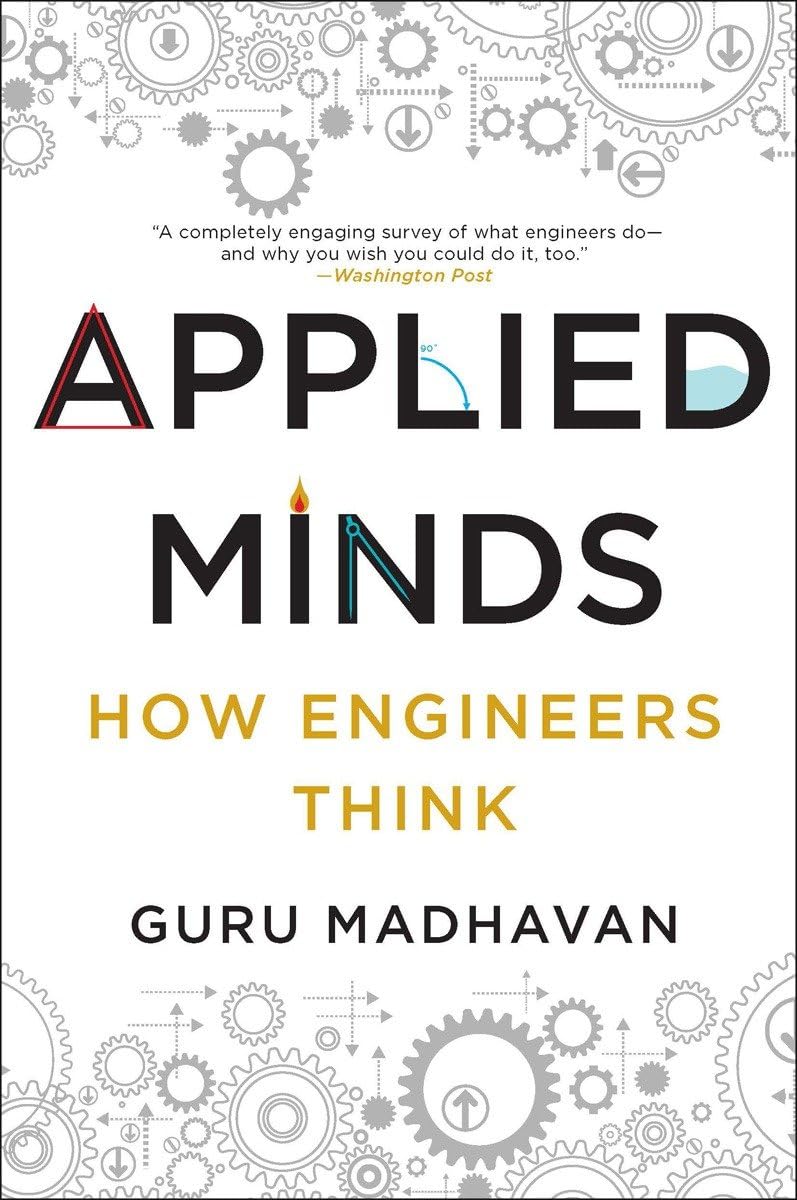
Applied Minds: How Engineers Think

Description:

Winner, IEEE-USA Award for DistinguishedLiterary Contributions Furthering Public Understanding and the Advancement ofthe Engineering Profession
Winner, American Society of Engineering Education Technological and Engineering Literacy/Philosophy of Engineering Division Meritorious Award "Engineers are titans of real-world problem-solving. . . . In this riveting study of how they think, [Guru Madhavan] puts behind-the-scenes geniuses . . . center stage."―NatureDubai's Burj Khalifa―the world's tallest building―looks nothing like Microsoft's Office Suite, and digital surround sound doesn't work like a citywide telecommunication grid. Yet these engineering feats have much in common.Applied Minds explores the unique visions and mental tools of engineers to reveal the enormous―and often understated―influence they wield in transforming problems into opportunities. The resulting account pairs the innovators of modern history―Thomas Edison, the Wright brothers, Steve Jobs―with everything from ATMs and the ZIP code system to the disposable diaper.An engineer himself, Guru Madhavan introduces a flexible intellectual tool kit called modular systems thinking as he explains the discipline's penchant for seeing structure where there is none. The creations that result from this process express the engineer's answers to the fundamental questions of design: usefulness, functionality, reliability, and user friendliness.Through narratives and case studies spanning the brilliant history of engineering, Madhavan shows how the concepts of prototyping, efficiency, reliability, standards, optimization, and feedback are put to use in fields as diverse as transportation, retail, health care, and entertainment.
Equal parts personal, practical, and profound,
Applied Minds charts a path to a future where we apply strategies borrowed from engineering to create useful and inspired solutions to our most pressing challenges.


Editorial Reviews

Review

Winner, IEEE-USA Award for DistinguishedLiterary Contributions Furthering Public Understanding and the Advancement ofthe Engineering Profession
Winner, American Society of Engineering Education Technological and Engineering Literacy/Philosophy of Engineering Division Meritorious Award

"An accessible and very human story of innovators."--Gemma Tarlach, Discover

"Engineers are titans of real-world problem-solving, yetare strangely invisible, notes biomedical engineer Guru Madhavan. In thisriveting study of how they think, he puts behind-the-scenes geniuses such asMargaret Hutchinson, who designed the first penicillin-production plant, centrestage."--Barbara Kiser, Nature

"This thoroughly engaging book demonstrates thatengineering thinking is truly multidisciplinary, multinational, andmulticultural. Through its diverse cast of engineers and wide-ranging examplesof their achievements,
Applied Minds leaves little doubt thatour world is a better place because of the engineers who inhabit it."--Henry Petroski, author of To Engineer Is Human and TheEssential Engineer

"Engaging...[and] insightful."--Sybil Derrible , Science

"A real pleasure to read, and lots to learn."--Tim Harford,
The Financial Times's UndercoverEconomist and presenter of BBC Radio 4's More or Less
"The heroes of Guru Madhavan's compact book about thelogical habits of engineers are not the usual suspects of the iPhone era. Withbarely a mention of Wozniak or Jobs, the author takes us back to an earliertime so that we can witness the solving of problems that have long since goneaway."--Jon Gertner , Wall StreetJournal

"Anyone trying to interest America's young people intechnical careers should read
Applied Minds.... Writing with aliveliness that reflects the energized, creative, problem-solving people hetalks about, Madhavan, a biomedical engineer, presents a completely engagingsurvey of what engineers do--and why you wish you could do it, too."--Nancy Szokan , Washington Post

"In this smart, insightful, and fascinating book, Madhavanshows how engineers turn problems into opportunities. The engineering mind-setis something we should all study and embrace. It applies to every aspect oflife."--Walter Isaacson, author of
TheInnovators and Steve Jobs

"An unabashed celebration of engineers and their 'plugand play' thinking tool kit....
Applied Minds is worth sharingwith young engineering students."--Robin Tatu, PrismMagazine, American Society of Engineering Education

"Guru Madhavan not onlydispels any hint of darkness concerning how engineers think, his delightfulbook explains how the designed world of machines and systems interacts with thesocial world in which we use the tools that engineers give us."--Alvin Roth, NobelPrize Winner

About the Author

Guru Madhavan is the Norman R. Augustine Senior Scholar and senior director of programs at the National Academy of Engineering. He is a prize–winning author of essays and books, including Wicked Problems and Applied Minds. He lives in Washington, DC.

Reviews:

5.0 out of 5 stars Shared this book with my son who is on his way to engineering school in the fall.

L.C. · July 26, 2020

LOVED this book. Ordered it after reading a Wall Street Journal article by the author. I'm not an engineer by trade but my father was and my son is now on his way. But I have always done things in a problem-solving, systems-creating way and this book helped to reinforce the how, and the why, and the way we are different from others and their approaches to life. Enjoyable and informative.

4.0 out of 5 stars The Engineering Mindset

L.A. · August 16, 2020

The central thesis of “Applied Minds” is that engineers have a “mindset” that enables them to turn problems into opportunities. The mindset is not simply defined so the author supports his thesis through a wide range of case studies.Engineers do not become household names - public recognition usually goes to the scientist who makes a fundamental discovery. It was fascinating to read about the people who created ATM machines, UPC bar codes, laser scanners, digital photography, and mobile telephony. The author provides insight into the origin of each technology and the problems that had to be solved to bring the technology to fruition. For example, the inventor of the first ATM first conceived of a machine to dispense chocolate bars before focusing on cash. Laser scanners used in supermarkets were originally developed to track the location of trains within the vast American railroad network. There are some surprising examples of how an engineering mindset was applied by creative people in the entertainment industry. The author interviewed the living engineers profiled; these first person recollections of their work add greatly to the narrative. This book does much to dispel stereotypes of engineers. The authors enthusiasm and passion shines through in his writing.It was disappointing that the author didn’t discuss the contributions of engineers to modern medicine, apart from the first large scale production of penicillin in the 1940s. Also, it was surprising not to see any discussion of engineering contributions to space exploration.To summarize: this book provides insights into how engineers think and the amazing inventions that flow from the engineering mindset. I haven’t come across a similar book yet. If you are an aspiring or practicing engineer you will get something out of reading “Applied Minds”.

5.0 out of 5 stars How almost anyone can develop an engineer's mind-set to create a significant competitive advantage

R.M. · November 28, 2016

Few people complete a formal education in engineering (B.S. degree through a Ph.D. degree) but Guru Madhavan is convinced – as am I – that almost anyone can develop an engineer's mind-set, one that could create a significant competitive advantage for them. "Engineers help create [begin italics] solution spaces [end italics] -- suites of possibilities that offer new choices, conveniences, and comforts -- that redefine our standard of living."; They have developed a mind-set that guides and informs those efforts.Howard Gardner has much of value to say about multiple intelligences that have almost unlimited applications in what are often viewed as separate and [begin italics] unrelated [end italics] arts and sciences. Mudhavan agrees with Gardner: “The engineering mind-set can be applied successfully in every walk of life because its core elements (structure, constraints, trade-offs) and its basic concepts (including recombination, optimization, efficiency, and prototyping, are equally effective in finding solutions to nonengineering challenges. We can see all these aspects converging clearly in the work of one of the most famous film directors of all time, who studied and had a ‘thorough grounding’ in engineering. His early technical training had an important influence on his creations.”Madhavan points out that, for Alfred Hitchcock, everything he presented on screen “was rooted in technical logic, even creating a suspenseful cinematic moment – the immediacy and very essence of the experience that would be thrilling and ‘chilling movie audiences long before air conditioning.’” Such effects are the result of both art and science.The Birds offers an excellent case in point. The technical issues with the movie were “prodigious,” Hitchcock said. “I mean films like Ben Hur and Cleopatra are child’s play compared to this.” Madhavan notes that live birds had to be trained for every shot and the aeorodynamic principles of gliders were applied “to simulate fake bird movements. Special wire works, miniatures, and gears were used to arrive at authentic-looking shorts of the feathered actors – a Hollywood version of robotics before computers.”Obviously, the engineer’s mind-set can help to create “suites of possibilities that offer new choices, conveniences, and comforts -- that redefine our standard of living." It can guide and inform those efforts. But there is a higher purpose to which Madhavan refers when suggesting that everyone is an engineer “at some point in the way we design our destinies. That’s why it’s the responsibility of not only engineers, but just about everyone to share the future course of engineering, which is entering an era of new eclecticism. With a shared vision we can create better solution spaces, convert random motions into progress, and improve societal muscle strength to address the complexities of today and tomorrow.”Guru Madhavan provides an abundance of information, insights, and counsel in this volume from a scope and depth of sources and resources that require 39 pages to be cited. Also of great value are the lessons he has learned from this material as well as his determination to prepare those who read his book to create their own ““suites of possibilities that offer new choices, conveniences, and comforts” and help others to do so. With all due respect to the importance of a higher standard of living, we need even more a higher quality of life. We don’t need a world filled with engineers but we could certainly benefit from a world in which everyone can think like one whenever necessary.

3.0 out of 5 stars Interesting in places but not informative overall

B. · May 27, 2019

Contains some interesting historical vignettes and a few worthwhile insights but, on the whole, meanders about the topic advertised in the title and most definitely fails to take anything like a systematic approach to the topic of how engineers think. It would have been very interesting to see even a systematic summary of that topic juxtaposed with how engineers might be adjusting or even transforming their ways of thinking in this era of (possibly oversold, I agree) Agile methods and (not oversold) the high and ever-increasing rate of of change in pace, scale, and scope in so many areas that require solid engineering thinking to keep pace or at least cope.

5.0 out of 5 stars This book does a good job of combining historical examples and linking them with ...

S.W. · February 26, 2018

Book overall is quite thought provoking and well written. Some chapters are definitely more interesting than others. This book does a good job of combining historical examples and linking them with common these such as synthesis of ideas and applying them to new situations.

I’m delighted when I’m seduced by the writing

H.i.V. · October 26, 2015

I am always thrilled in a particular kind of way when I read a book about a subject I never imagined I’d be interested in. I’m delighted when I’m seduced by the writing, engaged by the ideas and, especially, find myself thinking, “Hmmm I never thought about That, in this way before”. “Applied Minds – How Engineers Think” is that kind of book, full of revelations and “aha” moments. I don’t often pause to think about the people who design bridges or sewer systems or a multitude of other structures and systems that we depend on every day. And I’ve never considered the mental processes involved in coming up with designs that must address so many details and important considerations. The stories in “Applied Minds” are compelling, intriguing and often moving. Guru Madhavan knows that telling stories is a great way to engage a broad readership and he is a wonderful storyteller. I particularly liked the chapter called “Learning from Others” with its unusual examples of how outside-the-box thinkers who are open to connecting unconventional dots, get their inspiration. Madhavan says an engineer’s mind is an “inference engine”, taking clues from nature and from other non-engineers, and applying them to their work. The more we can break down silos, talk to, and learn from others, the better off we’ll all be. “Applied Minds” encourages us all to be curious and to ask those basic questions: why, how, what if? - to see where that leads. This is a book for all of us and also one I hope all engineering students and their professors will read and discuss.

Must read

a. · January 23, 2018

Must read for all engineers

Four Stars

A. · January 16, 2016

Interesting book about engineers' different approaches towards different problems. Uses different examples from engineerng history to explain his ideas.

Four Stars

H.J. · October 26, 2016

A must read for engineers. Gives lot of insight to how an engineer should think and work.

Five Stars

V.V.R. · December 14, 2017

Interesting

Applied Minds: How Engineers Think

Product ID: U039335301K
Condition: New

4.1

AED9019

Price includes VAT & Import Duties
Type: Paperback
Availability: In Stock

Quantity:

|

Order today to get by 7-14 business days

Delivery fee of AED 20. Free for orders above AED 200.

Returns & Warranty policies

Imported From: United States

At BOLO, we work hard to ensure the products you receive are new, genuine, and sourced from reputable suppliers.

BOLO is not an authorized or official retailer for most brands, nor are we affiliated with manufacturers unless specifically stated on a product page. Instead, we source verified sellers, authorized distributors or directly from the manufacturer.

Each product undergoes thorough inspection and verification at our consolidation and fulfilment centers to ensure it meets our strict authenticity and quality standards before being shipped and delivered to you.

If you ever have concerns regarding the authenticity of a product purchased from us, please contact Bolo Support. We will review your inquiry promptly and, if necessary, provide documentation verifying authenticity or offer a suitable resolution.

Your trust is our top priority, and we are committed to maintaining transparency and integrity in every transaction.

All product information, images, descriptions, and reviews originate from the manufacturer or from trusted sellers overseas. BOLO is not affiliated with, endorsed by, or an authorized retailer for most brands listed on our website unless stated otherwise.

While we strive to display accurate information, variations in packaging, labeling, instructions, or formulation may occasionally occur due to regional differences or supplier updates. For detailed or manufacturer-specific information, please contact the brand directly or reach out to BOLO Support for assistance.

Unless otherwise stated, all prices displayed on the product page include applicable taxes and import duties.

BOLO operates in accordance with the laws and regulations of United Arab Emirates. Any items found to be restricted or prohibited for sale within the UAE will be cancelled prior to shipment. We take proactive measures to ensure that only products permitted for sale in United Arab Emirates are listed on our website.

All items are shipped by air, and any products classified as “Dangerous Goods (DG)” under IATA regulations will be removed from the order and cancelled.

All orders are processed manually, and we make every effort to process them promptly once confirmed. Products cancelled due to the above reasons will be permanently removed from listings across the website.

Similar suggestions by Bolo

More from this brand

Similar items from “Patents & Inventions”

Applied Minds: How Engineers Think

Product ID: U039335301K
Condition: New

4.1

Applied Minds: How Engineers Think-0
Type: Paperback

AED9019

Price includes VAT & Import Duties
Availability: In Stock

Quantity:

|

Order today to get by 7-14 business days

Delivery fee of AED 20. Free for orders above AED 200.

Returns & Warranty policies

Imported From: United States

At BOLO, we work hard to ensure the products you receive are new, genuine, and sourced from reputable suppliers.

BOLO is not an authorized or official retailer for most brands, nor are we affiliated with manufacturers unless specifically stated on a product page. Instead, we source verified sellers, authorized distributors or directly from the manufacturer.

Each product undergoes thorough inspection and verification at our consolidation and fulfilment centers to ensure it meets our strict authenticity and quality standards before being shipped and delivered to you.

If you ever have concerns regarding the authenticity of a product purchased from us, please contact Bolo Support. We will review your inquiry promptly and, if necessary, provide documentation verifying authenticity or offer a suitable resolution.

Your trust is our top priority, and we are committed to maintaining transparency and integrity in every transaction.

All product information, images, descriptions, and reviews originate from the manufacturer or from trusted sellers overseas. BOLO is not affiliated with, endorsed by, or an authorized retailer for most brands listed on our website unless stated otherwise.

While we strive to display accurate information, variations in packaging, labeling, instructions, or formulation may occasionally occur due to regional differences or supplier updates. For detailed or manufacturer-specific information, please contact the brand directly or reach out to BOLO Support for assistance.

Unless otherwise stated, all prices displayed on the product page include applicable taxes and import duties.

BOLO operates in accordance with the laws and regulations of United Arab Emirates. Any items found to be restricted or prohibited for sale within the UAE will be cancelled prior to shipment. We take proactive measures to ensure that only products permitted for sale in United Arab Emirates are listed on our website.

All items are shipped by air, and any products classified as “Dangerous Goods (DG)” under IATA regulations will be removed from the order and cancelled.

All orders are processed manually, and we make every effort to process them promptly once confirmed. Products cancelled due to the above reasons will be permanently removed from listings across the website.

Description:

Winner, IEEE-USA Award for DistinguishedLiterary Contributions Furthering Public Understanding and the Advancement ofthe Engineering Profession
Winner, American Society of Engineering Education Technological and Engineering Literacy/Philosophy of Engineering Division Meritorious Award "Engineers are titans of real-world problem-solving. . . . In this riveting study of how they think, [Guru Madhavan] puts behind-the-scenes geniuses . . . center stage."―NatureDubai's Burj Khalifa―the world's tallest building―looks nothing like Microsoft's Office Suite, and digital surround sound doesn't work like a citywide telecommunication grid. Yet these engineering feats have much in common.Applied Minds explores the unique visions and mental tools of engineers to reveal the enormous―and often understated―influence they wield in transforming problems into opportunities. The resulting account pairs the innovators of modern history―Thomas Edison, the Wright brothers, Steve Jobs―with everything from ATMs and the ZIP code system to the disposable diaper.An engineer himself, Guru Madhavan introduces a flexible intellectual tool kit called modular systems thinking as he explains the discipline's penchant for seeing structure where there is none. The creations that result from this process express the engineer's answers to the fundamental questions of design: usefulness, functionality, reliability, and user friendliness.Through narratives and case studies spanning the brilliant history of engineering, Madhavan shows how the concepts of prototyping, efficiency, reliability, standards, optimization, and feedback are put to use in fields as diverse as transportation, retail, health care, and entertainment.
Equal parts personal, practical, and profound,
Applied Minds charts a path to a future where we apply strategies borrowed from engineering to create useful and inspired solutions to our most pressing challenges.


Editorial Reviews

Review

Winner, IEEE-USA Award for DistinguishedLiterary Contributions Furthering Public Understanding and the Advancement ofthe Engineering Profession
Winner, American Society of Engineering Education Technological and Engineering Literacy/Philosophy of Engineering Division Meritorious Award

"An accessible and very human story of innovators."--Gemma Tarlach, Discover

"Engineers are titans of real-world problem-solving, yetare strangely invisible, notes biomedical engineer Guru Madhavan. In thisriveting study of how they think, he puts behind-the-scenes geniuses such asMargaret Hutchinson, who designed the first penicillin-production plant, centrestage."--Barbara Kiser, Nature

"This thoroughly engaging book demonstrates thatengineering thinking is truly multidisciplinary, multinational, andmulticultural. Through its diverse cast of engineers and wide-ranging examplesof their achievements,
Applied Minds leaves little doubt thatour world is a better place because of the engineers who inhabit it."--Henry Petroski, author of To Engineer Is Human and TheEssential Engineer

"Engaging...[and] insightful."--Sybil Derrible , Science

"A real pleasure to read, and lots to learn."--Tim Harford,
The Financial Times's UndercoverEconomist and presenter of BBC Radio 4's More or Less
"The heroes of Guru Madhavan's compact book about thelogical habits of engineers are not the usual suspects of the iPhone era. Withbarely a mention of Wozniak or Jobs, the author takes us back to an earliertime so that we can witness the solving of problems that have long since goneaway."--Jon Gertner , Wall StreetJournal

"Anyone trying to interest America's young people intechnical careers should read
Applied Minds.... Writing with aliveliness that reflects the energized, creative, problem-solving people hetalks about, Madhavan, a biomedical engineer, presents a completely engagingsurvey of what engineers do--and why you wish you could do it, too."--Nancy Szokan , Washington Post

"In this smart, insightful, and fascinating book, Madhavanshows how engineers turn problems into opportunities. The engineering mind-setis something we should all study and embrace. It applies to every aspect oflife."--Walter Isaacson, author of
TheInnovators and Steve Jobs

"An unabashed celebration of engineers and their 'plugand play' thinking tool kit....
Applied Minds is worth sharingwith young engineering students."--Robin Tatu, PrismMagazine, American Society of Engineering Education

"Guru Madhavan not onlydispels any hint of darkness concerning how engineers think, his delightfulbook explains how the designed world of machines and systems interacts with thesocial world in which we use the tools that engineers give us."--Alvin Roth, NobelPrize Winner

About the Author

Guru Madhavan is the Norman R. Augustine Senior Scholar and senior director of programs at the National Academy of Engineering. He is a prize–winning author of essays and books, including Wicked Problems and Applied Minds. He lives in Washington, DC.

Reviews:

5.0 out of 5 stars Shared this book with my son who is on his way to engineering school in the fall.

L.C. · July 26, 2020

LOVED this book. Ordered it after reading a Wall Street Journal article by the author. I'm not an engineer by trade but my father was and my son is now on his way. But I have always done things in a problem-solving, systems-creating way and this book helped to reinforce the how, and the why, and the way we are different from others and their approaches to life. Enjoyable and informative.

4.0 out of 5 stars The Engineering Mindset

L.A. · August 16, 2020

The central thesis of “Applied Minds” is that engineers have a “mindset” that enables them to turn problems into opportunities. The mindset is not simply defined so the author supports his thesis through a wide range of case studies.Engineers do not become household names - public recognition usually goes to the scientist who makes a fundamental discovery. It was fascinating to read about the people who created ATM machines, UPC bar codes, laser scanners, digital photography, and mobile telephony. The author provides insight into the origin of each technology and the problems that had to be solved to bring the technology to fruition. For example, the inventor of the first ATM first conceived of a machine to dispense chocolate bars before focusing on cash. Laser scanners used in supermarkets were originally developed to track the location of trains within the vast American railroad network. There are some surprising examples of how an engineering mindset was applied by creative people in the entertainment industry. The author interviewed the living engineers profiled; these first person recollections of their work add greatly to the narrative. This book does much to dispel stereotypes of engineers. The authors enthusiasm and passion shines through in his writing.It was disappointing that the author didn’t discuss the contributions of engineers to modern medicine, apart from the first large scale production of penicillin in the 1940s. Also, it was surprising not to see any discussion of engineering contributions to space exploration.To summarize: this book provides insights into how engineers think and the amazing inventions that flow from the engineering mindset. I haven’t come across a similar book yet. If you are an aspiring or practicing engineer you will get something out of reading “Applied Minds”.

5.0 out of 5 stars How almost anyone can develop an engineer's mind-set to create a significant competitive advantage

R.M. · November 28, 2016

Few people complete a formal education in engineering (B.S. degree through a Ph.D. degree) but Guru Madhavan is convinced – as am I – that almost anyone can develop an engineer's mind-set, one that could create a significant competitive advantage for them. "Engineers help create [begin italics] solution spaces [end italics] -- suites of possibilities that offer new choices, conveniences, and comforts -- that redefine our standard of living."; They have developed a mind-set that guides and informs those efforts.Howard Gardner has much of value to say about multiple intelligences that have almost unlimited applications in what are often viewed as separate and [begin italics] unrelated [end italics] arts and sciences. Mudhavan agrees with Gardner: “The engineering mind-set can be applied successfully in every walk of life because its core elements (structure, constraints, trade-offs) and its basic concepts (including recombination, optimization, efficiency, and prototyping, are equally effective in finding solutions to nonengineering challenges. We can see all these aspects converging clearly in the work of one of the most famous film directors of all time, who studied and had a ‘thorough grounding’ in engineering. His early technical training had an important influence on his creations.”Madhavan points out that, for Alfred Hitchcock, everything he presented on screen “was rooted in technical logic, even creating a suspenseful cinematic moment – the immediacy and very essence of the experience that would be thrilling and ‘chilling movie audiences long before air conditioning.’” Such effects are the result of both art and science.The Birds offers an excellent case in point. The technical issues with the movie were “prodigious,” Hitchcock said. “I mean films like Ben Hur and Cleopatra are child’s play compared to this.” Madhavan notes that live birds had to be trained for every shot and the aeorodynamic principles of gliders were applied “to simulate fake bird movements. Special wire works, miniatures, and gears were used to arrive at authentic-looking shorts of the feathered actors – a Hollywood version of robotics before computers.”Obviously, the engineer’s mind-set can help to create “suites of possibilities that offer new choices, conveniences, and comforts -- that redefine our standard of living." It can guide and inform those efforts. But there is a higher purpose to which Madhavan refers when suggesting that everyone is an engineer “at some point in the way we design our destinies. That’s why it’s the responsibility of not only engineers, but just about everyone to share the future course of engineering, which is entering an era of new eclecticism. With a shared vision we can create better solution spaces, convert random motions into progress, and improve societal muscle strength to address the complexities of today and tomorrow.”Guru Madhavan provides an abundance of information, insights, and counsel in this volume from a scope and depth of sources and resources that require 39 pages to be cited. Also of great value are the lessons he has learned from this material as well as his determination to prepare those who read his book to create their own ““suites of possibilities that offer new choices, conveniences, and comforts” and help others to do so. With all due respect to the importance of a higher standard of living, we need even more a higher quality of life. We don’t need a world filled with engineers but we could certainly benefit from a world in which everyone can think like one whenever necessary.

3.0 out of 5 stars Interesting in places but not informative overall

B. · May 27, 2019

Contains some interesting historical vignettes and a few worthwhile insights but, on the whole, meanders about the topic advertised in the title and most definitely fails to take anything like a systematic approach to the topic of how engineers think. It would have been very interesting to see even a systematic summary of that topic juxtaposed with how engineers might be adjusting or even transforming their ways of thinking in this era of (possibly oversold, I agree) Agile methods and (not oversold) the high and ever-increasing rate of of change in pace, scale, and scope in so many areas that require solid engineering thinking to keep pace or at least cope.

5.0 out of 5 stars This book does a good job of combining historical examples and linking them with ...

S.W. · February 26, 2018

Book overall is quite thought provoking and well written. Some chapters are definitely more interesting than others. This book does a good job of combining historical examples and linking them with common these such as synthesis of ideas and applying them to new situations.

I’m delighted when I’m seduced by the writing

H.i.V. · October 26, 2015

I am always thrilled in a particular kind of way when I read a book about a subject I never imagined I’d be interested in. I’m delighted when I’m seduced by the writing, engaged by the ideas and, especially, find myself thinking, “Hmmm I never thought about That, in this way before”. “Applied Minds – How Engineers Think” is that kind of book, full of revelations and “aha” moments. I don’t often pause to think about the people who design bridges or sewer systems or a multitude of other structures and systems that we depend on every day. And I’ve never considered the mental processes involved in coming up with designs that must address so many details and important considerations. The stories in “Applied Minds” are compelling, intriguing and often moving. Guru Madhavan knows that telling stories is a great way to engage a broad readership and he is a wonderful storyteller. I particularly liked the chapter called “Learning from Others” with its unusual examples of how outside-the-box thinkers who are open to connecting unconventional dots, get their inspiration. Madhavan says an engineer’s mind is an “inference engine”, taking clues from nature and from other non-engineers, and applying them to their work. The more we can break down silos, talk to, and learn from others, the better off we’ll all be. “Applied Minds” encourages us all to be curious and to ask those basic questions: why, how, what if? - to see where that leads. This is a book for all of us and also one I hope all engineering students and their professors will read and discuss.

Must read

a. · January 23, 2018

Must read for all engineers

Four Stars

A. · January 16, 2016

Interesting book about engineers' different approaches towards different problems. Uses different examples from engineerng history to explain his ideas.

Four Stars

H.J. · October 26, 2016

A must read for engineers. Gives lot of insight to how an engineer should think and work.

Five Stars

V.V.R. · December 14, 2017

Interesting

Similar suggestions by Bolo

More from this brand

Similar items from “Patents & Inventions”