Description:
Editorial Reviews
Review
― Patricia Cohen, New York Times
"Mearsheimer provides an admirable mixture of conceptual clarity and detailed historical observation…He is an excellent critic of rival perspectives, exposing their weaknesses with real forensic flair. Admirably, he seems to be happiest when swimming against the prevailing tide of academic opinion."
― Adam Roberts, Times Literary Supplement
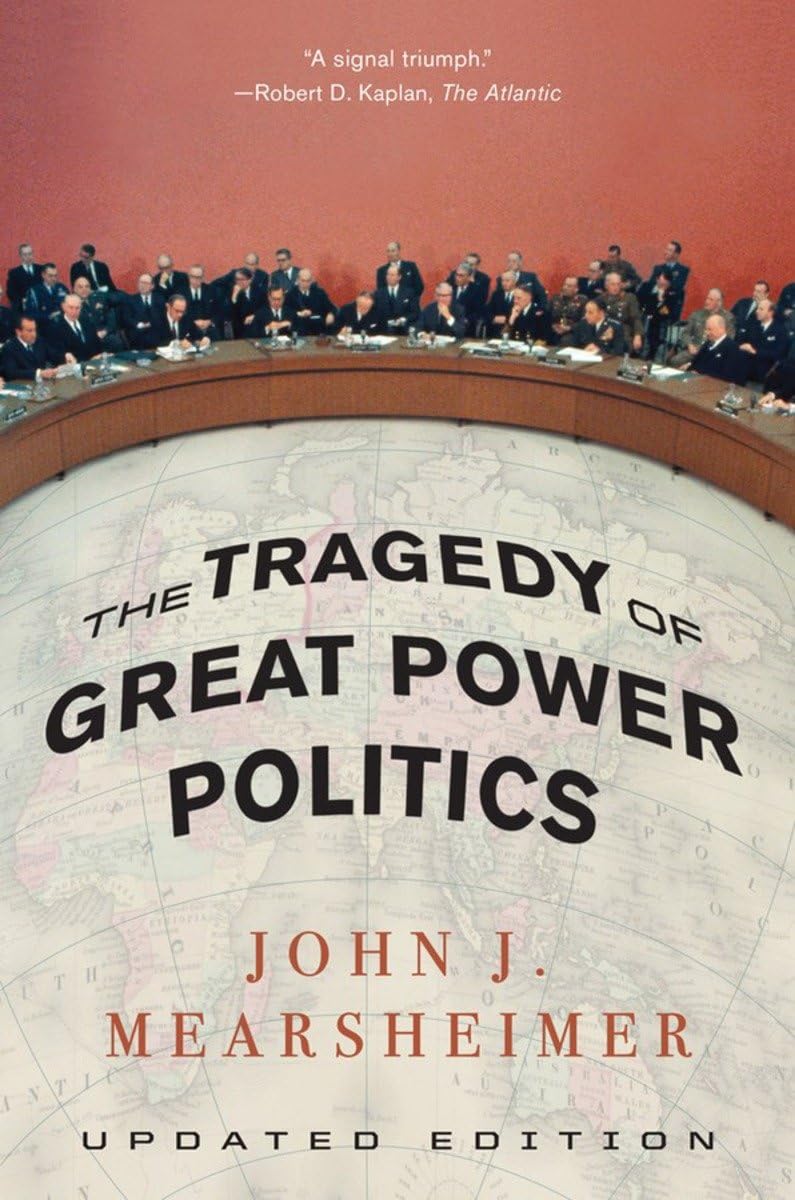
"A signal triumph."
― Robert D. Kaplan, The Atlantic
About the Author
Reviews:
5.0 out of 5 stars A new understanding of why wars occur.
If you're interested in this, you are probably a political science or international relations student, which is a shame because very few general readers would pick this up, and it's those who need it the most, this really deserves to be a best-seller. I majored in biochemistry and am an indie game developer, never took a single class in political science, but on a friend's recommendation who was majoring in that I read this book, and I've re-read it several times over the years, and it's become one of my favorite books (certainly in my top 10 of nonfiction).Basically, this book presents an overarching theory of why wars exist, one that is precise enough to allow even uninformed readers to make predictable, and historically accurate, and precise predictions about when a country will go to war (and why). Most people believe wars to happen for one of several reasons -- "human nature" (because humans just like fighting and are inherently violent or stupid or something), or perhaps the war over religion and ideology, or perhaps over resources. I'd guess that almost everyone believes war happens for one of those reasons.This book dispels that notion very cleanly and completely. After you read it, you'll realize that nations go to war simply because they are afraid. They know that if they lose a war against a greater power, their nation is done for -- it will become occupied, or a puppet state, of a greater power, and lose whatever power they had. Nations do not want that to happen, they are terrified of being dominated by greater nations. And this is a systematic thing, no individual might consciously decide on this, but this is how all nations do seem to work: they are afraid of being conquered, so they go to war to make sure they are the one who conquer, not the one being conquered. This central notion that fear of being conquered by another nation, and not anything else, drives almost all war is the main thesis of the book, and it's argued for very convincingly, with a lot of historical examples.So, the first way a country can be certain it's not going to be conquered by its neighbors is to become the strongest power in its major landmass -- the regional hegemon. Most nations in a position to do so will try to gain regional power -- that is what China is doing in asia, that's what the US did the Americas, and that's what various european countries (e.g. England, France, the Dutch, the Germans, the Russians) have attempted to do for europe, and so on.By this thesis, it may seem counter-intuitive, but according to this idea, the reason Germany went to war was not because they were nationalistic or inherently violent, or because of the ideological differences between fascism, capitalism, and communism, or because wanted to purify Europe of undesirable races, or even that they were angry over the conditions imposed on them after WW1 (though that's part of it), but simply because Germany feared being conquered and wanted to become the most powerful nation in Europe to make sure they would survive.This is a *very* different understanding of war than most people have, I want to emphasize that again. And it sounds strange at first, but this book will probably convince you of it (as evidence, Germany in WW1 had a very different ideology, but the conditions were somewhat similar, and they still went to war, for the same reason they did go to war in WW2. Sometimes WW1 is blamed on entangling alliances or the assassination of an archduke, but, in reality, according to this theory, Germany went to war in WW1 for the exact same reason they want to war in WW2, because they saw an opportunity to become local hegemon of Europe, and took that opportunity).If you still aren't convinced, that isn't of course the job of this review, it's the job of the book; the number of examples used in the book far exceed would I could bring up here. And the author's writing is much better than mine in any case. I'm just trying to explain why I like the book: because it gives you a different opinion of war than the usual one, and does so very convincingly, through factual argument, and explains it in a simple to understand way (you don't need to have even taken a political science course to follow along with the argument).
5.0 out of 5 stars Fantastic book!
Fantastic book, written in a simple to read language and truly informative. I’m going to read more of his books, he is an inspiration.
4.0 out of 5 stars A good case overstated
As Mearsheimer's theories several other reviewers here have discussed I just want to add a few points. I always have a reluctant to accept someone who makes a political theory that only has a limited place for individuals.However while Mearsheimer makes an extremely good case for his Offensive Realism, I found myself while reading though his examples a bit dubious over his explanations like Russia did not try to stay out of WW2 after the fall of France because she was trying to pass the buck. I think its because she was too weak to get involved in the conflict. Japan could have gone to war in 1941 against Russia rather then the US, in fact Mearsheimer's theories might suggest that Russia would have been a better target for them after all Russia was weak and their main rival in the region. At the end of WW2, the US with its forces in Europe would have been a hegemonic power there. Why did she not go for Eastern Europe too and why did she allow European powers to become independent? It controlled Japan too, why give that up?Mearsheimer's himself admits having problems in explaining why Germany did not go to war in 1905 against France when his theories suggested that they should have.The other issue is that this book states the system does not matter but what the rulers are interested in which is a relative advantages over their rivals. Well democratic societies, the electorate makes it quite clear it want *absolute* improvement in their living standards every year. If a leader of the US was to reduce the living standards of the US by reducing the living standards of China (as I think the writer suggests) I doubt the US voters would be pleased with their drop in living standards. If for example the US conquered Mexico then it would in the long term have made the Mexicans citizens, they would have voted, large sums of money would have gone into Mexico etc. The former US electorate would be upset as it sees large sums of money of its money going South. We can see such a situation actually occurring with Turkey attempts to join the EC. The rich states of EC don't want this drain in their living standards.Also democratic societies electorates although they are prepared for a war, generally they want peace and will demand that they get it eg the Japanese electorate in the 1920s made the Japanese troops come back from its invasion of Eastern Russia, as did the US electorate in Vietnam and the Israel electorate in Lebanon. Both the Israeli and US electorates, are looking at the X of their troops that are getting killed not the 5*X terrorist that they are killing. In both, we can see that the electorate is saying lets get the troops to safety as soon as we can and a democratic leader that does not do so will find himself out soon.
5.0 out of 5 stars Critical to understand international relations
This was one hell of a book. John Mearshimer is widely debated among international relations scholars, and even those who dislike him often have to contend that he's been deeply influential.In "The Tragedy of Great Power Politics" he makes the case for what he calls Offensive Realism, a theoretical framework for understanding how powerful nations have peacefully and military interacted throughout history - and how they will continue to in the future.In it, he unpacks numerous dense historical examples, compares the results against his theory and those of more traditional realist thought as well as liberal international relations theory, and attempts to make predictions about the future of relations between China and the United States. Nearly a decade old, the book has already made some unsettlingly accurate predictions about the course of the relationship.For those looking to understand why states like Russia may have chosen to bumble into Ukraine, why China may try to take Taiwan, or why the United States intervenes in so many far flung places, it's a vital read.
Interesting
The important theories of IR putting together the actual reality of the international system.
A must read for those who want to understand how the world works.
An excellent analysis of the giants of geopolitics by a giant in the field himself. Mearsheimer is one of the best geopolitical analysts out there.
Literatura fundamental
Para quem estuda Relações Internacionais, essa é uma obra absolutamente fundamental. Certamente está entre as obras indispensáveis de ler de cabo a rabo para compreender o ambiente internacional.
The Tragedy of Great Power Politics.
This book provides crucial historical information that has been grounded in theoretical principles and that is what I like about it. I uses it as academic reference source in my international relations studies.
No frills. Must read.
No frills analysis of great powers relationships over the last two centuries. Perfectly current. Must read.
Visit the W. W. Norton & Company Store
The Tragedy of Great Power Politics
AED15514
Quantity:
Order today to get by 7-14 business days
Delivery fee of AED 20. Free for orders above AED 200.
Imported From: United States
At BOLO, we work hard to ensure the products you receive are new, genuine, and sourced from reputable suppliers.
BOLO is not an authorized or official retailer for most brands, nor are we affiliated with manufacturers unless specifically stated on a product page. Instead, we source verified sellers, authorized distributors or directly from the manufacturer.
Each product undergoes thorough inspection and verification at our consolidation and fulfilment centers to ensure it meets our strict authenticity and quality standards before being shipped and delivered to you.
If you ever have concerns regarding the authenticity of a product purchased from us, please contact Bolo Support. We will review your inquiry promptly and, if necessary, provide documentation verifying authenticity or offer a suitable resolution.
Your trust is our top priority, and we are committed to maintaining transparency and integrity in every transaction.
All product information, images, descriptions, and reviews originate from the manufacturer or from trusted sellers overseas. BOLO is not affiliated with, endorsed by, or an authorized retailer for most brands listed on our website unless stated otherwise.
While we strive to display accurate information, variations in packaging, labeling, instructions, or formulation may occasionally occur due to regional differences or supplier updates. For detailed or manufacturer-specific information, please contact the brand directly or reach out to BOLO Support for assistance.
Unless otherwise stated, all prices displayed on the product page include applicable taxes and import duties.
BOLO operates in accordance with the laws and regulations of United Arab Emirates. Any items found to be restricted or prohibited for sale within the UAE will be cancelled prior to shipment. We take proactive measures to ensure that only products permitted for sale in United Arab Emirates are listed on our website.
All items are shipped by air, and any products classified as “Dangerous Goods (DG)” under IATA regulations will be removed from the order and cancelled.
All orders are processed manually, and we make every effort to process them promptly once confirmed. Products cancelled due to the above reasons will be permanently removed from listings across the website.
Similar suggestions by Bolo
More from this brand
Similar items from “Asian”
Share with
Or share with link
https://www.bolo.ae/products/U0393349276
Visit the W. W. Norton & Company Store
The Tragedy of Great Power Politics

AED15514
Quantity:
Order today to get by 7-14 business days
Delivery fee of AED 20. Free for orders above AED 200.
Imported From: United States
At BOLO, we work hard to ensure the products you receive are new, genuine, and sourced from reputable suppliers.
BOLO is not an authorized or official retailer for most brands, nor are we affiliated with manufacturers unless specifically stated on a product page. Instead, we source verified sellers, authorized distributors or directly from the manufacturer.
Each product undergoes thorough inspection and verification at our consolidation and fulfilment centers to ensure it meets our strict authenticity and quality standards before being shipped and delivered to you.
If you ever have concerns regarding the authenticity of a product purchased from us, please contact Bolo Support. We will review your inquiry promptly and, if necessary, provide documentation verifying authenticity or offer a suitable resolution.
Your trust is our top priority, and we are committed to maintaining transparency and integrity in every transaction.
All product information, images, descriptions, and reviews originate from the manufacturer or from trusted sellers overseas. BOLO is not affiliated with, endorsed by, or an authorized retailer for most brands listed on our website unless stated otherwise.
While we strive to display accurate information, variations in packaging, labeling, instructions, or formulation may occasionally occur due to regional differences or supplier updates. For detailed or manufacturer-specific information, please contact the brand directly or reach out to BOLO Support for assistance.
Unless otherwise stated, all prices displayed on the product page include applicable taxes and import duties.
BOLO operates in accordance with the laws and regulations of United Arab Emirates. Any items found to be restricted or prohibited for sale within the UAE will be cancelled prior to shipment. We take proactive measures to ensure that only products permitted for sale in United Arab Emirates are listed on our website.
All items are shipped by air, and any products classified as “Dangerous Goods (DG)” under IATA regulations will be removed from the order and cancelled.
All orders are processed manually, and we make every effort to process them promptly once confirmed. Products cancelled due to the above reasons will be permanently removed from listings across the website.
Description:
Editorial Reviews
Review
― Patricia Cohen, New York Times
"Mearsheimer provides an admirable mixture of conceptual clarity and detailed historical observation…He is an excellent critic of rival perspectives, exposing their weaknesses with real forensic flair. Admirably, he seems to be happiest when swimming against the prevailing tide of academic opinion."
― Adam Roberts, Times Literary Supplement
"A signal triumph."
― Robert D. Kaplan, The Atlantic
About the Author
Reviews:
5.0 out of 5 stars A new understanding of why wars occur.
If you're interested in this, you are probably a political science or international relations student, which is a shame because very few general readers would pick this up, and it's those who need it the most, this really deserves to be a best-seller. I majored in biochemistry and am an indie game developer, never took a single class in political science, but on a friend's recommendation who was majoring in that I read this book, and I've re-read it several times over the years, and it's become one of my favorite books (certainly in my top 10 of nonfiction).Basically, this book presents an overarching theory of why wars exist, one that is precise enough to allow even uninformed readers to make predictable, and historically accurate, and precise predictions about when a country will go to war (and why). Most people believe wars to happen for one of several reasons -- "human nature" (because humans just like fighting and are inherently violent or stupid or something), or perhaps the war over religion and ideology, or perhaps over resources. I'd guess that almost everyone believes war happens for one of those reasons.This book dispels that notion very cleanly and completely. After you read it, you'll realize that nations go to war simply because they are afraid. They know that if they lose a war against a greater power, their nation is done for -- it will become occupied, or a puppet state, of a greater power, and lose whatever power they had. Nations do not want that to happen, they are terrified of being dominated by greater nations. And this is a systematic thing, no individual might consciously decide on this, but this is how all nations do seem to work: they are afraid of being conquered, so they go to war to make sure they are the one who conquer, not the one being conquered. This central notion that fear of being conquered by another nation, and not anything else, drives almost all war is the main thesis of the book, and it's argued for very convincingly, with a lot of historical examples.So, the first way a country can be certain it's not going to be conquered by its neighbors is to become the strongest power in its major landmass -- the regional hegemon. Most nations in a position to do so will try to gain regional power -- that is what China is doing in asia, that's what the US did the Americas, and that's what various european countries (e.g. England, France, the Dutch, the Germans, the Russians) have attempted to do for europe, and so on.By this thesis, it may seem counter-intuitive, but according to this idea, the reason Germany went to war was not because they were nationalistic or inherently violent, or because of the ideological differences between fascism, capitalism, and communism, or because wanted to purify Europe of undesirable races, or even that they were angry over the conditions imposed on them after WW1 (though that's part of it), but simply because Germany feared being conquered and wanted to become the most powerful nation in Europe to make sure they would survive.This is a *very* different understanding of war than most people have, I want to emphasize that again. And it sounds strange at first, but this book will probably convince you of it (as evidence, Germany in WW1 had a very different ideology, but the conditions were somewhat similar, and they still went to war, for the same reason they did go to war in WW2. Sometimes WW1 is blamed on entangling alliances or the assassination of an archduke, but, in reality, according to this theory, Germany went to war in WW1 for the exact same reason they want to war in WW2, because they saw an opportunity to become local hegemon of Europe, and took that opportunity).If you still aren't convinced, that isn't of course the job of this review, it's the job of the book; the number of examples used in the book far exceed would I could bring up here. And the author's writing is much better than mine in any case. I'm just trying to explain why I like the book: because it gives you a different opinion of war than the usual one, and does so very convincingly, through factual argument, and explains it in a simple to understand way (you don't need to have even taken a political science course to follow along with the argument).
5.0 out of 5 stars Fantastic book!
Fantastic book, written in a simple to read language and truly informative. I’m going to read more of his books, he is an inspiration.
4.0 out of 5 stars A good case overstated
As Mearsheimer's theories several other reviewers here have discussed I just want to add a few points. I always have a reluctant to accept someone who makes a political theory that only has a limited place for individuals.However while Mearsheimer makes an extremely good case for his Offensive Realism, I found myself while reading though his examples a bit dubious over his explanations like Russia did not try to stay out of WW2 after the fall of France because she was trying to pass the buck. I think its because she was too weak to get involved in the conflict. Japan could have gone to war in 1941 against Russia rather then the US, in fact Mearsheimer's theories might suggest that Russia would have been a better target for them after all Russia was weak and their main rival in the region. At the end of WW2, the US with its forces in Europe would have been a hegemonic power there. Why did she not go for Eastern Europe too and why did she allow European powers to become independent? It controlled Japan too, why give that up?Mearsheimer's himself admits having problems in explaining why Germany did not go to war in 1905 against France when his theories suggested that they should have.The other issue is that this book states the system does not matter but what the rulers are interested in which is a relative advantages over their rivals. Well democratic societies, the electorate makes it quite clear it want *absolute* improvement in their living standards every year. If a leader of the US was to reduce the living standards of the US by reducing the living standards of China (as I think the writer suggests) I doubt the US voters would be pleased with their drop in living standards. If for example the US conquered Mexico then it would in the long term have made the Mexicans citizens, they would have voted, large sums of money would have gone into Mexico etc. The former US electorate would be upset as it sees large sums of money of its money going South. We can see such a situation actually occurring with Turkey attempts to join the EC. The rich states of EC don't want this drain in their living standards.Also democratic societies electorates although they are prepared for a war, generally they want peace and will demand that they get it eg the Japanese electorate in the 1920s made the Japanese troops come back from its invasion of Eastern Russia, as did the US electorate in Vietnam and the Israel electorate in Lebanon. Both the Israeli and US electorates, are looking at the X of their troops that are getting killed not the 5*X terrorist that they are killing. In both, we can see that the electorate is saying lets get the troops to safety as soon as we can and a democratic leader that does not do so will find himself out soon.
5.0 out of 5 stars Critical to understand international relations
This was one hell of a book. John Mearshimer is widely debated among international relations scholars, and even those who dislike him often have to contend that he's been deeply influential.In "The Tragedy of Great Power Politics" he makes the case for what he calls Offensive Realism, a theoretical framework for understanding how powerful nations have peacefully and military interacted throughout history - and how they will continue to in the future.In it, he unpacks numerous dense historical examples, compares the results against his theory and those of more traditional realist thought as well as liberal international relations theory, and attempts to make predictions about the future of relations between China and the United States. Nearly a decade old, the book has already made some unsettlingly accurate predictions about the course of the relationship.For those looking to understand why states like Russia may have chosen to bumble into Ukraine, why China may try to take Taiwan, or why the United States intervenes in so many far flung places, it's a vital read.
Interesting
The important theories of IR putting together the actual reality of the international system.
A must read for those who want to understand how the world works.
An excellent analysis of the giants of geopolitics by a giant in the field himself. Mearsheimer is one of the best geopolitical analysts out there.
Literatura fundamental
Para quem estuda Relações Internacionais, essa é uma obra absolutamente fundamental. Certamente está entre as obras indispensáveis de ler de cabo a rabo para compreender o ambiente internacional.
The Tragedy of Great Power Politics.
This book provides crucial historical information that has been grounded in theoretical principles and that is what I like about it. I uses it as academic reference source in my international relations studies.
No frills. Must read.
No frills analysis of great powers relationships over the last two centuries. Perfectly current. Must read.
Similar suggestions by Bolo
More from this brand
Similar items from “Asian”
Share with
Or share with link
https://www.bolo.ae/products/U0393349276