Deliver toUnited Arab Emirates
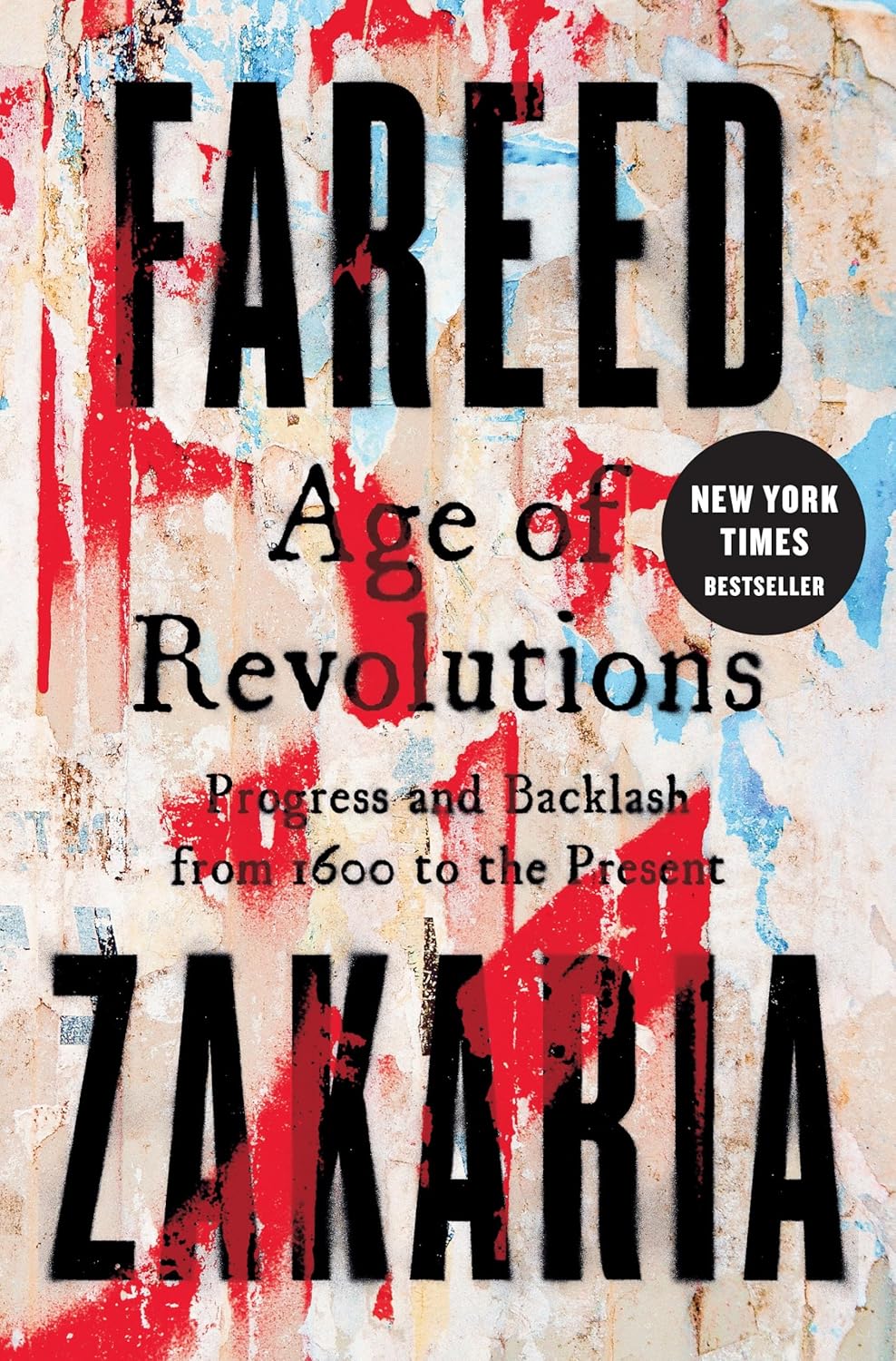
Age of Revolutions: Progress and Backlash from 1600 to the Present

Description:

A New York Times Bestseller • A Wall Street Journal Best Book of 2024

The CNN host and best-selling author explores the revolutions―past and present―that define the polarized and unstable age in which we live.

Populist rage, ideological fracture, economic and technological shocks, war, and an international system studded with catastrophic risk―the early decades of the twenty-first century may be the most revolutionary period in modern history. But it is not the first. Humans have lived, and thrived, through more than one great realignment. What are these revolutions, and how can they help us to understand our fraught world?

In this major work, Fareed Zakaria masterfully investigates the eras and movements that have shaken norms while shaping the modern world. Three such periods hold profound lessons for today. First, in the seventeenth-century Netherlands, a fascinating series of transformations made that tiny land the richest in the world―and created politics as we know it today. Next, the French Revolution, an explosive era that devoured its ideological children and left a bloody legacy that haunts us today. Finally, the mother of all revolutions, the Industrial Revolution, which catapulted Great Britain and the US to global dominance and created the modern world.

Alongside these paradigm-shifting historical events, Zakaria probes four present-day revolutions: globalization, technology, identity, and geopolitics. For all their benefits, the globalization and technology revolutions have produced profound disruptions and pervasive anxiety and our identity. And increasingly, identity is the battlefield on which the twenty-first century’s polarized politics are fought. All this is set against a geopolitical revolution as great as the one that catapulted the United States to world power in the late nineteenth century. Now we are entering a world in which the US is no longer the dominant power. As we find ourselves at the nexus of four seismic revolutions, we can easily imagine a dark future. But Zakaria proves that pessimism is premature. If we act wisely, the liberal international order can be revived and populism relegated to the ash heap of history.

As few public intellectuals can, Zakaria combines intellectual range, deep historical insight, and uncanny prescience to once again reframe and illuminate our turbulent present. His bold, compelling arguments make this book essential reading in our age of revolutions.

13 black-and-white images


Editorial Reviews

Review

"Powerful . . . Zakaria’s book will help readers feel honored and grateful that we get to be part of this glorious and ongoing liberal journey. He understands that we liberals can’t just offer economic benefits; we also have to make the spiritual and civic case for our way of life."
David Brooks, New York Times

"Few thinkers can grasp the complexity of this moment, but Fareed Zakaria does it masterfully."
Eric Schmidt, Wall Street Journal

"Congrats to @FareedZakaria on his dazzling new book, “Age of Revolutions,” out later this month. So much in it! I found myself marking passage after passage, fact after fact. You gain 10 IQ points just reading this book."
Nicholas Kristof, New York Times columnist via X

"Zakaria has figured out policy wonkery and TV, and many points between. The Indian-born pundit could thus claim to be America’s best-known tutor on world events. Even by his standards, however,
Age of Revolutions is breathtakingly ambitious. . . Age of Revolutions successfully bridges the divide between the general reader and the academic. It is an easy read that offers fresh perspective. That is no mean feat."
Edward Luce, Financial Times

"[Is] the rot in the system fixable or fatal? In his book, Zakaria performs an invaluable service in framing these questions precisely the right way. How sturdy, in the end, will the American and global systems prove against all these hurricane-force winds of change? What’s at stake is modernity itself."
Michael Hirsh, Foreign Policy

"Zakaria believes that we can and do make progress. But he is wary of the assumption that history tends to move in the direction of ever-greater human flourishing . . . Zakaria’s book represents an attempt to distinguish between revolutions that have inspired thermostatic reactions and revolutions that have endured."
Gideon Lewis-Kraus, New Yorker

"Zakaria [is] a lively writer and good storyteller. . . Zakaria warns against revolutions that move too fast and displace too many people; it now seems that’s exactly what went wrong in the last 40 years with the rise of the global economy."
Tim Wu, New York Times

"This is
the indispensable book for understanding the world today. Fareed Zakaria tackles the central question of our age: What are the causes of the seismic social disruptions we are going through and the political backlashes that have ensued? Connecting five centuries of history to a deep understanding of our current anxieties, he shows how transformations in technology, economics, and politics interact. We are living through one of the most revolutionary ages in history, and the resulting disruptions have led to a clash between those who celebrate progress, open markets, and technology versus those who resist them. Zakaria argues that we must infuse our journey forward with moral meaning and restore a sense of pride in the ideals of freedom, individual rights, and democracy. The result is both a fascinating look at history and an inspiring vision for the future"
Walter Isaacson, author of Elon Musk, Steve Jobs, Leonardo da Vinci, and Einstein, among others

About the Author

Fareed Zakaria is the host of CNN’s flagship international affairs show, Fareed Zakaria GPS, as well as weekly columnist for the Washington Post. He is the author of four New York Times bestsellers, including Ten Lessons for a Post-Pandemic World. He lives in New York City.

Reviews:

5.0 out of 5 stars Thorough analysis & insightful diagnosis

H.I.G. · September 25, 2024

I have watched Zakaria's informative show for years, but this is the first book of his that I've read. It turns out he writes the way he talks: he suggests a point or "thesis" on something, then he elaborates and logically builds his case while interspersing quotes or paraphrasing from a diversity of sources, and then he closes the argument by summarizing it while at the same time allowing for some flexibility in thought on his and our part as the listener or reader. The book, as a whole, follows that model, as do the chapters and thoughts within the chapters. That makes it easy - at least for me - to follow where he is leading us.Walter Isaacson's summary and "praise" of the book (can be seen before this review/comments section) hits the mark perfectly, so need to repeat it here. The book is a thorough but focused review of several revolutions - in the broadest sense of the word, i.e., to include societal bloodless revolutions, not just the bloody ones - starting with the Dutch in the 1500's, leading up to today, and why some succeeded and others did not. His position is that the world is currently in a turbulent and revolutionary and counter-revolutionary era with extremes on both sides of the liberal and illiberal spectrum. The way forward, he concludes, is to learn from history on what has worked and move away from the extremes. "Extremism may feel satisfying, but gradual reform more often produces enduring change.", he states, along with "work within the fabric of society, with actual communities and people, to educate, persuade, and convince them of your cause". In essence, he is saying (basing it on his historical analysis documented in the book) that gradual bottoms-up approaches are more successful than directed top-down approaches. And, very importantly, he adds "The greatest challenge remains to infuse that journey with moral meaning."I am in that same camp of thought in terms of the overall "end point" he envisions. The challenge I see is having a viable plan on how to get there. The problem I see is twofold: there is a high level of misinformation and mistrust in our society, and I don't see the group of true leaders - anywhere - that can help lead us to where Zakaria concludes we need to go. If anything, leaders (not just political ones) seem to be getting more and more entrenched in extremes. Perhaps in his next book Zakaria will present his thoughts on some of the elements of a viable plan to get to that "end point".Bottom line: a very valuable read that leads one to use our critical thinking skills.I

5.0 out of 5 stars Great book

W. · September 12, 2025

I thought Zakaria provided a great brief history and superb analysis of world powers rise and fall through the last 500 years. Great pace and superb points made on how world powers got to be world powers, loved it.

4.0 out of 5 stars Insightful yet disappointing

F. · July 21, 2024

Insightful book about the most relevant revolutions in western history yet, it disappoints towards the last chapters as the author does not analyse the ongoing, current revolution. He only provides opinions.It was interesting to learn and see revolutions from the perspective of identity politics. New skill.

5.0 out of 5 stars Cogent argument for an age of revolutions

J.M. · June 27, 2024

Fareed Zakaria's "Age of Revolutions" is an extraordinary exploration of the pivotal changes shaping our world today. Zakaria, with his characteristic clarity and insightful analysis, delves into the political, economic, and technological revolutions that are transforming societies globally.What sets this book apart is Zakaria's ability to connect complex global trends with historical context and future implications. He seamlessly weaves together narratives from different parts of the world, highlighting how local events have global repercussions. His analysis is both broad in scope and rich in detail, making it accessible to readers with varied interests.Zakaria's writing is engaging and thought-provoking, prompting readers to rethink their perspectives on current affairs. He doesn't shy away from discussing the challenges these revolutions bring, but he also provides a balanced view by exploring potential opportunities and solutions."Age of Revolutions" is a must-read for anyone interested in understanding the dynamic forces at play in today's world. Zakaria's insights are invaluable for navigating the complexities of the 21st century. Highly recommended!

Fascinating insights

K.C. · August 8, 2025

Wonderfully argued. Yes, the shift towards closed/open seems to be the closest description of curent affairs. I disagree though that the French Revolution failed; there could be no going back to the ancient regime. Attempts were made by Louis xviii and Charles x, but failed. The 2nd empire was a disastrous joke that Bismarck put out of its misery. The ideas from the French Revolution percolated in Europe and could not be put out. That is its legacy. The ebb and flow of backlash is intriguing, but i wonder if too much respect is given to the current one in the USA; it comes out of so much bigotry and anger at one group losing its place that had been based on oppression; I have no sympathy for them as they have chosen to become more extreme and are willing to tarnish, cheat, burn the whole place to get back what they had lost. I empathize with many of them for the loss of livelihood and how hard it can be to get it back but to think that someone like Trump can help is beyond belief as he only cares about his own space, wealth , etc...

Add this book to your reading list

D.W. · September 9, 2025

An excellent book. Fareed is very balanced in his views. Definitely a book to add to your reading list.

Recommend this work

V.P. · March 20, 2025

Just the right level of detail, not too much or too little. Compelling flow and narrative and well worth my time.

History of the common man

G.J.A. · December 1, 2024

One of the best history books I have read. It is not about the exploits of kings and aristocracy but addresses some of the big picture trends of our history that impacted ordinary people. It points to lessons learnt and mistakes that should not be repeated and how these outcomes have shaped the present day. Humanity has been here before, but perhaps not at this level of complexity. We can choose to heed the lessonslearnt or blindly revert to reactionary instincts.

A must read

M.L. · August 5, 2024

A must read if you want to understand where our forms of government come from; why and where we are heading. A most informative read; well written by a brilliant author.

Age of Revolutions: Progress and Backlash from 1600 to the Present

Product ID: U0393239233
Condition: New

4.6

AED18986

Price includes VAT & Import Duties
Type: Hardcover
Availability: In Stock

Quantity:

|

Order today to get by 7-14 business days

Delivery fee of AED 20. Free for orders above AED 200.

Returns & Warranty policies

Imported From: United States

At BOLO, we work hard to ensure the products you receive are new, genuine, and sourced from reputable suppliers.

BOLO is not an authorized or official retailer for most brands, nor are we affiliated with manufacturers unless specifically stated on a product page. Instead, we source verified sellers, authorized distributors or directly from the manufacturer.

Each product undergoes thorough inspection and verification at our consolidation and fulfilment centers to ensure it meets our strict authenticity and quality standards before being shipped and delivered to you.

If you ever have concerns regarding the authenticity of a product purchased from us, please contact Bolo Support. We will review your inquiry promptly and, if necessary, provide documentation verifying authenticity or offer a suitable resolution.

Your trust is our top priority, and we are committed to maintaining transparency and integrity in every transaction.

All product information, images, descriptions, and reviews originate from the manufacturer or from trusted sellers overseas. BOLO is not affiliated with, endorsed by, or an authorized retailer for most brands listed on our website unless stated otherwise.

While we strive to display accurate information, variations in packaging, labeling, instructions, or formulation may occasionally occur due to regional differences or supplier updates. For detailed or manufacturer-specific information, please contact the brand directly or reach out to BOLO Support for assistance.

Unless otherwise stated, all prices displayed on the product page include applicable taxes and import duties.

BOLO operates in accordance with the laws and regulations of United Arab Emirates. Any items found to be restricted or prohibited for sale within the UAE will be cancelled prior to shipment. We take proactive measures to ensure that only products permitted for sale in United Arab Emirates are listed on our website.

All items are shipped by air, and any products classified as “Dangerous Goods (DG)” under IATA regulations will be removed from the order and cancelled.

All orders are processed manually, and we make every effort to process them promptly once confirmed. Products cancelled due to the above reasons will be permanently removed from listings across the website.

Similar suggestions by Bolo

More from this brand

Similar items from “Globalization”

Age of Revolutions: Progress and Backlash from 1600 to the Present

Product ID: U0393239233
Condition: New

4.6

Age of Revolutions: Progress and Backlash from 1600 to the Present-0
Type: Hardcover

AED18986

Price includes VAT & Import Duties
Availability: In Stock

Quantity:

|

Order today to get by 7-14 business days

Delivery fee of AED 20. Free for orders above AED 200.

Returns & Warranty policies

Imported From: United States

At BOLO, we work hard to ensure the products you receive are new, genuine, and sourced from reputable suppliers.

BOLO is not an authorized or official retailer for most brands, nor are we affiliated with manufacturers unless specifically stated on a product page. Instead, we source verified sellers, authorized distributors or directly from the manufacturer.

Each product undergoes thorough inspection and verification at our consolidation and fulfilment centers to ensure it meets our strict authenticity and quality standards before being shipped and delivered to you.

If you ever have concerns regarding the authenticity of a product purchased from us, please contact Bolo Support. We will review your inquiry promptly and, if necessary, provide documentation verifying authenticity or offer a suitable resolution.

Your trust is our top priority, and we are committed to maintaining transparency and integrity in every transaction.

All product information, images, descriptions, and reviews originate from the manufacturer or from trusted sellers overseas. BOLO is not affiliated with, endorsed by, or an authorized retailer for most brands listed on our website unless stated otherwise.

While we strive to display accurate information, variations in packaging, labeling, instructions, or formulation may occasionally occur due to regional differences or supplier updates. For detailed or manufacturer-specific information, please contact the brand directly or reach out to BOLO Support for assistance.

Unless otherwise stated, all prices displayed on the product page include applicable taxes and import duties.

BOLO operates in accordance with the laws and regulations of United Arab Emirates. Any items found to be restricted or prohibited for sale within the UAE will be cancelled prior to shipment. We take proactive measures to ensure that only products permitted for sale in United Arab Emirates are listed on our website.

All items are shipped by air, and any products classified as “Dangerous Goods (DG)” under IATA regulations will be removed from the order and cancelled.

All orders are processed manually, and we make every effort to process them promptly once confirmed. Products cancelled due to the above reasons will be permanently removed from listings across the website.

Description:

A New York Times Bestseller • A Wall Street Journal Best Book of 2024

The CNN host and best-selling author explores the revolutions―past and present―that define the polarized and unstable age in which we live.

Populist rage, ideological fracture, economic and technological shocks, war, and an international system studded with catastrophic risk―the early decades of the twenty-first century may be the most revolutionary period in modern history. But it is not the first. Humans have lived, and thrived, through more than one great realignment. What are these revolutions, and how can they help us to understand our fraught world?

In this major work, Fareed Zakaria masterfully investigates the eras and movements that have shaken norms while shaping the modern world. Three such periods hold profound lessons for today. First, in the seventeenth-century Netherlands, a fascinating series of transformations made that tiny land the richest in the world―and created politics as we know it today. Next, the French Revolution, an explosive era that devoured its ideological children and left a bloody legacy that haunts us today. Finally, the mother of all revolutions, the Industrial Revolution, which catapulted Great Britain and the US to global dominance and created the modern world.

Alongside these paradigm-shifting historical events, Zakaria probes four present-day revolutions: globalization, technology, identity, and geopolitics. For all their benefits, the globalization and technology revolutions have produced profound disruptions and pervasive anxiety and our identity. And increasingly, identity is the battlefield on which the twenty-first century’s polarized politics are fought. All this is set against a geopolitical revolution as great as the one that catapulted the United States to world power in the late nineteenth century. Now we are entering a world in which the US is no longer the dominant power. As we find ourselves at the nexus of four seismic revolutions, we can easily imagine a dark future. But Zakaria proves that pessimism is premature. If we act wisely, the liberal international order can be revived and populism relegated to the ash heap of history.

As few public intellectuals can, Zakaria combines intellectual range, deep historical insight, and uncanny prescience to once again reframe and illuminate our turbulent present. His bold, compelling arguments make this book essential reading in our age of revolutions.

13 black-and-white images


Editorial Reviews

Review

"Powerful . . . Zakaria’s book will help readers feel honored and grateful that we get to be part of this glorious and ongoing liberal journey. He understands that we liberals can’t just offer economic benefits; we also have to make the spiritual and civic case for our way of life."
David Brooks, New York Times

"Few thinkers can grasp the complexity of this moment, but Fareed Zakaria does it masterfully."
Eric Schmidt, Wall Street Journal

"Congrats to @FareedZakaria on his dazzling new book, “Age of Revolutions,” out later this month. So much in it! I found myself marking passage after passage, fact after fact. You gain 10 IQ points just reading this book."
Nicholas Kristof, New York Times columnist via X

"Zakaria has figured out policy wonkery and TV, and many points between. The Indian-born pundit could thus claim to be America’s best-known tutor on world events. Even by his standards, however,
Age of Revolutions is breathtakingly ambitious. . . Age of Revolutions successfully bridges the divide between the general reader and the academic. It is an easy read that offers fresh perspective. That is no mean feat."
Edward Luce, Financial Times

"[Is] the rot in the system fixable or fatal? In his book, Zakaria performs an invaluable service in framing these questions precisely the right way. How sturdy, in the end, will the American and global systems prove against all these hurricane-force winds of change? What’s at stake is modernity itself."
Michael Hirsh, Foreign Policy

"Zakaria believes that we can and do make progress. But he is wary of the assumption that history tends to move in the direction of ever-greater human flourishing . . . Zakaria’s book represents an attempt to distinguish between revolutions that have inspired thermostatic reactions and revolutions that have endured."
Gideon Lewis-Kraus, New Yorker

"Zakaria [is] a lively writer and good storyteller. . . Zakaria warns against revolutions that move too fast and displace too many people; it now seems that’s exactly what went wrong in the last 40 years with the rise of the global economy."
Tim Wu, New York Times

"This is
the indispensable book for understanding the world today. Fareed Zakaria tackles the central question of our age: What are the causes of the seismic social disruptions we are going through and the political backlashes that have ensued? Connecting five centuries of history to a deep understanding of our current anxieties, he shows how transformations in technology, economics, and politics interact. We are living through one of the most revolutionary ages in history, and the resulting disruptions have led to a clash between those who celebrate progress, open markets, and technology versus those who resist them. Zakaria argues that we must infuse our journey forward with moral meaning and restore a sense of pride in the ideals of freedom, individual rights, and democracy. The result is both a fascinating look at history and an inspiring vision for the future"
Walter Isaacson, author of Elon Musk, Steve Jobs, Leonardo da Vinci, and Einstein, among others

About the Author

Fareed Zakaria is the host of CNN’s flagship international affairs show, Fareed Zakaria GPS, as well as weekly columnist for the Washington Post. He is the author of four New York Times bestsellers, including Ten Lessons for a Post-Pandemic World. He lives in New York City.

Reviews:

5.0 out of 5 stars Thorough analysis & insightful diagnosis

H.I.G. · September 25, 2024

I have watched Zakaria's informative show for years, but this is the first book of his that I've read. It turns out he writes the way he talks: he suggests a point or "thesis" on something, then he elaborates and logically builds his case while interspersing quotes or paraphrasing from a diversity of sources, and then he closes the argument by summarizing it while at the same time allowing for some flexibility in thought on his and our part as the listener or reader. The book, as a whole, follows that model, as do the chapters and thoughts within the chapters. That makes it easy - at least for me - to follow where he is leading us.Walter Isaacson's summary and "praise" of the book (can be seen before this review/comments section) hits the mark perfectly, so need to repeat it here. The book is a thorough but focused review of several revolutions - in the broadest sense of the word, i.e., to include societal bloodless revolutions, not just the bloody ones - starting with the Dutch in the 1500's, leading up to today, and why some succeeded and others did not. His position is that the world is currently in a turbulent and revolutionary and counter-revolutionary era with extremes on both sides of the liberal and illiberal spectrum. The way forward, he concludes, is to learn from history on what has worked and move away from the extremes. "Extremism may feel satisfying, but gradual reform more often produces enduring change.", he states, along with "work within the fabric of society, with actual communities and people, to educate, persuade, and convince them of your cause". In essence, he is saying (basing it on his historical analysis documented in the book) that gradual bottoms-up approaches are more successful than directed top-down approaches. And, very importantly, he adds "The greatest challenge remains to infuse that journey with moral meaning."I am in that same camp of thought in terms of the overall "end point" he envisions. The challenge I see is having a viable plan on how to get there. The problem I see is twofold: there is a high level of misinformation and mistrust in our society, and I don't see the group of true leaders - anywhere - that can help lead us to where Zakaria concludes we need to go. If anything, leaders (not just political ones) seem to be getting more and more entrenched in extremes. Perhaps in his next book Zakaria will present his thoughts on some of the elements of a viable plan to get to that "end point".Bottom line: a very valuable read that leads one to use our critical thinking skills.I

5.0 out of 5 stars Great book

W. · September 12, 2025

I thought Zakaria provided a great brief history and superb analysis of world powers rise and fall through the last 500 years. Great pace and superb points made on how world powers got to be world powers, loved it.

4.0 out of 5 stars Insightful yet disappointing

F. · July 21, 2024

Insightful book about the most relevant revolutions in western history yet, it disappoints towards the last chapters as the author does not analyse the ongoing, current revolution. He only provides opinions.It was interesting to learn and see revolutions from the perspective of identity politics. New skill.

5.0 out of 5 stars Cogent argument for an age of revolutions

J.M. · June 27, 2024

Fareed Zakaria's "Age of Revolutions" is an extraordinary exploration of the pivotal changes shaping our world today. Zakaria, with his characteristic clarity and insightful analysis, delves into the political, economic, and technological revolutions that are transforming societies globally.What sets this book apart is Zakaria's ability to connect complex global trends with historical context and future implications. He seamlessly weaves together narratives from different parts of the world, highlighting how local events have global repercussions. His analysis is both broad in scope and rich in detail, making it accessible to readers with varied interests.Zakaria's writing is engaging and thought-provoking, prompting readers to rethink their perspectives on current affairs. He doesn't shy away from discussing the challenges these revolutions bring, but he also provides a balanced view by exploring potential opportunities and solutions."Age of Revolutions" is a must-read for anyone interested in understanding the dynamic forces at play in today's world. Zakaria's insights are invaluable for navigating the complexities of the 21st century. Highly recommended!

Fascinating insights

K.C. · August 8, 2025

Wonderfully argued. Yes, the shift towards closed/open seems to be the closest description of curent affairs. I disagree though that the French Revolution failed; there could be no going back to the ancient regime. Attempts were made by Louis xviii and Charles x, but failed. The 2nd empire was a disastrous joke that Bismarck put out of its misery. The ideas from the French Revolution percolated in Europe and could not be put out. That is its legacy. The ebb and flow of backlash is intriguing, but i wonder if too much respect is given to the current one in the USA; it comes out of so much bigotry and anger at one group losing its place that had been based on oppression; I have no sympathy for them as they have chosen to become more extreme and are willing to tarnish, cheat, burn the whole place to get back what they had lost. I empathize with many of them for the loss of livelihood and how hard it can be to get it back but to think that someone like Trump can help is beyond belief as he only cares about his own space, wealth , etc...

Add this book to your reading list

D.W. · September 9, 2025

An excellent book. Fareed is very balanced in his views. Definitely a book to add to your reading list.

Recommend this work

V.P. · March 20, 2025

Just the right level of detail, not too much or too little. Compelling flow and narrative and well worth my time.

History of the common man

G.J.A. · December 1, 2024

One of the best history books I have read. It is not about the exploits of kings and aristocracy but addresses some of the big picture trends of our history that impacted ordinary people. It points to lessons learnt and mistakes that should not be repeated and how these outcomes have shaped the present day. Humanity has been here before, but perhaps not at this level of complexity. We can choose to heed the lessonslearnt or blindly revert to reactionary instincts.

A must read

M.L. · August 5, 2024

A must read if you want to understand where our forms of government come from; why and where we are heading. A most informative read; well written by a brilliant author.

Similar suggestions by Bolo

More from this brand

Similar items from “Globalization”