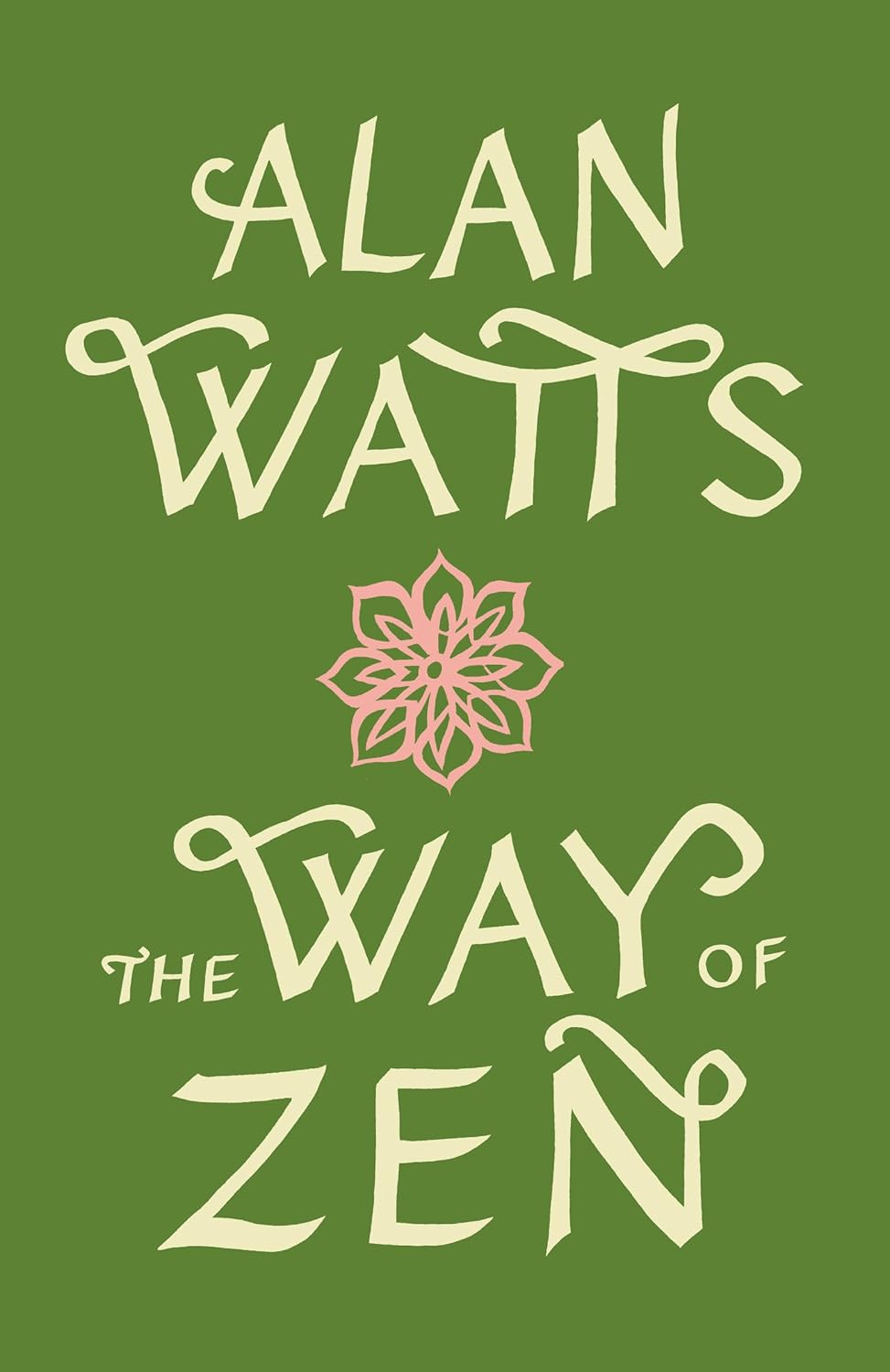
Description:
Editorial Reviews
Reviews:
5.0 out of 5 stars Worth a couple dozen other books on Zen Buddhism
This can be seen as a significant book in the transmission of the dharma to the Western world, even though, or perhaps especially because, it is written by a Westerner. Consistently admired since its first publication in 1957, and reprinted many times, The Way of Zen is that rarest of books, a popular and academic success. You will not read far before seeing why. Watts's style is reasoned and reasonable, clear and authoritative, but without a hint of affectation. Watts knows what he is talking about and to whom he is speaking. Because of his perspective between two worlds, he is, more than almost any other writer on Zen, able to match the ideas of the East to the mind of the West, and in doing so make the broader outlines of Zen as clear as the polished, dustless mirror.The book is divided into two parts, "Background and History" and Principles and Practice," each with four chapters. There is a bibliography also divided into two parts, the first referring to original sources and second to general works on Zen in European languages. There are 16 pages of Chinese Notes in calligraphy keyed to the text, and an Index."The Way" in the title refers to the "watercourse way" from Taoism, a philosophy to which Zen owes much, as Watts makes clear in the first two chapters, "The Philosophy of the Tao" and "The Origins of Buddhism." The first chapter is one of the best on Taoism that I have ever read, replete with insight and wisdom. Throughout, Watts expresses himself in an infectious style, even in the very scholarly chapters on the history of Buddhism where he traces Zen from its origin in India, through the Buddha under the Po tree, to Ch'an in China, and finally into Japan. Parallels between the unforced, natural way of Taoism and the spontaneity of Zen Buddhism are explored in a most convincing and engaging manner. Along the way we learn a little about Hinduism and Confucianism.The chapters on the principles and practices of Zen, comprising a goodly portion of the book are nothing short of marvelous, full of wit and sly observations, revealing Watts's thorough knowledge of Zen and his deep appreciation. Here are some examples of Watts at work:Referring obliquely to the rise of communism (a word he never uses in the book) he writes, "When the throne of the Absolute is left vacant, the relative usurps it..." (p. 11) Perhaps Watts is also indicating why he believes that humanism is not a complete answer.On the cosmology of the Tao: "...the natural universe works mainly according to the principles of growth...If the universe were made, there would of course be someone who knows <how> it is made..." He adds, "...the Tao does not <know> how it produces the universe..." (pp. 16-17)"Since opposed principles, or ideologies, are irreconcilable, wars fought over principle will be wars of mutual annihilation. But wars fought for simple greed will be far less destructive, because the aggressor will be careful not to destroy what he is fighting to capture." (pp. 29-30)"Hindu philosophy has not made the mistake of imagining that one can make an informative, factual, and positive statement about the ultimate reality." (p, 34)"Buddhism has frequently compared the course of time to the apparent motion of a wave, wherein the actual water only moves up and down, creating the illusion of a of water moving over the surface. It is a similar illusion that there is a constant <self> moving through successive experiences, constituting a link between them in such a way that the youth becomes the man who becomes the graybeard who becomes the corpse." (p. 123)In his exploration of koans used by the Rinzai School of Zen, it becomes clear that one of the purposes of the koan is to put doubt into the mind of the young aspirant that he knows anything at all. From that redoubtable position, real learning can begin. I was reminded of a saying attributed to baseball's Earl Weaver, the very successful manager of the Baltimore Orioles in their glory years: "It's what you learn after you know it all that counts."Here is a story from the Ch'uan Teng Lu, told by Watts about "a fascinating encounter between Tao-hsin and the sage Fa-yung, who lived in a lonely temple on Mount Niu-t'ou, and was so holy that the birds used to bring him offerings of flowers. As the two men were talking, a wild animal roared close by, and Tao-hsin jumped. Fa-yung commented, --referring, of course, to the instinctive (klesa) of fright. Shortly afterwards, while he was for a moment unobserved, Tao-hsin wrote the Chinese character for on the rock where Fa-yung was accustomed to sit. When Fa-yung returned to sit down again, he saw the sacred name and hesitated to sit. said Tao-hsin, At this remark Fa-yung was fully awakened...and the birds never brought any more flowers." (pp. 89-90).While this is an excellent introduction to Zen--and more--for the educated person, it is especially a delight for those of you who have already read a few books on Zen. There is no other book that I know of that goes as deeply into Zen as agreeably as does The Way of Zen.--Dennis Littrell, author of "Yoga: Sacred and Profane (Beyond Hatha Yoga)"
5.0 out of 5 stars The Way of Zen
In "The Way of Zen," Alan Watts offers a comprehensive exploration of Zen Buddhism, blending historical context with practical insights. The book presents the essence of Zen, explaining its origins, key principles, and practices. Watts makes complex philosophical concepts accessible, providing readers with a deeper understanding of Zen’s impact on thought, culture, and personal spirituality. It’s a valuable read for anyone interested in Eastern philosophies and the practical application of mindfulness and meditation in daily life.
5.0 out of 5 stars Way of Zen
The book is great. History Philosophy and Application you can't go wrong
4.0 out of 5 stars More a history book than a guide
This book does a great job of covering the history and development of Zen, and its various divisions. It tells the chronological story of the people and places that shaped Zen into what it is today.It is very specific, using the original names of various people, places, concepts, and sects of Zen. There are hundreds of words you will encounter that you've never heard of, you will hope to retain due to intrigue, but will ultimately forget because you are not Rain Man (at least I'm no Kim Peak).Interspersed into the rich history of Zen is a large amount of what Alan Watts is known for: profound, rich, yet simple, insight.I found this book to be of use for both a history lesson and spiritual growth. Perhaps more a history lesson than a genuine spiritual guide.
5.0 out of 5 stars '...Zen is a liberation from time.'
I have finally read one of Alan's books! I'm a big fan of Watts, and have listened to lots of his lectures and audiobooks but have never sat down to read his words rather than listen to them. Even switching formats I couldn't help but read it in Alan's voice. I think I picked a good one to start with too, seeing as how packed with information it is. I think half of it would have passed me by had I tried to listen to it instead. And the thing is that as dense as it is it's rich, and to me endlessly interesting material. This was the kind of book that I found myself highlighting or notating nearly every other page, and I know that revisiting those highlights will be something I do quite often. Not all of it was entirely new material for me, but it's presented and discussed in that inimitably 'Alan Watts' way that offers a clear perspective. And for a book published in 1957 it holds up remarkably well. Zen is--after all--a 'liberation from time'.Anyone interested in the history and development of Zen practice (through it's roots in Taoism and Buddhism) as well as its principles and practice (in natural life and in the arts) should look no further than Alan's book. He presents ideas that are as frustrating as they are revelatory. The kind of ideas that you must not grasp to grasp. Ones that are grown of spontaneity rather than created by trying. It's fun to think about, fun to read, and offers plenty for an eventual reread as well. I loved it.'Awakening almost necessarily involves a sense of relief because it brings to an end the habitual psychological cramp of trying to grasp the mind with the mind, which in turn generates the ego with all its conflicts and defenses. In time, the sense of relief wears off–but not the awakening, unless one has confused it with the sense of relief and has attempted to exploit it by indulging in ecstasy. Awakening is thus only incidentally pleasant or ecstatic, only at first an experience of intense emotional release. But in itself it is just the ending of an artificial and absurd use of the mind.'
5.0 out of 5 stars Pleased with my purchase
Exactly as described.
5.0 out of 5 stars Well reviewed (Western) review of Zen.
Arrived on time in pristine condition.
Libro en óptimas condiciones
El libro llegó en excelentes condiciones, no tiene ningún detalle, la edición es buena.
Amazing book
Amazing bookReally love these writingsI encourage you to look Alan Watts up on YouTube !!!
does a pretty good job of explaining the inexpressible
Watts sets out the background and history, principles and practice of Zen Buddhism. I’ve just finished re-reading my falling-apart copy for the first time in decades. I had a spontaneous satori when young, in Woking (how banal), walking back to my parents’ house, early one morning, from my crack-of-dawn shift at an “old people’s home” (as they were called in those days). I was looking at a lush laurel hedge and wow... and so on. I had no words for ‘it’, but tried to describe ‘it’ to friends, and someone said, maybe try reading about Zen. And there ‘it’ was. For a couple of years I was able to access ‘it’ at will and thought I would always be able to do so. After a bit more of the turmoil of life, I lost ‘it’, but in a way it’s never lost. Alan Watts reassuringly says: Awakening is only incidentally pleasant or ecstatic, only at first an experience of intense emotional release. In itself, it is just the ending of an artificial and absurd use of the mind. Above and beyond that it’s nothing special.
Eastern way of thinking explained for everyone
A mind expanding access to the Eastern way thinking.Well written and understandable even for readers with English not as their mother tongue.
A Transformative Journey into Zen: Alan Watts’ Masterpiece
My Experience with The Way of Zen by Alan Watts:If you’re seeking a profound yet accessible understanding of Zen Buddhism, this book is unparalleled. Alan Watts masterfully demystifies Zen, offering insights that not only elucidate its principles but also provide guidance on living a more mindful and authentic life.What Resonated with Me:• Comprehensive Exploration: Watts delves into the historical roots of Zen, tracing its evolution from Taoism and Mahayana Buddhism, and elucidates its core principles and practices. • Clarity and Accessibility: Despite the depth of the subject, Watts presents complex concepts in a clear and engaging manner, making them accessible to both newcomers and those familiar with Eastern philosophies.• Practical Application: Beyond theoretical insights, the book offers guidance on how to integrate Zen principles into daily life, encouraging a shift towards a more present and liberated existence.Insights from Other Readers:• A review on Thoughts on Papyrus highlights that Watts “traces the origins of Zen Buddhism…and then explains very clearly some of its basic principles and practices.” • Four Minute Books describes it as “the ultimate guide to understanding the history, principles, and benefits of Zen and how it can help us experience mental stillness and enjoy life even in uncertain times.” Why I Recommend It:For anyone interested in exploring Zen Buddhism or seeking a deeper understanding of life, The Way of Zen is an invaluable resource. Watts’ eloquent writing and profound insights make this book a timeless guide for personal growth and spiritual awakening.Conclusion:The Way of Zen is more than just a book; it’s an invitation to transform your perspective and embrace a more authentic and liberated way of living. Whether you’re new to Zen or looking to deepen your understanding, this masterpiece by Alan Watts is highly recommended.
Visit the Vintage Store
The Way of Zen
AED9591
Quantity:
Order today to get by 7-14 business days
Delivery fee of AED 20. Free for orders above AED 200.
Imported From: United States
At BOLO, we work hard to ensure the products you receive are new, genuine, and sourced from reputable suppliers.
BOLO is not an authorized or official retailer for most brands, nor are we affiliated with manufacturers unless specifically stated on a product page. Instead, we source verified sellers, authorized distributors or directly from the manufacturer.
Each product undergoes thorough inspection and verification at our consolidation and fulfilment centers to ensure it meets our strict authenticity and quality standards before being shipped and delivered to you.
If you ever have concerns regarding the authenticity of a product purchased from us, please contact Bolo Support. We will review your inquiry promptly and, if necessary, provide documentation verifying authenticity or offer a suitable resolution.
Your trust is our top priority, and we are committed to maintaining transparency and integrity in every transaction.
All product information, images, descriptions, and reviews originate from the manufacturer or from trusted sellers overseas. BOLO is not affiliated with, endorsed by, or an authorized retailer for most brands listed on our website unless stated otherwise.
While we strive to display accurate information, variations in packaging, labeling, instructions, or formulation may occasionally occur due to regional differences or supplier updates. For detailed or manufacturer-specific information, please contact the brand directly or reach out to BOLO Support for assistance.
Unless otherwise stated, all prices displayed on the product page include applicable taxes and import duties.
BOLO operates in accordance with the laws and regulations of United Arab Emirates. Any items found to be restricted or prohibited for sale within the UAE will be cancelled prior to shipment. We take proactive measures to ensure that only products permitted for sale in United Arab Emirates are listed on our website.
All items are shipped by air, and any products classified as “Dangerous Goods (DG)” under IATA regulations will be removed from the order and cancelled.
All orders are processed manually, and we make every effort to process them promptly once confirmed. Products cancelled due to the above reasons will be permanently removed from listings across the website.
Similar suggestions by Bolo
More from this brand
Similar items from “Spirituality”
Share with
Or share with link
https://www.bolo.ae/products/U0375705104
Visit the Vintage Store
The Way of Zen

AED9591
Quantity:
Order today to get by 7-14 business days
Delivery fee of AED 20. Free for orders above AED 200.
Imported From: United States
At BOLO, we work hard to ensure the products you receive are new, genuine, and sourced from reputable suppliers.
BOLO is not an authorized or official retailer for most brands, nor are we affiliated with manufacturers unless specifically stated on a product page. Instead, we source verified sellers, authorized distributors or directly from the manufacturer.
Each product undergoes thorough inspection and verification at our consolidation and fulfilment centers to ensure it meets our strict authenticity and quality standards before being shipped and delivered to you.
If you ever have concerns regarding the authenticity of a product purchased from us, please contact Bolo Support. We will review your inquiry promptly and, if necessary, provide documentation verifying authenticity or offer a suitable resolution.
Your trust is our top priority, and we are committed to maintaining transparency and integrity in every transaction.
All product information, images, descriptions, and reviews originate from the manufacturer or from trusted sellers overseas. BOLO is not affiliated with, endorsed by, or an authorized retailer for most brands listed on our website unless stated otherwise.
While we strive to display accurate information, variations in packaging, labeling, instructions, or formulation may occasionally occur due to regional differences or supplier updates. For detailed or manufacturer-specific information, please contact the brand directly or reach out to BOLO Support for assistance.
Unless otherwise stated, all prices displayed on the product page include applicable taxes and import duties.
BOLO operates in accordance with the laws and regulations of United Arab Emirates. Any items found to be restricted or prohibited for sale within the UAE will be cancelled prior to shipment. We take proactive measures to ensure that only products permitted for sale in United Arab Emirates are listed on our website.
All items are shipped by air, and any products classified as “Dangerous Goods (DG)” under IATA regulations will be removed from the order and cancelled.
All orders are processed manually, and we make every effort to process them promptly once confirmed. Products cancelled due to the above reasons will be permanently removed from listings across the website.
Description:
Editorial Reviews
Reviews:
5.0 out of 5 stars Worth a couple dozen other books on Zen Buddhism
This can be seen as a significant book in the transmission of the dharma to the Western world, even though, or perhaps especially because, it is written by a Westerner. Consistently admired since its first publication in 1957, and reprinted many times, The Way of Zen is that rarest of books, a popular and academic success. You will not read far before seeing why. Watts's style is reasoned and reasonable, clear and authoritative, but without a hint of affectation. Watts knows what he is talking about and to whom he is speaking. Because of his perspective between two worlds, he is, more than almost any other writer on Zen, able to match the ideas of the East to the mind of the West, and in doing so make the broader outlines of Zen as clear as the polished, dustless mirror.The book is divided into two parts, "Background and History" and Principles and Practice," each with four chapters. There is a bibliography also divided into two parts, the first referring to original sources and second to general works on Zen in European languages. There are 16 pages of Chinese Notes in calligraphy keyed to the text, and an Index."The Way" in the title refers to the "watercourse way" from Taoism, a philosophy to which Zen owes much, as Watts makes clear in the first two chapters, "The Philosophy of the Tao" and "The Origins of Buddhism." The first chapter is one of the best on Taoism that I have ever read, replete with insight and wisdom. Throughout, Watts expresses himself in an infectious style, even in the very scholarly chapters on the history of Buddhism where he traces Zen from its origin in India, through the Buddha under the Po tree, to Ch'an in China, and finally into Japan. Parallels between the unforced, natural way of Taoism and the spontaneity of Zen Buddhism are explored in a most convincing and engaging manner. Along the way we learn a little about Hinduism and Confucianism.The chapters on the principles and practices of Zen, comprising a goodly portion of the book are nothing short of marvelous, full of wit and sly observations, revealing Watts's thorough knowledge of Zen and his deep appreciation. Here are some examples of Watts at work:Referring obliquely to the rise of communism (a word he never uses in the book) he writes, "When the throne of the Absolute is left vacant, the relative usurps it..." (p. 11) Perhaps Watts is also indicating why he believes that humanism is not a complete answer.On the cosmology of the Tao: "...the natural universe works mainly according to the principles of growth...If the universe were made, there would of course be someone who knows <how> it is made..." He adds, "...the Tao does not <know> how it produces the universe..." (pp. 16-17)"Since opposed principles, or ideologies, are irreconcilable, wars fought over principle will be wars of mutual annihilation. But wars fought for simple greed will be far less destructive, because the aggressor will be careful not to destroy what he is fighting to capture." (pp. 29-30)"Hindu philosophy has not made the mistake of imagining that one can make an informative, factual, and positive statement about the ultimate reality." (p, 34)"Buddhism has frequently compared the course of time to the apparent motion of a wave, wherein the actual water only moves up and down, creating the illusion of a of water moving over the surface. It is a similar illusion that there is a constant <self> moving through successive experiences, constituting a link between them in such a way that the youth becomes the man who becomes the graybeard who becomes the corpse." (p. 123)In his exploration of koans used by the Rinzai School of Zen, it becomes clear that one of the purposes of the koan is to put doubt into the mind of the young aspirant that he knows anything at all. From that redoubtable position, real learning can begin. I was reminded of a saying attributed to baseball's Earl Weaver, the very successful manager of the Baltimore Orioles in their glory years: "It's what you learn after you know it all that counts."Here is a story from the Ch'uan Teng Lu, told by Watts about "a fascinating encounter between Tao-hsin and the sage Fa-yung, who lived in a lonely temple on Mount Niu-t'ou, and was so holy that the birds used to bring him offerings of flowers. As the two men were talking, a wild animal roared close by, and Tao-hsin jumped. Fa-yung commented, --referring, of course, to the instinctive (klesa) of fright. Shortly afterwards, while he was for a moment unobserved, Tao-hsin wrote the Chinese character for on the rock where Fa-yung was accustomed to sit. When Fa-yung returned to sit down again, he saw the sacred name and hesitated to sit. said Tao-hsin, At this remark Fa-yung was fully awakened...and the birds never brought any more flowers." (pp. 89-90).While this is an excellent introduction to Zen--and more--for the educated person, it is especially a delight for those of you who have already read a few books on Zen. There is no other book that I know of that goes as deeply into Zen as agreeably as does The Way of Zen.--Dennis Littrell, author of "Yoga: Sacred and Profane (Beyond Hatha Yoga)"
5.0 out of 5 stars The Way of Zen
In "The Way of Zen," Alan Watts offers a comprehensive exploration of Zen Buddhism, blending historical context with practical insights. The book presents the essence of Zen, explaining its origins, key principles, and practices. Watts makes complex philosophical concepts accessible, providing readers with a deeper understanding of Zen’s impact on thought, culture, and personal spirituality. It’s a valuable read for anyone interested in Eastern philosophies and the practical application of mindfulness and meditation in daily life.
5.0 out of 5 stars Way of Zen
The book is great. History Philosophy and Application you can't go wrong
4.0 out of 5 stars More a history book than a guide
This book does a great job of covering the history and development of Zen, and its various divisions. It tells the chronological story of the people and places that shaped Zen into what it is today.It is very specific, using the original names of various people, places, concepts, and sects of Zen. There are hundreds of words you will encounter that you've never heard of, you will hope to retain due to intrigue, but will ultimately forget because you are not Rain Man (at least I'm no Kim Peak).Interspersed into the rich history of Zen is a large amount of what Alan Watts is known for: profound, rich, yet simple, insight.I found this book to be of use for both a history lesson and spiritual growth. Perhaps more a history lesson than a genuine spiritual guide.
5.0 out of 5 stars '...Zen is a liberation from time.'
I have finally read one of Alan's books! I'm a big fan of Watts, and have listened to lots of his lectures and audiobooks but have never sat down to read his words rather than listen to them. Even switching formats I couldn't help but read it in Alan's voice. I think I picked a good one to start with too, seeing as how packed with information it is. I think half of it would have passed me by had I tried to listen to it instead. And the thing is that as dense as it is it's rich, and to me endlessly interesting material. This was the kind of book that I found myself highlighting or notating nearly every other page, and I know that revisiting those highlights will be something I do quite often. Not all of it was entirely new material for me, but it's presented and discussed in that inimitably 'Alan Watts' way that offers a clear perspective. And for a book published in 1957 it holds up remarkably well. Zen is--after all--a 'liberation from time'.Anyone interested in the history and development of Zen practice (through it's roots in Taoism and Buddhism) as well as its principles and practice (in natural life and in the arts) should look no further than Alan's book. He presents ideas that are as frustrating as they are revelatory. The kind of ideas that you must not grasp to grasp. Ones that are grown of spontaneity rather than created by trying. It's fun to think about, fun to read, and offers plenty for an eventual reread as well. I loved it.'Awakening almost necessarily involves a sense of relief because it brings to an end the habitual psychological cramp of trying to grasp the mind with the mind, which in turn generates the ego with all its conflicts and defenses. In time, the sense of relief wears off–but not the awakening, unless one has confused it with the sense of relief and has attempted to exploit it by indulging in ecstasy. Awakening is thus only incidentally pleasant or ecstatic, only at first an experience of intense emotional release. But in itself it is just the ending of an artificial and absurd use of the mind.'
5.0 out of 5 stars Pleased with my purchase
Exactly as described.
5.0 out of 5 stars Well reviewed (Western) review of Zen.
Arrived on time in pristine condition.
Libro en óptimas condiciones
El libro llegó en excelentes condiciones, no tiene ningún detalle, la edición es buena.
Amazing book
Amazing bookReally love these writingsI encourage you to look Alan Watts up on YouTube !!!
does a pretty good job of explaining the inexpressible
Watts sets out the background and history, principles and practice of Zen Buddhism. I’ve just finished re-reading my falling-apart copy for the first time in decades. I had a spontaneous satori when young, in Woking (how banal), walking back to my parents’ house, early one morning, from my crack-of-dawn shift at an “old people’s home” (as they were called in those days). I was looking at a lush laurel hedge and wow... and so on. I had no words for ‘it’, but tried to describe ‘it’ to friends, and someone said, maybe try reading about Zen. And there ‘it’ was. For a couple of years I was able to access ‘it’ at will and thought I would always be able to do so. After a bit more of the turmoil of life, I lost ‘it’, but in a way it’s never lost. Alan Watts reassuringly says: Awakening is only incidentally pleasant or ecstatic, only at first an experience of intense emotional release. In itself, it is just the ending of an artificial and absurd use of the mind. Above and beyond that it’s nothing special.
Eastern way of thinking explained for everyone
A mind expanding access to the Eastern way thinking.Well written and understandable even for readers with English not as their mother tongue.
A Transformative Journey into Zen: Alan Watts’ Masterpiece
My Experience with The Way of Zen by Alan Watts:If you’re seeking a profound yet accessible understanding of Zen Buddhism, this book is unparalleled. Alan Watts masterfully demystifies Zen, offering insights that not only elucidate its principles but also provide guidance on living a more mindful and authentic life.What Resonated with Me:• Comprehensive Exploration: Watts delves into the historical roots of Zen, tracing its evolution from Taoism and Mahayana Buddhism, and elucidates its core principles and practices. • Clarity and Accessibility: Despite the depth of the subject, Watts presents complex concepts in a clear and engaging manner, making them accessible to both newcomers and those familiar with Eastern philosophies.• Practical Application: Beyond theoretical insights, the book offers guidance on how to integrate Zen principles into daily life, encouraging a shift towards a more present and liberated existence.Insights from Other Readers:• A review on Thoughts on Papyrus highlights that Watts “traces the origins of Zen Buddhism…and then explains very clearly some of its basic principles and practices.” • Four Minute Books describes it as “the ultimate guide to understanding the history, principles, and benefits of Zen and how it can help us experience mental stillness and enjoy life even in uncertain times.” Why I Recommend It:For anyone interested in exploring Zen Buddhism or seeking a deeper understanding of life, The Way of Zen is an invaluable resource. Watts’ eloquent writing and profound insights make this book a timeless guide for personal growth and spiritual awakening.Conclusion:The Way of Zen is more than just a book; it’s an invitation to transform your perspective and embrace a more authentic and liberated way of living. Whether you’re new to Zen or looking to deepen your understanding, this masterpiece by Alan Watts is highly recommended.
Similar suggestions by Bolo
More from this brand
Similar items from “Spirituality”
Share with
Or share with link
https://www.bolo.ae/products/U0375705104