Deliver toUnited Arab Emirates
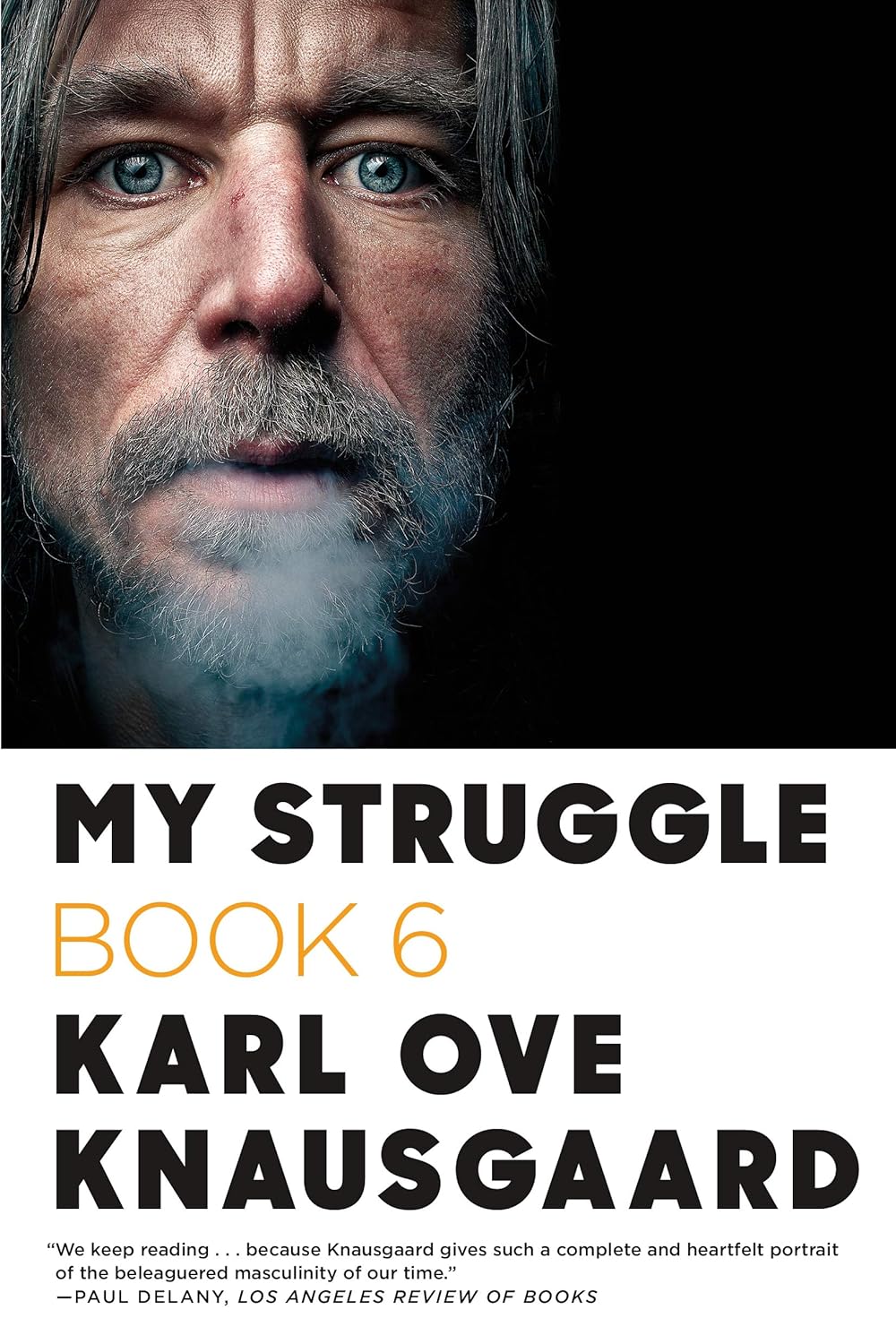
My Struggle: Book 6

Description:

The final sixth installment in the long-awaited, internationally celebrated My Struggle series from Karl Ove Knausgaard.

The full scope and achievement of Karl Ove Knausgaard’s monumental work is evident in this final installment of his
My Struggle series. Grappling directly with the consequences of Knausgaard’s transgressive blurring of public and private, Book 6 is a troubling and engrossing look into the mind of one of the most exciting artists of our time. Knausgaard includes a long essay on Hitler and Mein Kampf, particularly relevant (if not prescient) in our current global climate of ascending dictatorships.


Editorial Reviews

Review

“. . . Knausgaard explores the various ways language can be leveraged for honest disclosure and tragic nationalism . . . and whether confessional style can be a force against propagandistic writing . . . [Book 6] caps a remarkable achievement...A fittingly bulky end to a radical feat of oversharing.” ―Kirkus Reviews, starred review

“At last, the highly anticipated conclusion to Knausgaard’s six-part masterwork arrives in English . . . Perhaps most notable about
Book 6 is a 400-page examination of Hitler, Nazism, and the nature of evil, which draws parallels between Mein Kampf and My Struggle . . . This uncomfortable comparison simultaneously explodes the purview of what fiction can do while zeroing in on the unique concerns of his narrator.” ―Booklist, starred review

“The final book of Knausgaard’s six-volume masterpiece goes maximalist and metatextual, examining the impact that the autobiographical series has had on the author’s life and the lives of those around him . . . The rationale for his project comes into brilliant focus. This volume is a thrilling conclusion to Knausgaard’s epic series.” ―
Publishers Weekly, starred review

About the Author

Karl Ove Knausgaard was born in Norway in 1968. My Struggle has won countless international literary awards and has been translated into at least fifteen languages. Knausgaard lives in Sweden with his wife and four children.

Don Bartlett has translated dozens of books of various genres, including several novels and short story collections by Jo Nesbø and It's Fine by Me by Per Petterson. He lives in Norfolk, England.

Martin Aitken is the translator of numerous novels from the Danish, Norwegian, and Swedish, including works by Peter Høeg, Ida Jessen, Kim Leine, Hanne Ørstavik, and Karl Ove Knausgaard. His translations of short stories and poetry have appeared in many literary journals and magazines. In 2012 he was awarded the American-Scandinavian Foundation’s Nadia Christensen Translation Prize. He lives and works in Denmark.

Reviews:

5.0 out of 5 stars Knausgaard and Proust

M. · January 1, 2021

We saw Knausgaard at the Brooklyn Book Fair in 2017. As we were waiting in line outside St. Ann’s Church, he entered wearing a weathered leather jacket matching his weathered appearance of someone who smokes too much and gets up too early to write. We sat in the balcony listening to his softly-spoken accented reading. Afterwards, we stood in the endless line and he signed two of my books. I explained quickly and gratuitously how we were inspired after his books to get around to our tour of Norway, visiting some of the locations in Bergen of Book Five, including the neighborhood around Absalon Beyers Gate (where there was a beautiful walk among the houses on the hill), and dinner at that bar/restaurant near the main square of Torgelmenningen, Café Opera. Maybe this was all just a little annoying for him to be listening to with that long line, and I should have kept my mouth shut. I had just then completed reading Book Five, I told him I thought it was the best one, and he auto-transcribed that statement into a simple dedication of ‘Best’, and signing his name in my Book One and Book Five. Then there was the next person in line for him.I remember the first time I saw the book a cute little blond girl was reading it sitting in a side seat near the door on the subway. I think I could guess from the subtle differences in her clothing that someone was likely European, maybe German or Scandinavian. Provocative title to read on the subway in New York City.I’ll give this review of the last book, but it stands in for the entire series. I must have spent about five years of my life non-exclusively reading all of it, waiting sometimes for the next volume to be published in translation. I took a break partially for this reason between Book Five and Book Six, the last appearing most formidable. Some reviewers had compared My Struggle to Remembrances of Times Past, and I took a year after Book Five (and the death of my mother) just re-reading all of those seven volumes of Proust, which I had not read in forty years – an amazing experience, looking through the layers of your memory thinking about the person you were then and all the experiences you have gained since then in reading it now. There is some of that in Knausgaard, too. People compare Knausgaard to Proust, but Knausgaard is not Proust. Proust is better, just at least in the density of the references he makes on each page, and of course it is all fiction. I appreciate now that Proust might be the best thing in my life I ever get to read. Still, My Struggle is the best thing I read in the decade from 2010 to 2020.It’s not really easy to explain why someone would want to read it, or why it’s good. Maybe it’s just a little addictive. The thing that got me in the beginning is reading about everyday life in Europe -- Northern Europe --, those countries that everyone always uses as models of the way societies should be, places where you think everyone is good looking. I traveled a fair amount in my youth backpacking in Europe, once a summer for three months, more recently staying in finer accommodations sometimes for up to a month, and I’ve always imagined what it would be like to grow up in Europe. Then there’s the idea that Knausgaard just sounds to be a pretty cool guy. There he was writing music reviews in high school, being in a band, of course trying to be a writer, and his relationships with girls and women. The author is about ten years younger than me, but there are the parallel experiences of all of us who grew up around that time, the music that was so important then (everyone dreamed of what it must be like to be a famous rock musician, whereas now it’s everyone on their phones or their computers), riding your bicycle, the open spaces of nature, and the specifics of a neighborhood you lived observed from a dependency relationship of a child.Books One and Two blur together for me a bit, but the hundred pages or so of cleaning up after his father’s death of course stand out in A Death in the Family, then a beer run to a party in the freezing cold one New Year’s Eve, unhappy walks with his wife and kids through Stockholm, and the beginning of his relationship with Linda in A Man in Love. Book Three begins a new chronology with his childhood, and his relationship with an angry father, which I can identify with, too. Book Four is just beautiful with its story of an adolescent taking a year before university teaching kids not much younger than he was in a small town in northern Norway, that high school feeling of being in a sea of love of young girls. (We traveled up north in Norway, and saw a number of small towns like that.) Book Five, as I told him, I thought was the best. It’s about him at university in Bergen, drinking excessively, just living a wild college life, as he tried to be writer, in a beautiful town. College years can be so epic.Book Six is different. There’s the conventional part at the beginning, where he is just taking care of his kids and the problems with his uncle over the story about his father. (If he had had any lawyer friends, I think they would have told him that he didn’t have anything to worry about, that his uncle never really had a case; maybe it was nice that he corrected some things anyway, but we all can obsess about things that may seem important at the time but turn out to be transitory.) Then there’s the similar part at the end, with the breakdown of Linda, and the story of the little vacation cottage in town. (We saw cottages like that on a walk through Sodermalm in Stockholm, and I had a vacation house and know their problems.) Book Six’s outer parts have more of a sense of living in the current moment, and not about memory. But, of course, the main part is the middle part of Book Six. Some reviewers say this is a four hundred page biography of Hitler, but I don’t think that’s accurate. The middle part is a meditation on a number of things, the Holocaust being the main subject, but there’s stuff about literature– Joyce, Faulkner, Zweig, Rilke, the Old Testament –, the art scene in Vienna, fifty pages analyzing one poem by Paul Celan, and a philosophical framework. Most of the six volumes appear to be premised on the existentialism of Heidegger, and maybe a bit of presentism. This one in particular gets into a conceptual framework of that with the Falling into the They and the Authenticity of Dasein. It can be slow-going. (I read an interview that someone did with Linda, and she said, ‘Skip, skip, skip’.) The author appears to have a variety of objectives in this. One is to try to provide some justification for the controversial title. Another is to show that the author is really a good human being, a European with sympathy for Jews, and is trying to make sure that people don’t misinterpret his title as from someone in an age of populism that is trying to revive racism or the Nazis. And a third might be to establish some intellectual credentials. I’m not sure if it’s all totally successful, but it’s a difficult subject to write about. Hitler’s life is described in its contingency as a real human being who actually produced some workmanlike paintings while living during his youth in hostels, and was not born a monster as he is popularly depicted – a stereotypical image which enables us to continue living and to not think too deeply about what happened, sort of like walking through the Anne Frank House in Amsterdam and then going out to dinner. Knausgaard as good as admits that anyone else who was living there then might be likely to have gone along and become a collaborator with that revolution of the lower middle class due to generally bad living conditions that were exploited by the Nazis, sort of like Hamsun, and not have had the character to stand up at a crucial moment and be one of the resistance.Wikipedia says that Knausgaard has now divorced Linda, lives part-time in London and part-time in Stockholm. Similar sources say he’s worth maybe five million dollars (although who knows how accurate these things are) and maybe more by now. I suppose that when I began reading these books he was worth a lot less. It might be interesting to see how success changes him, if he gets married again, who takes care of his kids. He’s gone on to write more books including his Season’s Quartet, but I think I’ll take a break from him for a while. Sometimes I wondered reading these if he understands himself as well as he thinks he does, if he’s really that different from the father he is trying to escape, if he will begin drinking again, if his children won’t remember him as a bit of a mean parent, too. Those clichés that you always grow up and turn into your parents or into what you were most afraid you would be when you were a child come to mind. I wish him good luck. Maybe he did understand all of this and just wanted to write it all down quickly, or maybe all of us have blind spots that prevent us from understanding ourselves the way we really are.

5.0 out of 5 stars ENDS with a BANG

S.M.F. · November 18, 2018

What a series and what a book! What I liked about this one is he peels back the layers of the onion even further giving us a glimpse of some of the struggles he goes through with trying to publish these books and exposing his family to every nuance and detail he writes about. Yes there is a big essay in the middle on Hitler which I thought was very well done. It's an insight into Hitler's life that many probably weren't aware of. In some ways it's an uncomfortable read...makes one think, 'how did such an ordinary small man turn into such an egomaniacal killer? ' Then the last part of the book deals with his wife's mental issues which again is both brave and awkward. But his writing turns the ordinary into the sublime. What is it about these books that makes the writing about ordinary events from a foreign country so alluring? I ask myself if the books took place in Minnesota or Nebraska or somewhere would they be just as compelling? Hard to say. Regardless, I loved these books and will miss them. The ended much the way they started...with a BANG!

4.0 out of 5 stars The ordinary becomes as riveting as a thriller.

N. · September 26, 2020

The entire 6 volumes are mesmerizing. Only the section on Hitler, albeit interesting, felt out of place. Why didn’t he turn it into a separate publication?

5.0 out of 5 stars We Sleepwalk Through Life

S. · December 9, 2023

After reading all 6 volumes I can say that I have never read anything like them. Knausgaard writes about life as it actually reveals itself - from the small details, the beauty of a tree, the inner life of an adolescent boy filled with angst at a brutal father, the nature of good and evil, the hidden signs of death all around us - this is unlike anything you will read. Can't recommend it enough. It will make you reexamine life.

3.0 out of 5 stars Needs an editor

A.C. · December 8, 2021

Something I’ve noticed a few times when reading well-known, successful authors is that the editors kind of blow off editing new books. They probably figure that these books will sell and they don’t need to cut anything or suggest changes. Or maybe the writer feels he or she has earned the right not to be edited. In any case, the final book in Knausgård’s My Struggle series is very tedious in the middle and it’s hard to see how the extensive passages on literary criticism and Hitler are relevant to the rest of the “novel.” (I put it in quotes because this series is more an autobiography/memoir than actual novel, in my opinion.) I skimmed a lot of this material. I’m glad I persisted though because the final part is very affecting, heartrending, actually. To be honest I feel very bad for Knausgård’s children. I worry how they will be affected by their father’s writing and their mother’s mental illness. I suppose that knowing how much they are loved will make up for the trauma. At least I hope so.

5.0 out of 5 stars Another Nobel for Norway!

T.M. · January 3, 2019

If you have read Books 1-5, you do not need to read a review of Book 6; you have already read it. For the rest of you, please go and read the first five volumes. Book 6 will certainly make sense regardless — Knausgärd does an excellent job of effortlessly reminding us of the antecedent breadcrumbs — but living through the gestation of the author’s struggle will make the ultimate revelation richly rewarding.Knausgärd continues his high standard of lyrically delivering the quotidian, but it is his deft and academically impressive connection of his personal struggle to the biggest enigma of the twentieth century that makes Book 6 a surprise and a delight, albeit an emotionally complicated delight.By connecting his well-documented daddy issues with the thrall in which Hitler held interbellum Germany, Knausgärd makes the personal profoundly universal.And he continues to expose his personal torment up to the very moment he stops writing. The poignant postscript of his subsequent divorce from his complex and accomplished wife at the time of his writing illustrates just how committed Knausgärd is to his art.

Un vortice

d.p. · November 12, 2018

Knausgaard non delude. Nemmeno questa volta. Anzi, direi che la sua scrittura, il suo stile sono giunti alla maturità. Si nota chiaramente un miglioramento, sicuramente frutto di studi e lezioni. Non è possibile eludere l'attrazione di questo vortice di parole, frasi, dettagli minuziosi, quotidianità che ci coinvolgono tutti. Nelle sue ansie, nei suoi rituali, nella sua vita, pur in luoghi distanti, ci si sente chiamati in causa, si ricordano episodi del nostro vissuto e si impara. Sempre divertendosi. Ovviamente bisogna amare la lettura per affrontare le 1200 pagine di questo ultimo capitolo della serie My Struggle, avere braccia forti per reggere il peso materiale del libro, e cercare di non dimenticare gli altri impegni per restare ancora un po' tra le pagine.

A scrappy end

A.C. · August 18, 2021

This is disappointing. I loved the other books in this series but this reads as a balance between a contractual obligation made by Knausgaard for the last in the series and an attempt to show he has some high level intellectual command. He doesn't and it's sad. He can't convey his complex critical thinking in a way that his broad audience, or any reader really - other then those people named Geir, can understand. This is not good writing. It is clear that he started three novels here and dumped them all into one. Badly.

Well made book

m. · November 14, 2018

This is really a beautifully printed and bound book. Chunky aspect ratio is cool.

Finished it, then instantly sad there will be no more

T.P. · July 16, 2019

Knausgaard became my favourite writer immeadiately after reading book one, 'A Death in the Family'. Although some are better than others, all are of a good standard. Book 6 has had some stick, but i loved reading it just as much as the others. He really does go on a tangent with book 6, which is great when you are interested the topic he goes in to great detail about, but otherwise it becomes a slog to get through if not, or just skip ahead, luckily for me the bulk of this tangent was about Hitler, and to me, was absolutely fascinating. I have never seen such a good analysis of Hitler, the Nazi's and Germany during this period.At the time i thought why not just write a seperate book about it, but of course due to the provacative 'My Struugle' title Karl Ove had to talk about Hitler, and he did so in a way that was superior to the acclaimed books that was written specfically about Hitler.As expected, there is the candid accounts of his life and relationship, and issues with Gunner about the writing of his first book. I can hopefully he will write book 7, but there was only ever meant to be six, so i don't think he will.

It was hard.

A.C. · April 24, 2019

This is the end of Knausgaard's journey about himself. About ourselves, and that it is the most difficult fact to accept. Reading this book I've experienced many different states of mind. I've been upset, sorry, bored to death, bewildered, puzzled, angry; but I'do it all again.

My Struggle: Book 6

Product ID: U0374534195
Condition: New

4.5

AED17365

Price includes VAT & Import Duties
Type: Paperback
Availability: In Stock

Quantity:

|

Order today to get by 7-14 business days

Delivery fee of AED 20. Free for orders above AED 200.

Returns & Warranty policies

Imported From: United States

At BOLO, we work hard to ensure the products you receive are new, genuine, and sourced from reputable suppliers.

BOLO is not an authorized or official retailer for most brands, nor are we affiliated with manufacturers unless specifically stated on a product page. Instead, we source verified sellers, authorized distributors or directly from the manufacturer.

Each product undergoes thorough inspection and verification at our consolidation and fulfilment centers to ensure it meets our strict authenticity and quality standards before being shipped and delivered to you.

If you ever have concerns regarding the authenticity of a product purchased from us, please contact Bolo Support. We will review your inquiry promptly and, if necessary, provide documentation verifying authenticity or offer a suitable resolution.

Your trust is our top priority, and we are committed to maintaining transparency and integrity in every transaction.

All product information, images, descriptions, and reviews originate from the manufacturer or from trusted sellers overseas. BOLO is not affiliated with, endorsed by, or an authorized retailer for most brands listed on our website unless stated otherwise.

While we strive to display accurate information, variations in packaging, labeling, instructions, or formulation may occasionally occur due to regional differences or supplier updates. For detailed or manufacturer-specific information, please contact the brand directly or reach out to BOLO Support for assistance.

Unless otherwise stated, all prices displayed on the product page include applicable taxes and import duties.

BOLO operates in accordance with the laws and regulations of United Arab Emirates. Any items found to be restricted or prohibited for sale within the UAE will be cancelled prior to shipment. We take proactive measures to ensure that only products permitted for sale in United Arab Emirates are listed on our website.

All items are shipped by air, and any products classified as “Dangerous Goods (DG)” under IATA regulations will be removed from the order and cancelled.

All orders are processed manually, and we make every effort to process them promptly once confirmed. Products cancelled due to the above reasons will be permanently removed from listings across the website.

Similar suggestions by Bolo

More from this brand

Similar items from “Literary”

My Struggle: Book 6

Product ID: U0374534195
Condition: New

4.5

My Struggle: Book 6-0
Type: Paperback

AED17365

Price includes VAT & Import Duties
Availability: In Stock

Quantity:

|

Order today to get by 7-14 business days

Delivery fee of AED 20. Free for orders above AED 200.

Returns & Warranty policies

Imported From: United States

At BOLO, we work hard to ensure the products you receive are new, genuine, and sourced from reputable suppliers.

BOLO is not an authorized or official retailer for most brands, nor are we affiliated with manufacturers unless specifically stated on a product page. Instead, we source verified sellers, authorized distributors or directly from the manufacturer.

Each product undergoes thorough inspection and verification at our consolidation and fulfilment centers to ensure it meets our strict authenticity and quality standards before being shipped and delivered to you.

If you ever have concerns regarding the authenticity of a product purchased from us, please contact Bolo Support. We will review your inquiry promptly and, if necessary, provide documentation verifying authenticity or offer a suitable resolution.

Your trust is our top priority, and we are committed to maintaining transparency and integrity in every transaction.

All product information, images, descriptions, and reviews originate from the manufacturer or from trusted sellers overseas. BOLO is not affiliated with, endorsed by, or an authorized retailer for most brands listed on our website unless stated otherwise.

While we strive to display accurate information, variations in packaging, labeling, instructions, or formulation may occasionally occur due to regional differences or supplier updates. For detailed or manufacturer-specific information, please contact the brand directly or reach out to BOLO Support for assistance.

Unless otherwise stated, all prices displayed on the product page include applicable taxes and import duties.

BOLO operates in accordance with the laws and regulations of United Arab Emirates. Any items found to be restricted or prohibited for sale within the UAE will be cancelled prior to shipment. We take proactive measures to ensure that only products permitted for sale in United Arab Emirates are listed on our website.

All items are shipped by air, and any products classified as “Dangerous Goods (DG)” under IATA regulations will be removed from the order and cancelled.

All orders are processed manually, and we make every effort to process them promptly once confirmed. Products cancelled due to the above reasons will be permanently removed from listings across the website.

Description:

The final sixth installment in the long-awaited, internationally celebrated My Struggle series from Karl Ove Knausgaard.

The full scope and achievement of Karl Ove Knausgaard’s monumental work is evident in this final installment of his
My Struggle series. Grappling directly with the consequences of Knausgaard’s transgressive blurring of public and private, Book 6 is a troubling and engrossing look into the mind of one of the most exciting artists of our time. Knausgaard includes a long essay on Hitler and Mein Kampf, particularly relevant (if not prescient) in our current global climate of ascending dictatorships.


Editorial Reviews

Review

“. . . Knausgaard explores the various ways language can be leveraged for honest disclosure and tragic nationalism . . . and whether confessional style can be a force against propagandistic writing . . . [Book 6] caps a remarkable achievement...A fittingly bulky end to a radical feat of oversharing.” ―Kirkus Reviews, starred review

“At last, the highly anticipated conclusion to Knausgaard’s six-part masterwork arrives in English . . . Perhaps most notable about
Book 6 is a 400-page examination of Hitler, Nazism, and the nature of evil, which draws parallels between Mein Kampf and My Struggle . . . This uncomfortable comparison simultaneously explodes the purview of what fiction can do while zeroing in on the unique concerns of his narrator.” ―Booklist, starred review

“The final book of Knausgaard’s six-volume masterpiece goes maximalist and metatextual, examining the impact that the autobiographical series has had on the author’s life and the lives of those around him . . . The rationale for his project comes into brilliant focus. This volume is a thrilling conclusion to Knausgaard’s epic series.” ―
Publishers Weekly, starred review

About the Author

Karl Ove Knausgaard was born in Norway in 1968. My Struggle has won countless international literary awards and has been translated into at least fifteen languages. Knausgaard lives in Sweden with his wife and four children.

Don Bartlett has translated dozens of books of various genres, including several novels and short story collections by Jo Nesbø and It's Fine by Me by Per Petterson. He lives in Norfolk, England.

Martin Aitken is the translator of numerous novels from the Danish, Norwegian, and Swedish, including works by Peter Høeg, Ida Jessen, Kim Leine, Hanne Ørstavik, and Karl Ove Knausgaard. His translations of short stories and poetry have appeared in many literary journals and magazines. In 2012 he was awarded the American-Scandinavian Foundation’s Nadia Christensen Translation Prize. He lives and works in Denmark.

Reviews:

5.0 out of 5 stars Knausgaard and Proust

M. · January 1, 2021

We saw Knausgaard at the Brooklyn Book Fair in 2017. As we were waiting in line outside St. Ann’s Church, he entered wearing a weathered leather jacket matching his weathered appearance of someone who smokes too much and gets up too early to write. We sat in the balcony listening to his softly-spoken accented reading. Afterwards, we stood in the endless line and he signed two of my books. I explained quickly and gratuitously how we were inspired after his books to get around to our tour of Norway, visiting some of the locations in Bergen of Book Five, including the neighborhood around Absalon Beyers Gate (where there was a beautiful walk among the houses on the hill), and dinner at that bar/restaurant near the main square of Torgelmenningen, Café Opera. Maybe this was all just a little annoying for him to be listening to with that long line, and I should have kept my mouth shut. I had just then completed reading Book Five, I told him I thought it was the best one, and he auto-transcribed that statement into a simple dedication of ‘Best’, and signing his name in my Book One and Book Five. Then there was the next person in line for him.I remember the first time I saw the book a cute little blond girl was reading it sitting in a side seat near the door on the subway. I think I could guess from the subtle differences in her clothing that someone was likely European, maybe German or Scandinavian. Provocative title to read on the subway in New York City.I’ll give this review of the last book, but it stands in for the entire series. I must have spent about five years of my life non-exclusively reading all of it, waiting sometimes for the next volume to be published in translation. I took a break partially for this reason between Book Five and Book Six, the last appearing most formidable. Some reviewers had compared My Struggle to Remembrances of Times Past, and I took a year after Book Five (and the death of my mother) just re-reading all of those seven volumes of Proust, which I had not read in forty years – an amazing experience, looking through the layers of your memory thinking about the person you were then and all the experiences you have gained since then in reading it now. There is some of that in Knausgaard, too. People compare Knausgaard to Proust, but Knausgaard is not Proust. Proust is better, just at least in the density of the references he makes on each page, and of course it is all fiction. I appreciate now that Proust might be the best thing in my life I ever get to read. Still, My Struggle is the best thing I read in the decade from 2010 to 2020.It’s not really easy to explain why someone would want to read it, or why it’s good. Maybe it’s just a little addictive. The thing that got me in the beginning is reading about everyday life in Europe -- Northern Europe --, those countries that everyone always uses as models of the way societies should be, places where you think everyone is good looking. I traveled a fair amount in my youth backpacking in Europe, once a summer for three months, more recently staying in finer accommodations sometimes for up to a month, and I’ve always imagined what it would be like to grow up in Europe. Then there’s the idea that Knausgaard just sounds to be a pretty cool guy. There he was writing music reviews in high school, being in a band, of course trying to be a writer, and his relationships with girls and women. The author is about ten years younger than me, but there are the parallel experiences of all of us who grew up around that time, the music that was so important then (everyone dreamed of what it must be like to be a famous rock musician, whereas now it’s everyone on their phones or their computers), riding your bicycle, the open spaces of nature, and the specifics of a neighborhood you lived observed from a dependency relationship of a child.Books One and Two blur together for me a bit, but the hundred pages or so of cleaning up after his father’s death of course stand out in A Death in the Family, then a beer run to a party in the freezing cold one New Year’s Eve, unhappy walks with his wife and kids through Stockholm, and the beginning of his relationship with Linda in A Man in Love. Book Three begins a new chronology with his childhood, and his relationship with an angry father, which I can identify with, too. Book Four is just beautiful with its story of an adolescent taking a year before university teaching kids not much younger than he was in a small town in northern Norway, that high school feeling of being in a sea of love of young girls. (We traveled up north in Norway, and saw a number of small towns like that.) Book Five, as I told him, I thought was the best. It’s about him at university in Bergen, drinking excessively, just living a wild college life, as he tried to be writer, in a beautiful town. College years can be so epic.Book Six is different. There’s the conventional part at the beginning, where he is just taking care of his kids and the problems with his uncle over the story about his father. (If he had had any lawyer friends, I think they would have told him that he didn’t have anything to worry about, that his uncle never really had a case; maybe it was nice that he corrected some things anyway, but we all can obsess about things that may seem important at the time but turn out to be transitory.) Then there’s the similar part at the end, with the breakdown of Linda, and the story of the little vacation cottage in town. (We saw cottages like that on a walk through Sodermalm in Stockholm, and I had a vacation house and know their problems.) Book Six’s outer parts have more of a sense of living in the current moment, and not about memory. But, of course, the main part is the middle part of Book Six. Some reviewers say this is a four hundred page biography of Hitler, but I don’t think that’s accurate. The middle part is a meditation on a number of things, the Holocaust being the main subject, but there’s stuff about literature– Joyce, Faulkner, Zweig, Rilke, the Old Testament –, the art scene in Vienna, fifty pages analyzing one poem by Paul Celan, and a philosophical framework. Most of the six volumes appear to be premised on the existentialism of Heidegger, and maybe a bit of presentism. This one in particular gets into a conceptual framework of that with the Falling into the They and the Authenticity of Dasein. It can be slow-going. (I read an interview that someone did with Linda, and she said, ‘Skip, skip, skip’.) The author appears to have a variety of objectives in this. One is to try to provide some justification for the controversial title. Another is to show that the author is really a good human being, a European with sympathy for Jews, and is trying to make sure that people don’t misinterpret his title as from someone in an age of populism that is trying to revive racism or the Nazis. And a third might be to establish some intellectual credentials. I’m not sure if it’s all totally successful, but it’s a difficult subject to write about. Hitler’s life is described in its contingency as a real human being who actually produced some workmanlike paintings while living during his youth in hostels, and was not born a monster as he is popularly depicted – a stereotypical image which enables us to continue living and to not think too deeply about what happened, sort of like walking through the Anne Frank House in Amsterdam and then going out to dinner. Knausgaard as good as admits that anyone else who was living there then might be likely to have gone along and become a collaborator with that revolution of the lower middle class due to generally bad living conditions that were exploited by the Nazis, sort of like Hamsun, and not have had the character to stand up at a crucial moment and be one of the resistance.Wikipedia says that Knausgaard has now divorced Linda, lives part-time in London and part-time in Stockholm. Similar sources say he’s worth maybe five million dollars (although who knows how accurate these things are) and maybe more by now. I suppose that when I began reading these books he was worth a lot less. It might be interesting to see how success changes him, if he gets married again, who takes care of his kids. He’s gone on to write more books including his Season’s Quartet, but I think I’ll take a break from him for a while. Sometimes I wondered reading these if he understands himself as well as he thinks he does, if he’s really that different from the father he is trying to escape, if he will begin drinking again, if his children won’t remember him as a bit of a mean parent, too. Those clichés that you always grow up and turn into your parents or into what you were most afraid you would be when you were a child come to mind. I wish him good luck. Maybe he did understand all of this and just wanted to write it all down quickly, or maybe all of us have blind spots that prevent us from understanding ourselves the way we really are.

5.0 out of 5 stars ENDS with a BANG

S.M.F. · November 18, 2018

What a series and what a book! What I liked about this one is he peels back the layers of the onion even further giving us a glimpse of some of the struggles he goes through with trying to publish these books and exposing his family to every nuance and detail he writes about. Yes there is a big essay in the middle on Hitler which I thought was very well done. It's an insight into Hitler's life that many probably weren't aware of. In some ways it's an uncomfortable read...makes one think, 'how did such an ordinary small man turn into such an egomaniacal killer? ' Then the last part of the book deals with his wife's mental issues which again is both brave and awkward. But his writing turns the ordinary into the sublime. What is it about these books that makes the writing about ordinary events from a foreign country so alluring? I ask myself if the books took place in Minnesota or Nebraska or somewhere would they be just as compelling? Hard to say. Regardless, I loved these books and will miss them. The ended much the way they started...with a BANG!

4.0 out of 5 stars The ordinary becomes as riveting as a thriller.

N. · September 26, 2020

The entire 6 volumes are mesmerizing. Only the section on Hitler, albeit interesting, felt out of place. Why didn’t he turn it into a separate publication?

5.0 out of 5 stars We Sleepwalk Through Life

S. · December 9, 2023

After reading all 6 volumes I can say that I have never read anything like them. Knausgaard writes about life as it actually reveals itself - from the small details, the beauty of a tree, the inner life of an adolescent boy filled with angst at a brutal father, the nature of good and evil, the hidden signs of death all around us - this is unlike anything you will read. Can't recommend it enough. It will make you reexamine life.

3.0 out of 5 stars Needs an editor

A.C. · December 8, 2021

Something I’ve noticed a few times when reading well-known, successful authors is that the editors kind of blow off editing new books. They probably figure that these books will sell and they don’t need to cut anything or suggest changes. Or maybe the writer feels he or she has earned the right not to be edited. In any case, the final book in Knausgård’s My Struggle series is very tedious in the middle and it’s hard to see how the extensive passages on literary criticism and Hitler are relevant to the rest of the “novel.” (I put it in quotes because this series is more an autobiography/memoir than actual novel, in my opinion.) I skimmed a lot of this material. I’m glad I persisted though because the final part is very affecting, heartrending, actually. To be honest I feel very bad for Knausgård’s children. I worry how they will be affected by their father’s writing and their mother’s mental illness. I suppose that knowing how much they are loved will make up for the trauma. At least I hope so.

5.0 out of 5 stars Another Nobel for Norway!

T.M. · January 3, 2019

If you have read Books 1-5, you do not need to read a review of Book 6; you have already read it. For the rest of you, please go and read the first five volumes. Book 6 will certainly make sense regardless — Knausgärd does an excellent job of effortlessly reminding us of the antecedent breadcrumbs — but living through the gestation of the author’s struggle will make the ultimate revelation richly rewarding.Knausgärd continues his high standard of lyrically delivering the quotidian, but it is his deft and academically impressive connection of his personal struggle to the biggest enigma of the twentieth century that makes Book 6 a surprise and a delight, albeit an emotionally complicated delight.By connecting his well-documented daddy issues with the thrall in which Hitler held interbellum Germany, Knausgärd makes the personal profoundly universal.And he continues to expose his personal torment up to the very moment he stops writing. The poignant postscript of his subsequent divorce from his complex and accomplished wife at the time of his writing illustrates just how committed Knausgärd is to his art.

Un vortice

d.p. · November 12, 2018

Knausgaard non delude. Nemmeno questa volta. Anzi, direi che la sua scrittura, il suo stile sono giunti alla maturità. Si nota chiaramente un miglioramento, sicuramente frutto di studi e lezioni. Non è possibile eludere l'attrazione di questo vortice di parole, frasi, dettagli minuziosi, quotidianità che ci coinvolgono tutti. Nelle sue ansie, nei suoi rituali, nella sua vita, pur in luoghi distanti, ci si sente chiamati in causa, si ricordano episodi del nostro vissuto e si impara. Sempre divertendosi. Ovviamente bisogna amare la lettura per affrontare le 1200 pagine di questo ultimo capitolo della serie My Struggle, avere braccia forti per reggere il peso materiale del libro, e cercare di non dimenticare gli altri impegni per restare ancora un po' tra le pagine.

A scrappy end

A.C. · August 18, 2021

This is disappointing. I loved the other books in this series but this reads as a balance between a contractual obligation made by Knausgaard for the last in the series and an attempt to show he has some high level intellectual command. He doesn't and it's sad. He can't convey his complex critical thinking in a way that his broad audience, or any reader really - other then those people named Geir, can understand. This is not good writing. It is clear that he started three novels here and dumped them all into one. Badly.

Well made book

m. · November 14, 2018

This is really a beautifully printed and bound book. Chunky aspect ratio is cool.

Finished it, then instantly sad there will be no more

T.P. · July 16, 2019

Knausgaard became my favourite writer immeadiately after reading book one, 'A Death in the Family'. Although some are better than others, all are of a good standard. Book 6 has had some stick, but i loved reading it just as much as the others. He really does go on a tangent with book 6, which is great when you are interested the topic he goes in to great detail about, but otherwise it becomes a slog to get through if not, or just skip ahead, luckily for me the bulk of this tangent was about Hitler, and to me, was absolutely fascinating. I have never seen such a good analysis of Hitler, the Nazi's and Germany during this period.At the time i thought why not just write a seperate book about it, but of course due to the provacative 'My Struugle' title Karl Ove had to talk about Hitler, and he did so in a way that was superior to the acclaimed books that was written specfically about Hitler.As expected, there is the candid accounts of his life and relationship, and issues with Gunner about the writing of his first book. I can hopefully he will write book 7, but there was only ever meant to be six, so i don't think he will.

It was hard.

A.C. · April 24, 2019

This is the end of Knausgaard's journey about himself. About ourselves, and that it is the most difficult fact to accept. Reading this book I've experienced many different states of mind. I've been upset, sorry, bored to death, bewildered, puzzled, angry; but I'do it all again.

Similar suggestions by Bolo

More from this brand

Similar items from “Literary”