Description:
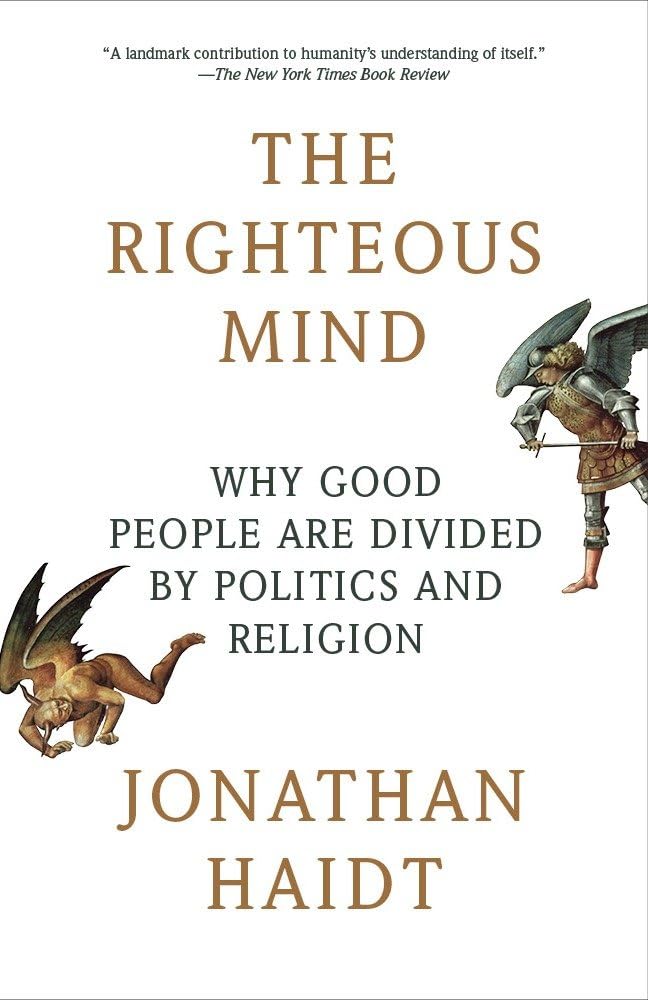
Drawing on his twenty-five years of groundbreaking research on moral psychology, Jonathan Haidt shows how moral judgments arise not from reason but from gut feelings. He shows why liberals, conservatives, and libertarians have such different intuitions about right and wrong, and he shows why each side is actually right about many of its central concerns.
In this subtle yet accessible book, Haidt gives you the key to understanding the miracle of human cooperation, as well as the curse of our eternal divisions and conflicts. If you’re ready to trade in anger for understanding, read The Righteous Mind.
Review
—NPR
“A landmark contribution to humanity’s understanding of itself. . . . Haidt is looking for more than victory. He’s looking for wisdom. That’s what makes The Righteous Mind well worth reading.”
—The New York Times Book Review
“An eye-opening and deceptively ambitious best seller . . . undoubtedly one of the most talked-about books of the year.”
—The Wall Street Journal
“Ingenious prose. . . . Beautifully written, Haidt’s book shines a new and creative light on moral psychology and presents a provocative message.”
—Science
“A remarkable and original synthesis of social psychology, political analysis, and moral reasoning.”
—Edward O. Wilson, University Research Professor Emeritus, Harvard University
“Highly readable, highly insightful. . . . The principal posture in which one envisions him is that of a scrappy, voluble, discerning patriot standing between the warring factions in American politics urging each to see the other’s viewpoint, to stop demonizing, bashing, clobbering. . . . Haidt’s real contribution, in my judgment, is inviting us all to sit at the table.”
—Washington Times
“Excellent. . . . An impressive book that should be read by anyone who has the slightest interest in how political opinions are reached.”
—The Daily Beast
“Haidt’s work feels particularly relevant now. . . . Haidt’s perspective can help us better understand our own political and religious leanings.”
—San Francisco Chronicle
“Jonathan Haidt is one of smartest and most creative psychologists alive, and his newest book, The Righteous Mind is a tour de force—a brave, brilliant and eloquent exploration of the most important issues of our time. It will challenge the way you think about liberals and conservatives, atheism and religion, good and evil. This is the book that everyone is going to be talking about.”
—Paul Bloom, Brooks and Suzanne Ragen Professor of Psychology, Yale University
“Haidt’s research has revolutionized the field of moral psychology. This elegantly written book has far-reaching implications for anyone interested in anthropology, politics, religion, or the many controversies that divide modern societies. If you want to know why you hold your moral beliefs and why many people disagree with you, read this book..”
—Simon Baron-Cohen, Cambridge University, Author of Zero Degrees of Empathy and The Science of Evil
“A much-needed voice of moral sanity.”
—Booklist
“[Haidt’s] framework for the different moral universes of liberals and conservatives struck me as a brilliant breakthrough . . . The Righteous Mind provides an invaluable road map.”
—Miller-McCune.com
“A well-informed tour of contemporary moral psychology…A cogent rendering of a moral universe of fertile complexity and latent flexibility.”
—Kirkus Reviews
“Haidt’s a good thing.”
—The Atlantic
“Jonathan Haidt’s absorbing The Righteous Mind should come with a warning label: ‘contents highly addictive.’ Written in a breezy and accessible style but informed by an impressively wide range of cutting-edge research in the social sciences, evolutionary biology and psychology, The Righteous Mind is about as interesting a book as you’ll pick up this year.”
—The Globe and Mail
“What makes [The Righteous Mind] so compelling is the fluid combination of erudition and entertainment, and the author’s obvious pleasure in challenging conventional wisdom. . . . [Haidt’s] core point is simple and well-made: our morality, much of it wired into brains from birth, at the same time binds us together and blinds us to different configurations of morality.”
—The Guardian (London)
“An important and timely book. . . . His ideas are controversial but they make you think.”
—Bill Moyers, Moyers & Company
“The Righteous Mind refutes the ‘New Atheists’ and shows that religion is a central part of our moral heritage. Haidt’s brilliant synthesis shows that Christians have nothing to fear and much to gain from the evolutionary paradigm.”
—Michael Dowd, author of Thank God for Evolution
“The Righteous Mind is an intellectual tour de force that brings Darwinian theorizing to the practical realm of everyday politics. The book is beautifully written, and it is truly unusual to encounter a book that makes a major theoretical contribution yet encourages one to turn its pages enthusiastically.”
—Christopher Boehm, Professor of Anthropology, University of Southern California, author of Moral Origins
“As a fellow who listens to heated political debate daily, I was fascinated, enlightened, and even amused by Haidt’s brilliant insights. This penetrating yet accessible book will help readers understand the righteous minds that inhabit politics.”
—Larry Sabato, University of Virginia, author of A More Perfect Constitution
“A profound discussion of the diverse psychological roots of morality and their role in producing political conflicts. It’s not too much to hope that the book will help to reduce those conflicts.”
—Richard E. Nisbett, University of Michigan, Author of The Geography of Thought
About the Author
Excerpt. © Reprinted by permission. All rights reserved.
Introduction
“Can we all get along?” That appeal was made famous on May 1, 1992, by Rodney King, a black man who had been beaten nearly to death by four Los Angeles police officers a year earlier. The entire nation had seen a videotape of the beating, so when a jury failed to convict the officers, their acquittal triggered widespread outrage and six days of rioting in Los Angeles. Fifty-three people were killed and more than seven thousand buildings were torched. Much of the mayhem was carried live; news cameras tracked the action from helicopters circling overhead. After a particularly horrific act of violence against a white truck driver, King was moved to make his appeal for peace.
King’s appeal is now so overused that it has become cultural kitsch, a catchphrase1 more often said for laughs than as a serious plea for mutual understanding. I therefore hesitated to use King’s words as the opening line of this book, but I decided to go ahead, for two reasons. The first is because most Americans nowadays are asking King’s question not about race relations but about political relations and the collapse of cooperation across party lines. Many Americans feel as though the nightly news from Washington is being sent to us from helicopters circling over the city, delivering dispatches from the war zone.
The second reason I decided to open this book with an overused phrase is because King followed it up with something lovely, something rarely quoted. As he stumbled through his television interview, fighting back tears and often repeating himself, he found these words: “Please, we can get along here. We all can get along. I mean, we’re all stuck here for a while. Let’s try to work it out.”
This book is about why it’s so hard for us to get along. We are indeed all stuck here for a while, so let’s at least do what we can to understand why we are so easily divided into hostile groups, each one certain of its righteousness.
###
People who devote their lives to studying something often come to believe that the object of their fascination is the key to understanding everything. Books have been published in recent years on the transformative role in human history played by cooking, mothering, war . . . even salt. This is one of those books. I study moral psychology, and I’m going to make the case that morality is the extraordinary human capacity that made civilization possible. I don’t mean to imply that cooking, mothering, war, and salt were not also necessary, but in this book I’m going to take you on a tour of human nature and history from the perspective of moral psychology.
By the end of the tour, I hope to have given you a new way to think about two of the most important, vexing, and divisive topics in human life: politics and religion. Etiquette books tell us not to discuss these topics in polite company, but I say go ahead. Politics and religion are both expressions of our underlying moral psychology, and an understanding of that psychology can help to bring people together. My goal in this book is to drain some of the heat, anger, and divisiveness out of these topics and replace them with awe, wonder, and curiosity. We are downright lucky that we evolved this complex moral psychology that allowed our species to burst out of the forests and savannas and into the delights, comforts, and extraordinary peacefulness of modern societies in just a few thousand years. My hope is that this book will make conversations about morality, politics, and religion more common, more civil, and more fun, even in mixed company. My hope is that it will help us to get along.
BORN TO BE RIGHTEOUS
I could have titled this book The Moral Mind to convey the sense that the human mind is designed to “do” morality, just as it’s designed to do language, sexuality, music, and many other things described in popular books reporting the latest scientific findings. But I chose the title The Righteous Mind to convey the sense that human nature is not just intrinsically moral, it’s also intrinsically moralistic, critical, and judgmental.
The word righteous comes from the old Norse word rettviss and the old English word rihtwis, both of which mean “just, upright, virtuous.” This meaning has been carried into the modern English words righteous and righteousness, although nowadays those words have strong religious connotations because they are usually used to translate the Hebrew word tzedek. Tzedek is a common word in the Hebrew Bible, often used to describe people who act in accordance with God’s wishes, but it is also an attribute of God and of God’s judgment of people (which is often harsh but always thought to be just).
The linkage of righteousness and judgmentalism is captured in some modern definitions of righteous, such as “arising from an outraged sense of justice, morality, or fair play.” The link also appears in the term self- righteous, which means “convinced of one’s own righteousness, especially in contrast with the actions and beliefs of others; narrowly moralistic and intolerant.” I want to show you that an obsession with righteousness (leading inevitably to self- righteousness) is the normal human condition. It is a feature of our evolutionary design, not a bug or error that crept into minds that would otherwise be objective and rational.
Our righteous minds made it possible for human beings—but no other animals—to produce large cooperative groups, tribes, and nations without the glue of kinship. But at the same time, our righteous minds guarantee that our cooperative groups will always be cursed by moralistic strife. Some degree of conflict among groups may even be necessary for the health and development of any society. When I was a teenager I wished for world peace, but now I yearn for a world in which competing ideologies are kept in balance, systems of accountability keep us all from getting away with too much, and fewer people believe that righteous ends justify violent means. Not a very romantic wish, but one that we might actually achieve.
WHAT LIES AHEAD
This book has three parts, which you can think of as three separate books—except that each one depends on the one before it. Each part presents one major principle of moral psychology.
Part I is about the first principle: Intuitions come first, strategic reasoning second. Moral intuitions arise automatically and almost instantaneously, long before moral reasoning has a chance to get started, and those first intuitions tend to drive our later reasoning. If you think that moral reasoning is something we do to figure out the truth, you’ll be constantly frustrated by how foolish, biased, and illogical people become when they disagree with you. But if you think about moral reasoning as a skill we humans evolved to further our social agendas—to justify our own actions and to defend the teams we belong to—then things will make a lot more sense. Keep your eye on the intuitions, and don’t take people’s moral arguments at face value. They’re mostly post hoc constructions made up on the fly, crafted to advance one or more strategic objectives.
The central metaphor of these four chapters is that the mind is divided, like a rider on an elephant, and the rider’s job is to serve the elephant. The rider is our conscious reasoning—the stream of words and images of which we are fully aware. The elephant is the other 99 percent of mental processes—the ones that occur outside of awareness but that actually govern most of our behavior. I developed this metaphor in my last book, The Happiness Hypothesis, where I described how the rider and elephant work together, sometimes poorly, as we stumble through life in search of meaning and connection. In this book I’ll use the metaphor to solve puzzles such as why it seems like everyone (else) is a hypocrite and why political partisans are so willing to believe outrageous lies and conspiracy theories. I’ll also use the metaphor to show you how you can better persuade people who seem unresponsive to reason.
Part II is about the second principle of moral psychology, which is that there’s more to morality than harm and fairness. The central metaphor of these four chapters is that the righteous mind is like a tongue with six taste receptors. Secular Western moralities are like cuisines that try to activate just one or two of these receptors—either concerns about harm and suffering, or concerns about fairness and injustice. But people have so many other powerful moral intuitions, such as those related to liberty, loyalty, authority, and sanctity. I’ll explain where these six taste receptors come from, how they form the basis of the world’s many moral cuisines, and why politicians on the right have a built- in advantage when it comes to cooking meals that voters like.
Part III is about the third principle: Morality binds and blinds. The central metaphor of these four chapters is that human beings are 90 percent chimp and percent bee. Human nature was produced by natural selection working at two levels simultaneously. Individuals compete with individuals within every group, and we are the descendants of primates who excelled at that competition. This gives us the ugly side of our nature, the one that is usually featured in books about our evolutionary origins. We are indeed selfish hypocrites so skilled at putting on a show of virtue that we fool even ourselves.
But human nature was also shaped as groups competed with other groups. As Darwin said long ago, the most cohesive and cooperative groups generally beat the groups of selfish individualists. Darwin’s ideas about group selection fell out of favor in the 1960s, but recent discoveries are putting his ideas back into play, and the implications are profound. We’re not always selfish hypocrites. We also have the ability, under special circumstances, to shut down our petty selves and become like cells in a larger body, or like bees in a hive, working for the good of the group. These experiences are often among the most cherished of our lives, although our hivishness can blind us to other moral concerns. Our bee-like nature facilitates altruism, heroism, war, and genocide.
Once you see our righteous minds as primate minds with a hivish overlay, you get a whole new perspective on morality, politics, and religion. I’ll show that our “higher nature” allows us to be profoundly altruistic, but that altruism is mostly aimed at members of our own groups. I’ll show that religion is (probably) an evolutionary adaptation for binding groups together and helping them to create communities with a shared morality. It is not a virus or a parasite, as some scientists (the “New Atheists”) have argued in recent years. And I’ll use this perspective to explain why some people are conservative, others are liberal (or progressive), and still others become libertarians. People bind themselves into political teams that share moral narratives. Once they accept a particular narrative, they become blind to alternative moral worlds.
(A note on terminology: In the United States, the word liberal refers to progressive or left- wing politics, and I will use the word in this sense. But in Europe and elsewhere, the word liberal is truer to its original meaning—valuing liberty above all else, including in economic activities. When Europeans use the word liberal, they often mean something more like the American term libertarian, which cannot be placed easily on the left- right spectrum. Readers from outside the United States may want to swap in the words progressive or left- wing whenever I say liberal.) In the coming chapters I’ll draw on the latest research in neuroscience, genetics, social psychology, and evolutionary modeling, but the take- home message of the book is ancient. It is the realization that we are all self- righteous hypocrites:
Why do you see the speck in your neighbor’s eye, but do not notice the log in your own eye? . . . You hypocrite, first take the log out of your own eye, and then you will see clearly to take the speck out of your neighbor’s eye. (Matthew 7:3–5)
Enlightenment (or wisdom, if you prefer) requires us all to take the logs out of our own eyes and then escape from our ceaseless, petty, and divisive moralism. As the eighth- century Chinese Zen master Sen-ts’an wrote:
The Perfect Way is only difficult
for those who pick and choose;
Do not like, do not dislike;
all will then be clear.
Make a hairbreadth difference,
and Heaven and Earth are set apart;
If you want the truth to stand clear before you,
never be for or against.
The struggle between “for” and “against”
is the mind’s worst disease.
I’m not saying we should live our lives like Sen-ts’an. In fact, I believe that a world without moralism, gossip, and judgment would quickly decay into chaos. But if we want to understand ourselves, our divisions, our limits, and our potentials, we need to step back, drop the moralism, apply some moral psychology, and analyze the game we’re all playing. .
Let us now examine the psychology of this struggle between “for” and “against.” It is a struggle that plays out in each of our righteous minds, and among all of our righteous groups.
Details:
Visit the Vintage Store
The Righteous Mind: Why Good People Are Divided by Politics and Religion
AED10698
Quantity:
Order today to get by 7-14 business days
Delivery fee of AED 20. Free for orders above AED 200.
 Imported From: United States
At BOLO, we work hard to ensure the products you receive are new, genuine, and sourced from reputable suppliers.
Every product in the BOLO catalogue is sourced through our Verified Global Supply Network of verified sellers, authorized distributors or directly from the manufacturer.
Each product undergoes thorough inspection and verification at our consolidation and fulfilment centers to ensure it meets our strict authenticity and quality standards before being shipped and delivered to you.
If you ever have concerns regarding the authenticity of a product purchased from us, please contact Bolo Support. We will review your inquiry promptly and, if necessary, provide documentation verifying authenticity or offer a suitable resolution.
Your trust is our top priority, and we are committed to maintaining transparency and integrity in every transaction.
While we strive to display accurate information, variations in packaging, labeling, instructions, or formulation may occasionally occur due to regional differences or supplier updates. For detailed or manufacturer-specific information, please contact the brand directly or reach out to BOLO Support for assistance.
Unless otherwise stated, all prices displayed on the product page include applicable taxes and import duties.
BOLO operates in accordance with the laws and regulations of United Arab Emirates. Any items found to be restricted or prohibited for sale within the United Arab Emirates will be cancelled prior to shipment. We take proactive measures to ensure that only products permitted for sale in United Arab Emirates are listed on our website.
All items are shipped by air, and any products classified as “Dangerous Goods (DG)” under IATA regulations will be removed from the order and cancelled.
All orders are processed manually, and we make every effort to process them promptly once confirmed. Products cancelled due to the above reasons will be permanently removed from listings across the website.


Similar suggestions by Bolo
More from this brand
Similar items from “Religion, Politics & State”
Share with
Or share with link
https://www.bolo.ae/products/U0307455777
Visit the Vintage Store
The Righteous Mind: Why Good People Are Divided by Politics and Religion
AED10698
Quantity:
Order today to get by 7-14 business days
Delivery fee of AED 20. Free for orders above AED 200.
Imported From: United States
At BOLO, we work hard to ensure the products you receive are new, genuine, and sourced from reputable suppliers.
Every product in the BOLO catalogue is sourced through our Verified Global Supply Network of verified sellers, authorized distributors or directly from the manufacturer.
Each product undergoes thorough inspection and verification at our consolidation and fulfilment centers to ensure it meets our strict authenticity and quality standards before being shipped and delivered to you.
If you ever have concerns regarding the authenticity of a product purchased from us, please contact Bolo Support. We will review your inquiry promptly and, if necessary, provide documentation verifying authenticity or offer a suitable resolution.
Your trust is our top priority, and we are committed to maintaining transparency and integrity in every transaction.
While we strive to display accurate information, variations in packaging, labeling, instructions, or formulation may occasionally occur due to regional differences or supplier updates. For detailed or manufacturer-specific information, please contact the brand directly or reach out to BOLO Support for assistance.
Unless otherwise stated, all prices displayed on the product page include applicable taxes and import duties.
BOLO operates in accordance with the laws and regulations of United Arab Emirates. Any items found to be restricted or prohibited for sale within the United Arab Emirates will be cancelled prior to shipment. We take proactive measures to ensure that only products permitted for sale in United Arab Emirates are listed on our website.
All items are shipped by air, and any products classified as “Dangerous Goods (DG)” under IATA regulations will be removed from the order and cancelled.
All orders are processed manually, and we make every effort to process them promptly once confirmed. Products cancelled due to the above reasons will be permanently removed from listings across the website.
Description:
Drawing on his twenty-five years of groundbreaking research on moral psychology, Jonathan Haidt shows how moral judgments arise not from reason but from gut feelings. He shows why liberals, conservatives, and libertarians have such different intuitions about right and wrong, and he shows why each side is actually right about many of its central concerns.
In this subtle yet accessible book, Haidt gives you the key to understanding the miracle of human cooperation, as well as the curse of our eternal divisions and conflicts. If you’re ready to trade in anger for understanding, read The Righteous Mind.
Review
—NPR
“A landmark contribution to humanity’s understanding of itself. . . . Haidt is looking for more than victory. He’s looking for wisdom. That’s what makes The Righteous Mind well worth reading.”
—The New York Times Book Review
“An eye-opening and deceptively ambitious best seller . . . undoubtedly one of the most talked-about books of the year.”
—The Wall Street Journal
“Ingenious prose. . . . Beautifully written, Haidt’s book shines a new and creative light on moral psychology and presents a provocative message.”
—Science
“A remarkable and original synthesis of social psychology, political analysis, and moral reasoning.”
—Edward O. Wilson, University Research Professor Emeritus, Harvard University
“Highly readable, highly insightful. . . . The principal posture in which one envisions him is that of a scrappy, voluble, discerning patriot standing between the warring factions in American politics urging each to see the other’s viewpoint, to stop demonizing, bashing, clobbering. . . . Haidt’s real contribution, in my judgment, is inviting us all to sit at the table.”
—Washington Times
“Excellent. . . . An impressive book that should be read by anyone who has the slightest interest in how political opinions are reached.”
—The Daily Beast
“Haidt’s work feels particularly relevant now. . . . Haidt’s perspective can help us better understand our own political and religious leanings.”
—San Francisco Chronicle
“Jonathan Haidt is one of smartest and most creative psychologists alive, and his newest book, The Righteous Mind is a tour de force—a brave, brilliant and eloquent exploration of the most important issues of our time. It will challenge the way you think about liberals and conservatives, atheism and religion, good and evil. This is the book that everyone is going to be talking about.”
—Paul Bloom, Brooks and Suzanne Ragen Professor of Psychology, Yale University
“Haidt’s research has revolutionized the field of moral psychology. This elegantly written book has far-reaching implications for anyone interested in anthropology, politics, religion, or the many controversies that divide modern societies. If you want to know why you hold your moral beliefs and why many people disagree with you, read this book..”
—Simon Baron-Cohen, Cambridge University, Author of Zero Degrees of Empathy and The Science of Evil
“A much-needed voice of moral sanity.”
—Booklist
“[Haidt’s] framework for the different moral universes of liberals and conservatives struck me as a brilliant breakthrough . . . The Righteous Mind provides an invaluable road map.”
—Miller-McCune.com
“A well-informed tour of contemporary moral psychology…A cogent rendering of a moral universe of fertile complexity and latent flexibility.”
—Kirkus Reviews
“Haidt’s a good thing.”
—The Atlantic
“Jonathan Haidt’s absorbing The Righteous Mind should come with a warning label: ‘contents highly addictive.’ Written in a breezy and accessible style but informed by an impressively wide range of cutting-edge research in the social sciences, evolutionary biology and psychology, The Righteous Mind is about as interesting a book as you’ll pick up this year.”
—The Globe and Mail
“What makes [The Righteous Mind] so compelling is the fluid combination of erudition and entertainment, and the author’s obvious pleasure in challenging conventional wisdom. . . . [Haidt’s] core point is simple and well-made: our morality, much of it wired into brains from birth, at the same time binds us together and blinds us to different configurations of morality.”
—The Guardian (London)
“An important and timely book. . . . His ideas are controversial but they make you think.”
—Bill Moyers, Moyers & Company
“The Righteous Mind refutes the ‘New Atheists’ and shows that religion is a central part of our moral heritage. Haidt’s brilliant synthesis shows that Christians have nothing to fear and much to gain from the evolutionary paradigm.”
—Michael Dowd, author of Thank God for Evolution
“The Righteous Mind is an intellectual tour de force that brings Darwinian theorizing to the practical realm of everyday politics. The book is beautifully written, and it is truly unusual to encounter a book that makes a major theoretical contribution yet encourages one to turn its pages enthusiastically.”
—Christopher Boehm, Professor of Anthropology, University of Southern California, author of Moral Origins
“As a fellow who listens to heated political debate daily, I was fascinated, enlightened, and even amused by Haidt’s brilliant insights. This penetrating yet accessible book will help readers understand the righteous minds that inhabit politics.”
—Larry Sabato, University of Virginia, author of A More Perfect Constitution
“A profound discussion of the diverse psychological roots of morality and their role in producing political conflicts. It’s not too much to hope that the book will help to reduce those conflicts.”
—Richard E. Nisbett, University of Michigan, Author of The Geography of Thought
About the Author
Excerpt. © Reprinted by permission. All rights reserved.
Introduction
“Can we all get along?” That appeal was made famous on May 1, 1992, by Rodney King, a black man who had been beaten nearly to death by four Los Angeles police officers a year earlier. The entire nation had seen a videotape of the beating, so when a jury failed to convict the officers, their acquittal triggered widespread outrage and six days of rioting in Los Angeles. Fifty-three people were killed and more than seven thousand buildings were torched. Much of the mayhem was carried live; news cameras tracked the action from helicopters circling overhead. After a particularly horrific act of violence against a white truck driver, King was moved to make his appeal for peace.
King’s appeal is now so overused that it has become cultural kitsch, a catchphrase1 more often said for laughs than as a serious plea for mutual understanding. I therefore hesitated to use King’s words as the opening line of this book, but I decided to go ahead, for two reasons. The first is because most Americans nowadays are asking King’s question not about race relations but about political relations and the collapse of cooperation across party lines. Many Americans feel as though the nightly news from Washington is being sent to us from helicopters circling over the city, delivering dispatches from the war zone.
The second reason I decided to open this book with an overused phrase is because King followed it up with something lovely, something rarely quoted. As he stumbled through his television interview, fighting back tears and often repeating himself, he found these words: “Please, we can get along here. We all can get along. I mean, we’re all stuck here for a while. Let’s try to work it out.”
This book is about why it’s so hard for us to get along. We are indeed all stuck here for a while, so let’s at least do what we can to understand why we are so easily divided into hostile groups, each one certain of its righteousness.
###
People who devote their lives to studying something often come to believe that the object of their fascination is the key to understanding everything. Books have been published in recent years on the transformative role in human history played by cooking, mothering, war . . . even salt. This is one of those books. I study moral psychology, and I’m going to make the case that morality is the extraordinary human capacity that made civilization possible. I don’t mean to imply that cooking, mothering, war, and salt were not also necessary, but in this book I’m going to take you on a tour of human nature and history from the perspective of moral psychology.
By the end of the tour, I hope to have given you a new way to think about two of the most important, vexing, and divisive topics in human life: politics and religion. Etiquette books tell us not to discuss these topics in polite company, but I say go ahead. Politics and religion are both expressions of our underlying moral psychology, and an understanding of that psychology can help to bring people together. My goal in this book is to drain some of the heat, anger, and divisiveness out of these topics and replace them with awe, wonder, and curiosity. We are downright lucky that we evolved this complex moral psychology that allowed our species to burst out of the forests and savannas and into the delights, comforts, and extraordinary peacefulness of modern societies in just a few thousand years. My hope is that this book will make conversations about morality, politics, and religion more common, more civil, and more fun, even in mixed company. My hope is that it will help us to get along.
BORN TO BE RIGHTEOUS
I could have titled this book The Moral Mind to convey the sense that the human mind is designed to “do” morality, just as it’s designed to do language, sexuality, music, and many other things described in popular books reporting the latest scientific findings. But I chose the title The Righteous Mind to convey the sense that human nature is not just intrinsically moral, it’s also intrinsically moralistic, critical, and judgmental.
The word righteous comes from the old Norse word rettviss and the old English word rihtwis, both of which mean “just, upright, virtuous.” This meaning has been carried into the modern English words righteous and righteousness, although nowadays those words have strong religious connotations because they are usually used to translate the Hebrew word tzedek. Tzedek is a common word in the Hebrew Bible, often used to describe people who act in accordance with God’s wishes, but it is also an attribute of God and of God’s judgment of people (which is often harsh but always thought to be just).
The linkage of righteousness and judgmentalism is captured in some modern definitions of righteous, such as “arising from an outraged sense of justice, morality, or fair play.” The link also appears in the term self- righteous, which means “convinced of one’s own righteousness, especially in contrast with the actions and beliefs of others; narrowly moralistic and intolerant.” I want to show you that an obsession with righteousness (leading inevitably to self- righteousness) is the normal human condition. It is a feature of our evolutionary design, not a bug or error that crept into minds that would otherwise be objective and rational.
Our righteous minds made it possible for human beings—but no other animals—to produce large cooperative groups, tribes, and nations without the glue of kinship. But at the same time, our righteous minds guarantee that our cooperative groups will always be cursed by moralistic strife. Some degree of conflict among groups may even be necessary for the health and development of any society. When I was a teenager I wished for world peace, but now I yearn for a world in which competing ideologies are kept in balance, systems of accountability keep us all from getting away with too much, and fewer people believe that righteous ends justify violent means. Not a very romantic wish, but one that we might actually achieve.
WHAT LIES AHEAD
This book has three parts, which you can think of as three separate books—except that each one depends on the one before it. Each part presents one major principle of moral psychology.
Part I is about the first principle: Intuitions come first, strategic reasoning second. Moral intuitions arise automatically and almost instantaneously, long before moral reasoning has a chance to get started, and those first intuitions tend to drive our later reasoning. If you think that moral reasoning is something we do to figure out the truth, you’ll be constantly frustrated by how foolish, biased, and illogical people become when they disagree with you. But if you think about moral reasoning as a skill we humans evolved to further our social agendas—to justify our own actions and to defend the teams we belong to—then things will make a lot more sense. Keep your eye on the intuitions, and don’t take people’s moral arguments at face value. They’re mostly post hoc constructions made up on the fly, crafted to advance one or more strategic objectives.
The central metaphor of these four chapters is that the mind is divided, like a rider on an elephant, and the rider’s job is to serve the elephant. The rider is our conscious reasoning—the stream of words and images of which we are fully aware. The elephant is the other 99 percent of mental processes—the ones that occur outside of awareness but that actually govern most of our behavior. I developed this metaphor in my last book, The Happiness Hypothesis, where I described how the rider and elephant work together, sometimes poorly, as we stumble through life in search of meaning and connection. In this book I’ll use the metaphor to solve puzzles such as why it seems like everyone (else) is a hypocrite and why political partisans are so willing to believe outrageous lies and conspiracy theories. I’ll also use the metaphor to show you how you can better persuade people who seem unresponsive to reason.
Part II is about the second principle of moral psychology, which is that there’s more to morality than harm and fairness. The central metaphor of these four chapters is that the righteous mind is like a tongue with six taste receptors. Secular Western moralities are like cuisines that try to activate just one or two of these receptors—either concerns about harm and suffering, or concerns about fairness and injustice. But people have so many other powerful moral intuitions, such as those related to liberty, loyalty, authority, and sanctity. I’ll explain where these six taste receptors come from, how they form the basis of the world’s many moral cuisines, and why politicians on the right have a built- in advantage when it comes to cooking meals that voters like.
Part III is about the third principle: Morality binds and blinds. The central metaphor of these four chapters is that human beings are 90 percent chimp and percent bee. Human nature was produced by natural selection working at two levels simultaneously. Individuals compete with individuals within every group, and we are the descendants of primates who excelled at that competition. This gives us the ugly side of our nature, the one that is usually featured in books about our evolutionary origins. We are indeed selfish hypocrites so skilled at putting on a show of virtue that we fool even ourselves.
But human nature was also shaped as groups competed with other groups. As Darwin said long ago, the most cohesive and cooperative groups generally beat the groups of selfish individualists. Darwin’s ideas about group selection fell out of favor in the 1960s, but recent discoveries are putting his ideas back into play, and the implications are profound. We’re not always selfish hypocrites. We also have the ability, under special circumstances, to shut down our petty selves and become like cells in a larger body, or like bees in a hive, working for the good of the group. These experiences are often among the most cherished of our lives, although our hivishness can blind us to other moral concerns. Our bee-like nature facilitates altruism, heroism, war, and genocide.
Once you see our righteous minds as primate minds with a hivish overlay, you get a whole new perspective on morality, politics, and religion. I’ll show that our “higher nature” allows us to be profoundly altruistic, but that altruism is mostly aimed at members of our own groups. I’ll show that religion is (probably) an evolutionary adaptation for binding groups together and helping them to create communities with a shared morality. It is not a virus or a parasite, as some scientists (the “New Atheists”) have argued in recent years. And I’ll use this perspective to explain why some people are conservative, others are liberal (or progressive), and still others become libertarians. People bind themselves into political teams that share moral narratives. Once they accept a particular narrative, they become blind to alternative moral worlds.
(A note on terminology: In the United States, the word liberal refers to progressive or left- wing politics, and I will use the word in this sense. But in Europe and elsewhere, the word liberal is truer to its original meaning—valuing liberty above all else, including in economic activities. When Europeans use the word liberal, they often mean something more like the American term libertarian, which cannot be placed easily on the left- right spectrum. Readers from outside the United States may want to swap in the words progressive or left- wing whenever I say liberal.) In the coming chapters I’ll draw on the latest research in neuroscience, genetics, social psychology, and evolutionary modeling, but the take- home message of the book is ancient. It is the realization that we are all self- righteous hypocrites:
Why do you see the speck in your neighbor’s eye, but do not notice the log in your own eye? . . . You hypocrite, first take the log out of your own eye, and then you will see clearly to take the speck out of your neighbor’s eye. (Matthew 7:3–5)
Enlightenment (or wisdom, if you prefer) requires us all to take the logs out of our own eyes and then escape from our ceaseless, petty, and divisive moralism. As the eighth- century Chinese Zen master Sen-ts’an wrote:
The Perfect Way is only difficult
for those who pick and choose;
Do not like, do not dislike;
all will then be clear.
Make a hairbreadth difference,
and Heaven and Earth are set apart;
If you want the truth to stand clear before you,
never be for or against.
The struggle between “for” and “against”
is the mind’s worst disease.
I’m not saying we should live our lives like Sen-ts’an. In fact, I believe that a world without moralism, gossip, and judgment would quickly decay into chaos. But if we want to understand ourselves, our divisions, our limits, and our potentials, we need to step back, drop the moralism, apply some moral psychology, and analyze the game we’re all playing. .
Let us now examine the psychology of this struggle between “for” and “against.” It is a struggle that plays out in each of our righteous minds, and among all of our righteous groups.
Details:
Similar suggestions by Bolo
More from this brand
Similar items from “Religion, Politics & State”
Share with
Or share with link
https://www.bolo.ae/products/U0307455777