Description:
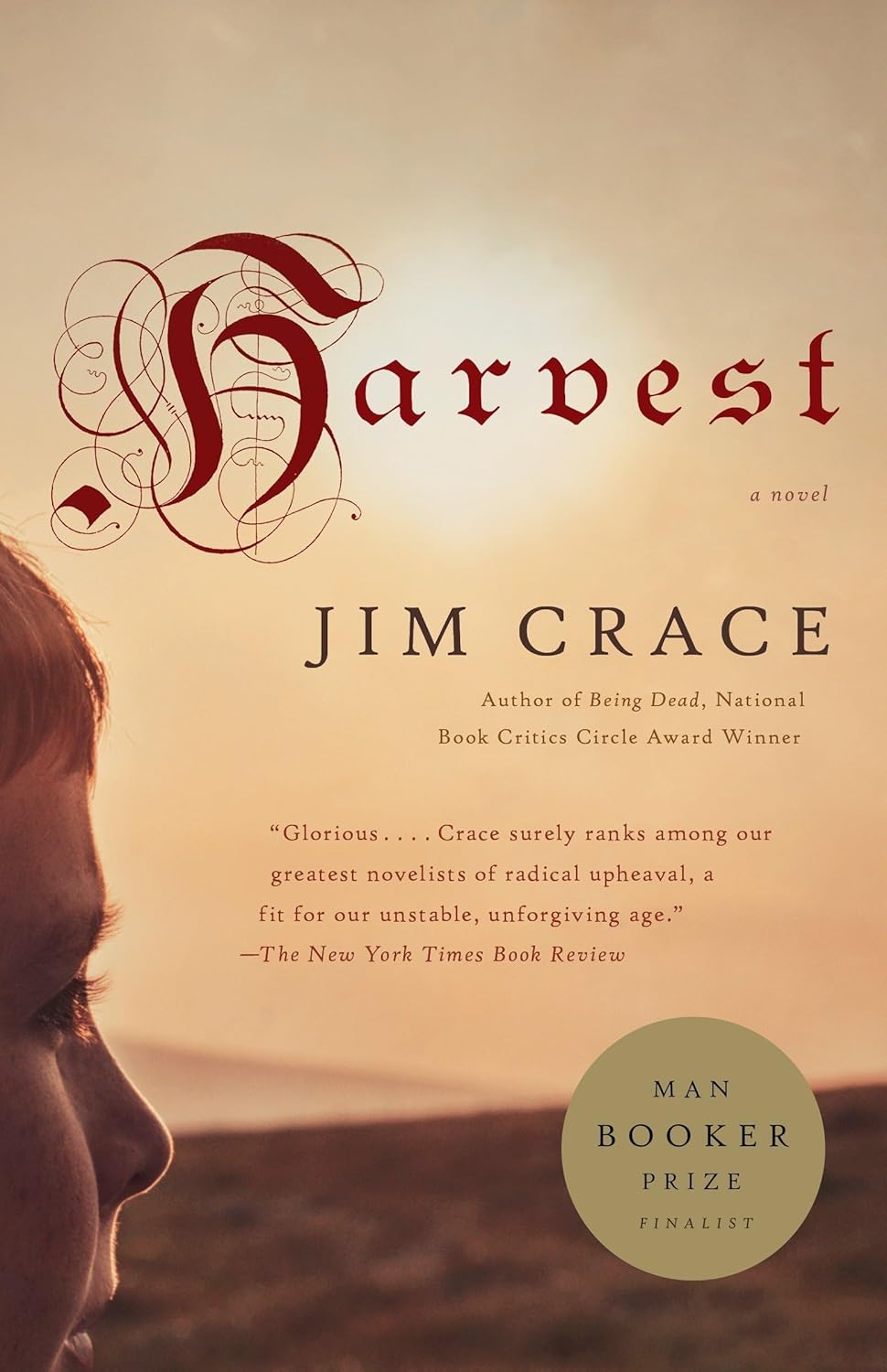
"In his compassionate curiosity and his instincts for insurgent uncertainty, Crace surely ranks among our greatest novelists of radical upheaval, a perfect fit for our unstable, unforgiving age." —The New York Times Book Review
On the morning after harvest, the inhabitants of a remote English village awaken looking forward to a hard-earned day of rest and feasting at their landowner's table. But the sky is marred by two conspicuous columns of smoke, replacing pleasurable anticipation with alarm and suspicion.
One smoke column is the result of an overnight fire that has damaged the master's outbuildings. The second column rises from the wooded edge of the village, sent up by newcomers to announce their presence. In the minds of the wary villagers a mere coincidence of events appears to be unlikely, with violent confrontation looming as the unavoidable outcome. Meanwhile, another newcomer has recently been spotted taking careful notes and making drawings of the land. It is his presence more than any other that will threaten the village's entire way of life.
In effortless and tender prose, Jim Crace details the unraveling of a pastoral idyll in the wake of economic progress. His tale is timeless and unsettling, framed by a beautifully evoked world that will linger in your memory long after you finish reading.
Editorial Reviews
Review
Longlisted for the Man Booker prize!
"Jim Crace is the most generous of writers. A fabulist, an open heart, an imagination in full flight. There is something of a harvest in every book: the promise, the violence, the fall, the regain. And Harvest is one of his best novels ever. He is, quite simply, one of the great writers of our time." —Colum McCann, National Book Award-winning author of Let the Great World Spin
"Glorious ... Harvest calls to mind J. M. Coetzee’s finest and most allegorical novel, Waiting for the Barbarians ... Crace writes with a particular, haunting empathy for the displaced ... His plots may be epic, but his sentences carry a sensual charge ... In his compassionate curiosity and his instincts for insurgent uncertainty, Crace surely ranks among our greatest novelists of radical upheaval, a perfect fit for our unstable, unforgiving age." —The New York Times Book Review
"The most seductive and enthralling of Crace’s novels." —New Statesman
"[Harvest] is intellectually and morally engaging while also being exciting to read ... Mr. Crace's imagery brilliantly suggests the loamy, lyric glories of rustic English language and life ... [he] devotes his considerable talents to telling an affecting tale of a bound world and its simple people as they head toward a tragic and inexorable breakdown."
—Wall Street Journal
"Surreptitiously thought-provoking ... Harvest attains a haunting and almost subversive quality." —Boston Globe
"Ravishingly rich in evocations of country life ... Crace’s prose is so sensual you can’t help but believe it describes an actual material place. But this village is like the forests of the Brothers Grimm, a setting meant to be both familiar and strange. If you think Crace is only talking about the shift from the medieval to the modern world, you’d be very, very wrong." —Salon
"In language beautiful and painstakingly precise, Jim Crace circumscribes the story as neatly as a fairy tale ... Entirely absorbing." —Minneapolis Star-Tribune
"Harvest is as finely written as it is tautly structured. Pungently flavoured with archaic words, its language is exhilaratingly exact, sometimes poetic and sometimes stark. Magnificently resurrecting a pivotal moment in our history about which it is deeply knowledgeable, this simultaneously elegiac and unillusioned novel is an achievement worthy to stand alongside those of Crace’s great fictional influence, William Golding." —The Sunday Times
"Crace, an original and a literary stylist, with, usually, something remarkable to say, says it here in a haunting work of sudden violence and vengeance ... Few novels as fine or as complex in their apparent simplicity will be published this, or indeed any, year." —Irish Times
"As with Crace's other novels, Harvest is deftly written, in language — formal, slightly archaic even — that reflects the setting it describes. It's also tightly plotted ... Crace's real concern is his characters, the way that, like all of us, they make mistakes and act from weakness, and turn on one another when things go wrong." —Los Angeles Times
"Crace’s signature measured delivery and deliberate focus create unforgettably poetic passages that quiver with beauty. An electrifying return to form." —Publishers Weekly, starred review
"Rarely does language so plainspoken and elemental tell a story so richly open to interpretation on so many different levels....With economy and grace, the award-winning Crace gives his work a simplicity and symmetry that belie the disturbances beneath the consciousness of its narrator....Crace continues to occupy a singular place in contemporary literature."
—Kirkus Reviews, starred review
About the Author
Excerpt. © Reprinted by permission. All rights reserved.
1
Two twists of smoke at a time of year too warm for cottage fires surprise us at first light, or they at least surprise those of us who've not been up to mischief in the dark. Our land is topped and tailed with flames. Beyond the frontier ditches of our fields and in the shelter of our woods, on common ground, where yesterday there wasn't anyone who could give rise to smoke, some newcomers, by the luster of an obliging reapers' moon, have put up their hut--four rough and ready walls, a bit of roof--and lit the more outlying of these fires. Their fire is damp. They will have thrown on wet greenery in order to procure the blackest plume, and thereby not be missed by us. It rises in a column that hardly bends or thins until it clears the canopies. It says, New neighbors have arrived; they've built a place; they've laid a hearth; they know the custom and the law. This first smoke has given them the right to stay. We'll see.
But it is the second twist of gray that calls us close, that has us rushing early from our homes on this rest day toward Master Kent's house. From a distance this smoke is pale. No one has added greenery to darken it. But the blaze itself is less faint-hearted. It is rackety. It is a timber fire, for sure. But ancient wood. Long-felled. The years are in its smell. We fear it is the manor house that burns and that we will be blamed for sleeping through. We'd best prepare excuses now. So, if we heard the cracking of its rafters and its beams in our slumbers this morning, we must have mistaken it for the usual busying of trees and wind, or for the toiling of dreams, or for the groaning of our bones. Yesterday was harvest end, the final sheaf. We were expecting to sleep long and late this morning, with heavy shoulders naturally but with buoyant hearts. Our happiness has deafened us, we'll say. It was only when we heard Willowjack, the master's fancy sorrel mare, protesting at the smoke with such alarm, that we awoke and went to help, as help we must, for no one wants to lose the manor house.
Now that we have reached our master's paddocks and his garths, we can smell and taste the straw. The smoke and flames are coming not from his home but from his hay lofts and his stable roofs. His pretty, painted dovecote has already gone. We expect to spot his home-birds' snowy wings against the smoke-gray sky. But there are none.
I know at once whom we should blame. When Christopher and Thomas Derby, our only twins, and Brooker Higgs came back from wooding last evening, they seemed a little too well satisfied, but they weren't bringing with them any fowl or rabbit for the pot, or even any fuel. Their only spoils, so far as I could tell, were a bulky, almost weightless sack and immodest fits of laughter. They'd been mushrooming. And by the looks of them they had already eaten raw some of the fairy caps they'd found. I did the same myself in my first summer of settlement here, a dozen or so years ago, when I was greener and less timid, though not young. I remember eating them. They are beyond forgetting. Just as yesterday, the last sheaf of that year's harvest had been cut and stood. And, just as today, we'd faced a break from labor, which meant that I could sleep my mischief off. So in the company of John Carr, my new neighbor then, my neighbor still, I went off that afternoon to Thank the Lord for His Munificence by hunting fairy caps in these same woods. I'll not forget the dancing lights, the rippling and the merriment, the halos and the melting trails that followed anything that moved, the enormous fearlessness I felt, the lasting fear (yes, even now), or how darkly blue the moon became that night, and then how red. I wish I'd had the courage since to try to find that moon again.
Last evening, when the twins and Brooker Higgs jaunted past our cottages and waved at us with gill stains on their fingertips, I asked these merry men, "Had any luck?" They bared their sack of spoils at once, because they were too foxed and stupefied to conceal them, even though they understood my ancient closeness to the manor house. I pulled aside the dampening of leaves and inspected their few remaining fairy caps, saved for later revels, I suppose, plus a good number of golden shawls, which, stewed in milk and placed inside a dead man's mouth, are meant to taste so good they'll jolt him back to life. Accounting for the bulk of their sack was a giant moonball, its soft, kid-leather skin already smoking spores, and far too yellowy and dry to cook. Why had they picked it, then? Why hadn't they just given it a satisfying kick? What kind of wayward lads were these?
Here's what took place. This is my reckoning, calculated without recourse to any constable or magistrate--and just as well, because this place is too far off from towns to number such judicious creatures among our livestock; we are too small, and getting smaller. Our final day of harvesting was not as joyful as it ought to have been, and not only because the crop proved so frugal in the ear. A gentleman we did not recognize was watching us reduce our barley field to stub; a visitor, a rare event, exciting and unnerving. We mowed with scythes; he worked with brushes and with quills. He was recording us, he said, or more exactly marking down our land, at Master Kent's request. He tipped his drawing board for anyone that asked and let them see the scratchings on his chart, the geometrics that he said were fields and woods, the squares that stood for cottages, the ponds, the lanes, the foresting.
He was a pleasant man, I'd say. No more than thirty years of age and dressed much like the master, not for labor but for the open air, in sturdy boots, breeches, a jerkin, and a plain cap without feather, brooch or badge. His beard was shaped and honed to a point with wax. I have a narrow trowel that matches it. A townsman's beard. A wealthy beard. And he was lopsided when he moved, with a stiff arm and shoulder on his left. His was a body not well suited to the balks and bumpy edges of a field. He was a stumbler. And there was, I thought, a trace of past illness in his expression as well as in his step. But I've never seen a man more ready with a smile. We could not help but stare at him and wonder, without saying so, if those scratchings on his board might scratch us too, in some unwelcome way.
Still, there was essential work to finish yesterday, whatever our distractions. If we hoped for sufficient grain to last the year, we'd have to deserve it with some sweat. This summer's yield was not yet good enough. Plenty, here, has wed itself to Leanness. At the lower, shaded limits by the dell and on the more neglected stony slopes our plants have proven miserly. They grew as short, askew and weakly as our limping visitor and so were hardly worth the reaping. But the higher field, which we left standing till the last, has always looked more sprightly--and more promising. Since spring we've waited with our fingers crossed as our better barley steadily renounced its green and let itself go tawny. From the lane, looking down toward the tracery of willows on the brook, the top end of our barley meadow, bristling and shivering on the breeze, showed us at last its ochers and its cadmiums, its ambers and its chromes. And the smells, which for so long in this slow summer were faint and damp, became nutlike and sugary. They promised winter ales and porridges. The awns and whiskers of the barley's ears were brittle and dry enough to chit-chat-chit every time they were disturbed, nattering with ten thousand voices at every effort of the wind or every scarper of a rabbit, mouse or bird. They said, "We've had enough. Our heads are baked and heavy now. We're dry. Bring out your blades and do your worst."
Reap and gossip. That's the rule. On harvest days, anyone who's got a pair of legs and arms can expect to earn supper with unceasing labor. Our numbers have been too reduced of late to allow a single useful soul to stay away. There's not a hand that will escape the brittle straw unscratched. The children go ahead of us, looking for the gray of any thistle heads that have outstripped our rust-gold barley, then duck below the level ears of grain to weed out nettles, teasels, docks; "dealing with the grievances," we say. The broadest shoulders swing their sickles and their scythes at the brimming cliffs of stalk; hares, partridges and sparrows flee before the blades; our wives and daughters bundle up and bind the sheaves, though not too carefully--they work on the principle of ten for the commons and one for the gleaning; our creaking fathers make the lines of stooks; the sun begins to dry what we have harvested. Our work is consecrated by the sun. Compared to winter days, let's say, or digging days, it's satisfying work, made all the more so by the company we keep, for on such days all the faces we know and love (as well as those I know but do not like entirely) are gathered in one space and bounded by common ditches and collective hopes. If, perhaps, we hear a barking deer nagging to be trapped and stewed, or a woodcock begging to make his hearse in a pie, we lift our heads as one and look toward the woods as one; we straighten up as one and stare at the sun, reprovingly, if it's been darkened by a cloud; our scythes and hand tools clack and chat in unison. And anything we say is heard by everyone. So there is openness and jollity.
The harvest teamwork allows us to be lewd. Our humor ripens as the barley falls. It's safe to spread the gossip noisily, it's safe to bait and goad, Who's sharing wives? Which bearded bachelor is far too friendly with his goat? Which widower (they look at me) has dipped his thumb in someone else's pot? Which blushing youngsters are the village spares, that's to say those children who've been conceived in one man's bed and then delivered in another's? Who's making love to apple tubs? Who's wedded to a sack of grain? Nothing is beyond our bounds, when we are cutting corn.
So it was hardly a surprise yesterday that once "Mr. Quill" in Master Kent's close company was attending with his survey sticks and measuring tapes to the shape and volume of our fallow field and so beyond hearing, we wondered, out loud, whether our visiting townsman had ever overcome his undisguised deficiencies to secure himself a willing wife. Was he a husband yet? And, if he was, what blushing pleasures might Mistress Quill take from such staggering and stiffness and from having such a likeness of her hairy private part upon her stumbling lover's chin? "I'd like to take a scythe to him," said my neighbor John. Another said, "I'd rather take my wooden staff to her." And then of course the bawdiness increased with such play on the prospect of caressing Mr. Quill's three-cornered beard and Mistress Quill's twin attribute that every time that evening and in our company he ruminated with his hand around his chin, as was his habit, the women there could barely plug their grins while their men looked on, biting their lips. "And have you noticed his white hands?" one of our village daughters asked. "I wonder if he's ever dirtied them . . . other than to . . ." No, she would not finish. What she had in mind did not seem possible.
It was only when the gentleman returned in the fullness of the afternoon and stood at our backs on the bristle of the field to quantify and measure us that we began again to wonder what awaited these treasured neighborhoods and to feel uneasy. What was he wanting from our soil, what were his charts securing? We saw his finger wagging on the count. We heard him numbering, until he reached the paltry fifty-eight that represented us. We know enough to understand that in the greater world, flour, meat and cheese are not divided into shares and portions for the larder, as they are here, but only weighed and sized for selling. Was Mr. Quill the confirmation of the rumor that had gone about our doors that Master Kent was in such narrows now he was a widower that he would need to measure and sell our land? No amount of openness and jollity could raise our spirits once that fear took hold. Our observer's ready smile was menacing.
We were slow to broadcast our alarm. But we tackled our last barley stands more silently, less lewdly--and more scrupulously, as we were being watched. Now each barking deer or woodcock call was a warning. Each darkling cloud reminded us how nothing in our fields was guaranteed. We only muttered to ourselves, too anxious to raise our voices loud enough to reach our neighbors down the reaping line. Some of the younger men set faces which declared they'd defend our acres with their lives or with the lives of anyone that crossed them. The usual silent swagger. Rather than speak up, they turned their anger on the pigeons and the rooks, and on a handful of our master's near-white doves, which had descended on the stub and were already robbing fallen grain that, by ancient gleaning rights, should have been ours. These "snowy devils," their out-of-season whiteness making them seem even more coldly pea-eyed and acquisitive than their gray and black companions, were feasting on our bread and ale, they said, and sent the children to use their slings or shower them with handfuls of grit or yell the thieves away, anything to evidence our tenancy. The air was full of wings and cries. So our final harvesting gained ground.
By my account, once our complicated working day was done and all our flat-eared barley was gathered in and carted away, the Derby twins and Brooker Higgs, unmarried men in a village dismayingly short of unmarried women, set off for the woods, while most of us, the rest of us, restored ourselves at home, took stock. We shook our heads and searched our hearts, until we had persuaded ourselves that Master Kent was too good and just a man to sell our fields. He'd always taken care of us. We'd always taken care of him. Besides, what was the evidence of any sale? A bearded, skew-whiff gentleman? A chart? The counting of our heads? No, we should not be mistrustful. We should face the rest day with easy hearts, and then enjoy the gleaning that would follow it, with our own Gleaning Queen the first to bend and pick a grain. We should expect our seasons to unfold in all their usual sequences, and so on through the harvests and the years. Everything was bound to keep its shape. That's what we thought. We were calm and leisurely. But, unlike the three bachelors, we had not found and eaten fairy caps and then concocted ways of getting even with the thieving birds, especially the white ones from the master's cote. Nor had we stumbled on a moonball, fatter than a blacksmith's head, but too tindery to eat. Such a dry and hollow moonball is good, as any tree scamp knows, for taking flames from here to there. It's good, if you are so inclined, while everybody sleeps and only night's black agents are at work, for taking fire into the master's yards.
Details:
Visit the Knopf Doubleday Publishing Group Store
Harvest: Man Booker Prize Finalist
AED8752
Quantity:
Order today to get by 7-14 business days
Delivery fee of AED 20. Free for orders above AED 200.
 Imported From: United States
At BOLO, we work hard to ensure the products you receive are new, genuine, and sourced from reputable suppliers.
Every product in the BOLO catalogue is sourced through our Verified Global Supply Network of verified sellers, authorized distributors or directly from the manufacturer.
Each product undergoes thorough inspection and verification at our consolidation and fulfilment centers to ensure it meets our strict authenticity and quality standards before being shipped and delivered to you.
If you ever have concerns regarding the authenticity of a product purchased from us, please contact Bolo Support. We will review your inquiry promptly and, if necessary, provide documentation verifying authenticity or offer a suitable resolution.
Your trust is our top priority, and we are committed to maintaining transparency and integrity in every transaction.
While we strive to display accurate information, variations in packaging, labeling, instructions, or formulation may occasionally occur due to regional differences or supplier updates. For detailed or manufacturer-specific information, please contact the brand directly or reach out to BOLO Support for assistance.
Unless otherwise stated, all prices displayed on the product page include applicable taxes and import duties.
BOLO operates in accordance with the laws and regulations of United Arab Emirates. Any items found to be restricted or prohibited for sale within the United Arab Emirates will be cancelled prior to shipment. We take proactive measures to ensure that only products permitted for sale in United Arab Emirates are listed on our website.
All items are shipped by air, and any products classified as “Dangerous Goods (DG)” under IATA regulations will be removed from the order and cancelled.
All orders are processed manually, and we make every effort to process them promptly once confirmed. Products cancelled due to the above reasons will be permanently removed from listings across the website.
Similar suggestions by Bolo
More from this brand
Similar items from “Historical”
Share with
Or share with link
https://www.bolo.ae/products/U0307278972
Visit the Knopf Doubleday Publishing Group Store
Harvest: Man Booker Prize Finalist
AED8752
Quantity:
Order today to get by 7-14 business days
Delivery fee of AED 20. Free for orders above AED 200.
Imported From: United States
At BOLO, we work hard to ensure the products you receive are new, genuine, and sourced from reputable suppliers.
Every product in the BOLO catalogue is sourced through our Verified Global Supply Network of verified sellers, authorized distributors or directly from the manufacturer.
Each product undergoes thorough inspection and verification at our consolidation and fulfilment centers to ensure it meets our strict authenticity and quality standards before being shipped and delivered to you.
If you ever have concerns regarding the authenticity of a product purchased from us, please contact Bolo Support. We will review your inquiry promptly and, if necessary, provide documentation verifying authenticity or offer a suitable resolution.
Your trust is our top priority, and we are committed to maintaining transparency and integrity in every transaction.
While we strive to display accurate information, variations in packaging, labeling, instructions, or formulation may occasionally occur due to regional differences or supplier updates. For detailed or manufacturer-specific information, please contact the brand directly or reach out to BOLO Support for assistance.
Unless otherwise stated, all prices displayed on the product page include applicable taxes and import duties.
BOLO operates in accordance with the laws and regulations of United Arab Emirates. Any items found to be restricted or prohibited for sale within the United Arab Emirates will be cancelled prior to shipment. We take proactive measures to ensure that only products permitted for sale in United Arab Emirates are listed on our website.
All items are shipped by air, and any products classified as “Dangerous Goods (DG)” under IATA regulations will be removed from the order and cancelled.
All orders are processed manually, and we make every effort to process them promptly once confirmed. Products cancelled due to the above reasons will be permanently removed from listings across the website.
Description:
"In his compassionate curiosity and his instincts for insurgent uncertainty, Crace surely ranks among our greatest novelists of radical upheaval, a perfect fit for our unstable, unforgiving age." —The New York Times Book Review
On the morning after harvest, the inhabitants of a remote English village awaken looking forward to a hard-earned day of rest and feasting at their landowner's table. But the sky is marred by two conspicuous columns of smoke, replacing pleasurable anticipation with alarm and suspicion.
One smoke column is the result of an overnight fire that has damaged the master's outbuildings. The second column rises from the wooded edge of the village, sent up by newcomers to announce their presence. In the minds of the wary villagers a mere coincidence of events appears to be unlikely, with violent confrontation looming as the unavoidable outcome. Meanwhile, another newcomer has recently been spotted taking careful notes and making drawings of the land. It is his presence more than any other that will threaten the village's entire way of life.
In effortless and tender prose, Jim Crace details the unraveling of a pastoral idyll in the wake of economic progress. His tale is timeless and unsettling, framed by a beautifully evoked world that will linger in your memory long after you finish reading.
Editorial Reviews
Review
Longlisted for the Man Booker prize!
"Jim Crace is the most generous of writers. A fabulist, an open heart, an imagination in full flight. There is something of a harvest in every book: the promise, the violence, the fall, the regain. And Harvest is one of his best novels ever. He is, quite simply, one of the great writers of our time." —Colum McCann, National Book Award-winning author of Let the Great World Spin
"Glorious ... Harvest calls to mind J. M. Coetzee’s finest and most allegorical novel, Waiting for the Barbarians ... Crace writes with a particular, haunting empathy for the displaced ... His plots may be epic, but his sentences carry a sensual charge ... In his compassionate curiosity and his instincts for insurgent uncertainty, Crace surely ranks among our greatest novelists of radical upheaval, a perfect fit for our unstable, unforgiving age." —The New York Times Book Review
"The most seductive and enthralling of Crace’s novels." —New Statesman
"[Harvest] is intellectually and morally engaging while also being exciting to read ... Mr. Crace's imagery brilliantly suggests the loamy, lyric glories of rustic English language and life ... [he] devotes his considerable talents to telling an affecting tale of a bound world and its simple people as they head toward a tragic and inexorable breakdown."
—Wall Street Journal
"Surreptitiously thought-provoking ... Harvest attains a haunting and almost subversive quality." —Boston Globe
"Ravishingly rich in evocations of country life ... Crace’s prose is so sensual you can’t help but believe it describes an actual material place. But this village is like the forests of the Brothers Grimm, a setting meant to be both familiar and strange. If you think Crace is only talking about the shift from the medieval to the modern world, you’d be very, very wrong." —Salon
"In language beautiful and painstakingly precise, Jim Crace circumscribes the story as neatly as a fairy tale ... Entirely absorbing." —Minneapolis Star-Tribune
"Harvest is as finely written as it is tautly structured. Pungently flavoured with archaic words, its language is exhilaratingly exact, sometimes poetic and sometimes stark. Magnificently resurrecting a pivotal moment in our history about which it is deeply knowledgeable, this simultaneously elegiac and unillusioned novel is an achievement worthy to stand alongside those of Crace’s great fictional influence, William Golding." —The Sunday Times
"Crace, an original and a literary stylist, with, usually, something remarkable to say, says it here in a haunting work of sudden violence and vengeance ... Few novels as fine or as complex in their apparent simplicity will be published this, or indeed any, year." —Irish Times
"As with Crace's other novels, Harvest is deftly written, in language — formal, slightly archaic even — that reflects the setting it describes. It's also tightly plotted ... Crace's real concern is his characters, the way that, like all of us, they make mistakes and act from weakness, and turn on one another when things go wrong." —Los Angeles Times
"Crace’s signature measured delivery and deliberate focus create unforgettably poetic passages that quiver with beauty. An electrifying return to form." —Publishers Weekly, starred review
"Rarely does language so plainspoken and elemental tell a story so richly open to interpretation on so many different levels....With economy and grace, the award-winning Crace gives his work a simplicity and symmetry that belie the disturbances beneath the consciousness of its narrator....Crace continues to occupy a singular place in contemporary literature."
—Kirkus Reviews, starred review
About the Author
Excerpt. © Reprinted by permission. All rights reserved.
1
Two twists of smoke at a time of year too warm for cottage fires surprise us at first light, or they at least surprise those of us who've not been up to mischief in the dark. Our land is topped and tailed with flames. Beyond the frontier ditches of our fields and in the shelter of our woods, on common ground, where yesterday there wasn't anyone who could give rise to smoke, some newcomers, by the luster of an obliging reapers' moon, have put up their hut--four rough and ready walls, a bit of roof--and lit the more outlying of these fires. Their fire is damp. They will have thrown on wet greenery in order to procure the blackest plume, and thereby not be missed by us. It rises in a column that hardly bends or thins until it clears the canopies. It says, New neighbors have arrived; they've built a place; they've laid a hearth; they know the custom and the law. This first smoke has given them the right to stay. We'll see.
But it is the second twist of gray that calls us close, that has us rushing early from our homes on this rest day toward Master Kent's house. From a distance this smoke is pale. No one has added greenery to darken it. But the blaze itself is less faint-hearted. It is rackety. It is a timber fire, for sure. But ancient wood. Long-felled. The years are in its smell. We fear it is the manor house that burns and that we will be blamed for sleeping through. We'd best prepare excuses now. So, if we heard the cracking of its rafters and its beams in our slumbers this morning, we must have mistaken it for the usual busying of trees and wind, or for the toiling of dreams, or for the groaning of our bones. Yesterday was harvest end, the final sheaf. We were expecting to sleep long and late this morning, with heavy shoulders naturally but with buoyant hearts. Our happiness has deafened us, we'll say. It was only when we heard Willowjack, the master's fancy sorrel mare, protesting at the smoke with such alarm, that we awoke and went to help, as help we must, for no one wants to lose the manor house.
Now that we have reached our master's paddocks and his garths, we can smell and taste the straw. The smoke and flames are coming not from his home but from his hay lofts and his stable roofs. His pretty, painted dovecote has already gone. We expect to spot his home-birds' snowy wings against the smoke-gray sky. But there are none.
I know at once whom we should blame. When Christopher and Thomas Derby, our only twins, and Brooker Higgs came back from wooding last evening, they seemed a little too well satisfied, but they weren't bringing with them any fowl or rabbit for the pot, or even any fuel. Their only spoils, so far as I could tell, were a bulky, almost weightless sack and immodest fits of laughter. They'd been mushrooming. And by the looks of them they had already eaten raw some of the fairy caps they'd found. I did the same myself in my first summer of settlement here, a dozen or so years ago, when I was greener and less timid, though not young. I remember eating them. They are beyond forgetting. Just as yesterday, the last sheaf of that year's harvest had been cut and stood. And, just as today, we'd faced a break from labor, which meant that I could sleep my mischief off. So in the company of John Carr, my new neighbor then, my neighbor still, I went off that afternoon to Thank the Lord for His Munificence by hunting fairy caps in these same woods. I'll not forget the dancing lights, the rippling and the merriment, the halos and the melting trails that followed anything that moved, the enormous fearlessness I felt, the lasting fear (yes, even now), or how darkly blue the moon became that night, and then how red. I wish I'd had the courage since to try to find that moon again.
Last evening, when the twins and Brooker Higgs jaunted past our cottages and waved at us with gill stains on their fingertips, I asked these merry men, "Had any luck?" They bared their sack of spoils at once, because they were too foxed and stupefied to conceal them, even though they understood my ancient closeness to the manor house. I pulled aside the dampening of leaves and inspected their few remaining fairy caps, saved for later revels, I suppose, plus a good number of golden shawls, which, stewed in milk and placed inside a dead man's mouth, are meant to taste so good they'll jolt him back to life. Accounting for the bulk of their sack was a giant moonball, its soft, kid-leather skin already smoking spores, and far too yellowy and dry to cook. Why had they picked it, then? Why hadn't they just given it a satisfying kick? What kind of wayward lads were these?
Here's what took place. This is my reckoning, calculated without recourse to any constable or magistrate--and just as well, because this place is too far off from towns to number such judicious creatures among our livestock; we are too small, and getting smaller. Our final day of harvesting was not as joyful as it ought to have been, and not only because the crop proved so frugal in the ear. A gentleman we did not recognize was watching us reduce our barley field to stub; a visitor, a rare event, exciting and unnerving. We mowed with scythes; he worked with brushes and with quills. He was recording us, he said, or more exactly marking down our land, at Master Kent's request. He tipped his drawing board for anyone that asked and let them see the scratchings on his chart, the geometrics that he said were fields and woods, the squares that stood for cottages, the ponds, the lanes, the foresting.
He was a pleasant man, I'd say. No more than thirty years of age and dressed much like the master, not for labor but for the open air, in sturdy boots, breeches, a jerkin, and a plain cap without feather, brooch or badge. His beard was shaped and honed to a point with wax. I have a narrow trowel that matches it. A townsman's beard. A wealthy beard. And he was lopsided when he moved, with a stiff arm and shoulder on his left. His was a body not well suited to the balks and bumpy edges of a field. He was a stumbler. And there was, I thought, a trace of past illness in his expression as well as in his step. But I've never seen a man more ready with a smile. We could not help but stare at him and wonder, without saying so, if those scratchings on his board might scratch us too, in some unwelcome way.
Still, there was essential work to finish yesterday, whatever our distractions. If we hoped for sufficient grain to last the year, we'd have to deserve it with some sweat. This summer's yield was not yet good enough. Plenty, here, has wed itself to Leanness. At the lower, shaded limits by the dell and on the more neglected stony slopes our plants have proven miserly. They grew as short, askew and weakly as our limping visitor and so were hardly worth the reaping. But the higher field, which we left standing till the last, has always looked more sprightly--and more promising. Since spring we've waited with our fingers crossed as our better barley steadily renounced its green and let itself go tawny. From the lane, looking down toward the tracery of willows on the brook, the top end of our barley meadow, bristling and shivering on the breeze, showed us at last its ochers and its cadmiums, its ambers and its chromes. And the smells, which for so long in this slow summer were faint and damp, became nutlike and sugary. They promised winter ales and porridges. The awns and whiskers of the barley's ears were brittle and dry enough to chit-chat-chit every time they were disturbed, nattering with ten thousand voices at every effort of the wind or every scarper of a rabbit, mouse or bird. They said, "We've had enough. Our heads are baked and heavy now. We're dry. Bring out your blades and do your worst."
Reap and gossip. That's the rule. On harvest days, anyone who's got a pair of legs and arms can expect to earn supper with unceasing labor. Our numbers have been too reduced of late to allow a single useful soul to stay away. There's not a hand that will escape the brittle straw unscratched. The children go ahead of us, looking for the gray of any thistle heads that have outstripped our rust-gold barley, then duck below the level ears of grain to weed out nettles, teasels, docks; "dealing with the grievances," we say. The broadest shoulders swing their sickles and their scythes at the brimming cliffs of stalk; hares, partridges and sparrows flee before the blades; our wives and daughters bundle up and bind the sheaves, though not too carefully--they work on the principle of ten for the commons and one for the gleaning; our creaking fathers make the lines of stooks; the sun begins to dry what we have harvested. Our work is consecrated by the sun. Compared to winter days, let's say, or digging days, it's satisfying work, made all the more so by the company we keep, for on such days all the faces we know and love (as well as those I know but do not like entirely) are gathered in one space and bounded by common ditches and collective hopes. If, perhaps, we hear a barking deer nagging to be trapped and stewed, or a woodcock begging to make his hearse in a pie, we lift our heads as one and look toward the woods as one; we straighten up as one and stare at the sun, reprovingly, if it's been darkened by a cloud; our scythes and hand tools clack and chat in unison. And anything we say is heard by everyone. So there is openness and jollity.
The harvest teamwork allows us to be lewd. Our humor ripens as the barley falls. It's safe to spread the gossip noisily, it's safe to bait and goad, Who's sharing wives? Which bearded bachelor is far too friendly with his goat? Which widower (they look at me) has dipped his thumb in someone else's pot? Which blushing youngsters are the village spares, that's to say those children who've been conceived in one man's bed and then delivered in another's? Who's making love to apple tubs? Who's wedded to a sack of grain? Nothing is beyond our bounds, when we are cutting corn.
So it was hardly a surprise yesterday that once "Mr. Quill" in Master Kent's close company was attending with his survey sticks and measuring tapes to the shape and volume of our fallow field and so beyond hearing, we wondered, out loud, whether our visiting townsman had ever overcome his undisguised deficiencies to secure himself a willing wife. Was he a husband yet? And, if he was, what blushing pleasures might Mistress Quill take from such staggering and stiffness and from having such a likeness of her hairy private part upon her stumbling lover's chin? "I'd like to take a scythe to him," said my neighbor John. Another said, "I'd rather take my wooden staff to her." And then of course the bawdiness increased with such play on the prospect of caressing Mr. Quill's three-cornered beard and Mistress Quill's twin attribute that every time that evening and in our company he ruminated with his hand around his chin, as was his habit, the women there could barely plug their grins while their men looked on, biting their lips. "And have you noticed his white hands?" one of our village daughters asked. "I wonder if he's ever dirtied them . . . other than to . . ." No, she would not finish. What she had in mind did not seem possible.
It was only when the gentleman returned in the fullness of the afternoon and stood at our backs on the bristle of the field to quantify and measure us that we began again to wonder what awaited these treasured neighborhoods and to feel uneasy. What was he wanting from our soil, what were his charts securing? We saw his finger wagging on the count. We heard him numbering, until he reached the paltry fifty-eight that represented us. We know enough to understand that in the greater world, flour, meat and cheese are not divided into shares and portions for the larder, as they are here, but only weighed and sized for selling. Was Mr. Quill the confirmation of the rumor that had gone about our doors that Master Kent was in such narrows now he was a widower that he would need to measure and sell our land? No amount of openness and jollity could raise our spirits once that fear took hold. Our observer's ready smile was menacing.
We were slow to broadcast our alarm. But we tackled our last barley stands more silently, less lewdly--and more scrupulously, as we were being watched. Now each barking deer or woodcock call was a warning. Each darkling cloud reminded us how nothing in our fields was guaranteed. We only muttered to ourselves, too anxious to raise our voices loud enough to reach our neighbors down the reaping line. Some of the younger men set faces which declared they'd defend our acres with their lives or with the lives of anyone that crossed them. The usual silent swagger. Rather than speak up, they turned their anger on the pigeons and the rooks, and on a handful of our master's near-white doves, which had descended on the stub and were already robbing fallen grain that, by ancient gleaning rights, should have been ours. These "snowy devils," their out-of-season whiteness making them seem even more coldly pea-eyed and acquisitive than their gray and black companions, were feasting on our bread and ale, they said, and sent the children to use their slings or shower them with handfuls of grit or yell the thieves away, anything to evidence our tenancy. The air was full of wings and cries. So our final harvesting gained ground.
By my account, once our complicated working day was done and all our flat-eared barley was gathered in and carted away, the Derby twins and Brooker Higgs, unmarried men in a village dismayingly short of unmarried women, set off for the woods, while most of us, the rest of us, restored ourselves at home, took stock. We shook our heads and searched our hearts, until we had persuaded ourselves that Master Kent was too good and just a man to sell our fields. He'd always taken care of us. We'd always taken care of him. Besides, what was the evidence of any sale? A bearded, skew-whiff gentleman? A chart? The counting of our heads? No, we should not be mistrustful. We should face the rest day with easy hearts, and then enjoy the gleaning that would follow it, with our own Gleaning Queen the first to bend and pick a grain. We should expect our seasons to unfold in all their usual sequences, and so on through the harvests and the years. Everything was bound to keep its shape. That's what we thought. We were calm and leisurely. But, unlike the three bachelors, we had not found and eaten fairy caps and then concocted ways of getting even with the thieving birds, especially the white ones from the master's cote. Nor had we stumbled on a moonball, fatter than a blacksmith's head, but too tindery to eat. Such a dry and hollow moonball is good, as any tree scamp knows, for taking flames from here to there. It's good, if you are so inclined, while everybody sleeps and only night's black agents are at work, for taking fire into the master's yards.
Details:
Similar suggestions by Bolo
More from this brand
Similar items from “Historical”
Share with
Or share with link
https://www.bolo.ae/products/U0307278972