Deliver toUnited Arab Emirates
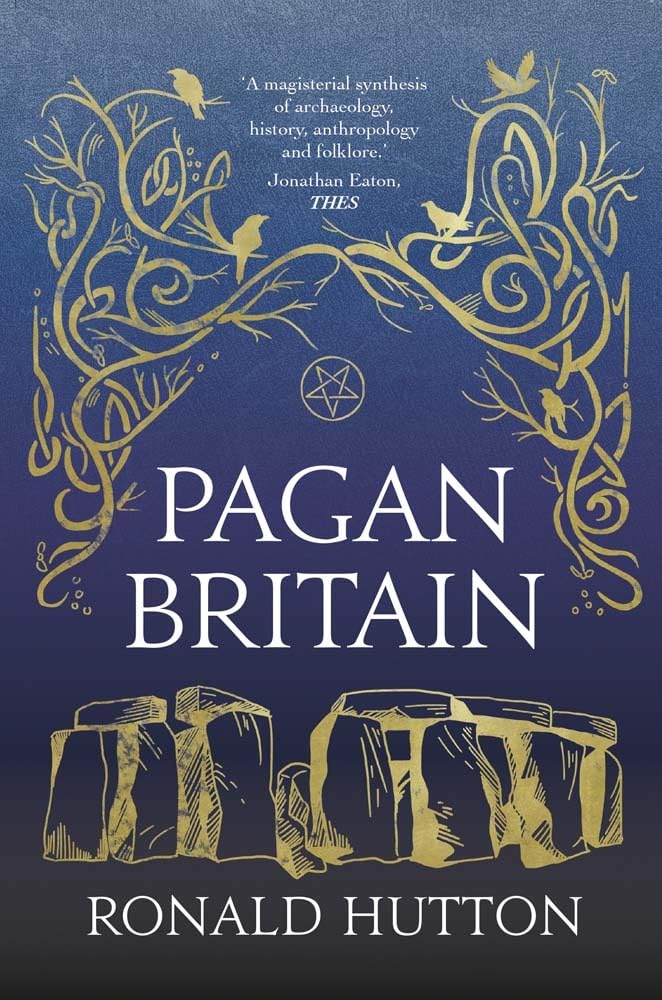
Pagan Britain

Description:

Britain's pagan past, with its mysterious monuments, atmospheric sites, enigmatic artifacts, bloodthirsty legends, and cryptic inscriptions, is both enthralling and perplexing to a resident of the twenty-first century. In this ambitious and thoroughly up-to-date book, Ronald Hutton reveals the long development, rapid suppression, and enduring cultural significance of paganism, from the Paleolithic era to the coming of Christianity. He draws on an array of recently discovered evidence and shows how new findings have radically transformed understandings of belief and ritual in Britain before the arrival of organized religion.
 
Setting forth a chronological narrative, along the way Hutton makes side visits to explore specific locations of ancient pagan activity. He includes the well-known sacred sites—Stonehenge, Avebury, Seahenge, Maiden Castle, Anglesey—as well as more obscure locations across the mainland and coastal islands. In tireless pursuit of the elusive “why” of pagan behavior, Hutton astonishes with the breadth of his understanding of Britain’s deep past and inspires with the originality of his insights.


Editorial Reviews

Review

Shortlisted for the 2015 Hessell-Tilman Prize

'At last, a balanced, well-written and original review of Britain's pre-Christian religions that treats the complex and enduring legacy of prehistory with due respect. It is also full of unexpected insights. A delight.' - Francis Pryor, author of
Britain BC: Life in Britain and Ireland Before the Romans

"A well-written and thoroughly researched study of a most important subject. The book is informed, fair minded and extremely readable. Nothing like this has been done before.'"―Richard Bradley, author of
The Prehistory of Britain and Ireland

About the Author

Ronald Hutton is professor of history at Bristol University and a leading authority on the British Isles in the sixteenth and seventeenth centuries, on ancient and medieval paganism and magic, and on the global context of witchcraft beliefs. He is the author of eighteen books.

Reviews:

5.0 out of 5 stars An exceptional book

C.M. · January 23, 2014

Ronald Hutton's Pagan Britain is a fascinating and comprehensive survey of the archaeological and historical evidence for British paganism. His erudition is amazing. Hutton considers literally hundreds of articles, books, objects and sites in his quest to provide a complete review of what is known about British pagan beliefs. He also traces how British paganism has been interpreted from Victorian times to the present day. The historiography often fascinated me as much as the discussions of henges and burial mounds. He analyzes how scientists and humanists approach the same material in markedly different fashions. Thus, the book is ultimately a meditation on how (in his words) "truth can be established in scholarship...especially in the study of the remote past."I can best give you an idea of his comprehensive approach by discussing his chapters on Mesolithic and Neolithic Britain. He discusses famous sites, such as Stonehenge, and the history of both the research at the site and theories about the site. He discusses typical artifacts from the period, and how they have been used to contemporary scholars to try to understand the past. Scholars have used many approaches to understand this material and Hutton never uses dismissive language to discuss any of them. He has a fascinating discussion on how contemporary academicians and "alternative" archaeologists have approached the same material. He traces the intellectual history of both and shows how what was yesterday's "alternative" explanation sometimes becomes today's orthodoxy. Again and again, Hutton emphasizes how little we actually know about the preliterate past and how many explanations can be attached to the same artifacts. Archaeology of religion, he writes, can "recover the material remains of ritual action...but not (usually) the ideas which inspired them."Little seems to escape his purview as he discusses paganism through the Iron Age, Roman Britain and the conversion of Britain to Christianity. He also has a comprehensive discussion of possible survivals of paganism in Christian period. Contemporary Pagans may be disappointed that he finds relatively little evidence for paganism surviving into the medieval age. In these chapters again he emphasizes what is actually concretely known and how this evidence is used. Thus, in discussing the possibility of human sacrifices, he devotes much time to detailing graves, burial practices and human skeletal remains found in unusual locations. Decapitated skeletons have been found and Hutton discusses alternative explanations for this. Roman sources claiming the British practiced human sacrifice are carefully deconstructed. Hutton also discusses various contemporary theories about human sacrifice. Hutton's conclusion here--as it is again and again in this book--is that the evidence supports a variety of possible explanation for archaeological remains and that human sacrifice in prehistoric Britain remains and will probably remain unprovable.He also discusses the intellectual history of modern interpretations of the British pagan past. Thus, he has an illuminating discussion on the "Goddess" theory which so riveted many scholars earlier in the 20th century. He shows how the needs and thought patterns of the present have often skewed the interpretations of the past.Hutton is a very fine writer. His prose is always clear and often beautiful. I imagined once or twice that a reincarnation of Shakespeare might shamelessly lift from Hutton's prose the way the actual bard did from Holinshed, though I suppose today creative plagiarism of that nature is out of style. The major difficulties reading the book result from the sheer amount of information presented. This is a dense and fascinating book. The book is illustrated with drawings and black and white photographs. Embedded in the text, they illuminate the argument of the book but do not particularly add to its beauty.I think anyone interested in history, archaeology, pagan religions or Britain would find this book well worth the time. Hutton is not sensational the way some books and TV shows about this material have been but his solid scholarship is much more illuminating.I do not know how a contemporary Pagan would react to this book; but it seems to me Hutton, a genial and intelligent man, is totally and completely respectful of contemporary Pagan spirituality and that a contemporary Pagan might very well want this book in his library.

5.0 out of 5 stars More greatness from Hutton

R. · August 8, 2023

Another excursion into the most page turningly, addictively readable, and yet completely scholarly history you're likely to find. Ronald Hutton's expertise lies in the history of paganism, "witchcraft", pre-Christian history and religion, and fields that touch these, and he is a force of nature that really brings the past to life in (as I said) a very readable but clearly quite scholarly way. His books are really long though - monstrous tomes that publishers make more palatable to a generalist audience by making the print about as small as most books use for footnotes. It was the same with his masterful "Triumph of the Moon" which I just finished. "Pagan Britain" is going to be just as good but readers looking for airy apologetics or mystical imagined history need to look elsewhere, and lots of his reviews show this. Many people in the pagan community look desperately for scholarly justification for what is modern, invented religious theater, and he doesn't pretend to do more than to bring the actual history before you and lay it on the table. Know that you're getting history and not The Sorcerer's Apprentice and you'll make a new history friend in Ronald Hutton.

4.0 out of 5 stars Very comprehensive

T. · December 11, 2022

It is a dense read for sure, but the author presents just about everything you'd ever want to know about pagan worship in pre- and post-Roman Britain. A LOT of time is spent describing earthen mound burials and other monuments erected over several millennia. The photos are black and white and not particularly useful. I liked that he talked about which archaeologists/historians have presented what theories as to the meaning behind these monuments and other artefacts over time. It ends in the early 2000's, so if you want something really up-to-date, you may want to search further.

5.0 out of 5 stars Great summary of what is known of prehistoric Britain and pagan religion

D.T. · April 5, 2021

This is a fantastic book that I thoroughly recommend. It is detailed and fact filled, yet well-written enough to be easily comprehensible to the beginner in the subject. I recommend it for anyone who wants to learn more about British pre-history and British pagan religion. Notably, it takes care not go further than the data. It states what is known, it provides what interpretations have been presented by other scholars, and encourages the reader to make their own mind up. This is important as so much is unknown about British prehistory, it is very much impossible to prove many theories one way or the other. Therefore it is a highly educational and empowering book that helps the reader imagine the distant past in a valid and personal way.One note of warning, if you're looking for blood thirsty descriptions of pagan sacrifice, the author tends to minimize the possibility of this type of thing, even when I would say they are justified. I think out of respect for the modern pagan movement.

5.0 out of 5 stars A very detailed read.

J.R.L. · February 17, 2014

Once again Hutton provides a meticulously written work that is long on scholarly research and short on the fuzziness and conjecture that is seen in a lot of work on this subject. 'Pagan Britain ' covers the length and breadth of the island with frequent references to Ireland as well. Although Hutton's work is (at times) heavy going, this is really to be expected when the material is covered in such exhaustive depth, the information contained in this book can be used again and again for academic research ( which is my purpose) or for simply allowing oneself to take a snapshot look back into a much maligned period in history. Hutton doesn't advocate any specific position in this book, but he does allow room for new scholarly works that could be viewed as controversial. A very interesting book and an important book for any seerious book collector.

5.0 out of 5 stars Highly recommended.

A.L. · May 11, 2018

Hutton knows his material well. This is a fascinating and thoroughly researched book. It’s hard to put down. His transitions from paganism through to Christianity are well done and gives a bird’s eye view of the time in which he writes. Highly recommended.

For those who want to know whats not known

D.W. · February 6, 2014

As the title to this review suggests, this book explains all that isn’t known about pre-Christian Briton – which is just about everything really. It seems that British archaeologists and historians know more about ancient cultures that existed on the other side of the globe than they do about those from their own island home.The hundreds of ancient mounds that dot the country may be burial mounds: but seeing as not all of them contained bodies or parts thereof, they may not be. The many stone circles and henges could be anything really – nobody knows and, those that think they do can’t agree with each other. Strange signs scratched or hammered into rock faces on out of the way hilltops in the early Neolithic may be messages to gods, or other travellers, or perhaps just the doodles of bored apprentice hunters told to sit on a cold, windy hilltop and watch out for the annual reindeer migration. And so it goes on.Having said that, the book is extremely well written and the author explains fully and in depth all that is not known about pagan Briton. The huge amount of data that is not known explains the length of this book.I fully recommend this book to anyone who has their own ideas about British pre-history to see if they share opinions with others, or their ideas are new. Perhaps between us we can add our new ideas to the whole chaos and make matters even worse than they are now.

Masterful Survey of 40,000 Years of Pagan British Religions

G. · January 26, 2014

In 1991, Ronald Hutton published 'The Pagan Religions of the Ancient British Isles,' at the time a unique, one-volume survey of its subject that quickly, and rightly, attained classic status, being quoted in almost every subsequent work on British prehistory. This new book is designed to supersede it, reassessing its contents and conclusions, expanding on it and adding a huge amount of new information that has come to light over the last two decades.First impressions are of an attractive, well-produced book, containing many more illustrations than its predecessor, though still in monochrome. The illustrations are well-chosen, including many of the usual suspects - the 'Sorcerer of Trois Frères,' the 'Venus of Willendorf,' and so on - but going well beyond them. For example, a group headed 'Less familiar Palaeolithic images' includes human figurines that were found alongside the much better known 'Venuses' on which whole theories of prehistoric belief have been built. These images and their accompanying text provide one example of a process Hutton follows throughout the book, returning to original excavation reports and re-examining, often at first-hand, the objects described so as to place them in their proper context. He has visited or re-visited many sites where objects were found, often in company with archaeological specialists. This meticulous research is filtered through the author's broad areas of personal interest, including ancient and modern paganisms and shamanism. These interests, however, are never allowed to overwhelm the evidence.As well as exploring prehistoric sites and the artefacts found at them, Professor Hutton examines ways in which attitudes to the past alter in tandem with more recent changes, so the Victorian era of conquest, colonisation and conversion by the British produced the idea that Britain itself was repeatedly conquered, colonised and converted throughout prehistory. The 20th century dismantling of the British Empire and our joining of the European Economic Union then produced a new vision of prehistory that replaced conquest with trade as the primary means by which the British Isles interacted with the rest of Europe. Pagan Britain offers many such insights into both our remote and more immediate ancestors.One of my own areas of interest is in what archaeologists call burnt mounds, piles of stones that have been subjected to very high temperatures before being either doused with water or immersed in it. Many theories have been put forward to explain them, including Native American style sweat lodges, Swedish style saunas, cooking sites for joints of meat or breweries for prehistoric beer. Thanks to this book, I now know that a major survey of such sites in Ireland, published in 2011, has shown all four explanations are sustainable for some of the sites. For a modern Druid such as myself who has experienced the power of ritualised sweat lodges and is also partial to the occasional pint of ale, this is welcome news indeed!One section of the book looks at interactions between professional archaeologists and interested non-professionals, including what might loosely be called the 'Earth Mysteries' community. These are often hostile and have been for a very long time. The story of how archaeology stopped being a hobby and became a profession, and how those who adopted it as such subsequently came to exercise such unquestioned access to, and control over, our shared heritage would make a fascinating sociological study in the development of elite dominance. Another admirable feature of 'Pagan Britain' is the extent to which it continually reveals topics such as this and shows them to be worthy of extended treatment. Hopefully a generation of researchers will be inspired to follow up on them. If so, they, like the rest of us, will owe a debt of gratitude to Professor Hutton for the diligence of his research, the breadth of his vision and his ability to bring so much information and so many ideas together.Hutton writes both for academic colleagues and general readers, achieving this rare double by the simple means of using clear, precise, jargon-free English. If more of his colleagues adopted this habit, they would render their work accessible to a much broader readership. Another aspect of Hutton's writing that appeals greatly is his inclusion of illuminating, entertaining, often bizarre incidental details such as the fact that the early 19th century scholar, William Buckland, was often accompanied at academic functions by his pet bear, which he dressed in a student's cap and gown. Such quirky and engaging human touches certainly help bring history to life.As with Professor Hutton's previous works on Paganisms ancient and modern, this book will no doubt divide the modern Pagan community, perhaps most strongly in its final chapter, 'The Legacy of British Paganism.' It is here, looking at changing academic and public attitudes towards possible survivals of paganism from ancient times, through the Middle Ages and up to the present day, that the author most maintains his reputation as an iconoclast. Those who dismiss this section as simple iconoclasm, however, can only do so by ignoring qualifying statements as in the following example: "The former tendency to assume that virtually all traditional British seasonal rites were survivors of paganism was clearly misplaced, but blanket dismissal of pagan ingredients in them would be even more erroneous. Broad themes of seasonal festivity often have more staying power than individual customs, though even some of those can be proved to have survived for millennia."A word of warning: if you are looking for the sort of certainty found in other books, such as the many claiming to have 'solved the mystery of Stonehenge' once and for all, you should definitely look elsewhere. Hutton is careful not to argue beyond what demonstrable facts allow. Where, as is often the case, the evidence is open to a variety of interpretations, he is equally careful to present all alternatives fairly, where possible evaluating which are the most likely, but willing to admit when none are proven or where such proof may not even be possible. Some may find the frequency with which a 'not proven' verdict is returned frustrating, but, as the author makes clear, there are times when our current state of knowledge simply leaves no definitive conclusion possible.Is 'Pagan Britain'', then, a worthy successor to Pagan Religions...'? My answer is a resounding yes. Like its illustrious predecessor, it offers a one-stop shop for all who, like me, have an abiding interest in prehistoric British religion, a desire to keep up with the latest information on the subject, but little access to academic journals, field reports or specialist publications. Professor Hutton draws together the whole gamut of recent research along with the speculations and conclusions stemming from it, bringing it all together for us. And for those who want to look further into areas of particular interest, there are extensive endnotes.As mentioned earlier, what makes 'Pagan Britain' so compelling is Professor Hutton's unusual breadth of personal interests and depth of knowledge in them, spanning paganisms old and new, shamanism, anthropology and archaeology, as well as British, European and world history. This is enhanced by his almost unrivalled list of contacts with colleagues across this wide range of disciplines, his enthusiasm and seemingly boundless energy for detailed and thorough research, and his remarkable ability to marshal and make sense of a huge quantity and range of information and present it with such clarity. In short, the book is a tour de force and, like 'Pagan Religions...', is essential reading for anyone with an interest in its subject.

Paperback Quality Poor

A. · July 21, 2023

My mistake for not paying extra for a hardcover. The paperback version is awful quality. Miniscule print and pictures, low quality paper, flimsy cover... will be a nightmare to even attempt a comfortable read. Super disappointed as this was my first Ronald Hutton purchase. Yale University Press should be ashamed. Will need a magnifying lens for the pages and some sort of stiff stabilizing jacket to hold the cover; ridiculous.

Pagan Britain ie before Christianity

E. · April 8, 2024

Twenty years in the making, piecing together fragments of the torn and worn tapesty of the history of predecessors using the "clues" they must have hoped would survive long enough for future generations to discipher and dissern. Messages left in cave walls,, on monuments, tools, weapons and in various word forms filtered down through the ages,possibly distorted and almost lost through various renditions of Christianity and what that means at various times through human history. Chistianity, mostly seems to try to subdue, subvert and destroy anything like or unlike itself and the people that have knowledge of "old traditions, rituals and rites." I look forward to delving deep into Ronald Hutton's Pagan Britain.

Great book, great service

R. · August 25, 2018

Book arrived promptly in excellent condition. This is a fascinating account of the archaeological finds across a huge expanse of time, from the early stone age up until the medieval period of Britain. The writing is not at all dry, but easy to read and often captivating. Hutton draws conclusions that are well-founded and reasonable, providing well-rounded explanations for the archaeological evidence amidst a wide gamut of current and past explanations for these finds. Would highly recommend the seller, the author, and the book.

Pagan Britain

Product ID: U0300268343
Condition: New

4.6

AED14065

Price includes VAT & Import Duties
Type: Paperback
Availability: In Stock

Quantity:

|

Order today to get by 7-14 business days

Delivery fee of AED 20. Free for orders above AED 200.

Returns & Warranty policies

Imported From: United States

At BOLO, we work hard to ensure the products you receive are new, genuine, and sourced from reputable suppliers.

BOLO is not an authorized or official retailer for most brands, nor are we affiliated with manufacturers unless specifically stated on a product page. Instead, we source verified sellers, authorized distributors or directly from the manufacturer.

Each product undergoes thorough inspection and verification at our consolidation and fulfilment centers to ensure it meets our strict authenticity and quality standards before being shipped and delivered to you.

If you ever have concerns regarding the authenticity of a product purchased from us, please contact Bolo Support. We will review your inquiry promptly and, if necessary, provide documentation verifying authenticity or offer a suitable resolution.

Your trust is our top priority, and we are committed to maintaining transparency and integrity in every transaction.

All product information, images, descriptions, and reviews originate from the manufacturer or from trusted sellers overseas. BOLO is not affiliated with, endorsed by, or an authorized retailer for most brands listed on our website unless stated otherwise.

While we strive to display accurate information, variations in packaging, labeling, instructions, or formulation may occasionally occur due to regional differences or supplier updates. For detailed or manufacturer-specific information, please contact the brand directly or reach out to BOLO Support for assistance.

Unless otherwise stated, all prices displayed on the product page include applicable taxes and import duties.

BOLO operates in accordance with the laws and regulations of United Arab Emirates. Any items found to be restricted or prohibited for sale within the UAE will be cancelled prior to shipment. We take proactive measures to ensure that only products permitted for sale in United Arab Emirates are listed on our website.

All items are shipped by air, and any products classified as “Dangerous Goods (DG)” under IATA regulations will be removed from the order and cancelled.

All orders are processed manually, and we make every effort to process them promptly once confirmed. Products cancelled due to the above reasons will be permanently removed from listings across the website.

More from this brand

Similar items from “General”

Pagan Britain

Product ID: U0300268343
Condition: New

4.6

Pagan Britain-0
Type: Paperback

AED14065

Price includes VAT & Import Duties
Availability: In Stock

Quantity:

|

Order today to get by 7-14 business days

Delivery fee of AED 20. Free for orders above AED 200.

Returns & Warranty policies

Imported From: United States

At BOLO, we work hard to ensure the products you receive are new, genuine, and sourced from reputable suppliers.

BOLO is not an authorized or official retailer for most brands, nor are we affiliated with manufacturers unless specifically stated on a product page. Instead, we source verified sellers, authorized distributors or directly from the manufacturer.

Each product undergoes thorough inspection and verification at our consolidation and fulfilment centers to ensure it meets our strict authenticity and quality standards before being shipped and delivered to you.

If you ever have concerns regarding the authenticity of a product purchased from us, please contact Bolo Support. We will review your inquiry promptly and, if necessary, provide documentation verifying authenticity or offer a suitable resolution.

Your trust is our top priority, and we are committed to maintaining transparency and integrity in every transaction.

All product information, images, descriptions, and reviews originate from the manufacturer or from trusted sellers overseas. BOLO is not affiliated with, endorsed by, or an authorized retailer for most brands listed on our website unless stated otherwise.

While we strive to display accurate information, variations in packaging, labeling, instructions, or formulation may occasionally occur due to regional differences or supplier updates. For detailed or manufacturer-specific information, please contact the brand directly or reach out to BOLO Support for assistance.

Unless otherwise stated, all prices displayed on the product page include applicable taxes and import duties.

BOLO operates in accordance with the laws and regulations of United Arab Emirates. Any items found to be restricted or prohibited for sale within the UAE will be cancelled prior to shipment. We take proactive measures to ensure that only products permitted for sale in United Arab Emirates are listed on our website.

All items are shipped by air, and any products classified as “Dangerous Goods (DG)” under IATA regulations will be removed from the order and cancelled.

All orders are processed manually, and we make every effort to process them promptly once confirmed. Products cancelled due to the above reasons will be permanently removed from listings across the website.

Description:

Britain's pagan past, with its mysterious monuments, atmospheric sites, enigmatic artifacts, bloodthirsty legends, and cryptic inscriptions, is both enthralling and perplexing to a resident of the twenty-first century. In this ambitious and thoroughly up-to-date book, Ronald Hutton reveals the long development, rapid suppression, and enduring cultural significance of paganism, from the Paleolithic era to the coming of Christianity. He draws on an array of recently discovered evidence and shows how new findings have radically transformed understandings of belief and ritual in Britain before the arrival of organized religion.
 
Setting forth a chronological narrative, along the way Hutton makes side visits to explore specific locations of ancient pagan activity. He includes the well-known sacred sites—Stonehenge, Avebury, Seahenge, Maiden Castle, Anglesey—as well as more obscure locations across the mainland and coastal islands. In tireless pursuit of the elusive “why” of pagan behavior, Hutton astonishes with the breadth of his understanding of Britain’s deep past and inspires with the originality of his insights.


Editorial Reviews

Review

Shortlisted for the 2015 Hessell-Tilman Prize

'At last, a balanced, well-written and original review of Britain's pre-Christian religions that treats the complex and enduring legacy of prehistory with due respect. It is also full of unexpected insights. A delight.' - Francis Pryor, author of
Britain BC: Life in Britain and Ireland Before the Romans

"A well-written and thoroughly researched study of a most important subject. The book is informed, fair minded and extremely readable. Nothing like this has been done before.'"―Richard Bradley, author of
The Prehistory of Britain and Ireland

About the Author

Ronald Hutton is professor of history at Bristol University and a leading authority on the British Isles in the sixteenth and seventeenth centuries, on ancient and medieval paganism and magic, and on the global context of witchcraft beliefs. He is the author of eighteen books.

Reviews:

5.0 out of 5 stars An exceptional book

C.M. · January 23, 2014

Ronald Hutton's Pagan Britain is a fascinating and comprehensive survey of the archaeological and historical evidence for British paganism. His erudition is amazing. Hutton considers literally hundreds of articles, books, objects and sites in his quest to provide a complete review of what is known about British pagan beliefs. He also traces how British paganism has been interpreted from Victorian times to the present day. The historiography often fascinated me as much as the discussions of henges and burial mounds. He analyzes how scientists and humanists approach the same material in markedly different fashions. Thus, the book is ultimately a meditation on how (in his words) "truth can be established in scholarship...especially in the study of the remote past."I can best give you an idea of his comprehensive approach by discussing his chapters on Mesolithic and Neolithic Britain. He discusses famous sites, such as Stonehenge, and the history of both the research at the site and theories about the site. He discusses typical artifacts from the period, and how they have been used to contemporary scholars to try to understand the past. Scholars have used many approaches to understand this material and Hutton never uses dismissive language to discuss any of them. He has a fascinating discussion on how contemporary academicians and "alternative" archaeologists have approached the same material. He traces the intellectual history of both and shows how what was yesterday's "alternative" explanation sometimes becomes today's orthodoxy. Again and again, Hutton emphasizes how little we actually know about the preliterate past and how many explanations can be attached to the same artifacts. Archaeology of religion, he writes, can "recover the material remains of ritual action...but not (usually) the ideas which inspired them."Little seems to escape his purview as he discusses paganism through the Iron Age, Roman Britain and the conversion of Britain to Christianity. He also has a comprehensive discussion of possible survivals of paganism in Christian period. Contemporary Pagans may be disappointed that he finds relatively little evidence for paganism surviving into the medieval age. In these chapters again he emphasizes what is actually concretely known and how this evidence is used. Thus, in discussing the possibility of human sacrifices, he devotes much time to detailing graves, burial practices and human skeletal remains found in unusual locations. Decapitated skeletons have been found and Hutton discusses alternative explanations for this. Roman sources claiming the British practiced human sacrifice are carefully deconstructed. Hutton also discusses various contemporary theories about human sacrifice. Hutton's conclusion here--as it is again and again in this book--is that the evidence supports a variety of possible explanation for archaeological remains and that human sacrifice in prehistoric Britain remains and will probably remain unprovable.He also discusses the intellectual history of modern interpretations of the British pagan past. Thus, he has an illuminating discussion on the "Goddess" theory which so riveted many scholars earlier in the 20th century. He shows how the needs and thought patterns of the present have often skewed the interpretations of the past.Hutton is a very fine writer. His prose is always clear and often beautiful. I imagined once or twice that a reincarnation of Shakespeare might shamelessly lift from Hutton's prose the way the actual bard did from Holinshed, though I suppose today creative plagiarism of that nature is out of style. The major difficulties reading the book result from the sheer amount of information presented. This is a dense and fascinating book. The book is illustrated with drawings and black and white photographs. Embedded in the text, they illuminate the argument of the book but do not particularly add to its beauty.I think anyone interested in history, archaeology, pagan religions or Britain would find this book well worth the time. Hutton is not sensational the way some books and TV shows about this material have been but his solid scholarship is much more illuminating.I do not know how a contemporary Pagan would react to this book; but it seems to me Hutton, a genial and intelligent man, is totally and completely respectful of contemporary Pagan spirituality and that a contemporary Pagan might very well want this book in his library.

5.0 out of 5 stars More greatness from Hutton

R. · August 8, 2023

Another excursion into the most page turningly, addictively readable, and yet completely scholarly history you're likely to find. Ronald Hutton's expertise lies in the history of paganism, "witchcraft", pre-Christian history and religion, and fields that touch these, and he is a force of nature that really brings the past to life in (as I said) a very readable but clearly quite scholarly way. His books are really long though - monstrous tomes that publishers make more palatable to a generalist audience by making the print about as small as most books use for footnotes. It was the same with his masterful "Triumph of the Moon" which I just finished. "Pagan Britain" is going to be just as good but readers looking for airy apologetics or mystical imagined history need to look elsewhere, and lots of his reviews show this. Many people in the pagan community look desperately for scholarly justification for what is modern, invented religious theater, and he doesn't pretend to do more than to bring the actual history before you and lay it on the table. Know that you're getting history and not The Sorcerer's Apprentice and you'll make a new history friend in Ronald Hutton.

4.0 out of 5 stars Very comprehensive

T. · December 11, 2022

It is a dense read for sure, but the author presents just about everything you'd ever want to know about pagan worship in pre- and post-Roman Britain. A LOT of time is spent describing earthen mound burials and other monuments erected over several millennia. The photos are black and white and not particularly useful. I liked that he talked about which archaeologists/historians have presented what theories as to the meaning behind these monuments and other artefacts over time. It ends in the early 2000's, so if you want something really up-to-date, you may want to search further.

5.0 out of 5 stars Great summary of what is known of prehistoric Britain and pagan religion

D.T. · April 5, 2021

This is a fantastic book that I thoroughly recommend. It is detailed and fact filled, yet well-written enough to be easily comprehensible to the beginner in the subject. I recommend it for anyone who wants to learn more about British pre-history and British pagan religion. Notably, it takes care not go further than the data. It states what is known, it provides what interpretations have been presented by other scholars, and encourages the reader to make their own mind up. This is important as so much is unknown about British prehistory, it is very much impossible to prove many theories one way or the other. Therefore it is a highly educational and empowering book that helps the reader imagine the distant past in a valid and personal way.One note of warning, if you're looking for blood thirsty descriptions of pagan sacrifice, the author tends to minimize the possibility of this type of thing, even when I would say they are justified. I think out of respect for the modern pagan movement.

5.0 out of 5 stars A very detailed read.

J.R.L. · February 17, 2014

Once again Hutton provides a meticulously written work that is long on scholarly research and short on the fuzziness and conjecture that is seen in a lot of work on this subject. 'Pagan Britain ' covers the length and breadth of the island with frequent references to Ireland as well. Although Hutton's work is (at times) heavy going, this is really to be expected when the material is covered in such exhaustive depth, the information contained in this book can be used again and again for academic research ( which is my purpose) or for simply allowing oneself to take a snapshot look back into a much maligned period in history. Hutton doesn't advocate any specific position in this book, but he does allow room for new scholarly works that could be viewed as controversial. A very interesting book and an important book for any seerious book collector.

5.0 out of 5 stars Highly recommended.

A.L. · May 11, 2018

Hutton knows his material well. This is a fascinating and thoroughly researched book. It’s hard to put down. His transitions from paganism through to Christianity are well done and gives a bird’s eye view of the time in which he writes. Highly recommended.

For those who want to know whats not known

D.W. · February 6, 2014

As the title to this review suggests, this book explains all that isn’t known about pre-Christian Briton – which is just about everything really. It seems that British archaeologists and historians know more about ancient cultures that existed on the other side of the globe than they do about those from their own island home.The hundreds of ancient mounds that dot the country may be burial mounds: but seeing as not all of them contained bodies or parts thereof, they may not be. The many stone circles and henges could be anything really – nobody knows and, those that think they do can’t agree with each other. Strange signs scratched or hammered into rock faces on out of the way hilltops in the early Neolithic may be messages to gods, or other travellers, or perhaps just the doodles of bored apprentice hunters told to sit on a cold, windy hilltop and watch out for the annual reindeer migration. And so it goes on.Having said that, the book is extremely well written and the author explains fully and in depth all that is not known about pagan Briton. The huge amount of data that is not known explains the length of this book.I fully recommend this book to anyone who has their own ideas about British pre-history to see if they share opinions with others, or their ideas are new. Perhaps between us we can add our new ideas to the whole chaos and make matters even worse than they are now.

Masterful Survey of 40,000 Years of Pagan British Religions

G. · January 26, 2014

In 1991, Ronald Hutton published 'The Pagan Religions of the Ancient British Isles,' at the time a unique, one-volume survey of its subject that quickly, and rightly, attained classic status, being quoted in almost every subsequent work on British prehistory. This new book is designed to supersede it, reassessing its contents and conclusions, expanding on it and adding a huge amount of new information that has come to light over the last two decades.First impressions are of an attractive, well-produced book, containing many more illustrations than its predecessor, though still in monochrome. The illustrations are well-chosen, including many of the usual suspects - the 'Sorcerer of Trois Frères,' the 'Venus of Willendorf,' and so on - but going well beyond them. For example, a group headed 'Less familiar Palaeolithic images' includes human figurines that were found alongside the much better known 'Venuses' on which whole theories of prehistoric belief have been built. These images and their accompanying text provide one example of a process Hutton follows throughout the book, returning to original excavation reports and re-examining, often at first-hand, the objects described so as to place them in their proper context. He has visited or re-visited many sites where objects were found, often in company with archaeological specialists. This meticulous research is filtered through the author's broad areas of personal interest, including ancient and modern paganisms and shamanism. These interests, however, are never allowed to overwhelm the evidence.As well as exploring prehistoric sites and the artefacts found at them, Professor Hutton examines ways in which attitudes to the past alter in tandem with more recent changes, so the Victorian era of conquest, colonisation and conversion by the British produced the idea that Britain itself was repeatedly conquered, colonised and converted throughout prehistory. The 20th century dismantling of the British Empire and our joining of the European Economic Union then produced a new vision of prehistory that replaced conquest with trade as the primary means by which the British Isles interacted with the rest of Europe. Pagan Britain offers many such insights into both our remote and more immediate ancestors.One of my own areas of interest is in what archaeologists call burnt mounds, piles of stones that have been subjected to very high temperatures before being either doused with water or immersed in it. Many theories have been put forward to explain them, including Native American style sweat lodges, Swedish style saunas, cooking sites for joints of meat or breweries for prehistoric beer. Thanks to this book, I now know that a major survey of such sites in Ireland, published in 2011, has shown all four explanations are sustainable for some of the sites. For a modern Druid such as myself who has experienced the power of ritualised sweat lodges and is also partial to the occasional pint of ale, this is welcome news indeed!One section of the book looks at interactions between professional archaeologists and interested non-professionals, including what might loosely be called the 'Earth Mysteries' community. These are often hostile and have been for a very long time. The story of how archaeology stopped being a hobby and became a profession, and how those who adopted it as such subsequently came to exercise such unquestioned access to, and control over, our shared heritage would make a fascinating sociological study in the development of elite dominance. Another admirable feature of 'Pagan Britain' is the extent to which it continually reveals topics such as this and shows them to be worthy of extended treatment. Hopefully a generation of researchers will be inspired to follow up on them. If so, they, like the rest of us, will owe a debt of gratitude to Professor Hutton for the diligence of his research, the breadth of his vision and his ability to bring so much information and so many ideas together.Hutton writes both for academic colleagues and general readers, achieving this rare double by the simple means of using clear, precise, jargon-free English. If more of his colleagues adopted this habit, they would render their work accessible to a much broader readership. Another aspect of Hutton's writing that appeals greatly is his inclusion of illuminating, entertaining, often bizarre incidental details such as the fact that the early 19th century scholar, William Buckland, was often accompanied at academic functions by his pet bear, which he dressed in a student's cap and gown. Such quirky and engaging human touches certainly help bring history to life.As with Professor Hutton's previous works on Paganisms ancient and modern, this book will no doubt divide the modern Pagan community, perhaps most strongly in its final chapter, 'The Legacy of British Paganism.' It is here, looking at changing academic and public attitudes towards possible survivals of paganism from ancient times, through the Middle Ages and up to the present day, that the author most maintains his reputation as an iconoclast. Those who dismiss this section as simple iconoclasm, however, can only do so by ignoring qualifying statements as in the following example: "The former tendency to assume that virtually all traditional British seasonal rites were survivors of paganism was clearly misplaced, but blanket dismissal of pagan ingredients in them would be even more erroneous. Broad themes of seasonal festivity often have more staying power than individual customs, though even some of those can be proved to have survived for millennia."A word of warning: if you are looking for the sort of certainty found in other books, such as the many claiming to have 'solved the mystery of Stonehenge' once and for all, you should definitely look elsewhere. Hutton is careful not to argue beyond what demonstrable facts allow. Where, as is often the case, the evidence is open to a variety of interpretations, he is equally careful to present all alternatives fairly, where possible evaluating which are the most likely, but willing to admit when none are proven or where such proof may not even be possible. Some may find the frequency with which a 'not proven' verdict is returned frustrating, but, as the author makes clear, there are times when our current state of knowledge simply leaves no definitive conclusion possible.Is 'Pagan Britain'', then, a worthy successor to Pagan Religions...'? My answer is a resounding yes. Like its illustrious predecessor, it offers a one-stop shop for all who, like me, have an abiding interest in prehistoric British religion, a desire to keep up with the latest information on the subject, but little access to academic journals, field reports or specialist publications. Professor Hutton draws together the whole gamut of recent research along with the speculations and conclusions stemming from it, bringing it all together for us. And for those who want to look further into areas of particular interest, there are extensive endnotes.As mentioned earlier, what makes 'Pagan Britain' so compelling is Professor Hutton's unusual breadth of personal interests and depth of knowledge in them, spanning paganisms old and new, shamanism, anthropology and archaeology, as well as British, European and world history. This is enhanced by his almost unrivalled list of contacts with colleagues across this wide range of disciplines, his enthusiasm and seemingly boundless energy for detailed and thorough research, and his remarkable ability to marshal and make sense of a huge quantity and range of information and present it with such clarity. In short, the book is a tour de force and, like 'Pagan Religions...', is essential reading for anyone with an interest in its subject.

Paperback Quality Poor

A. · July 21, 2023

My mistake for not paying extra for a hardcover. The paperback version is awful quality. Miniscule print and pictures, low quality paper, flimsy cover... will be a nightmare to even attempt a comfortable read. Super disappointed as this was my first Ronald Hutton purchase. Yale University Press should be ashamed. Will need a magnifying lens for the pages and some sort of stiff stabilizing jacket to hold the cover; ridiculous.

Pagan Britain ie before Christianity

E. · April 8, 2024

Twenty years in the making, piecing together fragments of the torn and worn tapesty of the history of predecessors using the "clues" they must have hoped would survive long enough for future generations to discipher and dissern. Messages left in cave walls,, on monuments, tools, weapons and in various word forms filtered down through the ages,possibly distorted and almost lost through various renditions of Christianity and what that means at various times through human history. Chistianity, mostly seems to try to subdue, subvert and destroy anything like or unlike itself and the people that have knowledge of "old traditions, rituals and rites." I look forward to delving deep into Ronald Hutton's Pagan Britain.

Great book, great service

R. · August 25, 2018

Book arrived promptly in excellent condition. This is a fascinating account of the archaeological finds across a huge expanse of time, from the early stone age up until the medieval period of Britain. The writing is not at all dry, but easy to read and often captivating. Hutton draws conclusions that are well-founded and reasonable, providing well-rounded explanations for the archaeological evidence amidst a wide gamut of current and past explanations for these finds. Would highly recommend the seller, the author, and the book.

More from this brand

Similar items from “General”