Deliver toUnited Arab Emirates
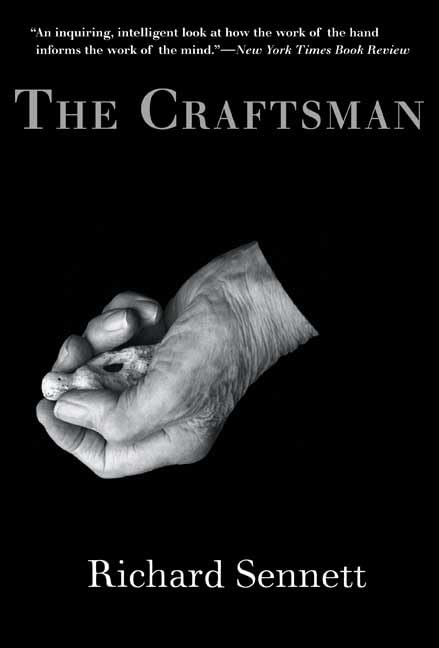
The Craftsman

Description:

In his most ambitious book to date, Richard Sennett offers an original perspective on craftsmanship and its close connections to work and ethical values
 
“[Sennett] compellingly explores the universe of skilled work.”—Brian C. Anderson,
Wall Street Journal
 
Craftsmanship, says Richard Sennett, names the basic human impulse to do a job well for its own sake, and good craftsmanship involves developing skills and focusing on the work rather than ourselves. The computer programmer, the doctor, the artist, and even the parent and citizen all engage in a craftsman’s work. In this thought-provoking book, Sennett explores the work of craftsmen past and present, identifies deep connections between material consciousness and ethical values, and challenges received ideas about what constitutes good work in today’s world.
 
The Craftsman engages the many dimensions of skill—from the technical demands to the obsessive energy required to do good work. Craftsmanship leads Sennett across time and space, from ancient Roman brickmakers to Renaissance goldsmiths to the printing presses of Enlightenment Paris and the factories of industrial London; in the modern world he explores what experiences of good work are shared by computer programmers, nurses and doctors, musicians, glassblowers, and cooks. Unique in the scope of his thinking, Sennett expands previous notions of crafts and craftsmen and apprises us of the surprising extent to which we can learn about ourselves through the labor of making physical things.


Editorial Reviews

Review

“[Sennett] compellingly explores the universe of skilled work, where ‘the desire to do a job well done for its own sake’ still flourishes.”—Brian C. Anderson, Wall Street Journal

“A powerful meditation on the ‘skill of making things well.’”—
New Yorker

“Sennett’s ‘guiding intuition’ in
The Craftsman is that ‘making is thinking.’ . . . [The] book gathers case after case in which we see how the work of the hand can inform the work of the mind.”—Lewis Hyde, New York Times Book Review

“Sennett looks at the evolution of craftsmanship and the historical forces which have stultified it, how it’s learned in the areas it still thrives, and issues of quality and ability. Sennett’s learned but inclusive prose proves entirely readable, and the breadth of his curiosity . . . take him in a number of fascinating directions.”—
Publishers Weekly

The Craftsman is [an] ambitious, thought-provoking look at how we humans connect with, relate to, and understand the world around us. . . . Sennett examines the making of things through the lenses of three different focal lengths—craftsmen, craft, and craftsmanship—each of which merits its own section. Within these overlapping perspectives, the view of the landscape slides from hand to human to humankind.”—Wayne Curtis, American Scholar

“Eloquent and persuasive.”—Scott Nesbit,
Culture

Craftsman is a fairly concrete, unvarnished word that Mr. Sennett gilds and bejewels with virtue and history. For Mr. Sennett, craftsmanship ‘represents the special human condition of being engaged,’ and ideal marriage of ‘hand to head’ that crowns technical mastery with a person’s sincerest efforts to make something well for its own sake. This would be dizzily heady stuff if Mr. Sennett’s book weren’t so prodigiously grounded in stuff itself as a means of knowledge.”—Jeremy Axelrod, New York Sun

“I am confident that as Sennett continues his quest to make sense of life and work, those of us who study the digital age will find it worthwhile to pay more attention to his body of work.”—Siva Vaidhyanathan,
Chronicle Review

“In this deeply thoughtful study, which resembles books by his teacher Hannah Arendt in combining sociological analysis and a supremely humane, ethical call to awareness, Sennett has cunningly widened the scope of what the words ‘craftsman’ and ‘craftsmanship’ traditionally denote. . . . [
The Craftsman’s] questions couldn’t be more pertinent.”—Eric Banks, Barnes and Noble Review

“This book challenges our thinking and understanding concerning how we create work and workplaces, and how we make social and political choices about what we produce and consume. Sennett reaches out to the craftsman in all of us.”—James H. Dulebohn,
People & Strategy

“Richard Sennett is one of the most eminent and prolific sociologists in the Western world. . . . [His readers] are led gradually and effortlessly into a special world, only to find themselves enthralled by an author who stimulates and fascinates at every turn.”—Daisaburo Hashizume,
American Interest

“A far-roving intellectual adventure.”—Julian Bell,
New York Review of Books

“This is a discursive, intellectually stimulating and often fascinating discussion that at times seems like an engaged, elevating conversation.”—William Kowinski,
NorthCoast Journal

“The good news elevating
The Craftsman from a delightful to an encouraging read is Sennett’s conviction that ‘nearly anyone can become a good craftsman.’”—Patrick McCormick, U.S. Catholic

“[Sennett] presents a wealth of material. . . . Interesting and true insights captivate the reader.”—Ralf Jeremias,
Working USA

“Richard Sennett’s
The Craftsman . . . [is] a work by a master writer which opens new ground and presents new possibilities in the understanding of craftsmanship, creation and work. . . . His analysis and insight into work, workers and craftsmanship is so evocative that it really requires a second or third reading.”—Brian Dijkema, cardus.ca

A 2008 Top Seller in Philosophy as compiled by YBP Library Services

Richard Sennett is the winner of the 2010 Spinoza Prize, sponsored by the International Spinoza Award Foundation

Selected as one of the best books of 2008 by Scott McLemee of
Barnes & Noble Review

About the Author

Richard Sennett is professor of sociology at New York University and at the London School of Economics. Before becoming a sociologist, he studied music. He has received many awards and honors, including the Hegel Prize for lifetime achievement in the humanities and social sciences.

Reviews:

5.0 out of 5 stars An Important Re-framing of an Old Idea

J.V.L. · June 10, 2010

Richard Sennett has been one of my most-preferred interpreters of physical and social culture since Flesh and Stone. He tackles issues that got trampled by misapplications of lit-crit and semiotic theory over the last few decades, and manages to get them back into the discussion. He has a rather dogged style: history, explication, and journalistic fairness are treated like responsibilities in language that is mostly quite dry, even bland. But what he lacks in vivacity, he more than covers with solid, methodical argumentation and a heartening tendency to broaden concepts and include the truly modern. In this volume, for example, Sennett adds Linux programming to the list of what we normally think of as craft, and I think he makes his case. Craft is a wicked thicket for us Moderns: we have not kept pace with its devaluation in an age of competitive production and disposable workers, and the quality of our handwork has suffered, but Sennett also convinces me that our comprehension of the world and the place of humans in it has suffered, because good craft is the meeting of mind and hand. What devalues handwork impoverishes the human mind. We lose our capacity for imagination.I read this book very closely, pencil in hand, convinced that Sennett has contributed greatly to our understanding of what it means to be human in a machine age. I believe that his work has eclipsed Hannah Arendt's by now. Excellent.

5.0 out of 5 stars One of the most thought provoking and compelling books on ...

a.b. · November 5, 2017

One of the most thought provoking and compelling books on the life of a maker. Sennett crafted each page of this book, restoring the value of the craftsman and historical link to a modern society rooted in the past. A must read for anyone grappling with our role in a modern technological society and how to stay connected to a real physical world. I was searching for answers and meaning behind why I am a maker in an industrial age, this book has validated my human need to "craft" and given meaning to why my human instincts should be acted on. Understanding the importance of craft in our culture gives life a deeper richer meaning.

4.0 out of 5 stars A decent book about having a craft

D.P. · September 30, 2017

A very incisive look into multiple aspects of having a craft. This is a very thought provoking book and I would recommend others to read as well. However, I must state it isn't for the beginner to read. Some parts were hard to follow.

5.0 out of 5 stars A complex but very rewarding read about craftsmanship, pride ...

M.S. · April 11, 2015

A complex but very rewarding read about craftsmanship, pride in one's work and the differences between individual work and mechanical production, and the intellectual investment in the former versus the more mechanistic approach in the latter.Sennet uses many examples from the world of music to illustrate his thesis and he finishes with an explanation of the philosophical underpinnings of his ideas, pragmatism in this case.This book has an extensive index and bibliography and his examples are well-chosen and illustrative and evidence of his wide understanding of the matter. Not a book to read on the beach or a plane or even at home in a week or so. It requires time and patience and is rewarding even when dipping into individual sections but the real benefit comes with the final section brings together the threads and leaves the (this) reader with much more understanding of this field of human endeavour than one had before.

5.0 out of 5 stars The Craftsman - reflections on our society

C.B. · October 10, 2017

The book offers a good overview on the topic of craftsmaship, craft and the craftsman as a historical and social process.In times of radical changes coming to place in all areas of work, in my case, it helped bring a reflection regarding our work choices, how we as society work and what we should be concerned with as changes come to all fields.The book is well written, full of historical examples and cases and it was well worth reading it. I do recommend !

3.0 out of 5 stars Assigned Reading

K.M. · February 15, 2011

Overall, this book is okay. It brings up some pretty interesting points about the history and development of crafts, as well as the use of technique and machines in craft. I say that this book is "okay" because of the fact that there are many times when this author writes on a tangent and then returns to his main point, leaving the reader confused and frustrated. It has made me thing about what I consider to be crafts, and also the processes that crafts involve. This book was assigned reading, but it wasn't too bad for assigned reading (college english course).

5.0 out of 5 stars They get their due

m. · December 28, 2024

We can and all should be craftspersons broadly understood

5.0 out of 5 stars In a moment when we talk about " data scientists " is worth reading this book that shows the hands and brain working together

C.M.N. · September 26, 2015

This book is very beautiful and encourages the thinking about the work in now a days. In a moment when we talk about " data scientists " is worth reading this book that shows the hands and brain working together . This book should be read for anyone thinking about man and machine interaction in the work. It shows what is behind the spectacular results : a craftsman .

Very deep book

E.B. · May 4, 2018

If you are in for a quick easy going and shallow reading about how cool is to do bricolage... you'd better go looking for another book. This is a great book on the true philosophical meaning of craftmanship. It's super interesting and chock full of wonderful insight and, while being in depth, still manages to be really enjoyable.

Entendendo o que é fazer e o seu desenvolvimento

P.N.M. · January 22, 2019

O livro é muito bem composto para a leitura. Absolutamente bem organizado e segue uma estrutura lógica e de fácil compreensão.As palavras usadas pelo autor são simples e de vez em quando um vocábulo menos comum é salpicado no texto. Porém vi isso na leitura como positivo, até mesmo para enriquecimento e dinâmica do processo.O autor parece ter pesquisado exaustivamente o tema e o leitor pode ler o livro ao longo de dias pois os temas e exemplos são trazidos constantemente à frente do novo assunto sendo tratado no momento.O leitor se beneficiará em ter um bloco de anotações ao lado pois os exemplos dados são riquíssimos e dignos de mais pesquisa e entendimento posterior.Indico aos que quiserem entender e refinar sua visão de carreira, não só da carreira manual ou artesã, mas mesmo aqueles que vem sua atividade como digna de dedicação e quiserem melhorar ou refinar a atividade. Se ver de certa forma como um artesão poderá lhe trazer benefícios e este livro será útil para guiar você neste caminho.

Great Read

s. · October 25, 2024

Enjoyed the narrative pulled together by the author.

Five Stars

a.k.p. · January 16, 2018

Beautiful Book

A great philosophical intervention

R.O. · September 22, 2012

This is a really great book. A transformative work that might prove, in time, to be hugely influential. It's also a very enjoyable, fascinating, engaging, personal read.What kind of book is it? I don't describe it as an exhaustive account of "craftwork", specific crafts now or historical. But it does contain a lot of interesting detail along such line, used for convincing effect. It is a philosophical book, deeply questioning our being in the world as physical beings making things and being made. It's not an entirely comprehensive account of philosophy's relationship with making (no discussion of Heidegger's Question Concerning Technology, no mention of the double meaning of Nietzsche's "philosophize with a hammer" and its double meaning, no mention of Deleuze and Guattari's "how to make yourself a body without organs" or their account of the handyman and the production of production). But that doesn't matter. The book works as a powerful intervention. Industrial fabrication of consumables, concepts and people has taken over. Philosophers in many cases have responded with vacuity (Sennett is a bit harsh on Arendt, but maybe its justified). Sennett brings us back down to earth and points out a whole area of human (and non-human) material existence that may well offer a different ethical route.Dewey's (little read) Democracy and Education is a key starting point, although it doesn't become explicit until later on in the book. Sennett is in the pragmatist tradition. But he recognises the limitations of Dewey's account of experience (and its basis in material action). Sennett goes beyond Dewey, with a materialism that recognises the power of material and tools to instruct and inspire. This would link up well with the "vibrant materialism" explored by Jane Bennett in her recent book of Bergson, Deleuze, Guattari et al.Would I recommend this? Yes, to anyone. It is a challenging read. But will provide plenty of material for you to work up into a new life and a new society.

The Craftsman

Product ID: U0300151195
Condition: New

4.4

AED16083

Price includes VAT & Import Duties
Type: Paperback
Availability: In Stock

Quantity:

|

Order today to get by 7-14 business days

Delivery fee of AED 20. Free for orders above AED 200.

Returns & Warranty policies

Imported From: United States

At BOLO, we work hard to ensure the products you receive are new, genuine, and sourced from reputable suppliers.

BOLO is not an authorized or official retailer for most brands, nor are we affiliated with manufacturers unless specifically stated on a product page. Instead, we source verified sellers, authorized distributors or directly from the manufacturer.

Each product undergoes thorough inspection and verification at our consolidation and fulfilment centers to ensure it meets our strict authenticity and quality standards before being shipped and delivered to you.

If you ever have concerns regarding the authenticity of a product purchased from us, please contact Bolo Support. We will review your inquiry promptly and, if necessary, provide documentation verifying authenticity or offer a suitable resolution.

Your trust is our top priority, and we are committed to maintaining transparency and integrity in every transaction.

All product information, images, descriptions, and reviews originate from the manufacturer or from trusted sellers overseas. BOLO is not affiliated with, endorsed by, or an authorized retailer for most brands listed on our website unless stated otherwise.

While we strive to display accurate information, variations in packaging, labeling, instructions, or formulation may occasionally occur due to regional differences or supplier updates. For detailed or manufacturer-specific information, please contact the brand directly or reach out to BOLO Support for assistance.

Unless otherwise stated, all prices displayed on the product page include applicable taxes and import duties.

BOLO operates in accordance with the laws and regulations of United Arab Emirates. Any items found to be restricted or prohibited for sale within the UAE will be cancelled prior to shipment. We take proactive measures to ensure that only products permitted for sale in United Arab Emirates are listed on our website.

All items are shipped by air, and any products classified as “Dangerous Goods (DG)” under IATA regulations will be removed from the order and cancelled.

All orders are processed manually, and we make every effort to process them promptly once confirmed. Products cancelled due to the above reasons will be permanently removed from listings across the website.

Similar suggestions by Bolo

More from this brand

Similar items from “Consciousness & Thought”

The Craftsman

Product ID: U0300151195
Condition: New

4.4

The Craftsman-0
Type: Paperback

AED16083

Price includes VAT & Import Duties
Availability: In Stock

Quantity:

|

Order today to get by 7-14 business days

Delivery fee of AED 20. Free for orders above AED 200.

Returns & Warranty policies

Imported From: United States

At BOLO, we work hard to ensure the products you receive are new, genuine, and sourced from reputable suppliers.

BOLO is not an authorized or official retailer for most brands, nor are we affiliated with manufacturers unless specifically stated on a product page. Instead, we source verified sellers, authorized distributors or directly from the manufacturer.

Each product undergoes thorough inspection and verification at our consolidation and fulfilment centers to ensure it meets our strict authenticity and quality standards before being shipped and delivered to you.

If you ever have concerns regarding the authenticity of a product purchased from us, please contact Bolo Support. We will review your inquiry promptly and, if necessary, provide documentation verifying authenticity or offer a suitable resolution.

Your trust is our top priority, and we are committed to maintaining transparency and integrity in every transaction.

All product information, images, descriptions, and reviews originate from the manufacturer or from trusted sellers overseas. BOLO is not affiliated with, endorsed by, or an authorized retailer for most brands listed on our website unless stated otherwise.

While we strive to display accurate information, variations in packaging, labeling, instructions, or formulation may occasionally occur due to regional differences or supplier updates. For detailed or manufacturer-specific information, please contact the brand directly or reach out to BOLO Support for assistance.

Unless otherwise stated, all prices displayed on the product page include applicable taxes and import duties.

BOLO operates in accordance with the laws and regulations of United Arab Emirates. Any items found to be restricted or prohibited for sale within the UAE will be cancelled prior to shipment. We take proactive measures to ensure that only products permitted for sale in United Arab Emirates are listed on our website.

All items are shipped by air, and any products classified as “Dangerous Goods (DG)” under IATA regulations will be removed from the order and cancelled.

All orders are processed manually, and we make every effort to process them promptly once confirmed. Products cancelled due to the above reasons will be permanently removed from listings across the website.

Description:

In his most ambitious book to date, Richard Sennett offers an original perspective on craftsmanship and its close connections to work and ethical values
 
“[Sennett] compellingly explores the universe of skilled work.”—Brian C. Anderson,
Wall Street Journal
 
Craftsmanship, says Richard Sennett, names the basic human impulse to do a job well for its own sake, and good craftsmanship involves developing skills and focusing on the work rather than ourselves. The computer programmer, the doctor, the artist, and even the parent and citizen all engage in a craftsman’s work. In this thought-provoking book, Sennett explores the work of craftsmen past and present, identifies deep connections between material consciousness and ethical values, and challenges received ideas about what constitutes good work in today’s world.
 
The Craftsman engages the many dimensions of skill—from the technical demands to the obsessive energy required to do good work. Craftsmanship leads Sennett across time and space, from ancient Roman brickmakers to Renaissance goldsmiths to the printing presses of Enlightenment Paris and the factories of industrial London; in the modern world he explores what experiences of good work are shared by computer programmers, nurses and doctors, musicians, glassblowers, and cooks. Unique in the scope of his thinking, Sennett expands previous notions of crafts and craftsmen and apprises us of the surprising extent to which we can learn about ourselves through the labor of making physical things.


Editorial Reviews

Review

“[Sennett] compellingly explores the universe of skilled work, where ‘the desire to do a job well done for its own sake’ still flourishes.”—Brian C. Anderson, Wall Street Journal

“A powerful meditation on the ‘skill of making things well.’”—
New Yorker

“Sennett’s ‘guiding intuition’ in
The Craftsman is that ‘making is thinking.’ . . . [The] book gathers case after case in which we see how the work of the hand can inform the work of the mind.”—Lewis Hyde, New York Times Book Review

“Sennett looks at the evolution of craftsmanship and the historical forces which have stultified it, how it’s learned in the areas it still thrives, and issues of quality and ability. Sennett’s learned but inclusive prose proves entirely readable, and the breadth of his curiosity . . . take him in a number of fascinating directions.”—
Publishers Weekly

The Craftsman is [an] ambitious, thought-provoking look at how we humans connect with, relate to, and understand the world around us. . . . Sennett examines the making of things through the lenses of three different focal lengths—craftsmen, craft, and craftsmanship—each of which merits its own section. Within these overlapping perspectives, the view of the landscape slides from hand to human to humankind.”—Wayne Curtis, American Scholar

“Eloquent and persuasive.”—Scott Nesbit,
Culture

Craftsman is a fairly concrete, unvarnished word that Mr. Sennett gilds and bejewels with virtue and history. For Mr. Sennett, craftsmanship ‘represents the special human condition of being engaged,’ and ideal marriage of ‘hand to head’ that crowns technical mastery with a person’s sincerest efforts to make something well for its own sake. This would be dizzily heady stuff if Mr. Sennett’s book weren’t so prodigiously grounded in stuff itself as a means of knowledge.”—Jeremy Axelrod, New York Sun

“I am confident that as Sennett continues his quest to make sense of life and work, those of us who study the digital age will find it worthwhile to pay more attention to his body of work.”—Siva Vaidhyanathan,
Chronicle Review

“In this deeply thoughtful study, which resembles books by his teacher Hannah Arendt in combining sociological analysis and a supremely humane, ethical call to awareness, Sennett has cunningly widened the scope of what the words ‘craftsman’ and ‘craftsmanship’ traditionally denote. . . . [
The Craftsman’s] questions couldn’t be more pertinent.”—Eric Banks, Barnes and Noble Review

“This book challenges our thinking and understanding concerning how we create work and workplaces, and how we make social and political choices about what we produce and consume. Sennett reaches out to the craftsman in all of us.”—James H. Dulebohn,
People & Strategy

“Richard Sennett is one of the most eminent and prolific sociologists in the Western world. . . . [His readers] are led gradually and effortlessly into a special world, only to find themselves enthralled by an author who stimulates and fascinates at every turn.”—Daisaburo Hashizume,
American Interest

“A far-roving intellectual adventure.”—Julian Bell,
New York Review of Books

“This is a discursive, intellectually stimulating and often fascinating discussion that at times seems like an engaged, elevating conversation.”—William Kowinski,
NorthCoast Journal

“The good news elevating
The Craftsman from a delightful to an encouraging read is Sennett’s conviction that ‘nearly anyone can become a good craftsman.’”—Patrick McCormick, U.S. Catholic

“[Sennett] presents a wealth of material. . . . Interesting and true insights captivate the reader.”—Ralf Jeremias,
Working USA

“Richard Sennett’s
The Craftsman . . . [is] a work by a master writer which opens new ground and presents new possibilities in the understanding of craftsmanship, creation and work. . . . His analysis and insight into work, workers and craftsmanship is so evocative that it really requires a second or third reading.”—Brian Dijkema, cardus.ca

A 2008 Top Seller in Philosophy as compiled by YBP Library Services

Richard Sennett is the winner of the 2010 Spinoza Prize, sponsored by the International Spinoza Award Foundation

Selected as one of the best books of 2008 by Scott McLemee of
Barnes & Noble Review

About the Author

Richard Sennett is professor of sociology at New York University and at the London School of Economics. Before becoming a sociologist, he studied music. He has received many awards and honors, including the Hegel Prize for lifetime achievement in the humanities and social sciences.

Reviews:

5.0 out of 5 stars An Important Re-framing of an Old Idea

J.V.L. · June 10, 2010

Richard Sennett has been one of my most-preferred interpreters of physical and social culture since Flesh and Stone. He tackles issues that got trampled by misapplications of lit-crit and semiotic theory over the last few decades, and manages to get them back into the discussion. He has a rather dogged style: history, explication, and journalistic fairness are treated like responsibilities in language that is mostly quite dry, even bland. But what he lacks in vivacity, he more than covers with solid, methodical argumentation and a heartening tendency to broaden concepts and include the truly modern. In this volume, for example, Sennett adds Linux programming to the list of what we normally think of as craft, and I think he makes his case. Craft is a wicked thicket for us Moderns: we have not kept pace with its devaluation in an age of competitive production and disposable workers, and the quality of our handwork has suffered, but Sennett also convinces me that our comprehension of the world and the place of humans in it has suffered, because good craft is the meeting of mind and hand. What devalues handwork impoverishes the human mind. We lose our capacity for imagination.I read this book very closely, pencil in hand, convinced that Sennett has contributed greatly to our understanding of what it means to be human in a machine age. I believe that his work has eclipsed Hannah Arendt's by now. Excellent.

5.0 out of 5 stars One of the most thought provoking and compelling books on ...

a.b. · November 5, 2017

One of the most thought provoking and compelling books on the life of a maker. Sennett crafted each page of this book, restoring the value of the craftsman and historical link to a modern society rooted in the past. A must read for anyone grappling with our role in a modern technological society and how to stay connected to a real physical world. I was searching for answers and meaning behind why I am a maker in an industrial age, this book has validated my human need to "craft" and given meaning to why my human instincts should be acted on. Understanding the importance of craft in our culture gives life a deeper richer meaning.

4.0 out of 5 stars A decent book about having a craft

D.P. · September 30, 2017

A very incisive look into multiple aspects of having a craft. This is a very thought provoking book and I would recommend others to read as well. However, I must state it isn't for the beginner to read. Some parts were hard to follow.

5.0 out of 5 stars A complex but very rewarding read about craftsmanship, pride ...

M.S. · April 11, 2015

A complex but very rewarding read about craftsmanship, pride in one's work and the differences between individual work and mechanical production, and the intellectual investment in the former versus the more mechanistic approach in the latter.Sennet uses many examples from the world of music to illustrate his thesis and he finishes with an explanation of the philosophical underpinnings of his ideas, pragmatism in this case.This book has an extensive index and bibliography and his examples are well-chosen and illustrative and evidence of his wide understanding of the matter. Not a book to read on the beach or a plane or even at home in a week or so. It requires time and patience and is rewarding even when dipping into individual sections but the real benefit comes with the final section brings together the threads and leaves the (this) reader with much more understanding of this field of human endeavour than one had before.

5.0 out of 5 stars The Craftsman - reflections on our society

C.B. · October 10, 2017

The book offers a good overview on the topic of craftsmaship, craft and the craftsman as a historical and social process.In times of radical changes coming to place in all areas of work, in my case, it helped bring a reflection regarding our work choices, how we as society work and what we should be concerned with as changes come to all fields.The book is well written, full of historical examples and cases and it was well worth reading it. I do recommend !

3.0 out of 5 stars Assigned Reading

K.M. · February 15, 2011

Overall, this book is okay. It brings up some pretty interesting points about the history and development of crafts, as well as the use of technique and machines in craft. I say that this book is "okay" because of the fact that there are many times when this author writes on a tangent and then returns to his main point, leaving the reader confused and frustrated. It has made me thing about what I consider to be crafts, and also the processes that crafts involve. This book was assigned reading, but it wasn't too bad for assigned reading (college english course).

5.0 out of 5 stars They get their due

m. · December 28, 2024

We can and all should be craftspersons broadly understood

5.0 out of 5 stars In a moment when we talk about " data scientists " is worth reading this book that shows the hands and brain working together

C.M.N. · September 26, 2015

This book is very beautiful and encourages the thinking about the work in now a days. In a moment when we talk about " data scientists " is worth reading this book that shows the hands and brain working together . This book should be read for anyone thinking about man and machine interaction in the work. It shows what is behind the spectacular results : a craftsman .

Very deep book

E.B. · May 4, 2018

If you are in for a quick easy going and shallow reading about how cool is to do bricolage... you'd better go looking for another book. This is a great book on the true philosophical meaning of craftmanship. It's super interesting and chock full of wonderful insight and, while being in depth, still manages to be really enjoyable.

Entendendo o que é fazer e o seu desenvolvimento

P.N.M. · January 22, 2019

O livro é muito bem composto para a leitura. Absolutamente bem organizado e segue uma estrutura lógica e de fácil compreensão.As palavras usadas pelo autor são simples e de vez em quando um vocábulo menos comum é salpicado no texto. Porém vi isso na leitura como positivo, até mesmo para enriquecimento e dinâmica do processo.O autor parece ter pesquisado exaustivamente o tema e o leitor pode ler o livro ao longo de dias pois os temas e exemplos são trazidos constantemente à frente do novo assunto sendo tratado no momento.O leitor se beneficiará em ter um bloco de anotações ao lado pois os exemplos dados são riquíssimos e dignos de mais pesquisa e entendimento posterior.Indico aos que quiserem entender e refinar sua visão de carreira, não só da carreira manual ou artesã, mas mesmo aqueles que vem sua atividade como digna de dedicação e quiserem melhorar ou refinar a atividade. Se ver de certa forma como um artesão poderá lhe trazer benefícios e este livro será útil para guiar você neste caminho.

Great Read

s. · October 25, 2024

Enjoyed the narrative pulled together by the author.

Five Stars

a.k.p. · January 16, 2018

Beautiful Book

A great philosophical intervention

R.O. · September 22, 2012

This is a really great book. A transformative work that might prove, in time, to be hugely influential. It's also a very enjoyable, fascinating, engaging, personal read.What kind of book is it? I don't describe it as an exhaustive account of "craftwork", specific crafts now or historical. But it does contain a lot of interesting detail along such line, used for convincing effect. It is a philosophical book, deeply questioning our being in the world as physical beings making things and being made. It's not an entirely comprehensive account of philosophy's relationship with making (no discussion of Heidegger's Question Concerning Technology, no mention of the double meaning of Nietzsche's "philosophize with a hammer" and its double meaning, no mention of Deleuze and Guattari's "how to make yourself a body without organs" or their account of the handyman and the production of production). But that doesn't matter. The book works as a powerful intervention. Industrial fabrication of consumables, concepts and people has taken over. Philosophers in many cases have responded with vacuity (Sennett is a bit harsh on Arendt, but maybe its justified). Sennett brings us back down to earth and points out a whole area of human (and non-human) material existence that may well offer a different ethical route.Dewey's (little read) Democracy and Education is a key starting point, although it doesn't become explicit until later on in the book. Sennett is in the pragmatist tradition. But he recognises the limitations of Dewey's account of experience (and its basis in material action). Sennett goes beyond Dewey, with a materialism that recognises the power of material and tools to instruct and inspire. This would link up well with the "vibrant materialism" explored by Jane Bennett in her recent book of Bergson, Deleuze, Guattari et al.Would I recommend this? Yes, to anyone. It is a challenging read. But will provide plenty of material for you to work up into a new life and a new society.

Similar suggestions by Bolo

More from this brand

Similar items from “Consciousness & Thought”