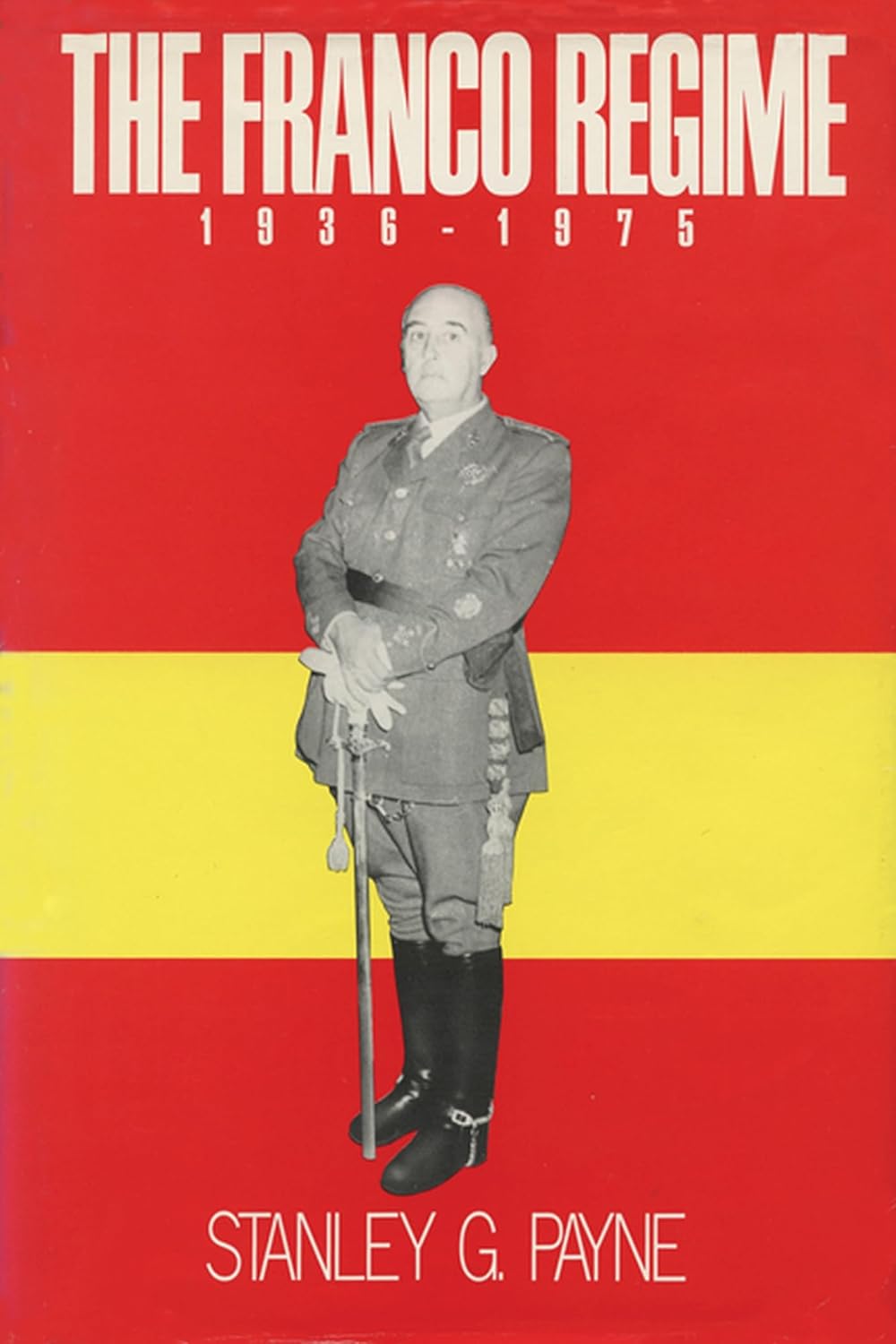
Description:
Editorial Reviews
Reviews:
4.0 out of 5 stars Very comprehensive, but narrow and flawed
Man do I feel conflicted about this book. It’s good, but, I’m sure there is a better book out there about Franco’s Spain. Despite my reservations, I finished this 600 page tome, and for better or worse it is probably the only book on Spain I’ll read in my life.The good: this is an oddly neutral book. It basically shares everything you could want to know, to the point of it being painful. Every cabinet reshuffling gets pages tracking the ministers and their backgrounds.As the author’s friend, Juan Linz, wrote in his review “[t]he objectivity with which the facts are told is extraordinary and sometimes distributing to the reader, who might have wished to see his value judgements…. at least debated.” That’s on the back of the darn book.One of the most frustrating elements of this book is it barely touches on the widespread human rights abuses of the regime. Pages and pages and pages and pages are spent how Franco managed the pipsqueak Carlist monarchists, but no description is given to the efforts to “manage” the Republican and left-wing opposition through a police state. It’s remarkable that the regime’s administrative efforts to develop hydroelectric power get more treatment than the political repression of the opposition.Is Stanley G. Payne a franquista?He doesn’t let the reader know. But, Payne clearly admires much of Franco, as a stabilizer and modernizer. At the same time, he doesn’t pull punches about him having a huge ego, spending too much of his time frivolously, or holding some silly ideas. But neither does he at all examine his role in brutal political repression.Kind of sucks.An additional irritant is that so much goes completely unexplained. Concepts like syndicalism, Carlism, concordats, etc., which feature prominently in the book, are given no definition or explanation of their significance. In a way, the substance of these concepts is not important to Payne’s analysis of Franco’s management of factions. That is part of the book’s issue.The book is so myopically focused on the internal politics of the regime, its jurisprudence, and Franco himself, there is room for little else. You certainly do not get little feel for day-to-day life in Franco’s Spain, which should be doable in 600 pages.I learned a lot. Payne does a remarkable, technically good job, but the narrowness and flaws of the book are significant. I have to hope there is a better book-length treatment of Franco’s Spain. If not, this book is serviceable.
5.0 out of 5 stars Splendid, objective and well documented
[...]. However, since this is a book for the international market, I think that a praise in Bolo, made by an interested observer and born in Spain, should be more valuable.Anyone interested in the recent history of Spain can reach a conclusion: Almost all the specialists lie.There are different ways to lie:One of them is having a previous political position and accepting, omitting or downplaying facts according to this position. Many specialists as Tuñón de Lara, Paul Preston, Ricardo de la Cierva, Pio Moa and some others could be under this chapter. Anyone familiar with the works of these writers can observe that the tendencies in some of them are opposite but they act in the same way. They have two different set of rules and the acceptability is defined depending on who performs the action to be analyzed.Another way to lie can be involuntary: When someone writes about the own experience and, because of that, has a limited view of the reality, the final picture has only one side. That could be the case of Burnett Bolloten, Felix Schlayer, George Orwell and many others that write about their personal experience living in one side during the war. They cannot really know if similar actions happen in the other side and, thus, this is not commented and their picture of the situation could be strongly deviated.The third one is worse since the writes lies in the name of the objectivity. The writer tries to keep a neutral position having in every single situation the same distance from both sides and, thus, forgetting who is in every case the killer and who is the victim.Payne is different...and better. He tries to be objective but, in doing so, he does not confuse objectivity with equidistance. He tries to attach the objectivity to the facts and that's why he can critizice one side and, at a different moment, can criticize the other side.Perhaps, Payne could be criticized about the name of the book. He starts before 1936. The book is not a biography of Franco but speaks even about his childhood. Once Franco starts to be a political and military leader, Payne gets more centered at his political activity.Franco, as described by Payne, is not the kind of moron and grey character that many specialists have been drawing for years. Actually, he is presented as a very interesting man, able to outsmart his many opponents even when his appearance was far from attractive.However, the book is not a favorable praise of Franco. Payne tries to explain what happened and why and, to understand that, a half-stupid Franco should leave many issues unexplained.During the Civil War, both sides were critiziced from abroad due to the huge number of assassinations. The dynamics of this moment or what were the forces during the II World War and the resulting position for Franco and for Spain cannot be understood without studying the character, changes and actions of the main actor.I would like to finish with a personal remark: After reading many books from very different writers about Spain during the XX century, I can say that this book has been clarifying for me in some previously unexplained issues.Gracias por su libro.
4.0 out of 5 stars Incomprehensible footnotes
Mr. Payne's book The Franco Regime contains a wealth of first class information. In the course of studying it - a pleasurable affair, because of its fine style - I had however some disappointments when I went after checking some footnotes.1. On page 139 (in my copy) Payne relates the Guernica bombing. I was inclined to believe his every word, but his footnote 54 mentions an important author with the alleged name Geoffrey Speer. However, following footnote 56 I studied Mr. Southworth's book Guernica! Guernica!, in which obviously the same author's name is spelled - correctly - George L. Steer. He is the author of The tree of Gernika. It is strange that Southworth book seems to be recommended by Payne, whereas Southworth is highly critical of Payne himself, who is accused of credulity of neo-franquist sources. I would have liked (and expected) that Payne had defended himself.In the same vein there is on p. 647 an odd recommendation of the book of the German Walther L. Bernecker, Spanien seit dem Burgerkrieg, that is very biased, or at least very hostile, against Franco, whereas Payne is making a case for reappraisal of Franco as a leader who deserves some credit.It seems that Mr. Payne mentions or recommends books that he did not give much attention.I must admit these are or not very important issues, but it makes me a bit anxious about the other footnotes.
Authoritative
Not light reading but a well researched and documented account of the Spanish civil war and the Franco regime in Spain
Visit the University of Wisconsin Press Store
The Franco Regime, 1936–1975
AED33903
Quantity:
Order today to get by 7-14 business days
This item qualifies for free delivery
Imported From: United States
At BOLO, we work hard to ensure the products you receive are new, genuine, and sourced from reputable suppliers.
BOLO is not an authorized or official retailer for most brands, nor are we affiliated with manufacturers unless specifically stated on a product page. Instead, we source verified sellers, authorized distributors or directly from the manufacturer.
Each product undergoes thorough inspection and verification at our consolidation and fulfilment centers to ensure it meets our strict authenticity and quality standards before being shipped and delivered to you.
If you ever have concerns regarding the authenticity of a product purchased from us, please contact Bolo Support. We will review your inquiry promptly and, if necessary, provide documentation verifying authenticity or offer a suitable resolution.
Your trust is our top priority, and we are committed to maintaining transparency and integrity in every transaction.
All product information, images, descriptions, and reviews originate from the manufacturer or from trusted sellers overseas. BOLO is not affiliated with, endorsed by, or an authorized retailer for most brands listed on our website unless stated otherwise.
While we strive to display accurate information, variations in packaging, labeling, instructions, or formulation may occasionally occur due to regional differences or supplier updates. For detailed or manufacturer-specific information, please contact the brand directly or reach out to BOLO Support for assistance.
Unless otherwise stated, all prices displayed on the product page include applicable taxes and import duties.
BOLO operates in accordance with the laws and regulations of United Arab Emirates. Any items found to be restricted or prohibited for sale within the UAE will be cancelled prior to shipment. We take proactive measures to ensure that only products permitted for sale in United Arab Emirates are listed on our website.
All items are shipped by air, and any products classified as “Dangerous Goods (DG)” under IATA regulations will be removed from the order and cancelled.
All orders are processed manually, and we make every effort to process them promptly once confirmed. Products cancelled due to the above reasons will be permanently removed from listings across the website.
Similar suggestions by Bolo
More from this brand
Similar items from “Europe”
Share with
Or share with link
https://www.bolo.ae/products/U0299110745
Visit the University of Wisconsin Press Store
The Franco Regime, 1936–1975

AED33903
Quantity:
Order today to get by 7-14 business days
This item qualifies for free delivery
Imported From: United States
At BOLO, we work hard to ensure the products you receive are new, genuine, and sourced from reputable suppliers.
BOLO is not an authorized or official retailer for most brands, nor are we affiliated with manufacturers unless specifically stated on a product page. Instead, we source verified sellers, authorized distributors or directly from the manufacturer.
Each product undergoes thorough inspection and verification at our consolidation and fulfilment centers to ensure it meets our strict authenticity and quality standards before being shipped and delivered to you.
If you ever have concerns regarding the authenticity of a product purchased from us, please contact Bolo Support. We will review your inquiry promptly and, if necessary, provide documentation verifying authenticity or offer a suitable resolution.
Your trust is our top priority, and we are committed to maintaining transparency and integrity in every transaction.
All product information, images, descriptions, and reviews originate from the manufacturer or from trusted sellers overseas. BOLO is not affiliated with, endorsed by, or an authorized retailer for most brands listed on our website unless stated otherwise.
While we strive to display accurate information, variations in packaging, labeling, instructions, or formulation may occasionally occur due to regional differences or supplier updates. For detailed or manufacturer-specific information, please contact the brand directly or reach out to BOLO Support for assistance.
Unless otherwise stated, all prices displayed on the product page include applicable taxes and import duties.
BOLO operates in accordance with the laws and regulations of United Arab Emirates. Any items found to be restricted or prohibited for sale within the UAE will be cancelled prior to shipment. We take proactive measures to ensure that only products permitted for sale in United Arab Emirates are listed on our website.
All items are shipped by air, and any products classified as “Dangerous Goods (DG)” under IATA regulations will be removed from the order and cancelled.
All orders are processed manually, and we make every effort to process them promptly once confirmed. Products cancelled due to the above reasons will be permanently removed from listings across the website.
Description:
Editorial Reviews
Reviews:
4.0 out of 5 stars Very comprehensive, but narrow and flawed
Man do I feel conflicted about this book. It’s good, but, I’m sure there is a better book out there about Franco’s Spain. Despite my reservations, I finished this 600 page tome, and for better or worse it is probably the only book on Spain I’ll read in my life.The good: this is an oddly neutral book. It basically shares everything you could want to know, to the point of it being painful. Every cabinet reshuffling gets pages tracking the ministers and their backgrounds.As the author’s friend, Juan Linz, wrote in his review “[t]he objectivity with which the facts are told is extraordinary and sometimes distributing to the reader, who might have wished to see his value judgements…. at least debated.” That’s on the back of the darn book.One of the most frustrating elements of this book is it barely touches on the widespread human rights abuses of the regime. Pages and pages and pages and pages are spent how Franco managed the pipsqueak Carlist monarchists, but no description is given to the efforts to “manage” the Republican and left-wing opposition through a police state. It’s remarkable that the regime’s administrative efforts to develop hydroelectric power get more treatment than the political repression of the opposition.Is Stanley G. Payne a franquista?He doesn’t let the reader know. But, Payne clearly admires much of Franco, as a stabilizer and modernizer. At the same time, he doesn’t pull punches about him having a huge ego, spending too much of his time frivolously, or holding some silly ideas. But neither does he at all examine his role in brutal political repression.Kind of sucks.An additional irritant is that so much goes completely unexplained. Concepts like syndicalism, Carlism, concordats, etc., which feature prominently in the book, are given no definition or explanation of their significance. In a way, the substance of these concepts is not important to Payne’s analysis of Franco’s management of factions. That is part of the book’s issue.The book is so myopically focused on the internal politics of the regime, its jurisprudence, and Franco himself, there is room for little else. You certainly do not get little feel for day-to-day life in Franco’s Spain, which should be doable in 600 pages.I learned a lot. Payne does a remarkable, technically good job, but the narrowness and flaws of the book are significant. I have to hope there is a better book-length treatment of Franco’s Spain. If not, this book is serviceable.
5.0 out of 5 stars Splendid, objective and well documented
[...]. However, since this is a book for the international market, I think that a praise in Bolo, made by an interested observer and born in Spain, should be more valuable.Anyone interested in the recent history of Spain can reach a conclusion: Almost all the specialists lie.There are different ways to lie:One of them is having a previous political position and accepting, omitting or downplaying facts according to this position. Many specialists as Tuñón de Lara, Paul Preston, Ricardo de la Cierva, Pio Moa and some others could be under this chapter. Anyone familiar with the works of these writers can observe that the tendencies in some of them are opposite but they act in the same way. They have two different set of rules and the acceptability is defined depending on who performs the action to be analyzed.Another way to lie can be involuntary: When someone writes about the own experience and, because of that, has a limited view of the reality, the final picture has only one side. That could be the case of Burnett Bolloten, Felix Schlayer, George Orwell and many others that write about their personal experience living in one side during the war. They cannot really know if similar actions happen in the other side and, thus, this is not commented and their picture of the situation could be strongly deviated.The third one is worse since the writes lies in the name of the objectivity. The writer tries to keep a neutral position having in every single situation the same distance from both sides and, thus, forgetting who is in every case the killer and who is the victim.Payne is different...and better. He tries to be objective but, in doing so, he does not confuse objectivity with equidistance. He tries to attach the objectivity to the facts and that's why he can critizice one side and, at a different moment, can criticize the other side.Perhaps, Payne could be criticized about the name of the book. He starts before 1936. The book is not a biography of Franco but speaks even about his childhood. Once Franco starts to be a political and military leader, Payne gets more centered at his political activity.Franco, as described by Payne, is not the kind of moron and grey character that many specialists have been drawing for years. Actually, he is presented as a very interesting man, able to outsmart his many opponents even when his appearance was far from attractive.However, the book is not a favorable praise of Franco. Payne tries to explain what happened and why and, to understand that, a half-stupid Franco should leave many issues unexplained.During the Civil War, both sides were critiziced from abroad due to the huge number of assassinations. The dynamics of this moment or what were the forces during the II World War and the resulting position for Franco and for Spain cannot be understood without studying the character, changes and actions of the main actor.I would like to finish with a personal remark: After reading many books from very different writers about Spain during the XX century, I can say that this book has been clarifying for me in some previously unexplained issues.Gracias por su libro.
4.0 out of 5 stars Incomprehensible footnotes
Mr. Payne's book The Franco Regime contains a wealth of first class information. In the course of studying it - a pleasurable affair, because of its fine style - I had however some disappointments when I went after checking some footnotes.1. On page 139 (in my copy) Payne relates the Guernica bombing. I was inclined to believe his every word, but his footnote 54 mentions an important author with the alleged name Geoffrey Speer. However, following footnote 56 I studied Mr. Southworth's book Guernica! Guernica!, in which obviously the same author's name is spelled - correctly - George L. Steer. He is the author of The tree of Gernika. It is strange that Southworth book seems to be recommended by Payne, whereas Southworth is highly critical of Payne himself, who is accused of credulity of neo-franquist sources. I would have liked (and expected) that Payne had defended himself.In the same vein there is on p. 647 an odd recommendation of the book of the German Walther L. Bernecker, Spanien seit dem Burgerkrieg, that is very biased, or at least very hostile, against Franco, whereas Payne is making a case for reappraisal of Franco as a leader who deserves some credit.It seems that Mr. Payne mentions or recommends books that he did not give much attention.I must admit these are or not very important issues, but it makes me a bit anxious about the other footnotes.
Authoritative
Not light reading but a well researched and documented account of the Spanish civil war and the Franco regime in Spain
Similar suggestions by Bolo
More from this brand
Similar items from “Europe”
Share with
Or share with link
https://www.bolo.ae/products/U0299110745