Deliver toUnited Arab Emirates
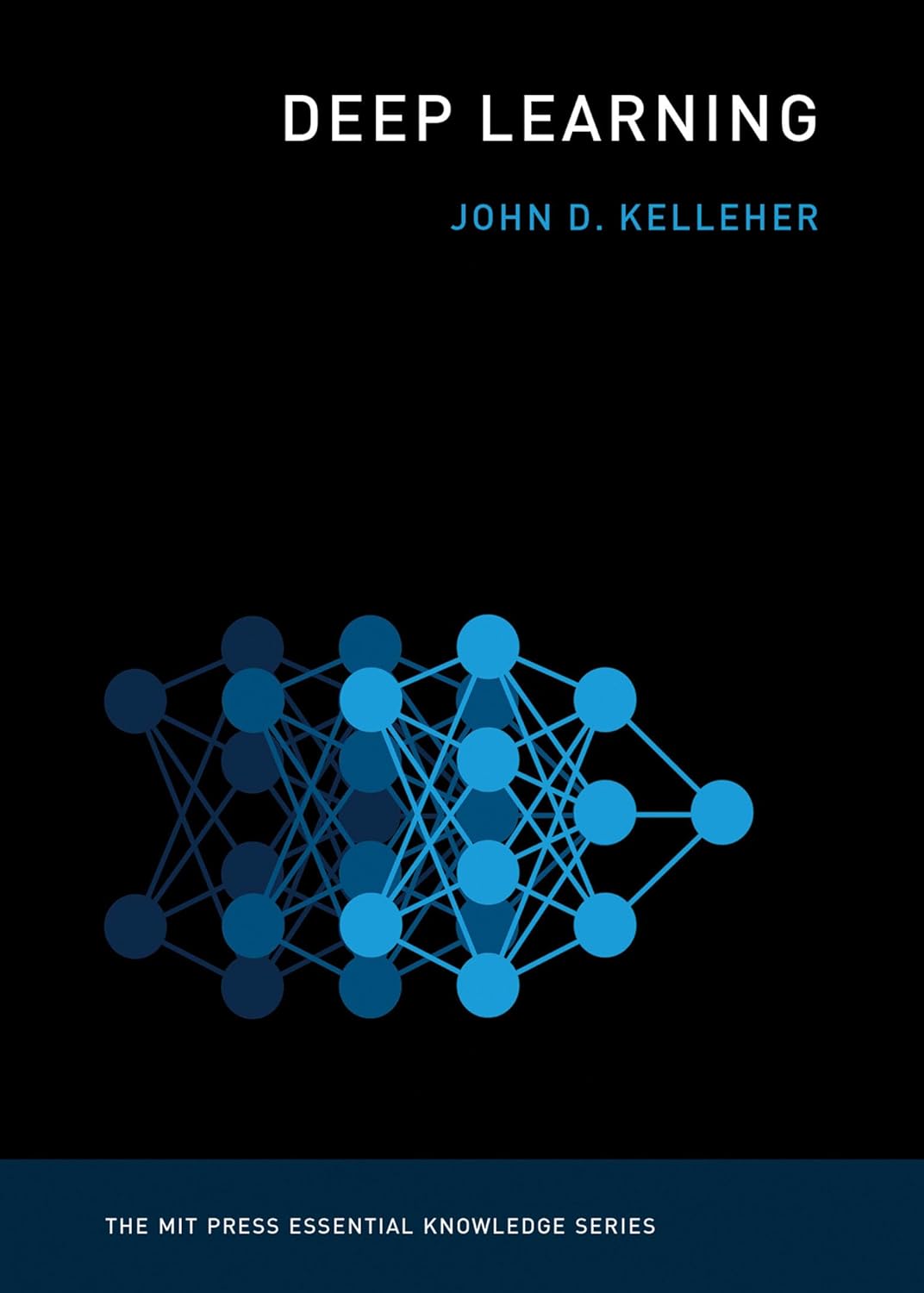
Deep Learning (The MIT Press Essential Knowledge series)

Description:

An accessible introduction to the artificial intelligence technology that enables computer vision, speech recognition, machine translation, and driverless cars.

Deep learning is an artificial intelligence technology that enables computer vision, speech recognition in mobile phones, machine translation, AI games, driverless cars, and other applications. When we use consumer products from Google, Microsoft, Facebook, Apple, or Baidu, we are often interacting with a deep learning system. In this volume in the MIT Press Essential Knowledge series, computer scientist John Kelleher offers an accessible and concise but comprehensive introduction to the fundamental technology at the heart of the artificial intelligence revolution.

Kelleher explains that deep learning enables data-driven decisions by identifying and extracting patterns from large datasets; its ability to learn from complex data makes deep learning ideally suited to take advantage of the rapid growth in big data and computational power. Kelleher also explains some of the basic concepts in deep learning, presents a history of advances in the field, and discusses the current state of the art. He describes the most important deep learning architectures, including autoencoders, recurrent neural networks, and long short-term networks, as well as such recent developments as Generative Adversarial Networks and capsule networks. He also provides a comprehensive (and comprehensible) introduction to the two fundamental algorithms in deep learning: gradient descent and backpropagation. Finally, Kelleher considers the future of deep learning—major trends, possible developments, and significant challenges.


Editorial Reviews

About the Author

John D. Kelleher is Academic Leader of the Information, Communication, and Entertainment Research Institute at the Technological University Dublin. He has authored a number of books, including: Deep Learning, MIT Press, 2019, Data Science, MIT Press, 2018, and Fundamentals of Machine Learning for Predictive Data Analytics, MIT Press, 2015.

Reviews:

5.0 out of 5 stars Excellent but not so easy.

A. · February 8, 2020

The back cover indicates "An accessible introduction to AI ..." Ok, it is accessible if you have a pretty good background in calculus including partial derivatives and chain rule, regression, matrix algebra operation, advanced geometry, etc." You get the picture. But, that is not the author's fault. This is the cognitive entry gate to understanding DNN. You need a foundation going in.I have read several books on DNNs. And, I taught myself how to develop such DNN models. Many of the books I had read before invariably combined some contextual material with some software codes to get you going. Although many of these books were between good and very good; it was refreshing to pick up a book solely concentrated on making you understand the underlying math of DNNs. Be warned, the author does not let a single stone unturned. If you are just into getting a high level understanding on how DNN work, maybe a couple of good articles at Medium will suffice. This book is a lot more than that. The author drills down on the subject.The author also has a pretty original approach to the subject that is much more geometry based than I had ever read elsewhere. He talks of mapping, and different types of spaces. He represents a lot of decisions along a two-dimensional graphs in ways I had not seen done by other authors.This book is very comparable and competitive with "Neural Networks, a Visual Introduction for Beginners" by Michael Taylor. And, I think for the ones with a pretty good background in math, but below the ones of a college grad or masters in math, Taylor's book is much more accessible and actually teaches you a lot. However, while Taylor is a very good teacher at the introductory level, Kelleher is also an excellent one at the more advanced level. Taylor and Kelleher approach the subject differently at different levels and you will learn a lot from both.From Taylor, I got a pretty good understanding of DNNs. And, I got to develop some pretty good DNNs to explain and simulate the stock market (with only a mediocre level of success, so I still have to keep my day job). From Kelleher, I learned that the DNN structure I was using that included Sigmoid activation functions was really outdated. And, that I really have to learn how to develop DNNs that use long short term memory (LSTM) with rectified linear function (ReLu) (instead of Sigmoid) to improve my DNNs. This will be an ambitious undertaking, as I will have to graduate from using a very simple R package (deepnet) that allows you to code a DNN in essentially a single line of code with all the arguments you need to specify a traditional DNN. But, to develop a DNN with LSTM with ReLu, I will have to use Python Keras with Tensorflow, a far more complex undertaking. Nevertheless, Kelleher imparted to me extensive theoretical knowledge on why I have to move away from Sigmoid activation and towards ReLu with LSTM. Given that, I could not ask more from Kelleher. He much raised my understanding of the subject.If you are in a similar boat as I am, you will appreciate this book a lot. As you will see, or as you know already DNNs is an ongoing process. There is no clear finish line. This is unlike many other model structures such as ARIMA, ECM, VAR, etc. where what you see is what you get; as these model structures have an end point. Once you reached it, you know and understand them. With DNNs, there is always either a topic you thought you understood, but you uncover you actually do not. And, there are a lot of subjects you don't even know off as the field is evolving rapidly in ever complex and diversified directions. I think DNNs will keep mathematicians busy for a pretty long time. And, that is kind of exciting in itself. When you uncover a quantitative method that seems to ever have room to evolve, it is pretty cool stuff.

5.0 out of 5 stars a gentle, solid and modern introduction to deep learning

M.G. · March 15, 2020

The author has provided, in this book, a modern (to 2019) introduction to deep learning. The focus of the book is on a limited number of topics, such as backpropagation, treated very deeply (but with few assumptions about technical preparation). In additional, Kelleher has given a pretty up-to-date perspective on this subject. In recent years, due to a number of factors, such as good matrix-calculation hardware, deep learning and neural networks have shot into the vanguard of interest for weak AI. Therefore, Kelleher's expert presentation, and careful "hand-holding", as he proceeds to discuss some of the important topics, like the evolution of threshold functions, is particularly timely. I think that the very minimal level of understanding of linear algebra and calculus that is necessary to grasp the technical aspects of his discussion, make this book very valuable book for a broad audience, such as for software engineers at a beginning level in this area, and technical staff generally. Short of a good course, this summary overview is about the best one could hope for in a technical introduction, at a high level. I strongly recommend this book as a very easy, short read, that will be informative about some important basics. With the advent of software and hardware improvements, over the next twenty or thirty years, like quantum computers, deep learning is very likely to remain a significant tool in many technical fields, including physics (which is my primary area of interest).

4.0 out of 5 stars Not an extensive book on the topic

E.M. · April 12, 2025

Read the sample before you buy this book. As it says, this is not a technical book. It's an introduction to those who are not technical on the subject.

5.0 out of 5 stars Compact intro to deep learning

S.Z. · November 27, 2024

This book is short and concise, making it a compact intro to the subject. It assumes relatively little background in math (if you're like me you might want to skip the parts that go through basic concepts multivariable calculus and linear algebra etc.), and the exposition is very clear. The diagrams are helpful, too. A good intro + historical overview of this young (and rapidly growing) field that prepares you for a deeper dive.

3.0 out of 5 stars not useful for me

k. · December 20, 2023

It's is not useful for me.

5.0 out of 5 stars Nice and simple

S. · January 7, 2025

Explain the concept very easily for a non- technical person.

5.0 out of 5 stars Fantastic intro to the math

A.F. · December 17, 2023

I saw this book recommended in various places and it did not disappoint. It lays a foundation that takes the mystery out of neural nets. It’s been many years for me since college math, so I found a few parts challenging, but the math really isn’t very hard. This book was written before the rise of transformers but it’s an amazing intro to the fundamentals. Start here and move on to other books if you still feel the need.

4.0 out of 5 stars Overall, a nice and accessible introduction to Deep Learning

E. · May 7, 2021

A decent introduction to the history and technical aspects of Deep Learning. Not for someone who wants to know how to use deep learning, nor is it sufficient for someone who wants to write there own deep learning algorithms. It is not appropriate for the former, but a wonderful primer and starting point for the latter. You will be ready for the recommended additional reading at the end of the book after reading this text.

a useful book

A. · October 28, 2024

A quality book about machine learning that exceeded my expectations. I congratulate the author, John D. Kelleher.

Excellent

C.d. · October 29, 2019

Contrairement à bien d'autres, l'auteur se donne pour objectif de bien faire comprendre son propos. Il y parvient à la faveur d'un réel effort pédagogique. Comme le précédent dans la même collection (Data science), l'ouvrage est clair et constitue un excellent panorama, accessible à un public de non-spécialistes. Sans technicité excessive, mais avec un cheminement suffisamment précis, il permet de comprendre les grandes lignes de la mise en oeuvre des principales méthodes présentées.

Contiene los contenidos básicos y explica con un método fácil de entender.

J.C. · April 13, 2023

Good for absolute beginners

S. · November 8, 2022

This is a good starting point for those interested in Deep learning .Also for all the technical buffs who have trouble explaining concepts to non-technical people in a simple way.

Consigliato. Spiega come funziona il DL.

J. · August 7, 2022

Scritto benissimo.Illustra in maniera divulgativa la storia dello sviluppo e soprattutto i principi di funzionamento del deep learning (altri libri si limitano invece a illustrarne le applicazioni). Un unico capitolo ha una quantità di matematica excessiva per una pubblicazione divulgativa ma l'autore stesso avvisa il lettore che può procedere oltre.È quindi un libro divulgativo ma rivolto a chi ha almeno una infarinatura scientifica.Consigliato.

Deep Learning (The MIT Press Essential Knowledge series)

Product ID: U0262537559
Condition: New

4.4

AED8981

Price includes VAT & Import Duties
Type: Paperback
Availability: In Stock

Quantity:

|

Order today to get by 7-14 business days

Delivery fee of AED 20. Free for orders above AED 200.

Returns & Warranty policies

Imported From: United States

At BOLO, we work hard to ensure the products you receive are new, genuine, and sourced from reputable suppliers.

BOLO is not an authorized or official retailer for most brands, nor are we affiliated with manufacturers unless specifically stated on a product page. Instead, we source verified sellers, authorized distributors or directly from the manufacturer.

Each product undergoes thorough inspection and verification at our consolidation and fulfilment centers to ensure it meets our strict authenticity and quality standards before being shipped and delivered to you.

If you ever have concerns regarding the authenticity of a product purchased from us, please contact Bolo Support. We will review your inquiry promptly and, if necessary, provide documentation verifying authenticity or offer a suitable resolution.

Your trust is our top priority, and we are committed to maintaining transparency and integrity in every transaction.

All product information, images, descriptions, and reviews originate from the manufacturer or from trusted sellers overseas. BOLO is not affiliated with, endorsed by, or an authorized retailer for most brands listed on our website unless stated otherwise.

While we strive to display accurate information, variations in packaging, labeling, instructions, or formulation may occasionally occur due to regional differences or supplier updates. For detailed or manufacturer-specific information, please contact the brand directly or reach out to BOLO Support for assistance.

Unless otherwise stated, all prices displayed on the product page include applicable taxes and import duties.

BOLO operates in accordance with the laws and regulations of United Arab Emirates. Any items found to be restricted or prohibited for sale within the UAE will be cancelled prior to shipment. We take proactive measures to ensure that only products permitted for sale in United Arab Emirates are listed on our website.

All items are shipped by air, and any products classified as “Dangerous Goods (DG)” under IATA regulations will be removed from the order and cancelled.

All orders are processed manually, and we make every effort to process them promptly once confirmed. Products cancelled due to the above reasons will be permanently removed from listings across the website.

Similar suggestions by Bolo

More from this brand

Similar items from “Intelligence & Semantics”

Deep Learning (The MIT Press Essential Knowledge series)

Product ID: U0262537559
Condition: New

4.4

Deep Learning (The MIT Press Essential Knowledge series)-0
Type: Paperback

AED8981

Price includes VAT & Import Duties
Availability: In Stock

Quantity:

|

Order today to get by 7-14 business days

Delivery fee of AED 20. Free for orders above AED 200.

Returns & Warranty policies

Imported From: United States

At BOLO, we work hard to ensure the products you receive are new, genuine, and sourced from reputable suppliers.

BOLO is not an authorized or official retailer for most brands, nor are we affiliated with manufacturers unless specifically stated on a product page. Instead, we source verified sellers, authorized distributors or directly from the manufacturer.

Each product undergoes thorough inspection and verification at our consolidation and fulfilment centers to ensure it meets our strict authenticity and quality standards before being shipped and delivered to you.

If you ever have concerns regarding the authenticity of a product purchased from us, please contact Bolo Support. We will review your inquiry promptly and, if necessary, provide documentation verifying authenticity or offer a suitable resolution.

Your trust is our top priority, and we are committed to maintaining transparency and integrity in every transaction.

All product information, images, descriptions, and reviews originate from the manufacturer or from trusted sellers overseas. BOLO is not affiliated with, endorsed by, or an authorized retailer for most brands listed on our website unless stated otherwise.

While we strive to display accurate information, variations in packaging, labeling, instructions, or formulation may occasionally occur due to regional differences or supplier updates. For detailed or manufacturer-specific information, please contact the brand directly or reach out to BOLO Support for assistance.

Unless otherwise stated, all prices displayed on the product page include applicable taxes and import duties.

BOLO operates in accordance with the laws and regulations of United Arab Emirates. Any items found to be restricted or prohibited for sale within the UAE will be cancelled prior to shipment. We take proactive measures to ensure that only products permitted for sale in United Arab Emirates are listed on our website.

All items are shipped by air, and any products classified as “Dangerous Goods (DG)” under IATA regulations will be removed from the order and cancelled.

All orders are processed manually, and we make every effort to process them promptly once confirmed. Products cancelled due to the above reasons will be permanently removed from listings across the website.

Description:

An accessible introduction to the artificial intelligence technology that enables computer vision, speech recognition, machine translation, and driverless cars.

Deep learning is an artificial intelligence technology that enables computer vision, speech recognition in mobile phones, machine translation, AI games, driverless cars, and other applications. When we use consumer products from Google, Microsoft, Facebook, Apple, or Baidu, we are often interacting with a deep learning system. In this volume in the MIT Press Essential Knowledge series, computer scientist John Kelleher offers an accessible and concise but comprehensive introduction to the fundamental technology at the heart of the artificial intelligence revolution.

Kelleher explains that deep learning enables data-driven decisions by identifying and extracting patterns from large datasets; its ability to learn from complex data makes deep learning ideally suited to take advantage of the rapid growth in big data and computational power. Kelleher also explains some of the basic concepts in deep learning, presents a history of advances in the field, and discusses the current state of the art. He describes the most important deep learning architectures, including autoencoders, recurrent neural networks, and long short-term networks, as well as such recent developments as Generative Adversarial Networks and capsule networks. He also provides a comprehensive (and comprehensible) introduction to the two fundamental algorithms in deep learning: gradient descent and backpropagation. Finally, Kelleher considers the future of deep learning—major trends, possible developments, and significant challenges.


Editorial Reviews

About the Author

John D. Kelleher is Academic Leader of the Information, Communication, and Entertainment Research Institute at the Technological University Dublin. He has authored a number of books, including: Deep Learning, MIT Press, 2019, Data Science, MIT Press, 2018, and Fundamentals of Machine Learning for Predictive Data Analytics, MIT Press, 2015.

Reviews:

5.0 out of 5 stars Excellent but not so easy.

A. · February 8, 2020

The back cover indicates "An accessible introduction to AI ..." Ok, it is accessible if you have a pretty good background in calculus including partial derivatives and chain rule, regression, matrix algebra operation, advanced geometry, etc." You get the picture. But, that is not the author's fault. This is the cognitive entry gate to understanding DNN. You need a foundation going in.I have read several books on DNNs. And, I taught myself how to develop such DNN models. Many of the books I had read before invariably combined some contextual material with some software codes to get you going. Although many of these books were between good and very good; it was refreshing to pick up a book solely concentrated on making you understand the underlying math of DNNs. Be warned, the author does not let a single stone unturned. If you are just into getting a high level understanding on how DNN work, maybe a couple of good articles at Medium will suffice. This book is a lot more than that. The author drills down on the subject.The author also has a pretty original approach to the subject that is much more geometry based than I had ever read elsewhere. He talks of mapping, and different types of spaces. He represents a lot of decisions along a two-dimensional graphs in ways I had not seen done by other authors.This book is very comparable and competitive with "Neural Networks, a Visual Introduction for Beginners" by Michael Taylor. And, I think for the ones with a pretty good background in math, but below the ones of a college grad or masters in math, Taylor's book is much more accessible and actually teaches you a lot. However, while Taylor is a very good teacher at the introductory level, Kelleher is also an excellent one at the more advanced level. Taylor and Kelleher approach the subject differently at different levels and you will learn a lot from both.From Taylor, I got a pretty good understanding of DNNs. And, I got to develop some pretty good DNNs to explain and simulate the stock market (with only a mediocre level of success, so I still have to keep my day job). From Kelleher, I learned that the DNN structure I was using that included Sigmoid activation functions was really outdated. And, that I really have to learn how to develop DNNs that use long short term memory (LSTM) with rectified linear function (ReLu) (instead of Sigmoid) to improve my DNNs. This will be an ambitious undertaking, as I will have to graduate from using a very simple R package (deepnet) that allows you to code a DNN in essentially a single line of code with all the arguments you need to specify a traditional DNN. But, to develop a DNN with LSTM with ReLu, I will have to use Python Keras with Tensorflow, a far more complex undertaking. Nevertheless, Kelleher imparted to me extensive theoretical knowledge on why I have to move away from Sigmoid activation and towards ReLu with LSTM. Given that, I could not ask more from Kelleher. He much raised my understanding of the subject.If you are in a similar boat as I am, you will appreciate this book a lot. As you will see, or as you know already DNNs is an ongoing process. There is no clear finish line. This is unlike many other model structures such as ARIMA, ECM, VAR, etc. where what you see is what you get; as these model structures have an end point. Once you reached it, you know and understand them. With DNNs, there is always either a topic you thought you understood, but you uncover you actually do not. And, there are a lot of subjects you don't even know off as the field is evolving rapidly in ever complex and diversified directions. I think DNNs will keep mathematicians busy for a pretty long time. And, that is kind of exciting in itself. When you uncover a quantitative method that seems to ever have room to evolve, it is pretty cool stuff.

5.0 out of 5 stars a gentle, solid and modern introduction to deep learning

M.G. · March 15, 2020

The author has provided, in this book, a modern (to 2019) introduction to deep learning. The focus of the book is on a limited number of topics, such as backpropagation, treated very deeply (but with few assumptions about technical preparation). In additional, Kelleher has given a pretty up-to-date perspective on this subject. In recent years, due to a number of factors, such as good matrix-calculation hardware, deep learning and neural networks have shot into the vanguard of interest for weak AI. Therefore, Kelleher's expert presentation, and careful "hand-holding", as he proceeds to discuss some of the important topics, like the evolution of threshold functions, is particularly timely. I think that the very minimal level of understanding of linear algebra and calculus that is necessary to grasp the technical aspects of his discussion, make this book very valuable book for a broad audience, such as for software engineers at a beginning level in this area, and technical staff generally. Short of a good course, this summary overview is about the best one could hope for in a technical introduction, at a high level. I strongly recommend this book as a very easy, short read, that will be informative about some important basics. With the advent of software and hardware improvements, over the next twenty or thirty years, like quantum computers, deep learning is very likely to remain a significant tool in many technical fields, including physics (which is my primary area of interest).

4.0 out of 5 stars Not an extensive book on the topic

E.M. · April 12, 2025

Read the sample before you buy this book. As it says, this is not a technical book. It's an introduction to those who are not technical on the subject.

5.0 out of 5 stars Compact intro to deep learning

S.Z. · November 27, 2024

This book is short and concise, making it a compact intro to the subject. It assumes relatively little background in math (if you're like me you might want to skip the parts that go through basic concepts multivariable calculus and linear algebra etc.), and the exposition is very clear. The diagrams are helpful, too. A good intro + historical overview of this young (and rapidly growing) field that prepares you for a deeper dive.

3.0 out of 5 stars not useful for me

k. · December 20, 2023

It's is not useful for me.

5.0 out of 5 stars Nice and simple

S. · January 7, 2025

Explain the concept very easily for a non- technical person.

5.0 out of 5 stars Fantastic intro to the math

A.F. · December 17, 2023

I saw this book recommended in various places and it did not disappoint. It lays a foundation that takes the mystery out of neural nets. It’s been many years for me since college math, so I found a few parts challenging, but the math really isn’t very hard. This book was written before the rise of transformers but it’s an amazing intro to the fundamentals. Start here and move on to other books if you still feel the need.

4.0 out of 5 stars Overall, a nice and accessible introduction to Deep Learning

E. · May 7, 2021

A decent introduction to the history and technical aspects of Deep Learning. Not for someone who wants to know how to use deep learning, nor is it sufficient for someone who wants to write there own deep learning algorithms. It is not appropriate for the former, but a wonderful primer and starting point for the latter. You will be ready for the recommended additional reading at the end of the book after reading this text.

a useful book

A. · October 28, 2024

A quality book about machine learning that exceeded my expectations. I congratulate the author, John D. Kelleher.

Excellent

C.d. · October 29, 2019

Contrairement à bien d'autres, l'auteur se donne pour objectif de bien faire comprendre son propos. Il y parvient à la faveur d'un réel effort pédagogique. Comme le précédent dans la même collection (Data science), l'ouvrage est clair et constitue un excellent panorama, accessible à un public de non-spécialistes. Sans technicité excessive, mais avec un cheminement suffisamment précis, il permet de comprendre les grandes lignes de la mise en oeuvre des principales méthodes présentées.

Contiene los contenidos básicos y explica con un método fácil de entender.

J.C. · April 13, 2023

Good for absolute beginners

S. · November 8, 2022

This is a good starting point for those interested in Deep learning .Also for all the technical buffs who have trouble explaining concepts to non-technical people in a simple way.

Consigliato. Spiega come funziona il DL.

J. · August 7, 2022

Scritto benissimo.Illustra in maniera divulgativa la storia dello sviluppo e soprattutto i principi di funzionamento del deep learning (altri libri si limitano invece a illustrarne le applicazioni). Un unico capitolo ha una quantità di matematica excessiva per una pubblicazione divulgativa ma l'autore stesso avvisa il lettore che può procedere oltre.È quindi un libro divulgativo ma rivolto a chi ha almeno una infarinatura scientifica.Consigliato.

Similar suggestions by Bolo

More from this brand

Similar items from “Intelligence & Semantics”