Description:
Editorial Reviews
About the Author
Reviews:
5.0 out of 5 stars Very easy read of a very complex subject
Very easy read of a very complex subject. I recommend it as much for the clarity of presentation as the content. Any one interested in consciousness, free will and how they may work will like this.
5.0 out of 5 stars Five Stars
Just now into this book; it is going to be good
4.0 out of 5 stars I thoroughly enjoyed the book
As one not steeped in cognitive science, I thoroughly enjoyed the book. I found the discussion into Free Will particularly illuminating.The brain stem is presented with options and it picks based on the sum total of its experiences and values. This in my opinion does not run afoul of determinism!
5.0 out of 5 stars Five Stars
good
5.0 out of 5 stars deeply engaging
excellent explanation of the evolution of what we think of as individual consciousness. torey relies more on hard science than philosophical imagination. the results are deeply engaging.
3.0 out of 5 stars Disappointing
I was excited to get this book. I had recently read a few books about the brain, which talked about consciousness and I was looking forward to a book that dealt with the topic specifically. But, it turned out that I learned more about consciousness from those other books. I strongly recommend reading them. They are: "The Future of the Mind," by Michio Kaku; "Incognito," by David Eagleman; and "Light on Life," by BKS Iyengar. (Aside: The last one is a yoga book, I have been impressed how well the map of the mind from Yoga and Buddhism compares with the map of the mind that has been recently coming out of neuroscience.)The main problem with this book (The Conscience Mind) is that the definition of consciousness is too narrow. It is simply the superficial, language-using consciousness. The books listed above discuss about that part as merely the tip of the iceberg. The premiss of this book is that consciousness does not exist without language. I don't believe that is true. There are many times that I evaluate solutions to technical problems by running ideas through my mind without ever thinking of the words to describe them. Call it intuition, or whatever, but it is much quicker than thinking if the words as I go along. And, I am sure I am conscious the whole time. In fact, being conscious without words is one of the steps of yoga and zen. Also, It seems implausible that the modern human mind would have evolved for the purpose of language (as the book implies). Evolution would not have created something that would have been useful 1000 generations later, when language would become more fully developed. Even the book admits that complex language developed many generations after the modern human brain evolved. There had to be an evolutionary advantage right then and there, or it would not have been selected for. It seems way more plausible that the modern human brain was developed to quickly produce and evaluate various courses of action in real situations, right then and there. Adapting the brain for language was eventually a great advantage, as this and other references make clear. But, that doesn't prove language was the advantage that drove the physical evolution or that it is a requirement for consciousness.Also, this book is long on hypotheses, but short on evidence to support its hypotheses. Many of them are reasonable, but they are not satisfying without evidence. And, there were sections of the book that seemed out of scope. For example, the last chapter on how life was initiated on Earth was interesting, but did not really have anything to our with The Conscious Mind. And, it was one of those examples of lots of hypotheses with little evidence. Another questionable section was the one about Free Will. It was not a fair argument about the existence of free will, since it started with the assumption that free will could not exist. It has the same weakness as many discussions about free will: it seems to assume that there is one obvious definition of free will, but it never actually states the definition of free will, or admits that it is an assumption. The section ends with the case for a new concept called "Functional Autonomy." I think the original definition of free will (used in the section) could have just been the author's "Functional Autonomy." I am not sure what is the definition of free will that the author believes could not exist, but nothing was proven about free will in this book.
5.0 out of 5 stars like the endograms that serve as the domain for a ...
A remarkable book that makes a compelling case for the fact that we do, in fact, know what consciousness is and how it evolved historically and how it works, computationally and biologically. I would have preferred to have more experimental evidence for the existence of certain features, like the endograms that serve as the domain for a mental motor function.
2.0 out of 5 stars Two Stars
The text would be interesting were it not littered with self-aggrandizing egoism.
Analyse pertinente sur conscience réflexive et langage
Cet ouvrage apporte une analyse intéressante sur l’évolution et le fonctionnement des circuits neuraux du langage humain et leurs rôles dans la conscience réflexive. Il manque cependant à mon goût de cas cliniques et d’appuis scientifiques.
Weak
A Little Bit of humility regarding the Limits of the authors intellect would have been helpful.
Did what I wanted. Might not have agreed with ...
Did what I wanted. Might not have agreed with Torey but he covered some interesting ground and raised some interesting questions. And not a difficult read either.
A cogent and reasonably compelling summary of how the mind evolved and how it develops in each one of us.
This is a short book written by (unfortunately the recently deceased) clinical psychologist Z. Torey. It is less then 200 pages - fewer than 160 pages of text with the rest taken up by glossary, notes, further readings and references.Torey has an interesting writing style, quite dense and full of technical jargon, that takes some getting use to. He does explain each instance of jargon so that the non-technical reader can follow - with some dedicated effort. In the end I was happy to have purchased it.Having had a longstanding interest in the nature of consciousness, this summary of Torey's particular slant on the evolution of the mind and his theory of how it develops and works in each individual was exactly what I was hoping for. It is not many authors who take the long and all encompassing view that he does. His metaphor that neuroplastic modification in the infant brain is the effector organ (or motor-arm) of language, complete with proprioceptors that effectively feed this data back to be treated in the same way as other purely sensory inputs is inspired, and represents a novel way of looking at the mind. His theory that the highest level of consciousness results from the oscillation of non-reflex language-related neural processing and feedback from utilizing this processing is both interesting and thought provoking.At the same time he unfortunately states and restates his unsubstantiated position that only Homo sapiens can have evolved this mechanism, and that all other species therefore cannot have consciousness. For me this position strains credibility and Torey seems to have completely ignored recent evidence to the contrary. Furthermore his assertion that we posses free will, or at least his version of "free won't", is presented in as argument that does not hold water on close inspection. ("Free won't" is a theory in which the conscious mind somehow magically intercepts the unconscious chain of processes that leads up to our conscious decisions - in the final few hundred milliseconds.)In spite of these few drawbacks Torey delivers a cogent and reasonably compelling summary of how the mind evolved and how it is established in the first year or so after birth in each one of us. Worth the read.
Visit the The MIT Press Store
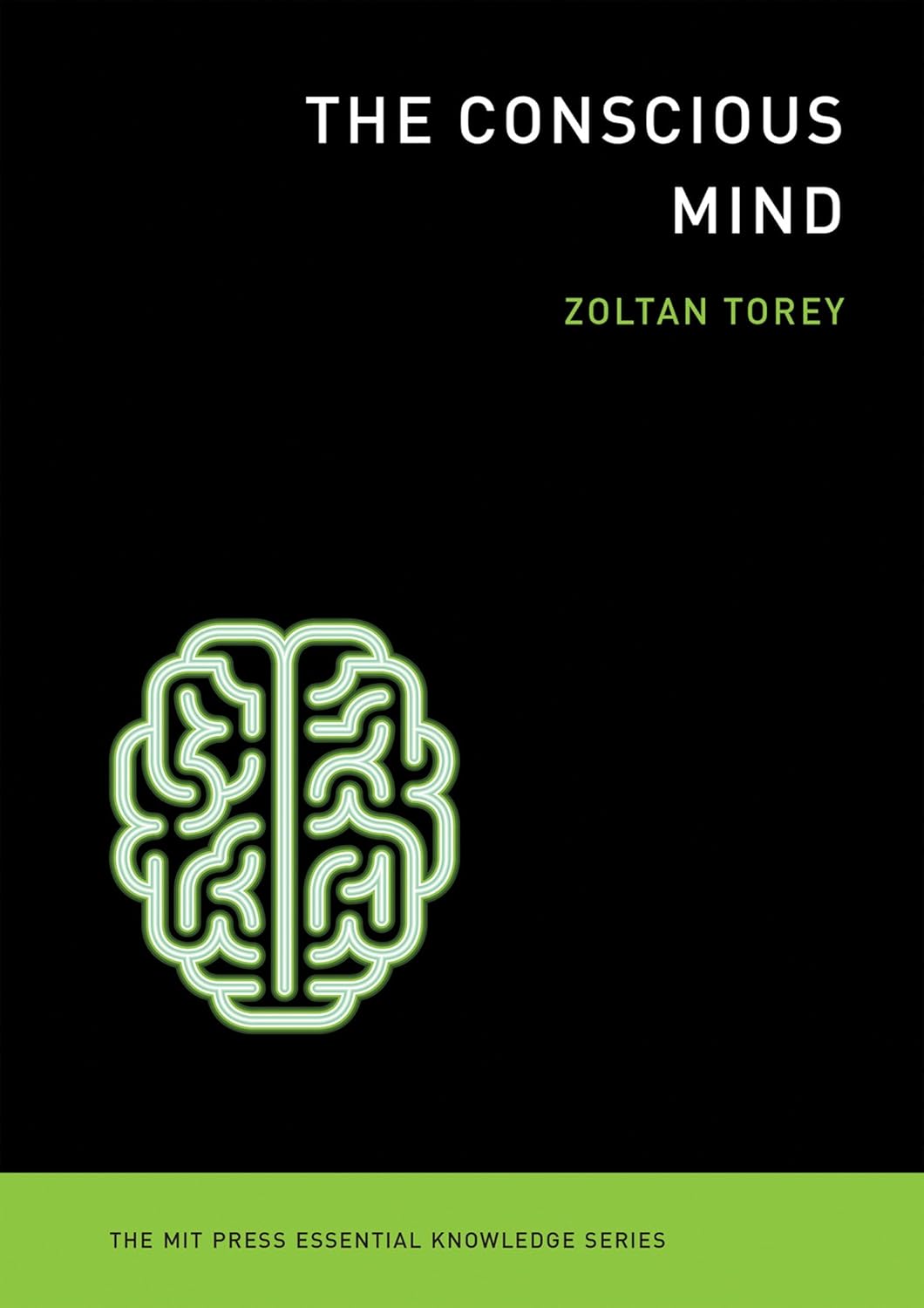
The Conscious Mind (The MIT Press Essential Knowledge series)
AED8773
Quantity:
Order today to get by 7-14 business days
Delivery fee of AED 20. Free for orders above AED 200.
Imported From: United States
At BOLO, we work hard to ensure the products you receive are new, genuine, and sourced from reputable suppliers.
BOLO is not an authorized or official retailer for most brands, nor are we affiliated with manufacturers unless specifically stated on a product page. Instead, we source verified sellers, authorized distributors or directly from the manufacturer.
Each product undergoes thorough inspection and verification at our consolidation and fulfilment centers to ensure it meets our strict authenticity and quality standards before being shipped and delivered to you.
If you ever have concerns regarding the authenticity of a product purchased from us, please contact Bolo Support. We will review your inquiry promptly and, if necessary, provide documentation verifying authenticity or offer a suitable resolution.
Your trust is our top priority, and we are committed to maintaining transparency and integrity in every transaction.
All product information, images, descriptions, and reviews originate from the manufacturer or from trusted sellers overseas. BOLO is not affiliated with, endorsed by, or an authorized retailer for most brands listed on our website unless stated otherwise.
While we strive to display accurate information, variations in packaging, labeling, instructions, or formulation may occasionally occur due to regional differences or supplier updates. For detailed or manufacturer-specific information, please contact the brand directly or reach out to BOLO Support for assistance.
Unless otherwise stated, all prices displayed on the product page include applicable taxes and import duties.
BOLO operates in accordance with the laws and regulations of United Arab Emirates. Any items found to be restricted or prohibited for sale within the UAE will be cancelled prior to shipment. We take proactive measures to ensure that only products permitted for sale in United Arab Emirates are listed on our website.
All items are shipped by air, and any products classified as “Dangerous Goods (DG)” under IATA regulations will be removed from the order and cancelled.
All orders are processed manually, and we make every effort to process them promptly once confirmed. Products cancelled due to the above reasons will be permanently removed from listings across the website.
Similar suggestions by Bolo
More from this brand
Similar items from “Cognitive Psychology”
Share with
Or share with link
https://www.bolo.ae/products/U0262527103
Visit the The MIT Press Store
The Conscious Mind (The MIT Press Essential Knowledge series)

AED8773
Quantity:
Order today to get by 7-14 business days
Delivery fee of AED 20. Free for orders above AED 200.
Imported From: United States
At BOLO, we work hard to ensure the products you receive are new, genuine, and sourced from reputable suppliers.
BOLO is not an authorized or official retailer for most brands, nor are we affiliated with manufacturers unless specifically stated on a product page. Instead, we source verified sellers, authorized distributors or directly from the manufacturer.
Each product undergoes thorough inspection and verification at our consolidation and fulfilment centers to ensure it meets our strict authenticity and quality standards before being shipped and delivered to you.
If you ever have concerns regarding the authenticity of a product purchased from us, please contact Bolo Support. We will review your inquiry promptly and, if necessary, provide documentation verifying authenticity or offer a suitable resolution.
Your trust is our top priority, and we are committed to maintaining transparency and integrity in every transaction.
All product information, images, descriptions, and reviews originate from the manufacturer or from trusted sellers overseas. BOLO is not affiliated with, endorsed by, or an authorized retailer for most brands listed on our website unless stated otherwise.
While we strive to display accurate information, variations in packaging, labeling, instructions, or formulation may occasionally occur due to regional differences or supplier updates. For detailed or manufacturer-specific information, please contact the brand directly or reach out to BOLO Support for assistance.
Unless otherwise stated, all prices displayed on the product page include applicable taxes and import duties.
BOLO operates in accordance with the laws and regulations of United Arab Emirates. Any items found to be restricted or prohibited for sale within the UAE will be cancelled prior to shipment. We take proactive measures to ensure that only products permitted for sale in United Arab Emirates are listed on our website.
All items are shipped by air, and any products classified as “Dangerous Goods (DG)” under IATA regulations will be removed from the order and cancelled.
All orders are processed manually, and we make every effort to process them promptly once confirmed. Products cancelled due to the above reasons will be permanently removed from listings across the website.
Description:
Editorial Reviews
About the Author
Reviews:
5.0 out of 5 stars Very easy read of a very complex subject
Very easy read of a very complex subject. I recommend it as much for the clarity of presentation as the content. Any one interested in consciousness, free will and how they may work will like this.
5.0 out of 5 stars Five Stars
Just now into this book; it is going to be good
4.0 out of 5 stars I thoroughly enjoyed the book
As one not steeped in cognitive science, I thoroughly enjoyed the book. I found the discussion into Free Will particularly illuminating.The brain stem is presented with options and it picks based on the sum total of its experiences and values. This in my opinion does not run afoul of determinism!
5.0 out of 5 stars Five Stars
good
5.0 out of 5 stars deeply engaging
excellent explanation of the evolution of what we think of as individual consciousness. torey relies more on hard science than philosophical imagination. the results are deeply engaging.
3.0 out of 5 stars Disappointing
I was excited to get this book. I had recently read a few books about the brain, which talked about consciousness and I was looking forward to a book that dealt with the topic specifically. But, it turned out that I learned more about consciousness from those other books. I strongly recommend reading them. They are: "The Future of the Mind," by Michio Kaku; "Incognito," by David Eagleman; and "Light on Life," by BKS Iyengar. (Aside: The last one is a yoga book, I have been impressed how well the map of the mind from Yoga and Buddhism compares with the map of the mind that has been recently coming out of neuroscience.)The main problem with this book (The Conscience Mind) is that the definition of consciousness is too narrow. It is simply the superficial, language-using consciousness. The books listed above discuss about that part as merely the tip of the iceberg. The premiss of this book is that consciousness does not exist without language. I don't believe that is true. There are many times that I evaluate solutions to technical problems by running ideas through my mind without ever thinking of the words to describe them. Call it intuition, or whatever, but it is much quicker than thinking if the words as I go along. And, I am sure I am conscious the whole time. In fact, being conscious without words is one of the steps of yoga and zen. Also, It seems implausible that the modern human mind would have evolved for the purpose of language (as the book implies). Evolution would not have created something that would have been useful 1000 generations later, when language would become more fully developed. Even the book admits that complex language developed many generations after the modern human brain evolved. There had to be an evolutionary advantage right then and there, or it would not have been selected for. It seems way more plausible that the modern human brain was developed to quickly produce and evaluate various courses of action in real situations, right then and there. Adapting the brain for language was eventually a great advantage, as this and other references make clear. But, that doesn't prove language was the advantage that drove the physical evolution or that it is a requirement for consciousness.Also, this book is long on hypotheses, but short on evidence to support its hypotheses. Many of them are reasonable, but they are not satisfying without evidence. And, there were sections of the book that seemed out of scope. For example, the last chapter on how life was initiated on Earth was interesting, but did not really have anything to our with The Conscious Mind. And, it was one of those examples of lots of hypotheses with little evidence. Another questionable section was the one about Free Will. It was not a fair argument about the existence of free will, since it started with the assumption that free will could not exist. It has the same weakness as many discussions about free will: it seems to assume that there is one obvious definition of free will, but it never actually states the definition of free will, or admits that it is an assumption. The section ends with the case for a new concept called "Functional Autonomy." I think the original definition of free will (used in the section) could have just been the author's "Functional Autonomy." I am not sure what is the definition of free will that the author believes could not exist, but nothing was proven about free will in this book.
5.0 out of 5 stars like the endograms that serve as the domain for a ...
A remarkable book that makes a compelling case for the fact that we do, in fact, know what consciousness is and how it evolved historically and how it works, computationally and biologically. I would have preferred to have more experimental evidence for the existence of certain features, like the endograms that serve as the domain for a mental motor function.
2.0 out of 5 stars Two Stars
The text would be interesting were it not littered with self-aggrandizing egoism.
Analyse pertinente sur conscience réflexive et langage
Cet ouvrage apporte une analyse intéressante sur l’évolution et le fonctionnement des circuits neuraux du langage humain et leurs rôles dans la conscience réflexive. Il manque cependant à mon goût de cas cliniques et d’appuis scientifiques.
Weak
A Little Bit of humility regarding the Limits of the authors intellect would have been helpful.
Did what I wanted. Might not have agreed with ...
Did what I wanted. Might not have agreed with Torey but he covered some interesting ground and raised some interesting questions. And not a difficult read either.
A cogent and reasonably compelling summary of how the mind evolved and how it develops in each one of us.
This is a short book written by (unfortunately the recently deceased) clinical psychologist Z. Torey. It is less then 200 pages - fewer than 160 pages of text with the rest taken up by glossary, notes, further readings and references.Torey has an interesting writing style, quite dense and full of technical jargon, that takes some getting use to. He does explain each instance of jargon so that the non-technical reader can follow - with some dedicated effort. In the end I was happy to have purchased it.Having had a longstanding interest in the nature of consciousness, this summary of Torey's particular slant on the evolution of the mind and his theory of how it develops and works in each individual was exactly what I was hoping for. It is not many authors who take the long and all encompassing view that he does. His metaphor that neuroplastic modification in the infant brain is the effector organ (or motor-arm) of language, complete with proprioceptors that effectively feed this data back to be treated in the same way as other purely sensory inputs is inspired, and represents a novel way of looking at the mind. His theory that the highest level of consciousness results from the oscillation of non-reflex language-related neural processing and feedback from utilizing this processing is both interesting and thought provoking.At the same time he unfortunately states and restates his unsubstantiated position that only Homo sapiens can have evolved this mechanism, and that all other species therefore cannot have consciousness. For me this position strains credibility and Torey seems to have completely ignored recent evidence to the contrary. Furthermore his assertion that we posses free will, or at least his version of "free won't", is presented in as argument that does not hold water on close inspection. ("Free won't" is a theory in which the conscious mind somehow magically intercepts the unconscious chain of processes that leads up to our conscious decisions - in the final few hundred milliseconds.)In spite of these few drawbacks Torey delivers a cogent and reasonably compelling summary of how the mind evolved and how it is established in the first year or so after birth in each one of us. Worth the read.
Similar suggestions by Bolo
More from this brand
Similar items from “Cognitive Psychology”
Share with
Or share with link
https://www.bolo.ae/products/U0262527103