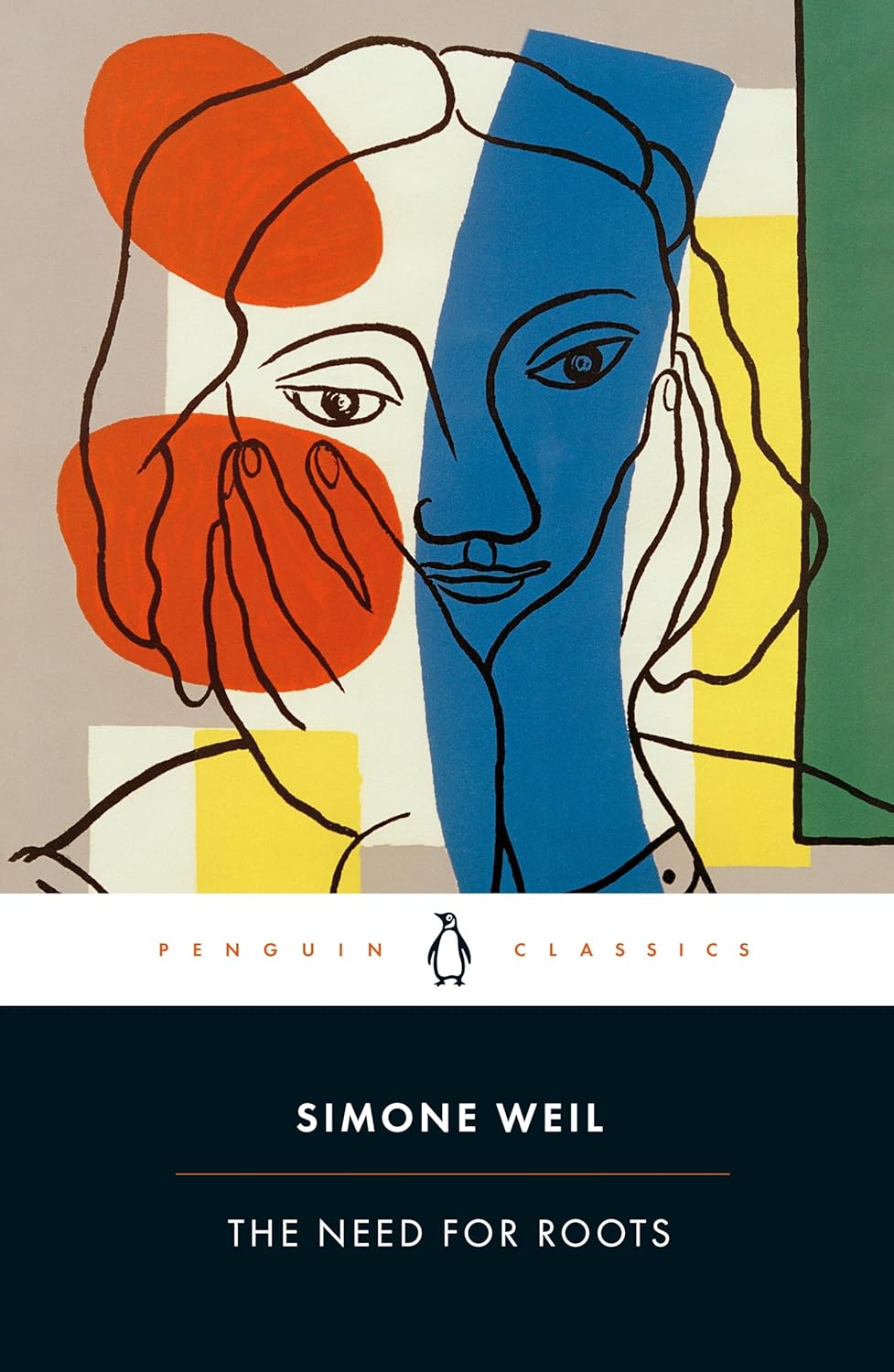
Description:
Editorial Reviews
Review
—Washington Post
About the Author
Reviews:
5.0 out of 5 stars Prophetic Critique Against Devaluing Those Who Grow Our Food
While not written about the American context, I found this to be a prophetic judgment against the way 98% of people in the USA - who don't farm - look down on and devalue the 2% of families in Ag who provide our food. If we don't change this and value locally grown food and our local farmers, there's no hope for our great-grandchildren's food supply.Based on her first-hand experience living and working on French farms from 1941 to 1942, Weil observed that rural workers feel “…haunted by the idea that they are being forgotten.”She explains that the people not employed in agriculture only think about farmers when they are hungry—if even then. “The result,” Weil says, “has been a kind of hatred among the rural classes for 'the left,’ as it is called in politics.”Weil further notes that rural workers frequently feel as though “everything happens in the cities,” leaving them with a persistent sense of being disconnected from modern life. The mainstream media’s portrayal of the urban “good life” only amplifies this dissatisfaction, acting like a drug “worse than cocaine” to those in rural areas.The result—both in France during the 1940s and in the United States today—has been a mass exodus from agricultural work, surrendering this vital part of human existence to industrial farms. Why? Weil poignantly concludes, “Nothing in the world makes up for loss of joy in work.”Having diagnosed the issue, Weil gives an impassioned plea for raising the dignity and value of rural work in her day. While the answers she advocates for in mid-1900s France may not be our own in the United States, her zeal should drive us to seek ways to answer our problems here and raise the dignity and nobility of rural work in our own society back to its rightful place of importance.
3.0 out of 5 stars Sociology in depth study
Simone Weil shares the roots of her story and she has many. Her mystical roots are not included here.
Not worth your time.
To start from the end: this is, at best, a hard-sell read for gushy younglings that fancy sentences about the energy of the spirit of truth found in love (or something in that nauseating fashion), while at worst, an obsolete piece of word torrent that's either water under the bridge, nonsense, poor futurology, or pushy religious/Christian propaganda. And to think that I reached for this book following a very insightful quote by Weil on attention in another writer's read! A heavy chunk of this book is absolutely foreign to anybody (probably including the French today) reading this in 2025, i.e., the state of the French nation's spirit under the Nazi Germany's rule and how to rebuild it after the war. Here, a lot is devoted to how industrial work should look like, effusions that are nothing but hilarious (and surely Weil would contract a brain stroke should she see modern giga factories or the conditions upon which Western fast fashion companies earn a king's ransom). This is one of these books that you struggle through to highlight a sentence that makes sense, requiring a superior willpower to keep searching for another in what is altogether a bundle of mediocrity. To add insult to injury, Weil isn't a brilliant writer, so don't expect experiencing any wonders language-wise. That and the fact she exploits the Big Lie upon which religion is founded in general and Christianity in particular, namely that there is Some Great Godly Goody Beyond that watches over us and inspires, blah blah blah. The problem is that there isn't and if your thoughts go for a dip in the void, they'll surface (at best) nothing or (like in Weil's case) delusions (e.g., there's a chunky section on science that would earn Weil a standing ovation from modern pancake prophets and other wackos). As such, I learned absolutely nothing positive from this book (other than reaffirming that thought based on religion bears no meaningful fruit). This isn't an Orphic read (a classic, ha!) that will make you touch the Heavens - it's a dinosaur, and like them, it's dead. Highly unrecommended.
Tudo ótimo.
Tudo em ordem. Rápida receção. Um clássico da filosofia moderna.
Profound
André Gide called the author "the patron saint of outsiders " for a reason!
Visit the Penguin Classics Store
The Need for Roots: Prelude to a Declaration of Obligations Towards the Human Being
AED9099
Quantity:
Order today to get by 7-14 business days
Delivery fee of AED 20. Free for orders above AED 200.
Imported From: United States
At BOLO, we work hard to ensure the products you receive are new, genuine, and sourced from reputable suppliers.
BOLO is not an authorized or official retailer for most brands, nor are we affiliated with manufacturers unless specifically stated on a product page. Instead, we source verified sellers, authorized distributors or directly from the manufacturer.
Each product undergoes thorough inspection and verification at our consolidation and fulfilment centers to ensure it meets our strict authenticity and quality standards before being shipped and delivered to you.
If you ever have concerns regarding the authenticity of a product purchased from us, please contact Bolo Support. We will review your inquiry promptly and, if necessary, provide documentation verifying authenticity or offer a suitable resolution.
Your trust is our top priority, and we are committed to maintaining transparency and integrity in every transaction.
All product information, images, descriptions, and reviews originate from the manufacturer or from trusted sellers overseas. BOLO is not affiliated with, endorsed by, or an authorized retailer for most brands listed on our website unless stated otherwise.
While we strive to display accurate information, variations in packaging, labeling, instructions, or formulation may occasionally occur due to regional differences or supplier updates. For detailed or manufacturer-specific information, please contact the brand directly or reach out to BOLO Support for assistance.
Unless otherwise stated, all prices displayed on the product page include applicable taxes and import duties.
BOLO operates in accordance with the laws and regulations of United Arab Emirates. Any items found to be restricted or prohibited for sale within the UAE will be cancelled prior to shipment. We take proactive measures to ensure that only products permitted for sale in United Arab Emirates are listed on our website.
All items are shipped by air, and any products classified as “Dangerous Goods (DG)” under IATA regulations will be removed from the order and cancelled.
All orders are processed manually, and we make every effort to process them promptly once confirmed. Products cancelled due to the above reasons will be permanently removed from listings across the website.
Similar suggestions by Bolo
More from this brand
Similar items from “Political”
Share with
Or share with link
https://www.bolo.ae/products/U0241467977
Visit the Penguin Classics Store
The Need for Roots: Prelude to a Declaration of Obligations Towards the Human Being

AED9099
Quantity:
Order today to get by 7-14 business days
Delivery fee of AED 20. Free for orders above AED 200.
Imported From: United States
At BOLO, we work hard to ensure the products you receive are new, genuine, and sourced from reputable suppliers.
BOLO is not an authorized or official retailer for most brands, nor are we affiliated with manufacturers unless specifically stated on a product page. Instead, we source verified sellers, authorized distributors or directly from the manufacturer.
Each product undergoes thorough inspection and verification at our consolidation and fulfilment centers to ensure it meets our strict authenticity and quality standards before being shipped and delivered to you.
If you ever have concerns regarding the authenticity of a product purchased from us, please contact Bolo Support. We will review your inquiry promptly and, if necessary, provide documentation verifying authenticity or offer a suitable resolution.
Your trust is our top priority, and we are committed to maintaining transparency and integrity in every transaction.
All product information, images, descriptions, and reviews originate from the manufacturer or from trusted sellers overseas. BOLO is not affiliated with, endorsed by, or an authorized retailer for most brands listed on our website unless stated otherwise.
While we strive to display accurate information, variations in packaging, labeling, instructions, or formulation may occasionally occur due to regional differences or supplier updates. For detailed or manufacturer-specific information, please contact the brand directly or reach out to BOLO Support for assistance.
Unless otherwise stated, all prices displayed on the product page include applicable taxes and import duties.
BOLO operates in accordance with the laws and regulations of United Arab Emirates. Any items found to be restricted or prohibited for sale within the UAE will be cancelled prior to shipment. We take proactive measures to ensure that only products permitted for sale in United Arab Emirates are listed on our website.
All items are shipped by air, and any products classified as “Dangerous Goods (DG)” under IATA regulations will be removed from the order and cancelled.
All orders are processed manually, and we make every effort to process them promptly once confirmed. Products cancelled due to the above reasons will be permanently removed from listings across the website.
Description:
Editorial Reviews
Review
—Washington Post
About the Author
Reviews:
5.0 out of 5 stars Prophetic Critique Against Devaluing Those Who Grow Our Food
While not written about the American context, I found this to be a prophetic judgment against the way 98% of people in the USA - who don't farm - look down on and devalue the 2% of families in Ag who provide our food. If we don't change this and value locally grown food and our local farmers, there's no hope for our great-grandchildren's food supply.Based on her first-hand experience living and working on French farms from 1941 to 1942, Weil observed that rural workers feel “…haunted by the idea that they are being forgotten.”She explains that the people not employed in agriculture only think about farmers when they are hungry—if even then. “The result,” Weil says, “has been a kind of hatred among the rural classes for 'the left,’ as it is called in politics.”Weil further notes that rural workers frequently feel as though “everything happens in the cities,” leaving them with a persistent sense of being disconnected from modern life. The mainstream media’s portrayal of the urban “good life” only amplifies this dissatisfaction, acting like a drug “worse than cocaine” to those in rural areas.The result—both in France during the 1940s and in the United States today—has been a mass exodus from agricultural work, surrendering this vital part of human existence to industrial farms. Why? Weil poignantly concludes, “Nothing in the world makes up for loss of joy in work.”Having diagnosed the issue, Weil gives an impassioned plea for raising the dignity and value of rural work in her day. While the answers she advocates for in mid-1900s France may not be our own in the United States, her zeal should drive us to seek ways to answer our problems here and raise the dignity and nobility of rural work in our own society back to its rightful place of importance.
3.0 out of 5 stars Sociology in depth study
Simone Weil shares the roots of her story and she has many. Her mystical roots are not included here.
Not worth your time.
To start from the end: this is, at best, a hard-sell read for gushy younglings that fancy sentences about the energy of the spirit of truth found in love (or something in that nauseating fashion), while at worst, an obsolete piece of word torrent that's either water under the bridge, nonsense, poor futurology, or pushy religious/Christian propaganda. And to think that I reached for this book following a very insightful quote by Weil on attention in another writer's read! A heavy chunk of this book is absolutely foreign to anybody (probably including the French today) reading this in 2025, i.e., the state of the French nation's spirit under the Nazi Germany's rule and how to rebuild it after the war. Here, a lot is devoted to how industrial work should look like, effusions that are nothing but hilarious (and surely Weil would contract a brain stroke should she see modern giga factories or the conditions upon which Western fast fashion companies earn a king's ransom). This is one of these books that you struggle through to highlight a sentence that makes sense, requiring a superior willpower to keep searching for another in what is altogether a bundle of mediocrity. To add insult to injury, Weil isn't a brilliant writer, so don't expect experiencing any wonders language-wise. That and the fact she exploits the Big Lie upon which religion is founded in general and Christianity in particular, namely that there is Some Great Godly Goody Beyond that watches over us and inspires, blah blah blah. The problem is that there isn't and if your thoughts go for a dip in the void, they'll surface (at best) nothing or (like in Weil's case) delusions (e.g., there's a chunky section on science that would earn Weil a standing ovation from modern pancake prophets and other wackos). As such, I learned absolutely nothing positive from this book (other than reaffirming that thought based on religion bears no meaningful fruit). This isn't an Orphic read (a classic, ha!) that will make you touch the Heavens - it's a dinosaur, and like them, it's dead. Highly unrecommended.
Tudo ótimo.
Tudo em ordem. Rápida receção. Um clássico da filosofia moderna.
Profound
André Gide called the author "the patron saint of outsiders " for a reason!
Similar suggestions by Bolo
More from this brand
Similar items from “Political”
Share with
Or share with link
https://www.bolo.ae/products/U0241467977