Deliver toUnited Arab Emirates
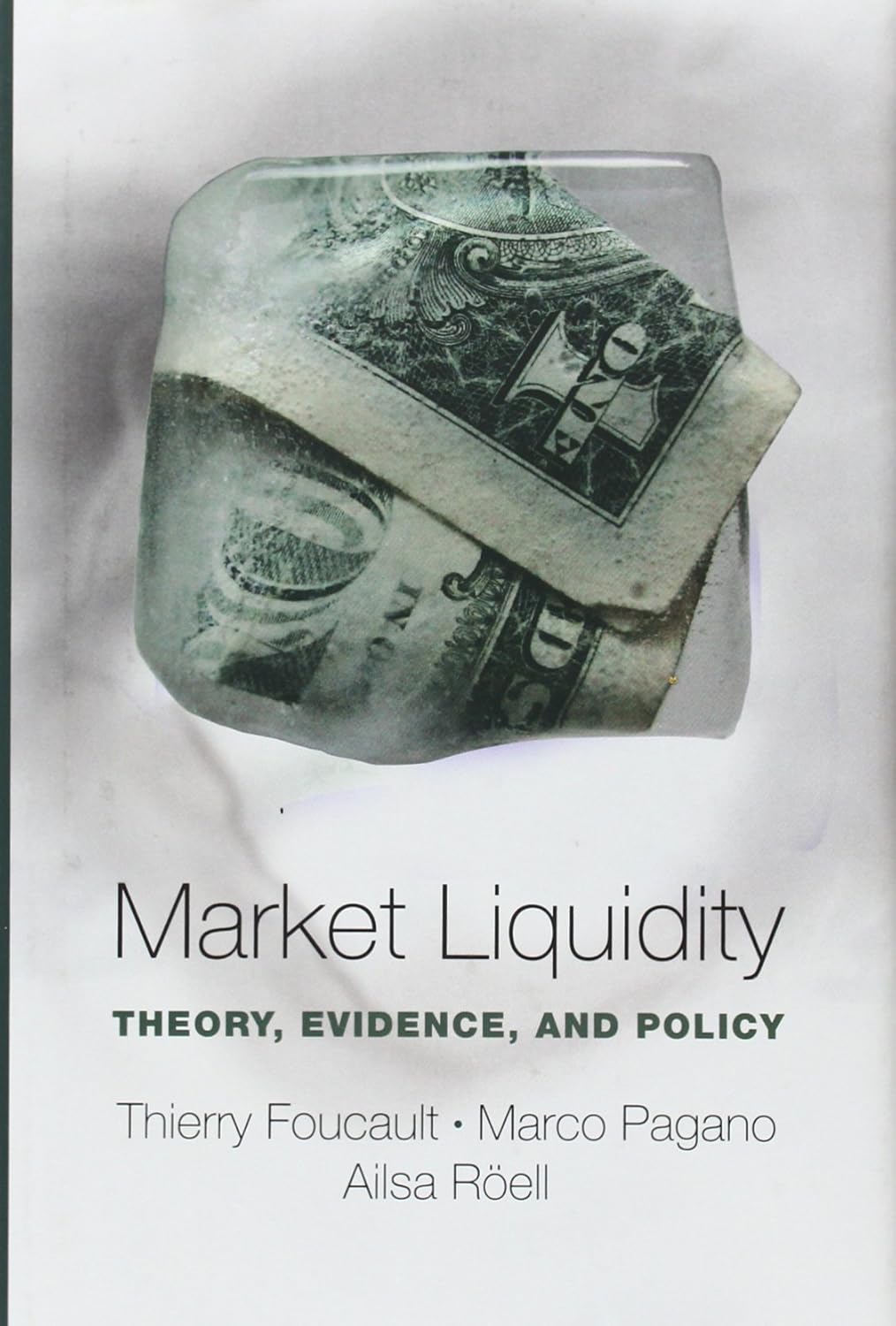
Market Liquidity: Theory, Evidence, and Policy

Description:

The way in which securities are traded is very different from the idealized picture of a frictionless and self-equilibrating market offered by the typical finance textbook. Market Liquidity offers a more accurate and authoritative take on liquidity and price discovery. The authors start from the assumption that not everyone is present at all times simultaneously on the market, and that even the limited number of participants who are have quite diverse information about the security's fundamentals. As a result, the order flow is a complex mix of information and noise, and a consensus price only emerges gradually over time as the trading process evolves and the participants interpret the actions of other traders. Thus a security's actual transaction price may deviate from its fundamental value, as it would be assessed by a fully informed set of investors.

This book takes these deviations seriously, and explains why and how they emerge in the trading process and are eventually eliminated. The authors draw on a vast body of theoretical insights and empirical findings on security price formation that have accumulated in the last thirty years, and have come to form a well-defined field within financial economics known as "market microstructure." Focusing on liquidity and price discovery, they analyze the tension between the two, pointing out that when price-relevant information reaches the market through trading pressure rather than through a public announcement, liquidity suffers.

The book also confronts many puzzling phenomena in securities markets and uses the analytical tools and empirical methods of market microstructure to understand them. These include issues such as why liquidity changes over time, why large trades move prices up or down, and why these price changes are subsequently reversed, why we see concentration of securities trading, why some traders willingly disclose their intended trades while others hide them, and why we observe temporary deviations from arbitrage prices.


Editorial Reviews

Review

"Market Liquidity by Professors Foucault, Pagano and Röell is a wonderful addition to the literature on how markets work; why, sometimes, they don't work as we might wish; and how this affects regulation and corporate decision making. The book is rich in detail, covering the institutional structure of financial markets and the economic and statistical models we use to understand them. While structured as a textbook, it can be read in different ways. Those less interested in the mathematical details will profit from the beautifully written description of the models, some of which are new, and their economic lessons."--Lawrence R. Glosten, S. Sloan Colt Professor of Banking and International Finance, Columbia University

"Ailsa, Marco and Thierry need to be commended for writing this important and timely contribution on the topic of liquidity that has not just matured over the past twenty years, but which has in fact taken a center-stage as practitioners, policy-makers and academics use liquidity of markets as a barometer for the 'healthy functioning' of economies. The book is rigorous and precise, which is useful given liquidity has many connotations. I strongly recommend the book to all interested in understanding liquidity."--Viral Acharya, C.V. Starr Professor of Economics, New York University

"This book is a highly readable introduction to market microstructure, emphasizing both practical institutional details and applications of theoretical and empirical research to the real word of trading. It is a not only a useful introduction to market microstructure for practitioners but also a great textbook for students at advanced undergraduate, masters, and even Ph.D. levels. I like in particular the numerous connections the book makes between trading institutions and public policy issues."--Albert "Pete" Kyle, Charles E. Smith Chair Professor of Finance, University of Maryland

"Drawing on their broad and extensive knowledge of market microstructure, three leading teachers and researchers have written a comprehensive guide to the principles and practicalities of securities trading. Market Liquidity comprehensively covers the dealer and limit order markets that account for the preponderance of trading volume. It provides perspectives on these markets from the viewpoints of market operators, traders, and regulators, and connects these markets to real corporate and investment decisions. The exposition is extremely systematic, lucid and accessible. Students and practitioners alike will find this text to be current and invaluable."--Joel Hasbrouck, Kenneth G. Langone Professor of Finance and Business Administration, New York University

"Foucault, Pagano, and Röell need to be commended for writing this important and timely contribution on the topic of liquidity that has not just matured over the past twenty years, but which has in fact taken center stage as practitioners, policymakers, and academics use liquidity of markets as a barometer for the 'healthy functioning' of economies. The book is rigorous and precise, which is useful given liquidity has many connotations, and it delivers highly on all of its three parts: the first on notions of liquidity and its measurement; the second is on the role of policy and regulation in affecting market liquidity; and, the third on how market liquidity affects asset prices, financial crises, and corporate policies. I strongly recommend this book to all interested in understanding liquidity." -- Viral Acharya, C.V. Starr Professor of Economics, New York University

"Market Liquidity is a wonderful addition to the literature on how markets work; why, sometimes, they don't work as we might wish; and how this affects regulation and corporate decision making. The book is rich in detail, covering the institutional structure of financial markets and the economic and statistical models we use to understand them. While structured as a textbook, it can be read in different ways. Those less interested in the mathematical details will profit from the beautifully written description of the models, some of which are new, and their economic lessons." -- Lawrence R. Glosten, S. Sloan Colt Professor of Banking and International Finance, Columbia University

Book Description

Market Liquidity offers a more accurate and authoritative take on liquidity and price discovery.

Reviews:

5.0 out of 5 stars An excellent description of market microstructure

N.P.G. · April 23, 2013

I haven't finished with the book yet, but on the first pass through it I think the writing is clear and easy to follow. The authors are careful to distinguish between different theoretical measures and models (e.g., models of the bid-ask spread) and make the effort to discuss when and how they can (and can't) be differentiated with real data. I also appreciated the wealth of academic citations and further reading recommendations. On the whole, I think Market Liquidity: Theory, Evidence, and Policy is a great introduction to the topic and I would recommend it to anyone interested in learning about or teaching liquidity or microstructure.

4.0 out of 5 stars Four Stars

D. · August 23, 2014

Highly theoretical, not that much for practitioners who want to understand the markets they place orders in to.

5.0 out of 5 stars Cutting-edge book on market liquidity

C. · April 26, 2013

Just take a look of the table of contents then you understand it is cutting edge and very valuable. If you find something missing in book such as O'Hara (1995), Brunnermeier (2001), Hasbrouck (2007), de Long and Rindi (2009), Vives (2010), Veldkamp (2011) or you want to advance your understanding of financial market, then this is the book for you. We all knew the research contribution made by the authors, now we should thank them for writing such a wonderful book.

5.0 out of 5 stars Excellent introduction to market microstructure

I.T. · February 11, 2014

This is a credible overview of the issues of market microstructure from an academic perspective. The focus is on equity markets, clearly the authors' forte, but there are also nice bits on fixed income and foreign exchange markets. The book covers a good deal of empirical research, basic quantitative models, as well as regulatory matters. All of it is interspersed with historical remarks and cleverly chosen anecdotes. A pleasure to read.

4.0 out of 5 stars Broad and thorough

A. · September 3, 2016

Liquidity can mean a bunch of things. In Economics it’s to do with the money supply and it’s been studied by the likes of Fisher, Keynes and Hicks, all the way to Milton Friedman. In corporate finance it’s to do with the amount of money a firm keeps on hand; given the role (the lack of) liquidity played in the crash of 2008, when firms sold anything that wasn’t nailed to the floor to get their hands on cash, it’s been studied quite extensively too, including by giants like Jean Tirole.This pioneering book is about a third type of liquidity: the impact of a transaction on the price of an asset. In particular, the authors concern themselves with liquidity in the equities market.I’ve spent a quarter century trading bonds, rather than stocks. Bonds trade on voice, mainly, so it’s quasi-impossible for academics to study bond liquidity. I’d therefore never bothered to read the literature.That was my loss!So in my previous job I designed and implemented a market-making algorithm for government bonds based on the “skewed inventory” principle that people use in FX. My colleague Bernard and I had advertised our ability to do this to our employers, but in reality we did not crack the problem until we’d spent a good three months on it, often despairing we’d come up with something reasonable.You can imagine my surprise when I saw the exact answer we came up with on page 150 of this book, which has been in print since 2013. I guess fixed income is a total backwater when it comes to formalizing how liquidity works. That’s my excuse, at any rate :-)The book is split into three parts:The first part is a survey of methods to calculate the right bid-ask for a trade. It starts simple and naïve and slowly builds in all the necessary components:• a charge to compensate for some of the flow being, ahem, “informed”• a charge (or rebate) for the fact that the trade will alter your inventory• finally, drumroll please, your “rent”The converse is covered too: How to go from observing the ticker tape to estimating what the market is charging for all of the above. I loved this part of the book, it made it worth the purchase.The second part of the book covers “Market Design” and should be required reading for all regulators, commentators, for Michael Lewis wannabes etc. You find out that the dealers win if tick size is large, what volatility does to bid-ask (clue: it does not make it easy to quote), it explains what the “Flash Boys” do (with the best explanation ever of Regulation NMS) and generally speaking it’s “all you ever wanted to know about rent extraction but were afraid to ask.”The third part of the book explores another very important aspect of liquidity: the fact that lack of liquidity can stand in the way of asset prices reaching their equilibrium. I’m close to Andrei Shleifer, but I’d never read the paper where he explains mathematically why “the market can stay irrational for longer than you can stay solvent.” The authors do a tremendous job of laying it all out, taking you through the logical steps of how arbitrageurs can be forced to liquidate good positions before the market does it for them. Bravo! They close the book by taking you through the latest theories regarding the impact of liquidity on corporate governance.So what we have here is a potential five-star book, but it is marred by some schoolboy errors that will hopefully disappear from future editions. I’d forgive the authors if those mistakes had not cost me so much time to discover. I list them here to save you from scratching your head:pp. 87-93 the authors confuse themselves for no reason. The spread in equation 3.12 can be derived trivially, but it needs to be imposed on the post-information mid, the one after we know if the customer wanted to buy or sell. So at the bottom of p. 93 where the authors say ASKt = MUt+ and BIDt = MUt- that’s plain wrong. You need to add the half-spread to MUt+ to get to ASKt and you need to subtract the half-spread from MUt- to get to BIDt.p. 109 it’s wrong to say that Yt = Dt, it’s –Dt. But two wrongs make a right (think about it) and formula 3.45 a bit further down is correct.p. 139 contrary to the claim the formulae do not describe the volatility in response to an uninformed trade. They describe the volatility in response to mixed flow of informed and uninformed trades.Finally (and this is not really a mistake) on page 167 the author gets all the math right, but fails to draw a conclusion that could be super-helpful to arguments made in the second part of the book: the dealer rent may well wash out of the correlation, but it sure hurts the client’s back pocket!Regardless of these mistakes, I thoroughly enjoyed this book and recommend it to anybody who wants to understand market liquidity. Don’t be scared, the math is totally within the grasp of a good high school student!

5.0 out of 5 stars Five Stars

C.G. · May 30, 2015

Great book

excellent

t. · May 9, 2014

very good book for masters level and to some extent PhD level studies. I found it to be very useful for my PhD research.

This book is very much useful for both the beginners and also to those who ...

D.G.H. · April 26, 2015

This book is very much useful for both the beginners and also to those who are advanced learners of Market Microstructure. This book can be easily adopted for course on Market Microstructure along with trading and exchanges. I used it for a course on Market Microstructure and students highly appreciated the contents. The authors provide lucid yet depth the liquidity aspects, both theoretical and empirical estimations. For those who are pursuing research in the area of Market Microstructure, this book will be a nice addition to their resources. I highly recommend it.

Broad and thorough

A. · September 3, 2016

Liquidity can mean a bunch of things. In Economics it’s to do with the money supply and it’s been studied by the likes of Fisher, Keynes and Hicks, all the way to Milton Friedman. In corporate finance it’s to do with the amount of money a firm keeps on hand; given the role (the lack of) liquidity played in the crash of 2008, when firms sold anything that wasn’t nailed to the floor to get their hands on cash, it’s been studied quite extensively too, including by giants like Jean Tirole.This pioneering book is about a third type of liquidity: the impact of a transaction on the price of an asset. In particular, the authors concern themselves with liquidity in the equities market.I’ve spent a quarter century trading bonds, rather than stocks. Bonds trade on voice, mainly, so it’s quasi-impossible for academics to study bond liquidity. I’d therefore never bothered to read the literature.That was my loss!So in my previous job I designed and implemented a market-making algorithm for government bonds based on the “skewed inventory” principle that people use in FX. My colleague Bernard and I had advertised our ability to do this to our employers, but in reality we did not crack the problem until we’d spent a good three months on it, often despairing we’d come up with something reasonable.You can imagine my surprise when I saw the exact answer we came up with on page 150 of this book, which has been in print since 2013. I guess fixed income is a total backwater when it comes to formalizing how liquidity works. That’s my excuse, at any rate :-)The book is split into three parts:The first part is a survey of methods to calculate the right bid-ask for a trade. It starts simple and naïve and slowly builds in all the necessary components:• a charge to compensate for some of the flow being, ahem, “informed”• a charge (or rebate) for the fact that the trade will alter your inventory• finally, drumroll please, your “rent”The converse is covered too: How to go from observing the ticker tape to estimating what the market is charging for all of the above. I loved this part of the book, it made it worth the purchase.The second part of the book covers “Market Design” and should be required reading for all regulators, commentators, for Michael Lewis wannabes etc. You find out that the dealers win if tick size is large, what volatility does to bid-ask (clue: it does not make it easy to quote), it explains what the “Flash Boys” do (with the best explanation ever of Regulation NMS) and generally speaking it’s “all you ever wanted to know about rent extraction but were afraid to ask.”The third part of the book explores another very important aspect of liquidity: the fact that lack of liquidity can stand in the way of asset prices reaching their equilibrium. I’m close to Andrei Shleifer, but I’d never read the paper where he explains mathematically why “the market can stay irrational for longer than you can stay solvent.” The authors do a tremendous job of laying it all out, taking you through the logical steps of how arbitrageurs can be forced to liquidate good positions before the market does it for them. Bravo! They close the book by taking you through the latest theories regarding the impact of liquidity on corporate governance.So what we have here is a potential five-star book, but it is marred by some schoolboy errors that will hopefully disappear from future editions. I’d forgive the authors if those mistakes had not cost me so much time to discover. I list them here to save you from scratching your head:pp. 87-93 the authors confuse themselves for no reason. The spread in equation 3.12 can be derived trivially, but it needs to be imposed on the post-information mid, the one after we know if the customer wanted to buy or sell. So at the bottom of p. 93 where the authors say ASKt = MUt+ and BIDt = MUt- that’s plain wrong. You need to add the half-spread to MUt+ to get to ASKt and you need to subtract the half-spread from MUt- to get to BIDt.p. 109 it’s wrong to say that Yt = Dt, it’s –Dt. But two wrongs make a right (think about it) and formula 3.45 a bit further down is correct.p. 139 contrary to the claim the formulae do not describe the volatility in response to an uninformed trade. They describe the volatility in response to mixed flow of informed and uninformed trades.Finally (and this is not really a mistake) on page 167 the author gets all the math right, but fails to draw a conclusion that could be super-helpful to arguments made in the second part of the book: the dealer rent may well wash out of the correlation, but it sure hurts the client’s back pocket!Regardless of these mistakes, I thoroughly enjoyed this book and recommend it to anybody who wants to understand market liquidity. Don’t be scared, the math is totally within the grasp of a good high school student!

Market Liquidity: Theory, Evidence, and Policy

Product ID: U0199936242
Condition: New

4.7

AED67010

Price includes VAT & Import Duties
Type: Hardcover
Availability: In Stock

Quantity:

|

Order today to get by 7-14 business days

This item qualifies for free delivery

Returns & Warranty policies

Imported From: United States

At BOLO, we work hard to ensure the products you receive are new, genuine, and sourced from reputable suppliers.

BOLO is not an authorized or official retailer for most brands, nor are we affiliated with manufacturers unless specifically stated on a product page. Instead, we source verified sellers, authorized distributors or directly from the manufacturer.

Each product undergoes thorough inspection and verification at our consolidation and fulfilment centers to ensure it meets our strict authenticity and quality standards before being shipped and delivered to you.

If you ever have concerns regarding the authenticity of a product purchased from us, please contact Bolo Support. We will review your inquiry promptly and, if necessary, provide documentation verifying authenticity or offer a suitable resolution.

Your trust is our top priority, and we are committed to maintaining transparency and integrity in every transaction.

All product information, images, descriptions, and reviews originate from the manufacturer or from trusted sellers overseas. BOLO is not affiliated with, endorsed by, or an authorized retailer for most brands listed on our website unless stated otherwise.

While we strive to display accurate information, variations in packaging, labeling, instructions, or formulation may occasionally occur due to regional differences or supplier updates. For detailed or manufacturer-specific information, please contact the brand directly or reach out to BOLO Support for assistance.

Unless otherwise stated, all prices displayed on the product page include applicable taxes and import duties.

BOLO operates in accordance with the laws and regulations of United Arab Emirates. Any items found to be restricted or prohibited for sale within the UAE will be cancelled prior to shipment. We take proactive measures to ensure that only products permitted for sale in United Arab Emirates are listed on our website.

All items are shipped by air, and any products classified as “Dangerous Goods (DG)” under IATA regulations will be removed from the order and cancelled.

All orders are processed manually, and we make every effort to process them promptly once confirmed. Products cancelled due to the above reasons will be permanently removed from listings across the website.

Similar suggestions by Bolo

More from this brand

Similar items from “Corporate Finance”

Market Liquidity: Theory, Evidence, and Policy

Product ID: U0199936242
Condition: New

4.7

Market Liquidity: Theory, Evidence, and Policy-0
Type: Hardcover

AED67010

Price includes VAT & Import Duties
Availability: In Stock

Quantity:

|

Order today to get by 7-14 business days

This item qualifies for free delivery

Returns & Warranty policies

Imported From: United States

At BOLO, we work hard to ensure the products you receive are new, genuine, and sourced from reputable suppliers.

BOLO is not an authorized or official retailer for most brands, nor are we affiliated with manufacturers unless specifically stated on a product page. Instead, we source verified sellers, authorized distributors or directly from the manufacturer.

Each product undergoes thorough inspection and verification at our consolidation and fulfilment centers to ensure it meets our strict authenticity and quality standards before being shipped and delivered to you.

If you ever have concerns regarding the authenticity of a product purchased from us, please contact Bolo Support. We will review your inquiry promptly and, if necessary, provide documentation verifying authenticity or offer a suitable resolution.

Your trust is our top priority, and we are committed to maintaining transparency and integrity in every transaction.

All product information, images, descriptions, and reviews originate from the manufacturer or from trusted sellers overseas. BOLO is not affiliated with, endorsed by, or an authorized retailer for most brands listed on our website unless stated otherwise.

While we strive to display accurate information, variations in packaging, labeling, instructions, or formulation may occasionally occur due to regional differences or supplier updates. For detailed or manufacturer-specific information, please contact the brand directly or reach out to BOLO Support for assistance.

Unless otherwise stated, all prices displayed on the product page include applicable taxes and import duties.

BOLO operates in accordance with the laws and regulations of United Arab Emirates. Any items found to be restricted or prohibited for sale within the UAE will be cancelled prior to shipment. We take proactive measures to ensure that only products permitted for sale in United Arab Emirates are listed on our website.

All items are shipped by air, and any products classified as “Dangerous Goods (DG)” under IATA regulations will be removed from the order and cancelled.

All orders are processed manually, and we make every effort to process them promptly once confirmed. Products cancelled due to the above reasons will be permanently removed from listings across the website.

Description:

The way in which securities are traded is very different from the idealized picture of a frictionless and self-equilibrating market offered by the typical finance textbook. Market Liquidity offers a more accurate and authoritative take on liquidity and price discovery. The authors start from the assumption that not everyone is present at all times simultaneously on the market, and that even the limited number of participants who are have quite diverse information about the security's fundamentals. As a result, the order flow is a complex mix of information and noise, and a consensus price only emerges gradually over time as the trading process evolves and the participants interpret the actions of other traders. Thus a security's actual transaction price may deviate from its fundamental value, as it would be assessed by a fully informed set of investors.

This book takes these deviations seriously, and explains why and how they emerge in the trading process and are eventually eliminated. The authors draw on a vast body of theoretical insights and empirical findings on security price formation that have accumulated in the last thirty years, and have come to form a well-defined field within financial economics known as "market microstructure." Focusing on liquidity and price discovery, they analyze the tension between the two, pointing out that when price-relevant information reaches the market through trading pressure rather than through a public announcement, liquidity suffers.

The book also confronts many puzzling phenomena in securities markets and uses the analytical tools and empirical methods of market microstructure to understand them. These include issues such as why liquidity changes over time, why large trades move prices up or down, and why these price changes are subsequently reversed, why we see concentration of securities trading, why some traders willingly disclose their intended trades while others hide them, and why we observe temporary deviations from arbitrage prices.


Editorial Reviews

Review

"Market Liquidity by Professors Foucault, Pagano and Röell is a wonderful addition to the literature on how markets work; why, sometimes, they don't work as we might wish; and how this affects regulation and corporate decision making. The book is rich in detail, covering the institutional structure of financial markets and the economic and statistical models we use to understand them. While structured as a textbook, it can be read in different ways. Those less interested in the mathematical details will profit from the beautifully written description of the models, some of which are new, and their economic lessons."--Lawrence R. Glosten, S. Sloan Colt Professor of Banking and International Finance, Columbia University

"Ailsa, Marco and Thierry need to be commended for writing this important and timely contribution on the topic of liquidity that has not just matured over the past twenty years, but which has in fact taken a center-stage as practitioners, policy-makers and academics use liquidity of markets as a barometer for the 'healthy functioning' of economies. The book is rigorous and precise, which is useful given liquidity has many connotations. I strongly recommend the book to all interested in understanding liquidity."--Viral Acharya, C.V. Starr Professor of Economics, New York University

"This book is a highly readable introduction to market microstructure, emphasizing both practical institutional details and applications of theoretical and empirical research to the real word of trading. It is a not only a useful introduction to market microstructure for practitioners but also a great textbook for students at advanced undergraduate, masters, and even Ph.D. levels. I like in particular the numerous connections the book makes between trading institutions and public policy issues."--Albert "Pete" Kyle, Charles E. Smith Chair Professor of Finance, University of Maryland

"Drawing on their broad and extensive knowledge of market microstructure, three leading teachers and researchers have written a comprehensive guide to the principles and practicalities of securities trading. Market Liquidity comprehensively covers the dealer and limit order markets that account for the preponderance of trading volume. It provides perspectives on these markets from the viewpoints of market operators, traders, and regulators, and connects these markets to real corporate and investment decisions. The exposition is extremely systematic, lucid and accessible. Students and practitioners alike will find this text to be current and invaluable."--Joel Hasbrouck, Kenneth G. Langone Professor of Finance and Business Administration, New York University

"Foucault, Pagano, and Röell need to be commended for writing this important and timely contribution on the topic of liquidity that has not just matured over the past twenty years, but which has in fact taken center stage as practitioners, policymakers, and academics use liquidity of markets as a barometer for the 'healthy functioning' of economies. The book is rigorous and precise, which is useful given liquidity has many connotations, and it delivers highly on all of its three parts: the first on notions of liquidity and its measurement; the second is on the role of policy and regulation in affecting market liquidity; and, the third on how market liquidity affects asset prices, financial crises, and corporate policies. I strongly recommend this book to all interested in understanding liquidity." -- Viral Acharya, C.V. Starr Professor of Economics, New York University

"Market Liquidity is a wonderful addition to the literature on how markets work; why, sometimes, they don't work as we might wish; and how this affects regulation and corporate decision making. The book is rich in detail, covering the institutional structure of financial markets and the economic and statistical models we use to understand them. While structured as a textbook, it can be read in different ways. Those less interested in the mathematical details will profit from the beautifully written description of the models, some of which are new, and their economic lessons." -- Lawrence R. Glosten, S. Sloan Colt Professor of Banking and International Finance, Columbia University

Book Description

Market Liquidity offers a more accurate and authoritative take on liquidity and price discovery.

Reviews:

5.0 out of 5 stars An excellent description of market microstructure

N.P.G. · April 23, 2013

I haven't finished with the book yet, but on the first pass through it I think the writing is clear and easy to follow. The authors are careful to distinguish between different theoretical measures and models (e.g., models of the bid-ask spread) and make the effort to discuss when and how they can (and can't) be differentiated with real data. I also appreciated the wealth of academic citations and further reading recommendations. On the whole, I think Market Liquidity: Theory, Evidence, and Policy is a great introduction to the topic and I would recommend it to anyone interested in learning about or teaching liquidity or microstructure.

4.0 out of 5 stars Four Stars

D. · August 23, 2014

Highly theoretical, not that much for practitioners who want to understand the markets they place orders in to.

5.0 out of 5 stars Cutting-edge book on market liquidity

C. · April 26, 2013

Just take a look of the table of contents then you understand it is cutting edge and very valuable. If you find something missing in book such as O'Hara (1995), Brunnermeier (2001), Hasbrouck (2007), de Long and Rindi (2009), Vives (2010), Veldkamp (2011) or you want to advance your understanding of financial market, then this is the book for you. We all knew the research contribution made by the authors, now we should thank them for writing such a wonderful book.

5.0 out of 5 stars Excellent introduction to market microstructure

I.T. · February 11, 2014

This is a credible overview of the issues of market microstructure from an academic perspective. The focus is on equity markets, clearly the authors' forte, but there are also nice bits on fixed income and foreign exchange markets. The book covers a good deal of empirical research, basic quantitative models, as well as regulatory matters. All of it is interspersed with historical remarks and cleverly chosen anecdotes. A pleasure to read.

4.0 out of 5 stars Broad and thorough

A. · September 3, 2016

Liquidity can mean a bunch of things. In Economics it’s to do with the money supply and it’s been studied by the likes of Fisher, Keynes and Hicks, all the way to Milton Friedman. In corporate finance it’s to do with the amount of money a firm keeps on hand; given the role (the lack of) liquidity played in the crash of 2008, when firms sold anything that wasn’t nailed to the floor to get their hands on cash, it’s been studied quite extensively too, including by giants like Jean Tirole.This pioneering book is about a third type of liquidity: the impact of a transaction on the price of an asset. In particular, the authors concern themselves with liquidity in the equities market.I’ve spent a quarter century trading bonds, rather than stocks. Bonds trade on voice, mainly, so it’s quasi-impossible for academics to study bond liquidity. I’d therefore never bothered to read the literature.That was my loss!So in my previous job I designed and implemented a market-making algorithm for government bonds based on the “skewed inventory” principle that people use in FX. My colleague Bernard and I had advertised our ability to do this to our employers, but in reality we did not crack the problem until we’d spent a good three months on it, often despairing we’d come up with something reasonable.You can imagine my surprise when I saw the exact answer we came up with on page 150 of this book, which has been in print since 2013. I guess fixed income is a total backwater when it comes to formalizing how liquidity works. That’s my excuse, at any rate :-)The book is split into three parts:The first part is a survey of methods to calculate the right bid-ask for a trade. It starts simple and naïve and slowly builds in all the necessary components:• a charge to compensate for some of the flow being, ahem, “informed”• a charge (or rebate) for the fact that the trade will alter your inventory• finally, drumroll please, your “rent”The converse is covered too: How to go from observing the ticker tape to estimating what the market is charging for all of the above. I loved this part of the book, it made it worth the purchase.The second part of the book covers “Market Design” and should be required reading for all regulators, commentators, for Michael Lewis wannabes etc. You find out that the dealers win if tick size is large, what volatility does to bid-ask (clue: it does not make it easy to quote), it explains what the “Flash Boys” do (with the best explanation ever of Regulation NMS) and generally speaking it’s “all you ever wanted to know about rent extraction but were afraid to ask.”The third part of the book explores another very important aspect of liquidity: the fact that lack of liquidity can stand in the way of asset prices reaching their equilibrium. I’m close to Andrei Shleifer, but I’d never read the paper where he explains mathematically why “the market can stay irrational for longer than you can stay solvent.” The authors do a tremendous job of laying it all out, taking you through the logical steps of how arbitrageurs can be forced to liquidate good positions before the market does it for them. Bravo! They close the book by taking you through the latest theories regarding the impact of liquidity on corporate governance.So what we have here is a potential five-star book, but it is marred by some schoolboy errors that will hopefully disappear from future editions. I’d forgive the authors if those mistakes had not cost me so much time to discover. I list them here to save you from scratching your head:pp. 87-93 the authors confuse themselves for no reason. The spread in equation 3.12 can be derived trivially, but it needs to be imposed on the post-information mid, the one after we know if the customer wanted to buy or sell. So at the bottom of p. 93 where the authors say ASKt = MUt+ and BIDt = MUt- that’s plain wrong. You need to add the half-spread to MUt+ to get to ASKt and you need to subtract the half-spread from MUt- to get to BIDt.p. 109 it’s wrong to say that Yt = Dt, it’s –Dt. But two wrongs make a right (think about it) and formula 3.45 a bit further down is correct.p. 139 contrary to the claim the formulae do not describe the volatility in response to an uninformed trade. They describe the volatility in response to mixed flow of informed and uninformed trades.Finally (and this is not really a mistake) on page 167 the author gets all the math right, but fails to draw a conclusion that could be super-helpful to arguments made in the second part of the book: the dealer rent may well wash out of the correlation, but it sure hurts the client’s back pocket!Regardless of these mistakes, I thoroughly enjoyed this book and recommend it to anybody who wants to understand market liquidity. Don’t be scared, the math is totally within the grasp of a good high school student!

5.0 out of 5 stars Five Stars

C.G. · May 30, 2015

Great book

excellent

t. · May 9, 2014

very good book for masters level and to some extent PhD level studies. I found it to be very useful for my PhD research.

This book is very much useful for both the beginners and also to those who ...

D.G.H. · April 26, 2015

This book is very much useful for both the beginners and also to those who are advanced learners of Market Microstructure. This book can be easily adopted for course on Market Microstructure along with trading and exchanges. I used it for a course on Market Microstructure and students highly appreciated the contents. The authors provide lucid yet depth the liquidity aspects, both theoretical and empirical estimations. For those who are pursuing research in the area of Market Microstructure, this book will be a nice addition to their resources. I highly recommend it.

Broad and thorough

A. · September 3, 2016

Liquidity can mean a bunch of things. In Economics it’s to do with the money supply and it’s been studied by the likes of Fisher, Keynes and Hicks, all the way to Milton Friedman. In corporate finance it’s to do with the amount of money a firm keeps on hand; given the role (the lack of) liquidity played in the crash of 2008, when firms sold anything that wasn’t nailed to the floor to get their hands on cash, it’s been studied quite extensively too, including by giants like Jean Tirole.This pioneering book is about a third type of liquidity: the impact of a transaction on the price of an asset. In particular, the authors concern themselves with liquidity in the equities market.I’ve spent a quarter century trading bonds, rather than stocks. Bonds trade on voice, mainly, so it’s quasi-impossible for academics to study bond liquidity. I’d therefore never bothered to read the literature.That was my loss!So in my previous job I designed and implemented a market-making algorithm for government bonds based on the “skewed inventory” principle that people use in FX. My colleague Bernard and I had advertised our ability to do this to our employers, but in reality we did not crack the problem until we’d spent a good three months on it, often despairing we’d come up with something reasonable.You can imagine my surprise when I saw the exact answer we came up with on page 150 of this book, which has been in print since 2013. I guess fixed income is a total backwater when it comes to formalizing how liquidity works. That’s my excuse, at any rate :-)The book is split into three parts:The first part is a survey of methods to calculate the right bid-ask for a trade. It starts simple and naïve and slowly builds in all the necessary components:• a charge to compensate for some of the flow being, ahem, “informed”• a charge (or rebate) for the fact that the trade will alter your inventory• finally, drumroll please, your “rent”The converse is covered too: How to go from observing the ticker tape to estimating what the market is charging for all of the above. I loved this part of the book, it made it worth the purchase.The second part of the book covers “Market Design” and should be required reading for all regulators, commentators, for Michael Lewis wannabes etc. You find out that the dealers win if tick size is large, what volatility does to bid-ask (clue: it does not make it easy to quote), it explains what the “Flash Boys” do (with the best explanation ever of Regulation NMS) and generally speaking it’s “all you ever wanted to know about rent extraction but were afraid to ask.”The third part of the book explores another very important aspect of liquidity: the fact that lack of liquidity can stand in the way of asset prices reaching their equilibrium. I’m close to Andrei Shleifer, but I’d never read the paper where he explains mathematically why “the market can stay irrational for longer than you can stay solvent.” The authors do a tremendous job of laying it all out, taking you through the logical steps of how arbitrageurs can be forced to liquidate good positions before the market does it for them. Bravo! They close the book by taking you through the latest theories regarding the impact of liquidity on corporate governance.So what we have here is a potential five-star book, but it is marred by some schoolboy errors that will hopefully disappear from future editions. I’d forgive the authors if those mistakes had not cost me so much time to discover. I list them here to save you from scratching your head:pp. 87-93 the authors confuse themselves for no reason. The spread in equation 3.12 can be derived trivially, but it needs to be imposed on the post-information mid, the one after we know if the customer wanted to buy or sell. So at the bottom of p. 93 where the authors say ASKt = MUt+ and BIDt = MUt- that’s plain wrong. You need to add the half-spread to MUt+ to get to ASKt and you need to subtract the half-spread from MUt- to get to BIDt.p. 109 it’s wrong to say that Yt = Dt, it’s –Dt. But two wrongs make a right (think about it) and formula 3.45 a bit further down is correct.p. 139 contrary to the claim the formulae do not describe the volatility in response to an uninformed trade. They describe the volatility in response to mixed flow of informed and uninformed trades.Finally (and this is not really a mistake) on page 167 the author gets all the math right, but fails to draw a conclusion that could be super-helpful to arguments made in the second part of the book: the dealer rent may well wash out of the correlation, but it sure hurts the client’s back pocket!Regardless of these mistakes, I thoroughly enjoyed this book and recommend it to anybody who wants to understand market liquidity. Don’t be scared, the math is totally within the grasp of a good high school student!

Similar suggestions by Bolo

More from this brand

Similar items from “Corporate Finance”