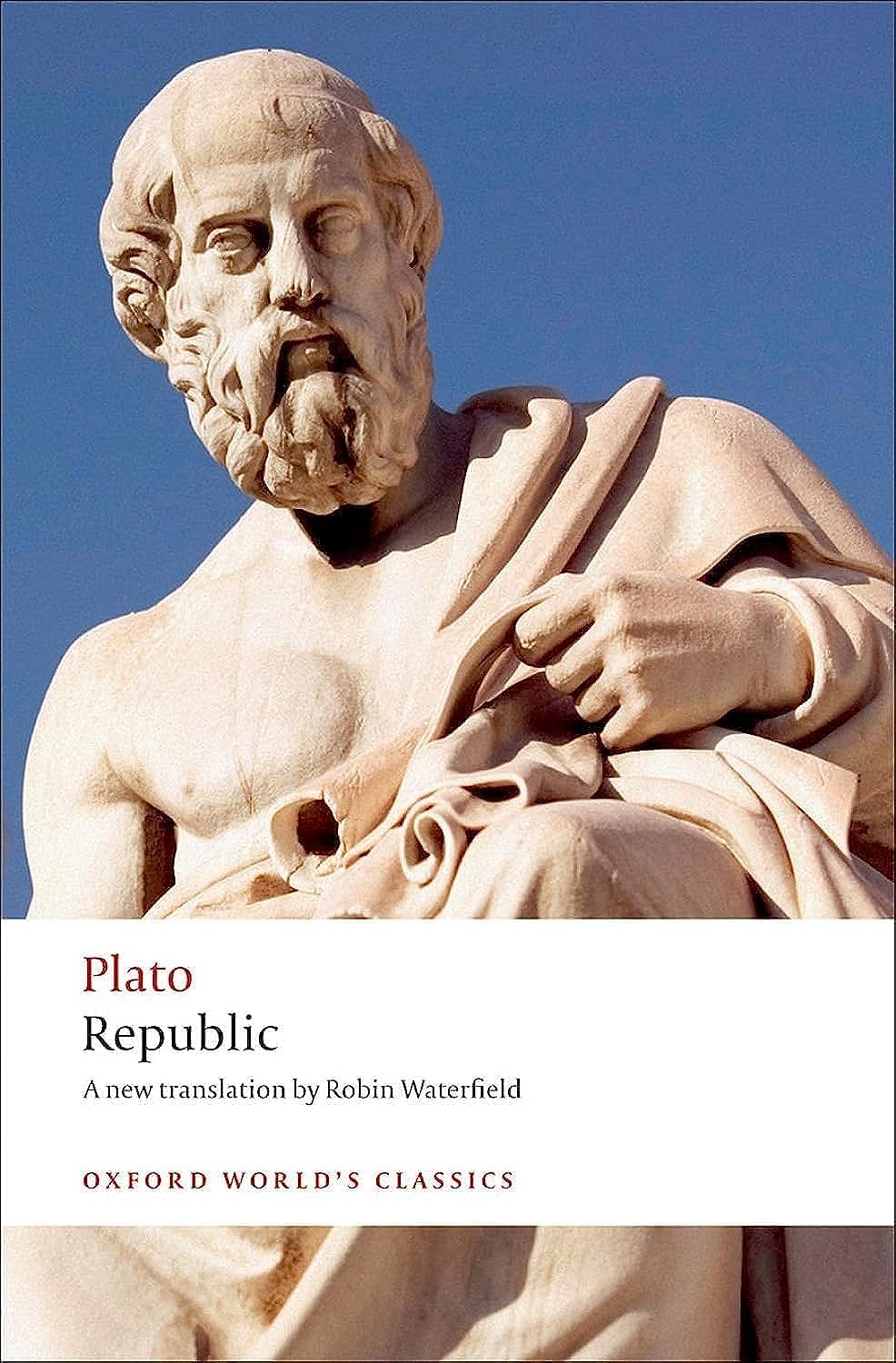
Description:
Editorial Reviews
Reviews:
5.0 out of 5 stars Republic (Oxford World's Classics)
(function() { P.when('cr-A', 'ready').execute(function(A) { if(typeof A.toggleExpanderAriaLabel === 'function') { A.toggleExpanderAriaLabel('review_text_read_more', 'Read more of this review', 'Read less of this review'); } }); })(); .review-text-read-more-expander:focus-visible { outline: 2px solid #2162a1; outline-offset: 2px; border-radius: 5px; } Plato’s Republic is truly a timeless masterpiece, and the edition from Oxford World's Classics makes this essential work even more accessible. Having read it multiple times since 2010, I can say with confidence that this book continues to offer new insights with each read.Plato’s exploration of justice, the ideal state, and the nature of human virtue is as relevant today as it was when it was first written. The dialogue between Socrates and his interlocutors is both intellectually stimulating and philosophically profound, delving into topics such as the nature of reality, the soul, and the pursuit of knowledge. The way Plato weaves these ideas together into a cohesive vision of society and morality is both captivating and thought-provoking.The Oxford World's Classics edition is excellent, providing helpful notes, a detailed introduction, and a clear translation that makes it easier to grasp the deeper meanings behind Plato’s complex ideas. This version enhances the reading experience and helps contextualize the historical and philosophical background for a modern audience.If you enjoy philosophy or simply want to gain a deeper understanding of how ideas about justice and society have evolved, I highly recommend Republic. It’s a foundational text that has stood the test of time, and this edition does it justice. Each reading offers more to think about, making it a book you can revisit time and time again.
5.0 out of 5 stars An Admirable Achievement in Clarity and Directness
Among all the translators of Plato's Republic who claim that their translations are intended to be readable, Robin Waterfield seems to be the only one to have truly fulfilled the pledge. His translation has demonstrated a simple belief that Plato meant for his Greek to be as readable and fluent as in an everyday conversation and that is exactly what Mr. Waterfield is doing with his modern English --- without assuming that there is a built-in difficulty in all the classic literatures. Because, he believes, "reading Plato should be easy; understanding Plato can be difficult." A rare combination of the knowledge of classic philosophy and the writing of children's fiction to his credit must have contributed to the admirable achievement of clarity and directness.In addition to readability, Waterfield has also made a unique contribution by abandoning the traditional "ten books" design (which was not made by Plato himself anyway) and regrouped them into "fourteen chapters" following the natural flow of the internal arguments in the texts. It is therefore only too logical for him to give each of his fourteen chapters a title and a brief introduction, not only for convenience but also to provide an overall scope of the book, which is in fact the longest and most complicated of all Plato's dialogues. Of course, he has no need to give up the standard means of reference to passages in Plato and the reader still feels quite at home with the conventional setting started as early as in 1578. To an avid reader, this new translation in Oxford World's Classics is an invaluable addition to his existing collection, large or small.One more point deserves our special admiration. While most translators think Republic is about justice in the sense of politics more or less, Waterfield alone chooses morality for the Greek word dikaiosone, which refers to something larger than justice and that "encompasses all the various virtues and is almost synonymous with virtue in general" (Aristotle Ethics). This intrinsic quality of justice does not, however, show up to give him support until in the last two Books (IX and X), or Chapters 12-14 in our case, where the issues of happiness, or unhappiness, and immortality of the soul are brought up. At this point Waterfield needs waste no time to prove that the book title Republic is rather inadequate, if not a misnomer, for being taken directly from the Greek word politeia, which means the public life of a community and has little or no apparent relationship to the idea of republicanism as we understand it today.
5.0 out of 5 stars Health freak
great
5.0 out of 5 stars A Gift
This was given to a friend as a gift. He was very pleased to receive it.
4.0 out of 5 stars It's good
I own a different paper copy that I find to be a much better translation than this one. Perhaps it's because it was the first translation I read of this classic book. The language used in this book is not the stoic language you migh expect, whether that's good or not is up to the individual.
5.0 out of 5 stars Great book
Excellent work in the Intro by the translator..., it preps the reader to best understand this complex work of classical philosophy.
5.0 out of 5 stars One of the finest translations of the Republic
One of the finest translations of the Republic, the central work in the Platonic corpus, with a solid introduction and helpful notes.
2.0 out of 5 stars Although some comments are positive, I reject this translation's ...
Although some comments are positive, I reject this translator's' decision to translate dikaois as "morality" instead of "justice" as every other translation gives it. The English word "morality" conveys shades of meaning foreign to Plato's argument; and using this new translation also makes it difficult to enter into dialogue with earlier interpretations who assume the translation "justice." It seems equally perverse to reject the traditional division into ten books and instead use fourteen "chapters" -- each one given a title! This is seriously distracting -- and again, makes it hard to enter into dialogue with anyone using another translation. I'd suggest using Tom Griffith's Cambridge translation instead.
Must read
(function() { P.when('cr-A', 'ready').execute(function(A) { if(typeof A.toggleExpanderAriaLabel === 'function') { A.toggleExpanderAriaLabel('review_text_read_more', 'Read more of this review', 'Read less of this review'); } }); })(); .review-text-read-more-expander:focus-visible { outline: 2px solid #2162a1; outline-offset: 2px; border-radius: 5px; } Plato's Republic is one of the most significant books I ever read. It contributed so vastly to western society. Whether you follow his philosophy of stoicism or not, this is a must-read.
Best translation of Plato's masterpiece. Great introduction and notes.
Plato's text is easy to read, but difficult to understand, which is why this edition is so good. I have a hard copy and Kindle version of Waterfield's translation which was also used by Simon Blackburn in his own book on the Republic.Here's my take on the book after multiple readings of this and other translations.There are two ideas of the 'good' at play in the Republic.Firstly, the idea of the 'good' as doing the right thing; what we call ethics or justice, this is the traditional idea of the Good presented by Glaucon in the Republic. Plato shows this to be inadequate at the beginning of the dialogue. The other, is the idea of the 'good' as something constituted, in such a way, that it can fulfil a particular purpose; this something, might be a household implement, an individual human being, or a community of human beings. The function of a knife is to cut, while the function of human beings, is to live and prosper. In order to cut, the knife must be sharp, and easily handled; in order to live and prosper, human beings must be healthy, and well provided for. Plato goes on to show, that this idea on its own, is also inadequate, and that the two types of 'good' are integral to something, much broader and deeper, than just ethics or function. This broader and deeper conception of the Good is Plato's imaginative project in the Republic; but before he can present his ideas, he looks to understand, how human beings are constituted, and how ethics or justice, have been formulated, to facilitate life and prosperity.Justice is the 'business of everyone performing their task ... the principle that each single individual is to perform his own task without troubling himself about the tasks of others'. Morality is how we treat others; if we respect the fact that each person has a different task to perform, we will also respect, the resources they have at their disposal, in order to complete these tasks. How are human beings constituted? According to Plato, the mind or soul, is made up of three faculties forming a pyramid structure, with rationality at the apex, a passionate nature forming the middle, and a desiring appetite the base. 'The desirous part, is the major constituent of an individual's mind and is naturally insatiably greedy for things', 'the rational part is wise and looks out for the whole of the mind', and should rule, with the passionate part as its subordinate ally. 'The rational part will do the planning, and the passionate part the fighting'. Plato argues that communities reflect this tripartite structure of the human mind. When the human being or community is well-regulated it is able to sustain life and prosperity.In this way, morality is both ethical and functional. The most rational part of the human mind, and the most rational part of a community, must rule in order for mankind to fulfil its particular purpose. Plato's broader and deeper conception of the Good, draws on these ideas, but at the same time relegates, life and prosperity, to the status of a common concern. It is the task of the philosopher to move beyond these concerns and search for the ideal form of the Good.
Republic of Plato
The media could not be loaded. An essential book.
A review of the edition, not the document itself.
The Oxford world classics or the Penguin classics series are both the best options if you want to read a famous classic for the excellent print, sourcing of definitive translations and excellent supplementary material. While the Penguin classics are geared towards a more causal/average reader, the oxford editions tend to come with more scholarly features like their appendices, chronologies, and translator notes, etc, and as such, is a superior choice for reading philosophical works.On the translation it self, Robin waterfield has done a great job of preserving the simplicity of the original greek text without losing any profundity. The translator notes act as a great guide for cutting through the biases of Plato and gives a more neutral understanding of the concepts. Since the original work is filled with references of that time, the book back notes provide you with the context required to fully grasp the text and the implicit meanings.tl;dr: This is the best edition to get if you are interested in reading Republic as a common reader.
Awesome 😊
Well PackagedGood ConditionGreat Shape
Visit the Plato (Author), Robin Waterfield (Translator) Store
Republic (Oxford World's Classics)
AED8587
Quantity:
Order today to get by 7-14 business days
Delivery fee of AED 20. Free for orders above AED 200.
Imported From: United States
At BOLO, we work hard to ensure the products you receive are new, genuine, and sourced from reputable suppliers.
BOLO is not an authorized or official retailer for most brands, nor are we affiliated with manufacturers unless specifically stated on a product page. Instead, we source verified sellers, authorized distributors or directly from the manufacturer.
Each product undergoes thorough inspection and verification at our consolidation and fulfilment centers to ensure it meets our strict authenticity and quality standards before being shipped and delivered to you.
If you ever have concerns regarding the authenticity of a product purchased from us, please contact Bolo Support. We will review your inquiry promptly and, if necessary, provide documentation verifying authenticity or offer a suitable resolution.
Your trust is our top priority, and we are committed to maintaining transparency and integrity in every transaction.
All product information, images, descriptions, and reviews originate from the manufacturer or from trusted sellers overseas. BOLO is not affiliated with, endorsed by, or an authorized retailer for most brands listed on our website unless stated otherwise.
While we strive to display accurate information, variations in packaging, labeling, instructions, or formulation may occasionally occur due to regional differences or supplier updates. For detailed or manufacturer-specific information, please contact the brand directly or reach out to BOLO Support for assistance.
Unless otherwise stated, all prices displayed on the product page include applicable taxes and import duties.
BOLO operates in accordance with the laws and regulations of United Arab Emirates. Any items found to be restricted or prohibited for sale within the UAE will be cancelled prior to shipment. We take proactive measures to ensure that only products permitted for sale in United Arab Emirates are listed on our website.
All items are shipped by air, and any products classified as “Dangerous Goods (DG)” under IATA regulations will be removed from the order and cancelled.
All orders are processed manually, and we make every effort to process them promptly once confirmed. Products cancelled due to the above reasons will be permanently removed from listings across the website.
More from this brand
Similar items from “Ancient Greek & Roman”
Share with
Or share with link
https://www.bolo.ae/products/U0199535760
Visit the Plato (Author), Robin Waterfield (Translator) Store
Republic (Oxford World's Classics)

AED8587
Quantity:
Order today to get by 7-14 business days
Delivery fee of AED 20. Free for orders above AED 200.
Imported From: United States
At BOLO, we work hard to ensure the products you receive are new, genuine, and sourced from reputable suppliers.
BOLO is not an authorized or official retailer for most brands, nor are we affiliated with manufacturers unless specifically stated on a product page. Instead, we source verified sellers, authorized distributors or directly from the manufacturer.
Each product undergoes thorough inspection and verification at our consolidation and fulfilment centers to ensure it meets our strict authenticity and quality standards before being shipped and delivered to you.
If you ever have concerns regarding the authenticity of a product purchased from us, please contact Bolo Support. We will review your inquiry promptly and, if necessary, provide documentation verifying authenticity or offer a suitable resolution.
Your trust is our top priority, and we are committed to maintaining transparency and integrity in every transaction.
All product information, images, descriptions, and reviews originate from the manufacturer or from trusted sellers overseas. BOLO is not affiliated with, endorsed by, or an authorized retailer for most brands listed on our website unless stated otherwise.
While we strive to display accurate information, variations in packaging, labeling, instructions, or formulation may occasionally occur due to regional differences or supplier updates. For detailed or manufacturer-specific information, please contact the brand directly or reach out to BOLO Support for assistance.
Unless otherwise stated, all prices displayed on the product page include applicable taxes and import duties.
BOLO operates in accordance with the laws and regulations of United Arab Emirates. Any items found to be restricted or prohibited for sale within the UAE will be cancelled prior to shipment. We take proactive measures to ensure that only products permitted for sale in United Arab Emirates are listed on our website.
All items are shipped by air, and any products classified as “Dangerous Goods (DG)” under IATA regulations will be removed from the order and cancelled.
All orders are processed manually, and we make every effort to process them promptly once confirmed. Products cancelled due to the above reasons will be permanently removed from listings across the website.
Description:
Editorial Reviews
Reviews:
5.0 out of 5 stars Republic (Oxford World's Classics)
(function() { P.when('cr-A', 'ready').execute(function(A) { if(typeof A.toggleExpanderAriaLabel === 'function') { A.toggleExpanderAriaLabel('review_text_read_more', 'Read more of this review', 'Read less of this review'); } }); })(); .review-text-read-more-expander:focus-visible { outline: 2px solid #2162a1; outline-offset: 2px; border-radius: 5px; } Plato’s Republic is truly a timeless masterpiece, and the edition from Oxford World's Classics makes this essential work even more accessible. Having read it multiple times since 2010, I can say with confidence that this book continues to offer new insights with each read.Plato’s exploration of justice, the ideal state, and the nature of human virtue is as relevant today as it was when it was first written. The dialogue between Socrates and his interlocutors is both intellectually stimulating and philosophically profound, delving into topics such as the nature of reality, the soul, and the pursuit of knowledge. The way Plato weaves these ideas together into a cohesive vision of society and morality is both captivating and thought-provoking.The Oxford World's Classics edition is excellent, providing helpful notes, a detailed introduction, and a clear translation that makes it easier to grasp the deeper meanings behind Plato’s complex ideas. This version enhances the reading experience and helps contextualize the historical and philosophical background for a modern audience.If you enjoy philosophy or simply want to gain a deeper understanding of how ideas about justice and society have evolved, I highly recommend Republic. It’s a foundational text that has stood the test of time, and this edition does it justice. Each reading offers more to think about, making it a book you can revisit time and time again.
5.0 out of 5 stars An Admirable Achievement in Clarity and Directness
Among all the translators of Plato's Republic who claim that their translations are intended to be readable, Robin Waterfield seems to be the only one to have truly fulfilled the pledge. His translation has demonstrated a simple belief that Plato meant for his Greek to be as readable and fluent as in an everyday conversation and that is exactly what Mr. Waterfield is doing with his modern English --- without assuming that there is a built-in difficulty in all the classic literatures. Because, he believes, "reading Plato should be easy; understanding Plato can be difficult." A rare combination of the knowledge of classic philosophy and the writing of children's fiction to his credit must have contributed to the admirable achievement of clarity and directness.In addition to readability, Waterfield has also made a unique contribution by abandoning the traditional "ten books" design (which was not made by Plato himself anyway) and regrouped them into "fourteen chapters" following the natural flow of the internal arguments in the texts. It is therefore only too logical for him to give each of his fourteen chapters a title and a brief introduction, not only for convenience but also to provide an overall scope of the book, which is in fact the longest and most complicated of all Plato's dialogues. Of course, he has no need to give up the standard means of reference to passages in Plato and the reader still feels quite at home with the conventional setting started as early as in 1578. To an avid reader, this new translation in Oxford World's Classics is an invaluable addition to his existing collection, large or small.One more point deserves our special admiration. While most translators think Republic is about justice in the sense of politics more or less, Waterfield alone chooses morality for the Greek word dikaiosone, which refers to something larger than justice and that "encompasses all the various virtues and is almost synonymous with virtue in general" (Aristotle Ethics). This intrinsic quality of justice does not, however, show up to give him support until in the last two Books (IX and X), or Chapters 12-14 in our case, where the issues of happiness, or unhappiness, and immortality of the soul are brought up. At this point Waterfield needs waste no time to prove that the book title Republic is rather inadequate, if not a misnomer, for being taken directly from the Greek word politeia, which means the public life of a community and has little or no apparent relationship to the idea of republicanism as we understand it today.
5.0 out of 5 stars Health freak
great
5.0 out of 5 stars A Gift
This was given to a friend as a gift. He was very pleased to receive it.
4.0 out of 5 stars It's good
I own a different paper copy that I find to be a much better translation than this one. Perhaps it's because it was the first translation I read of this classic book. The language used in this book is not the stoic language you migh expect, whether that's good or not is up to the individual.
5.0 out of 5 stars Great book
Excellent work in the Intro by the translator..., it preps the reader to best understand this complex work of classical philosophy.
5.0 out of 5 stars One of the finest translations of the Republic
One of the finest translations of the Republic, the central work in the Platonic corpus, with a solid introduction and helpful notes.
2.0 out of 5 stars Although some comments are positive, I reject this translation's ...
Although some comments are positive, I reject this translator's' decision to translate dikaois as "morality" instead of "justice" as every other translation gives it. The English word "morality" conveys shades of meaning foreign to Plato's argument; and using this new translation also makes it difficult to enter into dialogue with earlier interpretations who assume the translation "justice." It seems equally perverse to reject the traditional division into ten books and instead use fourteen "chapters" -- each one given a title! This is seriously distracting -- and again, makes it hard to enter into dialogue with anyone using another translation. I'd suggest using Tom Griffith's Cambridge translation instead.
Must read
(function() { P.when('cr-A', 'ready').execute(function(A) { if(typeof A.toggleExpanderAriaLabel === 'function') { A.toggleExpanderAriaLabel('review_text_read_more', 'Read more of this review', 'Read less of this review'); } }); })(); .review-text-read-more-expander:focus-visible { outline: 2px solid #2162a1; outline-offset: 2px; border-radius: 5px; } Plato's Republic is one of the most significant books I ever read. It contributed so vastly to western society. Whether you follow his philosophy of stoicism or not, this is a must-read.
Best translation of Plato's masterpiece. Great introduction and notes.
Plato's text is easy to read, but difficult to understand, which is why this edition is so good. I have a hard copy and Kindle version of Waterfield's translation which was also used by Simon Blackburn in his own book on the Republic.Here's my take on the book after multiple readings of this and other translations.There are two ideas of the 'good' at play in the Republic.Firstly, the idea of the 'good' as doing the right thing; what we call ethics or justice, this is the traditional idea of the Good presented by Glaucon in the Republic. Plato shows this to be inadequate at the beginning of the dialogue. The other, is the idea of the 'good' as something constituted, in such a way, that it can fulfil a particular purpose; this something, might be a household implement, an individual human being, or a community of human beings. The function of a knife is to cut, while the function of human beings, is to live and prosper. In order to cut, the knife must be sharp, and easily handled; in order to live and prosper, human beings must be healthy, and well provided for. Plato goes on to show, that this idea on its own, is also inadequate, and that the two types of 'good' are integral to something, much broader and deeper, than just ethics or function. This broader and deeper conception of the Good is Plato's imaginative project in the Republic; but before he can present his ideas, he looks to understand, how human beings are constituted, and how ethics or justice, have been formulated, to facilitate life and prosperity.Justice is the 'business of everyone performing their task ... the principle that each single individual is to perform his own task without troubling himself about the tasks of others'. Morality is how we treat others; if we respect the fact that each person has a different task to perform, we will also respect, the resources they have at their disposal, in order to complete these tasks. How are human beings constituted? According to Plato, the mind or soul, is made up of three faculties forming a pyramid structure, with rationality at the apex, a passionate nature forming the middle, and a desiring appetite the base. 'The desirous part, is the major constituent of an individual's mind and is naturally insatiably greedy for things', 'the rational part is wise and looks out for the whole of the mind', and should rule, with the passionate part as its subordinate ally. 'The rational part will do the planning, and the passionate part the fighting'. Plato argues that communities reflect this tripartite structure of the human mind. When the human being or community is well-regulated it is able to sustain life and prosperity.In this way, morality is both ethical and functional. The most rational part of the human mind, and the most rational part of a community, must rule in order for mankind to fulfil its particular purpose. Plato's broader and deeper conception of the Good, draws on these ideas, but at the same time relegates, life and prosperity, to the status of a common concern. It is the task of the philosopher to move beyond these concerns and search for the ideal form of the Good.
Republic of Plato
The media could not be loaded. An essential book.
A review of the edition, not the document itself.
The Oxford world classics or the Penguin classics series are both the best options if you want to read a famous classic for the excellent print, sourcing of definitive translations and excellent supplementary material. While the Penguin classics are geared towards a more causal/average reader, the oxford editions tend to come with more scholarly features like their appendices, chronologies, and translator notes, etc, and as such, is a superior choice for reading philosophical works.On the translation it self, Robin waterfield has done a great job of preserving the simplicity of the original greek text without losing any profundity. The translator notes act as a great guide for cutting through the biases of Plato and gives a more neutral understanding of the concepts. Since the original work is filled with references of that time, the book back notes provide you with the context required to fully grasp the text and the implicit meanings.tl;dr: This is the best edition to get if you are interested in reading Republic as a common reader.
Awesome 😊
Well PackagedGood ConditionGreat Shape
More from this brand
Similar items from “Ancient Greek & Roman”
Share with
Or share with link
https://www.bolo.ae/products/U0199535760