Description:
Editorial Reviews
About the Author
Raoul W. Adamchak has grown organic crops for thirty years. He farms and teaches at the certified organic Market Garden at the University of California, Davis Student Farm. Raoul has received the UC Davis 2020 Sustainability Champion Award for Environmental Excellence.
Reviews:
5.0 out of 5 stars Very honest, objective, fact-based conversation on such an important subject.
This is an excellent book written with neutrality, science-based evidence, and clear for everyone to understand. This updated version is very important to read as the world faces many threats, one of them being the sustainable food production and the challenges this represents with population growth and climate change. Dr. Pamela Ronald offers very concrete examples on the safety and benefits of genetic engineering in food production, and the positive outcomes it has had in different parts of the world. She's also a supporter of organic food (her husband is an organic farmer), but she does a smart balance of both food production method as she says we need to evaluate the effectiveness of each on a case by case basis. I like her approach and writing style because at no point I feel she's trying to convince me of anything; the reader comes to their own conclusions based on the evidence presented, which is solid. We do need to support innovation, the safety & benefits of genetic engineering, and politicians supporting scientific evidence. Reading this book has cleared many of the misconceptions I had on the subject of genetic engineering and I appreciate her honesty and tremendous research she dedicated in producing this wonderful book. Highly recommended!
5.0 out of 5 stars Informative and balanced discussion of the GMO debates.
An organic farmer and her geneticist husband collaborate on a grounded exploration of the GMO problem. It's clear and convincing, but it won't tell you that GMOs are dangerous. Backed up by empirical data, anecdotal enough to be interesting, If you are actually interested in and unbiased and balanced discussion of these critical issues, you will find the book informative and at times entertaining. If hating on Monsanto is your thing, don't waste your money. Just read the Internet, because everything you get there is true.
4.0 out of 5 stars Interesting read
Overall an interesting book with some good information. The recipes seem a little out of place. I would have preferred more of a discussion on the topic at hand, but as it is I believe the book presents good information in support of GE and organic practices and touches nicely on some of the problems facing both types of agricultural cultivation.
5.0 out of 5 stars Ronald and Adamchak are not writers
And despite this I'm giving the book 5 stars. Because at the end of the day they manage to take the complexities of food production and bioengineering and communicate pragmatically, passionately and most importantly accurately. Yes there are times when the maxim "show don't tell" is executed with far less skill than I would like in a book. But I forgive the writers for the occasional stilted dialogue or overly florid description. Because I have read plenty of books on these topics by skilled journalists (Michael Pollen for example), who may be better writers, but ultimately get the science confused and mangled. Worse they are far to prone to ignore information that does not fit their preconceived narratives, and in doing so they fail to give a complete picture that tells their largely privileged audiences what they need to know. Journalists like Pollen instead tell his audience what they want to hear. When it comes to food production we need more scientists and more farmers talking, and writing passionately about what they know, and I'm more than willing to sift through a little mediocre writing to get their point of view on such an important topic.And what a fantastically educational and thoughtful source this is. Before you sign that next antiGMO petition, or go to the polls about a labeling law, you need to read this book. You owe it to yourself to be informed, and Pam and Raoul have the unique perspectives of an organic farmer and a biologist that deserve to be heard.
5.0 out of 5 stars Informative and Interesting
This book presents a novel approach to agriculture. What if we could grow food organically and use gene editing to increase production and help to eliminate diseases and problems that occur with heirloom or landrace varieties of fruits and vegetables? Well written and gives a great explanation of technology.
3.0 out of 5 stars Three Stars
Interesting but not something I'm going to follow.
5.0 out of 5 stars GE and organic
great read. well written argument for GE foods and plants. Loved the way they wove in the personal stories and pulled the whole story together. I used it for a research paper. It provided a lot of great examples of how GE foods can help feed a hungry world, Also enjoyed the link with the organic side of the argument. you hear so much about organic and GE foods being at odds, but this book shows they could work together.
5.0 out of 5 stars Organic Biotechnology
Great book that gives a real-life perspective to the GMO-Organic debate. Actually after reading this book, there's really not much of a debate left. He runs the organic farm at UC Davis (one of the country's leading agriculture schools) and she is a plant geneticist who was able to express flood-tolerance genes into local rice varieties in Asia. The Dr Ronald explains her work and how it is influenced by her husband's job and how together, they question the anti-GMO movement. They even share family recipes! A must read for anyone wanting to understand food production without fear mongering anti-GMO sentiments.
Very balanced arguments, well written.
I read this book to add more arguments to both sides of an exam essay on GM crops, and it was very helpful. It is a good book for people who do not know much about the subject in detail, and can be used for oneself to balance those chinese whispers that are heard when topics of such controversy are discussed online by anonymous people with no solid knowledge. There is a nice balance between scientific detail and storytelling, making it easy to read. A controversial connection between two technologies (organic and GM agriculture) is suggested, and by reading about it, much is learned about both pro-GM and anti-GM arguments. Read this!
Contains accessible, well balanced information
I found this book easy reading. It addressed most of the major questions I had about genetic engineering (e.g. about human health safety, copyright issues, cross pollination, genetic diversity). An important point for me was that the information provided was reliable, with citations back to the scientific literature (one small criticism would be that many of the citations are quite dated). The information is also well balanced - partly thanks to the combination of the authors being a scientist working on GE and an organic farmer. Both authors come across as level headed, wanting to create a farming system that maximizes environmental sustainability and safety for farm workers and consumers. Refreshingly, they are not dug into the common ideological positions of being outright for or against GE (or conventional/organic farming). Interestingly the scientist (Ronald), does not come across as a raving techno-optimist that thinks GE can solve all the worlds problems. In the same vein her husband, the organic farmer (Adamchak), also comes across as very pragmatic and grounded, simply looking for the best solutions to the challenges of organic farming. Ronald's chapters are a sober look at some of the potential uses of GE, but include good discussion of the drawbacks too. As some mention, the book does describe the author's day-to-day family lives. For me this was actually interesting and useful, because it provided perspective on what they thought, how they lived and some of their values (e.g. being vegetarian). That said, I did find some of the "conversations" in the book sounded slightly contrived, in order to try and bring across a given point, and they do acknowledge having done this in the front-matter, but it wasn't too bad. As a non-biologist I learned a lot of interesting new information in the book, both about GE techniques, history and practice and about organic farming, heirloom varieties and so on. It's not the most in depth, but was easy reading as I mentioned, and the most accessible source of balanced information that I have read so far. For me it was absolutely worth it.
Fantastic book
Fantastic view of orgánic farming! Very easy to understand from the Lab to the Land process. Good view of nowadays farming.
Non è un compromesso...
...ma una soluzione che prende il meglio dalle due biotecnologie complementari, il cosiddetto "organico" e l'intervento diretto sul DNA, ovvero la creazione dei cosiddetti "OGM"!
Changed my mind
Having sat on the fence with regards to the GM foods debate for many years, this helped me.Well written and informative. Theory and examples from all over the world. My knowledge on this subject went from anacodote to fact in short order.
Visit the Oxford University Press Store
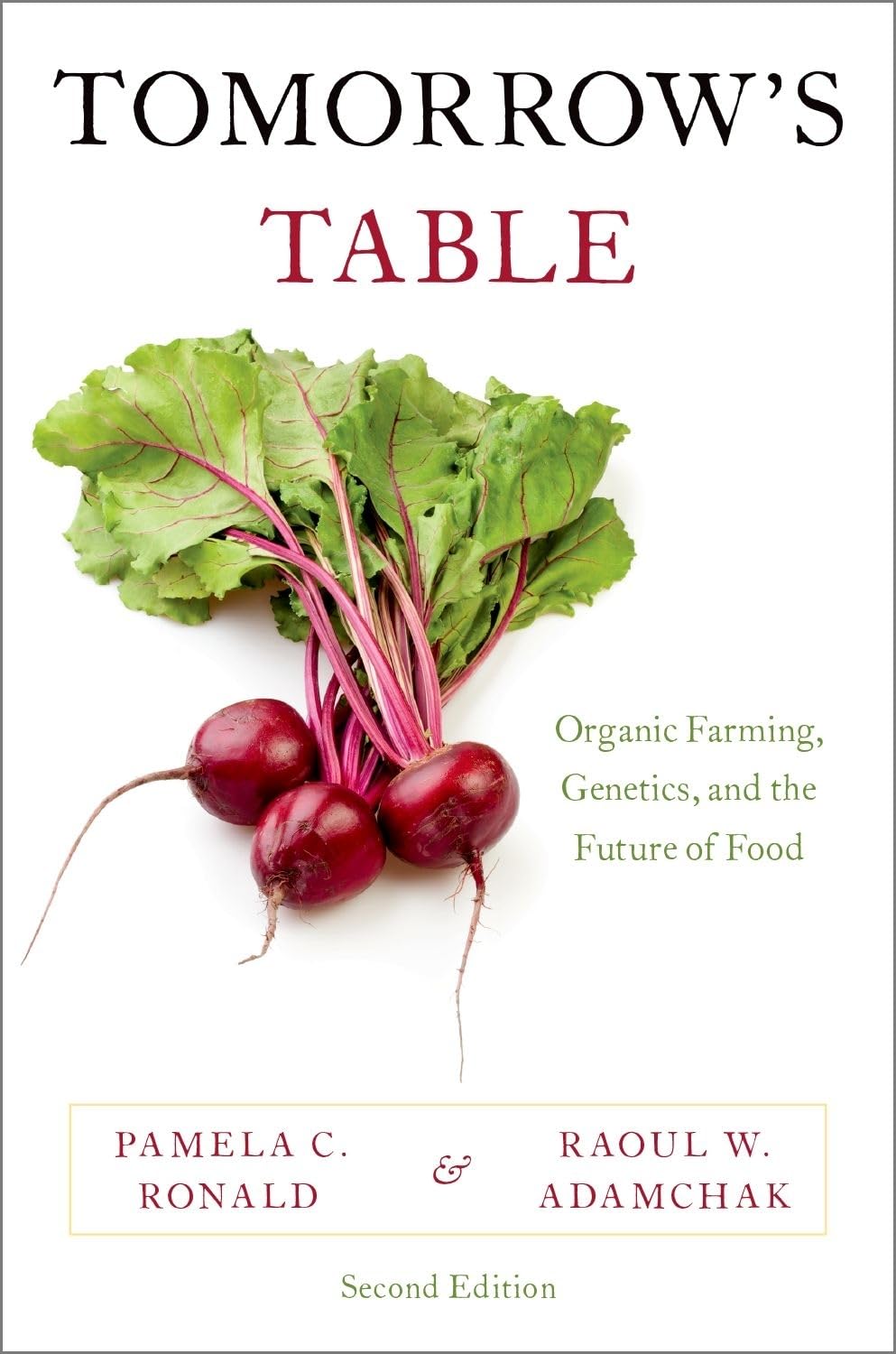
Tomorrow's Table: Organic Farming, Genetics, and the Future of Food
AED8264
Quantity:
Order today to get by 7-14 business days
Delivery fee of AED 20. Free for orders above AED 200.
Imported From: United States
At BOLO, we work hard to ensure the products you receive are new, genuine, and sourced from reputable suppliers.
BOLO is not an authorized or official retailer for most brands, nor are we affiliated with manufacturers unless specifically stated on a product page. Instead, we source verified sellers, authorized distributors or directly from the manufacturer.
Each product undergoes thorough inspection and verification at our consolidation and fulfilment centers to ensure it meets our strict authenticity and quality standards before being shipped and delivered to you.
If you ever have concerns regarding the authenticity of a product purchased from us, please contact Bolo Support. We will review your inquiry promptly and, if necessary, provide documentation verifying authenticity or offer a suitable resolution.
Your trust is our top priority, and we are committed to maintaining transparency and integrity in every transaction.
All product information, images, descriptions, and reviews originate from the manufacturer or from trusted sellers overseas. BOLO is not affiliated with, endorsed by, or an authorized retailer for most brands listed on our website unless stated otherwise.
While we strive to display accurate information, variations in packaging, labeling, instructions, or formulation may occasionally occur due to regional differences or supplier updates. For detailed or manufacturer-specific information, please contact the brand directly or reach out to BOLO Support for assistance.
Unless otherwise stated, all prices displayed on the product page include applicable taxes and import duties.
BOLO operates in accordance with the laws and regulations of United Arab Emirates. Any items found to be restricted or prohibited for sale within the UAE will be cancelled prior to shipment. We take proactive measures to ensure that only products permitted for sale in United Arab Emirates are listed on our website.
All items are shipped by air, and any products classified as “Dangerous Goods (DG)” under IATA regulations will be removed from the order and cancelled.
All orders are processed manually, and we make every effort to process them promptly once confirmed. Products cancelled due to the above reasons will be permanently removed from listings across the website.
Similar suggestions by Bolo
More from this brand
Similar items from “Food Science”
Share with
Or share with link
https://www.bolo.ae/products/U0199342083
Visit the Oxford University Press Store
Tomorrow's Table: Organic Farming, Genetics, and the Future of Food

AED8264
Quantity:
Order today to get by 7-14 business days
Delivery fee of AED 20. Free for orders above AED 200.
Imported From: United States
At BOLO, we work hard to ensure the products you receive are new, genuine, and sourced from reputable suppliers.
BOLO is not an authorized or official retailer for most brands, nor are we affiliated with manufacturers unless specifically stated on a product page. Instead, we source verified sellers, authorized distributors or directly from the manufacturer.
Each product undergoes thorough inspection and verification at our consolidation and fulfilment centers to ensure it meets our strict authenticity and quality standards before being shipped and delivered to you.
If you ever have concerns regarding the authenticity of a product purchased from us, please contact Bolo Support. We will review your inquiry promptly and, if necessary, provide documentation verifying authenticity or offer a suitable resolution.
Your trust is our top priority, and we are committed to maintaining transparency and integrity in every transaction.
All product information, images, descriptions, and reviews originate from the manufacturer or from trusted sellers overseas. BOLO is not affiliated with, endorsed by, or an authorized retailer for most brands listed on our website unless stated otherwise.
While we strive to display accurate information, variations in packaging, labeling, instructions, or formulation may occasionally occur due to regional differences or supplier updates. For detailed or manufacturer-specific information, please contact the brand directly or reach out to BOLO Support for assistance.
Unless otherwise stated, all prices displayed on the product page include applicable taxes and import duties.
BOLO operates in accordance with the laws and regulations of United Arab Emirates. Any items found to be restricted or prohibited for sale within the UAE will be cancelled prior to shipment. We take proactive measures to ensure that only products permitted for sale in United Arab Emirates are listed on our website.
All items are shipped by air, and any products classified as “Dangerous Goods (DG)” under IATA regulations will be removed from the order and cancelled.
All orders are processed manually, and we make every effort to process them promptly once confirmed. Products cancelled due to the above reasons will be permanently removed from listings across the website.
Description:
Editorial Reviews
About the Author
Raoul W. Adamchak has grown organic crops for thirty years. He farms and teaches at the certified organic Market Garden at the University of California, Davis Student Farm. Raoul has received the UC Davis 2020 Sustainability Champion Award for Environmental Excellence.
Reviews:
5.0 out of 5 stars Very honest, objective, fact-based conversation on such an important subject.
This is an excellent book written with neutrality, science-based evidence, and clear for everyone to understand. This updated version is very important to read as the world faces many threats, one of them being the sustainable food production and the challenges this represents with population growth and climate change. Dr. Pamela Ronald offers very concrete examples on the safety and benefits of genetic engineering in food production, and the positive outcomes it has had in different parts of the world. She's also a supporter of organic food (her husband is an organic farmer), but she does a smart balance of both food production method as she says we need to evaluate the effectiveness of each on a case by case basis. I like her approach and writing style because at no point I feel she's trying to convince me of anything; the reader comes to their own conclusions based on the evidence presented, which is solid. We do need to support innovation, the safety & benefits of genetic engineering, and politicians supporting scientific evidence. Reading this book has cleared many of the misconceptions I had on the subject of genetic engineering and I appreciate her honesty and tremendous research she dedicated in producing this wonderful book. Highly recommended!
5.0 out of 5 stars Informative and balanced discussion of the GMO debates.
An organic farmer and her geneticist husband collaborate on a grounded exploration of the GMO problem. It's clear and convincing, but it won't tell you that GMOs are dangerous. Backed up by empirical data, anecdotal enough to be interesting, If you are actually interested in and unbiased and balanced discussion of these critical issues, you will find the book informative and at times entertaining. If hating on Monsanto is your thing, don't waste your money. Just read the Internet, because everything you get there is true.
4.0 out of 5 stars Interesting read
Overall an interesting book with some good information. The recipes seem a little out of place. I would have preferred more of a discussion on the topic at hand, but as it is I believe the book presents good information in support of GE and organic practices and touches nicely on some of the problems facing both types of agricultural cultivation.
5.0 out of 5 stars Ronald and Adamchak are not writers
And despite this I'm giving the book 5 stars. Because at the end of the day they manage to take the complexities of food production and bioengineering and communicate pragmatically, passionately and most importantly accurately. Yes there are times when the maxim "show don't tell" is executed with far less skill than I would like in a book. But I forgive the writers for the occasional stilted dialogue or overly florid description. Because I have read plenty of books on these topics by skilled journalists (Michael Pollen for example), who may be better writers, but ultimately get the science confused and mangled. Worse they are far to prone to ignore information that does not fit their preconceived narratives, and in doing so they fail to give a complete picture that tells their largely privileged audiences what they need to know. Journalists like Pollen instead tell his audience what they want to hear. When it comes to food production we need more scientists and more farmers talking, and writing passionately about what they know, and I'm more than willing to sift through a little mediocre writing to get their point of view on such an important topic.And what a fantastically educational and thoughtful source this is. Before you sign that next antiGMO petition, or go to the polls about a labeling law, you need to read this book. You owe it to yourself to be informed, and Pam and Raoul have the unique perspectives of an organic farmer and a biologist that deserve to be heard.
5.0 out of 5 stars Informative and Interesting
This book presents a novel approach to agriculture. What if we could grow food organically and use gene editing to increase production and help to eliminate diseases and problems that occur with heirloom or landrace varieties of fruits and vegetables? Well written and gives a great explanation of technology.
3.0 out of 5 stars Three Stars
Interesting but not something I'm going to follow.
5.0 out of 5 stars GE and organic
great read. well written argument for GE foods and plants. Loved the way they wove in the personal stories and pulled the whole story together. I used it for a research paper. It provided a lot of great examples of how GE foods can help feed a hungry world, Also enjoyed the link with the organic side of the argument. you hear so much about organic and GE foods being at odds, but this book shows they could work together.
5.0 out of 5 stars Organic Biotechnology
Great book that gives a real-life perspective to the GMO-Organic debate. Actually after reading this book, there's really not much of a debate left. He runs the organic farm at UC Davis (one of the country's leading agriculture schools) and she is a plant geneticist who was able to express flood-tolerance genes into local rice varieties in Asia. The Dr Ronald explains her work and how it is influenced by her husband's job and how together, they question the anti-GMO movement. They even share family recipes! A must read for anyone wanting to understand food production without fear mongering anti-GMO sentiments.
Very balanced arguments, well written.
I read this book to add more arguments to both sides of an exam essay on GM crops, and it was very helpful. It is a good book for people who do not know much about the subject in detail, and can be used for oneself to balance those chinese whispers that are heard when topics of such controversy are discussed online by anonymous people with no solid knowledge. There is a nice balance between scientific detail and storytelling, making it easy to read. A controversial connection between two technologies (organic and GM agriculture) is suggested, and by reading about it, much is learned about both pro-GM and anti-GM arguments. Read this!
Contains accessible, well balanced information
I found this book easy reading. It addressed most of the major questions I had about genetic engineering (e.g. about human health safety, copyright issues, cross pollination, genetic diversity). An important point for me was that the information provided was reliable, with citations back to the scientific literature (one small criticism would be that many of the citations are quite dated). The information is also well balanced - partly thanks to the combination of the authors being a scientist working on GE and an organic farmer. Both authors come across as level headed, wanting to create a farming system that maximizes environmental sustainability and safety for farm workers and consumers. Refreshingly, they are not dug into the common ideological positions of being outright for or against GE (or conventional/organic farming). Interestingly the scientist (Ronald), does not come across as a raving techno-optimist that thinks GE can solve all the worlds problems. In the same vein her husband, the organic farmer (Adamchak), also comes across as very pragmatic and grounded, simply looking for the best solutions to the challenges of organic farming. Ronald's chapters are a sober look at some of the potential uses of GE, but include good discussion of the drawbacks too. As some mention, the book does describe the author's day-to-day family lives. For me this was actually interesting and useful, because it provided perspective on what they thought, how they lived and some of their values (e.g. being vegetarian). That said, I did find some of the "conversations" in the book sounded slightly contrived, in order to try and bring across a given point, and they do acknowledge having done this in the front-matter, but it wasn't too bad. As a non-biologist I learned a lot of interesting new information in the book, both about GE techniques, history and practice and about organic farming, heirloom varieties and so on. It's not the most in depth, but was easy reading as I mentioned, and the most accessible source of balanced information that I have read so far. For me it was absolutely worth it.
Fantastic book
Fantastic view of orgánic farming! Very easy to understand from the Lab to the Land process. Good view of nowadays farming.
Non è un compromesso...
...ma una soluzione che prende il meglio dalle due biotecnologie complementari, il cosiddetto "organico" e l'intervento diretto sul DNA, ovvero la creazione dei cosiddetti "OGM"!
Changed my mind
Having sat on the fence with regards to the GM foods debate for many years, this helped me.Well written and informative. Theory and examples from all over the world. My knowledge on this subject went from anacodote to fact in short order.
Similar suggestions by Bolo
More from this brand
Similar items from “Food Science”
Share with
Or share with link
https://www.bolo.ae/products/U0199342083