Deliver toUnited Arab Emirates
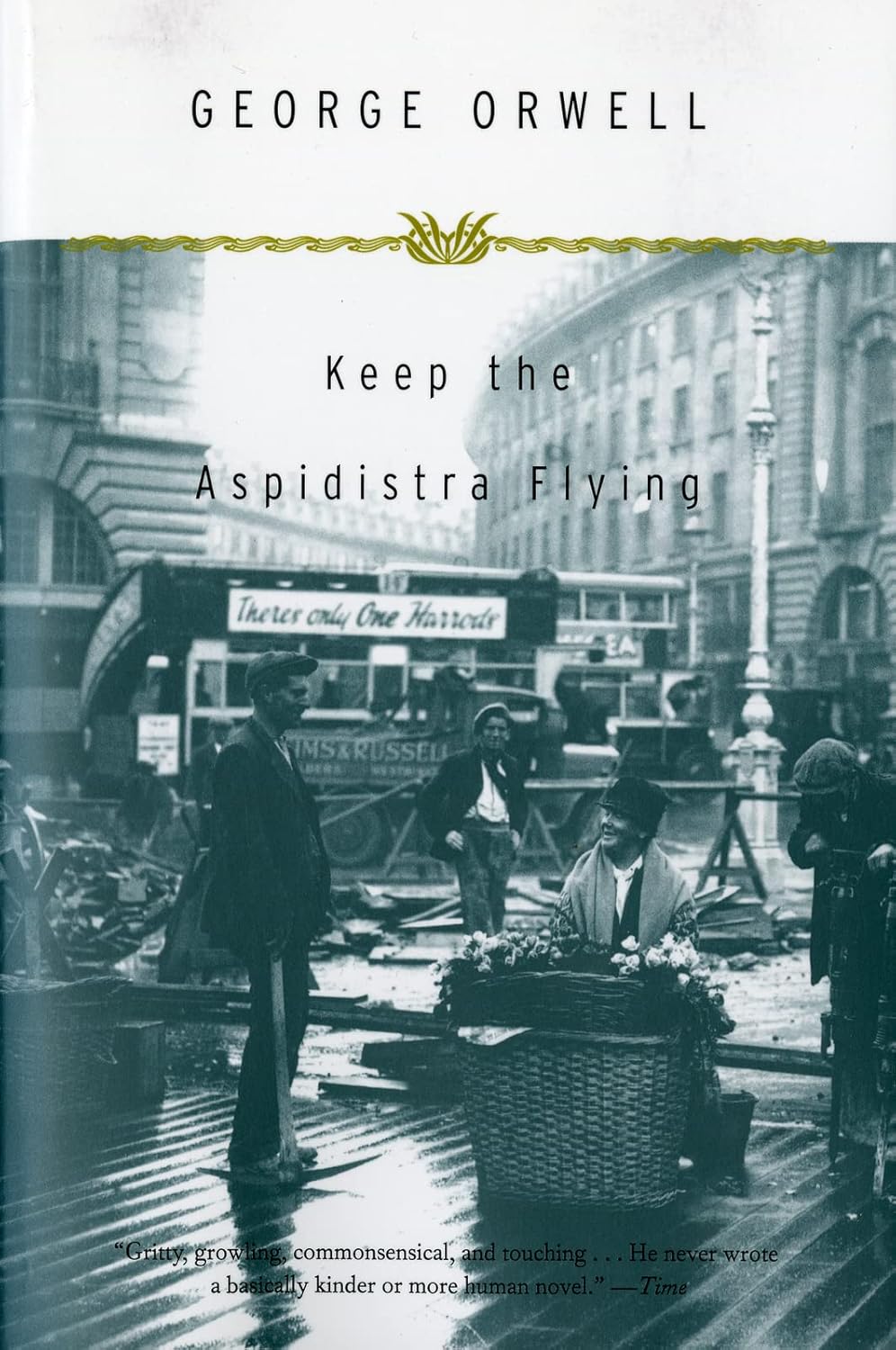
Keep The Aspidistra Flying

Description:

A pre-cursor to his more famous works of Animal Farm and 1984, Keep the Aspidistra Flying is Orwell’s social commentary on capitalism’s constraints. Orwell captures the struggles of an aspiring writer with almost pitch-perfect attention to psychological detail, exploring the gulf between art and life.
Gordon Comstock is a poor young man who works in a grubby London bookstore and spends his evenings shivering in a rented room, trying to write. He is determined to stay free of the “money world” of lucrative jobs, family responsibilities, and the kind of security symbolized by the homely aspidistra plant that sits in every middle-class British window.


Editorial Reviews

Amazon.com Review

London, 1936. Gordon Comstock has declared war on the money god; and Gordon is losing the war. Nearly 30 and "rather moth-eaten already," a poet whose one small book of verse has fallen "flatter than any pancake," Gordon has given up a "good" job and gone to work in a bookshop at half his former salary. Always broke, but too proud to accept charity, he rarely sees his few friends and cannot get the virginal Rosemary to bed because (or so he believes), "If you have no money ... women won't love you." On the windowsill of Gordon's shabby rooming-house room is a sickly but unkillable aspidistra--a plant he abhors as the banner of the sort of "mingy, lower-middle-class decency" he is fleeing in his downward flight. In Keep the Aspidistra Flying, George Orwell has created a darkly compassionate satire to which anyone who has ever been oppressed by the lack of brass, or by the need to make it, will all too easily relate. He etches the ugly insanity of what Gordon calls "the money-world" in unflinching detail, but the satire has a second edge, too, and Gordon himself is scarcely heroic. In the course of his misadventures, we become grindingly aware that his radical solution to the problem of the money-world is no solution at all--that in his desperate reaction against a monstrous system, he has become something of a monster himself. Orwell keeps both of his edges sharp to the very end--a "happy" ending that poses tough questions about just how happy it really is. That the book itself is not sour, but constantly fresh and frequently funny, is the result of Orwell's steady, unsentimental attention to the telling detail; his dry, quiet humor; his fascination with both the follies and the excellences of his characters; and his courageous refusal to embrace the comforts of any easy answer. --Daniel Hintzsche

About the Author

George Orwell (1903–1950), the pen name of Eric Arthur Blair, was an English novelist, essayist, and critic. He was born in India and educated at Eton. After service with the Indian Imperial Police in Burma, he returned to Europe to earn his living by writing. An author and journalist, Orwell was one of the most prominent and influential figures in twentieth-century literature. His unique political allegory Animal Farm was published in 1945, and it was this novel, together with the dystopia of 1984 (1949), which brought him worldwide fame. 

Reviews:

5.0 out of 5 stars You can get anything in this world if you genuinely don't want it

H.S. · April 23, 2008

After recently reading the 4 volume set of the essays, plus Coming Up for Air, which I found in my shelf unread, I had thought that the Aspidistra would be the closing session on Orwell for me. I thought I had covered the field. Unfortunately and surprisingly, the aspidistra are so fresh and enjoyable, despite their sordid subject, that I find myself under compulsive pressure to order the books that I have not read yet (the Clergyman's Daughter, the Road to Wigan Pier, Down and Out in Paris and London).As much as I like to look at plants, assuming they grow wild or they are cultivated by somebody else, I am no gardener nor botanist. I honestly did not know what an aspidistra is. I looked it up in the Langenscheid's Dictionary English - German. I learned that an aspidistra is an Aspidistra. Aha. Google Images teach me that the thing is a somewhat non-descript and somewhat unkempt pot plant. It seems to like growing in places that no self-respecting plant ought to survive. Orwell's novel has them as a symbol for undestructability under nasty circumstances.For the novel's hero Gordon Comstock, they are the enemy. They are allied with the oppressors, the seedy boarding houses and lower middle class dwellings that he loathes so much. They symbolize the lack of money; money rules, specifically when you don't have any.The twist of the 'plot' is that Gordon chose to be poorer than he needed to be, by throwing away 'good jobs' in the money making world. We have here a study in the pretensions of poverty.The most brillant parts of this amazing novel have us watch confrontations, or should I say Pas-de-Deux, of different social strata. Gordon tries to hide and is ashamed of his poverty, while his friend Ravelston is trying to hide and is ashamed of his wealth. The rich man is the socialist, who tries and tries to convince the poor man of the merits of socialism. Gordon can't be bothered, he doesn't have enough money to be a socialist.The novel is far exceeding my expectations and I may have to think again about my classification of Orwell as mainly an essayist.

4.0 out of 5 stars What in tarnation

M. · February 27, 2025

There is something seriously wrong in Gordon Comstock, and we're going to read how he brings himself, and poor Rosemary, down into the muck in Keep the Aspidistra Flying.The aspidistra (known as the cast iron plant in the States) is a sort of symbol of the power and endurance of the middle class--back when it actually existed, anyway. This plant is apparently something even people who struggle with plastic plants could successfully grow.In Keep the Aspidistra, it also sort of represents the human spirit tied up with the "money god". It appears again and again in the book, even when Comstock has sunk to his lowest.The "flying" part refers to banners. So basically, "keep the middle class flying" or, to quote the book directly, "[keep yourself] respectable".Comstock despises the "money god". He's absolutely obsessed with the fact that, for some bizarre, unfathomable reason, life requires money to live. The more money, the better. Comstock is also disgusted by this fact and, despite being able to work a decent job, slowly descends into the muck until he realizes what an idiot he is, but not before dragging his girlfriend down with him.He wants to be a poet living in a garret--so in absolute poverty. "In the mud" as it were. This would be more or less fine if Comstock wasn't an irresponsible incel crybaby. Then, when he does get his hands on a bit of cash, he wastes it like a drunk and compounds his problems. 99% of the book is following Comstock around as he creates problem after problem for himself because he doesn't want to work a "good" or "respectable" job. It's never 100% clear why he feels this way besides being resentful of the money god. My working theory is baby just didn't want the responsibility because that's...pretty on-par with the sullen Comstock.In the end, Comstock gets himself together. He's such an unbearable whiny loser than you can't cheer for him, though.

5.0 out of 5 stars Great book

M.L. · October 23, 2025

I’m a GO fan and this book was great. Price was fine. Sad it ended. Good story of one’s search for meaning in poverty. Just a touch of spice to it.

Another must read by George Orwell

R.k.J. · July 28, 2024

Reading books in which the protagonist is facing his overpowering thoughts is always something which I love reading. In this novel the protagonist wages a war against money and the people who hold power over money by never letting himself get caught in a monotonous life cycle in which he is forced to work as per the wishes of his employer. Although this decision of his pushes him in the abyss of chaos and hundreds of problems, he is criticised not only by his family members by his decision but also his close friends and lover criticises his decisions though they never present them in front of him. His love towards writing poetry is also not very fruitful as he doesn't get any recognition in public. The story pushes the reader into an internal conflict and will keep you hooked .

kargo berbat

Ö. · June 28, 2022

kitap gayet guzel ama kargosu olum berbat lanet bi de prime musterisi olmama ragmen

A great writer

A.C. · September 13, 2019

Depressing, uplifting and beautifully expressed. Hard to imagine a better portrait of London in the 30’s. Money, class distinction and the awful reality of life for the downtrodden. Thank God for the introduction of the minimum wage and national health. A great novel that makes you consider life then and now.

just as good as I remember

C. · July 12, 2025

I read this as a teenager and now for my book group. You can’t help but be immersed in the misery of poverty, I love the ending. I really think it’s a masterpiece of its time.

important pour connaitre Orwell

D.R. · August 31, 2014

Largement autobiographique (les origines sociales de Gordon: famille lower middle class, qui manque cruellement d'argent mais veut garder les apparences; les premières souffrances dues au manque lorsque Gordon est dans sa public school-pour laquelle ses parents se sont saignés aux 4 veines et sacrifié l'avenir de sa soeur Julia), "Keep..." introduit le concept central de l'oeuvre d' Orwell: la "décence" (Il n'emploie as encore le terme du concept abouti de "common decency"qui apparaitra je crois dans "The Road to Wigan Pier". Traumatisé par ce qu'il considère comme la soumission de la société au dieu argent, Gordon décide de se libérer de cet esclavage, refuse toute compromis et tombe de plus en plus bas dans la société, et se réfugie dans son statut de "poète" (raté). Bien entendu, il est d'autant plus l'esclave de l'argent qu'il veut s'en débarrasser, le manque d'argent étant finalement bien plus aliénant que l'argent lui même. Le manque d'argent non seulement lui fait mener une vie misérable, mais éteint toute créativité artistique-comment peut on écrire de la poésie avec 2£ par semaine?- et entraîne une frustration sexuelle insupportable (La même idée se trouve dans Burmese Days). Le personnage de Rosemary (son amie), permet d'introduire la notion de décence: il est possible de vivre décemment sans devenir l'esclave de l'argent. Coup de griffe au passage aux socialistes fortunés, en la personne de Ravelston, marxiste avec une rente de 2000£ par an (beaucoup d'argent à l'époque) et qui, comme dit Rosemary, peut se permettre d'avoir des principes.La fin est inattendue pour Orwell le pessimiste: on s'attend à une fin tragique, comme le suicide de James dans Burmese Days: Gordon en effet doit choisir entre se joindre aux adorateurs du dieu argent, donc renier ce en quoi il croit,ou renier son humanité en abandonnant Rosemary (enceinte) à son sort. Gordon choisit de rentrer dans le rang. Est ce bien un "happy ending"? N'est il pas plutôt pessimiste de dire que finalement c'est l'argent qui l'emporte? Non, justement grâce à cette notion de "décence", qu'Orwell mentionne plusieurs fois dans les dix dernières pages, et qui permet de vivre dans le monde de l'argent, si soi-même on a des valeurs supérieures, ici la Vie symbolisée par le foetus que porte Rosemary.En résumé:Peut on vivre en refusant l'argent?Ce refus n'est il pas finalement plus aliénant que l'argent lui même?La solution peut elle être collective (le marxisme de Ravelston), ou individuelle (la "décence" de Rosemary, puis Gordon)Le salut est finalement dans la reconnaissance d'un lien social, une vertu personnelle qu'Orwell appellera plus tard "common decency) que se retrouve d'une façon innée dans le peupleEn conclusion: une étape indispensable pour comprendre la pensée d'Orwell

Keep The Aspidistra Flying

Product ID: U0156468999
Condition: New

4.2

AED8421

Price includes VAT & Import Duties
Type: Paperback
Availability: In Stock

Quantity:

|

Order today to get by 7-14 business days

Delivery fee of AED 20. Free for orders above AED 200.

Returns & Warranty policies

Imported From: United States

At BOLO, we work hard to ensure the products you receive are new, genuine, and sourced from reputable suppliers.

BOLO is not an authorized or official retailer for most brands, nor are we affiliated with manufacturers unless specifically stated on a product page. Instead, we source verified sellers, authorized distributors or directly from the manufacturer.

Each product undergoes thorough inspection and verification at our consolidation and fulfilment centers to ensure it meets our strict authenticity and quality standards before being shipped and delivered to you.

If you ever have concerns regarding the authenticity of a product purchased from us, please contact Bolo Support. We will review your inquiry promptly and, if necessary, provide documentation verifying authenticity or offer a suitable resolution.

Your trust is our top priority, and we are committed to maintaining transparency and integrity in every transaction.

All product information, images, descriptions, and reviews originate from the manufacturer or from trusted sellers overseas. BOLO is not affiliated with, endorsed by, or an authorized retailer for most brands listed on our website unless stated otherwise.

While we strive to display accurate information, variations in packaging, labeling, instructions, or formulation may occasionally occur due to regional differences or supplier updates. For detailed or manufacturer-specific information, please contact the brand directly or reach out to BOLO Support for assistance.

Unless otherwise stated, all prices displayed on the product page include applicable taxes and import duties.

BOLO operates in accordance with the laws and regulations of United Arab Emirates. Any items found to be restricted or prohibited for sale within the UAE will be cancelled prior to shipment. We take proactive measures to ensure that only products permitted for sale in United Arab Emirates are listed on our website.

All items are shipped by air, and any products classified as “Dangerous Goods (DG)” under IATA regulations will be removed from the order and cancelled.

All orders are processed manually, and we make every effort to process them promptly once confirmed. Products cancelled due to the above reasons will be permanently removed from listings across the website.

Similar suggestions by Bolo

More from this brand

Similar items from “Murder”

Keep The Aspidistra Flying

Product ID: U0156468999
Condition: New

4.2

Keep The Aspidistra Flying-0
Type: Paperback

AED8421

Price includes VAT & Import Duties
Availability: In Stock

Quantity:

|

Order today to get by 7-14 business days

Delivery fee of AED 20. Free for orders above AED 200.

Returns & Warranty policies

Imported From: United States

At BOLO, we work hard to ensure the products you receive are new, genuine, and sourced from reputable suppliers.

BOLO is not an authorized or official retailer for most brands, nor are we affiliated with manufacturers unless specifically stated on a product page. Instead, we source verified sellers, authorized distributors or directly from the manufacturer.

Each product undergoes thorough inspection and verification at our consolidation and fulfilment centers to ensure it meets our strict authenticity and quality standards before being shipped and delivered to you.

If you ever have concerns regarding the authenticity of a product purchased from us, please contact Bolo Support. We will review your inquiry promptly and, if necessary, provide documentation verifying authenticity or offer a suitable resolution.

Your trust is our top priority, and we are committed to maintaining transparency and integrity in every transaction.

All product information, images, descriptions, and reviews originate from the manufacturer or from trusted sellers overseas. BOLO is not affiliated with, endorsed by, or an authorized retailer for most brands listed on our website unless stated otherwise.

While we strive to display accurate information, variations in packaging, labeling, instructions, or formulation may occasionally occur due to regional differences or supplier updates. For detailed or manufacturer-specific information, please contact the brand directly or reach out to BOLO Support for assistance.

Unless otherwise stated, all prices displayed on the product page include applicable taxes and import duties.

BOLO operates in accordance with the laws and regulations of United Arab Emirates. Any items found to be restricted or prohibited for sale within the UAE will be cancelled prior to shipment. We take proactive measures to ensure that only products permitted for sale in United Arab Emirates are listed on our website.

All items are shipped by air, and any products classified as “Dangerous Goods (DG)” under IATA regulations will be removed from the order and cancelled.

All orders are processed manually, and we make every effort to process them promptly once confirmed. Products cancelled due to the above reasons will be permanently removed from listings across the website.

Description:

A pre-cursor to his more famous works of Animal Farm and 1984, Keep the Aspidistra Flying is Orwell’s social commentary on capitalism’s constraints. Orwell captures the struggles of an aspiring writer with almost pitch-perfect attention to psychological detail, exploring the gulf between art and life.
Gordon Comstock is a poor young man who works in a grubby London bookstore and spends his evenings shivering in a rented room, trying to write. He is determined to stay free of the “money world” of lucrative jobs, family responsibilities, and the kind of security symbolized by the homely aspidistra plant that sits in every middle-class British window.


Editorial Reviews

Amazon.com Review

London, 1936. Gordon Comstock has declared war on the money god; and Gordon is losing the war. Nearly 30 and "rather moth-eaten already," a poet whose one small book of verse has fallen "flatter than any pancake," Gordon has given up a "good" job and gone to work in a bookshop at half his former salary. Always broke, but too proud to accept charity, he rarely sees his few friends and cannot get the virginal Rosemary to bed because (or so he believes), "If you have no money ... women won't love you." On the windowsill of Gordon's shabby rooming-house room is a sickly but unkillable aspidistra--a plant he abhors as the banner of the sort of "mingy, lower-middle-class decency" he is fleeing in his downward flight. In Keep the Aspidistra Flying, George Orwell has created a darkly compassionate satire to which anyone who has ever been oppressed by the lack of brass, or by the need to make it, will all too easily relate. He etches the ugly insanity of what Gordon calls "the money-world" in unflinching detail, but the satire has a second edge, too, and Gordon himself is scarcely heroic. In the course of his misadventures, we become grindingly aware that his radical solution to the problem of the money-world is no solution at all--that in his desperate reaction against a monstrous system, he has become something of a monster himself. Orwell keeps both of his edges sharp to the very end--a "happy" ending that poses tough questions about just how happy it really is. That the book itself is not sour, but constantly fresh and frequently funny, is the result of Orwell's steady, unsentimental attention to the telling detail; his dry, quiet humor; his fascination with both the follies and the excellences of his characters; and his courageous refusal to embrace the comforts of any easy answer. --Daniel Hintzsche

About the Author

George Orwell (1903–1950), the pen name of Eric Arthur Blair, was an English novelist, essayist, and critic. He was born in India and educated at Eton. After service with the Indian Imperial Police in Burma, he returned to Europe to earn his living by writing. An author and journalist, Orwell was one of the most prominent and influential figures in twentieth-century literature. His unique political allegory Animal Farm was published in 1945, and it was this novel, together with the dystopia of 1984 (1949), which brought him worldwide fame. 

Reviews:

5.0 out of 5 stars You can get anything in this world if you genuinely don't want it

H.S. · April 23, 2008

After recently reading the 4 volume set of the essays, plus Coming Up for Air, which I found in my shelf unread, I had thought that the Aspidistra would be the closing session on Orwell for me. I thought I had covered the field. Unfortunately and surprisingly, the aspidistra are so fresh and enjoyable, despite their sordid subject, that I find myself under compulsive pressure to order the books that I have not read yet (the Clergyman's Daughter, the Road to Wigan Pier, Down and Out in Paris and London).As much as I like to look at plants, assuming they grow wild or they are cultivated by somebody else, I am no gardener nor botanist. I honestly did not know what an aspidistra is. I looked it up in the Langenscheid's Dictionary English - German. I learned that an aspidistra is an Aspidistra. Aha. Google Images teach me that the thing is a somewhat non-descript and somewhat unkempt pot plant. It seems to like growing in places that no self-respecting plant ought to survive. Orwell's novel has them as a symbol for undestructability under nasty circumstances.For the novel's hero Gordon Comstock, they are the enemy. They are allied with the oppressors, the seedy boarding houses and lower middle class dwellings that he loathes so much. They symbolize the lack of money; money rules, specifically when you don't have any.The twist of the 'plot' is that Gordon chose to be poorer than he needed to be, by throwing away 'good jobs' in the money making world. We have here a study in the pretensions of poverty.The most brillant parts of this amazing novel have us watch confrontations, or should I say Pas-de-Deux, of different social strata. Gordon tries to hide and is ashamed of his poverty, while his friend Ravelston is trying to hide and is ashamed of his wealth. The rich man is the socialist, who tries and tries to convince the poor man of the merits of socialism. Gordon can't be bothered, he doesn't have enough money to be a socialist.The novel is far exceeding my expectations and I may have to think again about my classification of Orwell as mainly an essayist.

4.0 out of 5 stars What in tarnation

M. · February 27, 2025

There is something seriously wrong in Gordon Comstock, and we're going to read how he brings himself, and poor Rosemary, down into the muck in Keep the Aspidistra Flying.The aspidistra (known as the cast iron plant in the States) is a sort of symbol of the power and endurance of the middle class--back when it actually existed, anyway. This plant is apparently something even people who struggle with plastic plants could successfully grow.In Keep the Aspidistra, it also sort of represents the human spirit tied up with the "money god". It appears again and again in the book, even when Comstock has sunk to his lowest.The "flying" part refers to banners. So basically, "keep the middle class flying" or, to quote the book directly, "[keep yourself] respectable".Comstock despises the "money god". He's absolutely obsessed with the fact that, for some bizarre, unfathomable reason, life requires money to live. The more money, the better. Comstock is also disgusted by this fact and, despite being able to work a decent job, slowly descends into the muck until he realizes what an idiot he is, but not before dragging his girlfriend down with him.He wants to be a poet living in a garret--so in absolute poverty. "In the mud" as it were. This would be more or less fine if Comstock wasn't an irresponsible incel crybaby. Then, when he does get his hands on a bit of cash, he wastes it like a drunk and compounds his problems. 99% of the book is following Comstock around as he creates problem after problem for himself because he doesn't want to work a "good" or "respectable" job. It's never 100% clear why he feels this way besides being resentful of the money god. My working theory is baby just didn't want the responsibility because that's...pretty on-par with the sullen Comstock.In the end, Comstock gets himself together. He's such an unbearable whiny loser than you can't cheer for him, though.

5.0 out of 5 stars Great book

M.L. · October 23, 2025

I’m a GO fan and this book was great. Price was fine. Sad it ended. Good story of one’s search for meaning in poverty. Just a touch of spice to it.

Another must read by George Orwell

R.k.J. · July 28, 2024

Reading books in which the protagonist is facing his overpowering thoughts is always something which I love reading. In this novel the protagonist wages a war against money and the people who hold power over money by never letting himself get caught in a monotonous life cycle in which he is forced to work as per the wishes of his employer. Although this decision of his pushes him in the abyss of chaos and hundreds of problems, he is criticised not only by his family members by his decision but also his close friends and lover criticises his decisions though they never present them in front of him. His love towards writing poetry is also not very fruitful as he doesn't get any recognition in public. The story pushes the reader into an internal conflict and will keep you hooked .

kargo berbat

Ö. · June 28, 2022

kitap gayet guzel ama kargosu olum berbat lanet bi de prime musterisi olmama ragmen

A great writer

A.C. · September 13, 2019

Depressing, uplifting and beautifully expressed. Hard to imagine a better portrait of London in the 30’s. Money, class distinction and the awful reality of life for the downtrodden. Thank God for the introduction of the minimum wage and national health. A great novel that makes you consider life then and now.

just as good as I remember

C. · July 12, 2025

I read this as a teenager and now for my book group. You can’t help but be immersed in the misery of poverty, I love the ending. I really think it’s a masterpiece of its time.

important pour connaitre Orwell

D.R. · August 31, 2014

Largement autobiographique (les origines sociales de Gordon: famille lower middle class, qui manque cruellement d'argent mais veut garder les apparences; les premières souffrances dues au manque lorsque Gordon est dans sa public school-pour laquelle ses parents se sont saignés aux 4 veines et sacrifié l'avenir de sa soeur Julia), "Keep..." introduit le concept central de l'oeuvre d' Orwell: la "décence" (Il n'emploie as encore le terme du concept abouti de "common decency"qui apparaitra je crois dans "The Road to Wigan Pier". Traumatisé par ce qu'il considère comme la soumission de la société au dieu argent, Gordon décide de se libérer de cet esclavage, refuse toute compromis et tombe de plus en plus bas dans la société, et se réfugie dans son statut de "poète" (raté). Bien entendu, il est d'autant plus l'esclave de l'argent qu'il veut s'en débarrasser, le manque d'argent étant finalement bien plus aliénant que l'argent lui même. Le manque d'argent non seulement lui fait mener une vie misérable, mais éteint toute créativité artistique-comment peut on écrire de la poésie avec 2£ par semaine?- et entraîne une frustration sexuelle insupportable (La même idée se trouve dans Burmese Days). Le personnage de Rosemary (son amie), permet d'introduire la notion de décence: il est possible de vivre décemment sans devenir l'esclave de l'argent. Coup de griffe au passage aux socialistes fortunés, en la personne de Ravelston, marxiste avec une rente de 2000£ par an (beaucoup d'argent à l'époque) et qui, comme dit Rosemary, peut se permettre d'avoir des principes.La fin est inattendue pour Orwell le pessimiste: on s'attend à une fin tragique, comme le suicide de James dans Burmese Days: Gordon en effet doit choisir entre se joindre aux adorateurs du dieu argent, donc renier ce en quoi il croit,ou renier son humanité en abandonnant Rosemary (enceinte) à son sort. Gordon choisit de rentrer dans le rang. Est ce bien un "happy ending"? N'est il pas plutôt pessimiste de dire que finalement c'est l'argent qui l'emporte? Non, justement grâce à cette notion de "décence", qu'Orwell mentionne plusieurs fois dans les dix dernières pages, et qui permet de vivre dans le monde de l'argent, si soi-même on a des valeurs supérieures, ici la Vie symbolisée par le foetus que porte Rosemary.En résumé:Peut on vivre en refusant l'argent?Ce refus n'est il pas finalement plus aliénant que l'argent lui même?La solution peut elle être collective (le marxisme de Ravelston), ou individuelle (la "décence" de Rosemary, puis Gordon)Le salut est finalement dans la reconnaissance d'un lien social, une vertu personnelle qu'Orwell appellera plus tard "common decency) que se retrouve d'une façon innée dans le peupleEn conclusion: une étape indispensable pour comprendre la pensée d'Orwell

Similar suggestions by Bolo

More from this brand

Similar items from “Murder”