Description:
Reviews:
5.0 out of 5 stars Must read for any history or tech enthusiast
One of the most memorable and fascinating books I've read. There is so much to learn from the stories and unfolding events detailed. It introduces little-known history about televison and the politics behind its creation. It's incredible what battles and obstacles were fought that ultimately led to the television marvels we have today. There is a lot to appreciate from this book and the people who made it all happen.
5.0 out of 5 stars Very well-written and interesting book
This is a facinating and well-written review of the development and introduction of HDTV. It focuses on the political interaction of government agencies, the broadcasters, and R&D efforts, more so than the technology. It is ironic that although the U.S. led the Japanese in the research and development of digital TV, by that time there was no domestic TV manufacturing capability to take advantage of this.(Note: I read the original hard cover edition and not the soft-cover 2009 update.)
4.0 out of 5 stars Defining Vision
A good read, if you are in the TV industry, on the technical side. Goes in-depth on the history of how digital TV came to be what it is today.
5.0 out of 5 stars Wow! What a ride!
I've owned my copy of this book for some five or six years now, found at a thrift shop for $2. Haven't read it until just now, just put it on a shelf and forgot about it because I don't really care about HDTV. So what?, pretty pictures! Who cares? Don't even have cable -- what's on the network news shows and PBS wastes too much of my time already.Well, one day I was short of reading material so I picked up Brinkley's book. I never had considered the multibillion-dollar stakes, the political infighting and outfighting, the corporate and international competition, nor the technology of digital broadcasting.What I found most intriguing about the book was the supposition that digital broadcasting was considered by all the "experts" to be absolutely "impossible". It took a non-broadcast engineer, Woo Paik, to pull it off -- and only because, as he said, he didn't know enough to know that it could not be done.Brinkley's narrative reads like a techno-thriller, which I suppose it actually is. He covers the doings of the tech engineers, the corporations that in the end combined into the Grand Alliance, the original digital HDTV inventors the Japanese NHK engineers, the machinations of the Broadcast Barons, the Cable Mongols, the FCC, the radio and satellite guys, the politicians and of course the lowlife lobbyists and lawyers.Probably the most disgusting part of the story is the original motivation for creating HDTV by the Broadcast Barons and their lobbyist lackeys. No, it was not for any lofty, noble reason such as serving the public interest or bringing quality programming to the masses. It was actually for their own greedy self-serving interest: that of protecting their portion of the radiofrequency spectrum from takeover by public-service agencies such as the police, fire departments, and emergency medical services. And when they realized that actually getting HDTV into broadcast operation would cost them big bucks in equipment upgrades, they actually worked behind the scenes to undermine HDTV once their political purpose was accomplished! It's all right here in this book; read all about it!Remember back in the '40s and '50s when they all said TV would result in an uplifting of public awareness and public virtue, what with all that quality educational programming and dutiful community discourse making our business and government "leaders" accountable to the public ? What up with that? Remember, we're talking about the very same people who brought us that! That's probably why nowadays everything in our society has to be presented as entertainment.And because everything has to be entertainment, that's one of the root causes for the current state of our national and societal situation.
5.0 out of 5 stars HDTV sort of by accident
The government ordered all telecasting beginning after a date certain (this year) to be digital, creating a big increase in the number of channels in the electromagnetic spectrum available for broadcasting. Digitizing spectrum use had its beginning in broadcaster interest in improving the quality (making more life-like), the picture available on our TV screens. Efforts in the States on behalf of that goal, begun shortly after World War II, were desultory until the Japanese came up with pictures that were a lot sharper than anything theretofore known. This drove American broadcasters and the whole TV industry bananas. These Asian makers of nice little automobiles simply could not be allowed to sweep the television world.That the Japanese advance was not true HDTV but the result of closer pixel lines, clever, but not breath-taking, afforded some relief. The holy grail of true HDTV was still undiscovered, an elusive target. Nonetheless, the Japanese pictures were sharper, ergo better, so the push for the real thing continued.I don't know whether the digital road provides the only conceivable path to true HDTV, but that was the path to success. It is also the path that had been urged on the industry by the Federal Communications Commission.The Commission, inevitably involved by virtue of its regulation of broadcasting, considered that the digital road presented the best chance for making TV compatible with computers, allowing for communications matchups of unimaginable possibilities.The story of how it all came about is brilliantly laid out by Joel Brinkley in "Defining Vision," a work of thorough research and deep understanding of the technology involved. The politics, the goals of winners--and losers (are there any?)--with the arrival of true HDTV, make for an incredibly complex story. Brinkley not only makes it clear and intelligible, but exciting and fun.A book deserved of the rating of five if any book ever did.Charles Tillinghast, author of "How Capitol Got the Beatles, and Then What Happened," and "American Broadcast Regulation and the First Amendment: Another Look."
Visit the Dey Street Books Store
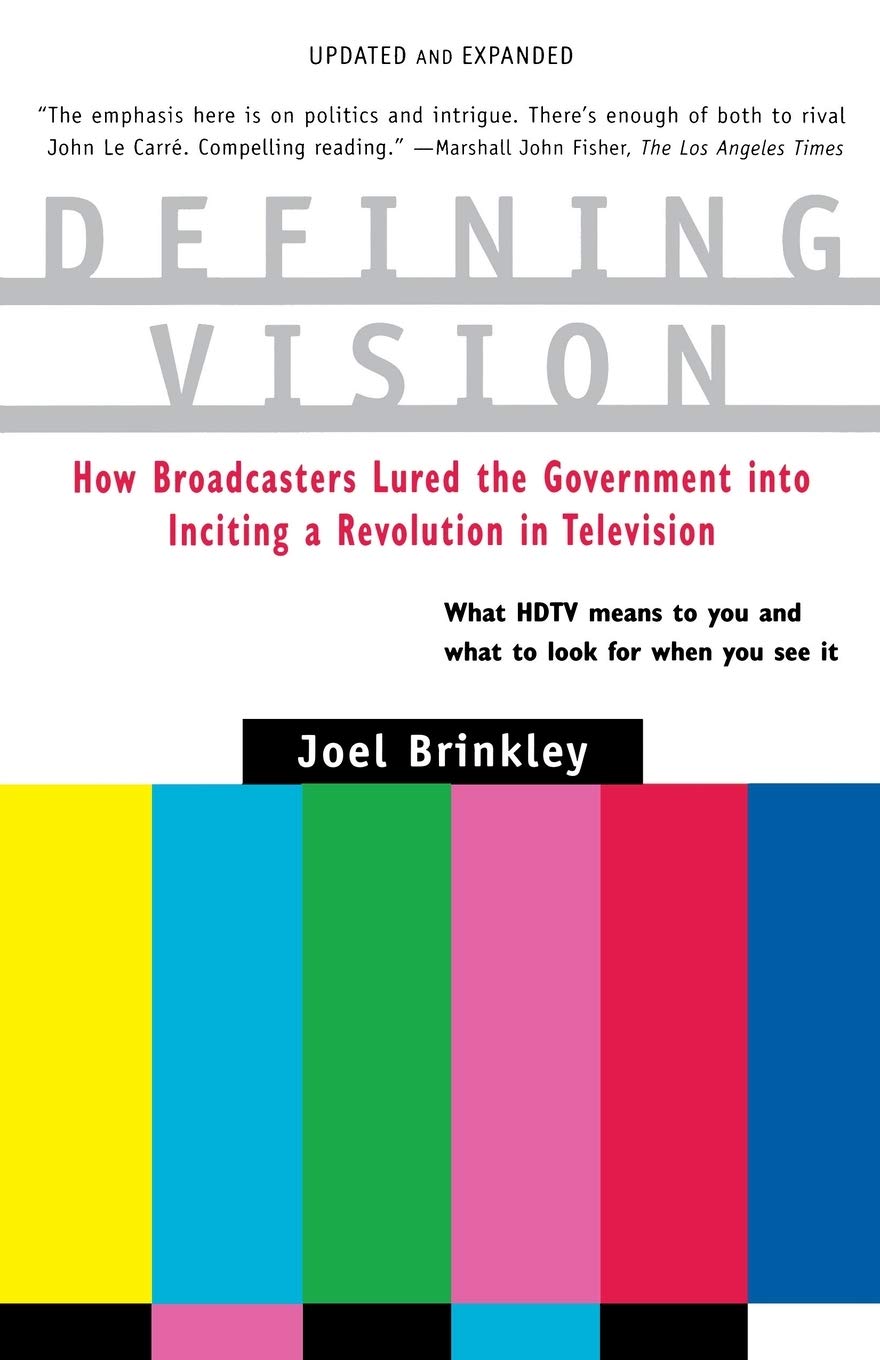
Defining Vision: How Broadcasters Lured the Government into Inciting a Revolution in Television, Updated and Expanded
AED10047
Quantity:
Order today to get by 7-14 business days
Delivery fee of AED 20. Free for orders above AED 200.
Imported From: United States
At BOLO, we work hard to ensure the products you receive are new, genuine, and sourced from reputable suppliers.
BOLO is not an authorized or official retailer for most brands, nor are we affiliated with manufacturers unless specifically stated on a product page. Instead, we source verified sellers, authorized distributors or directly from the manufacturer.
Each product undergoes thorough inspection and verification at our consolidation and fulfilment centers to ensure it meets our strict authenticity and quality standards before being shipped and delivered to you.
If you ever have concerns regarding the authenticity of a product purchased from us, please contact Bolo Support. We will review your inquiry promptly and, if necessary, provide documentation verifying authenticity or offer a suitable resolution.
Your trust is our top priority, and we are committed to maintaining transparency and integrity in every transaction.
All product information, images, descriptions, and reviews originate from the manufacturer or from trusted sellers overseas. BOLO is not affiliated with, endorsed by, or an authorized retailer for most brands listed on our website unless stated otherwise.
While we strive to display accurate information, variations in packaging, labeling, instructions, or formulation may occasionally occur due to regional differences or supplier updates. For detailed or manufacturer-specific information, please contact the brand directly or reach out to BOLO Support for assistance.
Unless otherwise stated, all prices displayed on the product page include applicable taxes and import duties.
BOLO operates in accordance with the laws and regulations of United Arab Emirates. Any items found to be restricted or prohibited for sale within the UAE will be cancelled prior to shipment. We take proactive measures to ensure that only products permitted for sale in United Arab Emirates are listed on our website.
All items are shipped by air, and any products classified as “Dangerous Goods (DG)” under IATA regulations will be removed from the order and cancelled.
All orders are processed manually, and we make every effort to process them promptly once confirmed. Products cancelled due to the above reasons will be permanently removed from listings across the website.
Similar suggestions by Bolo
More from this brand
Similar items from “Intelligence & Semantics”
Share with
Or share with link
https://www.bolo.ae/products/U0156005972
Visit the Dey Street Books Store
Defining Vision: How Broadcasters Lured the Government into Inciting a Revolution in Television, Updated and Expanded

AED10047
Quantity:
Order today to get by 7-14 business days
Delivery fee of AED 20. Free for orders above AED 200.
Imported From: United States
At BOLO, we work hard to ensure the products you receive are new, genuine, and sourced from reputable suppliers.
BOLO is not an authorized or official retailer for most brands, nor are we affiliated with manufacturers unless specifically stated on a product page. Instead, we source verified sellers, authorized distributors or directly from the manufacturer.
Each product undergoes thorough inspection and verification at our consolidation and fulfilment centers to ensure it meets our strict authenticity and quality standards before being shipped and delivered to you.
If you ever have concerns regarding the authenticity of a product purchased from us, please contact Bolo Support. We will review your inquiry promptly and, if necessary, provide documentation verifying authenticity or offer a suitable resolution.
Your trust is our top priority, and we are committed to maintaining transparency and integrity in every transaction.
All product information, images, descriptions, and reviews originate from the manufacturer or from trusted sellers overseas. BOLO is not affiliated with, endorsed by, or an authorized retailer for most brands listed on our website unless stated otherwise.
While we strive to display accurate information, variations in packaging, labeling, instructions, or formulation may occasionally occur due to regional differences or supplier updates. For detailed or manufacturer-specific information, please contact the brand directly or reach out to BOLO Support for assistance.
Unless otherwise stated, all prices displayed on the product page include applicable taxes and import duties.
BOLO operates in accordance with the laws and regulations of United Arab Emirates. Any items found to be restricted or prohibited for sale within the UAE will be cancelled prior to shipment. We take proactive measures to ensure that only products permitted for sale in United Arab Emirates are listed on our website.
All items are shipped by air, and any products classified as “Dangerous Goods (DG)” under IATA regulations will be removed from the order and cancelled.
All orders are processed manually, and we make every effort to process them promptly once confirmed. Products cancelled due to the above reasons will be permanently removed from listings across the website.
Description:
Reviews:
5.0 out of 5 stars Must read for any history or tech enthusiast
One of the most memorable and fascinating books I've read. There is so much to learn from the stories and unfolding events detailed. It introduces little-known history about televison and the politics behind its creation. It's incredible what battles and obstacles were fought that ultimately led to the television marvels we have today. There is a lot to appreciate from this book and the people who made it all happen.
5.0 out of 5 stars Very well-written and interesting book
This is a facinating and well-written review of the development and introduction of HDTV. It focuses on the political interaction of government agencies, the broadcasters, and R&D efforts, more so than the technology. It is ironic that although the U.S. led the Japanese in the research and development of digital TV, by that time there was no domestic TV manufacturing capability to take advantage of this.(Note: I read the original hard cover edition and not the soft-cover 2009 update.)
4.0 out of 5 stars Defining Vision
A good read, if you are in the TV industry, on the technical side. Goes in-depth on the history of how digital TV came to be what it is today.
5.0 out of 5 stars Wow! What a ride!
I've owned my copy of this book for some five or six years now, found at a thrift shop for $2. Haven't read it until just now, just put it on a shelf and forgot about it because I don't really care about HDTV. So what?, pretty pictures! Who cares? Don't even have cable -- what's on the network news shows and PBS wastes too much of my time already.Well, one day I was short of reading material so I picked up Brinkley's book. I never had considered the multibillion-dollar stakes, the political infighting and outfighting, the corporate and international competition, nor the technology of digital broadcasting.What I found most intriguing about the book was the supposition that digital broadcasting was considered by all the "experts" to be absolutely "impossible". It took a non-broadcast engineer, Woo Paik, to pull it off -- and only because, as he said, he didn't know enough to know that it could not be done.Brinkley's narrative reads like a techno-thriller, which I suppose it actually is. He covers the doings of the tech engineers, the corporations that in the end combined into the Grand Alliance, the original digital HDTV inventors the Japanese NHK engineers, the machinations of the Broadcast Barons, the Cable Mongols, the FCC, the radio and satellite guys, the politicians and of course the lowlife lobbyists and lawyers.Probably the most disgusting part of the story is the original motivation for creating HDTV by the Broadcast Barons and their lobbyist lackeys. No, it was not for any lofty, noble reason such as serving the public interest or bringing quality programming to the masses. It was actually for their own greedy self-serving interest: that of protecting their portion of the radiofrequency spectrum from takeover by public-service agencies such as the police, fire departments, and emergency medical services. And when they realized that actually getting HDTV into broadcast operation would cost them big bucks in equipment upgrades, they actually worked behind the scenes to undermine HDTV once their political purpose was accomplished! It's all right here in this book; read all about it!Remember back in the '40s and '50s when they all said TV would result in an uplifting of public awareness and public virtue, what with all that quality educational programming and dutiful community discourse making our business and government "leaders" accountable to the public ? What up with that? Remember, we're talking about the very same people who brought us that! That's probably why nowadays everything in our society has to be presented as entertainment.And because everything has to be entertainment, that's one of the root causes for the current state of our national and societal situation.
5.0 out of 5 stars HDTV sort of by accident
The government ordered all telecasting beginning after a date certain (this year) to be digital, creating a big increase in the number of channels in the electromagnetic spectrum available for broadcasting. Digitizing spectrum use had its beginning in broadcaster interest in improving the quality (making more life-like), the picture available on our TV screens. Efforts in the States on behalf of that goal, begun shortly after World War II, were desultory until the Japanese came up with pictures that were a lot sharper than anything theretofore known. This drove American broadcasters and the whole TV industry bananas. These Asian makers of nice little automobiles simply could not be allowed to sweep the television world.That the Japanese advance was not true HDTV but the result of closer pixel lines, clever, but not breath-taking, afforded some relief. The holy grail of true HDTV was still undiscovered, an elusive target. Nonetheless, the Japanese pictures were sharper, ergo better, so the push for the real thing continued.I don't know whether the digital road provides the only conceivable path to true HDTV, but that was the path to success. It is also the path that had been urged on the industry by the Federal Communications Commission.The Commission, inevitably involved by virtue of its regulation of broadcasting, considered that the digital road presented the best chance for making TV compatible with computers, allowing for communications matchups of unimaginable possibilities.The story of how it all came about is brilliantly laid out by Joel Brinkley in "Defining Vision," a work of thorough research and deep understanding of the technology involved. The politics, the goals of winners--and losers (are there any?)--with the arrival of true HDTV, make for an incredibly complex story. Brinkley not only makes it clear and intelligible, but exciting and fun.A book deserved of the rating of five if any book ever did.Charles Tillinghast, author of "How Capitol Got the Beatles, and Then What Happened," and "American Broadcast Regulation and the First Amendment: Another Look."
Similar suggestions by Bolo
More from this brand
Similar items from “Intelligence & Semantics”
Share with
Or share with link
https://www.bolo.ae/products/U0156005972