Description:
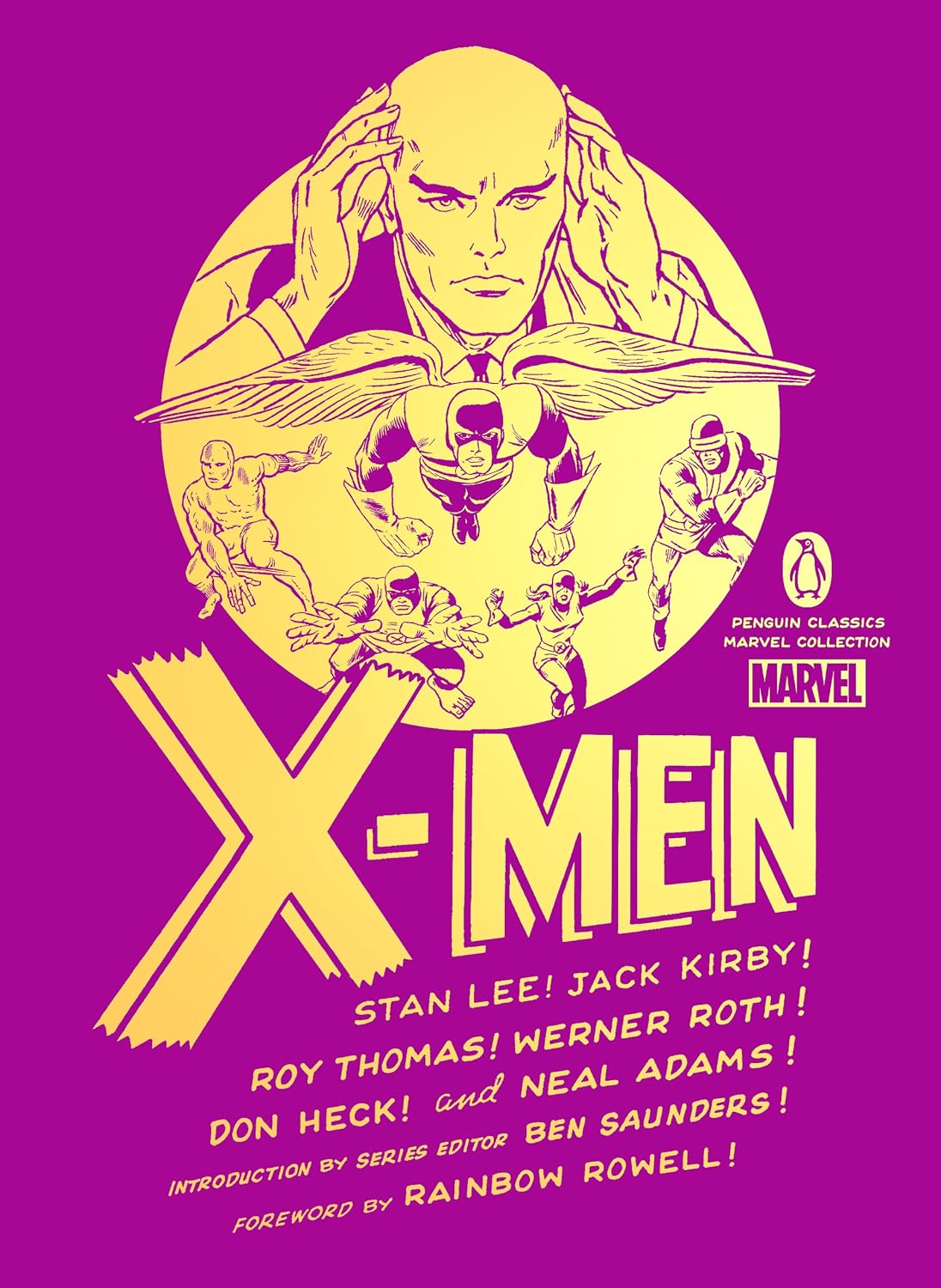
Collects X-Men #1, 3, 4, 5, 7, 8, 14, 15, 16, 38, 41, 42, 44, 45, and 46.It is impossible to imagine American popular culture without Marvel Comics. For decades, Marvel has published groundbreaking visual narratives that sustain attention on multiple levels: as metaphors for the experience of difference and otherness; as meditations on the fluid nature of identity; and as high-water marks in the artistic tradition of American cartooning, to name a few.
The seeds of a pop-cultural phenomenon were sown with the launch of the first X-Men comic in 1963, at the height of “the Marvel Revolution,” under the creative team of Stan Lee and Jack Kirby. The title was bookended by some of the best Super Hero comics of that era; the first issue established a creative formula that continues to inspire contemporary creators, while the final issues remain acclaimed for the groundbreaking artwork of Neal Adams. This collection gathers several key tales from the original run of the classic X-Men series.
A foreword by Rainbow Rowell and scholarly introductions and apparatus by Ben Saunders offer further insight into the enduring significance of the X-Men and classic Marvel comics.
Review
—Publishers Weekly
“Penguin provides introductory essays; superb analyses by the series editor, Ben Saunders; and extensive bibliographies.”
—Michael Dirda, The Washington Post
“Stories become classics when generations of readers sort through them, talk about them, imitate them, and recommend them. In this case, baby boomers read them when they débuted, Gen X-ers grew up with their sequels, and millennials encountered them through Marvel movies. Each generation of fans—initially fanboys, increasingly fangirls, and these days nonbinary fans, too—found new ways not just to read the comics but to use them. That’s how canons form. Amateurs and professionals, over decades, come to something like consensus about which books matter and why—or else they love to argue about it, and we get to follow the arguments. Canons rise and fall, gain works and lose others, when one generation of people with the power to publish, teach, and edit diverges from the one before ... A top-flight comic by Kirby—or his successor on “Captain America,” Jim Steranko—barely needed words. You could follow the story just by watching the characters act and react. Thankfully, Penguin volumes do justice to these images. They reproduce sixties comics in bright, flat, colorful inks on thick white paper—unlike the dot-based process used on old newsprint, but perhaps truer to their bold, thrill-chasing spirit.”
—Stephanie Burt, The New Yorker
“As before, all three of these volumes re-present Professor Ben Saunders’ learned general series intro which does an excellent job of succinctly explaining the rise of Marvel Comics and the Marvel Method.”
—Forces of Geek
About the Author
Born Jacob Kurtzberg in 1917 to Jewish-Austrian parents on New York’s Lower East Side, Jack Kirby came of age at the birth of the American comic book industry. Horrified by the rise of Nazism, Kirby co‑created the patriotic hero Captain America with Joe Simon in 1940. Cap’s exploits on the comic book page entertained millions of American readers at home and inspired US troops fighting the enemy abroad. Kirby’s partnership with Simon continued throughout the 1940s and early ’50s; together, they produced comics in every popular genre, from Western to romance. In 1958, Kirby began his equally fruitful collaboration with writer- editor Stan Lee, and in 1961 the two men co‑created the foundational text of the modern Marvel Universe: The Fantastic Four. Over the next decade, Kirby and Lee would introduce a mind- boggling array of new characters— including the Avengers, the Hulk, Thor, Iron Man, the Silver Surfer, and the X‑Men. Kirby’s groundbreaking work with Lee formed the foundation of the Marvel Universe. In the early 1970s, Kirby moved to DC Comics, where he created his interconnected Fourth World series, as well as freestanding titles such as The Demon. He returned to Marvel in 1975, writing and illustrating The Black Panther and Captain America, and introducing series such as Devil Dinosaur, and The Eternals. Kirby died in 1994. Today, he is generally regarded as one of the most important and influential creators in the history of American comics. His work has inspired multiple generations of writers, artists, designers, and filmmakers, who continue to explore his vast universe of concepts and characters. He was an inaugural inductee into the Eisner Hall of Fame in 1987.
Roy Thomas joined the Marvel Bullpen as a writer and editor under Stan Lee, scripting key runs of nearly every title of the time: Amazing Spider-Man, Avengers, Daredevil, Doctor Strange, Sub-Mariner, Thor, X-Men and more. He wrote the first 10 years of Marvel’s Conan the Barbarian and Savage Sword of Conan; and launched such series as Defenders, Iron Fist, Invaders and Warlock. At DC, he developed All-Star Squadron, Infinity Inc. and related titles, proving instrumental in reviving the Golden Age Justice Society of America. Thomas later became editor of Alter Ego, a magazine devoted to comic-book history, and co-scripted the sword-and-sorcery films Fire and Ice and Conan the Destroyer.
Werner Roth may not be remembered as widely as Marvel Age giants like Kirby, Ditko or Buscema, but that cannot change the fact that he was a key contributor during the early years when Marvel’s Silver Age legacy was still an unknown quantity. In fact, unlike those other artists, Werner Roth was an active participant in the earliest years of Marvel’s Atlas Era: the beyond beautiful heroine, Venus; Matt Slade, Western gunfighter; the horror/suspense stories of Strange Tales, Menace and World of Fantasy…Werner did it all! His two titles of longest creative standing were the Native American Western title Apache Kid and Lorna, the Jungle Queen, for which he turned in consistently lovely artwork. After several years away from comics, he reemerged at Marvel drawing X-Men, the first permanent artist installed to fill the big shoes of Jack Kirby. Werner’s X-Men work has charm to burn, with freewheeling renderings of such frozen-in-time characters like The Locust, Kukulcan/El Tigre, and Factor Three. He also created the visual look of The Banshee, certainly one of his most memorable contributions to the X-Men legacy. After his run on the X-Men ended, Werner dabbled in comics for a bit in the ’70s before retiring.
Don Heck (1929-1995) worked for Harvey, Quality, Hillman and other publishers before arriving at Atlas Comics, later Marvel, where he penciled and inked stories for virtually every genre: crime, horror, jungle, romance, war, Western and more. With Stan Lee and others, he launched Iron Man, his supporting cast and his early rogues’ gallery — including the Black Widow, Hawkeye and the Mandarin. He also succeeded Jack Kirby on Avengers. At DC, his artwork appeared in Justice League of America, Flash, Wonder Woman and other titles.
Neal Adams took the industry by storm with groundbreaking artwork on X-Men and Avengers. At DC, he and Dennis O’Neil collaborated on Batman and converted Green Lantern to Green Lantern/Green Arrow, a title famed for its combination of social commentary and comic-book action. He later founded Continuity Associates, home of Bucky O’Hare, Ms. Mystic and other fan favorites. After years of political activism, Adams returned to comics to write and draw Batman: Odyssey for DC, and provide art for Marvel’s New Avengers.
Arnold Drake (1924-2007) helped shape the Silver Age both at Marvel with Captain Marvel and X-Men; and at DC with Batman, Doom Patrol and “Stanley and His Monster.” His media tie-in work ranged from Star Trek to Bob Hope and Jerry Lewis. He wrote, produced and directed the 1964 horror film The Flesh Eaters, and wrote lyrics for several musicals. He won 1967 Alley Awards for Best Full-Length Story and Best New Strip (both for Deadman in Strange Adventures), as well as the Bill Finger Award for Excellence in Comics Writing.
Guaranteed immortality for introducing Johnny Blaze, the Ghost Rider, Gary Friedrich also played a pivotal role in Marvel’s 1970s Western and war comics, penning memorable tales of Sgt. Fury and launching the Marine series Captain Savage. In addition, Friedrich wrote issues of Incredible Hulk, Captain America, Captain Marvel, Daredevil, X-Men and more. With Steve Ditko, he co-created Charlton’s Blue Beetle, now a DC character. With Len Brown, he wrote a series of books on popular music.
One of the Golden Age’s earliest talents, George Tuska (1916-2009) created characters for Fiction House, Harvey Comics and Fawcett Comics’ Captain Marvel Adventures, among many others. He helped launch one of the most popular post-war genres in Lev Gleason’s Crime Does Not Pay. He eventually provided multi-genre art for Atlas Comics, to which he returned following its transformation into Marvel. Tuska penciled Ghost Rider, Luke Cage: Power Man and Sub-Mariner, as well as a 10-year Iron Man stint. At DC, he illustrated Challengers of the Unknown and Superman, among others. As a comic-strip artist, Tuska drew Buck Rogers, Scorchy Smith and DC’s World’s Greatest Superheroes. His final industry work was cover art for Masquerade, part of Dynamite’s Golden Age character revival, bringing him full circle.
Ben Saunders is a professor of English at the University of Oregon. He is the author of Desiring Donne: Poetry, Sexuality, Interpretation and Do the Gods Wear Capes?: Spirituality, Fantasy, and Superheroes, as well as numerous critical essays on subjects ranging from the writings of Shakespeare to the recordings of Little Richard. He has also curated several museum exhibitions of comics art, including the record- breaking, multimedia touring show Marvel: Universe of Super Heroes— a retrospective exploring the artistic and cultural impact of Marvel Comics from 1939 to the present.
Rainbow Rowell is the award- winning, #1 New York Times bestselling author of Eleanor & Park, Fangirl, Landline, Attachments, and the Simon Snow Trilogy. She has written monthly Runaways and She-Hulk comics for Marvel.
Details:
Visit the Penguin Classics Store
X-Men (Penguin Classics Marvel Collection)
AED22491
Quantity:
Order today to get by 7-14 business days
This item qualifies for free delivery
 Imported From: United States
At BOLO, we work hard to ensure the products you receive are new, genuine, and sourced from reputable suppliers.
Every product in the BOLO catalogue is sourced through our Verified Global Supply Network of verified sellers, authorized distributors or directly from the manufacturer.
Each product undergoes thorough inspection and verification at our consolidation and fulfilment centers to ensure it meets our strict authenticity and quality standards before being shipped and delivered to you.
If you ever have concerns regarding the authenticity of a product purchased from us, please contact Bolo Support. We will review your inquiry promptly and, if necessary, provide documentation verifying authenticity or offer a suitable resolution.
Your trust is our top priority, and we are committed to maintaining transparency and integrity in every transaction.
While we strive to display accurate information, variations in packaging, labeling, instructions, or formulation may occasionally occur due to regional differences or supplier updates. For detailed or manufacturer-specific information, please contact the brand directly or reach out to BOLO Support for assistance.
Unless otherwise stated, all prices displayed on the product page include applicable taxes and import duties.
BOLO operates in accordance with the laws and regulations of United Arab Emirates. Any items found to be restricted or prohibited for sale within the United Arab Emirates will be cancelled prior to shipment. We take proactive measures to ensure that only products permitted for sale in United Arab Emirates are listed on our website.
All items are shipped by air, and any products classified as “Dangerous Goods (DG)” under IATA regulations will be removed from the order and cancelled.
All orders are processed manually, and we make every effort to process them promptly once confirmed. Products cancelled due to the above reasons will be permanently removed from listings across the website.


More from this brand
Similar items from “Superheroes”
Share with
Or share with link
https://www.bolo.ae/products/U0143135767
Visit the Penguin Classics Store
X-Men (Penguin Classics Marvel Collection)
AED22491
Quantity:
Order today to get by 7-14 business days
This item qualifies for free delivery
Imported From: United States
At BOLO, we work hard to ensure the products you receive are new, genuine, and sourced from reputable suppliers.
Every product in the BOLO catalogue is sourced through our Verified Global Supply Network of verified sellers, authorized distributors or directly from the manufacturer.
Each product undergoes thorough inspection and verification at our consolidation and fulfilment centers to ensure it meets our strict authenticity and quality standards before being shipped and delivered to you.
If you ever have concerns regarding the authenticity of a product purchased from us, please contact Bolo Support. We will review your inquiry promptly and, if necessary, provide documentation verifying authenticity or offer a suitable resolution.
Your trust is our top priority, and we are committed to maintaining transparency and integrity in every transaction.
While we strive to display accurate information, variations in packaging, labeling, instructions, or formulation may occasionally occur due to regional differences or supplier updates. For detailed or manufacturer-specific information, please contact the brand directly or reach out to BOLO Support for assistance.
Unless otherwise stated, all prices displayed on the product page include applicable taxes and import duties.
BOLO operates in accordance with the laws and regulations of United Arab Emirates. Any items found to be restricted or prohibited for sale within the United Arab Emirates will be cancelled prior to shipment. We take proactive measures to ensure that only products permitted for sale in United Arab Emirates are listed on our website.
All items are shipped by air, and any products classified as “Dangerous Goods (DG)” under IATA regulations will be removed from the order and cancelled.
All orders are processed manually, and we make every effort to process them promptly once confirmed. Products cancelled due to the above reasons will be permanently removed from listings across the website.
Description:
Collects X-Men #1, 3, 4, 5, 7, 8, 14, 15, 16, 38, 41, 42, 44, 45, and 46.It is impossible to imagine American popular culture without Marvel Comics. For decades, Marvel has published groundbreaking visual narratives that sustain attention on multiple levels: as metaphors for the experience of difference and otherness; as meditations on the fluid nature of identity; and as high-water marks in the artistic tradition of American cartooning, to name a few.
The seeds of a pop-cultural phenomenon were sown with the launch of the first X-Men comic in 1963, at the height of “the Marvel Revolution,” under the creative team of Stan Lee and Jack Kirby. The title was bookended by some of the best Super Hero comics of that era; the first issue established a creative formula that continues to inspire contemporary creators, while the final issues remain acclaimed for the groundbreaking artwork of Neal Adams. This collection gathers several key tales from the original run of the classic X-Men series.
A foreword by Rainbow Rowell and scholarly introductions and apparatus by Ben Saunders offer further insight into the enduring significance of the X-Men and classic Marvel comics.
Review
—Publishers Weekly
“Penguin provides introductory essays; superb analyses by the series editor, Ben Saunders; and extensive bibliographies.”
—Michael Dirda, The Washington Post
“Stories become classics when generations of readers sort through them, talk about them, imitate them, and recommend them. In this case, baby boomers read them when they débuted, Gen X-ers grew up with their sequels, and millennials encountered them through Marvel movies. Each generation of fans—initially fanboys, increasingly fangirls, and these days nonbinary fans, too—found new ways not just to read the comics but to use them. That’s how canons form. Amateurs and professionals, over decades, come to something like consensus about which books matter and why—or else they love to argue about it, and we get to follow the arguments. Canons rise and fall, gain works and lose others, when one generation of people with the power to publish, teach, and edit diverges from the one before ... A top-flight comic by Kirby—or his successor on “Captain America,” Jim Steranko—barely needed words. You could follow the story just by watching the characters act and react. Thankfully, Penguin volumes do justice to these images. They reproduce sixties comics in bright, flat, colorful inks on thick white paper—unlike the dot-based process used on old newsprint, but perhaps truer to their bold, thrill-chasing spirit.”
—Stephanie Burt, The New Yorker
“As before, all three of these volumes re-present Professor Ben Saunders’ learned general series intro which does an excellent job of succinctly explaining the rise of Marvel Comics and the Marvel Method.”
—Forces of Geek
About the Author
Born Jacob Kurtzberg in 1917 to Jewish-Austrian parents on New York’s Lower East Side, Jack Kirby came of age at the birth of the American comic book industry. Horrified by the rise of Nazism, Kirby co‑created the patriotic hero Captain America with Joe Simon in 1940. Cap’s exploits on the comic book page entertained millions of American readers at home and inspired US troops fighting the enemy abroad. Kirby’s partnership with Simon continued throughout the 1940s and early ’50s; together, they produced comics in every popular genre, from Western to romance. In 1958, Kirby began his equally fruitful collaboration with writer- editor Stan Lee, and in 1961 the two men co‑created the foundational text of the modern Marvel Universe: The Fantastic Four. Over the next decade, Kirby and Lee would introduce a mind- boggling array of new characters— including the Avengers, the Hulk, Thor, Iron Man, the Silver Surfer, and the X‑Men. Kirby’s groundbreaking work with Lee formed the foundation of the Marvel Universe. In the early 1970s, Kirby moved to DC Comics, where he created his interconnected Fourth World series, as well as freestanding titles such as The Demon. He returned to Marvel in 1975, writing and illustrating The Black Panther and Captain America, and introducing series such as Devil Dinosaur, and The Eternals. Kirby died in 1994. Today, he is generally regarded as one of the most important and influential creators in the history of American comics. His work has inspired multiple generations of writers, artists, designers, and filmmakers, who continue to explore his vast universe of concepts and characters. He was an inaugural inductee into the Eisner Hall of Fame in 1987.
Roy Thomas joined the Marvel Bullpen as a writer and editor under Stan Lee, scripting key runs of nearly every title of the time: Amazing Spider-Man, Avengers, Daredevil, Doctor Strange, Sub-Mariner, Thor, X-Men and more. He wrote the first 10 years of Marvel’s Conan the Barbarian and Savage Sword of Conan; and launched such series as Defenders, Iron Fist, Invaders and Warlock. At DC, he developed All-Star Squadron, Infinity Inc. and related titles, proving instrumental in reviving the Golden Age Justice Society of America. Thomas later became editor of Alter Ego, a magazine devoted to comic-book history, and co-scripted the sword-and-sorcery films Fire and Ice and Conan the Destroyer.
Werner Roth may not be remembered as widely as Marvel Age giants like Kirby, Ditko or Buscema, but that cannot change the fact that he was a key contributor during the early years when Marvel’s Silver Age legacy was still an unknown quantity. In fact, unlike those other artists, Werner Roth was an active participant in the earliest years of Marvel’s Atlas Era: the beyond beautiful heroine, Venus; Matt Slade, Western gunfighter; the horror/suspense stories of Strange Tales, Menace and World of Fantasy…Werner did it all! His two titles of longest creative standing were the Native American Western title Apache Kid and Lorna, the Jungle Queen, for which he turned in consistently lovely artwork. After several years away from comics, he reemerged at Marvel drawing X-Men, the first permanent artist installed to fill the big shoes of Jack Kirby. Werner’s X-Men work has charm to burn, with freewheeling renderings of such frozen-in-time characters like The Locust, Kukulcan/El Tigre, and Factor Three. He also created the visual look of The Banshee, certainly one of his most memorable contributions to the X-Men legacy. After his run on the X-Men ended, Werner dabbled in comics for a bit in the ’70s before retiring.
Don Heck (1929-1995) worked for Harvey, Quality, Hillman and other publishers before arriving at Atlas Comics, later Marvel, where he penciled and inked stories for virtually every genre: crime, horror, jungle, romance, war, Western and more. With Stan Lee and others, he launched Iron Man, his supporting cast and his early rogues’ gallery — including the Black Widow, Hawkeye and the Mandarin. He also succeeded Jack Kirby on Avengers. At DC, his artwork appeared in Justice League of America, Flash, Wonder Woman and other titles.
Neal Adams took the industry by storm with groundbreaking artwork on X-Men and Avengers. At DC, he and Dennis O’Neil collaborated on Batman and converted Green Lantern to Green Lantern/Green Arrow, a title famed for its combination of social commentary and comic-book action. He later founded Continuity Associates, home of Bucky O’Hare, Ms. Mystic and other fan favorites. After years of political activism, Adams returned to comics to write and draw Batman: Odyssey for DC, and provide art for Marvel’s New Avengers.
Arnold Drake (1924-2007) helped shape the Silver Age both at Marvel with Captain Marvel and X-Men; and at DC with Batman, Doom Patrol and “Stanley and His Monster.” His media tie-in work ranged from Star Trek to Bob Hope and Jerry Lewis. He wrote, produced and directed the 1964 horror film The Flesh Eaters, and wrote lyrics for several musicals. He won 1967 Alley Awards for Best Full-Length Story and Best New Strip (both for Deadman in Strange Adventures), as well as the Bill Finger Award for Excellence in Comics Writing.
Guaranteed immortality for introducing Johnny Blaze, the Ghost Rider, Gary Friedrich also played a pivotal role in Marvel’s 1970s Western and war comics, penning memorable tales of Sgt. Fury and launching the Marine series Captain Savage. In addition, Friedrich wrote issues of Incredible Hulk, Captain America, Captain Marvel, Daredevil, X-Men and more. With Steve Ditko, he co-created Charlton’s Blue Beetle, now a DC character. With Len Brown, he wrote a series of books on popular music.
One of the Golden Age’s earliest talents, George Tuska (1916-2009) created characters for Fiction House, Harvey Comics and Fawcett Comics’ Captain Marvel Adventures, among many others. He helped launch one of the most popular post-war genres in Lev Gleason’s Crime Does Not Pay. He eventually provided multi-genre art for Atlas Comics, to which he returned following its transformation into Marvel. Tuska penciled Ghost Rider, Luke Cage: Power Man and Sub-Mariner, as well as a 10-year Iron Man stint. At DC, he illustrated Challengers of the Unknown and Superman, among others. As a comic-strip artist, Tuska drew Buck Rogers, Scorchy Smith and DC’s World’s Greatest Superheroes. His final industry work was cover art for Masquerade, part of Dynamite’s Golden Age character revival, bringing him full circle.
Ben Saunders is a professor of English at the University of Oregon. He is the author of Desiring Donne: Poetry, Sexuality, Interpretation and Do the Gods Wear Capes?: Spirituality, Fantasy, and Superheroes, as well as numerous critical essays on subjects ranging from the writings of Shakespeare to the recordings of Little Richard. He has also curated several museum exhibitions of comics art, including the record- breaking, multimedia touring show Marvel: Universe of Super Heroes— a retrospective exploring the artistic and cultural impact of Marvel Comics from 1939 to the present.
Rainbow Rowell is the award- winning, #1 New York Times bestselling author of Eleanor & Park, Fangirl, Landline, Attachments, and the Simon Snow Trilogy. She has written monthly Runaways and She-Hulk comics for Marvel.
Details:
More from this brand
Similar items from “Superheroes”
Share with
Or share with link
https://www.bolo.ae/products/U0143135767