Deliver toUnited Arab Emirates
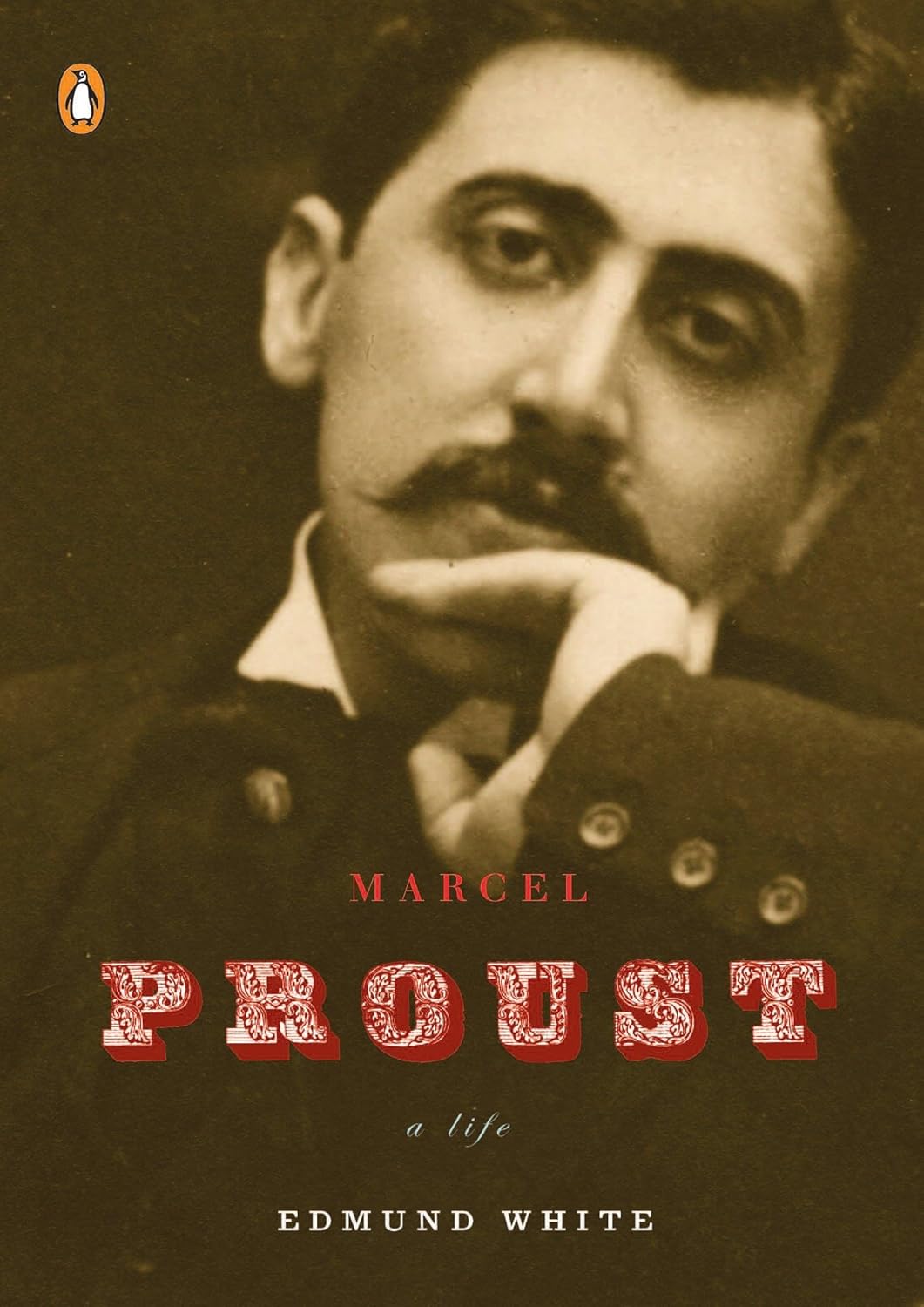
Marcel Proust: A Life (Penguin Lives)

Description:

The celebrated novelist and influential cultural critic's classic biography of one of history's most important writers, Marcel Proust

If there is anyone worthy of producing an intimate biography of the enigmatic genius behind
Remembrance of Things Past, it is Edmund White, himself an award- winning writer for whom Marcel Proust has long been an obsession. White introduces us not only to the recluse endlessly rewriting his one massive work through the night, but also the darling of Parisian salons, the grasper after honors, and the closeted homosexual-a subject this book is the first to explore openly. From the frothiest gossip to the deepest angst, here is a moving portrait to be treasured by anyone looking for an introduction to this literary icon.


Editorial Reviews

Review

"White has a novelist's eye for the telling detail or the remarkable phrase and, like Proust himself, concentrates upon the minutiae of the past so that it might live again. He has a wonderful sympathy with his subject, adduced in such reflections as ''Proust fancied that so long as he failed to begin his life's work, his life would go on.'' -- Peter Ackroyd, The New York Times Book Review

"White's deft prose is densely packed with information but never burdensome. He gives a good sense of why Proust's work is valuable, and why it remains eternally fresh."
-- Washington Post

"A tale of twentieth-century literature 'par excellence' that White makes fun, accessible, and insightful."
-The Philadelphia Inquirer

"White's biography of Proust is a paragon of the genre; an engrossing and delightful piece of work."
-Norah Vincent, author of Self-Made Man

About the Author

Edmund White is the author of many novels, including A Boy's Own Story, The Beautiful Room Is Empty, The Farewell Symphony, and Our Young Man. His nonfiction includes City Boy, Inside a Pearl, The Unpunished Vice, and other memoirs; The Flâneur, about Paris; and literary biographies and essays. He was named the 2018 winner of the PEN/Saul Bellow Award for Achievement in American Fiction and received the 2019 Medal for Distinguished Contribution to American Letters from the National Book Foundation.

Reviews:

5.0 out of 5 stars Insightful, the Proust Mystery Revealed

C.F. · May 31, 2016

A remarkable biography of one of France's greatest writers whose fame has traveled around the world. Who doesn't know the "madeleine" episode, where Proust describes at length how eating a special kind of cookie (that's what a madeleine is) called back memories of childhood and more? Proust did not study psychology but he was, as Edmund White so expertly explains, a natural master at it.In fact, it is the decrypting of the Proust mystery - because Proust, the social climber, was in fact a secret, intimate, tortured man - is what makes this book so fascinating. It unveils the tragedy of gay life in a time (the early 20th century) when "outing" was not permissible, in fact, Proust never even considered it. A must read for Proust fans but also for anyone who wants to understand how great minds work when confronted with social challenges like the opprobium that haunted gay men in his days.

5.0 out of 5 stars Proust Reader on White

S.R. · November 17, 2010

Edmund White's brief (156 pages) biography of Proust reveals few details not found in the longer works by Carter, Painter or Tadié. But it differs from these other books by having been written by an accomplished novelist and a gay man, two qualities that help the author provide new insights into Proust.White on Proust the homosexual:At the same time that Proust was eager to make love to other young men, he was equally determined to avoid the label "homosexual." Years later he would tell André Gide that one could write about homosexuality even at great length, so long as one did not ascribe it oneself. This bit of literary advice is coherent with Proust's general closetedness-a secretiveness that was all the more absurd since everyone near him knew he was gay. (46)This suggestion that Proust was a homosexual having an affair with the young Daudet could not be allowed to pass by unchallenged. Three days later the two men, standing at a distance of twenty-five yards, fired in the air above each other's heads: Proust reported that his bullet fell just next to Lorrain's foot. Proust showed a surprising coolness under fire. Perhaps he was proudest of the cachet of his seconds, the painter Jean Béraud and a celebrated he-man duelist, Gustave de Borda. No one remarked on the absurdity of one homosexual "accusing" another of being homosexual, which led to a duel to clear the "reputation" of the "injured" party....To be labeled a homosexual in print (as opposed to living a homosexual life in private or discreetly among friends) was social anathema, even in Paris, until the very recent past. (75-76)Bibesco remembered that at one of his mother's salons he had first met Proust, whom he later characterized by saying he had eyes of "Japanese lacquer" and a hand that was "dangling and soft." When he subsequently instructed Marcel on how to shake hands with a virile grip, Proust said, "If I followed your example, people would take me for an invert." Which is just an indication of how devious the thinking of a homosexual of the period could become-a homosexual affects a limp handshake so that heterosexuals will not think he is a homosexual disguising himself as a hearty hetero-whereas in fact he is exactly what he appears to be: a homosexual with a limp handshake. (82)To be sure, almost no one who did not know him thought that Proust himself was homosexual. The Narrator is one of the few unambiguous heterosexuals in the book; almost all the other characters turn out to be gay. After Proust's death several essays congratulated him on his "courage" in braving such disgusting corners of experience, as though Proust were a moral Jean-Henri Fabre-the pioneering entomologist-and his homosexual characters were insects. (150)White on Proust the writer:But Proust had more personal objections to Ruskin. Sesame and Lilies is about the importance of reading as a way of improving the lot of the working class; whereas Proust prefaced his translation with one his most moving texts, "On Reading," about the magical power of reading to awaken the imagination of a child-an end in itself. (79)As the trajectory of this single character [Charlus] demonstrates, Proust had learned a method of presentation that falls midway between that of Dickens and that of Henry James. Dickens assigns his characters one or two memorable traits, sometimes highly comic, which they display each time they make an appearance; James, by contrast, is so quick to add nuances to every portrait that he ends up effacing them with excessive shading. Proust invented a way of showing a character such as Charlus in Dickensian bold relief at any given moment-Charlus as the enraged queen or, later, Charlus as the shattered King Lear. Yet by building up a slow composite of images through time, Proust achieves the same complexity that James had aimed at, though far more memorably. (109)Proust esteemed Wagner's way of "spitting out everything he knew about a subject, everything close or distant, easy or difficult." This sort of fullness and explicitness he obviously preferred in literature as well, an amplitude he contrasted favorably to the pared-back reticence of the neo-classical style, as it was practiced by Anatole France or even André Gide. Still more important, Wagner's opera Parsifal has been designated by many critics as the very template for Remembrance of Things Past, since both works trace the quest of a young man-in Parsifal, for the Holy Grail; and in Proust's book, for the secret of literature. (112)Rather than distorting the proportions of the whole book, as some critics have complained, the introduction of Albertine actually fills an immense void, "since little dalliances without importance and fleeting flirtations are replaced by the violent, tragic grandeur of Racinian passion," as Proust's best and most recent biographer, Jean-Yves Tadié, writes. (129)The apparently meandering prologue to the whole epic, "Combray," for instance, is actually something like a strict overture to an opera, in the sense that it announces and compresses all the successive themes. (141)Proust was anti-intellectual and convinced that the domain of art, which is recollected experience, can never be tapped through reasoning or method alone; it must be delivered to us, fresh and vivid, through a process beyond the control of the intellect or willpower. Paradoxically, if Proust was anti-intellectual he was also profoundly philosophical, in that what he sought was not the accidents but the essence of any past event. Involuntary memory, by definition anti-intellectual, nevertheless refines away all the unnecessary details of a forgotten moment and retains only its unadorned core. (143)Proust Reader

4.0 out of 5 stars A witty, original, opinionated, and useful introduction to "In Search of Lost Time"

D.C.S. · October 30, 2009

Clever, witty, and elegantly written, Edmund White's sketch of Proust's life will not satisfy--and is not meant to satisfy--those readers looking for a full-scale literary biography. (Then again, what were you expecting from a 150-page book?) Instead, this slim and tidy chapbook is a valuable introduction to Proust's seven-volume bildungsroman and will almost certainly allow readers to appreciate even more the wonders of "In Search of Lost Time." Briefly describing Proust's life and times, his family and friends, his literary predecessors, and the work's textual history, White's summary has just enough material to motivate readers to move on to the novel itself.Perhaps unsurprisingly for an iconic gay author like White, the volume focuses on the open secret of Proust's sexuality, how this duality influenced his writing, and how Proust "inverted"--if you'll excuse the pun--certain characters by borrowing real-life friends (many of whom White identifies) and making them women rather than men in his novel. In the affair between Swann and Odette, for example, White sees echoes of "the alternating bouts of jealousy and reconciliation" between Proust and his lover Reynaldo Hahn; likewise, "a little bevy of handsome youths" whom Proust met on the beach became the gang of girls in the second volume. Some critics have criticized this emphasis on Proust's homosexuality as a misplaced, modern obsession, but I think it's a revealing perspective. His masterpiece is, after all, largely preoccupied with sexual relations, and it's hardly inappropriate to highlight people who are transposed from life's stage to the pages of a book--especially one as autobiographical as Proust's.Having recently begun the third volume of "In Search of Lost Time," I regret that I had not read White's biographical outline first. Once I finished the book, I went back to the first two volumes and re-read passages I had missed or misunderstood the first time around. I think I would have understood and enjoyed the first two volumes even more, and this is true even in those occasional instances where I'm not sure I agree with White's interpretations--starting with his claim that "Proust's fame and prestige have eclipsed those" of writers such as Joyce, Woolf, and Faulkner. (Really, does literature have to be a competitive sport?) This little "life" provides just enough background and analysis to encourage rather than predispose Proust's modern-day readers.

Proust - after a fashion!

B. · September 4, 2020

I'm a Proust fanatic, as a lot of people now know, and I'm pleased to have made this purchase. It would have helped if I'd noticed the text is in German (which I read only after a fashion). If I struggle, I'll shop for the English version.There's bound to be one. (I could even have it already.) This Proust thing is now so deeply rooted, I'd keep the little volume even if it were in Mandarin Chinese.bm.

A la Recherche de Proust

B. · October 12, 2025

Very entertaining. Written from a gay perspective and a focus on Proust’s own reluctance to admit his own homosexuality. Useful in understanding nuances of Proust’s massive seven volume novel.

The book who makes you read "La recherche"

A. · December 13, 2014

An astonishing way to discover Marcel Proust's work.A very good introduction to "La recherche".Edmund Withe has a wonderful style. His writing makes you closer to Marcel Proust...

Fantastic short biography

D.t. · February 15, 2019

Gem of a book. Difficult to see how it could be bettered as a short biography of Proust and how his life relates to his masterwork. Easy to read with a lot of insights and intelligence. I read it after finishing the novels, though it might also be good to read beforehand as an introduction. Also enjoying Celeste Albaret’s memoir ‘ Monsieur Proust’.

sehr lesenswert

H. · January 29, 2013

informativ und sehr interessant, nicht nur das Leben Prousts betreffend, sondern auch seine Philosophie; sehr gut geschrieben und mit Sicherheit weiterzuempfehlen

Marcel Proust: A Life (Penguin Lives)

Product ID: U0143114980
Condition: New

4.4

AED9098

Price includes VAT & Import Duties
Type: Paperback
Availability: In Stock

Quantity:

|

Order today to get by 7-14 business days

Delivery fee of AED 20. Free for orders above AED 200.

Returns & Warranty policies

Imported From: United States

At BOLO, we work hard to ensure the products you receive are new, genuine, and sourced from reputable suppliers.

BOLO is not an authorized or official retailer for most brands, nor are we affiliated with manufacturers unless specifically stated on a product page. Instead, we source verified sellers, authorized distributors or directly from the manufacturer.

Each product undergoes thorough inspection and verification at our consolidation and fulfilment centers to ensure it meets our strict authenticity and quality standards before being shipped and delivered to you.

If you ever have concerns regarding the authenticity of a product purchased from us, please contact Bolo Support. We will review your inquiry promptly and, if necessary, provide documentation verifying authenticity or offer a suitable resolution.

Your trust is our top priority, and we are committed to maintaining transparency and integrity in every transaction.

All product information, images, descriptions, and reviews originate from the manufacturer or from trusted sellers overseas. BOLO is not affiliated with, endorsed by, or an authorized retailer for most brands listed on our website unless stated otherwise.

While we strive to display accurate information, variations in packaging, labeling, instructions, or formulation may occasionally occur due to regional differences or supplier updates. For detailed or manufacturer-specific information, please contact the brand directly or reach out to BOLO Support for assistance.

Unless otherwise stated, all prices displayed on the product page include applicable taxes and import duties.

BOLO operates in accordance with the laws and regulations of United Arab Emirates. Any items found to be restricted or prohibited for sale within the UAE will be cancelled prior to shipment. We take proactive measures to ensure that only products permitted for sale in United Arab Emirates are listed on our website.

All items are shipped by air, and any products classified as “Dangerous Goods (DG)” under IATA regulations will be removed from the order and cancelled.

All orders are processed manually, and we make every effort to process them promptly once confirmed. Products cancelled due to the above reasons will be permanently removed from listings across the website.

Similar suggestions by Bolo

More from this brand

Similar items from “French”

Marcel Proust: A Life (Penguin Lives)

Product ID: U0143114980
Condition: New

4.4

Marcel Proust: A Life (Penguin Lives)-0
Type: Paperback

AED9098

Price includes VAT & Import Duties
Availability: In Stock

Quantity:

|

Order today to get by 7-14 business days

Delivery fee of AED 20. Free for orders above AED 200.

Returns & Warranty policies

Imported From: United States

At BOLO, we work hard to ensure the products you receive are new, genuine, and sourced from reputable suppliers.

BOLO is not an authorized or official retailer for most brands, nor are we affiliated with manufacturers unless specifically stated on a product page. Instead, we source verified sellers, authorized distributors or directly from the manufacturer.

Each product undergoes thorough inspection and verification at our consolidation and fulfilment centers to ensure it meets our strict authenticity and quality standards before being shipped and delivered to you.

If you ever have concerns regarding the authenticity of a product purchased from us, please contact Bolo Support. We will review your inquiry promptly and, if necessary, provide documentation verifying authenticity or offer a suitable resolution.

Your trust is our top priority, and we are committed to maintaining transparency and integrity in every transaction.

All product information, images, descriptions, and reviews originate from the manufacturer or from trusted sellers overseas. BOLO is not affiliated with, endorsed by, or an authorized retailer for most brands listed on our website unless stated otherwise.

While we strive to display accurate information, variations in packaging, labeling, instructions, or formulation may occasionally occur due to regional differences or supplier updates. For detailed or manufacturer-specific information, please contact the brand directly or reach out to BOLO Support for assistance.

Unless otherwise stated, all prices displayed on the product page include applicable taxes and import duties.

BOLO operates in accordance with the laws and regulations of United Arab Emirates. Any items found to be restricted or prohibited for sale within the UAE will be cancelled prior to shipment. We take proactive measures to ensure that only products permitted for sale in United Arab Emirates are listed on our website.

All items are shipped by air, and any products classified as “Dangerous Goods (DG)” under IATA regulations will be removed from the order and cancelled.

All orders are processed manually, and we make every effort to process them promptly once confirmed. Products cancelled due to the above reasons will be permanently removed from listings across the website.

Description:

The celebrated novelist and influential cultural critic's classic biography of one of history's most important writers, Marcel Proust

If there is anyone worthy of producing an intimate biography of the enigmatic genius behind
Remembrance of Things Past, it is Edmund White, himself an award- winning writer for whom Marcel Proust has long been an obsession. White introduces us not only to the recluse endlessly rewriting his one massive work through the night, but also the darling of Parisian salons, the grasper after honors, and the closeted homosexual-a subject this book is the first to explore openly. From the frothiest gossip to the deepest angst, here is a moving portrait to be treasured by anyone looking for an introduction to this literary icon.


Editorial Reviews

Review

"White has a novelist's eye for the telling detail or the remarkable phrase and, like Proust himself, concentrates upon the minutiae of the past so that it might live again. He has a wonderful sympathy with his subject, adduced in such reflections as ''Proust fancied that so long as he failed to begin his life's work, his life would go on.'' -- Peter Ackroyd, The New York Times Book Review

"White's deft prose is densely packed with information but never burdensome. He gives a good sense of why Proust's work is valuable, and why it remains eternally fresh."
-- Washington Post

"A tale of twentieth-century literature 'par excellence' that White makes fun, accessible, and insightful."
-The Philadelphia Inquirer

"White's biography of Proust is a paragon of the genre; an engrossing and delightful piece of work."
-Norah Vincent, author of Self-Made Man

About the Author

Edmund White is the author of many novels, including A Boy's Own Story, The Beautiful Room Is Empty, The Farewell Symphony, and Our Young Man. His nonfiction includes City Boy, Inside a Pearl, The Unpunished Vice, and other memoirs; The Flâneur, about Paris; and literary biographies and essays. He was named the 2018 winner of the PEN/Saul Bellow Award for Achievement in American Fiction and received the 2019 Medal for Distinguished Contribution to American Letters from the National Book Foundation.

Reviews:

5.0 out of 5 stars Insightful, the Proust Mystery Revealed

C.F. · May 31, 2016

A remarkable biography of one of France's greatest writers whose fame has traveled around the world. Who doesn't know the "madeleine" episode, where Proust describes at length how eating a special kind of cookie (that's what a madeleine is) called back memories of childhood and more? Proust did not study psychology but he was, as Edmund White so expertly explains, a natural master at it.In fact, it is the decrypting of the Proust mystery - because Proust, the social climber, was in fact a secret, intimate, tortured man - is what makes this book so fascinating. It unveils the tragedy of gay life in a time (the early 20th century) when "outing" was not permissible, in fact, Proust never even considered it. A must read for Proust fans but also for anyone who wants to understand how great minds work when confronted with social challenges like the opprobium that haunted gay men in his days.

5.0 out of 5 stars Proust Reader on White

S.R. · November 17, 2010

Edmund White's brief (156 pages) biography of Proust reveals few details not found in the longer works by Carter, Painter or Tadié. But it differs from these other books by having been written by an accomplished novelist and a gay man, two qualities that help the author provide new insights into Proust.White on Proust the homosexual:At the same time that Proust was eager to make love to other young men, he was equally determined to avoid the label "homosexual." Years later he would tell André Gide that one could write about homosexuality even at great length, so long as one did not ascribe it oneself. This bit of literary advice is coherent with Proust's general closetedness-a secretiveness that was all the more absurd since everyone near him knew he was gay. (46)This suggestion that Proust was a homosexual having an affair with the young Daudet could not be allowed to pass by unchallenged. Three days later the two men, standing at a distance of twenty-five yards, fired in the air above each other's heads: Proust reported that his bullet fell just next to Lorrain's foot. Proust showed a surprising coolness under fire. Perhaps he was proudest of the cachet of his seconds, the painter Jean Béraud and a celebrated he-man duelist, Gustave de Borda. No one remarked on the absurdity of one homosexual "accusing" another of being homosexual, which led to a duel to clear the "reputation" of the "injured" party....To be labeled a homosexual in print (as opposed to living a homosexual life in private or discreetly among friends) was social anathema, even in Paris, until the very recent past. (75-76)Bibesco remembered that at one of his mother's salons he had first met Proust, whom he later characterized by saying he had eyes of "Japanese lacquer" and a hand that was "dangling and soft." When he subsequently instructed Marcel on how to shake hands with a virile grip, Proust said, "If I followed your example, people would take me for an invert." Which is just an indication of how devious the thinking of a homosexual of the period could become-a homosexual affects a limp handshake so that heterosexuals will not think he is a homosexual disguising himself as a hearty hetero-whereas in fact he is exactly what he appears to be: a homosexual with a limp handshake. (82)To be sure, almost no one who did not know him thought that Proust himself was homosexual. The Narrator is one of the few unambiguous heterosexuals in the book; almost all the other characters turn out to be gay. After Proust's death several essays congratulated him on his "courage" in braving such disgusting corners of experience, as though Proust were a moral Jean-Henri Fabre-the pioneering entomologist-and his homosexual characters were insects. (150)White on Proust the writer:But Proust had more personal objections to Ruskin. Sesame and Lilies is about the importance of reading as a way of improving the lot of the working class; whereas Proust prefaced his translation with one his most moving texts, "On Reading," about the magical power of reading to awaken the imagination of a child-an end in itself. (79)As the trajectory of this single character [Charlus] demonstrates, Proust had learned a method of presentation that falls midway between that of Dickens and that of Henry James. Dickens assigns his characters one or two memorable traits, sometimes highly comic, which they display each time they make an appearance; James, by contrast, is so quick to add nuances to every portrait that he ends up effacing them with excessive shading. Proust invented a way of showing a character such as Charlus in Dickensian bold relief at any given moment-Charlus as the enraged queen or, later, Charlus as the shattered King Lear. Yet by building up a slow composite of images through time, Proust achieves the same complexity that James had aimed at, though far more memorably. (109)Proust esteemed Wagner's way of "spitting out everything he knew about a subject, everything close or distant, easy or difficult." This sort of fullness and explicitness he obviously preferred in literature as well, an amplitude he contrasted favorably to the pared-back reticence of the neo-classical style, as it was practiced by Anatole France or even André Gide. Still more important, Wagner's opera Parsifal has been designated by many critics as the very template for Remembrance of Things Past, since both works trace the quest of a young man-in Parsifal, for the Holy Grail; and in Proust's book, for the secret of literature. (112)Rather than distorting the proportions of the whole book, as some critics have complained, the introduction of Albertine actually fills an immense void, "since little dalliances without importance and fleeting flirtations are replaced by the violent, tragic grandeur of Racinian passion," as Proust's best and most recent biographer, Jean-Yves Tadié, writes. (129)The apparently meandering prologue to the whole epic, "Combray," for instance, is actually something like a strict overture to an opera, in the sense that it announces and compresses all the successive themes. (141)Proust was anti-intellectual and convinced that the domain of art, which is recollected experience, can never be tapped through reasoning or method alone; it must be delivered to us, fresh and vivid, through a process beyond the control of the intellect or willpower. Paradoxically, if Proust was anti-intellectual he was also profoundly philosophical, in that what he sought was not the accidents but the essence of any past event. Involuntary memory, by definition anti-intellectual, nevertheless refines away all the unnecessary details of a forgotten moment and retains only its unadorned core. (143)Proust Reader

4.0 out of 5 stars A witty, original, opinionated, and useful introduction to "In Search of Lost Time"

D.C.S. · October 30, 2009

Clever, witty, and elegantly written, Edmund White's sketch of Proust's life will not satisfy--and is not meant to satisfy--those readers looking for a full-scale literary biography. (Then again, what were you expecting from a 150-page book?) Instead, this slim and tidy chapbook is a valuable introduction to Proust's seven-volume bildungsroman and will almost certainly allow readers to appreciate even more the wonders of "In Search of Lost Time." Briefly describing Proust's life and times, his family and friends, his literary predecessors, and the work's textual history, White's summary has just enough material to motivate readers to move on to the novel itself.Perhaps unsurprisingly for an iconic gay author like White, the volume focuses on the open secret of Proust's sexuality, how this duality influenced his writing, and how Proust "inverted"--if you'll excuse the pun--certain characters by borrowing real-life friends (many of whom White identifies) and making them women rather than men in his novel. In the affair between Swann and Odette, for example, White sees echoes of "the alternating bouts of jealousy and reconciliation" between Proust and his lover Reynaldo Hahn; likewise, "a little bevy of handsome youths" whom Proust met on the beach became the gang of girls in the second volume. Some critics have criticized this emphasis on Proust's homosexuality as a misplaced, modern obsession, but I think it's a revealing perspective. His masterpiece is, after all, largely preoccupied with sexual relations, and it's hardly inappropriate to highlight people who are transposed from life's stage to the pages of a book--especially one as autobiographical as Proust's.Having recently begun the third volume of "In Search of Lost Time," I regret that I had not read White's biographical outline first. Once I finished the book, I went back to the first two volumes and re-read passages I had missed or misunderstood the first time around. I think I would have understood and enjoyed the first two volumes even more, and this is true even in those occasional instances where I'm not sure I agree with White's interpretations--starting with his claim that "Proust's fame and prestige have eclipsed those" of writers such as Joyce, Woolf, and Faulkner. (Really, does literature have to be a competitive sport?) This little "life" provides just enough background and analysis to encourage rather than predispose Proust's modern-day readers.

Proust - after a fashion!

B. · September 4, 2020

I'm a Proust fanatic, as a lot of people now know, and I'm pleased to have made this purchase. It would have helped if I'd noticed the text is in German (which I read only after a fashion). If I struggle, I'll shop for the English version.There's bound to be one. (I could even have it already.) This Proust thing is now so deeply rooted, I'd keep the little volume even if it were in Mandarin Chinese.bm.

A la Recherche de Proust

B. · October 12, 2025

Very entertaining. Written from a gay perspective and a focus on Proust’s own reluctance to admit his own homosexuality. Useful in understanding nuances of Proust’s massive seven volume novel.

The book who makes you read "La recherche"

A. · December 13, 2014

An astonishing way to discover Marcel Proust's work.A very good introduction to "La recherche".Edmund Withe has a wonderful style. His writing makes you closer to Marcel Proust...

Fantastic short biography

D.t. · February 15, 2019

Gem of a book. Difficult to see how it could be bettered as a short biography of Proust and how his life relates to his masterwork. Easy to read with a lot of insights and intelligence. I read it after finishing the novels, though it might also be good to read beforehand as an introduction. Also enjoying Celeste Albaret’s memoir ‘ Monsieur Proust’.

sehr lesenswert

H. · January 29, 2013

informativ und sehr interessant, nicht nur das Leben Prousts betreffend, sondern auch seine Philosophie; sehr gut geschrieben und mit Sicherheit weiterzuempfehlen

Similar suggestions by Bolo

More from this brand

Similar items from “French”