Deliver toUnited Arab Emirates
Mutants: On Genetic Variety and the Human Body

Description:

Visit Armand Marie Leroi on the web: http://armandleroi.com/index.html

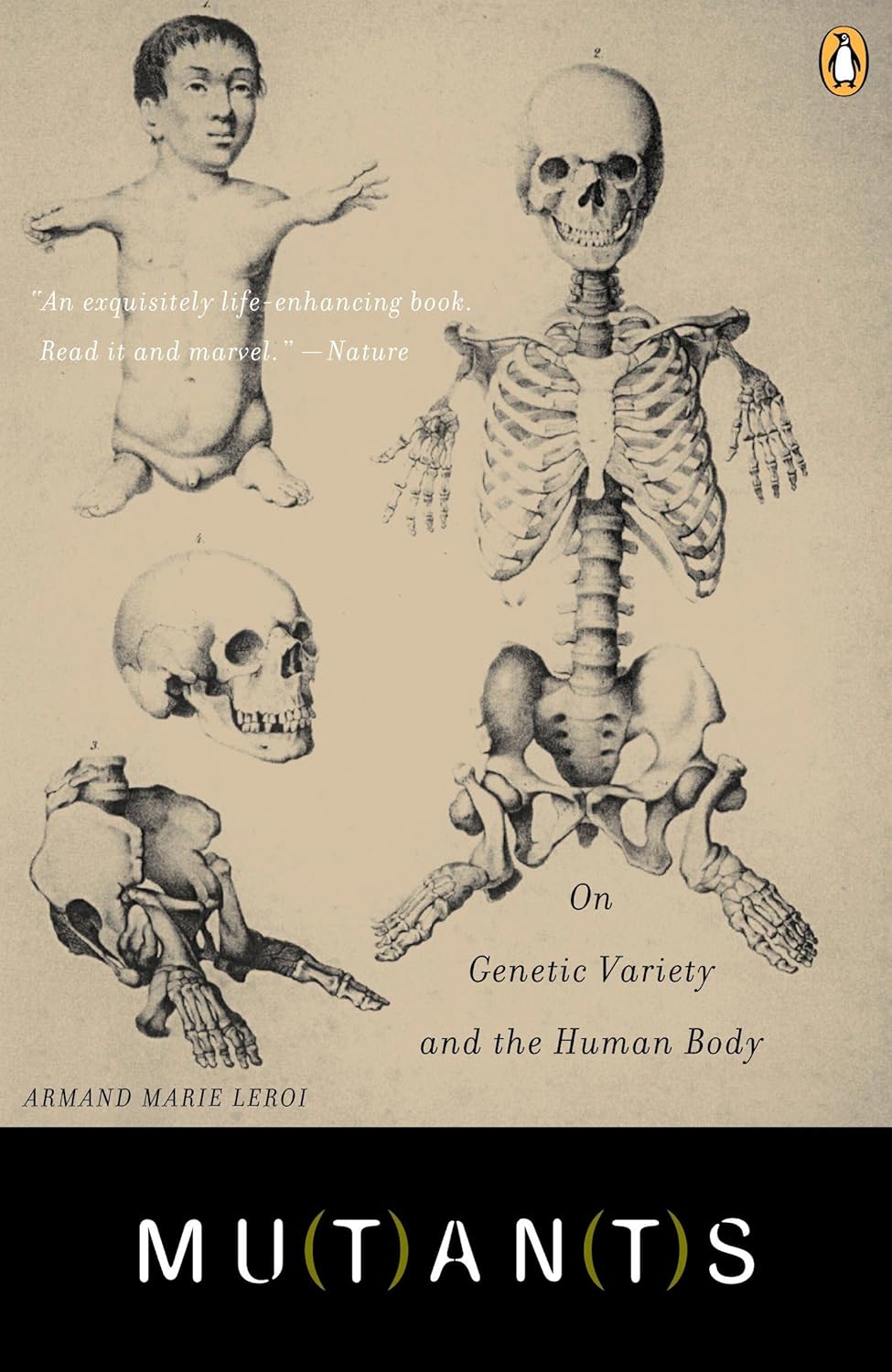
Stepping effortlessly from myth to cutting-edge science, Mutants gives a brilliant narrative account of our genetic code and the captivating people whose bodies have revealed it—a French convent girl who found herself changing sex at puberty; children who, echoing Homer’s Cyclops, are born with a single eye in the middle of their foreheads; a village of long-lived Croatian dwarves; one family, whose bodies were entirely covered with hair, was kept at the Burmese royal court for four generations and gave Darwin one of his keenest insights into heredity. This elegant, humane, and engaging book “captures what we know of the development of what makes us human” (Nature).


Editorial Reviews

Review

"Combines meticulous historical research, [and] brand-new genetic understanding to tell an absorbing tale." —Matt Ridley, author of Genome

"A marvelous accomplishment. A good look a the amazing prospect before us as we decode the human genome..." —
The Seattle Times

About the Author

Visit Armand Marie Leroi on the web: http://armandleroi.com/index.html

Armand Marie Leroi has lived in South Africa, Canada, and the United States. Since 1996, he has been a lecturer in evolutionary genetics at Imperial College, London. He has published widely in technical journals on evolutionary and developmental genetics and writes occasionally for the London Review of Books.

Reviews:

5.0 out of 5 stars Interesting book/ great seller

R. · September 6, 2025

Hardcover book in very good condition as described.Great price, and reasonable shipping cost. Arrived safely/ well packaged to protect it from damage.This is a very interesting book about genetic abnormalities handled with great respect to the afflicted individuals. Not everyone will find this a book that they will want to read, but it is a very good book on the subject.

5.0 out of 5 stars At play in the genetic casino

e. · April 18, 2005

"Mutants" is part side-show and part genetic crapshoot where the mutated gene almost always loses. The author states that on the average, 300 mutations burden each newly conceived embryo. Five of the mutations won't make it into the general population because of miscarriage and childhood deaths---"No one leaves the genetic casino unscathed." Being born with three sets of eye-lashes, an extra set of ears on one's neck, or in my case, crooked little fingers, are very benign mutations compared to what can and sometimes does go wrong.The primary theme of this elegant, engaging book is that mutations are the signposts that can be used to determine exactly where in the morphogenesis of an infant, something went physically or genetically astray.Chapter 1, "A Perfect Join (On the invisible geometry of embryos)" takes the reader on a tour through the first few hours and days of a fertilized egg. Conjoined twins are an example of what can go wrong with the developmental mechanics within the womb. One unfortunate baby was born with 21 partially developed twins (determined through a leg count) in his skull. However, the main thrust of this chapter, using conjoined twins as an example of the process gone wrong, is the search for an 'organizer': that which informs the cells what to do, what to become, and where to go. It is a process that is part mechanical, part chemical, and part sheer dumb luck. As the author puts it: "The power of cell-cell adhesion to mould the developing body is startling."In the next chapter, the author examines the powerful homeotic genes and signaling proteins such as 'sonic hedgehog,' employing some gruesome examples of what can go wrong during the formation of the neural tube and other body parts. Human and animal Cyclops, as well as other mutations such as 'mermaids' are outcomes of control processes gone wrong. Sonic hedgehog-defective infants have a single cerebral hemisphere, hence one eye. "Mice in which the sonic hedgehog gene has been completely disabled have malformed hearts, lungs, kidneys and guts. They are always stillborn and have no paws..."I certainly wouldn't recommend this book to a pregnant friend. It's frightening enough to have a vague notion of what might go wrong, without this author's meticulous gene-by-gene guide as to the results of many mutations.Limb buds, skeletons, growth, gender, and skin color are all viewed in turn, through the distorting lens of genes gone wrong. We are introduced to pigmies, piebalds, cretins, and castrati.The penultimate chapter, "The Sober Life (on Ageing)" is especially interesting because ageing is something we all do regardless of our original mutational burden. The author raises the interesting question as to whether death is just another genetic engineering problem. "Were it not for ageing's pervasive effects, 95 per cent of us would celebrate our centenaries; half of us would better the biblical Patriarchs by centuries and live for more than a thousand years."Sir Peter Medawar was the first to suggest that mutations causing fatal errors in old age are not necessarily selected against. Once we've bred and raised our children, what use has nature for us?The final chapter, "Anthropometamorphosis (an Epilogue)" ends rather wistfully with a discussion of beauty, and why it may be important for the survival of a species. Beauty is defined as the absence of imperfections: "the machine errors that arise from the vicissitudes of the womb, childhood, maturity and old age, that are written all over our bodies and that are so ubiquitous that when we see someone who appears to have evaded them, however fleetingly, we pause to look with amazed delight."Read "Mutants" and you may also find yourself pausing, and looking about with amazed delight. Armand Marie Leroi does not exploit freaks of mutation so much as he weaves them into the story of each of our individual lives.

4.0 out of 5 stars Very well written- a mixture of genetics, antropology, history, philosphy

C.C. · April 1, 2006

This is a very readable book, only getting too technical once or twice, but for the most part fully explaining concepts for his readers.Leroi bases his study of mutations in human beings on the philosophy of Francis Bacon. Bacon helped establish the principles by which the scientific inquiry of the natural world was to be conducted. Bacon saw that natural history can be divided intot he study of normal nature, aberrant nature, and nature manipulated by man. Leroi writes: "Centureies ahead of his time, Bacon recognized that the pursuit of the causes of error is not an end in itlsef, bur rather just a means. The monstrous, the strange, the deviant, or merely the different, he is saying, reveal the laws of nature. And once we know those laws, we can reconstruct the world as we wish."The range of Leroi's knowledge is considerable. The story repeatedly drew together the fields of philosophy, anthropology, history, and molecular biology.Leroi is the one of the first to discuss that in Africa the Delta 32 polymorphism of the CCR5 gene is currently increasing in frequency because it confers resistance to HIV. We know that CCR5 in some lucky persons of Northern European background gives them some protection against HIV infection. However this trait is so rare among Africans that I suspect the increase will not make significant changes in the grim outlook for sub-Saharan Africa.The book is actually hopeful even though it discusses the many ways that we as humans can go genetically 'wrong'. Leroi states: "The aveage newly conceived human bears three hundred mutations that impair its health in some fashion."Leroi's historic studies add much to the book. He uncovers the range of enlightened thinkers who saw human mutations, not as the work of the devil, but as opportunity to study God's methods. For example he quotes Montaigne: "Those whom we call monsters are not so with GOd, who in the immensity of his work seeth the infinite forms therein contained."Of course there are times that the book makes your hair stand on end. For example: "In 1982, a thirty-five-year-old Chinese man was reported with a parasitic head embedded in the right side of his own head. The extra head had a small brain, two weak eyes, two eyebrows, a nose, twelve teeth, a tongue and lots of hair. When the main head pursed its lips, stuck out its tongue or blinked its eyelids, so did the parasitic head; when the main head ate, the parasite drooled...A Dutch child born in 1995 had the remains of twenty-one foetuses (as determined by a leg count) embedded in its brain."There is a very interesting case study of the artist Henri de Toulouse-Lautrec. "By the time he was seven his mother had taken him to Lourdes, where she hoped to find a cure for some vaguely described limb problem... By the age of ten he was complaining of constant severe pains in his legs and thighs, and at thirteen minor falls caused fractures in both femurs which, to judge from the length of time during which he supported himself with canes, took about six months to heal. He would use a cane nearly all his adult life. Laurterc also undertwent some unusual facial changes. He developed a pendoulous lower lip, a tendency to drool, and a speech impediment rather like a growling lisp, and his teeth rotted while he was still in his teens."The examples continue to build on each other, offering new inforamtion and insight throughout the book.

5.0 out of 5 stars Fascinating and Informative

D.Y. · January 15, 2015

This book isn't just a carnival trip to stare at the freaks. It is actually deeply informative on the genetics and development of the embryo that lead to specific deformities. This book tends to assume you have a lot of knowledge on the structure of embryos, so keep a laptop nearby if (like me) you needed to look up structures such as an egg yolk(?) or sac. I tragically spent a lot of time on that one and seem to have forgotten all about it completely, right down to what it is called. Eh, I'll look it up again. Anyway, there is so much to read in so much detail it seems the book should be longer. It amazes you. How does anything manage to form in an average way? How did I end up with a working index finger AND working sight AND the ability to read AND the ability to write AND the ability to retain (some lol) information. Along with all the rest! It really puts embryonic development into perspective. It also helps in understanding the exact nature of deformities, taking away fear and superstition and judgement. Definitely a must read. (More than once, if you're anything like me.)

5.0 out of 5 stars We all have mutations

A.C. · March 29, 2025

Mutations. A great read. This book had me thinking about all these birth defects and genes mutations. Are you born with a gene mutation?

mutants

G. · October 15, 2009

This book is more of a medical text than a non fiction book It deals with not only mutants -- a change in chromosomes or genes of a cell which may affect the structure and development of the resultant offspring --but also with developmental abnormalities which are not mutants eg.coinjoined twins.Following an introduction covering the identification and history of mutants chapters are devoted to a) conjoined twins b)monstroties c)arms and legs d)skeleton e)genderf)skin and g)ageingThroughout the book there are multiple illustrations ranging from the 15-20th centuries taken mainly from museums.The book is very well written and researched although the bits on DNA are pretty elementary.A book to be recommended but not for the faint of heart.

Five Stars

R.S. · July 28, 2016

Decent quality.

A fascinating exploration of genetic errors that afflict mankind.

R.S. · October 19, 2018

Most of humans have an average, "normal" body - ten fingers, two hands, one nose, two eyes, two ears, etc. We are so used to this setup that we forget that development and life is an incredibly complicated process, requiring thousands of genes to work as coordinated teams to shape various cells, tissues and organs. And as is often the case with complicated things in life, they can go wrong. This book is a fascinating, albeit heart-breaking tour of some quirks of mutations, or mistakes in our DNA, that can lead to defective systems, whether they are our bones, eyes, or our nether regions (yikes!). Highly recommended.

Uno sguardo generale sulla tanatologia. Ben fatto a livello storico e culturale, ma poco iconografico.

E. · June 7, 2014

Il testo passa in rassegna diversi "tipi" di freaks, analizza la possibile origine clinica e gli aspetti mitologici e archetipali. Ma le immagini sono pochissime e di scarsa definizione. Il testo vale comunque.

Insightful

N. · December 8, 2024

Yes

Mutants: On Genetic Variety and the Human Body

Product ID: U0142004820
Condition: New

4.6

AED8032

Price includes VAT & Import Duties
Type: Paperback
Availability: In Stock

Quantity:

|

Order today to get by 7-14 business days

Delivery fee of AED 20. Free for orders above AED 200.

Returns & Warranty policies

Imported From: United States

At BOLO, we work hard to ensure the products you receive are new, genuine, and sourced from reputable suppliers.

BOLO is not an authorized or official retailer for most brands, nor are we affiliated with manufacturers unless specifically stated on a product page. Instead, we source verified sellers, authorized distributors or directly from the manufacturer.

Each product undergoes thorough inspection and verification at our consolidation and fulfilment centers to ensure it meets our strict authenticity and quality standards before being shipped and delivered to you.

If you ever have concerns regarding the authenticity of a product purchased from us, please contact Bolo Support. We will review your inquiry promptly and, if necessary, provide documentation verifying authenticity or offer a suitable resolution.

Your trust is our top priority, and we are committed to maintaining transparency and integrity in every transaction.

All product information, images, descriptions, and reviews originate from the manufacturer or from trusted sellers overseas. BOLO is not affiliated with, endorsed by, or an authorized retailer for most brands listed on our website unless stated otherwise.

While we strive to display accurate information, variations in packaging, labeling, instructions, or formulation may occasionally occur due to regional differences or supplier updates. For detailed or manufacturer-specific information, please contact the brand directly or reach out to BOLO Support for assistance.

Unless otherwise stated, all prices displayed on the product page include applicable taxes and import duties.

BOLO operates in accordance with the laws and regulations of United Arab Emirates. Any items found to be restricted or prohibited for sale within the UAE will be cancelled prior to shipment. We take proactive measures to ensure that only products permitted for sale in United Arab Emirates are listed on our website.

All items are shipped by air, and any products classified as “Dangerous Goods (DG)” under IATA regulations will be removed from the order and cancelled.

All orders are processed manually, and we make every effort to process them promptly once confirmed. Products cancelled due to the above reasons will be permanently removed from listings across the website.

Similar suggestions by Bolo

More from this brand

Similar items from “Anatomy”

Mutants: On Genetic Variety and the Human Body

Product ID: U0142004820
Condition: New

4.6

Mutants: On Genetic Variety and the Human Body-0
Type: Paperback

AED8032

Price includes VAT & Import Duties
Availability: In Stock

Quantity:

|

Order today to get by 7-14 business days

Delivery fee of AED 20. Free for orders above AED 200.

Returns & Warranty policies

Imported From: United States

At BOLO, we work hard to ensure the products you receive are new, genuine, and sourced from reputable suppliers.

BOLO is not an authorized or official retailer for most brands, nor are we affiliated with manufacturers unless specifically stated on a product page. Instead, we source verified sellers, authorized distributors or directly from the manufacturer.

Each product undergoes thorough inspection and verification at our consolidation and fulfilment centers to ensure it meets our strict authenticity and quality standards before being shipped and delivered to you.

If you ever have concerns regarding the authenticity of a product purchased from us, please contact Bolo Support. We will review your inquiry promptly and, if necessary, provide documentation verifying authenticity or offer a suitable resolution.

Your trust is our top priority, and we are committed to maintaining transparency and integrity in every transaction.

All product information, images, descriptions, and reviews originate from the manufacturer or from trusted sellers overseas. BOLO is not affiliated with, endorsed by, or an authorized retailer for most brands listed on our website unless stated otherwise.

While we strive to display accurate information, variations in packaging, labeling, instructions, or formulation may occasionally occur due to regional differences or supplier updates. For detailed or manufacturer-specific information, please contact the brand directly or reach out to BOLO Support for assistance.

Unless otherwise stated, all prices displayed on the product page include applicable taxes and import duties.

BOLO operates in accordance with the laws and regulations of United Arab Emirates. Any items found to be restricted or prohibited for sale within the UAE will be cancelled prior to shipment. We take proactive measures to ensure that only products permitted for sale in United Arab Emirates are listed on our website.

All items are shipped by air, and any products classified as “Dangerous Goods (DG)” under IATA regulations will be removed from the order and cancelled.

All orders are processed manually, and we make every effort to process them promptly once confirmed. Products cancelled due to the above reasons will be permanently removed from listings across the website.

Description:

Visit Armand Marie Leroi on the web: http://armandleroi.com/index.html

Stepping effortlessly from myth to cutting-edge science, Mutants gives a brilliant narrative account of our genetic code and the captivating people whose bodies have revealed it—a French convent girl who found herself changing sex at puberty; children who, echoing Homer’s Cyclops, are born with a single eye in the middle of their foreheads; a village of long-lived Croatian dwarves; one family, whose bodies were entirely covered with hair, was kept at the Burmese royal court for four generations and gave Darwin one of his keenest insights into heredity. This elegant, humane, and engaging book “captures what we know of the development of what makes us human” (Nature).


Editorial Reviews

Review

"Combines meticulous historical research, [and] brand-new genetic understanding to tell an absorbing tale." —Matt Ridley, author of Genome

"A marvelous accomplishment. A good look a the amazing prospect before us as we decode the human genome..." —
The Seattle Times

About the Author

Visit Armand Marie Leroi on the web: http://armandleroi.com/index.html

Armand Marie Leroi has lived in South Africa, Canada, and the United States. Since 1996, he has been a lecturer in evolutionary genetics at Imperial College, London. He has published widely in technical journals on evolutionary and developmental genetics and writes occasionally for the London Review of Books.

Reviews:

5.0 out of 5 stars Interesting book/ great seller

R. · September 6, 2025

Hardcover book in very good condition as described.Great price, and reasonable shipping cost. Arrived safely/ well packaged to protect it from damage.This is a very interesting book about genetic abnormalities handled with great respect to the afflicted individuals. Not everyone will find this a book that they will want to read, but it is a very good book on the subject.

5.0 out of 5 stars At play in the genetic casino

e. · April 18, 2005

"Mutants" is part side-show and part genetic crapshoot where the mutated gene almost always loses. The author states that on the average, 300 mutations burden each newly conceived embryo. Five of the mutations won't make it into the general population because of miscarriage and childhood deaths---"No one leaves the genetic casino unscathed." Being born with three sets of eye-lashes, an extra set of ears on one's neck, or in my case, crooked little fingers, are very benign mutations compared to what can and sometimes does go wrong.The primary theme of this elegant, engaging book is that mutations are the signposts that can be used to determine exactly where in the morphogenesis of an infant, something went physically or genetically astray.Chapter 1, "A Perfect Join (On the invisible geometry of embryos)" takes the reader on a tour through the first few hours and days of a fertilized egg. Conjoined twins are an example of what can go wrong with the developmental mechanics within the womb. One unfortunate baby was born with 21 partially developed twins (determined through a leg count) in his skull. However, the main thrust of this chapter, using conjoined twins as an example of the process gone wrong, is the search for an 'organizer': that which informs the cells what to do, what to become, and where to go. It is a process that is part mechanical, part chemical, and part sheer dumb luck. As the author puts it: "The power of cell-cell adhesion to mould the developing body is startling."In the next chapter, the author examines the powerful homeotic genes and signaling proteins such as 'sonic hedgehog,' employing some gruesome examples of what can go wrong during the formation of the neural tube and other body parts. Human and animal Cyclops, as well as other mutations such as 'mermaids' are outcomes of control processes gone wrong. Sonic hedgehog-defective infants have a single cerebral hemisphere, hence one eye. "Mice in which the sonic hedgehog gene has been completely disabled have malformed hearts, lungs, kidneys and guts. They are always stillborn and have no paws..."I certainly wouldn't recommend this book to a pregnant friend. It's frightening enough to have a vague notion of what might go wrong, without this author's meticulous gene-by-gene guide as to the results of many mutations.Limb buds, skeletons, growth, gender, and skin color are all viewed in turn, through the distorting lens of genes gone wrong. We are introduced to pigmies, piebalds, cretins, and castrati.The penultimate chapter, "The Sober Life (on Ageing)" is especially interesting because ageing is something we all do regardless of our original mutational burden. The author raises the interesting question as to whether death is just another genetic engineering problem. "Were it not for ageing's pervasive effects, 95 per cent of us would celebrate our centenaries; half of us would better the biblical Patriarchs by centuries and live for more than a thousand years."Sir Peter Medawar was the first to suggest that mutations causing fatal errors in old age are not necessarily selected against. Once we've bred and raised our children, what use has nature for us?The final chapter, "Anthropometamorphosis (an Epilogue)" ends rather wistfully with a discussion of beauty, and why it may be important for the survival of a species. Beauty is defined as the absence of imperfections: "the machine errors that arise from the vicissitudes of the womb, childhood, maturity and old age, that are written all over our bodies and that are so ubiquitous that when we see someone who appears to have evaded them, however fleetingly, we pause to look with amazed delight."Read "Mutants" and you may also find yourself pausing, and looking about with amazed delight. Armand Marie Leroi does not exploit freaks of mutation so much as he weaves them into the story of each of our individual lives.

4.0 out of 5 stars Very well written- a mixture of genetics, antropology, history, philosphy

C.C. · April 1, 2006

This is a very readable book, only getting too technical once or twice, but for the most part fully explaining concepts for his readers.Leroi bases his study of mutations in human beings on the philosophy of Francis Bacon. Bacon helped establish the principles by which the scientific inquiry of the natural world was to be conducted. Bacon saw that natural history can be divided intot he study of normal nature, aberrant nature, and nature manipulated by man. Leroi writes: "Centureies ahead of his time, Bacon recognized that the pursuit of the causes of error is not an end in itlsef, bur rather just a means. The monstrous, the strange, the deviant, or merely the different, he is saying, reveal the laws of nature. And once we know those laws, we can reconstruct the world as we wish."The range of Leroi's knowledge is considerable. The story repeatedly drew together the fields of philosophy, anthropology, history, and molecular biology.Leroi is the one of the first to discuss that in Africa the Delta 32 polymorphism of the CCR5 gene is currently increasing in frequency because it confers resistance to HIV. We know that CCR5 in some lucky persons of Northern European background gives them some protection against HIV infection. However this trait is so rare among Africans that I suspect the increase will not make significant changes in the grim outlook for sub-Saharan Africa.The book is actually hopeful even though it discusses the many ways that we as humans can go genetically 'wrong'. Leroi states: "The aveage newly conceived human bears three hundred mutations that impair its health in some fashion."Leroi's historic studies add much to the book. He uncovers the range of enlightened thinkers who saw human mutations, not as the work of the devil, but as opportunity to study God's methods. For example he quotes Montaigne: "Those whom we call monsters are not so with GOd, who in the immensity of his work seeth the infinite forms therein contained."Of course there are times that the book makes your hair stand on end. For example: "In 1982, a thirty-five-year-old Chinese man was reported with a parasitic head embedded in the right side of his own head. The extra head had a small brain, two weak eyes, two eyebrows, a nose, twelve teeth, a tongue and lots of hair. When the main head pursed its lips, stuck out its tongue or blinked its eyelids, so did the parasitic head; when the main head ate, the parasite drooled...A Dutch child born in 1995 had the remains of twenty-one foetuses (as determined by a leg count) embedded in its brain."There is a very interesting case study of the artist Henri de Toulouse-Lautrec. "By the time he was seven his mother had taken him to Lourdes, where she hoped to find a cure for some vaguely described limb problem... By the age of ten he was complaining of constant severe pains in his legs and thighs, and at thirteen minor falls caused fractures in both femurs which, to judge from the length of time during which he supported himself with canes, took about six months to heal. He would use a cane nearly all his adult life. Laurterc also undertwent some unusual facial changes. He developed a pendoulous lower lip, a tendency to drool, and a speech impediment rather like a growling lisp, and his teeth rotted while he was still in his teens."The examples continue to build on each other, offering new inforamtion and insight throughout the book.

5.0 out of 5 stars Fascinating and Informative

D.Y. · January 15, 2015

This book isn't just a carnival trip to stare at the freaks. It is actually deeply informative on the genetics and development of the embryo that lead to specific deformities. This book tends to assume you have a lot of knowledge on the structure of embryos, so keep a laptop nearby if (like me) you needed to look up structures such as an egg yolk(?) or sac. I tragically spent a lot of time on that one and seem to have forgotten all about it completely, right down to what it is called. Eh, I'll look it up again. Anyway, there is so much to read in so much detail it seems the book should be longer. It amazes you. How does anything manage to form in an average way? How did I end up with a working index finger AND working sight AND the ability to read AND the ability to write AND the ability to retain (some lol) information. Along with all the rest! It really puts embryonic development into perspective. It also helps in understanding the exact nature of deformities, taking away fear and superstition and judgement. Definitely a must read. (More than once, if you're anything like me.)

5.0 out of 5 stars We all have mutations

A.C. · March 29, 2025

Mutations. A great read. This book had me thinking about all these birth defects and genes mutations. Are you born with a gene mutation?

mutants

G. · October 15, 2009

This book is more of a medical text than a non fiction book It deals with not only mutants -- a change in chromosomes or genes of a cell which may affect the structure and development of the resultant offspring --but also with developmental abnormalities which are not mutants eg.coinjoined twins.Following an introduction covering the identification and history of mutants chapters are devoted to a) conjoined twins b)monstroties c)arms and legs d)skeleton e)genderf)skin and g)ageingThroughout the book there are multiple illustrations ranging from the 15-20th centuries taken mainly from museums.The book is very well written and researched although the bits on DNA are pretty elementary.A book to be recommended but not for the faint of heart.

Five Stars

R.S. · July 28, 2016

Decent quality.

A fascinating exploration of genetic errors that afflict mankind.

R.S. · October 19, 2018

Most of humans have an average, "normal" body - ten fingers, two hands, one nose, two eyes, two ears, etc. We are so used to this setup that we forget that development and life is an incredibly complicated process, requiring thousands of genes to work as coordinated teams to shape various cells, tissues and organs. And as is often the case with complicated things in life, they can go wrong. This book is a fascinating, albeit heart-breaking tour of some quirks of mutations, or mistakes in our DNA, that can lead to defective systems, whether they are our bones, eyes, or our nether regions (yikes!). Highly recommended.

Uno sguardo generale sulla tanatologia. Ben fatto a livello storico e culturale, ma poco iconografico.

E. · June 7, 2014

Il testo passa in rassegna diversi "tipi" di freaks, analizza la possibile origine clinica e gli aspetti mitologici e archetipali. Ma le immagini sono pochissime e di scarsa definizione. Il testo vale comunque.

Insightful

N. · December 8, 2024

Yes

Similar suggestions by Bolo

More from this brand

Similar items from “Anatomy”