Deliver toUnited Arab Emirates
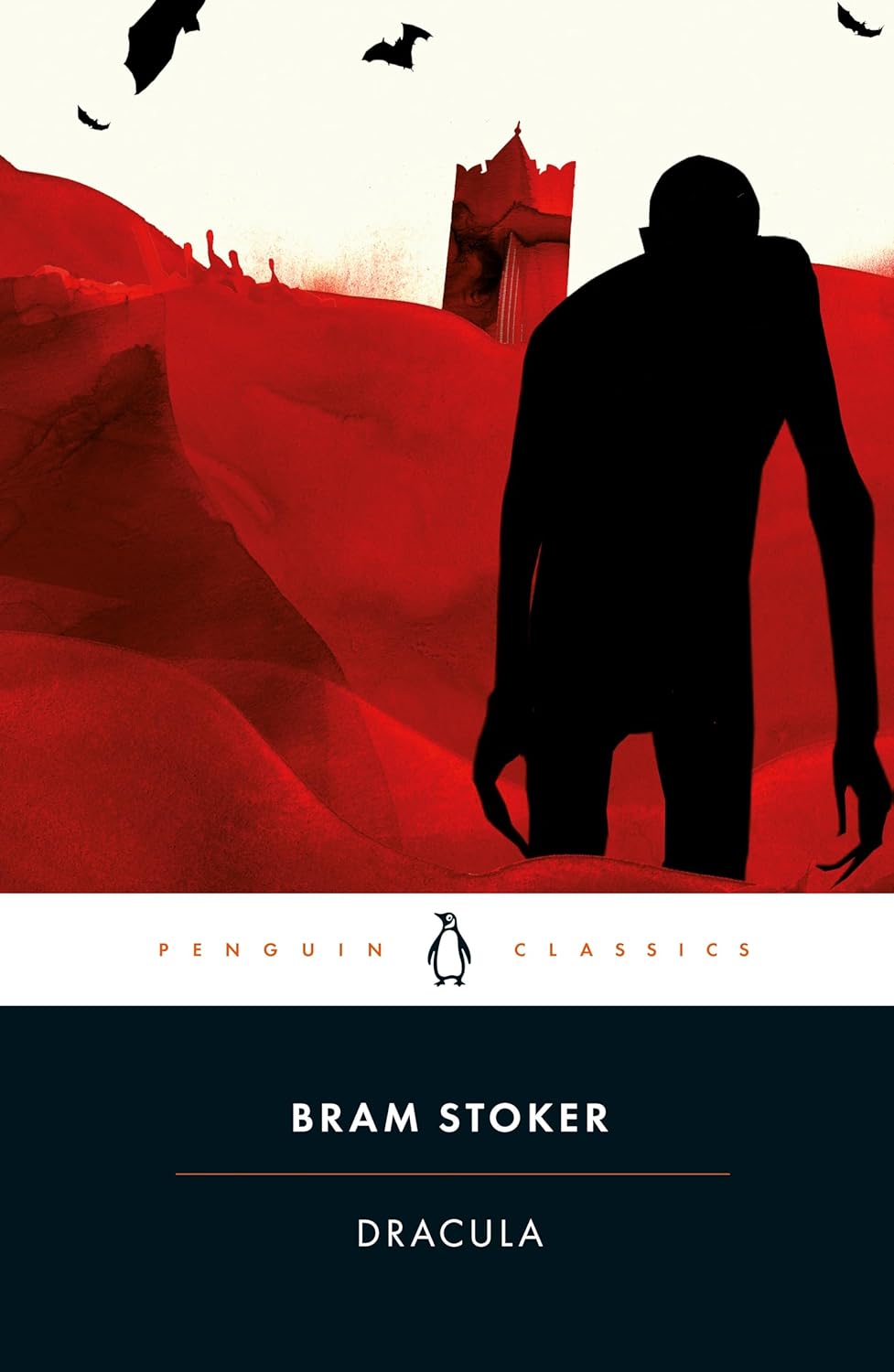
Dracula (Penguin Classics)

Description:

Bram Stoker's peerless tale of desperate battle against a powerful, ancient vampire

When Jonathan Harker visits Transylvania to help Count Dracula purchase a London house, he makes horrifying discoveries in his client's castle. Soon afterwards, disturbing incidents unfold in England: a ship runs aground on the shores of Whitby, its crew vanished; beautiful Lucy Westenra slowly succumbs to a mysterious, wasting illness, her blood drained away; and the lunatic Renfield raves about the imminent arrival of his 'master'. In the ensuing battle of wills between the sinister Count and a determined group of adversaries - led by the intrepid vampire hunter Abraham van Helsing - Bram Stoker created a masterpiece of the horror genre, probing into questions of identity, sanity and the dark corners of Victorian sexuality and desire.

For this completely updated edition, Maurice Hindle has revised his introduction, list of further reading and notes, and added two appendices: Stoker's essay on censorship and his interview with Winston Churchill, both published in 1908. Christopher Frayling's preface discusses the significance and the influences that contributed to his creation of the Dracula myth. 

For more than seventy years, Penguin has been the leading publisher of classic literature in the English-speaking world. With more than 1,700 titles, Penguin Classics represents a global bookshelf of the best works throughout history and across genres and disciplines. Readers trust the series to provide authoritative texts enhanced by introductions and notes by distinguished scholars and contemporary authors, as well as up-to-date translations by award-winning translators.


Editorial Reviews

Review

"Those who cannot find their own reflection in Bram Stoker's still-living creation are surely the undead."

About the Author

Abraham 'Bram' Stoker (1847 - 1912) was educated at Trinity College, Dublin and joined the Irish Civil Service before his love of theatre led him to become the unpaid drama critic for the Dublin Mail. He went on to act as as manager and secretary for the actor Sir Henry Irving, while writing his novels, the most famous of which is Dracula.

Maurice Hindle teaches at the Open University.

Reviews:

5.0 out of 5 stars Novel is better than it’s reputation

D. · December 11, 2024

KindleUnlimited review. Highly recommend anyone who heard of or watched a Dracula film read this novel. Written in the style of a synchronous diary (i.e., epistolary format), the original Dracula story is a gothic Victorian horror novel containing several variations from the numerous screen adaptations.Each early chapter is entitled “Jonathan’s Harkin’s Journal” and starting with “3 May. Bistritz” is similarly dated with the day and month with occasionally the time. Starting in Chapter 5 the narration expands to include person correspondence between Mina Murray & Lucy Westenra and Quincy Morris & Arthur Holmwood as well as a diary entry from Dr. John Seward. Chapter 6 includes Mina’s journal entries from to 24 July to 6 August and Dr. Seward’s diary entry from 5 June to 20 July. This unique narrative approach continues and expands throughout all 27 chapters (last dated entry 6 November) providing a multifaceted and rich world with an account of events from different character perspectives. As a side note, chapter 25 provides a physiological profile of Count Dracula commensurate with a crime scene investigation procedural program.I think the most interesting character not present in film adaptations is Quincy Morris, a noble American Cowboy brandishing Winchester repeating weapons. Although the love quad-angle between Lucy and three of the men (Morris, Seward, and Holmwood) appears farcical when first presented, it established the prior relationship between the men and why no animosity developed between the them after wards. Furthermore, the manly friends have participated in animal hunts where Morris the American was the director and guide.Another apparent anachronism is how wealth us in itself a virtue: “And, too, it made me think of the wonderful power of money! What can it not do when it is properly applied; and what might it do when basely used! I felt so thankful that Lord Godalming is rich, and that both he and Mr. Morris, who also has plenty of money, are willing to spend it so freely. For if they did not, our little expedition could not start, either so promptly or so well equipped, as it will within another hour.” Some may argue that this viewpoint is still prevalent is modern society… ergo economic might makes right.Although the novel was published in 1897, the year is omitted but presumed to be contemporary to the 1890s. Most notably is detailed description of Count Dracula: “His face was a strong—a very strong—aquiline, with high bridge of the thin nose and peculiarly arched nostrils; with lofty domed forehead, and hair growing scantily round the temples but profusely elsewhere. His eyebrows were very massive, almost meeting over the nose, and with bushy hair that seemed to curl in its own profusion. The mouth, so far as I could see it under the heavy moustache, was fixed and rather cruel-looking, with peculiarly sharp white teeth; these protruded over the lips, whose remarkable ruddiness showed astonishing vitality in a man of his years. For the rest, his ears were pale, and at the tops extremely pointed; the chin was broad and strong, and the cheeks firm though thin. The general effect was one of extraordinary pallor… I had noticed the backs of his hands… seemed rather white and fine… rather coarse—broad, with squat fingers. Strange to say, there were hairs in the center of the palm. The nails were long and fine, and cut to a sharp point… his breath was rank…”An odd dissimilarity is the locomotion of how Dracula traverses the castle’s exterior “just as a lizard moves along a wall” whereas in many movies he changes into a flying bat. Later he does travel as a bat, a wolf, fog, and a puff of smoke. Another story difference is Dracula’s ability to call and direct large packs of wolves. He clearly commands the wolves, rats, and spiders as he does any person under his vampiric spell.The story unfolds as a mystery. It’s not until the end of Chapter 14 that Professor Abraham Van Helsing reveals what actually happened to Miss Lucy. There are curious mentions in Stoker’s “Dracula” (1897) novel that make it seem more contemporary. Characters anonymously traverse London in Hansom cabs much like people take an Uber ride today. The party travelled from Paris to Varna via the Orient Express which predates the eponymous “Murder on the Orient Express” (1934) by Agatha Christie. Characters dispatch letters and telegrams like modern society send emails and text messages. Mina prepares typed pages of chronology organized journal entries with her traveler’s typewriter like printing on a modern computer. Similarly, Doctor Seward’s penchant to record his diary instead of writing had the character quip “How I miss my phonograph! To write diary with a pen is irksome to me; but Van Helsing says I must.”There is the typical Victorian ethnocentric view of other cultures. For instance, when discussing killing Count Dracula in Transylvania the author stated “We think that we shall not have much trouble with officials or the seamen. Thank God! this is the country where bribery can do anything, and we are well supplied with money. We have only to make sure that the ship cannot come into port between sunset and sunrise without our being warned, and we shall be safe. Judge Moneybag will settle this case, I think!”As usually the case, Raeford Renfeild’s and Dr. Van Helsing characters are more fully explored in the novel than it’s film counterparts. Renfield is possessed by Dracula much like Gollum in Lord of the Rings and is truly a pitiful character. Whereas, Van Helsing (both an experienced medical doctor, educator, and lawyer) is intelligent, brave, and sincere - a true friend. Similarly, many know that Dracula preying upon the neck of his victims is an allegory for sexual assault. However, the end of Chapter 21 and beginning of Chapter 22 details Dracula’s attack on Mina Harken leaves no doubt to the correlation. The Count’s backstory is summarized as “… he was in life a most wonderful man. Soldier, statesman, and alchemist… He had a mighty brain, a learning beyond compare, and a heart that knew no fear and no remorse... and there was no branch of knowledge of his time that he did not essay.“

5.0 out of 5 stars Oxford World's Classics Luckhurst DRACULA on Kindle is by far the best edition

J.M.R. · December 15, 2013

The Oxford World's Classics DRACULA edited by Roger Luckhurst has the best introduction and the best notes to DRACULA I've ever seen. It outclasses THE ESSENTIAL DRACULA, whose notes push the reader around one way or another. It explains more and it also, wisely, keeps quiet more, letting the book weave its own spell.The introduction shows how DRACULA is a wonderful mix of almost every kind of evil the Victorian English could think of. The vampire has evil features from anti-Catholic prejudice, from anti-Semitic prejudice, from prejudice against Islam, Middle Europe, the unscientific past -- about the only un-English thing that gets a good word is garlic. As the introducer points out, Dracula is in part based on the "real" Dracula, Vlad the Impaler, but is also based on so many other evil rulers and monsters, real and fictional, that no single source for our monster can be cited or believed in.In other words, Stoker got together a lot of reference works and then made Dracula up, and what a stunning, wonderful job he did.The Luckhurst Oxford World Classics edition is available on Kindle for a small price that's well worth its wonderful notes and analysis. Bolo, in its curiously mysterious way, will not show you the book if you just type in DRACULA. You have to type in something like DRACULA OXFORD instead, and I very much suggest you do that. Doing without notes of one kind or another seems out of the question to me. There are passages in a messed-up seaside-town dialect Stoker made up from a reference book, and I contend NO ONE can read these passages without notes. Luckhurst also fits all the superstitions together, to the degree that Stoker lets him, and I think you need that kind of help too.As for Stoker's DRACULA itself, it came across to me in this reading better than it ever had before. I'd read it two or three times in the past, but I'd been overexposed to NOSFERATU and the Lugosi movie, so I misremembered the book, made it cruder in my recollection than it actually was. Two main points I had forgotten (I'm afraid deep DRACULA readers won't think much of me after these admissions -- and watch out, because some of them are mild S-P-O-I-L-E-R-S):1) Jonathan Harker, Dracula's helpless victim throughout the first fifth of the book, not only survives but gets a pat on the back for his manliness from the rest of the novel's many heroes. That was a relief, and unified the book for me. You can't keep a good man down.2) Renfield, the crazy guy who eats flies and spiders, is a good reasoner from a high social class (Luckhurst's annotations make this quite clear, and the way Renfield talks tells the reader the same thing). In movie versions, he's creepy and that's about it. In the novel, he's a philosopher, and some of the most important points about vampire philosophy in general come to us from him.Put these two things together, and the book comes out more intelligent than I remembered, and less pure senseless horror. As pure senseless horror it's just a bit silly. The intelligence and strength of Harker and Renfield save it from that silliness.Lots of people who don't like the book point out that the opening section, where Harker and Dracula face off against one another, is as horrifying as anybody who likes nineteenth century thrillers could possibly want ... but then the book seems to go soft suddenly, focusing on a shallow woman and seeming, for quite a while, like a dull romance novel.Luckhurst's notes, again, helped me get over this impression of slowdown. The nature of manliness and womanliness is tremendously important to Stoker's world-view. As Luckhurst points out, all the novel's manly men break down at one point or another, and are braced up by their need to care for weak, helpless women. All the clichés about masculinity and femininity are dragged out -- and all of them are subverted in the most interesting, and horrifying, possible way.Mina, for example, is a strong, capable woman. Furthermore, she's practically indispensable to the vampire-hunt. The tough doctor, Seward, keeps a diary on phonograph cylinders. He's totally up-to-date, but he forgets even to write a summary of what the cylinders are about, so he can't find anything he told his recorded diary! All he can do is paw helplessly through a drawer full of phonograph cylinders. Mina types them up for him, so that at last the good guys can start tracking Dracula down.But the good guys' decision to keep her out of the rest of their activities, and inform her of nothing as they start sharpening their stakes, makes her immediately fall into Dracula's clutches.In other words, if only they trusted women more, their women wouldn't get hurt so much.Stranger than Dracula himself. But the book has lots of this kind of strangeness. We find out what vampires are bit by bit and bite by bite, but when we're all done, strangely enough, we still don't know what we've really been dealing with: a middle-European monster, or our own monstrous views of how life should go.I never had more fun than with this DRACULA.

I love this series of books!

F. · August 24, 2023

I've wanted to buy "Dracula" by Bram Stoker for years, but it wasn't until I found this edition that I actually did it. It's a lovely, luxurious feeling to the entire book, but I have to agree with others: the print is fairly small and a little hard to read and therefore I give this book one star less than the maximum.

Horror story?

G.C. · February 7, 2024

Great read.

Great way to approach’s to a classic

R. · August 18, 2025

Great illustrations, free on Kindle, even better. It is a classic that everyone should read and experience at least once in their life.

Best horror book

I.G. · February 10, 2025

Oh my god! I freakin love the book, so cool and so good to read, i eyes were glued and every second i was Thinking ' whats happening next now? ' amazing book for horror lovers as i am ❤❤❤

Perfecto.

C.A. · April 19, 2018

Maravilloso, portada, letras, calidad, cubierta... el estado perfecto. Un clásico de Bram Stoker obligatorio en cualquier colección, la obra maestra de la novela gótica y mejor obra del escritor irlandés. 100 % recomendable.

Dracula (Penguin Classics)

Product ID: U014143984K
Condition: New

4.5

AED7215

Price includes VAT & Import Duties
Type: Paperback
Availability: In Stock

Quantity:

|

Order today to get by 7-14 business days

Delivery fee of AED 20. Free for orders above AED 200.

Returns & Warranty policies

Imported From: United States

At BOLO, we work hard to ensure the products you receive are new, genuine, and sourced from reputable suppliers.

BOLO is not an authorized or official retailer for most brands, nor are we affiliated with manufacturers unless specifically stated on a product page. Instead, we source verified sellers, authorized distributors or directly from the manufacturer.

Each product undergoes thorough inspection and verification at our consolidation and fulfilment centers to ensure it meets our strict authenticity and quality standards before being shipped and delivered to you.

If you ever have concerns regarding the authenticity of a product purchased from us, please contact Bolo Support. We will review your inquiry promptly and, if necessary, provide documentation verifying authenticity or offer a suitable resolution.

Your trust is our top priority, and we are committed to maintaining transparency and integrity in every transaction.

All product information, images, descriptions, and reviews originate from the manufacturer or from trusted sellers overseas. BOLO is not affiliated with, endorsed by, or an authorized retailer for most brands listed on our website unless stated otherwise.

While we strive to display accurate information, variations in packaging, labeling, instructions, or formulation may occasionally occur due to regional differences or supplier updates. For detailed or manufacturer-specific information, please contact the brand directly or reach out to BOLO Support for assistance.

Unless otherwise stated, all prices displayed on the product page include applicable taxes and import duties.

BOLO operates in accordance with the laws and regulations of United Arab Emirates. Any items found to be restricted or prohibited for sale within the UAE will be cancelled prior to shipment. We take proactive measures to ensure that only products permitted for sale in United Arab Emirates are listed on our website.

All items are shipped by air, and any products classified as “Dangerous Goods (DG)” under IATA regulations will be removed from the order and cancelled.

All orders are processed manually, and we make every effort to process them promptly once confirmed. Products cancelled due to the above reasons will be permanently removed from listings across the website.

Similar suggestions by Bolo

More from this brand

Similar items from “Horror”

Dracula (Penguin Classics)

Product ID: U014143984K
Condition: New

4.5

Dracula (Penguin Classics)-0
Type: Paperback

AED7215

Price includes VAT & Import Duties
Availability: In Stock

Quantity:

|

Order today to get by 7-14 business days

Delivery fee of AED 20. Free for orders above AED 200.

Returns & Warranty policies

Imported From: United States

At BOLO, we work hard to ensure the products you receive are new, genuine, and sourced from reputable suppliers.

BOLO is not an authorized or official retailer for most brands, nor are we affiliated with manufacturers unless specifically stated on a product page. Instead, we source verified sellers, authorized distributors or directly from the manufacturer.

Each product undergoes thorough inspection and verification at our consolidation and fulfilment centers to ensure it meets our strict authenticity and quality standards before being shipped and delivered to you.

If you ever have concerns regarding the authenticity of a product purchased from us, please contact Bolo Support. We will review your inquiry promptly and, if necessary, provide documentation verifying authenticity or offer a suitable resolution.

Your trust is our top priority, and we are committed to maintaining transparency and integrity in every transaction.

All product information, images, descriptions, and reviews originate from the manufacturer or from trusted sellers overseas. BOLO is not affiliated with, endorsed by, or an authorized retailer for most brands listed on our website unless stated otherwise.

While we strive to display accurate information, variations in packaging, labeling, instructions, or formulation may occasionally occur due to regional differences or supplier updates. For detailed or manufacturer-specific information, please contact the brand directly or reach out to BOLO Support for assistance.

Unless otherwise stated, all prices displayed on the product page include applicable taxes and import duties.

BOLO operates in accordance with the laws and regulations of United Arab Emirates. Any items found to be restricted or prohibited for sale within the UAE will be cancelled prior to shipment. We take proactive measures to ensure that only products permitted for sale in United Arab Emirates are listed on our website.

All items are shipped by air, and any products classified as “Dangerous Goods (DG)” under IATA regulations will be removed from the order and cancelled.

All orders are processed manually, and we make every effort to process them promptly once confirmed. Products cancelled due to the above reasons will be permanently removed from listings across the website.

Description:

Bram Stoker's peerless tale of desperate battle against a powerful, ancient vampire

When Jonathan Harker visits Transylvania to help Count Dracula purchase a London house, he makes horrifying discoveries in his client's castle. Soon afterwards, disturbing incidents unfold in England: a ship runs aground on the shores of Whitby, its crew vanished; beautiful Lucy Westenra slowly succumbs to a mysterious, wasting illness, her blood drained away; and the lunatic Renfield raves about the imminent arrival of his 'master'. In the ensuing battle of wills between the sinister Count and a determined group of adversaries - led by the intrepid vampire hunter Abraham van Helsing - Bram Stoker created a masterpiece of the horror genre, probing into questions of identity, sanity and the dark corners of Victorian sexuality and desire.

For this completely updated edition, Maurice Hindle has revised his introduction, list of further reading and notes, and added two appendices: Stoker's essay on censorship and his interview with Winston Churchill, both published in 1908. Christopher Frayling's preface discusses the significance and the influences that contributed to his creation of the Dracula myth. 

For more than seventy years, Penguin has been the leading publisher of classic literature in the English-speaking world. With more than 1,700 titles, Penguin Classics represents a global bookshelf of the best works throughout history and across genres and disciplines. Readers trust the series to provide authoritative texts enhanced by introductions and notes by distinguished scholars and contemporary authors, as well as up-to-date translations by award-winning translators.


Editorial Reviews

Review

"Those who cannot find their own reflection in Bram Stoker's still-living creation are surely the undead."

About the Author

Abraham 'Bram' Stoker (1847 - 1912) was educated at Trinity College, Dublin and joined the Irish Civil Service before his love of theatre led him to become the unpaid drama critic for the Dublin Mail. He went on to act as as manager and secretary for the actor Sir Henry Irving, while writing his novels, the most famous of which is Dracula.

Maurice Hindle teaches at the Open University.

Reviews:

5.0 out of 5 stars Novel is better than it’s reputation

D. · December 11, 2024

KindleUnlimited review. Highly recommend anyone who heard of or watched a Dracula film read this novel. Written in the style of a synchronous diary (i.e., epistolary format), the original Dracula story is a gothic Victorian horror novel containing several variations from the numerous screen adaptations.Each early chapter is entitled “Jonathan’s Harkin’s Journal” and starting with “3 May. Bistritz” is similarly dated with the day and month with occasionally the time. Starting in Chapter 5 the narration expands to include person correspondence between Mina Murray & Lucy Westenra and Quincy Morris & Arthur Holmwood as well as a diary entry from Dr. John Seward. Chapter 6 includes Mina’s journal entries from to 24 July to 6 August and Dr. Seward’s diary entry from 5 June to 20 July. This unique narrative approach continues and expands throughout all 27 chapters (last dated entry 6 November) providing a multifaceted and rich world with an account of events from different character perspectives. As a side note, chapter 25 provides a physiological profile of Count Dracula commensurate with a crime scene investigation procedural program.I think the most interesting character not present in film adaptations is Quincy Morris, a noble American Cowboy brandishing Winchester repeating weapons. Although the love quad-angle between Lucy and three of the men (Morris, Seward, and Holmwood) appears farcical when first presented, it established the prior relationship between the men and why no animosity developed between the them after wards. Furthermore, the manly friends have participated in animal hunts where Morris the American was the director and guide.Another apparent anachronism is how wealth us in itself a virtue: “And, too, it made me think of the wonderful power of money! What can it not do when it is properly applied; and what might it do when basely used! I felt so thankful that Lord Godalming is rich, and that both he and Mr. Morris, who also has plenty of money, are willing to spend it so freely. For if they did not, our little expedition could not start, either so promptly or so well equipped, as it will within another hour.” Some may argue that this viewpoint is still prevalent is modern society… ergo economic might makes right.Although the novel was published in 1897, the year is omitted but presumed to be contemporary to the 1890s. Most notably is detailed description of Count Dracula: “His face was a strong—a very strong—aquiline, with high bridge of the thin nose and peculiarly arched nostrils; with lofty domed forehead, and hair growing scantily round the temples but profusely elsewhere. His eyebrows were very massive, almost meeting over the nose, and with bushy hair that seemed to curl in its own profusion. The mouth, so far as I could see it under the heavy moustache, was fixed and rather cruel-looking, with peculiarly sharp white teeth; these protruded over the lips, whose remarkable ruddiness showed astonishing vitality in a man of his years. For the rest, his ears were pale, and at the tops extremely pointed; the chin was broad and strong, and the cheeks firm though thin. The general effect was one of extraordinary pallor… I had noticed the backs of his hands… seemed rather white and fine… rather coarse—broad, with squat fingers. Strange to say, there were hairs in the center of the palm. The nails were long and fine, and cut to a sharp point… his breath was rank…”An odd dissimilarity is the locomotion of how Dracula traverses the castle’s exterior “just as a lizard moves along a wall” whereas in many movies he changes into a flying bat. Later he does travel as a bat, a wolf, fog, and a puff of smoke. Another story difference is Dracula’s ability to call and direct large packs of wolves. He clearly commands the wolves, rats, and spiders as he does any person under his vampiric spell.The story unfolds as a mystery. It’s not until the end of Chapter 14 that Professor Abraham Van Helsing reveals what actually happened to Miss Lucy. There are curious mentions in Stoker’s “Dracula” (1897) novel that make it seem more contemporary. Characters anonymously traverse London in Hansom cabs much like people take an Uber ride today. The party travelled from Paris to Varna via the Orient Express which predates the eponymous “Murder on the Orient Express” (1934) by Agatha Christie. Characters dispatch letters and telegrams like modern society send emails and text messages. Mina prepares typed pages of chronology organized journal entries with her traveler’s typewriter like printing on a modern computer. Similarly, Doctor Seward’s penchant to record his diary instead of writing had the character quip “How I miss my phonograph! To write diary with a pen is irksome to me; but Van Helsing says I must.”There is the typical Victorian ethnocentric view of other cultures. For instance, when discussing killing Count Dracula in Transylvania the author stated “We think that we shall not have much trouble with officials or the seamen. Thank God! this is the country where bribery can do anything, and we are well supplied with money. We have only to make sure that the ship cannot come into port between sunset and sunrise without our being warned, and we shall be safe. Judge Moneybag will settle this case, I think!”As usually the case, Raeford Renfeild’s and Dr. Van Helsing characters are more fully explored in the novel than it’s film counterparts. Renfield is possessed by Dracula much like Gollum in Lord of the Rings and is truly a pitiful character. Whereas, Van Helsing (both an experienced medical doctor, educator, and lawyer) is intelligent, brave, and sincere - a true friend. Similarly, many know that Dracula preying upon the neck of his victims is an allegory for sexual assault. However, the end of Chapter 21 and beginning of Chapter 22 details Dracula’s attack on Mina Harken leaves no doubt to the correlation. The Count’s backstory is summarized as “… he was in life a most wonderful man. Soldier, statesman, and alchemist… He had a mighty brain, a learning beyond compare, and a heart that knew no fear and no remorse... and there was no branch of knowledge of his time that he did not essay.“

5.0 out of 5 stars Oxford World's Classics Luckhurst DRACULA on Kindle is by far the best edition

J.M.R. · December 15, 2013

The Oxford World's Classics DRACULA edited by Roger Luckhurst has the best introduction and the best notes to DRACULA I've ever seen. It outclasses THE ESSENTIAL DRACULA, whose notes push the reader around one way or another. It explains more and it also, wisely, keeps quiet more, letting the book weave its own spell.The introduction shows how DRACULA is a wonderful mix of almost every kind of evil the Victorian English could think of. The vampire has evil features from anti-Catholic prejudice, from anti-Semitic prejudice, from prejudice against Islam, Middle Europe, the unscientific past -- about the only un-English thing that gets a good word is garlic. As the introducer points out, Dracula is in part based on the "real" Dracula, Vlad the Impaler, but is also based on so many other evil rulers and monsters, real and fictional, that no single source for our monster can be cited or believed in.In other words, Stoker got together a lot of reference works and then made Dracula up, and what a stunning, wonderful job he did.The Luckhurst Oxford World Classics edition is available on Kindle for a small price that's well worth its wonderful notes and analysis. Bolo, in its curiously mysterious way, will not show you the book if you just type in DRACULA. You have to type in something like DRACULA OXFORD instead, and I very much suggest you do that. Doing without notes of one kind or another seems out of the question to me. There are passages in a messed-up seaside-town dialect Stoker made up from a reference book, and I contend NO ONE can read these passages without notes. Luckhurst also fits all the superstitions together, to the degree that Stoker lets him, and I think you need that kind of help too.As for Stoker's DRACULA itself, it came across to me in this reading better than it ever had before. I'd read it two or three times in the past, but I'd been overexposed to NOSFERATU and the Lugosi movie, so I misremembered the book, made it cruder in my recollection than it actually was. Two main points I had forgotten (I'm afraid deep DRACULA readers won't think much of me after these admissions -- and watch out, because some of them are mild S-P-O-I-L-E-R-S):1) Jonathan Harker, Dracula's helpless victim throughout the first fifth of the book, not only survives but gets a pat on the back for his manliness from the rest of the novel's many heroes. That was a relief, and unified the book for me. You can't keep a good man down.2) Renfield, the crazy guy who eats flies and spiders, is a good reasoner from a high social class (Luckhurst's annotations make this quite clear, and the way Renfield talks tells the reader the same thing). In movie versions, he's creepy and that's about it. In the novel, he's a philosopher, and some of the most important points about vampire philosophy in general come to us from him.Put these two things together, and the book comes out more intelligent than I remembered, and less pure senseless horror. As pure senseless horror it's just a bit silly. The intelligence and strength of Harker and Renfield save it from that silliness.Lots of people who don't like the book point out that the opening section, where Harker and Dracula face off against one another, is as horrifying as anybody who likes nineteenth century thrillers could possibly want ... but then the book seems to go soft suddenly, focusing on a shallow woman and seeming, for quite a while, like a dull romance novel.Luckhurst's notes, again, helped me get over this impression of slowdown. The nature of manliness and womanliness is tremendously important to Stoker's world-view. As Luckhurst points out, all the novel's manly men break down at one point or another, and are braced up by their need to care for weak, helpless women. All the clichés about masculinity and femininity are dragged out -- and all of them are subverted in the most interesting, and horrifying, possible way.Mina, for example, is a strong, capable woman. Furthermore, she's practically indispensable to the vampire-hunt. The tough doctor, Seward, keeps a diary on phonograph cylinders. He's totally up-to-date, but he forgets even to write a summary of what the cylinders are about, so he can't find anything he told his recorded diary! All he can do is paw helplessly through a drawer full of phonograph cylinders. Mina types them up for him, so that at last the good guys can start tracking Dracula down.But the good guys' decision to keep her out of the rest of their activities, and inform her of nothing as they start sharpening their stakes, makes her immediately fall into Dracula's clutches.In other words, if only they trusted women more, their women wouldn't get hurt so much.Stranger than Dracula himself. But the book has lots of this kind of strangeness. We find out what vampires are bit by bit and bite by bite, but when we're all done, strangely enough, we still don't know what we've really been dealing with: a middle-European monster, or our own monstrous views of how life should go.I never had more fun than with this DRACULA.

I love this series of books!

F. · August 24, 2023

I've wanted to buy "Dracula" by Bram Stoker for years, but it wasn't until I found this edition that I actually did it. It's a lovely, luxurious feeling to the entire book, but I have to agree with others: the print is fairly small and a little hard to read and therefore I give this book one star less than the maximum.

Horror story?

G.C. · February 7, 2024

Great read.

Great way to approach’s to a classic

R. · August 18, 2025

Great illustrations, free on Kindle, even better. It is a classic that everyone should read and experience at least once in their life.

Best horror book

I.G. · February 10, 2025

Oh my god! I freakin love the book, so cool and so good to read, i eyes were glued and every second i was Thinking ' whats happening next now? ' amazing book for horror lovers as i am ❤❤❤

Perfecto.

C.A. · April 19, 2018

Maravilloso, portada, letras, calidad, cubierta... el estado perfecto. Un clásico de Bram Stoker obligatorio en cualquier colección, la obra maestra de la novela gótica y mejor obra del escritor irlandés. 100 % recomendable.

Similar suggestions by Bolo

More from this brand

Similar items from “Horror”