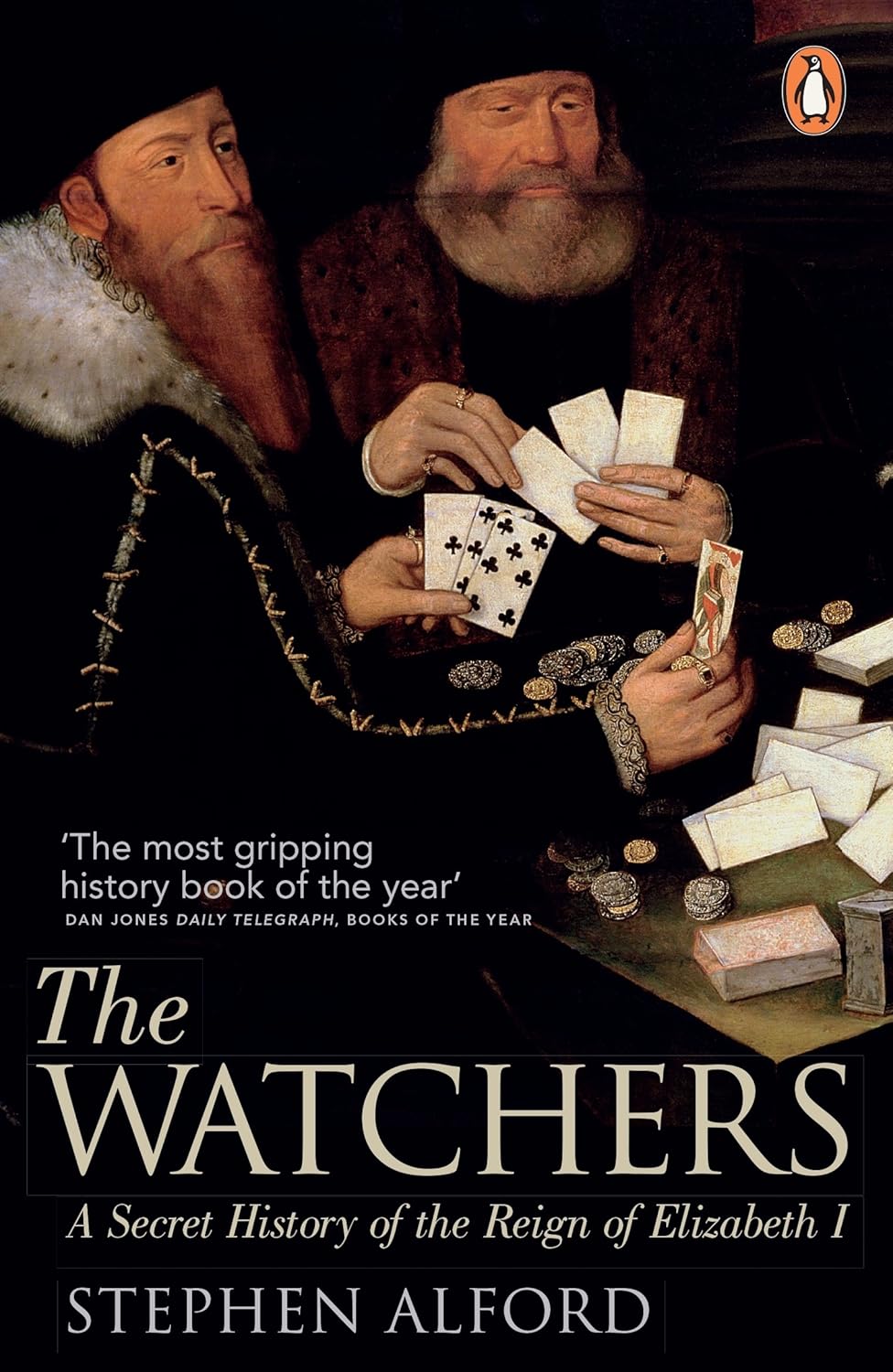
Description:
Editorial Reviews
Review
Reviews:
5.0 out of 5 stars Great read - and not just for history buffs
Sent this book by the publishers, I really looked forward to reading what’s ostensibly a behind the scenes account of Queen Elizabeth I’s reign but from the point of view of the “watchers”: that is, reporters, listeners, spies – the men whose speciality was espionage. Elizabethan times, it turns out, are notorious for their extensive use of spies and networks, all of which were established to protect England and ensure the queen’s successful reign. As Alford writes in the introduction, while Elizabeth and her council worked hard to maintain “clever and persuasive projections of political stability, empire, self-confidence and national myth” there was, in fact, “a darker story… set against a Europe divided and oppressed by religious conflict, civil war and the ambitions of kings and princes.”Taking the crown after her half-sister “Bloody Mary” tried to purge the Protestant stain, and trying to stabilise an England divided by religious schism and rapidly changing succession, Elizabeth’s job was not easy. Declaring England as Protestant, but claiming that Catholicism would be tolerated, Elizabeth nonetheless was acutely aware of how precarious her position as ruler and religious head of a reeling nation was. Plots to declare her rule invalid, assassination attempts, never mind trying to overthrow Elizabeth and place Mary Queen of Scots on the throne abounded. Then there was the job of trying to find Elizabeth a suitable husband, all of which meant that though the kingdom flourished in terms of exploration, the humanities and arts, there was also a seething underbelly that threatened to erupt and destroy everything at any time. The greatest threat was that of the Catholics who, discontent with Elizabeth’s heretical leadership and perceiving it as ungodly, sought to rid themselves of Henry VIII’s daughter and restore the “true religion”. Working from within their homeland, their overseas networks were extensive, travelling across Europe and involving some of the most powerful people abroad as well.The stage is thus set for espionage, betrayal, treason, propaganda, secrets, torture, faith, martyrdom and lies all of which Sir Francis Walsingham and his successors sought to control.Carefully researched and very well-written, this book is an eye-opener that also makes the mind boggle. The lengths to which various individuals would go to inveigle themselves into (Catholic) families or communities in order to uncover plots and treasons were phenomenal. Conspirators were discovered frequently, many from noble families. The Throckmorton plot was one of the most famous and this is covered in detail throughout the book. Fascinating in its complexity and the degree of commitment and sacrifice believers were ready to make, uncovering it was to prove an even greater triumph.The book goes onto explore the stories, derring-do, successes and failures of many spies and traitors, how far they were willing to go (disguise, denying their identities for long periods, sacrificing family and a “normal” life for little reward) and from these we also learn how disposed Walsingham and his men were to use torture to uncover secrets and plots and how brutal their interrogation methods were. Some of the spies, or intelligencers, were gentleman and even poets, others were criminals, but many were chameleons, able to shift, camouflage themselves and change with subtlety. There was William Parry, Thomas Phelippes, Gilbery Gifford, Chrales Sledd, Sir Robert Cecil, Burghley, simply to name a few (forgive my memory) - names both known and unknown to history buffs. Perhaps, for those names less familiar, it’s testimony to how well they performed their roles – they disappeared not simply into the woodwork, but became lost in the pages of history and time until Alford recovers them. Uncovering the plots and deeds of desperate men, these watchers brought many to trial and death and, in doing so, ensured Elizabeth’s long reign.Utilising surviving records, Alford has done an amazing job and recreated in detail a tumultuous but fascinating period. Almost akin to a Renaissance version of Tinker, Tailor, Soldier, Spy, I found this book fascinating, challenging (to keep track of the different names and roles), but also a wonderful insight into what occurs behind the doors, under the tables and in the shadows and whispers of a colourful and deceptively confidant queen’s reign. Like an ice-berg, it was the seven-eights we didn’t see that ensured the topmost part remained afloat. Alford has given us access to that which we don’t normally witness and exposed the intricacy and deadly seriousness of spying in Elizabethan times.A great read for history buffs, writers, anyone who loves tales of espionage and appreciates solid research delivered in an entertaining and engaging manner.
4.0 out of 5 stars Walsingham and Burghley vs. Mary Queen of Scots
Stephen Alford provides a great deal of information about the reign of Elizabeth I, concentrating on the threats to herself and England, and ultimately it is primarily about the struggle between Mary Queen of Scots and Elizabeth.Elizabeth was the last Tutor to rule; the daughter of Henry VIII's marriage to Anne Boleyn who assumed the throne at the death of her half sister, Mary. While Henry had instituted the Anglican Church and defied the authority of the Pope and Catholicism, his daughter Mary was a devout Catholic, and Elizabeth Proetestant. Upon her assumption to the throne, England began persecuting Catholics whose loyalty they questioned, and from Catholic Europe, hundreds of priests were sent in secret to England to encourage Catholics and defy Elizabeth. Most of them were killed, imprisoned, or deported by the effective work of Elizabeth's chief snoop, Walsingham.Elizabeth's two primary ministers were Lord Burghley, and Sir Francis Walsingham. It is Walsingham that much of the book is centered on. He established a network of spies, intelligence gatherers, and forgerers to fight back against the forces of the Catholic Church. In a nutshell, he was very good at what he did, and there are numerous characters in this book that engaged in intelligence work, often as double agents in the service of Walsingham.Of course, the elephant in the room was Mary Queen of Scots. She had fled Scotland and was held in somewhat isolation by Elizabeth for almost twenty years. Mary is an historical person of legend. While she was a cousin of Elizabeth, she was a compelling and yet somewhat victimized person. I felt that Alford should have provided more background information on Mary because there is a vast story of her life before she fled in disgrace to England, and thus became a problem for the English because of her validity as a successor to the throne since Elizabeth never married, and also the fact that she was a devout Catholic.Walsingham was intent on the death of Mary Queen of Scots. He realized the threat she posed to the throne of Elizabeth, and worked tirelessly over the years to have laws passed that would legally allow Mary to be put to death. All of this was eventually accomplished in the Babington Plot. It is clear in the book that the years of captivity had taken a toll on the health both physically and mentally of Mary Queen of Scots, and she was untimately not match for Walsingham.There is some confusion in the author's presentation in the forgery that Walsingham and his lieutienant Thomas Philippes provided as an attempt to provide overwhelming evidence that Mary was in support of the plot to kill Elizabeth and encourage an uprising and foreign invasion to restore England to the Church. In John Guy's work, Queen of Scots: The True Life of Mary Stuart it is proposed that there is no evidence to support the claim that the main text of the letter was altered and the postscript-a blatant and audacious forgery, was not used against Mary. Later in the book, Alford even questions his initial assumptions regarding the need for the forged postscript. It left me a bit confused.The weakest part is the title. It doesn't hook the average reader, but I am always in the mix for something regarding the Queen of Scots and her cousin Elizabeth, and thus, the purchase of the book.But overall, a good book about a fascinating time in English history. I would recommend it to the reader with some prior background in this era, as this is certainly not an "opening" book for this turbulent time.
3.0 out of 5 stars Interesting to hard core intelligence history buffs.
It was sort of a graduate thesis for a history major specializing in either the Elizabethan era or hard core intelligence history buffs. It could have been fleshed out with more context to make it a better read,
5.0 out of 5 stars Necessary History for History Nerds
This book was gut wrenching, and I appreciated every word of it. The author did due diligence to present a detailed and defendable point of view of a century of espionage.If I had one critique, it would be that his usage of the comma confused me. I must wonder if this is because he is British and I am American. The comma should be used to give the reader pause to breathe, to know when to stop, and to separate dependent clauses and introductions in a sentence. In this book, if one followed the author's logic of comma usage, one may often be left not knowing when to stop reading and when to connect different subjects to predicates.I had to re-read about one fifth of the book while reading it to make sure I was following his story. If I followed his cadence, via comma placement, verbatim, I often missed the actual intent of a sentence. It took me a while to fall into his style. I have experience in copy editing, proofreading, and I wrote a senior paper on poor grammar in the STEM majors; I get punctuation. My only thought is that British sentence segmentation differs from ours.It speaks volumes, then, that I gave this book to two other people, both of whom are history geeks. It's just such a good book.Buy it. Read it. Feel for Lopez.I will cherish my copy.
Elizabethan Spies in the Shadows
We often perceive Elizabethan England with 20/20 hindsight as an inevitable, civilised progress through leisurely and triumphant English success. But the subjects of the Virgin Queen did not have our knowledge that their monarch would enjoy a smooth transition as an Anglican ruler.Elizabethan England was awash with espionage due to conflicts between Anglicans (or Reformers, as they were then called) and Roman Catholics. Queen Elizabeth was gifted with several dedicated courtiers who laboured hard and long to ensure that she survived numerous attempts to assassinate her. Lord Burleigh and Sir Francis Walsingham both employed many shady spies to ferret out plots and protect Gloriana.Stephen Alford provides us with an in-depth examination of the colourful characters who fought ruthlessly to ensure that Mary, Queen of Scots would not ascend the English throne.Alford's research is impeccable and the details of espionage are chilling, engaging, lurid and moving. A worthy read for anyone who enjoys the details of Tudor England.
The Watchers
Elizabeth I looked unlikely to ever inherit the throne. However, when Edward VI died so young, after the brief reign of Lady Jane Grey and following Mary I dying childless, Elizabeth finally became queen. She found a country torn between the Catholic and Protestant faiths, rebellions and misery. Worse, she had no successor and, refusing to marry, none were forthcoming. Luckily for Elizabeth, she had a good and loyal government, who used espionage, interrogation, surveillance, suppression of dissent, treason laws and propaganda to protect the queen from attack and the country from invasion.Two key men who protected Elizabeth were Sir William Cecil and Sir Francis Walsingham and this book tells the story of how their loyalty protected her against a Catholic Europe that were united against her. They saw Elizabeth as the heretic daughter of the loathed Anne Boleyn and Mary Queen of Scots as the Catholic queen-in-waiting. Within months of Elizabeth being crowned, Mary and her then husband, the French dauphin, had dinnerware stamped with the royal arms of England. Elizabeth was understandably outraged and the insult never forgiven.There is much in this riveting book about the threat posed by Mary Stuart - Queen of Scots - and this book recounts in detail all the major conspiracies linked to her, including the Babington plot. Mary was a figurehead of Catholic rebellion and she represented the most complicated political and dynastic problem of Elizabeth's reign. There are also threats of invasion, including the Spanish Armada. Lastly, there is much about Catholic priests being trained in Rome, described as, "the heart of the enemy's camp" and being sent on missions to work secretly in England. Spies existed in a network across Europe to intercept letters and gather intelligence, often working as servants, unsuspected in the heart of exiled Catholic households.Lastly, this book asks how dangerous many of the perceived threats against Elizabeth were. Was there a likelihood that threats were discovered in order to gain advantage with the queen? After all, fear was something that could be used to secure Elizabeth's favour and there was infighting, especially between the Cecil's and the Earl of Essex after Walsingham's death. This is an excellent account of the Elizabethan era and the men who worked tirelessly to protect Elizabeth from harm. It is an exciting tale of ciphers, spying, danger, torture and endless plots and conspiracy. In the end, you have to conclude that whatever else may have happened, these men won by virtue that Elizabeth died in her bed at the age of sixty nine and that, some might say despite her best efforts to the contrary, these men arranged the accession to the throne after her death without religious turmoil or civil war (as you will see in the section about Mary Queen of Scots, these men were not afraid of risking Elizabeth's ire to do what they felt was right for the country). This is a fascinating account of Elizabethan espionage, undertaken by the government during Elizabeth's reign to keep the country safe from invasion and Catholic plots and the queen safe from assassination. Highly recommended.
A good book.
A well researched and engaging account of the realities underlying Elizabethan politics. That so much is documented and known about these activities reflects the efficiency of the spy masters and the government they served. I recommend this book to those who seek to touch the personalities behind historical events.
Fascinating
From today’s perspective our view of Elizabethan England is one of Gloriana; golden years; England triumphant against its Spanish adversaries. However, the religious pendulum in Tudor England that swung painfully between Catholic and Protestant following the reformation created a world of paranoia and uncertainty, of division and discontent. This is the backdrop to Stephen Alford’s excellent book. It reveals the efforts made by Lord Burghley and Sir Francis Walsingham in particular to protect the fragile monarchy from its enemies within and without England. It shows a remarkable web of espionage not only in England but throughout Europe and reveals the hidden stories behind many of the plots to assassinate Elizabeth and put Mary Queen of Scots on the throne. It is a remarkable study of the period. Fascinating.
How Elizabethan England survived the 16th century
This book was a revelation for me of the extraordinary pressure put on the English crown by the Roman Catholic princes, kings and Popes during the entirety of Elizabeth 1st reign. Highly recommended
Visit the Penguin Books Store
Watchers
AED11679
Quantity:
Order today to get by 7-14 business days
Delivery fee of AED 20. Free for orders above AED 200.
Imported From: United States
At BOLO, we work hard to ensure the products you receive are new, genuine, and sourced from reputable suppliers.
BOLO is not an authorized or official retailer for most brands, nor are we affiliated with manufacturers unless specifically stated on a product page. Instead, we source verified sellers, authorized distributors or directly from the manufacturer.
Each product undergoes thorough inspection and verification at our consolidation and fulfilment centers to ensure it meets our strict authenticity and quality standards before being shipped and delivered to you.
If you ever have concerns regarding the authenticity of a product purchased from us, please contact Bolo Support. We will review your inquiry promptly and, if necessary, provide documentation verifying authenticity or offer a suitable resolution.
Your trust is our top priority, and we are committed to maintaining transparency and integrity in every transaction.
All product information, images, descriptions, and reviews originate from the manufacturer or from trusted sellers overseas. BOLO is not affiliated with, endorsed by, or an authorized retailer for most brands listed on our website unless stated otherwise.
While we strive to display accurate information, variations in packaging, labeling, instructions, or formulation may occasionally occur due to regional differences or supplier updates. For detailed or manufacturer-specific information, please contact the brand directly or reach out to BOLO Support for assistance.
Unless otherwise stated, all prices displayed on the product page include applicable taxes and import duties.
BOLO operates in accordance with the laws and regulations of United Arab Emirates. Any items found to be restricted or prohibited for sale within the UAE will be cancelled prior to shipment. We take proactive measures to ensure that only products permitted for sale in United Arab Emirates are listed on our website.
All items are shipped by air, and any products classified as “Dangerous Goods (DG)” under IATA regulations will be removed from the order and cancelled.
All orders are processed manually, and we make every effort to process them promptly once confirmed. Products cancelled due to the above reasons will be permanently removed from listings across the website.
More from this brand
Similar items from “England”
Share with
Or share with link
https://www.bolo.ae/products/U0141043652
Visit the Penguin Books Store
Watchers

AED11679
Quantity:
Order today to get by 7-14 business days
Delivery fee of AED 20. Free for orders above AED 200.
Imported From: United States
At BOLO, we work hard to ensure the products you receive are new, genuine, and sourced from reputable suppliers.
BOLO is not an authorized or official retailer for most brands, nor are we affiliated with manufacturers unless specifically stated on a product page. Instead, we source verified sellers, authorized distributors or directly from the manufacturer.
Each product undergoes thorough inspection and verification at our consolidation and fulfilment centers to ensure it meets our strict authenticity and quality standards before being shipped and delivered to you.
If you ever have concerns regarding the authenticity of a product purchased from us, please contact Bolo Support. We will review your inquiry promptly and, if necessary, provide documentation verifying authenticity or offer a suitable resolution.
Your trust is our top priority, and we are committed to maintaining transparency and integrity in every transaction.
All product information, images, descriptions, and reviews originate from the manufacturer or from trusted sellers overseas. BOLO is not affiliated with, endorsed by, or an authorized retailer for most brands listed on our website unless stated otherwise.
While we strive to display accurate information, variations in packaging, labeling, instructions, or formulation may occasionally occur due to regional differences or supplier updates. For detailed or manufacturer-specific information, please contact the brand directly or reach out to BOLO Support for assistance.
Unless otherwise stated, all prices displayed on the product page include applicable taxes and import duties.
BOLO operates in accordance with the laws and regulations of United Arab Emirates. Any items found to be restricted or prohibited for sale within the UAE will be cancelled prior to shipment. We take proactive measures to ensure that only products permitted for sale in United Arab Emirates are listed on our website.
All items are shipped by air, and any products classified as “Dangerous Goods (DG)” under IATA regulations will be removed from the order and cancelled.
All orders are processed manually, and we make every effort to process them promptly once confirmed. Products cancelled due to the above reasons will be permanently removed from listings across the website.
Description:
Editorial Reviews
Review
Reviews:
5.0 out of 5 stars Great read - and not just for history buffs
Sent this book by the publishers, I really looked forward to reading what’s ostensibly a behind the scenes account of Queen Elizabeth I’s reign but from the point of view of the “watchers”: that is, reporters, listeners, spies – the men whose speciality was espionage. Elizabethan times, it turns out, are notorious for their extensive use of spies and networks, all of which were established to protect England and ensure the queen’s successful reign. As Alford writes in the introduction, while Elizabeth and her council worked hard to maintain “clever and persuasive projections of political stability, empire, self-confidence and national myth” there was, in fact, “a darker story… set against a Europe divided and oppressed by religious conflict, civil war and the ambitions of kings and princes.”Taking the crown after her half-sister “Bloody Mary” tried to purge the Protestant stain, and trying to stabilise an England divided by religious schism and rapidly changing succession, Elizabeth’s job was not easy. Declaring England as Protestant, but claiming that Catholicism would be tolerated, Elizabeth nonetheless was acutely aware of how precarious her position as ruler and religious head of a reeling nation was. Plots to declare her rule invalid, assassination attempts, never mind trying to overthrow Elizabeth and place Mary Queen of Scots on the throne abounded. Then there was the job of trying to find Elizabeth a suitable husband, all of which meant that though the kingdom flourished in terms of exploration, the humanities and arts, there was also a seething underbelly that threatened to erupt and destroy everything at any time. The greatest threat was that of the Catholics who, discontent with Elizabeth’s heretical leadership and perceiving it as ungodly, sought to rid themselves of Henry VIII’s daughter and restore the “true religion”. Working from within their homeland, their overseas networks were extensive, travelling across Europe and involving some of the most powerful people abroad as well.The stage is thus set for espionage, betrayal, treason, propaganda, secrets, torture, faith, martyrdom and lies all of which Sir Francis Walsingham and his successors sought to control.Carefully researched and very well-written, this book is an eye-opener that also makes the mind boggle. The lengths to which various individuals would go to inveigle themselves into (Catholic) families or communities in order to uncover plots and treasons were phenomenal. Conspirators were discovered frequently, many from noble families. The Throckmorton plot was one of the most famous and this is covered in detail throughout the book. Fascinating in its complexity and the degree of commitment and sacrifice believers were ready to make, uncovering it was to prove an even greater triumph.The book goes onto explore the stories, derring-do, successes and failures of many spies and traitors, how far they were willing to go (disguise, denying their identities for long periods, sacrificing family and a “normal” life for little reward) and from these we also learn how disposed Walsingham and his men were to use torture to uncover secrets and plots and how brutal their interrogation methods were. Some of the spies, or intelligencers, were gentleman and even poets, others were criminals, but many were chameleons, able to shift, camouflage themselves and change with subtlety. There was William Parry, Thomas Phelippes, Gilbery Gifford, Chrales Sledd, Sir Robert Cecil, Burghley, simply to name a few (forgive my memory) - names both known and unknown to history buffs. Perhaps, for those names less familiar, it’s testimony to how well they performed their roles – they disappeared not simply into the woodwork, but became lost in the pages of history and time until Alford recovers them. Uncovering the plots and deeds of desperate men, these watchers brought many to trial and death and, in doing so, ensured Elizabeth’s long reign.Utilising surviving records, Alford has done an amazing job and recreated in detail a tumultuous but fascinating period. Almost akin to a Renaissance version of Tinker, Tailor, Soldier, Spy, I found this book fascinating, challenging (to keep track of the different names and roles), but also a wonderful insight into what occurs behind the doors, under the tables and in the shadows and whispers of a colourful and deceptively confidant queen’s reign. Like an ice-berg, it was the seven-eights we didn’t see that ensured the topmost part remained afloat. Alford has given us access to that which we don’t normally witness and exposed the intricacy and deadly seriousness of spying in Elizabethan times.A great read for history buffs, writers, anyone who loves tales of espionage and appreciates solid research delivered in an entertaining and engaging manner.
4.0 out of 5 stars Walsingham and Burghley vs. Mary Queen of Scots
Stephen Alford provides a great deal of information about the reign of Elizabeth I, concentrating on the threats to herself and England, and ultimately it is primarily about the struggle between Mary Queen of Scots and Elizabeth.Elizabeth was the last Tutor to rule; the daughter of Henry VIII's marriage to Anne Boleyn who assumed the throne at the death of her half sister, Mary. While Henry had instituted the Anglican Church and defied the authority of the Pope and Catholicism, his daughter Mary was a devout Catholic, and Elizabeth Proetestant. Upon her assumption to the throne, England began persecuting Catholics whose loyalty they questioned, and from Catholic Europe, hundreds of priests were sent in secret to England to encourage Catholics and defy Elizabeth. Most of them were killed, imprisoned, or deported by the effective work of Elizabeth's chief snoop, Walsingham.Elizabeth's two primary ministers were Lord Burghley, and Sir Francis Walsingham. It is Walsingham that much of the book is centered on. He established a network of spies, intelligence gatherers, and forgerers to fight back against the forces of the Catholic Church. In a nutshell, he was very good at what he did, and there are numerous characters in this book that engaged in intelligence work, often as double agents in the service of Walsingham.Of course, the elephant in the room was Mary Queen of Scots. She had fled Scotland and was held in somewhat isolation by Elizabeth for almost twenty years. Mary is an historical person of legend. While she was a cousin of Elizabeth, she was a compelling and yet somewhat victimized person. I felt that Alford should have provided more background information on Mary because there is a vast story of her life before she fled in disgrace to England, and thus became a problem for the English because of her validity as a successor to the throne since Elizabeth never married, and also the fact that she was a devout Catholic.Walsingham was intent on the death of Mary Queen of Scots. He realized the threat she posed to the throne of Elizabeth, and worked tirelessly over the years to have laws passed that would legally allow Mary to be put to death. All of this was eventually accomplished in the Babington Plot. It is clear in the book that the years of captivity had taken a toll on the health both physically and mentally of Mary Queen of Scots, and she was untimately not match for Walsingham.There is some confusion in the author's presentation in the forgery that Walsingham and his lieutienant Thomas Philippes provided as an attempt to provide overwhelming evidence that Mary was in support of the plot to kill Elizabeth and encourage an uprising and foreign invasion to restore England to the Church. In John Guy's work, Queen of Scots: The True Life of Mary Stuart it is proposed that there is no evidence to support the claim that the main text of the letter was altered and the postscript-a blatant and audacious forgery, was not used against Mary. Later in the book, Alford even questions his initial assumptions regarding the need for the forged postscript. It left me a bit confused.The weakest part is the title. It doesn't hook the average reader, but I am always in the mix for something regarding the Queen of Scots and her cousin Elizabeth, and thus, the purchase of the book.But overall, a good book about a fascinating time in English history. I would recommend it to the reader with some prior background in this era, as this is certainly not an "opening" book for this turbulent time.
3.0 out of 5 stars Interesting to hard core intelligence history buffs.
It was sort of a graduate thesis for a history major specializing in either the Elizabethan era or hard core intelligence history buffs. It could have been fleshed out with more context to make it a better read,
5.0 out of 5 stars Necessary History for History Nerds
This book was gut wrenching, and I appreciated every word of it. The author did due diligence to present a detailed and defendable point of view of a century of espionage.If I had one critique, it would be that his usage of the comma confused me. I must wonder if this is because he is British and I am American. The comma should be used to give the reader pause to breathe, to know when to stop, and to separate dependent clauses and introductions in a sentence. In this book, if one followed the author's logic of comma usage, one may often be left not knowing when to stop reading and when to connect different subjects to predicates.I had to re-read about one fifth of the book while reading it to make sure I was following his story. If I followed his cadence, via comma placement, verbatim, I often missed the actual intent of a sentence. It took me a while to fall into his style. I have experience in copy editing, proofreading, and I wrote a senior paper on poor grammar in the STEM majors; I get punctuation. My only thought is that British sentence segmentation differs from ours.It speaks volumes, then, that I gave this book to two other people, both of whom are history geeks. It's just such a good book.Buy it. Read it. Feel for Lopez.I will cherish my copy.
Elizabethan Spies in the Shadows
We often perceive Elizabethan England with 20/20 hindsight as an inevitable, civilised progress through leisurely and triumphant English success. But the subjects of the Virgin Queen did not have our knowledge that their monarch would enjoy a smooth transition as an Anglican ruler.Elizabethan England was awash with espionage due to conflicts between Anglicans (or Reformers, as they were then called) and Roman Catholics. Queen Elizabeth was gifted with several dedicated courtiers who laboured hard and long to ensure that she survived numerous attempts to assassinate her. Lord Burleigh and Sir Francis Walsingham both employed many shady spies to ferret out plots and protect Gloriana.Stephen Alford provides us with an in-depth examination of the colourful characters who fought ruthlessly to ensure that Mary, Queen of Scots would not ascend the English throne.Alford's research is impeccable and the details of espionage are chilling, engaging, lurid and moving. A worthy read for anyone who enjoys the details of Tudor England.
The Watchers
Elizabeth I looked unlikely to ever inherit the throne. However, when Edward VI died so young, after the brief reign of Lady Jane Grey and following Mary I dying childless, Elizabeth finally became queen. She found a country torn between the Catholic and Protestant faiths, rebellions and misery. Worse, she had no successor and, refusing to marry, none were forthcoming. Luckily for Elizabeth, she had a good and loyal government, who used espionage, interrogation, surveillance, suppression of dissent, treason laws and propaganda to protect the queen from attack and the country from invasion.Two key men who protected Elizabeth were Sir William Cecil and Sir Francis Walsingham and this book tells the story of how their loyalty protected her against a Catholic Europe that were united against her. They saw Elizabeth as the heretic daughter of the loathed Anne Boleyn and Mary Queen of Scots as the Catholic queen-in-waiting. Within months of Elizabeth being crowned, Mary and her then husband, the French dauphin, had dinnerware stamped with the royal arms of England. Elizabeth was understandably outraged and the insult never forgiven.There is much in this riveting book about the threat posed by Mary Stuart - Queen of Scots - and this book recounts in detail all the major conspiracies linked to her, including the Babington plot. Mary was a figurehead of Catholic rebellion and she represented the most complicated political and dynastic problem of Elizabeth's reign. There are also threats of invasion, including the Spanish Armada. Lastly, there is much about Catholic priests being trained in Rome, described as, "the heart of the enemy's camp" and being sent on missions to work secretly in England. Spies existed in a network across Europe to intercept letters and gather intelligence, often working as servants, unsuspected in the heart of exiled Catholic households.Lastly, this book asks how dangerous many of the perceived threats against Elizabeth were. Was there a likelihood that threats were discovered in order to gain advantage with the queen? After all, fear was something that could be used to secure Elizabeth's favour and there was infighting, especially between the Cecil's and the Earl of Essex after Walsingham's death. This is an excellent account of the Elizabethan era and the men who worked tirelessly to protect Elizabeth from harm. It is an exciting tale of ciphers, spying, danger, torture and endless plots and conspiracy. In the end, you have to conclude that whatever else may have happened, these men won by virtue that Elizabeth died in her bed at the age of sixty nine and that, some might say despite her best efforts to the contrary, these men arranged the accession to the throne after her death without religious turmoil or civil war (as you will see in the section about Mary Queen of Scots, these men were not afraid of risking Elizabeth's ire to do what they felt was right for the country). This is a fascinating account of Elizabethan espionage, undertaken by the government during Elizabeth's reign to keep the country safe from invasion and Catholic plots and the queen safe from assassination. Highly recommended.
A good book.
A well researched and engaging account of the realities underlying Elizabethan politics. That so much is documented and known about these activities reflects the efficiency of the spy masters and the government they served. I recommend this book to those who seek to touch the personalities behind historical events.
Fascinating
From today’s perspective our view of Elizabethan England is one of Gloriana; golden years; England triumphant against its Spanish adversaries. However, the religious pendulum in Tudor England that swung painfully between Catholic and Protestant following the reformation created a world of paranoia and uncertainty, of division and discontent. This is the backdrop to Stephen Alford’s excellent book. It reveals the efforts made by Lord Burghley and Sir Francis Walsingham in particular to protect the fragile monarchy from its enemies within and without England. It shows a remarkable web of espionage not only in England but throughout Europe and reveals the hidden stories behind many of the plots to assassinate Elizabeth and put Mary Queen of Scots on the throne. It is a remarkable study of the period. Fascinating.
How Elizabethan England survived the 16th century
This book was a revelation for me of the extraordinary pressure put on the English crown by the Roman Catholic princes, kings and Popes during the entirety of Elizabeth 1st reign. Highly recommended
More from this brand
Similar items from “England”
Share with
Or share with link
https://www.bolo.ae/products/U0141043652