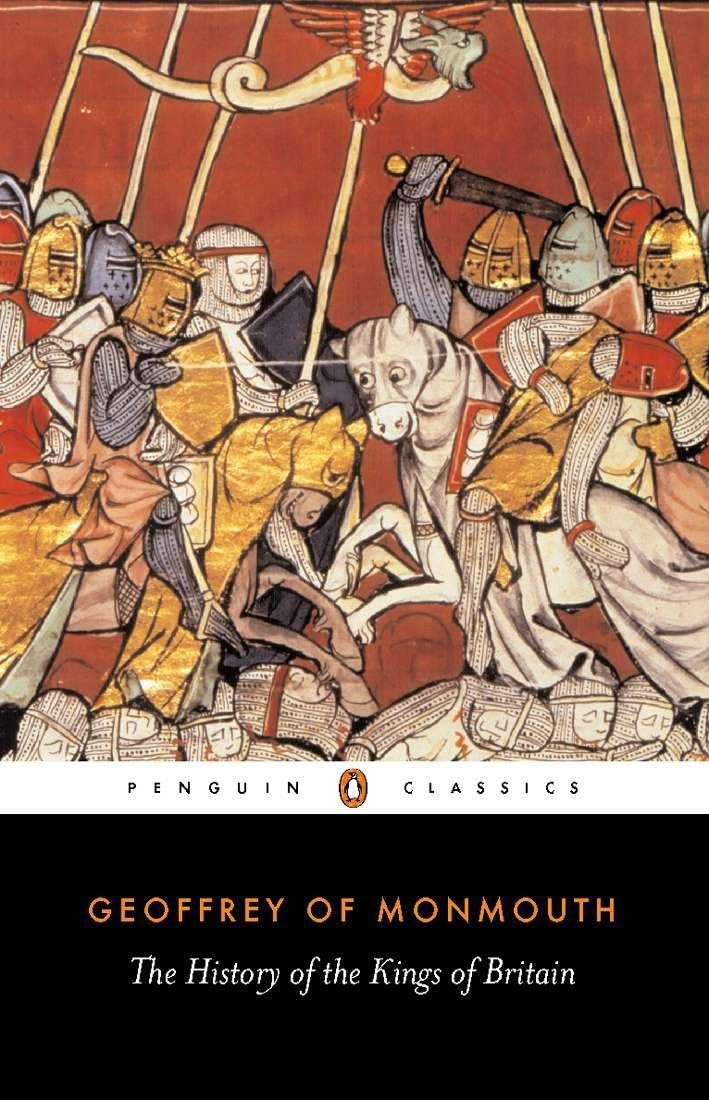
Description:
Editorial Reviews
About the Author
Lewis Thorpe was professor of French at Nottingham University from 1958 to 1977 and president of the British Branch of the International Arthurian Society. He published many books and articles on Arthur, both on the French and English traditions. He died in 1977.
Reviews:
5.0 out of 5 stars Ian Myles Slater on: Good Option, No Longer Alone
[Note to the Reader: just in case Bolo's software merges reviews of different translations: This is a review of the Penguin Classics "History of the Kings of Britain" by Geoffrey of Monmouth, translated by Lewis Thorpe, originally published in 1966 (with some minor bibliographic additions and corrections in the early 1970s).][Further note: the Kindle edition of the Penguin translation is almost 100 pages shorter than tthe paperback, because it omits the invaluable index,which packs in a lot of information. Being able to.search the text isn't a good alternative. I can't recommend it as an alternative to the paperback if you're considering which translation to.buy.]Geoffrey of Monmouth's "History of the Kings of Britain" (as it is usually called) was, during the Middle Ages, one of the most influential books yet written in Britain. It was perhaps exceeded in European importance only by the Venerable Bede's "Ecclesiastical History of the English People" -- and Geoffrey's "Historia Regum Britanniae" is presented as a companion to Bede, covering topics that Bede, a mere Anglo-Saxon interloper, never knew. It purports to give the "real" history of the islands, from the advent of Brutus the Trojan and his followers to the successors of Arthur.If one adds its numerous translations into vernacular languages (it was, of course, written in Latin -- only the English understood English) one can agree with the medievalist John Jay Parry that Geoffrey's book was simply one of the most influential of the Middle Ages, wherever written.From the mid-1960s until 2007, anyone looking for a modern English translation of Geoffrey's Latin text had only one first-rate option: Lewis Thorpe's spirited English version for Penguin Classics, which first appeared in 1966. (And which I read sometime in the late 1960s.) This was based mainly on a single "good" manuscript, as edited by Acton Griscom in 1929, with consultation of the two other modern editions of the Latin text then available, by E. Faral (also 1929; an attempt at a critical text based on several manuscripts), and by Jacob Hammer (a "Variant Version," 1951).In my opinion, Thorpe's translation, despite its restricted textual foundation, remains the best introduction to Geoffrey, and the "historical" Arthur he created; the introduction and notes assume no specialized knowledge on the part of the reader, and the translation itself is graceful, and divided in eight parts, which increase its intelligibility (instead of the traditional twelve-book format, with chapters of greatly varying lengths; marginal references to such divisions are included for ease of cross-reference.) Thorpe also includes a chronology ("Time Chart") and a good (amazing detail) index of characters and places, with details of events they are involved with.In the Middle Ages, it was, of course, especially popular in England (where it was several times translated, sometimes by way of a French translation), and notably in Wales: Parry counted at least three Welsh translations, preserved in at least fifty manuscripts. (See Parry's Introduction to "Brut Y Brenhinned," or 'chronicle of rulers,' an edition and translation of one of the several Welsh translations, published in 1937, and now available on-line from the Medieval Academy of America). Indeed, little as the Welsh and the English agreed on other things, they both borrowed "Brut," i.e. "Brutus," originally a nickname for the "Historia," as a generic term for a national chronicle.The book presents the British -- that is, strictly speaking, the Welsh and their ancestors -- as descendants of displaced Trojans, presenting itself as a sort of sequel to Virgil's "Aeneid," as well as "prequel" to Bede. Geoffrey claims to be translating an "Old British Book" (i.e., a book in Welsh, or, possibly Breton), a claim taken seriously into the early twentieth century, by which time it became reasonably clear that the supposed versions of the "old book" -- one of which had been dated to the seventh century! -- were in fact post-Geoffrey; although some of these Welsh translations did contain genuine old stories interpolated into Geoffrey's versions.Geoffrey also claimed to be translating a separate "Prophecies of Merlin," usually incorporated into the larger work -- this too is no longer taken seriously. (He also wrote a verse sequel, "The Life of Merlin," which has been translated into English at least three times. Reviews of a Kindle edition of J.J. Parry's translation -- as "Vita Merlini" -- complaining of format issues, are not encouraging.)King Arthur may already have been launched into European celebrity before the 1130s, when Geoffrey tied him down to a more-or-less recognizable time and place, and equipped him with the most up-to-date manners and customs of the early twelfth century, but it is to Geoffrey we owe the standard picture of Merlin as the adviser of kings, the stories of King Lear and of Cymbeline, and, perhaps, Old King Cole (or Coel) -- although not the nursery-rhyme that enshrines him."Historia Regum Britanniae" was a medieval equivalent of a best-seller, with at least 219 known surviving manuscripts of the Latin original, plus translations and paraphrases (as mentioned, into Welsh, French, and Middle English), in whole or in part, into most Western European languages (and rather quickly, by medieval standards). There was also at least one attempt to "dress up" its Latin style with classical and Biblical (Vulgate) tags. It was even turned it into Latin hexameters (which brought the story even closer to Virgil in form, if not quality).A good part of the vast Arthurian literature derives its "historical" structure from Geoffrey's book, directly, or, probably more often, indirectly. (See the opening line of "Sir Gawain and the Green Knight," for one convenient example: "After the siege and assault were ceased at Troy...") Malory did not include Geoffrey's main Merlin material, but he did include Arthur's "Roman War" (as Book V of the Caxton edition), which is a highlight of Geoffrey's version. (The "Historia" is largely structured around clashes between the Romans and the Britons, as rival "Trojan" nations.)Despite recurrent rejections of its historicity, in whole or in part, beginning with skepticism at its first appearance, it remained, right through the seventeenth century, an "authority" on Britain, from the settlement by Trojan exiles, through Roman invasions, to Arthur, and finally the Anglo-Saxon conquest; with intimations that the true Britons, that is, the Welsh, would regain sovereignty. The Welsh Tudors were particularly interested in it as a legitimating document.The other translation available was that by Sebastian Evans, published in Dent's "Temple Library" in 1904, and included in the original Everyman's Library series a few years later, in which it was reprinted through much of the twentieth century. Evans' slightly bowdlerized translation, into Elizabethan-sounding prose, was at least readable, if not a good reflection of Geoffrey's style. Alas, it was based on the the derivative "San-Marte" edition (ed. A. Schulz, 1854), based mainly on the earlier, uncritical, printed texts, with some variant readings and corrections. It was improved with some later editing, notably by Charles W. Dunn in 1963, but could not escape the faults of its origin.Since Thorpe's work, there have been two subsequent translations, both appearing in 2007, one of them, by Michael Faletra (Broadview Books), unfortunately, out-of-date almost as soon as printed. {Correction: as of 2020, it is available directly from the publisher, although it only shows up on Bolo as offered by dealers at inflated prices. It contains some valuable supplementary material, including the 'Vita Merlini;")The other, part of an edition by Michael D. Reeve of the Latin text, was translated by Neil Wright, who, ironically, had edited the "provisional edition" used for Faletra's translation. I've been reading the Reeve/Wright version, with the object of reviewing it, and I like it very much; but as an edition it is anything but user-friendly, and probably downright intimidating to the novice. The introduction is given over almost entirely to problems in establishing the text, and takes for granted that the reader knows something about Geoffrey's life and times, and the significance of whether one or another of the book's various dedications to assorted 12th-century VIPs is original, interpolated later, or added by another hand. Wright's translation compares well with Thorpe's in most passages, and having the Latin text at hand to see what is being translated is often enlightening.ADDENDA 2020After a number of false starts, I finally determined that Michael B. Faletra's 2007 translation (as The History of the Kings of Britain), which I alluded to above, is in print from the publisher, Broadview Press, although Bolo seems to offer it only through dealers, at inflated prices. It is based an edition of a single (very good) manuscript, has useful footnotes, an index of proper names (although not as full as Thorpe's), and an appendix of translations of related medieval texts, including, finally, Geoffrey's "Vita Merlini" (Life of Merlin).. It appears to be an excellent choice for those who are too unfamiliar with Latin to make much use of the Neil and Wright edition and translation.Also of possible interest is the 2019 "The History of the Kings of Britain: The First Variant Version," edited and translated by David W. Burchmore, in the Dumbarton Oaks Medieval Library, with facing Latin text. This uses the manuscripts of the "variant" manuscripts, a project started by Hammer's 1951 edition, and continued by Neil Wright in an edition based on more manuscripts (1988). Burchmore argues that this is not a draft by Geoffrey, not a re-writing in simpler Latin by someone else, but in fact Geoffrey's main source book: which requires that Geoffrey's "old British book" was neither old nor in Welsh (or Breton). He further identifies it as the base text form for Wace's French "Roman de Brut," and so was the ultimate source of all later vernacular versions -- including that in Holinshed's Chronicle, Shakespeare's source.
5.0 out of 5 stars Ancient history.
This appears to be a very interesting book for those interested in the in kings of Britain through 1100.A sidebar for how Bolo handles new books: I do not think I have ever received a new book from Bolo without some damage to it! This book had some minor damage as well. I don’t know what to do about it except to order new books from other sources if possible.
4.0 out of 5 stars Good translation. Important story. Dubious history.
I finished reading Geoffrey of Monmouth's The History of the Kings of Britain in November 2014, all except the 83-page "index raisonné". It's really a ripping yarn, and there's probably some truth in it. Most importantly, people in the centuries after this book did place some credibility in it. I recently read (in "Faith and Treason: The Story of the Gunpowder Plot") that James I of England thought that he was descended from Brutus in accordance with the genealogy in Geoffrey's book.I thought there was not enough commentary at the beginning on just how much of the book had any historical veracity. The very early material about Aeneas and Brutus was obviously totally bogus, although an enormous amount of detail was provided. No doubt the old foundation legends were built upon, century after century, until they ended up in the hands of Geoffrey. I prefer books which give copious footnotes on the veracity or otherwise of ancient attempts at history. For example, the Penguin Pausanias guide books to ancient Greece (Volume 1 and Volume 2) give superb commentary paragraph by paragraph on the authenticity or otherwise of everything in those huge books.It was interesting to see the early origins of the story of King Lear, Cordelia, Regan and Goneril.It was interesting to see some early origins for the Merlin and Arthur stories.Some of the later material about the Angles and Saxons had some credibility. There's a lot of support from Gildas and Nennius and Bede, but they are extremely unreliable also. (Bede is, apparently, very reliable for the couple of hundred years before his time, but not for the earlier history, which he based on other sources.)
5.0 out of 5 stars full of lies, fabrications, and myths
...but this is an essential text because it was the one that the medieval chroniclers and early modern historians told each other about the dark early days of the British Isles. This text lies behind the stories that Shakespeare read to plot out his British history plays... like King Lear...
5.0 out of 5 stars Read it and dee
Interesting
5.0 out of 5 stars and this book was highly recommended as a good start
I am a fairly new student to the early influences of English literature, and this book was highly recommended as a good start. It is a very enjoyable read; many of the stories are similar to what one would read in the Old Testament of the Bible. The translator does a fantastic job of filling in what is left open-ended by Mammoth, ensuring one understands the context and setting of the stories recorded. One of must take not that this is not an accurate history, but a mythological telling of the founding of Britain. If one is looking for factual history, this is probably not the right book. Nonetheless, it is enjoyable and still gives a glimpse into our past.
It's a bit esoteric for most readers
An interesting and foundational history which is for the most part well grounded in fact. It does however also include predictions made by Merlin ( the magician of Arthurian legend) . While hardly factual, this does allow some insight into the thinking of people during those early centuries.All in all a worthwhile read.
A must!
A must if you are interested in the history of England…although it is not totally reliable.
Don't buy it
It's a feke. You can find that old text on the web without any cost. It's an old translation; out of copyright. Don't buy it. Una vecchia edizione mal scritta che si trova sul web gratis.
Gr8 TUVM
Gr8 TUVM
Un Libro Clasico
Impresion de primera
Visit the Penguin Books Store
The History of the Kings of Britain (Penguin Classics)
AED12574
Quantity:
Order today to get by 7-14 business days
Delivery fee of AED 20. Free for orders above AED 200.
Imported From: United States
At BOLO, we work hard to ensure the products you receive are new, genuine, and sourced from reputable suppliers.
BOLO is not an authorized or official retailer for most brands, nor are we affiliated with manufacturers unless specifically stated on a product page. Instead, we source verified sellers, authorized distributors or directly from the manufacturer.
Each product undergoes thorough inspection and verification at our consolidation and fulfilment centers to ensure it meets our strict authenticity and quality standards before being shipped and delivered to you.
If you ever have concerns regarding the authenticity of a product purchased from us, please contact Bolo Support. We will review your inquiry promptly and, if necessary, provide documentation verifying authenticity or offer a suitable resolution.
Your trust is our top priority, and we are committed to maintaining transparency and integrity in every transaction.
All product information, images, descriptions, and reviews originate from the manufacturer or from trusted sellers overseas. BOLO is not affiliated with, endorsed by, or an authorized retailer for most brands listed on our website unless stated otherwise.
While we strive to display accurate information, variations in packaging, labeling, instructions, or formulation may occasionally occur due to regional differences or supplier updates. For detailed or manufacturer-specific information, please contact the brand directly or reach out to BOLO Support for assistance.
Unless otherwise stated, all prices displayed on the product page include applicable taxes and import duties.
BOLO operates in accordance with the laws and regulations of United Arab Emirates. Any items found to be restricted or prohibited for sale within the UAE will be cancelled prior to shipment. We take proactive measures to ensure that only products permitted for sale in United Arab Emirates are listed on our website.
All items are shipped by air, and any products classified as “Dangerous Goods (DG)” under IATA regulations will be removed from the order and cancelled.
All orders are processed manually, and we make every effort to process them promptly once confirmed. Products cancelled due to the above reasons will be permanently removed from listings across the website.
Similar suggestions by Bolo
More from this brand
Similar items from “British & Irish”
Share with
Or share with link
https://www.bolo.ae/products/U0140441700
Visit the Penguin Books Store
The History of the Kings of Britain (Penguin Classics)

AED12574
Quantity:
Order today to get by 7-14 business days
Delivery fee of AED 20. Free for orders above AED 200.
Imported From: United States
At BOLO, we work hard to ensure the products you receive are new, genuine, and sourced from reputable suppliers.
BOLO is not an authorized or official retailer for most brands, nor are we affiliated with manufacturers unless specifically stated on a product page. Instead, we source verified sellers, authorized distributors or directly from the manufacturer.
Each product undergoes thorough inspection and verification at our consolidation and fulfilment centers to ensure it meets our strict authenticity and quality standards before being shipped and delivered to you.
If you ever have concerns regarding the authenticity of a product purchased from us, please contact Bolo Support. We will review your inquiry promptly and, if necessary, provide documentation verifying authenticity or offer a suitable resolution.
Your trust is our top priority, and we are committed to maintaining transparency and integrity in every transaction.
All product information, images, descriptions, and reviews originate from the manufacturer or from trusted sellers overseas. BOLO is not affiliated with, endorsed by, or an authorized retailer for most brands listed on our website unless stated otherwise.
While we strive to display accurate information, variations in packaging, labeling, instructions, or formulation may occasionally occur due to regional differences or supplier updates. For detailed or manufacturer-specific information, please contact the brand directly or reach out to BOLO Support for assistance.
Unless otherwise stated, all prices displayed on the product page include applicable taxes and import duties.
BOLO operates in accordance with the laws and regulations of United Arab Emirates. Any items found to be restricted or prohibited for sale within the UAE will be cancelled prior to shipment. We take proactive measures to ensure that only products permitted for sale in United Arab Emirates are listed on our website.
All items are shipped by air, and any products classified as “Dangerous Goods (DG)” under IATA regulations will be removed from the order and cancelled.
All orders are processed manually, and we make every effort to process them promptly once confirmed. Products cancelled due to the above reasons will be permanently removed from listings across the website.
Description:
Editorial Reviews
About the Author
Lewis Thorpe was professor of French at Nottingham University from 1958 to 1977 and president of the British Branch of the International Arthurian Society. He published many books and articles on Arthur, both on the French and English traditions. He died in 1977.
Reviews:
5.0 out of 5 stars Ian Myles Slater on: Good Option, No Longer Alone
[Note to the Reader: just in case Bolo's software merges reviews of different translations: This is a review of the Penguin Classics "History of the Kings of Britain" by Geoffrey of Monmouth, translated by Lewis Thorpe, originally published in 1966 (with some minor bibliographic additions and corrections in the early 1970s).][Further note: the Kindle edition of the Penguin translation is almost 100 pages shorter than tthe paperback, because it omits the invaluable index,which packs in a lot of information. Being able to.search the text isn't a good alternative. I can't recommend it as an alternative to the paperback if you're considering which translation to.buy.]Geoffrey of Monmouth's "History of the Kings of Britain" (as it is usually called) was, during the Middle Ages, one of the most influential books yet written in Britain. It was perhaps exceeded in European importance only by the Venerable Bede's "Ecclesiastical History of the English People" -- and Geoffrey's "Historia Regum Britanniae" is presented as a companion to Bede, covering topics that Bede, a mere Anglo-Saxon interloper, never knew. It purports to give the "real" history of the islands, from the advent of Brutus the Trojan and his followers to the successors of Arthur.If one adds its numerous translations into vernacular languages (it was, of course, written in Latin -- only the English understood English) one can agree with the medievalist John Jay Parry that Geoffrey's book was simply one of the most influential of the Middle Ages, wherever written.From the mid-1960s until 2007, anyone looking for a modern English translation of Geoffrey's Latin text had only one first-rate option: Lewis Thorpe's spirited English version for Penguin Classics, which first appeared in 1966. (And which I read sometime in the late 1960s.) This was based mainly on a single "good" manuscript, as edited by Acton Griscom in 1929, with consultation of the two other modern editions of the Latin text then available, by E. Faral (also 1929; an attempt at a critical text based on several manuscripts), and by Jacob Hammer (a "Variant Version," 1951).In my opinion, Thorpe's translation, despite its restricted textual foundation, remains the best introduction to Geoffrey, and the "historical" Arthur he created; the introduction and notes assume no specialized knowledge on the part of the reader, and the translation itself is graceful, and divided in eight parts, which increase its intelligibility (instead of the traditional twelve-book format, with chapters of greatly varying lengths; marginal references to such divisions are included for ease of cross-reference.) Thorpe also includes a chronology ("Time Chart") and a good (amazing detail) index of characters and places, with details of events they are involved with.In the Middle Ages, it was, of course, especially popular in England (where it was several times translated, sometimes by way of a French translation), and notably in Wales: Parry counted at least three Welsh translations, preserved in at least fifty manuscripts. (See Parry's Introduction to "Brut Y Brenhinned," or 'chronicle of rulers,' an edition and translation of one of the several Welsh translations, published in 1937, and now available on-line from the Medieval Academy of America). Indeed, little as the Welsh and the English agreed on other things, they both borrowed "Brut," i.e. "Brutus," originally a nickname for the "Historia," as a generic term for a national chronicle.The book presents the British -- that is, strictly speaking, the Welsh and their ancestors -- as descendants of displaced Trojans, presenting itself as a sort of sequel to Virgil's "Aeneid," as well as "prequel" to Bede. Geoffrey claims to be translating an "Old British Book" (i.e., a book in Welsh, or, possibly Breton), a claim taken seriously into the early twentieth century, by which time it became reasonably clear that the supposed versions of the "old book" -- one of which had been dated to the seventh century! -- were in fact post-Geoffrey; although some of these Welsh translations did contain genuine old stories interpolated into Geoffrey's versions.Geoffrey also claimed to be translating a separate "Prophecies of Merlin," usually incorporated into the larger work -- this too is no longer taken seriously. (He also wrote a verse sequel, "The Life of Merlin," which has been translated into English at least three times. Reviews of a Kindle edition of J.J. Parry's translation -- as "Vita Merlini" -- complaining of format issues, are not encouraging.)King Arthur may already have been launched into European celebrity before the 1130s, when Geoffrey tied him down to a more-or-less recognizable time and place, and equipped him with the most up-to-date manners and customs of the early twelfth century, but it is to Geoffrey we owe the standard picture of Merlin as the adviser of kings, the stories of King Lear and of Cymbeline, and, perhaps, Old King Cole (or Coel) -- although not the nursery-rhyme that enshrines him."Historia Regum Britanniae" was a medieval equivalent of a best-seller, with at least 219 known surviving manuscripts of the Latin original, plus translations and paraphrases (as mentioned, into Welsh, French, and Middle English), in whole or in part, into most Western European languages (and rather quickly, by medieval standards). There was also at least one attempt to "dress up" its Latin style with classical and Biblical (Vulgate) tags. It was even turned it into Latin hexameters (which brought the story even closer to Virgil in form, if not quality).A good part of the vast Arthurian literature derives its "historical" structure from Geoffrey's book, directly, or, probably more often, indirectly. (See the opening line of "Sir Gawain and the Green Knight," for one convenient example: "After the siege and assault were ceased at Troy...") Malory did not include Geoffrey's main Merlin material, but he did include Arthur's "Roman War" (as Book V of the Caxton edition), which is a highlight of Geoffrey's version. (The "Historia" is largely structured around clashes between the Romans and the Britons, as rival "Trojan" nations.)Despite recurrent rejections of its historicity, in whole or in part, beginning with skepticism at its first appearance, it remained, right through the seventeenth century, an "authority" on Britain, from the settlement by Trojan exiles, through Roman invasions, to Arthur, and finally the Anglo-Saxon conquest; with intimations that the true Britons, that is, the Welsh, would regain sovereignty. The Welsh Tudors were particularly interested in it as a legitimating document.The other translation available was that by Sebastian Evans, published in Dent's "Temple Library" in 1904, and included in the original Everyman's Library series a few years later, in which it was reprinted through much of the twentieth century. Evans' slightly bowdlerized translation, into Elizabethan-sounding prose, was at least readable, if not a good reflection of Geoffrey's style. Alas, it was based on the the derivative "San-Marte" edition (ed. A. Schulz, 1854), based mainly on the earlier, uncritical, printed texts, with some variant readings and corrections. It was improved with some later editing, notably by Charles W. Dunn in 1963, but could not escape the faults of its origin.Since Thorpe's work, there have been two subsequent translations, both appearing in 2007, one of them, by Michael Faletra (Broadview Books), unfortunately, out-of-date almost as soon as printed. {Correction: as of 2020, it is available directly from the publisher, although it only shows up on Bolo as offered by dealers at inflated prices. It contains some valuable supplementary material, including the 'Vita Merlini;")The other, part of an edition by Michael D. Reeve of the Latin text, was translated by Neil Wright, who, ironically, had edited the "provisional edition" used for Faletra's translation. I've been reading the Reeve/Wright version, with the object of reviewing it, and I like it very much; but as an edition it is anything but user-friendly, and probably downright intimidating to the novice. The introduction is given over almost entirely to problems in establishing the text, and takes for granted that the reader knows something about Geoffrey's life and times, and the significance of whether one or another of the book's various dedications to assorted 12th-century VIPs is original, interpolated later, or added by another hand. Wright's translation compares well with Thorpe's in most passages, and having the Latin text at hand to see what is being translated is often enlightening.ADDENDA 2020After a number of false starts, I finally determined that Michael B. Faletra's 2007 translation (as The History of the Kings of Britain), which I alluded to above, is in print from the publisher, Broadview Press, although Bolo seems to offer it only through dealers, at inflated prices. It is based an edition of a single (very good) manuscript, has useful footnotes, an index of proper names (although not as full as Thorpe's), and an appendix of translations of related medieval texts, including, finally, Geoffrey's "Vita Merlini" (Life of Merlin).. It appears to be an excellent choice for those who are too unfamiliar with Latin to make much use of the Neil and Wright edition and translation.Also of possible interest is the 2019 "The History of the Kings of Britain: The First Variant Version," edited and translated by David W. Burchmore, in the Dumbarton Oaks Medieval Library, with facing Latin text. This uses the manuscripts of the "variant" manuscripts, a project started by Hammer's 1951 edition, and continued by Neil Wright in an edition based on more manuscripts (1988). Burchmore argues that this is not a draft by Geoffrey, not a re-writing in simpler Latin by someone else, but in fact Geoffrey's main source book: which requires that Geoffrey's "old British book" was neither old nor in Welsh (or Breton). He further identifies it as the base text form for Wace's French "Roman de Brut," and so was the ultimate source of all later vernacular versions -- including that in Holinshed's Chronicle, Shakespeare's source.
5.0 out of 5 stars Ancient history.
This appears to be a very interesting book for those interested in the in kings of Britain through 1100.A sidebar for how Bolo handles new books: I do not think I have ever received a new book from Bolo without some damage to it! This book had some minor damage as well. I don’t know what to do about it except to order new books from other sources if possible.
4.0 out of 5 stars Good translation. Important story. Dubious history.
I finished reading Geoffrey of Monmouth's The History of the Kings of Britain in November 2014, all except the 83-page "index raisonné". It's really a ripping yarn, and there's probably some truth in it. Most importantly, people in the centuries after this book did place some credibility in it. I recently read (in "Faith and Treason: The Story of the Gunpowder Plot") that James I of England thought that he was descended from Brutus in accordance with the genealogy in Geoffrey's book.I thought there was not enough commentary at the beginning on just how much of the book had any historical veracity. The very early material about Aeneas and Brutus was obviously totally bogus, although an enormous amount of detail was provided. No doubt the old foundation legends were built upon, century after century, until they ended up in the hands of Geoffrey. I prefer books which give copious footnotes on the veracity or otherwise of ancient attempts at history. For example, the Penguin Pausanias guide books to ancient Greece (Volume 1 and Volume 2) give superb commentary paragraph by paragraph on the authenticity or otherwise of everything in those huge books.It was interesting to see the early origins of the story of King Lear, Cordelia, Regan and Goneril.It was interesting to see some early origins for the Merlin and Arthur stories.Some of the later material about the Angles and Saxons had some credibility. There's a lot of support from Gildas and Nennius and Bede, but they are extremely unreliable also. (Bede is, apparently, very reliable for the couple of hundred years before his time, but not for the earlier history, which he based on other sources.)
5.0 out of 5 stars full of lies, fabrications, and myths
...but this is an essential text because it was the one that the medieval chroniclers and early modern historians told each other about the dark early days of the British Isles. This text lies behind the stories that Shakespeare read to plot out his British history plays... like King Lear...
5.0 out of 5 stars Read it and dee
Interesting
5.0 out of 5 stars and this book was highly recommended as a good start
I am a fairly new student to the early influences of English literature, and this book was highly recommended as a good start. It is a very enjoyable read; many of the stories are similar to what one would read in the Old Testament of the Bible. The translator does a fantastic job of filling in what is left open-ended by Mammoth, ensuring one understands the context and setting of the stories recorded. One of must take not that this is not an accurate history, but a mythological telling of the founding of Britain. If one is looking for factual history, this is probably not the right book. Nonetheless, it is enjoyable and still gives a glimpse into our past.
It's a bit esoteric for most readers
An interesting and foundational history which is for the most part well grounded in fact. It does however also include predictions made by Merlin ( the magician of Arthurian legend) . While hardly factual, this does allow some insight into the thinking of people during those early centuries.All in all a worthwhile read.
A must!
A must if you are interested in the history of England…although it is not totally reliable.
Don't buy it
It's a feke. You can find that old text on the web without any cost. It's an old translation; out of copyright. Don't buy it. Una vecchia edizione mal scritta che si trova sul web gratis.
Gr8 TUVM
Gr8 TUVM
Un Libro Clasico
Impresion de primera
Similar suggestions by Bolo
More from this brand
Similar items from “British & Irish”
Share with
Or share with link
https://www.bolo.ae/products/U0140441700