Deliver toUnited Arab Emirates
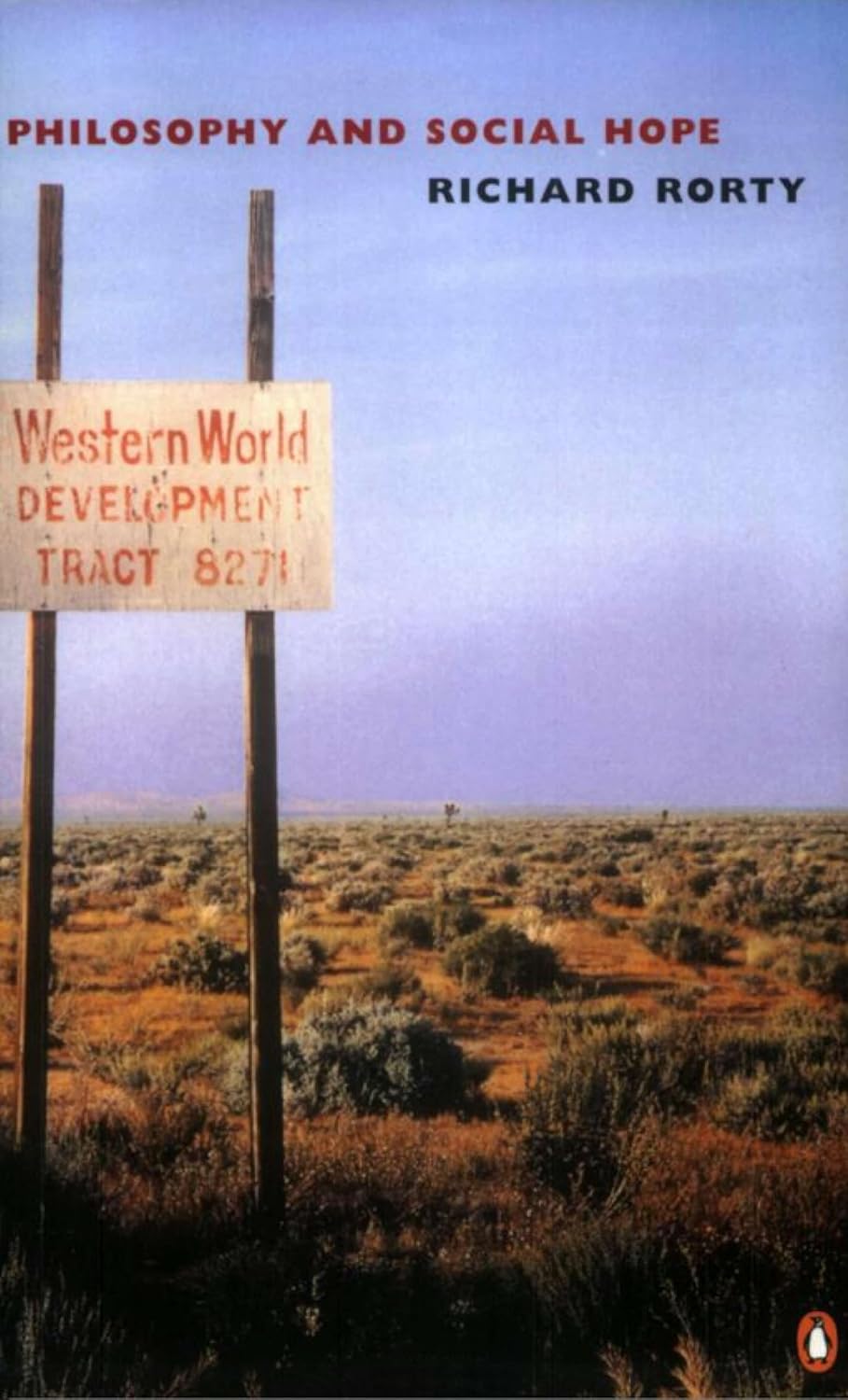
Philosophy and Social Hope

Description:

Richard Rorty is one of the most provocative figures in recent philosophical, literary and cultural debate. This collection brings together those of his writings aimed at a wider audience, many published in book form for the first time. In these eloquent essays, articles and lectures, Rorty gives a stimulating summary of his central philosophical beliefs and how they relate to his political hopes; he also offers some challenging insights into contemporary America, justice, education and love.


Editorial Reviews

About the Author

Richard Rorty is Professor of Comparative Literature at Stanford University. He is the author of PHILSOPHY AND THE MIRROR OF NATURE, CONTINGENCY, IRONY AND SOLIDARITY, and ACHIEVING OUR COUNTRY.

Reviews:

5.0 out of 5 stars Helpful For Courses on Ethics

P.C. · April 20, 2009

To my chagrin, I admit that this is the first book by Rorty that I have read. I will now read much more by him. The ethics of pragmatism, at least as he enunciates it in the introduction and several chapters of this book, is very interesting, if not fully compelling (at least to a transcendental phenomenologist such as myself). And I have found his book a very readable addition to standard selections from Plato, Aristotle, Aquinas, Kant, Mill, and de Beauvoir in my General Ethics courses.Rorty's pragmatism really is a unique ethical stance--one rooted in historical contexts and necessarily limited by human finitude. It recognizes no absolutes, and instead it takes concrete, intersubjective structures and institutions as a real hope for shared ethical behavior. In this way, Rorty's optimism is one shared by Mill toward the end of his famous pamphlet on utilitarianism.As of now, though, I remain unconvinced by Rorty's argument, and I would claim that the anti-foundationalist Rorty relies on intersubjectivity in the same, foundational ways as more transcendental versions of ethics (see Husserl's description of transcendental intersubjectivity or even Kant's discussion of the kingdom of ends).I will use this book again, and I will read more of his works.

4.0 out of 5 stars Nice & Clear... Whether it's agreeable is up to you.

H.Y. · April 28, 2001

I knew that he was a so-called "relativist", and so I was rather skeptic about his writings. So, I was rather surprised to find a clear and reasonable discussion about a lot of things in this book. The position of the liberal left in America, and its relation with the labor union movement...So I liked it, and I think I understand his position to an extent. He says that we should stop pretending that there is a "reality" beyond what we feel and experience. We should stop dreaming that there is some "truth" out there that we have to find. He says that we should try to do things that promote freedom and democracy, and we shouldn't do things for the sake of some ideal or some image of a perfect world that should eventually be achieved.That's all very fine, except....If there is no ideal, if there is no fixed value, then how does he justify his faith in democracy and freedon? Why are these ideas unquestionably good?Also, he says that pursuing science and stuff just for the sake of it, cannot be justified. Western science is not pursuing the absolute truth about this world. It is a really good thing, but only because it was usefull to us so far. (But since it was VERY useful, people who praise voodoo magic and folk "science" as something equally great as western science are plain stupid, since those things were very limited in their scope of usefullness). And so, we can't justify stuff like super colliders or space exploration, since it's usefullness to democracy and freedom are questionable.Well... how the hell would anybody know what would be good for what purpose? People who were looking for big prime numbers probably had no practical use of those theories in mind. Yet, today, they are quite useful in cryptography... which is probably good for freedom in many ways. A lot of scientific discoveries had no practical use, and so was not useful in any sense at that time. And there were many projects that was supposed to improve the world that didn't do anything.It's a good book, and the writing is clear and sometimes even fun. You will understant Rorty's ideas, and its a great introduction. But it's an introduction that makes you think. I don't know if the answers to my questions (and undoubtedly, many other people would have thought about the same thing, since I'm not the brightest person on earth) are in his other writings, although I doubt it.

5.0 out of 5 stars Acid on the Dross

D.D.E.M. · April 22, 2003

Rorty is one of the most important philosophers of the twentieth and twenty-first centuries not because he offers a new theory or new system, but precisely because he is so good at warning us about getting addicted to theories and systems. For this he is hated by many philosophers, despised by many in the literati, scorned by metaphysicians and clerics (as a nihilist or relativist), and reviled by philosophical purists who believe he gleefully misreads the works of their heroes and masters.But like acid on the dross of idiotic or, to be more charitable, useless ideas which have led many a thinker into the deep and twisted woods of high theory, never to be seen again, Rorty pours out his neo-pragmatist criticisms on the various "isms" that claim to be more in touch with the "real world" than their competitors. What is left after the acid bath is a stark realization that there is little that we have to build a better world than our strenuously forged concessions, compromises, agreements, collaborations, and conversations about what in fact having a better world means. This antifoundational view leaves wholly unsatisfied people who believe that something more concrete is needed to build the world into something more salutary and livable than it was yesterday. Rorty tells the reader that there is nothing more concrete than he or she, that the need for rationalist foundations is a diversion from the true font of social hope and freedom. In this, he surpasses even John Dewey in democratic credentials, although such a claim is seen as heresy in many philosophical circles. Unlike Dewey, Rorty offers no decision procedure for democratic practice. He bids us only to go and be democrats (his preference), or come up with your own good reasons for going in another direction. He will not clobber you with arguments proving the link between democracy and human nature. He will ask you to consider the advantages of his own preferences, and try to convince you to give them a shot.While Rorty does overstate his case, it isn't by very much, for in his view we must shake off the idea that we need more (or will get more) to resolve issues such as cloning, capital punishment, abortion or hyper-nationalism than consensus. Ultimately, every attempt to lay a philosophical foundation, to provide a rationalist bedrock for our choices and conduct, fails. Even the notion of "inalienable rights" is a fiction, but a good one that we embrace because of its use, because of how it organizes the societies that believe in it. Each foundation can be picked to pieces by other arguments and other social imperatives, or other changes in what the culture believes is relevant to itself. Democracy isn't better than Islamic or Christian fundamentalism; it is only better if a certain kind of freedom is more relevant than paradise in the next life. Rorty argues in this volume and elsewhere that we must get over philosophy and theory and instead roll up our sleeves and get to work in public debate, meaningful social criticism, and engagement with the world that is. The best a philosopher can hope to do is help along conversations big and small about issues big and small, bringing no particular expertise to the process save for the value of a good education and the intellectual virtues honed during play with arguments and ideas.For those who find Rorty's message unsettling, all I can say is that they should take up Philosophy and Social Hope, allow the unsettling to take place, enjoy the ride where enjoyment is possible, and then put the book aside. They may return to it years hence, to challenge it, to find new points of agreement, to throw it across the room as an attack on their souls and the Gods of their fathers and of their countries. But, like so many important thinkers, Rorty cannot be ignored -- whether you like him or not.

Good introduction to Rorty

A.C. · June 13, 2021

Greatly enjoyed the read. This is a collection of Rorty's lectures in over a decade. You'll get to see how his pragmatism is applied in many aspects, personal and political..

Product is in a good shape. I'm satisfied.

W.P. · March 20, 2020

Overall, there's no defect. Little usage by the previous owner. The papers are brown as a result of foxing, the usual.

Interesting ideas to disagree with

i. · April 30, 2019

Interesting and well-written pieces even if one doesn't agree with the author. It's good to try to see things from another perspective.

God may be dead, but Rorty provides a personal ethic and a wonderful vision of the future if we choose to follow it

A.P. · October 23, 2018

Professor Rorty does use some interesting words, requiring occasional use of a dictionary, but his writing is clear and unambiguous. Religions involving a multi-dimensional universe, God or some sort of unique and special human "ingredient" (soul?) are redundant apart from providing useful ethical ideas the world can live by. the future of the human race is solidarity with one another, seeking increased happiness of all driven by higher ideals selected democratically by humanity, not plucked from some metaphysical world.This is Nietche, but without the individualism and the Superman which helped give rise to the Nazis and the destruction that followed.

Five Stars

P. · May 19, 2016

Good book. Thank you

Philosophy and Social Hope

Product ID: U0140262881
Condition: New

4.5

AED12011

Price includes VAT & Import Duties
Type: Paperback
Availability: In Stock

Quantity:

|

Order today to get by 7-14 business days

Delivery fee of AED 20. Free for orders above AED 200.

Returns & Warranty policies

Imported From: United States

At BOLO, we work hard to ensure the products you receive are new, genuine, and sourced from reputable suppliers.

BOLO is not an authorized or official retailer for most brands, nor are we affiliated with manufacturers unless specifically stated on a product page. Instead, we source verified sellers, authorized distributors or directly from the manufacturer.

Each product undergoes thorough inspection and verification at our consolidation and fulfilment centers to ensure it meets our strict authenticity and quality standards before being shipped and delivered to you.

If you ever have concerns regarding the authenticity of a product purchased from us, please contact Bolo Support. We will review your inquiry promptly and, if necessary, provide documentation verifying authenticity or offer a suitable resolution.

Your trust is our top priority, and we are committed to maintaining transparency and integrity in every transaction.

All product information, images, descriptions, and reviews originate from the manufacturer or from trusted sellers overseas. BOLO is not affiliated with, endorsed by, or an authorized retailer for most brands listed on our website unless stated otherwise.

While we strive to display accurate information, variations in packaging, labeling, instructions, or formulation may occasionally occur due to regional differences or supplier updates. For detailed or manufacturer-specific information, please contact the brand directly or reach out to BOLO Support for assistance.

Unless otherwise stated, all prices displayed on the product page include applicable taxes and import duties.

BOLO operates in accordance with the laws and regulations of United Arab Emirates. Any items found to be restricted or prohibited for sale within the UAE will be cancelled prior to shipment. We take proactive measures to ensure that only products permitted for sale in United Arab Emirates are listed on our website.

All items are shipped by air, and any products classified as “Dangerous Goods (DG)” under IATA regulations will be removed from the order and cancelled.

All orders are processed manually, and we make every effort to process them promptly once confirmed. Products cancelled due to the above reasons will be permanently removed from listings across the website.

Similar suggestions by Bolo

More from this brand

Similar items from “Modern”

Philosophy and Social Hope

Product ID: U0140262881
Condition: New

4.5

Philosophy and Social Hope-0
Type: Paperback

AED12011

Price includes VAT & Import Duties
Availability: In Stock

Quantity:

|

Order today to get by 7-14 business days

Delivery fee of AED 20. Free for orders above AED 200.

Returns & Warranty policies

Imported From: United States

At BOLO, we work hard to ensure the products you receive are new, genuine, and sourced from reputable suppliers.

BOLO is not an authorized or official retailer for most brands, nor are we affiliated with manufacturers unless specifically stated on a product page. Instead, we source verified sellers, authorized distributors or directly from the manufacturer.

Each product undergoes thorough inspection and verification at our consolidation and fulfilment centers to ensure it meets our strict authenticity and quality standards before being shipped and delivered to you.

If you ever have concerns regarding the authenticity of a product purchased from us, please contact Bolo Support. We will review your inquiry promptly and, if necessary, provide documentation verifying authenticity or offer a suitable resolution.

Your trust is our top priority, and we are committed to maintaining transparency and integrity in every transaction.

All product information, images, descriptions, and reviews originate from the manufacturer or from trusted sellers overseas. BOLO is not affiliated with, endorsed by, or an authorized retailer for most brands listed on our website unless stated otherwise.

While we strive to display accurate information, variations in packaging, labeling, instructions, or formulation may occasionally occur due to regional differences or supplier updates. For detailed or manufacturer-specific information, please contact the brand directly or reach out to BOLO Support for assistance.

Unless otherwise stated, all prices displayed on the product page include applicable taxes and import duties.

BOLO operates in accordance with the laws and regulations of United Arab Emirates. Any items found to be restricted or prohibited for sale within the UAE will be cancelled prior to shipment. We take proactive measures to ensure that only products permitted for sale in United Arab Emirates are listed on our website.

All items are shipped by air, and any products classified as “Dangerous Goods (DG)” under IATA regulations will be removed from the order and cancelled.

All orders are processed manually, and we make every effort to process them promptly once confirmed. Products cancelled due to the above reasons will be permanently removed from listings across the website.

Description:

Richard Rorty is one of the most provocative figures in recent philosophical, literary and cultural debate. This collection brings together those of his writings aimed at a wider audience, many published in book form for the first time. In these eloquent essays, articles and lectures, Rorty gives a stimulating summary of his central philosophical beliefs and how they relate to his political hopes; he also offers some challenging insights into contemporary America, justice, education and love.


Editorial Reviews

About the Author

Richard Rorty is Professor of Comparative Literature at Stanford University. He is the author of PHILSOPHY AND THE MIRROR OF NATURE, CONTINGENCY, IRONY AND SOLIDARITY, and ACHIEVING OUR COUNTRY.

Reviews:

5.0 out of 5 stars Helpful For Courses on Ethics

P.C. · April 20, 2009

To my chagrin, I admit that this is the first book by Rorty that I have read. I will now read much more by him. The ethics of pragmatism, at least as he enunciates it in the introduction and several chapters of this book, is very interesting, if not fully compelling (at least to a transcendental phenomenologist such as myself). And I have found his book a very readable addition to standard selections from Plato, Aristotle, Aquinas, Kant, Mill, and de Beauvoir in my General Ethics courses.Rorty's pragmatism really is a unique ethical stance--one rooted in historical contexts and necessarily limited by human finitude. It recognizes no absolutes, and instead it takes concrete, intersubjective structures and institutions as a real hope for shared ethical behavior. In this way, Rorty's optimism is one shared by Mill toward the end of his famous pamphlet on utilitarianism.As of now, though, I remain unconvinced by Rorty's argument, and I would claim that the anti-foundationalist Rorty relies on intersubjectivity in the same, foundational ways as more transcendental versions of ethics (see Husserl's description of transcendental intersubjectivity or even Kant's discussion of the kingdom of ends).I will use this book again, and I will read more of his works.

4.0 out of 5 stars Nice & Clear... Whether it's agreeable is up to you.

H.Y. · April 28, 2001

I knew that he was a so-called "relativist", and so I was rather skeptic about his writings. So, I was rather surprised to find a clear and reasonable discussion about a lot of things in this book. The position of the liberal left in America, and its relation with the labor union movement...So I liked it, and I think I understand his position to an extent. He says that we should stop pretending that there is a "reality" beyond what we feel and experience. We should stop dreaming that there is some "truth" out there that we have to find. He says that we should try to do things that promote freedom and democracy, and we shouldn't do things for the sake of some ideal or some image of a perfect world that should eventually be achieved.That's all very fine, except....If there is no ideal, if there is no fixed value, then how does he justify his faith in democracy and freedon? Why are these ideas unquestionably good?Also, he says that pursuing science and stuff just for the sake of it, cannot be justified. Western science is not pursuing the absolute truth about this world. It is a really good thing, but only because it was usefull to us so far. (But since it was VERY useful, people who praise voodoo magic and folk "science" as something equally great as western science are plain stupid, since those things were very limited in their scope of usefullness). And so, we can't justify stuff like super colliders or space exploration, since it's usefullness to democracy and freedom are questionable.Well... how the hell would anybody know what would be good for what purpose? People who were looking for big prime numbers probably had no practical use of those theories in mind. Yet, today, they are quite useful in cryptography... which is probably good for freedom in many ways. A lot of scientific discoveries had no practical use, and so was not useful in any sense at that time. And there were many projects that was supposed to improve the world that didn't do anything.It's a good book, and the writing is clear and sometimes even fun. You will understant Rorty's ideas, and its a great introduction. But it's an introduction that makes you think. I don't know if the answers to my questions (and undoubtedly, many other people would have thought about the same thing, since I'm not the brightest person on earth) are in his other writings, although I doubt it.

5.0 out of 5 stars Acid on the Dross

D.D.E.M. · April 22, 2003

Rorty is one of the most important philosophers of the twentieth and twenty-first centuries not because he offers a new theory or new system, but precisely because he is so good at warning us about getting addicted to theories and systems. For this he is hated by many philosophers, despised by many in the literati, scorned by metaphysicians and clerics (as a nihilist or relativist), and reviled by philosophical purists who believe he gleefully misreads the works of their heroes and masters.But like acid on the dross of idiotic or, to be more charitable, useless ideas which have led many a thinker into the deep and twisted woods of high theory, never to be seen again, Rorty pours out his neo-pragmatist criticisms on the various "isms" that claim to be more in touch with the "real world" than their competitors. What is left after the acid bath is a stark realization that there is little that we have to build a better world than our strenuously forged concessions, compromises, agreements, collaborations, and conversations about what in fact having a better world means. This antifoundational view leaves wholly unsatisfied people who believe that something more concrete is needed to build the world into something more salutary and livable than it was yesterday. Rorty tells the reader that there is nothing more concrete than he or she, that the need for rationalist foundations is a diversion from the true font of social hope and freedom. In this, he surpasses even John Dewey in democratic credentials, although such a claim is seen as heresy in many philosophical circles. Unlike Dewey, Rorty offers no decision procedure for democratic practice. He bids us only to go and be democrats (his preference), or come up with your own good reasons for going in another direction. He will not clobber you with arguments proving the link between democracy and human nature. He will ask you to consider the advantages of his own preferences, and try to convince you to give them a shot.While Rorty does overstate his case, it isn't by very much, for in his view we must shake off the idea that we need more (or will get more) to resolve issues such as cloning, capital punishment, abortion or hyper-nationalism than consensus. Ultimately, every attempt to lay a philosophical foundation, to provide a rationalist bedrock for our choices and conduct, fails. Even the notion of "inalienable rights" is a fiction, but a good one that we embrace because of its use, because of how it organizes the societies that believe in it. Each foundation can be picked to pieces by other arguments and other social imperatives, or other changes in what the culture believes is relevant to itself. Democracy isn't better than Islamic or Christian fundamentalism; it is only better if a certain kind of freedom is more relevant than paradise in the next life. Rorty argues in this volume and elsewhere that we must get over philosophy and theory and instead roll up our sleeves and get to work in public debate, meaningful social criticism, and engagement with the world that is. The best a philosopher can hope to do is help along conversations big and small about issues big and small, bringing no particular expertise to the process save for the value of a good education and the intellectual virtues honed during play with arguments and ideas.For those who find Rorty's message unsettling, all I can say is that they should take up Philosophy and Social Hope, allow the unsettling to take place, enjoy the ride where enjoyment is possible, and then put the book aside. They may return to it years hence, to challenge it, to find new points of agreement, to throw it across the room as an attack on their souls and the Gods of their fathers and of their countries. But, like so many important thinkers, Rorty cannot be ignored -- whether you like him or not.

Good introduction to Rorty

A.C. · June 13, 2021

Greatly enjoyed the read. This is a collection of Rorty's lectures in over a decade. You'll get to see how his pragmatism is applied in many aspects, personal and political..

Product is in a good shape. I'm satisfied.

W.P. · March 20, 2020

Overall, there's no defect. Little usage by the previous owner. The papers are brown as a result of foxing, the usual.

Interesting ideas to disagree with

i. · April 30, 2019

Interesting and well-written pieces even if one doesn't agree with the author. It's good to try to see things from another perspective.

God may be dead, but Rorty provides a personal ethic and a wonderful vision of the future if we choose to follow it

A.P. · October 23, 2018

Professor Rorty does use some interesting words, requiring occasional use of a dictionary, but his writing is clear and unambiguous. Religions involving a multi-dimensional universe, God or some sort of unique and special human "ingredient" (soul?) are redundant apart from providing useful ethical ideas the world can live by. the future of the human race is solidarity with one another, seeking increased happiness of all driven by higher ideals selected democratically by humanity, not plucked from some metaphysical world.This is Nietche, but without the individualism and the Superman which helped give rise to the Nazis and the destruction that followed.

Five Stars

P. · May 19, 2016

Good book. Thank you

Similar suggestions by Bolo

More from this brand

Similar items from “Modern”