Deliver toUnited Arab Emirates
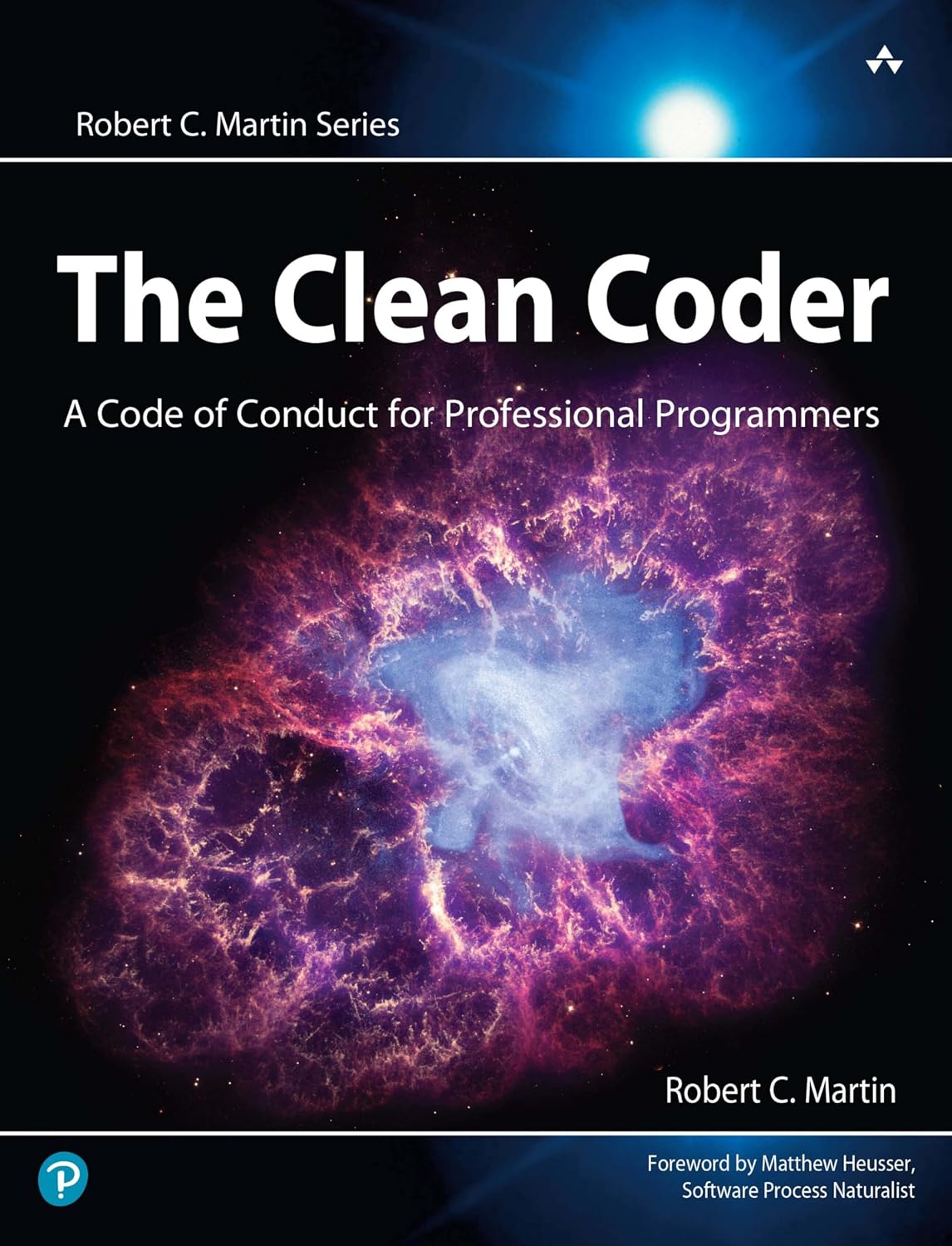
The Clean Coder: A Code of Conduct for Professional Programmers

Description:

Programmers who endure and succeed amidst swirling uncertainty and nonstop pressure share a common attribute: They care deeply about the practice of creating software. They treat it as a craft. They are professionals.

In The Clean Coder: A Code of Conduct for Professional Programmers, legendary software expert Robert C. Martin introduces the disciplines, techniques, tools, and practices of true software craftsmanship. This book is packed with practical advice–about everything from estimating and coding to refactoring and testing. It covers much more than technique: It is about attitude. Martin shows how to approach software development with honor, self-respect, and pride; work well and work clean; communicate and estimate faithfully; face difficult decisions with clarity and honesty; and understand that deep knowledge comes with a responsibility to act.

Readers will learn

  • What it means to behave as a true software craftsman
  • How to deal with conflict, tight schedules, and unreasonable managers
  • How to get into the flow of coding, and get past writer’s block
  • How to handle unrelenting pressure and avoid burnout
  • How to combine enduring attitudes with new development paradigms
  • How to manage your time, and avoid blind alleys, marshes, bogs, and swamps
  • How to foster environments where programmers and teams can thrive
  • When to say “No”–and how to say it
  • When to say “Yes”–and what yes really means

Great software is something to marvel at: powerful, elegant, functional, a pleasure to work with as both a developer and as a user. Great software isn’t written by machines. It is written by professionals with an unshakable commitment to craftsmanship. The Clean Coder will help you become one of them–and earn the pride and fulfillment that they alone possess.


Editorial Reviews

Review

"'Uncle Bob' Martin definitely raises the bar with his latest book. He explains his expectation for a professional programmer on management interactions, time management, pressure, on collaboration, and on the choice of tools to use. Beyond TDD and ATDD, Martin explains what every programmer who considers him- or herself a professional not only needs to know, but also needs to follow in order to make the young profession of software development grow." -Markus Gärtner Senior Software Developer it-agile GmbH www.it-agile.de www.shino.de "Some technical books inspire and teach; some delight and amuse. Rarely does a technical book do all four of these things. Robert Martin's always have for me and The Clean Coder is no exception. Read, learn, and live the lessons in this book and you can accurately call yourself a software professional." -George Bullock Senior Program Manager Microsoft Corp. "If a computer science degree had 'required reading for after you graduate, ' this would be it. In the real world, your bad code doesn't vanish when the semester's over, you don't get an A for marathon coding the night before an assignment's due, and, worst of all, you have to deal with people. So, coding gurus are not necessarily professionals. The Clean Coder describes the journey to professionalism . . . and it does a remarkably entertaining job of it." -Jeff Overbey University of Illinois at Urbana-Champaign "The Clean Coder is much more than a set of rules or guidelines. It contains hard-earned wisdom and knowledge that is normally obtained through many years of trial and error or by working as an apprentice to a master craftsman. If you call yourself a software professional, you need this book." -R. L. Bogetti Lead System Designer Baxter Healthcare www.RLBogetti.com

From the Back Cover

Even bad code can function. But if code isn't clean, it can bring a development organization to its knees. Every year, countless hours and significant resources are lost because of poorly written code. But it doesn't have to be that way.
Noted software expert Robert C. Martin presents a revolutionary paradigm with "Clean Code: A Handbook of Agile Software Craftsmanship." Martin has teamed up with his colleagues from Object Mentor to distill their best agile practice of cleaning code "on the fly" into a book that will instill within you the values of a software craftsman and make you a better programmer-but only if you work at it.
What kind of work will you be doing? You'll be reading code-lots of code. And you will be challenged to think about what's right about that code, and what's wrong with it. More importantly, you will be challenged to reassess your professional values and your commitment to your craft.
"Clean Code" is divided into three parts. The first describes the principles, patterns, and practices of writing clean code. The second part consists of several case studies of increasing complexity. Each case study is an exercise in cleaning up code-of transforming a code base that has some problems into one that is sound and efficient. The third part is the payoff: a single chapter containing a list of heuristics and "smells" gathered while creating the case studies. The result is a knowledge base that describes the way we think when we write, read, and clean code.
Readers will come away from this book understanding
How to tell the difference between good and bad codeHow to write good code and how to transform bad code into good codeHow to create good names, good functions, good objects, and good classesHow to format code for maximum readabilityHow to implement complete error handling without obscuring code logicHow to unit test and practice test-driven developmentThis book is a must for any developer, software engineer, project manager, team lead, or systems analyst with an interest in producing better code.

Reviews:

5.0 out of 5 stars Must read for any programmer

P.J.H. · April 15, 2016

Programming is an interesting profession. It’s not just an engineering exercise, where you’re building the most logical, structured, and well-designed application according to some set of industry best practices; rather, there’s a great deal of creativity that goes into it – an artistic quality, if you will. Instead of solving a particular problem the same way for every project, you must creatively adapt your thinking and communication to meet the expectations of each project’s stakeholders. Programming is not well understood like other professions. You know what lawyers, accountants, and doctors do. Their workflows and processes are well known since their professions are mature and a good portion of the population has interacted with them directly or indirectly. Programming, on the other hand, is different. To many people, a website or software solution magically just “appears” after a programmer spends time at his or her computer. Enter Robert C. Martin’s The Clean Coder.The Clean Coder helps demonstrate how programmers can conduct themselves as professionals, removing that black-box quality and holding themselves to standards as other professionals do so they garner the same respect from their peers and can help others do more with technology.I’ll talk about some of the lessons that really resonate with me:In the forward, Matthew Heusser relays a story about how his colleague, Joe, considers “estimates” from the technical team and “estimates” from the legal team with completely different mindsets. In short, Joe considered legal estimates to be final, whereas technical estimates were negotiable. Why weren’t estimates from the two teams treated equally? In my career, I’ve seen the same thing many times, largely stemming from three reasons. First is the assumed “magic” that non-technical people think programmers wield. Throughout the book, Martin explains how to remove the veil of mystery regarding said magic. Second is that I’ve run across others that compared us with their profession and made some assumptions, such as, though a harsher example, we’re being lazy or noncommittal. Here, the author discusses how to address such assumptions when confronted with them. Third, and the most important part that we can influence, is the tech person’s mindset and approach to work. From the text, the programmer learns how to craft their own mindset and workflows to handle these. In essence, we can’t make things perfect, but we control a lot of parameters to make things better.The first three chapters cover the conduct that a software developer professional should exhibit. A recurring theme within all three chapters is that software developers should take responsibility for what they say and do. Martin gracefully simplified this down to: how/why to say “no” and how/why to say “yes.” For example, if a developer agrees to a timeline, then they should make the timeline. If there are risks or unknowns on something you’re defining a timeline for, don’t agree to it, but rather just agree to what you can commit to if possible. The key is to not let yourself get bullied into agreeing to something you know you can’t meet with confidence. Others will build their own schedules and commitments around what you say, and there may be serious repercussions and loss of face if you fail to deliver. If you’re not as accurate as possible, you’ll erode the trust you have with your colleagues.Along with controlling and defining your commitments, you need to take responsibility for your work output. Specifically, being a professional means that you certify and guarantee that your work output functions. For example, accountants ensure that their accounts balance when they finish closing out the books monthly, quarterly, and year’s end. If they left discrepancies, they would soon find themselves out of work. However, developers seem to be able to deliver questionable code or features that just plain don’t work, again and again. I understand why: development is hard. There are a lot of moving pieces and people in a software development project; as a result, there are a lot of rules that get balanced when you go in and change something. None of that takes away from the fact that developers lose trust of their peers when they fail to deliver working solutions for the tasks assigned to them. They’ll probably remember the failure (their label, not yours) instead of the nuanced “whys” that caused that failure.Luckily, software developers have tools available to them to prevent this from happening, but only if the tools are actually put to use. Martin’s philosophy around testing is something with which I completely agree. The only way you can truly know that what you’ve added or changed doesn’t break everything else on a project – regardless of size – is to test it and have a structured, scalable approach to testing. Manual testing takes time, sometimes A LOT of time, and you leave a lot to chance that way. Hence automation. When automated, a test can be written once and then just be executed. It makes it trivial to repeatedly ensure that your code matches all the criteria it needs to meet. (Note: I wouldn’t recommend this approach across the board, particularly if an MVP, pilot system, or feature with a lot of changing specifications is being created, which is quite common with my startup customers. For something mature, scalable, and maintainable in a financially feasible manner, it’s required.)Martin’s discussion of “expected criteria” is another area that is really important for developers to understand and put to use. Ultimately, a customer or stakeholder will have to accept the software that a developer builds. When is the software done? What do clients judge the system’s success by? What aspects of the software do they value, and how do they prioritize what they value? To address this, I've always operated from the mindset of: the software is done when the customer tells me it's done. Part of that determination is working with the customer to define the acceptance criteria, though that can be difficult if the customer is non-technical or busy. Even high-level criteria are helpful, such as "Search for a product, and buy it” or “Load fast.” That’s fine so long as the stakeholders are open to iterations later to arrive at what they truly want. Conversely, the criteria could be very specific. Ideally, the developer helps the customer put more definition on their acceptance criteria throughout the process. The more quantitative, the better. The developer is finished with the work when they deploy or deliver the software or functionality that meets all the acceptance criteria. In conclusion, it’s not so important how the acceptance tests are written even though there are best practices; what is important is that you and the client know what is “done” and agree to it.The book is chock-full of other applicable advice as well, from numerically-driven ways to handle estimates to suggestions for interacting with colleagues. All of the recommendations align to the goal of helping developers comport themselves as professionals so they’ll be treated as such by other professionals. It’s very important because our work is nebulous and our profession is new. I highly recommend this book to anyone who wants to be a professional software developer for the long-term or works a lot with them.

5.0 out of 5 stars Not what I'd thought it would be.

T.E.S. · August 8, 2014

I thought this would be about details of a type of coding or coding practice. I can't say I enjoyed the book but I learned a great deal from it. This book deals with the philosophy and ethics of being professional first, and being a coder second. It brought home a lot of flaws that I've displayed across the years. That's why it wasn't all that enjoyable; the writing was all too clear and direct.Although I've been around IT for some time, I've only recently started working directly with professonal developers. That was my motivation for buying the book -- so I could do a better job and maybe earn a bit of respect. It did introduce me to Test Driven Developement (that in itself ought to reinforce that professional coding is new to me). After just one day of trying it I find that I pick up after distractions much faster, cover more cases to test, and even write in such a way the code seems to document itself without the huge effort I've had to make in the past just to get so-so results. And it seems to make even some of the dreary parts more fun because you can almost imagine it as a game you play against yourself. So I'm sold on TDD.I'd begun to realize the importance of having good estimates and honest, timely reappraisals before starting to read the book, but the author certainly drives home how very critical this is to a professional coder and the rest of the team.If you've programmed essentially for yourself (as a systems admin or database admin) but are moving toward true development, this is an essential book to read. It will show you bad habits to avoid and drive home the professional behavior that will earn you respect. I admit that is based on only about three months of experience in working with developers, but over the past two weeks (since I started the book) I'm sure that I sense a greater acceptance and respect.

-

D.N. · February 3, 2021

-

Essential read for any software professional

J. · August 11, 2025

Absolute must read for any software professional. Has tremendously improved my professional output, discipline and confidence to influence the success of my team.

I think every programmer should read this book very early in their career.

C.Z. · April 29, 2018

Another great book from Uncle Bob. This time it is not about the program but the programmer. I think every programmer should read this book very early in their career. What Bob writes about professionalism is spot on.

A must read for any serious professional

E. · June 7, 2023

I'm about halfway through and already its one of the most meaningful books in my career. It tackles a lot of the non-code issues in programming, such as being consistent on deliverables and communicating effectively.No matter how good of a coder you are, following the advice in this book will make you a better professional and more employable. Absolutely worth every penny.

Excellent book!!

C.M.G. · June 18, 2021

This book is perfect for those who want to see and learn tips to improve as a professional, an excellent book for my taste.

The Clean Coder: A Code of Conduct for Professional Programmers

Product ID: U0137081073
Condition: New

4.6

AED29996

Price includes VAT & Import Duties
Type: Paperback
Availability: In Stock

Quantity:

|

Order today to get by 7-14 business days

This item qualifies for free delivery

Returns & Warranty policies

Imported From: United States

At BOLO, we work hard to ensure the products you receive are new, genuine, and sourced from reputable suppliers.

BOLO is not an authorized or official retailer for most brands, nor are we affiliated with manufacturers unless specifically stated on a product page. Instead, we source verified sellers, authorized distributors or directly from the manufacturer.

Each product undergoes thorough inspection and verification at our consolidation and fulfilment centers to ensure it meets our strict authenticity and quality standards before being shipped and delivered to you.

If you ever have concerns regarding the authenticity of a product purchased from us, please contact Bolo Support. We will review your inquiry promptly and, if necessary, provide documentation verifying authenticity or offer a suitable resolution.

Your trust is our top priority, and we are committed to maintaining transparency and integrity in every transaction.

All product information, images, descriptions, and reviews originate from the manufacturer or from trusted sellers overseas. BOLO is not affiliated with, endorsed by, or an authorized retailer for most brands listed on our website unless stated otherwise.

While we strive to display accurate information, variations in packaging, labeling, instructions, or formulation may occasionally occur due to regional differences or supplier updates. For detailed or manufacturer-specific information, please contact the brand directly or reach out to BOLO Support for assistance.

Unless otherwise stated, all prices displayed on the product page include applicable taxes and import duties.

BOLO operates in accordance with the laws and regulations of United Arab Emirates. Any items found to be restricted or prohibited for sale within the UAE will be cancelled prior to shipment. We take proactive measures to ensure that only products permitted for sale in United Arab Emirates are listed on our website.

All items are shipped by air, and any products classified as “Dangerous Goods (DG)” under IATA regulations will be removed from the order and cancelled.

All orders are processed manually, and we make every effort to process them promptly once confirmed. Products cancelled due to the above reasons will be permanently removed from listings across the website.

Similar suggestions by Bolo

More from this brand

Similar items from “Software Development”

The Clean Coder: A Code of Conduct for Professional Programmers

Product ID: U0137081073
Condition: New

4.6

The Clean Coder: A Code of Conduct for Professional Programmers-0
Type: Paperback

AED29996

Price includes VAT & Import Duties
Availability: In Stock

Quantity:

|

Order today to get by 7-14 business days

This item qualifies for free delivery

Returns & Warranty policies

Imported From: United States

At BOLO, we work hard to ensure the products you receive are new, genuine, and sourced from reputable suppliers.

BOLO is not an authorized or official retailer for most brands, nor are we affiliated with manufacturers unless specifically stated on a product page. Instead, we source verified sellers, authorized distributors or directly from the manufacturer.

Each product undergoes thorough inspection and verification at our consolidation and fulfilment centers to ensure it meets our strict authenticity and quality standards before being shipped and delivered to you.

If you ever have concerns regarding the authenticity of a product purchased from us, please contact Bolo Support. We will review your inquiry promptly and, if necessary, provide documentation verifying authenticity or offer a suitable resolution.

Your trust is our top priority, and we are committed to maintaining transparency and integrity in every transaction.

All product information, images, descriptions, and reviews originate from the manufacturer or from trusted sellers overseas. BOLO is not affiliated with, endorsed by, or an authorized retailer for most brands listed on our website unless stated otherwise.

While we strive to display accurate information, variations in packaging, labeling, instructions, or formulation may occasionally occur due to regional differences or supplier updates. For detailed or manufacturer-specific information, please contact the brand directly or reach out to BOLO Support for assistance.

Unless otherwise stated, all prices displayed on the product page include applicable taxes and import duties.

BOLO operates in accordance with the laws and regulations of United Arab Emirates. Any items found to be restricted or prohibited for sale within the UAE will be cancelled prior to shipment. We take proactive measures to ensure that only products permitted for sale in United Arab Emirates are listed on our website.

All items are shipped by air, and any products classified as “Dangerous Goods (DG)” under IATA regulations will be removed from the order and cancelled.

All orders are processed manually, and we make every effort to process them promptly once confirmed. Products cancelled due to the above reasons will be permanently removed from listings across the website.

Description:

Programmers who endure and succeed amidst swirling uncertainty and nonstop pressure share a common attribute: They care deeply about the practice of creating software. They treat it as a craft. They are professionals.

In The Clean Coder: A Code of Conduct for Professional Programmers, legendary software expert Robert C. Martin introduces the disciplines, techniques, tools, and practices of true software craftsmanship. This book is packed with practical advice–about everything from estimating and coding to refactoring and testing. It covers much more than technique: It is about attitude. Martin shows how to approach software development with honor, self-respect, and pride; work well and work clean; communicate and estimate faithfully; face difficult decisions with clarity and honesty; and understand that deep knowledge comes with a responsibility to act.

Readers will learn

  • What it means to behave as a true software craftsman
  • How to deal with conflict, tight schedules, and unreasonable managers
  • How to get into the flow of coding, and get past writer’s block
  • How to handle unrelenting pressure and avoid burnout
  • How to combine enduring attitudes with new development paradigms
  • How to manage your time, and avoid blind alleys, marshes, bogs, and swamps
  • How to foster environments where programmers and teams can thrive
  • When to say “No”–and how to say it
  • When to say “Yes”–and what yes really means

Great software is something to marvel at: powerful, elegant, functional, a pleasure to work with as both a developer and as a user. Great software isn’t written by machines. It is written by professionals with an unshakable commitment to craftsmanship. The Clean Coder will help you become one of them–and earn the pride and fulfillment that they alone possess.


Editorial Reviews

Review

"'Uncle Bob' Martin definitely raises the bar with his latest book. He explains his expectation for a professional programmer on management interactions, time management, pressure, on collaboration, and on the choice of tools to use. Beyond TDD and ATDD, Martin explains what every programmer who considers him- or herself a professional not only needs to know, but also needs to follow in order to make the young profession of software development grow." -Markus Gärtner Senior Software Developer it-agile GmbH www.it-agile.de www.shino.de "Some technical books inspire and teach; some delight and amuse. Rarely does a technical book do all four of these things. Robert Martin's always have for me and The Clean Coder is no exception. Read, learn, and live the lessons in this book and you can accurately call yourself a software professional." -George Bullock Senior Program Manager Microsoft Corp. "If a computer science degree had 'required reading for after you graduate, ' this would be it. In the real world, your bad code doesn't vanish when the semester's over, you don't get an A for marathon coding the night before an assignment's due, and, worst of all, you have to deal with people. So, coding gurus are not necessarily professionals. The Clean Coder describes the journey to professionalism . . . and it does a remarkably entertaining job of it." -Jeff Overbey University of Illinois at Urbana-Champaign "The Clean Coder is much more than a set of rules or guidelines. It contains hard-earned wisdom and knowledge that is normally obtained through many years of trial and error or by working as an apprentice to a master craftsman. If you call yourself a software professional, you need this book." -R. L. Bogetti Lead System Designer Baxter Healthcare www.RLBogetti.com

From the Back Cover

Even bad code can function. But if code isn't clean, it can bring a development organization to its knees. Every year, countless hours and significant resources are lost because of poorly written code. But it doesn't have to be that way.
Noted software expert Robert C. Martin presents a revolutionary paradigm with "Clean Code: A Handbook of Agile Software Craftsmanship." Martin has teamed up with his colleagues from Object Mentor to distill their best agile practice of cleaning code "on the fly" into a book that will instill within you the values of a software craftsman and make you a better programmer-but only if you work at it.
What kind of work will you be doing? You'll be reading code-lots of code. And you will be challenged to think about what's right about that code, and what's wrong with it. More importantly, you will be challenged to reassess your professional values and your commitment to your craft.
"Clean Code" is divided into three parts. The first describes the principles, patterns, and practices of writing clean code. The second part consists of several case studies of increasing complexity. Each case study is an exercise in cleaning up code-of transforming a code base that has some problems into one that is sound and efficient. The third part is the payoff: a single chapter containing a list of heuristics and "smells" gathered while creating the case studies. The result is a knowledge base that describes the way we think when we write, read, and clean code.
Readers will come away from this book understanding
How to tell the difference between good and bad codeHow to write good code and how to transform bad code into good codeHow to create good names, good functions, good objects, and good classesHow to format code for maximum readabilityHow to implement complete error handling without obscuring code logicHow to unit test and practice test-driven developmentThis book is a must for any developer, software engineer, project manager, team lead, or systems analyst with an interest in producing better code.

Reviews:

5.0 out of 5 stars Must read for any programmer

P.J.H. · April 15, 2016

Programming is an interesting profession. It’s not just an engineering exercise, where you’re building the most logical, structured, and well-designed application according to some set of industry best practices; rather, there’s a great deal of creativity that goes into it – an artistic quality, if you will. Instead of solving a particular problem the same way for every project, you must creatively adapt your thinking and communication to meet the expectations of each project’s stakeholders. Programming is not well understood like other professions. You know what lawyers, accountants, and doctors do. Their workflows and processes are well known since their professions are mature and a good portion of the population has interacted with them directly or indirectly. Programming, on the other hand, is different. To many people, a website or software solution magically just “appears” after a programmer spends time at his or her computer. Enter Robert C. Martin’s The Clean Coder.The Clean Coder helps demonstrate how programmers can conduct themselves as professionals, removing that black-box quality and holding themselves to standards as other professionals do so they garner the same respect from their peers and can help others do more with technology.I’ll talk about some of the lessons that really resonate with me:In the forward, Matthew Heusser relays a story about how his colleague, Joe, considers “estimates” from the technical team and “estimates” from the legal team with completely different mindsets. In short, Joe considered legal estimates to be final, whereas technical estimates were negotiable. Why weren’t estimates from the two teams treated equally? In my career, I’ve seen the same thing many times, largely stemming from three reasons. First is the assumed “magic” that non-technical people think programmers wield. Throughout the book, Martin explains how to remove the veil of mystery regarding said magic. Second is that I’ve run across others that compared us with their profession and made some assumptions, such as, though a harsher example, we’re being lazy or noncommittal. Here, the author discusses how to address such assumptions when confronted with them. Third, and the most important part that we can influence, is the tech person’s mindset and approach to work. From the text, the programmer learns how to craft their own mindset and workflows to handle these. In essence, we can’t make things perfect, but we control a lot of parameters to make things better.The first three chapters cover the conduct that a software developer professional should exhibit. A recurring theme within all three chapters is that software developers should take responsibility for what they say and do. Martin gracefully simplified this down to: how/why to say “no” and how/why to say “yes.” For example, if a developer agrees to a timeline, then they should make the timeline. If there are risks or unknowns on something you’re defining a timeline for, don’t agree to it, but rather just agree to what you can commit to if possible. The key is to not let yourself get bullied into agreeing to something you know you can’t meet with confidence. Others will build their own schedules and commitments around what you say, and there may be serious repercussions and loss of face if you fail to deliver. If you’re not as accurate as possible, you’ll erode the trust you have with your colleagues.Along with controlling and defining your commitments, you need to take responsibility for your work output. Specifically, being a professional means that you certify and guarantee that your work output functions. For example, accountants ensure that their accounts balance when they finish closing out the books monthly, quarterly, and year’s end. If they left discrepancies, they would soon find themselves out of work. However, developers seem to be able to deliver questionable code or features that just plain don’t work, again and again. I understand why: development is hard. There are a lot of moving pieces and people in a software development project; as a result, there are a lot of rules that get balanced when you go in and change something. None of that takes away from the fact that developers lose trust of their peers when they fail to deliver working solutions for the tasks assigned to them. They’ll probably remember the failure (their label, not yours) instead of the nuanced “whys” that caused that failure.Luckily, software developers have tools available to them to prevent this from happening, but only if the tools are actually put to use. Martin’s philosophy around testing is something with which I completely agree. The only way you can truly know that what you’ve added or changed doesn’t break everything else on a project – regardless of size – is to test it and have a structured, scalable approach to testing. Manual testing takes time, sometimes A LOT of time, and you leave a lot to chance that way. Hence automation. When automated, a test can be written once and then just be executed. It makes it trivial to repeatedly ensure that your code matches all the criteria it needs to meet. (Note: I wouldn’t recommend this approach across the board, particularly if an MVP, pilot system, or feature with a lot of changing specifications is being created, which is quite common with my startup customers. For something mature, scalable, and maintainable in a financially feasible manner, it’s required.)Martin’s discussion of “expected criteria” is another area that is really important for developers to understand and put to use. Ultimately, a customer or stakeholder will have to accept the software that a developer builds. When is the software done? What do clients judge the system’s success by? What aspects of the software do they value, and how do they prioritize what they value? To address this, I've always operated from the mindset of: the software is done when the customer tells me it's done. Part of that determination is working with the customer to define the acceptance criteria, though that can be difficult if the customer is non-technical or busy. Even high-level criteria are helpful, such as "Search for a product, and buy it” or “Load fast.” That’s fine so long as the stakeholders are open to iterations later to arrive at what they truly want. Conversely, the criteria could be very specific. Ideally, the developer helps the customer put more definition on their acceptance criteria throughout the process. The more quantitative, the better. The developer is finished with the work when they deploy or deliver the software or functionality that meets all the acceptance criteria. In conclusion, it’s not so important how the acceptance tests are written even though there are best practices; what is important is that you and the client know what is “done” and agree to it.The book is chock-full of other applicable advice as well, from numerically-driven ways to handle estimates to suggestions for interacting with colleagues. All of the recommendations align to the goal of helping developers comport themselves as professionals so they’ll be treated as such by other professionals. It’s very important because our work is nebulous and our profession is new. I highly recommend this book to anyone who wants to be a professional software developer for the long-term or works a lot with them.

5.0 out of 5 stars Not what I'd thought it would be.

T.E.S. · August 8, 2014

I thought this would be about details of a type of coding or coding practice. I can't say I enjoyed the book but I learned a great deal from it. This book deals with the philosophy and ethics of being professional first, and being a coder second. It brought home a lot of flaws that I've displayed across the years. That's why it wasn't all that enjoyable; the writing was all too clear and direct.Although I've been around IT for some time, I've only recently started working directly with professonal developers. That was my motivation for buying the book -- so I could do a better job and maybe earn a bit of respect. It did introduce me to Test Driven Developement (that in itself ought to reinforce that professional coding is new to me). After just one day of trying it I find that I pick up after distractions much faster, cover more cases to test, and even write in such a way the code seems to document itself without the huge effort I've had to make in the past just to get so-so results. And it seems to make even some of the dreary parts more fun because you can almost imagine it as a game you play against yourself. So I'm sold on TDD.I'd begun to realize the importance of having good estimates and honest, timely reappraisals before starting to read the book, but the author certainly drives home how very critical this is to a professional coder and the rest of the team.If you've programmed essentially for yourself (as a systems admin or database admin) but are moving toward true development, this is an essential book to read. It will show you bad habits to avoid and drive home the professional behavior that will earn you respect. I admit that is based on only about three months of experience in working with developers, but over the past two weeks (since I started the book) I'm sure that I sense a greater acceptance and respect.

-

D.N. · February 3, 2021

-

Essential read for any software professional

J. · August 11, 2025

Absolute must read for any software professional. Has tremendously improved my professional output, discipline and confidence to influence the success of my team.

I think every programmer should read this book very early in their career.

C.Z. · April 29, 2018

Another great book from Uncle Bob. This time it is not about the program but the programmer. I think every programmer should read this book very early in their career. What Bob writes about professionalism is spot on.

A must read for any serious professional

E. · June 7, 2023

I'm about halfway through and already its one of the most meaningful books in my career. It tackles a lot of the non-code issues in programming, such as being consistent on deliverables and communicating effectively.No matter how good of a coder you are, following the advice in this book will make you a better professional and more employable. Absolutely worth every penny.

Excellent book!!

C.M.G. · June 18, 2021

This book is perfect for those who want to see and learn tips to improve as a professional, an excellent book for my taste.

Similar suggestions by Bolo

More from this brand

Similar items from “Software Development”