Deliver toUnited Arab Emirates
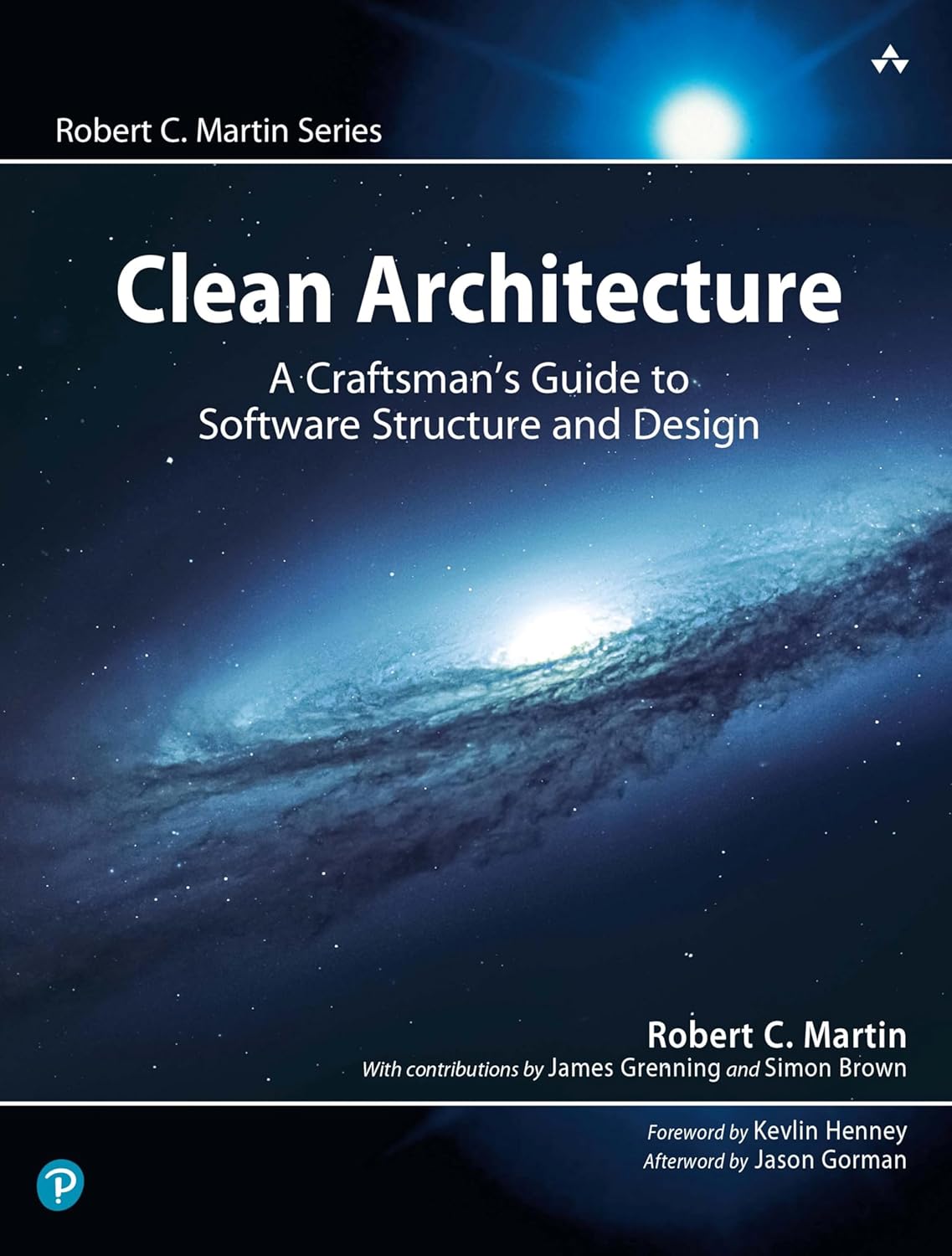
Clean Architecture: A Craftsman's Guide to Software Structure and Design (Robert C. Martin Series)

Description:

Practical Software Architecture Solutions from the Legendary Robert C. Martin (“Uncle Bob”)

By applying universal rules of software architecture, you can dramatically improve developer productivity throughout the life of any software system. Now, building upon the success of his best-selling books Clean Code and The Clean Coder, legendary software craftsman Robert C. Martin (“Uncle Bob”) reveals those rules and helps you apply them.

Martin’s Clean Architecture doesn’t merely present options. Drawing on over a half-century of experience in software environments of every imaginable type, Martin tells you what choices to make and why they are critical to your success. As you’ve come to expect from Uncle Bob, this book is packed with direct, no-nonsense solutions for the real challenges you’ll face–the ones that will make or break your projects.

  • Learn what software architects need to achieve–and core disciplines and practices for achieving it
  • Master essential software design principles for addressing function, component separation, and data management
  • See how programming paradigms impose discipline by restricting what developers can do
  • Understand what’s critically important and what’s merely a “detail”
  • Implement optimal, high-level structures for web, database, thick-client, console, and embedded applications
  • Define appropriate boundaries and layers, and organize components and services
  • See why designs and architectures go wrong, and how to prevent (or fix) these failures

Clean Architecture is essential reading for every current or aspiring software architect, systems analyst, system designer, and software manager–and for every programmer who must execute someone else’s designs.


Register your book for convenient access to downloads, updates, and/or corrections as they become available. See inside book for details.


Editorial Reviews

About the Author

Robert C. Martin (“Uncle Bob”) has been a programmer since 1970. He is founder of Uncle Bob Consulting, LLC, and cofounder with his son Micah Martin of The Clean Coders LLC. Martin has published dozens of articles in various trade journals and is a regular speaker at international conferences and trade shows. He has authored and edited many books, including: Designing Object Oriented C++ Applications Using the Booch Method, Patterns Languages of Program Design 3, More C++ Gems, Extreme Programming in Practice, Agile Software Development: Principles, Patterns, and Practices, UML for Java Programmers, Clean Code, and The Clean Coder. A leader in the industry of software development, Martin served for three years as editor-in-chief of the C++ Report, and he served as the first chairman of the Agile Alliance.

Reviews:

5.0 out of 5 stars Excellent book

L.P. · October 22, 2025

This book is pure history, really enjoyable reading, the autor experience is priceless and the examples in every chapter gives you how the engineers work back in the day !!!!

5.0 out of 5 stars material, quality , packaging

L. · September 4, 2025

Everything is good, packaging , quality, and material. Thank you <3

4.0 out of 5 stars It came quickly, but damaged

E.S. · October 23, 2024

It looks like the book was a victim of a razor blade. I'm going to tape it and carry on since I love my books pretty hard anyway, but I'm bummed it has sliced pages. What matters is the information.

5.0 out of 5 stars Software Review

A.C. · August 21, 2025

Cover some topics to improved our knowledge

5.0 out of 5 stars Capital Work on Software Architecture By An Architecture Master

C.R. · August 18, 2018

No doubt that Robert C. Martin is one of the most influential author and software development theorist of our times. The already standard SOLID principles had been with us for decades, serving software discipline with full success. The Clean Series is a set of books full of advises, thoughts, ideas, rationales and principles with the same impact. If you know his videos and lectures, probably this book will see familiar and many of the topics discussed repetitive. But the book has the value to reunite and review his software development discipline philosophy in a concise and complete harmonious set of essays.The main idea is to avoid dependency applying the Dependency Rule at all levels, classes and components. The Dependency Inversion graph, where high-level functions calling middle-level functions through an interface that the middle-interface implements, is a medular software construction that should be applied as an obsessive pattern. It guarantees independence, reusable, clean architecture. This book explains how and why for this.The result is the idea of Plugin architecture where the core of the system, the set of functionality that implements the use cases and business rules (interactors (R. C. Martin)/controls (I. Jacobson)/controllers (C. Larman) should be the center at which all other parts (IO components, details) will point via abstractions (interfaces or abstract classes).I have been practicing clean architecture ideas for many years (and before Martin coined the term) following Martin guidance a principles. Its product is natural, simple, robust, structured, reusable and beautiful to work.Paradoxically, the last chapter about packaging components--written by S. Brown--seems a contradiction to the whole book ideas and Brown somehow point to that ("My definition of a component is slightly different..."). In that chapter, Brown explains several alternatives for software architecture organization with a marked inclination for a monolithic package that represents the services of the system (and repository interaction) and another that represents the controllers. The reasons of that resultant recommendation (a junior undisciplined programmer that don't follow the cleanliness of the architecture, etc.) are really weak and out of the architect control. His recommendation violates almost all components principles explained by Martin (REP, CCP, CRP, etc.)I love this book and totally recommend the book for all fans of good, clean architecture.

5.0 out of 5 stars Outstanding Book!!

J.S. · June 19, 2025

This book provides outstanding insight into good, clean software architecture. It should be mandatory reading for software engineering students!!

5.0 out of 5 stars Another solid book by Robert Martin

M.V. · November 1, 2017

I liked this book less than the Clean Code, but it was a better read for me than the Clean Coder. I've found a distillation of this book in article from Robert Martin, which he wrote in 2012 while working at 8th Light (I cannot paste a link in here). The book is partially a very detailed description of the ideas from the article and what is behind them.The book starts with 3 myths we developers live in:1. Myth: We just need to get to market first and we clean it up later.2. Myth: Messy code makes us faster today and slows us later. Myth: We can switch mode from making messes to cleaning messes. (making messes is always slower, even in very short term as shown in example of a simple kata in the book)3. Myth: Starting from scratch is a solution.There is a well written history lesson in the next part. Uncle Bob presents Structured Programming, OOP and Functional Programming and says there is nothing else (programming paradigm-wise) to be invented. Part 3 is about SOLID principles from architecture point of view and part 4 are his Component Principles about component cohesion and coupling from his Agile Software Development book.Part 5 is about Architecture and was the most interesting to read. Most memorable chapters for me were the Screaming Architecture and the Clean Architecture. Both of them are not new, you could have seen them in his videos or the article from 8thlight. The point of Screaming Architecture is that when a new developer joins a health-care project, he should be able to immediately tell "this is a health-care project" just from the project structure. Another topic which was part of multiple chapters, are micro-services. I felt that Robert Martin is not very fond of starting with them. He says services are little more than expensive function calls and as a communication mechanism between the project boundaries (i.e. a detail), they are a decision which should be deffered as far as possible.Part 6, the Details, are a detailed explanations of his article Clean Architecture from 2012. There is a little gem in there, the Missing Chapter 34 written by Simon Brown. I liked his explanation of 4 different kinds of packaging classes together to form components.

Super książka!

A.C. · September 26, 2024

Dobra zawartość, dobrze się czyta. Nic tylko polecać chcącym poszerzać swoją wiedzę.

Must-read for everyone who wants to deal with software architectures

B.D. · July 3, 2024

This book is a real gem in the software architecture field. It discusses the basics and programming paradigms, then goes up a level and speaks about component cohesion, then component coupling, sketches up a general architecture model that relies on these principles, and then explains many different cases and patterns. Arguably one of the most valuable books I've ever read.

Best technical book I have read

s.k. · March 25, 2023

I have other books on coding and it’s standard This art covers everything from ethics to estimation this a good asset for anybody who want to make quality software i there was more on tdd I would have delighted but this book is super

Great book.

K.R.S. · October 21, 2019

Martin follows a clean and practical approach in this book. He explains with great pedagogy key concept of the architecture. As any other book of practices, this is a merely guide or tool, so you should be careful and diligent evaluating your requirements to see if the advice given in the book applies to you.

The father of software architecture in a book

M. · August 16, 2025

A must-read if you care about the architecture of the software you are working on. You don't have to follow all the rules by the book, but the reflection about architecture is what matters.

Clean Architecture: A Craftsman's Guide to Software Structure and Design (Robert C. Martin Series)

Product ID: U0134494164
Condition: New

4.6

AED18100

Price includes VAT & Import Duties
Type: Paperback
Availability: In Stock

Quantity:

|

Order today to get by 7-14 business days

Delivery fee of AED 20. Free for orders above AED 200.

Returns & Warranty policies

Imported From: United States

At BOLO, we work hard to ensure the products you receive are new, genuine, and sourced from reputable suppliers.

BOLO is not an authorized or official retailer for most brands, nor are we affiliated with manufacturers unless specifically stated on a product page. Instead, we source verified sellers, authorized distributors or directly from the manufacturer.

Each product undergoes thorough inspection and verification at our consolidation and fulfilment centers to ensure it meets our strict authenticity and quality standards before being shipped and delivered to you.

If you ever have concerns regarding the authenticity of a product purchased from us, please contact Bolo Support. We will review your inquiry promptly and, if necessary, provide documentation verifying authenticity or offer a suitable resolution.

Your trust is our top priority, and we are committed to maintaining transparency and integrity in every transaction.

All product information, images, descriptions, and reviews originate from the manufacturer or from trusted sellers overseas. BOLO is not affiliated with, endorsed by, or an authorized retailer for most brands listed on our website unless stated otherwise.

While we strive to display accurate information, variations in packaging, labeling, instructions, or formulation may occasionally occur due to regional differences or supplier updates. For detailed or manufacturer-specific information, please contact the brand directly or reach out to BOLO Support for assistance.

Unless otherwise stated, all prices displayed on the product page include applicable taxes and import duties.

BOLO operates in accordance with the laws and regulations of United Arab Emirates. Any items found to be restricted or prohibited for sale within the UAE will be cancelled prior to shipment. We take proactive measures to ensure that only products permitted for sale in United Arab Emirates are listed on our website.

All items are shipped by air, and any products classified as “Dangerous Goods (DG)” under IATA regulations will be removed from the order and cancelled.

All orders are processed manually, and we make every effort to process them promptly once confirmed. Products cancelled due to the above reasons will be permanently removed from listings across the website.

Similar suggestions by Bolo

More from this brand

Similar items from “Software Development”

Clean Architecture: A Craftsman's Guide to Software Structure and Design (Robert C. Martin Series)

Product ID: U0134494164
Condition: New

4.6

Clean Architecture: A Craftsman's Guide to Software Structure and Design (Robert C. Martin Series)-0
Type: Paperback

AED18100

Price includes VAT & Import Duties
Availability: In Stock

Quantity:

|

Order today to get by 7-14 business days

Delivery fee of AED 20. Free for orders above AED 200.

Returns & Warranty policies

Imported From: United States

At BOLO, we work hard to ensure the products you receive are new, genuine, and sourced from reputable suppliers.

BOLO is not an authorized or official retailer for most brands, nor are we affiliated with manufacturers unless specifically stated on a product page. Instead, we source verified sellers, authorized distributors or directly from the manufacturer.

Each product undergoes thorough inspection and verification at our consolidation and fulfilment centers to ensure it meets our strict authenticity and quality standards before being shipped and delivered to you.

If you ever have concerns regarding the authenticity of a product purchased from us, please contact Bolo Support. We will review your inquiry promptly and, if necessary, provide documentation verifying authenticity or offer a suitable resolution.

Your trust is our top priority, and we are committed to maintaining transparency and integrity in every transaction.

All product information, images, descriptions, and reviews originate from the manufacturer or from trusted sellers overseas. BOLO is not affiliated with, endorsed by, or an authorized retailer for most brands listed on our website unless stated otherwise.

While we strive to display accurate information, variations in packaging, labeling, instructions, or formulation may occasionally occur due to regional differences or supplier updates. For detailed or manufacturer-specific information, please contact the brand directly or reach out to BOLO Support for assistance.

Unless otherwise stated, all prices displayed on the product page include applicable taxes and import duties.

BOLO operates in accordance with the laws and regulations of United Arab Emirates. Any items found to be restricted or prohibited for sale within the UAE will be cancelled prior to shipment. We take proactive measures to ensure that only products permitted for sale in United Arab Emirates are listed on our website.

All items are shipped by air, and any products classified as “Dangerous Goods (DG)” under IATA regulations will be removed from the order and cancelled.

All orders are processed manually, and we make every effort to process them promptly once confirmed. Products cancelled due to the above reasons will be permanently removed from listings across the website.

Description:

Practical Software Architecture Solutions from the Legendary Robert C. Martin (“Uncle Bob”)

By applying universal rules of software architecture, you can dramatically improve developer productivity throughout the life of any software system. Now, building upon the success of his best-selling books Clean Code and The Clean Coder, legendary software craftsman Robert C. Martin (“Uncle Bob”) reveals those rules and helps you apply them.

Martin’s Clean Architecture doesn’t merely present options. Drawing on over a half-century of experience in software environments of every imaginable type, Martin tells you what choices to make and why they are critical to your success. As you’ve come to expect from Uncle Bob, this book is packed with direct, no-nonsense solutions for the real challenges you’ll face–the ones that will make or break your projects.

  • Learn what software architects need to achieve–and core disciplines and practices for achieving it
  • Master essential software design principles for addressing function, component separation, and data management
  • See how programming paradigms impose discipline by restricting what developers can do
  • Understand what’s critically important and what’s merely a “detail”
  • Implement optimal, high-level structures for web, database, thick-client, console, and embedded applications
  • Define appropriate boundaries and layers, and organize components and services
  • See why designs and architectures go wrong, and how to prevent (or fix) these failures

Clean Architecture is essential reading for every current or aspiring software architect, systems analyst, system designer, and software manager–and for every programmer who must execute someone else’s designs.


Register your book for convenient access to downloads, updates, and/or corrections as they become available. See inside book for details.


Editorial Reviews

About the Author

Robert C. Martin (“Uncle Bob”) has been a programmer since 1970. He is founder of Uncle Bob Consulting, LLC, and cofounder with his son Micah Martin of The Clean Coders LLC. Martin has published dozens of articles in various trade journals and is a regular speaker at international conferences and trade shows. He has authored and edited many books, including: Designing Object Oriented C++ Applications Using the Booch Method, Patterns Languages of Program Design 3, More C++ Gems, Extreme Programming in Practice, Agile Software Development: Principles, Patterns, and Practices, UML for Java Programmers, Clean Code, and The Clean Coder. A leader in the industry of software development, Martin served for three years as editor-in-chief of the C++ Report, and he served as the first chairman of the Agile Alliance.

Reviews:

5.0 out of 5 stars Excellent book

L.P. · October 22, 2025

This book is pure history, really enjoyable reading, the autor experience is priceless and the examples in every chapter gives you how the engineers work back in the day !!!!

5.0 out of 5 stars material, quality , packaging

L. · September 4, 2025

Everything is good, packaging , quality, and material. Thank you <3

4.0 out of 5 stars It came quickly, but damaged

E.S. · October 23, 2024

It looks like the book was a victim of a razor blade. I'm going to tape it and carry on since I love my books pretty hard anyway, but I'm bummed it has sliced pages. What matters is the information.

5.0 out of 5 stars Software Review

A.C. · August 21, 2025

Cover some topics to improved our knowledge

5.0 out of 5 stars Capital Work on Software Architecture By An Architecture Master

C.R. · August 18, 2018

No doubt that Robert C. Martin is one of the most influential author and software development theorist of our times. The already standard SOLID principles had been with us for decades, serving software discipline with full success. The Clean Series is a set of books full of advises, thoughts, ideas, rationales and principles with the same impact. If you know his videos and lectures, probably this book will see familiar and many of the topics discussed repetitive. But the book has the value to reunite and review his software development discipline philosophy in a concise and complete harmonious set of essays.The main idea is to avoid dependency applying the Dependency Rule at all levels, classes and components. The Dependency Inversion graph, where high-level functions calling middle-level functions through an interface that the middle-interface implements, is a medular software construction that should be applied as an obsessive pattern. It guarantees independence, reusable, clean architecture. This book explains how and why for this.The result is the idea of Plugin architecture where the core of the system, the set of functionality that implements the use cases and business rules (interactors (R. C. Martin)/controls (I. Jacobson)/controllers (C. Larman) should be the center at which all other parts (IO components, details) will point via abstractions (interfaces or abstract classes).I have been practicing clean architecture ideas for many years (and before Martin coined the term) following Martin guidance a principles. Its product is natural, simple, robust, structured, reusable and beautiful to work.Paradoxically, the last chapter about packaging components--written by S. Brown--seems a contradiction to the whole book ideas and Brown somehow point to that ("My definition of a component is slightly different..."). In that chapter, Brown explains several alternatives for software architecture organization with a marked inclination for a monolithic package that represents the services of the system (and repository interaction) and another that represents the controllers. The reasons of that resultant recommendation (a junior undisciplined programmer that don't follow the cleanliness of the architecture, etc.) are really weak and out of the architect control. His recommendation violates almost all components principles explained by Martin (REP, CCP, CRP, etc.)I love this book and totally recommend the book for all fans of good, clean architecture.

5.0 out of 5 stars Outstanding Book!!

J.S. · June 19, 2025

This book provides outstanding insight into good, clean software architecture. It should be mandatory reading for software engineering students!!

5.0 out of 5 stars Another solid book by Robert Martin

M.V. · November 1, 2017

I liked this book less than the Clean Code, but it was a better read for me than the Clean Coder. I've found a distillation of this book in article from Robert Martin, which he wrote in 2012 while working at 8th Light (I cannot paste a link in here). The book is partially a very detailed description of the ideas from the article and what is behind them.The book starts with 3 myths we developers live in:1. Myth: We just need to get to market first and we clean it up later.2. Myth: Messy code makes us faster today and slows us later. Myth: We can switch mode from making messes to cleaning messes. (making messes is always slower, even in very short term as shown in example of a simple kata in the book)3. Myth: Starting from scratch is a solution.There is a well written history lesson in the next part. Uncle Bob presents Structured Programming, OOP and Functional Programming and says there is nothing else (programming paradigm-wise) to be invented. Part 3 is about SOLID principles from architecture point of view and part 4 are his Component Principles about component cohesion and coupling from his Agile Software Development book.Part 5 is about Architecture and was the most interesting to read. Most memorable chapters for me were the Screaming Architecture and the Clean Architecture. Both of them are not new, you could have seen them in his videos or the article from 8thlight. The point of Screaming Architecture is that when a new developer joins a health-care project, he should be able to immediately tell "this is a health-care project" just from the project structure. Another topic which was part of multiple chapters, are micro-services. I felt that Robert Martin is not very fond of starting with them. He says services are little more than expensive function calls and as a communication mechanism between the project boundaries (i.e. a detail), they are a decision which should be deffered as far as possible.Part 6, the Details, are a detailed explanations of his article Clean Architecture from 2012. There is a little gem in there, the Missing Chapter 34 written by Simon Brown. I liked his explanation of 4 different kinds of packaging classes together to form components.

Super książka!

A.C. · September 26, 2024

Dobra zawartość, dobrze się czyta. Nic tylko polecać chcącym poszerzać swoją wiedzę.

Must-read for everyone who wants to deal with software architectures

B.D. · July 3, 2024

This book is a real gem in the software architecture field. It discusses the basics and programming paradigms, then goes up a level and speaks about component cohesion, then component coupling, sketches up a general architecture model that relies on these principles, and then explains many different cases and patterns. Arguably one of the most valuable books I've ever read.

Best technical book I have read

s.k. · March 25, 2023

I have other books on coding and it’s standard This art covers everything from ethics to estimation this a good asset for anybody who want to make quality software i there was more on tdd I would have delighted but this book is super

Great book.

K.R.S. · October 21, 2019

Martin follows a clean and practical approach in this book. He explains with great pedagogy key concept of the architecture. As any other book of practices, this is a merely guide or tool, so you should be careful and diligent evaluating your requirements to see if the advice given in the book applies to you.

The father of software architecture in a book

M. · August 16, 2025

A must-read if you care about the architecture of the software you are working on. You don't have to follow all the rules by the book, but the reflection about architecture is what matters.

Similar suggestions by Bolo

More from this brand

Similar items from “Software Development”