Description:
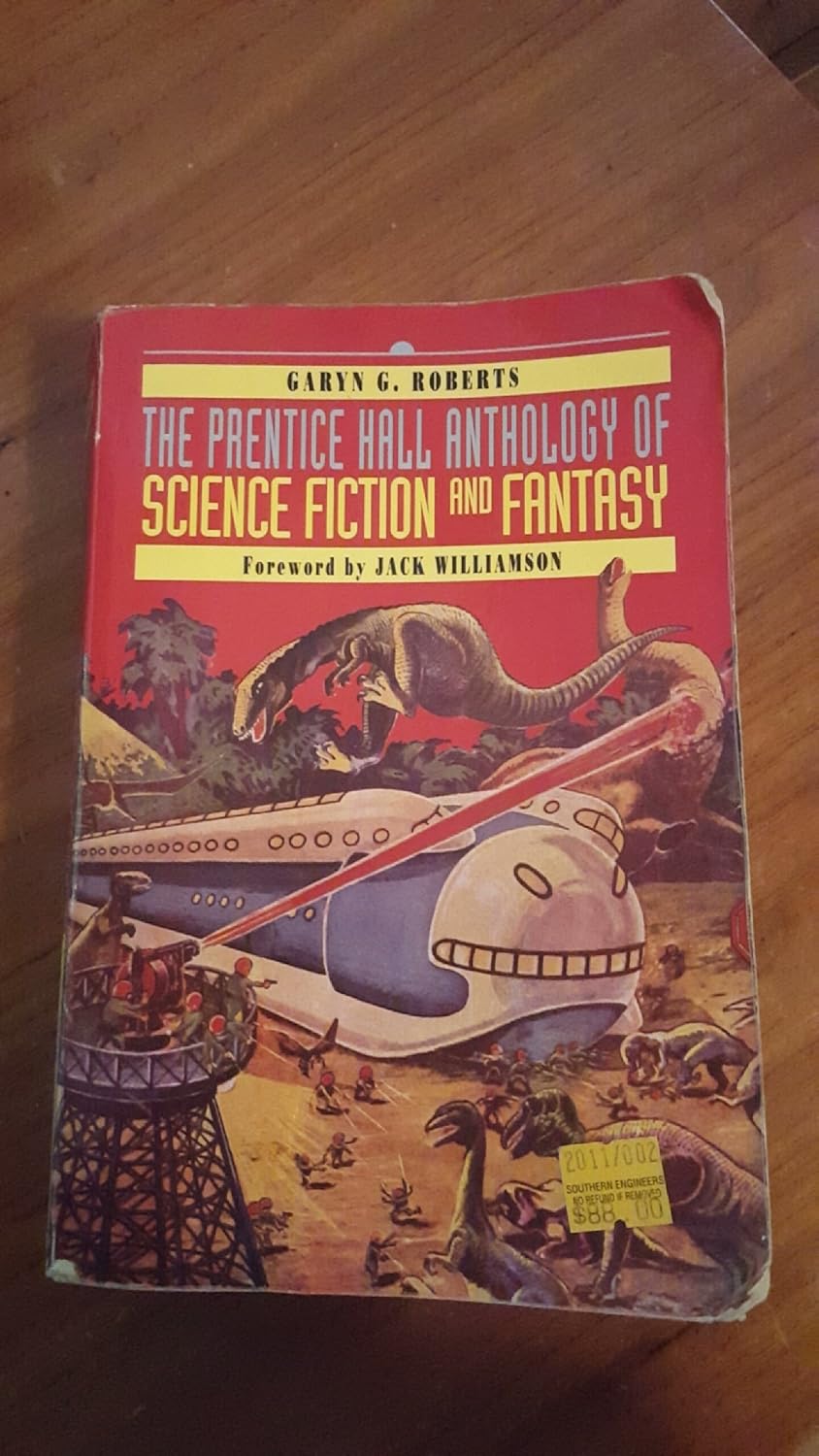
This one volume anthology explores the last two hundred years of Science Fiction and Fantasy&;featuring women and men authors of various ethnic backgrounds, and a range of both traditional canonical literature and popular culture. Designed to heighten interest in a fun and exciting topic, this book will lead readers to meaningful intellectual, social, and historic investigations. Contributing authors include Mary W. Shelly, Edgar Allen Poe, Nathaniel Hawthorne, Charles Dickens, Louisa May Alcott, Harriet Beecher Stowe, Bram Stoker, Stephen King, J.R.R. Tolkien, Jules Verne, Jack London, Ray Bradbury, and Kurt Vonnegut. For fans of science fiction, fantasy, and the stories presented here, who appreciate that they represent the best of humanity, and include potential warnings for where humanity is headed.
Editorial Reviews
From the Inside Flap
Astounding Stories versus Unknown Worlds
The stories showcased and analyzed here are "Fantasy" and/or "Science Fiction" written and published in English, or Fantasy and/or Science Fiction translated into and published in English. This book's contents, discussions, and organization are designed to explore the distinctions and similarities between two broadly yet specifically defined genres of fictionFantasy and Science Fiction. "Genres," for the purpose of this book, are generally and simply defined as artistic and story categories. Definitions and differences between stories and story genres are important starting points for analysis and appreciation; however, from a larger cultural, anthropological, and sociological perspective, similarities between stories and story forms may be more telling and significant. For the purpose of this book, "society" and "culture" are essentially interchangeable terms, referencing a group of interrelated people tied together by common mythology. A mythology is an all-encompassing narrative/story or a complex of interrelated component stories that serves as cultural definition, religion, reality, and explanation and justification of action. Crossovers between Fantasy and Science Fiction, as well as crossovers between Fantasy, Science Fiction, and other genres, such as Mysteries, Detective Fiction, Westerns, Adventure stories, and more, are explored.
Herein, the reader will find a range of ethnicities, mythologies, religions, and perspectives represented. Women writers, women's writing, and female story characters are found throughout this book, since women writers were and are integral parts of Fantasy and Science Fiction (F&SF) history. (An investigation of authors' pseudonyms from the first half of the twentieth century, for example, shows that women were much more a part of F&SF history than previously thought by students of these genres.) It is important to remember that modern F&SF was first articulated, if not begun, by a young woman named Mary Shelley and her archetypal novel, Frankenstein, or the Modern Prometheus (1818, rev. 1831).
With the exception of J. R. R. Tolkien's "Chapter Five: Riddles in the Dark" (1937), all stories reprinted here are complete; even the famed Tolkien sequence, which features Bilbo Baggins and Gollum, stands by itself, outside the larger context of Tolkien's novel, as a complete tale.
Many of the authors included in this book have created series F&SF story characters of various sorts and degrees of popular and critical success. At first, the temptation was to feature the best series characters and their best stories, regardless of other considerations, such as story themes. But, if this was to be done, then as good and important as Fritz Leiber's Fahfrd and the Grey Mouser story, "The Bazaar of the Bizarre" (Fantastic, August 1963), are, what may be an even more representative landmark story of Leiber's life achievements and contributions to the genre"Smoke Ghost" (Unknown Worlds, October 1941)would have to be excluded. Further, much of the popular success of Leiber's swashbuckling duo is an extension of that enjoyed by Robert E. Howard's more archetypal stories of Conan the Barbarian, such as "The Tower of the Elephant" (Weird Tales, March 1933). With this in mind, the temptation then became to ignore all series characters categorically. This plan would not have been prudent either. "The Tower of the Elephant" is one of Howard's most important contributions to Heroic Fantasy, and to ignore it because it is a Conan story would be as short-sighted as including all series characters and stories without abandon.
Other difficult choices needed to be made. The list of great Ray Bradbury stories is extensive, but only one could be chosen. In this case, after much thought, one of Bradbury's stories written specially for The Martian Chronicles (1950)"There Will Come Soft Rains"was chosen because Bradbury has cited it as a personal favorite, and because the profound message of the story about humans comes from a setting uniquely devoid of humans. Other authors presented similar difficultiesbut what problems to have! Some of these authors included Catherine Moore, Edmond Hamilton, Leigh Brackett, Robert Bloch, George R. R. Martin, William Gibson (it was difficult to pass on both "Johnny Neumonic" and "The Gernsback Continuum"), Edgar Allan Poe, and Nathaniel Hawthorne. In a few cases, such as with Judith Merril and Philip Jose Farmer, the stories presented here were the authors' first professional salesthis was interesting, but not really a consideration.
So, then, the single most difficult aspect of assembling this tribute to stories of imagination and science was narrowing the list of stories to be included. There was a wealth of tremendous tales composed by tremendous, visioned authors from which to choose. Factors for story inclusion were
The readability and fun of each story Expert opinion of professional authors of F&SF Hardcore fan enthusiasm for each story Authors' favorites of their own stories Story length Story completeness (as single-standing works) Unique and important contribution of each story to larger topic(s) Each story's ability to represent the larger body of work by the author
Such parameters, though barriers of sorts, helped keep the project focused. In short, this book is as limited and defined, yet comprehensive, as possible.
In addition, one primary goal of the total story and content selection is to provide an effective mix of both "popular" and "canonical" stories, familiar/traditional tales, and once-popular but now "lost classics." Any story worth anything as an intellectual construct, as a credible and representative piece of cultural anthropology, as an enthralling narrative work, is or once was popularof the people. There is no other way. Fantasy and Science Fiction are highly democratic types of literature. Everyone is eligible to participate, and there are really no sacred cows in terms of story content.
For example, just as there were well-documented conflicts between Howard Phillips Lovecraft and Hugo Gernsback, Groff Conklin and E. E. "Doc" Smith, and Sam Moskowitz and Donald A. Wollheim, there has been an ongoing philosophical battle between fans (often, but not always, proponents of the popular) and scholars (often, but not always, proponents of the canonical) of F&SF for years. The truly seasoned expert of F&SF knows that both Lovecraft and Gernsback were giants, and that both fanaticism and scholarship are integral parts of the F&SF mix.
There is another matter. Many authors of Fantasy and Science Fiction resist (in some cases vehemently) the notion that they are genre specific, or easily and narrowly categorized in terms of the stories they write. Ray Bradbury, Harlan Ellison, Dean R. Koontz, and Clive Barker are four such authors. These wordsmiths quite appropriately deem themselves "magicians of words," "imaginative thinkers," "proponents of the fantastic," and so on.
The organization of stories in this book was consciously constructed, but there exists extensive overlapping of themes, settings, character types, and so on between the stories categorized here as Fantasy and Science Fiction. In addition to being organized by genre, the stories are set up chronologically (historicallyby date of first appearance) and thematically. Some of the stories, such as Robert Louis Stevenson's "The Body Snatchers" (Pall Mall Gazette, Extra Christmas Issue, 1884), Fredric Brown's "Arena" (Astounding Science-Fiction, July 1944), and Arthur C. Clarke's "The Sentinel" (10 Story Fantasy, Spring 1951), are included not only because they stand alone as important literary contributions to Fantasy and Science Fiction, but also because they were successfully adapted into motion pictures and/or television episodes.
Please note the essay included near the end of the book. It is great fun to read and provides important contextual information for the stories and discussions included in this volume, and for the larger topics of Fantasy and Science Fiction.
Ever since the early days of the twentieth century, when pulp magazine Science Fiction saw its genesis in the United States at the hands of Hugo Gernsback, definitions of Science Fiction and Fantasy have been passionately debated. Gernsback set forth his definitions of Science Fiction in the editorials in the pages of Amazing Stories. Meanwhile, the faltering Weird Tales, later to be deemed the "greatest Fantasy magazine of all time," published the Fantasy and Science Fiction alike of H. P Lovecraft, Edmond Hamilton, Catherine Moore, Clark Ashton Smith, and others. Ironically, Weird Tales had published Science Fiction in its coarse wood pulp pages for three years before Amazing Stories arrived. By the 1930s, former Amazing Stories author John W Campbell edited the most revered Science Fiction pulp magazine everAstounding Storiesand its Fantasy counterpart, Unknown Worlds. Even the hard scientist Gernsback would let elements of wonder and fantasy creep into Amazing Stories and his other publications. The distinctions are important and unimportant.
The essays and headnotes in this book are intended as general overviews, places to begin and continue intellectual inquiry. More about these authors and stories may be found in a variety of multimedia sources. Some of these are listed at the back of this volume. Know that the best scholars of Fantasy and Science Fiction of all time include Everett E Bleiler, August Derleth, and Sam Moskowitz. The work of these three gentlemen is first rate. There have been and are others.
Remember that all stories are fiction, autobiography, and metaphor. They are also all true. Read and understand the works of Ray Bradbury and this becomes obvious. Remember, too, as Clive Barker and others before him have reminded us: there are no new stories, just retellings of the old. The old myths and legends are still powerful and viable today. Consider the current mastery of Steven Spielberg and George Lucas. Read Jack Williamson's Legion of Space series (begun in the 1930s), add some of Alex Raymond's classic newspaper comic strip, Flash Gordon (also from the 1930s), and some of James Fenimore Cooper's Leatherstocking series (begun in the 1820s), and the result is the Star Wars saga. Indiana Jones has ancestors in the nineteenth-century works of H. Rider Haggard (1856-1925) and Talbot Mundy (1879-1940), and in the pages of turn-of-the-century Argosy magazine. Stephen King astutely acknowledges and details his cultural and literary heritage in one of the single best studies of the Dark Fantasy genre in his book Danse Macabre (1981).
As the author/editor/compiler of The Prentice Hall Anthology of Science Fiction and Fantasy, my intent is to provide a fair and realistic representation and discussion of Fantasy and Science Fiction of the nineteenth and twentieth centuries. A primary goal of this book is to provide bases for further investigation. My sincere hope is that this book be considered a tribute to a group of people and a tradition of storytelling and imagining that are unmatched in excellence. We owe these thinkers, these visionaries and humanitarians, a great deal. For me, they number among my most important treasuresmy family and friends. Many good and tremendous authors and stories are not presented here. Go find them, and enjoy the quest.
Garyn G. Roberts, Ph.D.
From the Back Cover
THE PRENTICE HALL ANTHOLOGY OF SCIENCE FICTION AND FANTASY provides a unique range of stories and discussions designed to heighten student interest in Science Fiction and Fantasy and in reading in general. Including works by authors of the last 200 years, such as Mary Shelley, Poe, Heinlein, Bradbury, Yolen, and King, the stories address important social issues, such as ethnicity, gender, war, and the environment. These tales tap into the experiences of the contemporary student and place these experiences into the larger context of world culture. The engaging use of popular media, such as books, magazines, motion pictures, radio, and television, provides an all-encompassing view of Science Fiction and Fantasy. This anthology is intended for the Science Fiction and Fantasy enthusiast as well as those new to these fiction genres.
About the Author
GARYN G. ROBERTS, Ph.D., is the chair of the Communications/English Discipline of Northwestern Michigan College (Traverse City, Michigan). He was born and raised in Wisconsin, home of Stanley G. Weinbaum and the Milwaukee Fictioneers, August Derleth and Arkham House, Robert Bloch, Fredric Brown, Clifford Simak, Alice Sheldon (aka James Tiptree Jr.), and Peter Straub, and north of the land of Chester Gould's Dick Tracy and Ray Bradbury's Greentown, Illinois.
Roberts received his B.B.A. in Marketing from the University of Wisconsin, Whitewater in 1981, his M.A. in Popular Culture Studies and Ph.D. in American Culture Studies (with emphases in English, History, and Sociology) from Bowling Green State University, Ohio, in 1983 and 1986 respectively. From 1986 to 1987, he taught in the English Department at Mankato State University, Minnesota; from 1987 to 1994, he taught in the American Thought and Language Department at Michigan State University; and in 1994, he joined the faculty at Northwestern Michigan College.
Beyond his family and friends (colleagues and students included), Dr. Roberts's loves and passions include Chester Gould's Dick Tracy, the writings and creative works of Robert Bloch and Ray Bradbury, the detailed and invaluable histories and scholarship of Sam Moskowitz, dime novels and related nineteenth-century fiction, the "pulps," classic newspaper comic strips, old movies, old radio, Big Little Books, comic books, paperback books, old TV, and other related forms of popular fiction and popular media.
Roberts is the author and editor of several books and a range of book chapters, articles, and literary dictionary entries. Subject matter of these includes, in part, dime novels, pulp magazines, 1950s Science Fiction invasion movies, pulp magazine editors Hugo Gernsback and Joseph T. Shaw, Jack London, Stephen King, Anne Rice, and Dean Kootz. In 1994, Roberts received an Edgar (Allan Poe) Award nomination in the "Best Critical/Biographical" category from the Mystery Writers of America for DICK TRACY AND AMERICAN CULTURE: MORALITY AND MYTHOLOGY, TEXT AND CONTEXT (McFarland, 1993). Currently, he is working on book-length tributes to Chester Gould, Robert Bloch, and Ray Bradbury.
Excerpt. © Reprinted by permission. All rights reserved.
PREFACE
Parameters, or, Amazing Stories versus Weird Tales,
Astounding Stories versus Unknown Worlds
The stories showcased and analyzed here are "Fantasy" and/or "Science Fiction" written and published in English, or Fantasy and/or Science Fiction translated into and published in English. This book's contents, discussions, and organization are designed to explore the distinctions and similarities between two broadly yet specifically defined genres of fictionFantasy and Science Fiction. "Genres," for the purpose of this book, are generally and simply defined as artistic and story categories. Definitions and differences between stories and story genres are important starting points for analysis and appreciation; however, from a larger cultural, anthropological, and sociological perspective, similarities between stories and story forms may be more telling and significant. For the purpose of this book, "society" and "culture" are essentially interchangeable terms, referencing a group of interrelated people tied together by common mythology. A mythology is an all-encompassing narrative/story or a complex of interrelated component stories that serves as cultural definition, religion, reality, and explanation and justification of action. Crossovers between Fantasy and Science Fiction, as well as crossovers between Fantasy, Science Fiction, and other genres, such as Mysteries, Detective Fiction, Westerns, Adventure stories, and more, are explored.
Herein, the reader will find a range of ethnicities, mythologies, religions, and perspectives represented. Women writers, women's writing, and female story characters are found throughout this book, since women writers were and are integral parts of Fantasy and Science Fiction (F&SF) history. (An investigation of authors' pseudonyms from the first half of the twentieth century, for example, shows that women were much more a part of F&SF history than previously thought by students of these genres.) It is important to remember that modern F&SF was first articulated, if not begun, by a young woman named Mary Shelley and her archetypal novel, Frankenstein, or the Modern Prometheus (1818, rev. 1831).
With the exception of J. R. R. Tolkien's "Chapter Five: Riddles in the Dark" (1937), all stories reprinted here are complete; even the famed Tolkien sequence, which features Bilbo Baggins and Gollum, stands by itself, outside the larger context of Tolkien's novel, as a complete tale.
Many of the authors included in this book have created series F&SF story characters of various sorts and degrees of popular and critical success. At first, the temptation was to feature the best series characters and their best stories, regardless of other considerations, such as story themes. But, if this was to be done, then as good and important as Fritz Leiber's Fahfrd and the Grey Mouser story, "The Bazaar of the Bizarre" (Fantastic, August 1963), are, what may be an even more representative landmark story of Leiber's life achievements and contributions to the genre"Smoke Ghost" (Unknown Worlds, October 1941)would have to be excluded. Further, much of the popular success of Leiber's swashbuckling duo is an extension of that enjoyed by Robert E. Howard's more archetypal stories of Conan the Barbarian, such as "The Tower of the Elephant" (Weird Tales, March 1933). With this in mind, the temptation then became to ignore all series characters categorically. This plan would not have been prudent either. "The Tower of the Elephant" is one of Howard's most important contributions to Heroic Fantasy, and to ignore it because it is a Conan story would be as short-sighted as including all series characters and stories without abandon.
Other difficult choices needed to be made. The list of great Ray Bradbury stories is extensive, but only one could be chosen. In this case, after much thought, one of Bradbury's stories written specially for The Martian Chronicles (1950)"There Will Come Soft Rains"was chosen because Bradbury has cited it as a personal favorite, and because the profound message of the story about humans comes from a setting uniquely devoid of humans. Other authors presented similar difficultiesbut what problems to have! Some of these authors included Catherine Moore, Edmond Hamilton, Leigh Brackett, Robert Bloch, George R. R. Martin, William Gibson (it was difficult to pass on both "Johnny Neumonic" and "The Gernsback Continuum"), Edgar Allan Poe, and Nathaniel Hawthorne. In a few cases, such as with Judith Merril and Philip Jose Farmer, the stories presented here were the authors' first professional salesthis was interesting, but not really a consideration.
So, then, the single most difficult aspect of assembling this tribute to stories of imagination and science was narrowing the list of stories to be included. There was a wealth of tremendous tales composed by tremendous, visioned authors from which to choose. Factors for story inclusion were
- The readability and fun of each story
- Expert opinion of professional authors of F&SF
- Hardcore fan enthusiasm for each story
- Authors' favorites of their own stories
- Story length
- Story completeness (as single-standing works)
- Unique and important contribution of each story to larger topic(s)
- Each story's ability to represent the larger body of work by the author
Such parameters, though barriers of sorts, helped keep the project focused. In short, this book is as limited and defined, yet comprehensive, as possible.
In addition, one primary goal of the total story and content selection is to provide an effective mix of both "popular" and "canonical" stories, familiar/traditional tales, and once-popular but now "lost classics." Any story worth anything as an intellectual construct, as a credible and representative piece of cultural anthropology, as an enthralling narrative work, is or once was popularof the people. There is no other way. Fantasy and Science Fiction are highly democratic types of literature. Everyone is eligible to participate, and there are really no sacred cows in terms of story content.
For example, just as there were well-documented conflicts between Howard Phillips Lovecraft and Hugo Gernsback, Groff Conklin and E. E. "Doc" Smith, and Sam Moskowitz and Donald A. Wollheim, there has been an ongoing philosophical battle between fans (often, but not always, proponents of the popular) and scholars (often, but not always, proponents of the canonical) of F&SF for years. The truly seasoned expert of F&SF knows that both Lovecraft and Gernsback were giants, and that both fanaticism and scholarship are integral parts of the F&SF mix.
There is another matter. Many authors of Fantasy and Science Fiction resist (in some cases vehemently) the notion that they are genre specific, or easily and narrowly categorized in terms of the stories they write. Ray Bradbury, Harlan Ellison, Dean R. Koontz, and Clive Barker are four such authors. These wordsmiths quite appropriately deem themselves "magicians of words," "imaginative thinkers," "proponents of the fantastic," and so on.
The organization of stories in this book was consciously constructed, but there exists extensive overlapping of themes, settings, character types, and so on between the stories categorized here as Fantasy and Science Fiction. In addition to being organized by genre, the stories are set up chronologically (historicallyby date of first appearance) and thematically. Some of the stories, such as Robert Louis Stevenson's "The Body Snatchers" (Pall Mall Gazette, Extra Christmas Issue, 1884), Fredric Brown's "Arena" (Astounding Science-Fiction, July 1944), and Arthur C. Clarke's "The Sentinel" (10 Story Fantasy, Spring 1951), are included not only because they stand alone as important literary contributions to Fantasy and Science Fiction, but also because they were successfully adapted into motion pictures and/or television episodes.
Please note the essay included near the end of the book. It is great fun to read and provides important contextual information for the stories and discussions included in this volume, and for the larger topics of Fantasy and Science Fiction.
Ever since the early days of the twentieth century, when pulp magazine Science Fiction saw its genesis in the United States at the hands of Hugo Gernsback, definitions of Science Fiction and Fantasy have been passionately debated. Gernsback set forth his definitions of Science Fiction in the editorials in the pages of Amazing Stories. Meanwhile, the faltering Weird Tales, later to be deemed the "greatest Fantasy magazine of all time," published the Fantasy and Science Fiction alike of H. P Lovecraft, Edmond Hamilton, Catherine Moore, Clark Ashton Smith, and others. Ironically, Weird Tales had published Science Fiction in its coarse wood pulp pages for three years before Amazing Stories arrived. By the 1930s, former Amazing Stories author John W Campbell edited the most revered Science Fiction pulp magazine everAstounding Storiesand its Fantasy counterpart, Unknown Worlds. Even the hard scientist Gernsback would let elements of wonder and fantasy creep into Amazing Stories and his other publications. The distinctions are important and unimportant.
The essays and headnotes in this book are intended as general overviews, places to begin and continue intellectual inquiry. More about these authors and stories may be found in a variety of multimedia sources. Some of these are listed at the back of this volume. Know that the best scholars of Fantasy and Science Fiction of all time include Everett E Bleiler, August Derleth, and Sam Moskowitz. The work of these three gentlemen is first rate. There have been and are others.
Remember that all stories are fiction, autobiography, and metaphor. They are also all true. Read and understand the works of Ray Bradbury and this becomes obvious. Remember, too, as Clive Barker and others before him have reminded us: there are no new stories, just retellings of the old. The old myths and legends are still powerful and viable today. Consider the current mastery of Steven Spielberg and George Lucas. Read Jack Williamson's Legion of Space series (begun in the 1930s), add some of Alex Raymond's classic newspaper comic strip, Flash Gordon (also from the 1930s), and some of James Fenimore Cooper's Leatherstocking series (begun in the 1820s), and the result is the Star Wars saga. Indiana Jones has ancestors in the nineteenth-century works of H. Rider Haggard (1856-1925) and Talbot Mundy (1879-1940), and in the pages of turn-of-the-century Argosy magazine. Stephen King astutely acknowledges and details his cultural and literary heritage in one of the single best studies of the Dark Fantasy genre in his book Danse Macabre (1981).
As the author/editor/compiler of The Prentice Hall Anthology of Science Fiction and Fantasy, my intent is to provide a fair and realistic representation and discussion of Fantasy and Science Fiction of the nineteenth and twentieth centuries. A primary goal of this book is to provide bases for further investigation. My sincere hope is that this book be considered a tribute to a group of people and a tradition of storytelling and imagining that are unmatched in excellence. We owe these thinkers, these visionaries and humanitarians, a great deal. For me, they number among my most important treasuresmy family and friends. Many good and tremendous authors and stories are not presented here. Go find them, and enjoy the quest.
Garyn G. Roberts, Ph.D.
Details:
Visit the Longman Pub Group Store
The Prentice Hall Anthology of Science Fiction and Fantasy
AED27875
Quantity:
Order today to get by 7-14 business days
This item qualifies for free delivery
 Imported From: United States
At BOLO, we work hard to ensure the products you receive are new, genuine, and sourced from reputable suppliers.
Every product in the BOLO catalogue is sourced through our Verified Global Supply Network of verified sellers, authorized distributors or directly from the manufacturer.
Each product undergoes thorough inspection and verification at our consolidation and fulfilment centers to ensure it meets our strict authenticity and quality standards before being shipped and delivered to you.
If you ever have concerns regarding the authenticity of a product purchased from us, please contact Bolo Support. We will review your inquiry promptly and, if necessary, provide documentation verifying authenticity or offer a suitable resolution.
Your trust is our top priority, and we are committed to maintaining transparency and integrity in every transaction.
While we strive to display accurate information, variations in packaging, labeling, instructions, or formulation may occasionally occur due to regional differences or supplier updates. For detailed or manufacturer-specific information, please contact the brand directly or reach out to BOLO Support for assistance.
Unless otherwise stated, all prices displayed on the product page include applicable taxes and import duties.
BOLO operates in accordance with the laws and regulations of United Arab Emirates. Any items found to be restricted or prohibited for sale within the United Arab Emirates will be cancelled prior to shipment. We take proactive measures to ensure that only products permitted for sale in United Arab Emirates are listed on our website.
All items are shipped by air, and any products classified as “Dangerous Goods (DG)” under IATA regulations will be removed from the order and cancelled.
All orders are processed manually, and we make every effort to process them promptly once confirmed. Products cancelled due to the above reasons will be permanently removed from listings across the website.
Similar suggestions by Bolo
More from this brand
Similar items from “Writing”
Share with
Or share with link
https://www.bolo.ae/products/U0130212806
Visit the Longman Pub Group Store
The Prentice Hall Anthology of Science Fiction and Fantasy
AED27875
Quantity:
Order today to get by 7-14 business days
This item qualifies for free delivery
Imported From: United States
At BOLO, we work hard to ensure the products you receive are new, genuine, and sourced from reputable suppliers.
Every product in the BOLO catalogue is sourced through our Verified Global Supply Network of verified sellers, authorized distributors or directly from the manufacturer.
Each product undergoes thorough inspection and verification at our consolidation and fulfilment centers to ensure it meets our strict authenticity and quality standards before being shipped and delivered to you.
If you ever have concerns regarding the authenticity of a product purchased from us, please contact Bolo Support. We will review your inquiry promptly and, if necessary, provide documentation verifying authenticity or offer a suitable resolution.
Your trust is our top priority, and we are committed to maintaining transparency and integrity in every transaction.
While we strive to display accurate information, variations in packaging, labeling, instructions, or formulation may occasionally occur due to regional differences or supplier updates. For detailed or manufacturer-specific information, please contact the brand directly or reach out to BOLO Support for assistance.
Unless otherwise stated, all prices displayed on the product page include applicable taxes and import duties.
BOLO operates in accordance with the laws and regulations of United Arab Emirates. Any items found to be restricted or prohibited for sale within the United Arab Emirates will be cancelled prior to shipment. We take proactive measures to ensure that only products permitted for sale in United Arab Emirates are listed on our website.
All items are shipped by air, and any products classified as “Dangerous Goods (DG)” under IATA regulations will be removed from the order and cancelled.
All orders are processed manually, and we make every effort to process them promptly once confirmed. Products cancelled due to the above reasons will be permanently removed from listings across the website.
Description:
This one volume anthology explores the last two hundred years of Science Fiction and Fantasy&;featuring women and men authors of various ethnic backgrounds, and a range of both traditional canonical literature and popular culture. Designed to heighten interest in a fun and exciting topic, this book will lead readers to meaningful intellectual, social, and historic investigations. Contributing authors include Mary W. Shelly, Edgar Allen Poe, Nathaniel Hawthorne, Charles Dickens, Louisa May Alcott, Harriet Beecher Stowe, Bram Stoker, Stephen King, J.R.R. Tolkien, Jules Verne, Jack London, Ray Bradbury, and Kurt Vonnegut. For fans of science fiction, fantasy, and the stories presented here, who appreciate that they represent the best of humanity, and include potential warnings for where humanity is headed.
Editorial Reviews
From the Inside Flap
Astounding Stories versus Unknown Worlds
The stories showcased and analyzed here are "Fantasy" and/or "Science Fiction" written and published in English, or Fantasy and/or Science Fiction translated into and published in English. This book's contents, discussions, and organization are designed to explore the distinctions and similarities between two broadly yet specifically defined genres of fictionFantasy and Science Fiction. "Genres," for the purpose of this book, are generally and simply defined as artistic and story categories. Definitions and differences between stories and story genres are important starting points for analysis and appreciation; however, from a larger cultural, anthropological, and sociological perspective, similarities between stories and story forms may be more telling and significant. For the purpose of this book, "society" and "culture" are essentially interchangeable terms, referencing a group of interrelated people tied together by common mythology. A mythology is an all-encompassing narrative/story or a complex of interrelated component stories that serves as cultural definition, religion, reality, and explanation and justification of action. Crossovers between Fantasy and Science Fiction, as well as crossovers between Fantasy, Science Fiction, and other genres, such as Mysteries, Detective Fiction, Westerns, Adventure stories, and more, are explored.
Herein, the reader will find a range of ethnicities, mythologies, religions, and perspectives represented. Women writers, women's writing, and female story characters are found throughout this book, since women writers were and are integral parts of Fantasy and Science Fiction (F&SF) history. (An investigation of authors' pseudonyms from the first half of the twentieth century, for example, shows that women were much more a part of F&SF history than previously thought by students of these genres.) It is important to remember that modern F&SF was first articulated, if not begun, by a young woman named Mary Shelley and her archetypal novel, Frankenstein, or the Modern Prometheus (1818, rev. 1831).
With the exception of J. R. R. Tolkien's "Chapter Five: Riddles in the Dark" (1937), all stories reprinted here are complete; even the famed Tolkien sequence, which features Bilbo Baggins and Gollum, stands by itself, outside the larger context of Tolkien's novel, as a complete tale.
Many of the authors included in this book have created series F&SF story characters of various sorts and degrees of popular and critical success. At first, the temptation was to feature the best series characters and their best stories, regardless of other considerations, such as story themes. But, if this was to be done, then as good and important as Fritz Leiber's Fahfrd and the Grey Mouser story, "The Bazaar of the Bizarre" (Fantastic, August 1963), are, what may be an even more representative landmark story of Leiber's life achievements and contributions to the genre"Smoke Ghost" (Unknown Worlds, October 1941)would have to be excluded. Further, much of the popular success of Leiber's swashbuckling duo is an extension of that enjoyed by Robert E. Howard's more archetypal stories of Conan the Barbarian, such as "The Tower of the Elephant" (Weird Tales, March 1933). With this in mind, the temptation then became to ignore all series characters categorically. This plan would not have been prudent either. "The Tower of the Elephant" is one of Howard's most important contributions to Heroic Fantasy, and to ignore it because it is a Conan story would be as short-sighted as including all series characters and stories without abandon.
Other difficult choices needed to be made. The list of great Ray Bradbury stories is extensive, but only one could be chosen. In this case, after much thought, one of Bradbury's stories written specially for The Martian Chronicles (1950)"There Will Come Soft Rains"was chosen because Bradbury has cited it as a personal favorite, and because the profound message of the story about humans comes from a setting uniquely devoid of humans. Other authors presented similar difficultiesbut what problems to have! Some of these authors included Catherine Moore, Edmond Hamilton, Leigh Brackett, Robert Bloch, George R. R. Martin, William Gibson (it was difficult to pass on both "Johnny Neumonic" and "The Gernsback Continuum"), Edgar Allan Poe, and Nathaniel Hawthorne. In a few cases, such as with Judith Merril and Philip Jose Farmer, the stories presented here were the authors' first professional salesthis was interesting, but not really a consideration.
So, then, the single most difficult aspect of assembling this tribute to stories of imagination and science was narrowing the list of stories to be included. There was a wealth of tremendous tales composed by tremendous, visioned authors from which to choose. Factors for story inclusion were
The readability and fun of each story Expert opinion of professional authors of F&SF Hardcore fan enthusiasm for each story Authors' favorites of their own stories Story length Story completeness (as single-standing works) Unique and important contribution of each story to larger topic(s) Each story's ability to represent the larger body of work by the author
Such parameters, though barriers of sorts, helped keep the project focused. In short, this book is as limited and defined, yet comprehensive, as possible.
In addition, one primary goal of the total story and content selection is to provide an effective mix of both "popular" and "canonical" stories, familiar/traditional tales, and once-popular but now "lost classics." Any story worth anything as an intellectual construct, as a credible and representative piece of cultural anthropology, as an enthralling narrative work, is or once was popularof the people. There is no other way. Fantasy and Science Fiction are highly democratic types of literature. Everyone is eligible to participate, and there are really no sacred cows in terms of story content.
For example, just as there were well-documented conflicts between Howard Phillips Lovecraft and Hugo Gernsback, Groff Conklin and E. E. "Doc" Smith, and Sam Moskowitz and Donald A. Wollheim, there has been an ongoing philosophical battle between fans (often, but not always, proponents of the popular) and scholars (often, but not always, proponents of the canonical) of F&SF for years. The truly seasoned expert of F&SF knows that both Lovecraft and Gernsback were giants, and that both fanaticism and scholarship are integral parts of the F&SF mix.
There is another matter. Many authors of Fantasy and Science Fiction resist (in some cases vehemently) the notion that they are genre specific, or easily and narrowly categorized in terms of the stories they write. Ray Bradbury, Harlan Ellison, Dean R. Koontz, and Clive Barker are four such authors. These wordsmiths quite appropriately deem themselves "magicians of words," "imaginative thinkers," "proponents of the fantastic," and so on.
The organization of stories in this book was consciously constructed, but there exists extensive overlapping of themes, settings, character types, and so on between the stories categorized here as Fantasy and Science Fiction. In addition to being organized by genre, the stories are set up chronologically (historicallyby date of first appearance) and thematically. Some of the stories, such as Robert Louis Stevenson's "The Body Snatchers" (Pall Mall Gazette, Extra Christmas Issue, 1884), Fredric Brown's "Arena" (Astounding Science-Fiction, July 1944), and Arthur C. Clarke's "The Sentinel" (10 Story Fantasy, Spring 1951), are included not only because they stand alone as important literary contributions to Fantasy and Science Fiction, but also because they were successfully adapted into motion pictures and/or television episodes.
Please note the essay included near the end of the book. It is great fun to read and provides important contextual information for the stories and discussions included in this volume, and for the larger topics of Fantasy and Science Fiction.
Ever since the early days of the twentieth century, when pulp magazine Science Fiction saw its genesis in the United States at the hands of Hugo Gernsback, definitions of Science Fiction and Fantasy have been passionately debated. Gernsback set forth his definitions of Science Fiction in the editorials in the pages of Amazing Stories. Meanwhile, the faltering Weird Tales, later to be deemed the "greatest Fantasy magazine of all time," published the Fantasy and Science Fiction alike of H. P Lovecraft, Edmond Hamilton, Catherine Moore, Clark Ashton Smith, and others. Ironically, Weird Tales had published Science Fiction in its coarse wood pulp pages for three years before Amazing Stories arrived. By the 1930s, former Amazing Stories author John W Campbell edited the most revered Science Fiction pulp magazine everAstounding Storiesand its Fantasy counterpart, Unknown Worlds. Even the hard scientist Gernsback would let elements of wonder and fantasy creep into Amazing Stories and his other publications. The distinctions are important and unimportant.
The essays and headnotes in this book are intended as general overviews, places to begin and continue intellectual inquiry. More about these authors and stories may be found in a variety of multimedia sources. Some of these are listed at the back of this volume. Know that the best scholars of Fantasy and Science Fiction of all time include Everett E Bleiler, August Derleth, and Sam Moskowitz. The work of these three gentlemen is first rate. There have been and are others.
Remember that all stories are fiction, autobiography, and metaphor. They are also all true. Read and understand the works of Ray Bradbury and this becomes obvious. Remember, too, as Clive Barker and others before him have reminded us: there are no new stories, just retellings of the old. The old myths and legends are still powerful and viable today. Consider the current mastery of Steven Spielberg and George Lucas. Read Jack Williamson's Legion of Space series (begun in the 1930s), add some of Alex Raymond's classic newspaper comic strip, Flash Gordon (also from the 1930s), and some of James Fenimore Cooper's Leatherstocking series (begun in the 1820s), and the result is the Star Wars saga. Indiana Jones has ancestors in the nineteenth-century works of H. Rider Haggard (1856-1925) and Talbot Mundy (1879-1940), and in the pages of turn-of-the-century Argosy magazine. Stephen King astutely acknowledges and details his cultural and literary heritage in one of the single best studies of the Dark Fantasy genre in his book Danse Macabre (1981).
As the author/editor/compiler of The Prentice Hall Anthology of Science Fiction and Fantasy, my intent is to provide a fair and realistic representation and discussion of Fantasy and Science Fiction of the nineteenth and twentieth centuries. A primary goal of this book is to provide bases for further investigation. My sincere hope is that this book be considered a tribute to a group of people and a tradition of storytelling and imagining that are unmatched in excellence. We owe these thinkers, these visionaries and humanitarians, a great deal. For me, they number among my most important treasuresmy family and friends. Many good and tremendous authors and stories are not presented here. Go find them, and enjoy the quest.
Garyn G. Roberts, Ph.D.
From the Back Cover
THE PRENTICE HALL ANTHOLOGY OF SCIENCE FICTION AND FANTASY provides a unique range of stories and discussions designed to heighten student interest in Science Fiction and Fantasy and in reading in general. Including works by authors of the last 200 years, such as Mary Shelley, Poe, Heinlein, Bradbury, Yolen, and King, the stories address important social issues, such as ethnicity, gender, war, and the environment. These tales tap into the experiences of the contemporary student and place these experiences into the larger context of world culture. The engaging use of popular media, such as books, magazines, motion pictures, radio, and television, provides an all-encompassing view of Science Fiction and Fantasy. This anthology is intended for the Science Fiction and Fantasy enthusiast as well as those new to these fiction genres.
About the Author
GARYN G. ROBERTS, Ph.D., is the chair of the Communications/English Discipline of Northwestern Michigan College (Traverse City, Michigan). He was born and raised in Wisconsin, home of Stanley G. Weinbaum and the Milwaukee Fictioneers, August Derleth and Arkham House, Robert Bloch, Fredric Brown, Clifford Simak, Alice Sheldon (aka James Tiptree Jr.), and Peter Straub, and north of the land of Chester Gould's Dick Tracy and Ray Bradbury's Greentown, Illinois.
Roberts received his B.B.A. in Marketing from the University of Wisconsin, Whitewater in 1981, his M.A. in Popular Culture Studies and Ph.D. in American Culture Studies (with emphases in English, History, and Sociology) from Bowling Green State University, Ohio, in 1983 and 1986 respectively. From 1986 to 1987, he taught in the English Department at Mankato State University, Minnesota; from 1987 to 1994, he taught in the American Thought and Language Department at Michigan State University; and in 1994, he joined the faculty at Northwestern Michigan College.
Beyond his family and friends (colleagues and students included), Dr. Roberts's loves and passions include Chester Gould's Dick Tracy, the writings and creative works of Robert Bloch and Ray Bradbury, the detailed and invaluable histories and scholarship of Sam Moskowitz, dime novels and related nineteenth-century fiction, the "pulps," classic newspaper comic strips, old movies, old radio, Big Little Books, comic books, paperback books, old TV, and other related forms of popular fiction and popular media.
Roberts is the author and editor of several books and a range of book chapters, articles, and literary dictionary entries. Subject matter of these includes, in part, dime novels, pulp magazines, 1950s Science Fiction invasion movies, pulp magazine editors Hugo Gernsback and Joseph T. Shaw, Jack London, Stephen King, Anne Rice, and Dean Kootz. In 1994, Roberts received an Edgar (Allan Poe) Award nomination in the "Best Critical/Biographical" category from the Mystery Writers of America for DICK TRACY AND AMERICAN CULTURE: MORALITY AND MYTHOLOGY, TEXT AND CONTEXT (McFarland, 1993). Currently, he is working on book-length tributes to Chester Gould, Robert Bloch, and Ray Bradbury.
Excerpt. © Reprinted by permission. All rights reserved.
PREFACE
Parameters, or, Amazing Stories versus Weird Tales,
Astounding Stories versus Unknown Worlds
The stories showcased and analyzed here are "Fantasy" and/or "Science Fiction" written and published in English, or Fantasy and/or Science Fiction translated into and published in English. This book's contents, discussions, and organization are designed to explore the distinctions and similarities between two broadly yet specifically defined genres of fictionFantasy and Science Fiction. "Genres," for the purpose of this book, are generally and simply defined as artistic and story categories. Definitions and differences between stories and story genres are important starting points for analysis and appreciation; however, from a larger cultural, anthropological, and sociological perspective, similarities between stories and story forms may be more telling and significant. For the purpose of this book, "society" and "culture" are essentially interchangeable terms, referencing a group of interrelated people tied together by common mythology. A mythology is an all-encompassing narrative/story or a complex of interrelated component stories that serves as cultural definition, religion, reality, and explanation and justification of action. Crossovers between Fantasy and Science Fiction, as well as crossovers between Fantasy, Science Fiction, and other genres, such as Mysteries, Detective Fiction, Westerns, Adventure stories, and more, are explored.
Herein, the reader will find a range of ethnicities, mythologies, religions, and perspectives represented. Women writers, women's writing, and female story characters are found throughout this book, since women writers were and are integral parts of Fantasy and Science Fiction (F&SF) history. (An investigation of authors' pseudonyms from the first half of the twentieth century, for example, shows that women were much more a part of F&SF history than previously thought by students of these genres.) It is important to remember that modern F&SF was first articulated, if not begun, by a young woman named Mary Shelley and her archetypal novel, Frankenstein, or the Modern Prometheus (1818, rev. 1831).
With the exception of J. R. R. Tolkien's "Chapter Five: Riddles in the Dark" (1937), all stories reprinted here are complete; even the famed Tolkien sequence, which features Bilbo Baggins and Gollum, stands by itself, outside the larger context of Tolkien's novel, as a complete tale.
Many of the authors included in this book have created series F&SF story characters of various sorts and degrees of popular and critical success. At first, the temptation was to feature the best series characters and their best stories, regardless of other considerations, such as story themes. But, if this was to be done, then as good and important as Fritz Leiber's Fahfrd and the Grey Mouser story, "The Bazaar of the Bizarre" (Fantastic, August 1963), are, what may be an even more representative landmark story of Leiber's life achievements and contributions to the genre"Smoke Ghost" (Unknown Worlds, October 1941)would have to be excluded. Further, much of the popular success of Leiber's swashbuckling duo is an extension of that enjoyed by Robert E. Howard's more archetypal stories of Conan the Barbarian, such as "The Tower of the Elephant" (Weird Tales, March 1933). With this in mind, the temptation then became to ignore all series characters categorically. This plan would not have been prudent either. "The Tower of the Elephant" is one of Howard's most important contributions to Heroic Fantasy, and to ignore it because it is a Conan story would be as short-sighted as including all series characters and stories without abandon.
Other difficult choices needed to be made. The list of great Ray Bradbury stories is extensive, but only one could be chosen. In this case, after much thought, one of Bradbury's stories written specially for The Martian Chronicles (1950)"There Will Come Soft Rains"was chosen because Bradbury has cited it as a personal favorite, and because the profound message of the story about humans comes from a setting uniquely devoid of humans. Other authors presented similar difficultiesbut what problems to have! Some of these authors included Catherine Moore, Edmond Hamilton, Leigh Brackett, Robert Bloch, George R. R. Martin, William Gibson (it was difficult to pass on both "Johnny Neumonic" and "The Gernsback Continuum"), Edgar Allan Poe, and Nathaniel Hawthorne. In a few cases, such as with Judith Merril and Philip Jose Farmer, the stories presented here were the authors' first professional salesthis was interesting, but not really a consideration.
So, then, the single most difficult aspect of assembling this tribute to stories of imagination and science was narrowing the list of stories to be included. There was a wealth of tremendous tales composed by tremendous, visioned authors from which to choose. Factors for story inclusion were
- The readability and fun of each story
- Expert opinion of professional authors of F&SF
- Hardcore fan enthusiasm for each story
- Authors' favorites of their own stories
- Story length
- Story completeness (as single-standing works)
- Unique and important contribution of each story to larger topic(s)
- Each story's ability to represent the larger body of work by the author
Such parameters, though barriers of sorts, helped keep the project focused. In short, this book is as limited and defined, yet comprehensive, as possible.
In addition, one primary goal of the total story and content selection is to provide an effective mix of both "popular" and "canonical" stories, familiar/traditional tales, and once-popular but now "lost classics." Any story worth anything as an intellectual construct, as a credible and representative piece of cultural anthropology, as an enthralling narrative work, is or once was popularof the people. There is no other way. Fantasy and Science Fiction are highly democratic types of literature. Everyone is eligible to participate, and there are really no sacred cows in terms of story content.
For example, just as there were well-documented conflicts between Howard Phillips Lovecraft and Hugo Gernsback, Groff Conklin and E. E. "Doc" Smith, and Sam Moskowitz and Donald A. Wollheim, there has been an ongoing philosophical battle between fans (often, but not always, proponents of the popular) and scholars (often, but not always, proponents of the canonical) of F&SF for years. The truly seasoned expert of F&SF knows that both Lovecraft and Gernsback were giants, and that both fanaticism and scholarship are integral parts of the F&SF mix.
There is another matter. Many authors of Fantasy and Science Fiction resist (in some cases vehemently) the notion that they are genre specific, or easily and narrowly categorized in terms of the stories they write. Ray Bradbury, Harlan Ellison, Dean R. Koontz, and Clive Barker are four such authors. These wordsmiths quite appropriately deem themselves "magicians of words," "imaginative thinkers," "proponents of the fantastic," and so on.
The organization of stories in this book was consciously constructed, but there exists extensive overlapping of themes, settings, character types, and so on between the stories categorized here as Fantasy and Science Fiction. In addition to being organized by genre, the stories are set up chronologically (historicallyby date of first appearance) and thematically. Some of the stories, such as Robert Louis Stevenson's "The Body Snatchers" (Pall Mall Gazette, Extra Christmas Issue, 1884), Fredric Brown's "Arena" (Astounding Science-Fiction, July 1944), and Arthur C. Clarke's "The Sentinel" (10 Story Fantasy, Spring 1951), are included not only because they stand alone as important literary contributions to Fantasy and Science Fiction, but also because they were successfully adapted into motion pictures and/or television episodes.
Please note the essay included near the end of the book. It is great fun to read and provides important contextual information for the stories and discussions included in this volume, and for the larger topics of Fantasy and Science Fiction.
Ever since the early days of the twentieth century, when pulp magazine Science Fiction saw its genesis in the United States at the hands of Hugo Gernsback, definitions of Science Fiction and Fantasy have been passionately debated. Gernsback set forth his definitions of Science Fiction in the editorials in the pages of Amazing Stories. Meanwhile, the faltering Weird Tales, later to be deemed the "greatest Fantasy magazine of all time," published the Fantasy and Science Fiction alike of H. P Lovecraft, Edmond Hamilton, Catherine Moore, Clark Ashton Smith, and others. Ironically, Weird Tales had published Science Fiction in its coarse wood pulp pages for three years before Amazing Stories arrived. By the 1930s, former Amazing Stories author John W Campbell edited the most revered Science Fiction pulp magazine everAstounding Storiesand its Fantasy counterpart, Unknown Worlds. Even the hard scientist Gernsback would let elements of wonder and fantasy creep into Amazing Stories and his other publications. The distinctions are important and unimportant.
The essays and headnotes in this book are intended as general overviews, places to begin and continue intellectual inquiry. More about these authors and stories may be found in a variety of multimedia sources. Some of these are listed at the back of this volume. Know that the best scholars of Fantasy and Science Fiction of all time include Everett E Bleiler, August Derleth, and Sam Moskowitz. The work of these three gentlemen is first rate. There have been and are others.
Remember that all stories are fiction, autobiography, and metaphor. They are also all true. Read and understand the works of Ray Bradbury and this becomes obvious. Remember, too, as Clive Barker and others before him have reminded us: there are no new stories, just retellings of the old. The old myths and legends are still powerful and viable today. Consider the current mastery of Steven Spielberg and George Lucas. Read Jack Williamson's Legion of Space series (begun in the 1930s), add some of Alex Raymond's classic newspaper comic strip, Flash Gordon (also from the 1930s), and some of James Fenimore Cooper's Leatherstocking series (begun in the 1820s), and the result is the Star Wars saga. Indiana Jones has ancestors in the nineteenth-century works of H. Rider Haggard (1856-1925) and Talbot Mundy (1879-1940), and in the pages of turn-of-the-century Argosy magazine. Stephen King astutely acknowledges and details his cultural and literary heritage in one of the single best studies of the Dark Fantasy genre in his book Danse Macabre (1981).
As the author/editor/compiler of The Prentice Hall Anthology of Science Fiction and Fantasy, my intent is to provide a fair and realistic representation and discussion of Fantasy and Science Fiction of the nineteenth and twentieth centuries. A primary goal of this book is to provide bases for further investigation. My sincere hope is that this book be considered a tribute to a group of people and a tradition of storytelling and imagining that are unmatched in excellence. We owe these thinkers, these visionaries and humanitarians, a great deal. For me, they number among my most important treasuresmy family and friends. Many good and tremendous authors and stories are not presented here. Go find them, and enjoy the quest.
Garyn G. Roberts, Ph.D.
Details:
Similar suggestions by Bolo
More from this brand
Similar items from “Writing”
Share with
Or share with link
https://www.bolo.ae/products/U0130212806