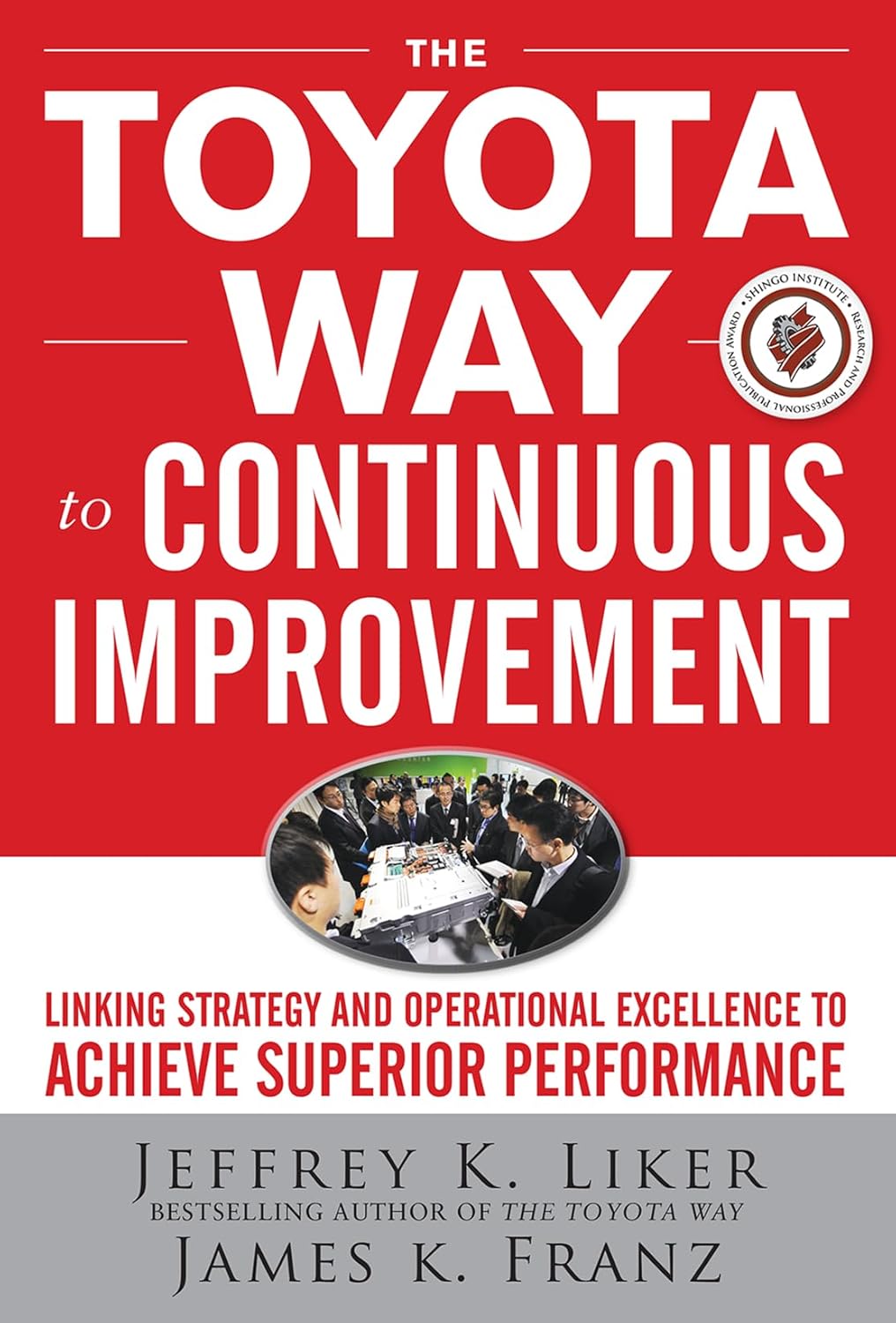
Description:
Building upon the international bestselling Toyota Way series of books by Jeffrey Liker, The Toyota Way to Continuous Improvement looks critically at lean deployments and identifies the root causes of why most of them fail. The book is organized into three major sections outlining:
- Why it is critical to go beyond implementing lean tools and, instead, build a culture of continuous improvement that connects operational excellence to business strategy
- Case studies from seven unique industries written from the perspective of the sensei (teacher) who led the lean transformation
- Lessons about transforming your own vision of an ideal organization into reality
Section One: Using the Plan-Do-Check-Adjust (PDCA) methodology, Liker and Franz contrast true PDCA thinking to that of the popular, superficial approach of copying "lean solutions." They describe the importance of developing people and show how the Toyota Way principles support and drive continuous improvement. Explaining how lean systems and processes start with a purpose that provides a true north direction for all activities, they wrap up this section by examining the glaring differences between building a system of people, processes, and problem- solving that is truly lean versus that of simply trying to "lean out" a process.
Section Two: This section brings together seven case studies as told by the sensei who led the transformation efforts. The companies range from traditional manufacturers, overhaul and maintenance of submarines, nuclear fuel rod production, health care providers, pathology labs, and product development. Each of these industries is different but the approaches used were remarkably similar.
Section Three: Beginning with a composite story describing a company in its early days of lean implementation, this section describes what went right and wrong during the initial implementation efforts. The authors bring to light some of the difficulties the sensei faces, such as bureaucracies, closed-minded mechanical thinking, and the challenges of developing lean coaches who can facilitate real change. They address the question: Which is better, slow and deep organic deployment or fast and broad mechanistic deployment? The answer may surprise you. The book ends with a discussion on how to make continuous improvement a way of life at your company and the role of leadership in any lean transformation.
The Toyota Way to Continuous Improvement is required reading for anyone seeking to transcend his or her tools-based approach and truly embrace a culture of continuous improvement.
From the Publisher
Jeffrey K. Liker, author of the bestselling The Toyota Way, is professor of industrial and operations engineering at the University of Michigan. His most recent book, Toyota Under Fire, chronicles Toyota’s response to the recession and recall crisis.
James K. Franz has more than 24 years of manufacturing experience and learned “lean” as a Toyota production engineer in the United States and Japan. He has worked for and consulted with various organizations, including Ford, Bosch, the U.S. Air Force, Exxon Mobil, AMCOR, Hertz, and Applied Materials. He also teaches for the University of Michigan’s Center for Professional Development’s Lean Certification course.
About the Author
James K. Franz learned lean as a Toyota Production Engineer in Japan, and has more than 22 years of manufacturing experience.
Excerpt. © Reprinted by permission. All rights reserved.
THE TOYOTA WAY to CONTINUOUS IMPROVEMENT
LINKING STRATEGY AND OPERATIONAL EXCELLENCE TO ACHIEVE SUPERIOR PERFORMANCE
By JEFFREY K. LIKER, JAMES K. FRANZThe McGraw-Hill Companies, Inc.
Copyright © 2011 The McGraw-Hill Companies, Inc.All rights reserved.
ISBN: 978-0-07-147746-8
Contents
Acknowledgments and Guest Author BiographiesPrologue: Is Toyota Still a Great Company Others Can Learn From?Section One The Journey to Continuous ImprovementChapter 1 Continuous Improvement toward ExcellenceChapter 2 PDCA and Striving for ExcellenceChapter 3 How Process Improvement Can Develop Excellent PeopleChapter 4 Lean Processes Start with a PurposeChapter 5 Lean Out Processes or Build Lean Systems?Section Two Case Studies of Lean Transformation through PDCAChapter 6 When Organic Meets Mechanistic: Lean Overhaul and Repair ofShips (with Robert Kucner)Chapter 7 An Australian Sensei Teaches a Proud Japanese Company New
Tricks: Bringing TPS to a Complex Equipment Manufacturer (with Tony
McNaughton)Chapter 8 Lean Iron-Ore Mining in the Pilbara Region of Western AustraliaChapter 9 Bringing Ford's Ideas Alive at Henry Ford Health System Labs
through PDCA Leadership (with Dr. Richard Zarbo)Chapter 10 Teaching Individuals to Fly by the Numbers: Transforming
Health-Care Processes (with Steve Hoeft)Chapter 11 Transforming How Products Are Engineered at North American
Automotive Supplier (with Charlie Baker)Chapter 12 Going Nuclear with Lean (with John Drogosz)Section Three Making Your Vision a RealityChapter 13 One Time around the Plan–Do–Check–Adjust (PDCA) Loop: A Lean
Short Story at Alte SchuleChapter 14 Sustaining, Spreading, Deepening: Continuing Turns of the PDCA
WheelChapter 15 Continuous Improvement as a Way of LifeNotesIndex
Excerpt
Continuous Improvement toward Excellence
The reason behind the absence of focus on product and people in so manyAmerican companies, it would seem, is ... overreliance on analysis fromcorporate ivory towers and overreliance on financial slight of hand, the toolsthat would appear to eliminate risk, but also, unfortunately, eliminateaction.
—Thomas Peters and Robert H. Waterman Jr.,In Search of Excellence
Continuous Improvement as the Pursuit of Excellence
It is hard to imagine any self-respecting CEO saying, "My vision for my companyis mediocrity." Excellence seems to be a universal goal. Yet our experienceworking with many companies has been that the actions of their chief executivestend to lead to mediocrity, not excellence. Perhaps it is a matter ofdefinition. When the CEO sets business goals, they're typically in terms ofprofitability and growth. Is being the profit leader in your industry or thegrowth leader in your industry equivalent to the pursuit of excellence? If acompany grows rapidly through mergers and acquisitions and becomes the largestcompany in its industry with the fastest-rising stock price, has it achievedexcellence?
Let's go back to basics. Your child is passionate about golf or music or cookingand thinks that he wants to make a career out of it. You explain if he is reallyserious about this, he will need to dedicate himself to what he loves, perhapsfor the rest of his life. Above all, he will have to obsessively practice,practice, practice. If he would like it to be a hobby, that is also fine,because he can always pick it up and have some fun in his spare time, buttreating it as a hobby is different from treating it as a vocation. Let's sayyour golf-loving son Johnny replies: "I don't really know about dedicating mylife or sacrificing, but I really want to win the juniors tournament next summerso that I can impress Judy enough to go to the senior prom with me." As aparent, you might feel deflated and think that Johnny is not really dedicatedand this will be a passing phase. The passion for excellence is just not there.
Defining excellence in an absolute sense is challenging. Is the standard forexcellence in playing the violin being among the top 10 in the world, being thebest in your country, or being the best in your town? Is the town virtuoso notexcellent just because the best in the world are so much better? Is excellencean absolute value, as in achieving an A in the course? We believe it is moreuseful to define excellence as a pursuit rather than as an absolute value. If weimprove, we're closer to excellence than we were before. The highest levels ofperformance give us a vision of excellence that provides a direction for ourefforts—a "true north."
Now suppose that Johnny grows up, gets his MBA, and rises quickly to become theCEO of a global food-processing company. He is a brilliant public speaker, andhe extols the virtue of making the highest-quality food for a competitive price.It all sounds good, but at the same time, his business decisions are all focusedon short-term transactions to increase the company's share price—mergers,acquisitions, selling off businesses, moving production to low-wage countries,and training legions of "black belts" to drive cost-reduction projects. Costsare going down, down, down. Quality is acceptable; there are problems, but noneof them are big enough to shut down the company. There is nothing distinctiveabout the products. The bottom line looks great. Is this true excellence as aproducer of high-quality food, or is making food simply a means to quickprofits, like a hobby? Johnny may be excellent at making money, but he is notexcellent at making food.
There is evidence that over the long term, companies that are striving for trueexcellence in the products they make and the services they provide outperformcompanies that are focused only on short-term financial goals. One of the best-selling business books of the 1980s was In Search of Excellence. Petersand Waterman identified the most successful American companies based on long-term financial performance and came up with a list of generalizations of whatthey had in common. Excellent companies "stuck to their knitting"; that is, theyfocused on what they were good at and worked to be the best at it. At the coreof their model were shared values. The managers in excellent companies valuedcustomers and had a passion for innovation within their industry:
The rational model causes us to denigrate the importance of values. The topperformers create a broad and uplifting, shared culture, a coherent frameworkwithin which charged-up people search for appropriate adaptations. Their abilityto extract extraordinary contributions from very large numbers of people turnson the ability to create a sense of highly-valued purpose.
Some people have pointed out that many of Peters and Waterman's "excellent"companies did not perform so well in the 10 years after the book came out. Butthere is further evidence that pursuing excellence pays over the long term. InBuilt to Last Jim Collins and his associates chronicled 18 "trulyexceptional and long-lasting companies" and compared them to less competitivecounterparts in terms of growth and financial performance over many years.Almost 20 years after In Search of Excellence, Collins and hisassociates also found that the most successful American companies had vision,were innovative, and had developed a strong set of shared values. The leaders ofthese companies were uniformly passionate about their customers and theirquality and intentionally developed next-generation leaders who shared thatpassion. Among Collins and his associates' many insights was that the companyitself is the ultimate creation. "We had to shift from seeing the company as avehicle for the products to seeing the products as a vehicle for the company."
In many companies, we hear inspiring speeches by CEOs who are very convincingabout their commitment to excellence. Unfortunately, when we have had anopportunity to investigate the actual state of the company, we have seensomething entirely different. We have seen disarray everywhere, people coming towork who seem more interested in watching the clock so that they can go homethan energetically doing excellent work, department managers who are moreinterested in growing their budgets than in performing a real service forcustomers, and poorly organized work processes.
In The High Velocity Edge, Steven Spear documents the success of leaderslike Boeing, Toyota, and Pratt & Whitney that are out front in business successwhile their competitors huff and puff and struggle to keep up. He identifiesoperational excellence as a key differentiator. In a personal interview, heexplained that the lack of interest in operational excellence starts withdeficiencies in our business education system:
Current management training, especially the typical MBA, suffers a fatalflaw. It is largely "transactional" in orientation, with students taught tothink in terms of buy/sell, enter/exit, hire/fire decisions. Business strategycourses are mainly about transactional decisions—entering or exitingmarkets, licensing, outsourcing and so forth to gain a positional edge overcompetitors, suppliers, and customers. Even many operations management courseshave taken on a transactional bent, with focus on facility site location,technology selection, production control tool use, and the like. However,outside of a few courses, missing is the critical idea of actually managing workin a way that uses operational excellence to give the firm competitiveadvantage, not merely finding a defensible position, but relentlessly outracingthe field with ever better products and services, and ever better ways ofbringing them to market.
The Toyota Way as the Path to Excellence
The Toyota Way provides an in-depth case study of one company's pursuitof operational excellence through continuous improvement and how it turned thatpursuit into a strategic differentiator. From the senior executives to smallgroups of team members on the shop floor, there is a feeling of intense energyfocused on getting better. Liker summarized the management principles he derivedfrom intensively studying Toyota as a 4P model: an integrated system ofphilosophy, processes, people, and problem solving. The 4P model is shown inFigure 1.1. The philosophy is the foundation: "Base your managementdecisions on a long-term philosophy, even at the expense of short-term financialgoals."
The most striking thing about Toyota is the consistency of values and the senseof mission up and down and across the company. The external focus isconsistently on adding value to customers and society. The internal focus is ondeveloping exceptional people and continually challenging them to pushthe boundaries of their abilities. "Challenge" is one of the five core values ofthe company. Toyota's internal document, The Toyota Way 2001, summarizesit this way: "We accept challenges with a creative spirit and the courage torealize our own dreams without losing drive or energy." Throughout its history,Toyota leaders have been expected to distinguish themselves by accepting anddelivering on a great challenge. For example, Takeshi Uchiyamada, head ofresearch and development (R&D) at the time of this writing, took on thechallenge of leading the development of the car for the twenty-first century,resulting in the creation of the first Prius.
In 2010, I (Jeff Liker) visited Herman Miller, an office furniture company thatToyota adopted as a student of the Toyota Production System (TPS). When theToyota experts first visited Herman Miller's file cabinet plant, chosen as thepilot for TPS, they issued a challenge. At the time (around the year 1998), theplant was assembling file cabinets on two assembly lines (two different productlines), running three shifts, with 126 assemblers. The challenge was to buildthe same volume with one assembly line, working two shifts, with 16 people. TheHerman Miller managers thought this was crazy, impossible, but with guidancefrom the Toyota experts, they worked at it, and worked at it, and are stillworking at it. Ten years later, through thousands of improvements, they hadincreased file cabinet production from 6,000/week to 7,250/week, on one assemblyline, running two shifts, with 30 people. Twenty-minute changeovers were reducedto zero changeover. Lead time to produce a file cabinet dropped from 62 hours to4 hours. This was the result of years of continuous improvement in practice.
In the fall of 2008, Toyota shocked the world when, like other companies, itfaltered in the Great Recession. In fact, for the fiscal year ended in March2009, it reported a financial loss for the first time in 60 years—$4.4billion. The New York Times wrote: "The Toyota Motor Company booked itsfirst annual net loss in six decades Friday and warned that it would plunge evendeeper into the red this year, a stunning reversal for an automaker whosebreakneck expansion and record profits seemed unstoppable just 12 months ago."
Is the important news here six decades of profitability year after year, or oneyear of loss in the worst industry downturn since the Great Depression? Inreality, Toyota's system did not fail. It performed exactly as planned, but theplan was not designed to deal with a drop of 35 percent in the market. The planfor operations was designed to give Toyota the flexibility to adapt to a ±20percent change in the market, which had worked just fine for decades. When salesdeclined to 65 percent of planned capacity, Toyota predictably lost money.Granted, Toyota could have softened the financial impact somewhat by acting likeits competition: aggressively lay off workers and idle plants. Instead, noregular employees lost their jobs; they came to work and participated intraining and improvement activities. The 4P model shows that the philosophy isbased on long-term thinking, not knee-jerk reactions to the latest change in thewinds of the economy or the speculations of various "pundits" on the financialchannels.
To support its long-term philosophy, after decades of consistent profits (forexample, $18 billion in fiscal year 2008 alone), Toyota saved plenty of cashreserves to weather the recession without involuntary layoffs or plant closings.Toyota's emergency system did kick in right away to find creative ways to cutcosts and restore profitability. In April 2009, Toyota was forecasting a loss ofmore than $6 billion for the fiscal year. By the fall of 2009, this projectedloss had dropped precipitously to an expected loss of $2 billion. At it turnsout, this was overstated, as the market picked up, and for the fiscal yearending in March 2010, Toyota posted a net profit of over $2.2 billion. Even thecomparatively minor pain that Toyota experienced was unsatisfactory to presidentAkio Toyoda and the board of directors. They ordered the company tosignificantly reduce its fixed overhead and operating costs so that in thefuture, Toyota could break even at 70 percent of planned sales.
This is not to say that Toyota is perfect; far from it. The recall crisis insome ways made the Great Recession appear easy to conquer. But imagine howdifficult it would have been to address the recall crisis if the company hadlaid off tens of thousands of employees and slashed R&D spending during therecession. Instead, its investment in training and developing people at alllevels gave it a formidable army to undertake the changes required by the recallcrisis.
Toyota will always have ups and downs and some leaders who fail to act accordingto the Toyota Way. The ideal that the company is striving for is always so farahead that it seems impossible to achieve, but the leaders do know in whatdirection they're headed, and it is about far more than being profitable orbeing the biggest. They're striving for their vision of excellence.
Lean and Why Companies Fail at It
Toyota's success has inspired tens of thousands of organizations to adopt someform of a "Lean" Program. The term was introduced in The Machine ThatChanged the World and later in Lean Thinking as a new paradigm thatwas as monumental as the shift from craft-style to mass production. The focus oflean is always on the customer and the value stream. It is a pursuit ofperfection by constantly eliminating waste through problem solving. Certainly anorganization that is truly dedicated to becoming lean is on a path towardexcellence. Yet, a large survey conducted by Industry Week in 2007 foundthat only 2 percent of companies that have a lean program achieved theiranticipated results. More recently, the Shingo Prize committee, which givesawards for excellence in lean manufacturing, went back to past winners and foundthat many had not sustained their progress after winning the award. Why is thepursuit of excellence through lean not working?
To answer this, we might ask: is lean a hobby, or is it a lifelong commitment tobecoming something great? A Lean Program with a short-term focus on cuttinginventory or head count is much more like Johnny wanting to win the summer golftournament to get the girl than like someone who is passionate about becomingthe best golfer that he can be. Somewhere along the line, we developed adisconnect between the passion for excellence of highly successful companieslike those that Peters and Waterman, and later Collins, were writing about andthe implementation of process improvement methodologies. Companies have to dosomething if they're serious about excellence, and improving processes to betterdeliver value to customers seems like the obvious thing to focus on. So what isthe source of the disconnect?
The Shingo Prize committee compared past award winners that had continued toimprove with those that had gone backward and found that those that had gonebackward were simply copying the tools, and those that had continued improvinghad turned the initial improvement efforts into a culture, starting with leaderswho were passionate about striving for excellence. The committee revamped theaward, calling it the Shingo Prize for Operational Excellence, and changed thecriteria to emphasize developing a culture of continuous improvement.
We will talk a great deal in this book about problem solving, which is differentfrom the connotation of firefighting. In firefighting, we are running aroundputting our finger in the dike and hoping that the dam will not collapse. Intrue problem solving, we are deeply trying to understand the root cause of aproblem so that we can ultimately prevent the problem from occurring again.Toyota uses the "five whys" method: keep drilling down by asking "why" until youfind the root cause. We did a five whys analysis to understand why so manycompanies are failing at lean. This is summarized in Figure 1.2.
(Continues...)
(Continues...)Excerpted from THE TOYOTA WAY to CONTINUOUS IMPROVEMENT by JEFFREY K. LIKER. Copyright © 2011 by The McGraw-Hill Companies, Inc.. Excerpted by permission of The McGraw-Hill Companies, Inc..
All rights reserved. No part of this excerpt may be reproduced or reprinted without permission in writing from the publisher.
Excerpts are provided by Dial-A-Book Inc. solely for the personal use of visitors to this web site.
Details:
Visit the McGraw Hill Store
The Toyota Way to Continuous Improvement: Linking Strategy and Operational Excellence to Achieve Superior Performance
AED17714
Quantity:
Order today to get by 7-14 business days
Delivery fee of AED 20. Free for orders above AED 200.
 Imported From: United States
At BOLO, we work hard to ensure the products you receive are new, genuine, and sourced from reputable suppliers.
Every product in the BOLO catalogue is sourced through our Verified Global Supply Network of verified sellers, authorized distributors or directly from the manufacturer.
Each product undergoes thorough inspection and verification at our consolidation and fulfilment centers to ensure it meets our strict authenticity and quality standards before being shipped and delivered to you.
If you ever have concerns regarding the authenticity of a product purchased from us, please contact Bolo Support. We will review your inquiry promptly and, if necessary, provide documentation verifying authenticity or offer a suitable resolution.
Your trust is our top priority, and we are committed to maintaining transparency and integrity in every transaction.
While we strive to display accurate information, variations in packaging, labeling, instructions, or formulation may occasionally occur due to regional differences or supplier updates. For detailed or manufacturer-specific information, please contact the brand directly or reach out to BOLO Support for assistance.
Unless otherwise stated, all prices displayed on the product page include applicable taxes and import duties.
BOLO operates in accordance with the laws and regulations of United Arab Emirates. Any items found to be restricted or prohibited for sale within the United Arab Emirates will be cancelled prior to shipment. We take proactive measures to ensure that only products permitted for sale in United Arab Emirates are listed on our website.
All items are shipped by air, and any products classified as “Dangerous Goods (DG)” under IATA regulations will be removed from the order and cancelled.
All orders are processed manually, and we make every effort to process them promptly once confirmed. Products cancelled due to the above reasons will be permanently removed from listings across the website.
Similar suggestions by Bolo
More from this brand
Similar items from “Total Quality Management”
Share with
Or share with link
https://www.bolo.ae/products/U0071477462
Visit the McGraw Hill Store
The Toyota Way to Continuous Improvement: Linking Strategy and Operational Excellence to Achieve Superior Performance
AED17714
Quantity:
Order today to get by 7-14 business days
Delivery fee of AED 20. Free for orders above AED 200.
Imported From: United States
At BOLO, we work hard to ensure the products you receive are new, genuine, and sourced from reputable suppliers.
Every product in the BOLO catalogue is sourced through our Verified Global Supply Network of verified sellers, authorized distributors or directly from the manufacturer.
Each product undergoes thorough inspection and verification at our consolidation and fulfilment centers to ensure it meets our strict authenticity and quality standards before being shipped and delivered to you.
If you ever have concerns regarding the authenticity of a product purchased from us, please contact Bolo Support. We will review your inquiry promptly and, if necessary, provide documentation verifying authenticity or offer a suitable resolution.
Your trust is our top priority, and we are committed to maintaining transparency and integrity in every transaction.
While we strive to display accurate information, variations in packaging, labeling, instructions, or formulation may occasionally occur due to regional differences or supplier updates. For detailed or manufacturer-specific information, please contact the brand directly or reach out to BOLO Support for assistance.
Unless otherwise stated, all prices displayed on the product page include applicable taxes and import duties.
BOLO operates in accordance with the laws and regulations of United Arab Emirates. Any items found to be restricted or prohibited for sale within the United Arab Emirates will be cancelled prior to shipment. We take proactive measures to ensure that only products permitted for sale in United Arab Emirates are listed on our website.
All items are shipped by air, and any products classified as “Dangerous Goods (DG)” under IATA regulations will be removed from the order and cancelled.
All orders are processed manually, and we make every effort to process them promptly once confirmed. Products cancelled due to the above reasons will be permanently removed from listings across the website.
Description:
Building upon the international bestselling Toyota Way series of books by Jeffrey Liker, The Toyota Way to Continuous Improvement looks critically at lean deployments and identifies the root causes of why most of them fail. The book is organized into three major sections outlining:
- Why it is critical to go beyond implementing lean tools and, instead, build a culture of continuous improvement that connects operational excellence to business strategy
- Case studies from seven unique industries written from the perspective of the sensei (teacher) who led the lean transformation
- Lessons about transforming your own vision of an ideal organization into reality
Section One: Using the Plan-Do-Check-Adjust (PDCA) methodology, Liker and Franz contrast true PDCA thinking to that of the popular, superficial approach of copying "lean solutions." They describe the importance of developing people and show how the Toyota Way principles support and drive continuous improvement. Explaining how lean systems and processes start with a purpose that provides a true north direction for all activities, they wrap up this section by examining the glaring differences between building a system of people, processes, and problem- solving that is truly lean versus that of simply trying to "lean out" a process.
Section Two: This section brings together seven case studies as told by the sensei who led the transformation efforts. The companies range from traditional manufacturers, overhaul and maintenance of submarines, nuclear fuel rod production, health care providers, pathology labs, and product development. Each of these industries is different but the approaches used were remarkably similar.
Section Three: Beginning with a composite story describing a company in its early days of lean implementation, this section describes what went right and wrong during the initial implementation efforts. The authors bring to light some of the difficulties the sensei faces, such as bureaucracies, closed-minded mechanical thinking, and the challenges of developing lean coaches who can facilitate real change. They address the question: Which is better, slow and deep organic deployment or fast and broad mechanistic deployment? The answer may surprise you. The book ends with a discussion on how to make continuous improvement a way of life at your company and the role of leadership in any lean transformation.
The Toyota Way to Continuous Improvement is required reading for anyone seeking to transcend his or her tools-based approach and truly embrace a culture of continuous improvement.
From the Publisher
Jeffrey K. Liker, author of the bestselling The Toyota Way, is professor of industrial and operations engineering at the University of Michigan. His most recent book, Toyota Under Fire, chronicles Toyota’s response to the recession and recall crisis.
James K. Franz has more than 24 years of manufacturing experience and learned “lean” as a Toyota production engineer in the United States and Japan. He has worked for and consulted with various organizations, including Ford, Bosch, the U.S. Air Force, Exxon Mobil, AMCOR, Hertz, and Applied Materials. He also teaches for the University of Michigan’s Center for Professional Development’s Lean Certification course.
About the Author
James K. Franz learned lean as a Toyota Production Engineer in Japan, and has more than 22 years of manufacturing experience.
Excerpt. © Reprinted by permission. All rights reserved.
THE TOYOTA WAY to CONTINUOUS IMPROVEMENT
LINKING STRATEGY AND OPERATIONAL EXCELLENCE TO ACHIEVE SUPERIOR PERFORMANCE
By JEFFREY K. LIKER, JAMES K. FRANZThe McGraw-Hill Companies, Inc.
Copyright © 2011 The McGraw-Hill Companies, Inc.All rights reserved.
ISBN: 978-0-07-147746-8
Contents
Acknowledgments and Guest Author BiographiesPrologue: Is Toyota Still a Great Company Others Can Learn From?Section One The Journey to Continuous ImprovementChapter 1 Continuous Improvement toward ExcellenceChapter 2 PDCA and Striving for ExcellenceChapter 3 How Process Improvement Can Develop Excellent PeopleChapter 4 Lean Processes Start with a PurposeChapter 5 Lean Out Processes or Build Lean Systems?Section Two Case Studies of Lean Transformation through PDCAChapter 6 When Organic Meets Mechanistic: Lean Overhaul and Repair ofShips (with Robert Kucner)Chapter 7 An Australian Sensei Teaches a Proud Japanese Company New
Tricks: Bringing TPS to a Complex Equipment Manufacturer (with Tony
McNaughton)Chapter 8 Lean Iron-Ore Mining in the Pilbara Region of Western AustraliaChapter 9 Bringing Ford's Ideas Alive at Henry Ford Health System Labs
through PDCA Leadership (with Dr. Richard Zarbo)Chapter 10 Teaching Individuals to Fly by the Numbers: Transforming
Health-Care Processes (with Steve Hoeft)Chapter 11 Transforming How Products Are Engineered at North American
Automotive Supplier (with Charlie Baker)Chapter 12 Going Nuclear with Lean (with John Drogosz)Section Three Making Your Vision a RealityChapter 13 One Time around the Plan–Do–Check–Adjust (PDCA) Loop: A Lean
Short Story at Alte SchuleChapter 14 Sustaining, Spreading, Deepening: Continuing Turns of the PDCA
WheelChapter 15 Continuous Improvement as a Way of LifeNotesIndex
Excerpt
Continuous Improvement toward Excellence
The reason behind the absence of focus on product and people in so manyAmerican companies, it would seem, is ... overreliance on analysis fromcorporate ivory towers and overreliance on financial slight of hand, the toolsthat would appear to eliminate risk, but also, unfortunately, eliminateaction.
—Thomas Peters and Robert H. Waterman Jr.,In Search of Excellence
Continuous Improvement as the Pursuit of Excellence
It is hard to imagine any self-respecting CEO saying, "My vision for my companyis mediocrity." Excellence seems to be a universal goal. Yet our experienceworking with many companies has been that the actions of their chief executivestend to lead to mediocrity, not excellence. Perhaps it is a matter ofdefinition. When the CEO sets business goals, they're typically in terms ofprofitability and growth. Is being the profit leader in your industry or thegrowth leader in your industry equivalent to the pursuit of excellence? If acompany grows rapidly through mergers and acquisitions and becomes the largestcompany in its industry with the fastest-rising stock price, has it achievedexcellence?
Let's go back to basics. Your child is passionate about golf or music or cookingand thinks that he wants to make a career out of it. You explain if he is reallyserious about this, he will need to dedicate himself to what he loves, perhapsfor the rest of his life. Above all, he will have to obsessively practice,practice, practice. If he would like it to be a hobby, that is also fine,because he can always pick it up and have some fun in his spare time, buttreating it as a hobby is different from treating it as a vocation. Let's sayyour golf-loving son Johnny replies: "I don't really know about dedicating mylife or sacrificing, but I really want to win the juniors tournament next summerso that I can impress Judy enough to go to the senior prom with me." As aparent, you might feel deflated and think that Johnny is not really dedicatedand this will be a passing phase. The passion for excellence is just not there.
Defining excellence in an absolute sense is challenging. Is the standard forexcellence in playing the violin being among the top 10 in the world, being thebest in your country, or being the best in your town? Is the town virtuoso notexcellent just because the best in the world are so much better? Is excellencean absolute value, as in achieving an A in the course? We believe it is moreuseful to define excellence as a pursuit rather than as an absolute value. If weimprove, we're closer to excellence than we were before. The highest levels ofperformance give us a vision of excellence that provides a direction for ourefforts—a "true north."
Now suppose that Johnny grows up, gets his MBA, and rises quickly to become theCEO of a global food-processing company. He is a brilliant public speaker, andhe extols the virtue of making the highest-quality food for a competitive price.It all sounds good, but at the same time, his business decisions are all focusedon short-term transactions to increase the company's share price—mergers,acquisitions, selling off businesses, moving production to low-wage countries,and training legions of "black belts" to drive cost-reduction projects. Costsare going down, down, down. Quality is acceptable; there are problems, but noneof them are big enough to shut down the company. There is nothing distinctiveabout the products. The bottom line looks great. Is this true excellence as aproducer of high-quality food, or is making food simply a means to quickprofits, like a hobby? Johnny may be excellent at making money, but he is notexcellent at making food.
There is evidence that over the long term, companies that are striving for trueexcellence in the products they make and the services they provide outperformcompanies that are focused only on short-term financial goals. One of the best-selling business books of the 1980s was In Search of Excellence. Petersand Waterman identified the most successful American companies based on long-term financial performance and came up with a list of generalizations of whatthey had in common. Excellent companies "stuck to their knitting"; that is, theyfocused on what they were good at and worked to be the best at it. At the coreof their model were shared values. The managers in excellent companies valuedcustomers and had a passion for innovation within their industry:
The rational model causes us to denigrate the importance of values. The topperformers create a broad and uplifting, shared culture, a coherent frameworkwithin which charged-up people search for appropriate adaptations. Their abilityto extract extraordinary contributions from very large numbers of people turnson the ability to create a sense of highly-valued purpose.
Some people have pointed out that many of Peters and Waterman's "excellent"companies did not perform so well in the 10 years after the book came out. Butthere is further evidence that pursuing excellence pays over the long term. InBuilt to Last Jim Collins and his associates chronicled 18 "trulyexceptional and long-lasting companies" and compared them to less competitivecounterparts in terms of growth and financial performance over many years.Almost 20 years after In Search of Excellence, Collins and hisassociates also found that the most successful American companies had vision,were innovative, and had developed a strong set of shared values. The leaders ofthese companies were uniformly passionate about their customers and theirquality and intentionally developed next-generation leaders who shared thatpassion. Among Collins and his associates' many insights was that the companyitself is the ultimate creation. "We had to shift from seeing the company as avehicle for the products to seeing the products as a vehicle for the company."
In many companies, we hear inspiring speeches by CEOs who are very convincingabout their commitment to excellence. Unfortunately, when we have had anopportunity to investigate the actual state of the company, we have seensomething entirely different. We have seen disarray everywhere, people coming towork who seem more interested in watching the clock so that they can go homethan energetically doing excellent work, department managers who are moreinterested in growing their budgets than in performing a real service forcustomers, and poorly organized work processes.
In The High Velocity Edge, Steven Spear documents the success of leaderslike Boeing, Toyota, and Pratt & Whitney that are out front in business successwhile their competitors huff and puff and struggle to keep up. He identifiesoperational excellence as a key differentiator. In a personal interview, heexplained that the lack of interest in operational excellence starts withdeficiencies in our business education system:
Current management training, especially the typical MBA, suffers a fatalflaw. It is largely "transactional" in orientation, with students taught tothink in terms of buy/sell, enter/exit, hire/fire decisions. Business strategycourses are mainly about transactional decisions—entering or exitingmarkets, licensing, outsourcing and so forth to gain a positional edge overcompetitors, suppliers, and customers. Even many operations management courseshave taken on a transactional bent, with focus on facility site location,technology selection, production control tool use, and the like. However,outside of a few courses, missing is the critical idea of actually managing workin a way that uses operational excellence to give the firm competitiveadvantage, not merely finding a defensible position, but relentlessly outracingthe field with ever better products and services, and ever better ways ofbringing them to market.
The Toyota Way as the Path to Excellence
The Toyota Way provides an in-depth case study of one company's pursuitof operational excellence through continuous improvement and how it turned thatpursuit into a strategic differentiator. From the senior executives to smallgroups of team members on the shop floor, there is a feeling of intense energyfocused on getting better. Liker summarized the management principles he derivedfrom intensively studying Toyota as a 4P model: an integrated system ofphilosophy, processes, people, and problem solving. The 4P model is shown inFigure 1.1. The philosophy is the foundation: "Base your managementdecisions on a long-term philosophy, even at the expense of short-term financialgoals."
The most striking thing about Toyota is the consistency of values and the senseof mission up and down and across the company. The external focus isconsistently on adding value to customers and society. The internal focus is ondeveloping exceptional people and continually challenging them to pushthe boundaries of their abilities. "Challenge" is one of the five core values ofthe company. Toyota's internal document, The Toyota Way 2001, summarizesit this way: "We accept challenges with a creative spirit and the courage torealize our own dreams without losing drive or energy." Throughout its history,Toyota leaders have been expected to distinguish themselves by accepting anddelivering on a great challenge. For example, Takeshi Uchiyamada, head ofresearch and development (R&D) at the time of this writing, took on thechallenge of leading the development of the car for the twenty-first century,resulting in the creation of the first Prius.
In 2010, I (Jeff Liker) visited Herman Miller, an office furniture company thatToyota adopted as a student of the Toyota Production System (TPS). When theToyota experts first visited Herman Miller's file cabinet plant, chosen as thepilot for TPS, they issued a challenge. At the time (around the year 1998), theplant was assembling file cabinets on two assembly lines (two different productlines), running three shifts, with 126 assemblers. The challenge was to buildthe same volume with one assembly line, working two shifts, with 16 people. TheHerman Miller managers thought this was crazy, impossible, but with guidancefrom the Toyota experts, they worked at it, and worked at it, and are stillworking at it. Ten years later, through thousands of improvements, they hadincreased file cabinet production from 6,000/week to 7,250/week, on one assemblyline, running two shifts, with 30 people. Twenty-minute changeovers were reducedto zero changeover. Lead time to produce a file cabinet dropped from 62 hours to4 hours. This was the result of years of continuous improvement in practice.
In the fall of 2008, Toyota shocked the world when, like other companies, itfaltered in the Great Recession. In fact, for the fiscal year ended in March2009, it reported a financial loss for the first time in 60 years—$4.4billion. The New York Times wrote: "The Toyota Motor Company booked itsfirst annual net loss in six decades Friday and warned that it would plunge evendeeper into the red this year, a stunning reversal for an automaker whosebreakneck expansion and record profits seemed unstoppable just 12 months ago."
Is the important news here six decades of profitability year after year, or oneyear of loss in the worst industry downturn since the Great Depression? Inreality, Toyota's system did not fail. It performed exactly as planned, but theplan was not designed to deal with a drop of 35 percent in the market. The planfor operations was designed to give Toyota the flexibility to adapt to a ±20percent change in the market, which had worked just fine for decades. When salesdeclined to 65 percent of planned capacity, Toyota predictably lost money.Granted, Toyota could have softened the financial impact somewhat by acting likeits competition: aggressively lay off workers and idle plants. Instead, noregular employees lost their jobs; they came to work and participated intraining and improvement activities. The 4P model shows that the philosophy isbased on long-term thinking, not knee-jerk reactions to the latest change in thewinds of the economy or the speculations of various "pundits" on the financialchannels.
To support its long-term philosophy, after decades of consistent profits (forexample, $18 billion in fiscal year 2008 alone), Toyota saved plenty of cashreserves to weather the recession without involuntary layoffs or plant closings.Toyota's emergency system did kick in right away to find creative ways to cutcosts and restore profitability. In April 2009, Toyota was forecasting a loss ofmore than $6 billion for the fiscal year. By the fall of 2009, this projectedloss had dropped precipitously to an expected loss of $2 billion. At it turnsout, this was overstated, as the market picked up, and for the fiscal yearending in March 2010, Toyota posted a net profit of over $2.2 billion. Even thecomparatively minor pain that Toyota experienced was unsatisfactory to presidentAkio Toyoda and the board of directors. They ordered the company tosignificantly reduce its fixed overhead and operating costs so that in thefuture, Toyota could break even at 70 percent of planned sales.
This is not to say that Toyota is perfect; far from it. The recall crisis insome ways made the Great Recession appear easy to conquer. But imagine howdifficult it would have been to address the recall crisis if the company hadlaid off tens of thousands of employees and slashed R&D spending during therecession. Instead, its investment in training and developing people at alllevels gave it a formidable army to undertake the changes required by the recallcrisis.
Toyota will always have ups and downs and some leaders who fail to act accordingto the Toyota Way. The ideal that the company is striving for is always so farahead that it seems impossible to achieve, but the leaders do know in whatdirection they're headed, and it is about far more than being profitable orbeing the biggest. They're striving for their vision of excellence.
Lean and Why Companies Fail at It
Toyota's success has inspired tens of thousands of organizations to adopt someform of a "Lean" Program. The term was introduced in The Machine ThatChanged the World and later in Lean Thinking as a new paradigm thatwas as monumental as the shift from craft-style to mass production. The focus oflean is always on the customer and the value stream. It is a pursuit ofperfection by constantly eliminating waste through problem solving. Certainly anorganization that is truly dedicated to becoming lean is on a path towardexcellence. Yet, a large survey conducted by Industry Week in 2007 foundthat only 2 percent of companies that have a lean program achieved theiranticipated results. More recently, the Shingo Prize committee, which givesawards for excellence in lean manufacturing, went back to past winners and foundthat many had not sustained their progress after winning the award. Why is thepursuit of excellence through lean not working?
To answer this, we might ask: is lean a hobby, or is it a lifelong commitment tobecoming something great? A Lean Program with a short-term focus on cuttinginventory or head count is much more like Johnny wanting to win the summer golftournament to get the girl than like someone who is passionate about becomingthe best golfer that he can be. Somewhere along the line, we developed adisconnect between the passion for excellence of highly successful companieslike those that Peters and Waterman, and later Collins, were writing about andthe implementation of process improvement methodologies. Companies have to dosomething if they're serious about excellence, and improving processes to betterdeliver value to customers seems like the obvious thing to focus on. So what isthe source of the disconnect?
The Shingo Prize committee compared past award winners that had continued toimprove with those that had gone backward and found that those that had gonebackward were simply copying the tools, and those that had continued improvinghad turned the initial improvement efforts into a culture, starting with leaderswho were passionate about striving for excellence. The committee revamped theaward, calling it the Shingo Prize for Operational Excellence, and changed thecriteria to emphasize developing a culture of continuous improvement.
We will talk a great deal in this book about problem solving, which is differentfrom the connotation of firefighting. In firefighting, we are running aroundputting our finger in the dike and hoping that the dam will not collapse. Intrue problem solving, we are deeply trying to understand the root cause of aproblem so that we can ultimately prevent the problem from occurring again.Toyota uses the "five whys" method: keep drilling down by asking "why" until youfind the root cause. We did a five whys analysis to understand why so manycompanies are failing at lean. This is summarized in Figure 1.2.
(Continues...)
(Continues...)Excerpted from THE TOYOTA WAY to CONTINUOUS IMPROVEMENT by JEFFREY K. LIKER. Copyright © 2011 by The McGraw-Hill Companies, Inc.. Excerpted by permission of The McGraw-Hill Companies, Inc..
All rights reserved. No part of this excerpt may be reproduced or reprinted without permission in writing from the publisher.
Excerpts are provided by Dial-A-Book Inc. solely for the personal use of visitors to this web site.
Details:
Similar suggestions by Bolo
More from this brand
Similar items from “Total Quality Management”
Share with
Or share with link
https://www.bolo.ae/products/U0071477462