Description:
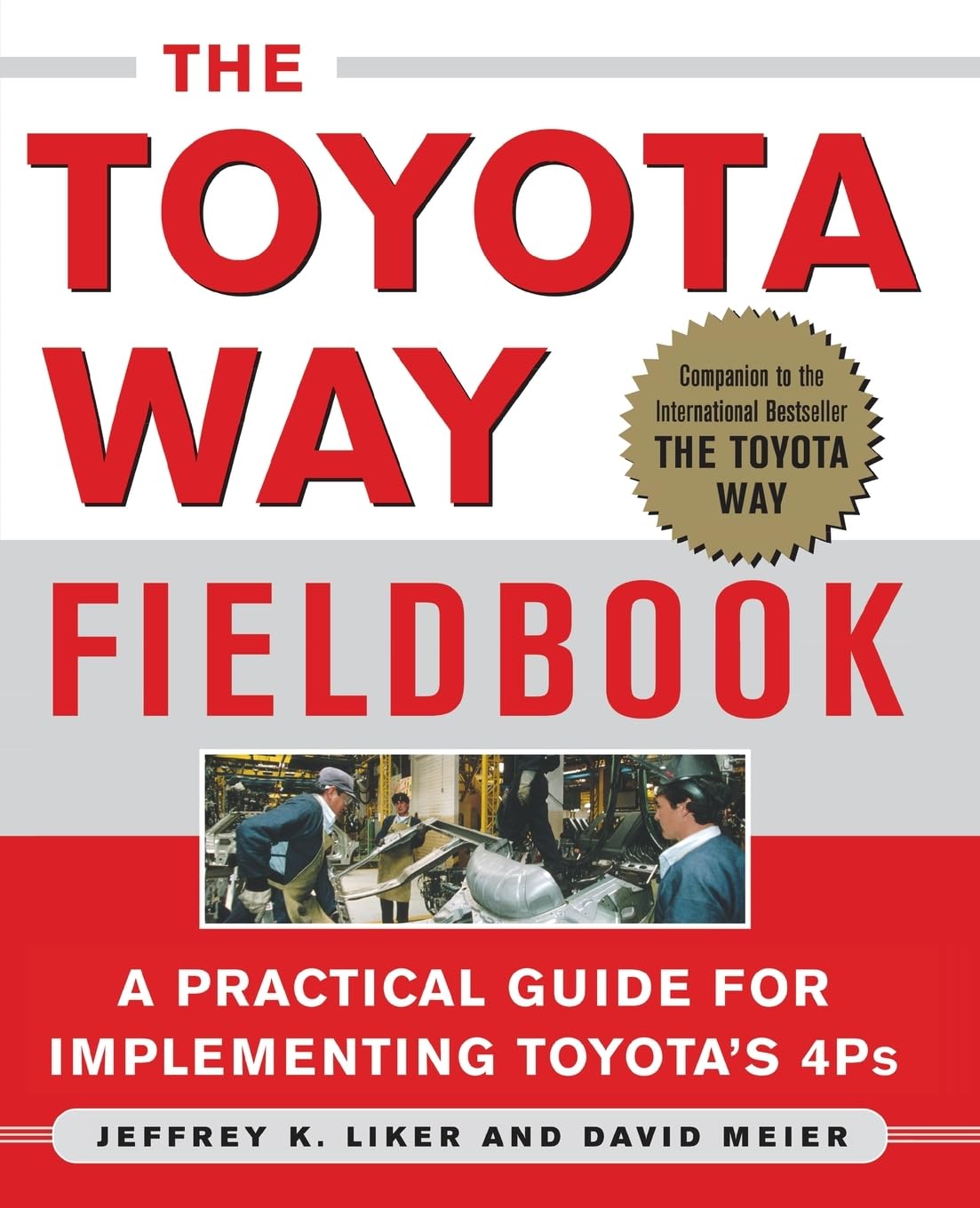
The Toyota Way Fieldbook is a companion to the international bestseller The Toyota Way. The Toyota Way Fieldbook builds on the philosophical aspects of Toyota's operating systems by detailing the concepts and providing practical examples for application that leaders need to bring Toyota's success-proven practices to life in any organization. The Toyota Way Fieldbook will help other companies learn from Toyota and develop systems that fit their unique cultures.
The book begins with a review of the principles of the Toyota Way through the 4Ps model-Philosophy, Processes, People and Partners, and Problem Solving. Readers looking to learn from Toyota's lean systems will be provided with the inside knowledge they need to
- Define the companies purpose and develop a long-term philosophy
- Create value streams with connected flow, standardized work, and level production
- Build a culture to stop and fix problems
- Develop leaders who promote and support the system
- Find and develop exceptional people and partners
- Learn the meaning of true root cause problem solving
- Lead the change process and transform the total enterprise
The depth of detail provided draws on the authors combined experience of coaching and supporting companies in lean transformation. Toyota experts at the Georgetown, Kentucky plant, formally trained David Meier in TPS. Combined with Jeff Liker's extensive study of Toyota and his insightful knowledge the authors have developed unique models and ideas to explain the true philosophies and principles of the Toyota Production System.
Editorial Reviews
From the Publisher
Jeffrey K. Liker, the author of the bestselling The Toyota Way, is Professor of Industrial and Operations Engineering and cofounder and Director of the Japan Technology Management Program at the University of Michigan. His work has appeared in The Harvard Business Review, Sloan Management Review, and other leading publications.
David Meier is the President of Lean Associates and was Group Leader for Toyota Motor Manufacturing for ten years. He helps other organizations across many industries learn from the Toyota Way.
From the Back Cover
Your hands-on guide to the secrets of Toyota's success!
Jeffrey Liker first revealed the management principles Toyota's worldwide reputation for quality and reliability in the international bestseller The Toyota Way.
Now, he and Toyota veteran David Meier take those lessons a step further with The Toyota Way Fieldbook. You'll receive the diagnostic tools, worksheets, and exercises--many adapted from Toyota originals--so you can craft the most effective approach for your organization.
Learn how to develop a long-term philosophy of cost reduction, build a culture that stops to fix problems quickly, develop leaders that live your system, and transform your company into a true lean learning organization that continuously improves, meets the needs of its customers, and positions itself for long-term success.
Most importantly, you'll understand the thinking behind lean tools and approaches so you can implement Toyota's 4P Model for success in your organization:
Philosophy--The company is a vehicle for adding value to customers, society, the community, and its associates.
Process--When leaders follow the right process they get the right results, including long-term cost-reduction and quality improvement.
People and Partners--Add value to an organization by challenging its people and partners to grow and become more skilled and confident.
Problem solving--Continuously solve root problems to drive organizational learning.
About the Author
David Meier is the President of Lean Associates and was Group Leader for Toyota Motor Manufacturing for ten years. He helps other organizations across many industries learn from the Toyota Way.
Excerpt. © Reprinted by permission. All rights reserved.
The Toyota Way Fieldbook
A Practical Guide for Implementing Toyota's 4PsBy Jeffrey K. Liker David MeierMcGraw-Hill
Copyright © 2006 The McGraw-Hill Companies, Inc.All right reserved.
ISBN: 978-0-07-144893-2
Contents
Chapter One
Background to the FieldbookWhy The Toyota Way Fieldbook?
Toyota's success as a company has been well documented. It has a well-earned reputation for excellence in quality, cost reduction, and hitting the market with vehicles that sell. The result has been a highly profitable company by any standards. Earning billions of dollars per year and amassing at any point in time $30 to $50 billion in cash reserves would be enough to convince anyone this company must be doing something right. Since The Toyota Way initially hit the shelves in January 2004, Toyota has continued to break records, earning over ¥10 trillion (about $10 billion) that year and becoming the most profitable company in the history of Japan. That pattern continues into 2005 breaking continuing profitability records while many of its competitors are losing market share and struggling to earn a profit. In 2005 Toyota in North America also won top honors in the coveted J.D. Power Initial Quality Award winning first place in 10 of 18 categories. Toyota then was recognized by Harbour Associates as having the most productive plants in North America. All this was accomplished while steadily increasing sales volume in North America at a time while its domestic competitors were losing volume.
But Toyota's impact on the world has gone beyond making money. It has even gone beyond making excellent vehicles people can enjoy driving. Toyota has contributed a new paradigm of manufacturing. "Lean production," a term coined in The Machine That Changed the World, is widely considered the next big step in the evolution of manufacturing beyond Ford's mass production. Who would have thought that Sakichi Toyoda, working in the rural hinterlands of what is now Toyota City in Japan, would have wrought a global powerhouse that has changed the face of manufacturing? And it has gone way beyond mass production of automobiles to all types of manufacturing: chemical processing, pharmaceuticals, nuclear fuel, ship and aircraft construction, medical products, building construction, shoemaking, sewing, defense bases that repair planes and ships and tanks, and on and on. And if that's not enough, there is a revolution in service industries working to apply lean thinking to drive out waste, including banks, insurance companies, hospitals, post offices, and more.
The Toyota Way became an international best-seller beyond expectations. We knew that those who were already committed to adopting lean manufacturing and to spreading lean beyond the shop floor would find something of interest in the book. But we did not realize how far lean thinking was spreading and how many people simply admired Toyota and wanted to see what they could learn from this corporate icon. Readers described feeling in awe when reading the book, inspired to go out and improve their organizations and their own personal lives. People read the book in just a few sittings and did not want to put it down. And all this for a business book?
The most common feedback from people who read the book was that it opened their eyes to a much broader view of what they could learn from Toyota. For them, it was more than the tools and methodologies of lean production or even lean applied to the office. They realized that Toyota had created an entire system of organization that focused on adding value to customers through people.
The sum total of Toyota's approach creates a unique culture that people throughout the world in many different kinds of organizations believe they can learn from. An overwhelming number of business leaders have written saying that they are adopting The Toyota Way as a blueprint for remaking their organizations. While they have reported taking away many different kinds of lessons, we cannot help wondering if the original book is enough to provide that blueprint. Our purpose had been to describe Toyota's management principles with case examples to bring them to life. The book was not written as a guide on how to apply the principles to your organization.
A fieldbook is intended to provide practical recipes for success, right? It should have tools, techniques, and methods that you can follow step by step. Well, maybe by some definitions. But then that posed a dilemma for us. On the one hand, the whole premise of The Toyota Way was that Toyota's system was much more than tools and techniques. Those tools and techniques—cells, kanban, mistake proofing, and quick changeover, among others—have already been well documented, and there is no shortage of detailed technical descriptions of these methods. On the other hand, the punch line of the book was that Toyota's main contribution has been to create a true learning organization. And the way they pass on the DNA of this learning organization as they expand globally is through dedicated sensei who act as personal tutors to new associates.
The Toyota Way is about tacit knowledge, not explicit procedural knowledge. "Tacit" knowledge is the craft type of knowledge that you gain from experience and reflection, not from reading a recipe. This tacit knowledge includes know-how and a philosophy of continuous improvement that is learned by doing with a coach who already has been enlightened through hard work and experience. The obvious implication is that the book should be reduced to one sentence: Go find a sensei to learn from and enjoy the journey!
We thought there was still value to writing a "fieldbook," but we struggled to define its purpose. We began by ruling out writing a "how-to" book that gives checklists and assessment instruments and step-by-step procedures. There are some in here, but those by themselves would not do justice to the profound insights we have gotten from our experiences with Toyota. Jeffrey Liker has spent over 20 years visiting and studying Toyota. David Meier spent almost 10 years with personal Japanese mentors at Toyota's Georgetown, Kentucky plant and could easily imagine their disapproving grunts and head shaking if he reduced Toyota's way to a cookbook format.
So we decided to take a different approach. The Toyota Way documented Toyota's Way. We decided the fieldbook should provide practical advice to those attempting to learn from The Toyota Way. We have both had years of experience in teaching Toyota's methods and philosophies to thousands of companies by lecture and hands-on consulting. We are constantly learning what works and what does not work. We are constantly facing misunderstandings about how to learn from Toyota. We also occasionally have the good fortune of seeing the light-bulbs go on, and people do amazingly innovative things based on what they learn. So we decided to share our experiences from hands-on efforts to help companies learn from Toyota.
We still realize this book is a long way from a how-to guide. We have many examples from Toyota to bring the concepts to life. And we can share many lessons we have had the good fortune to learn. But we've taken our understanding of Toyota one step further, providing advice on how to learn from the Toyota Way. The learning journey must be your own personal journey. Treat this book as picking up on the lessons of the Toyota Way and applying it to how you can learn from Toyota. But these are just ideas. You have to apply the ideas in your situation in your way.
Some of the ideas we present here may generate some disagreement in the lean manufacturing community. There are as many specific approaches to a particular situation as there are lean "experts." You may look at one of our examples and think, "They should have done it this way," or "There is another possible method." If you make these observations, great! That means you understand the concepts well enough to realize the various possible solutions to any situation.
The one reality of the Toyota Way is that there is always more than one way to achieve the desired result. The important thing is to learn, to think about what you have learned, to apply it, and to reflect on the process and continuously improve in such a way as to strengthen your organization for the long term.
You may think that we have left out or completely missed some important aspects of the Toyota Way. There is no question that this is the case. An entire book could easily be written about any topic covered here. We have attempted to distill the information to those things that are most critical and often overlooked elsewhere. We are fully aware that we ourselves might have overlooked some key items, and we would love to hear from you so those items may be considered for future work.
How the Book Is Organized
The starting point for this book is the 4P model developed in The Toyota Way. The four Ps are Philosophy, Process, People/Partners, and Problem Solving (all right, there are kind of five Ps). In this book we have also used the 4P structure, but we did not exactly stick to the original principles. We found a somewhat different list, one more amenable to teaching others how to apply the principles.
We still stuck with the high-level organization of the 4P model. Here's a brief description of the 4Ps and what makes them somewhat unique to Toyota:
* Philosophy. At the most fundamental level, Toyota's leaders see the company as a vehicle for adding value to customers, society, the community, and its associates. This is not naive political mumbo jumbo. It's real. It goes back to the founder, Sakichi Toyoda, and his desire to invent power looms to make life simpler for women in the farming community in which he grew up. It continued when Sakichi asked his son Kiichiro Toyoda to make his own contribution to the world by starting an automobile company. It is imprinted in all of Toyota's leaders today. It sets the foundation for all the other principles.
* Process. Toyota leaders have learned through mentorship and experience that when they follow the right process, they get the right results. While some of the things you should do in the name of the Toyota Way bring immediate dollars to the bottom line, such as shedding inventory or eliminating wasted human motion in jobs, others are investments that in the long term enable cost reduction and quality improvement. It is the long-term investments that are the most difficult. Some are quantifiable in a clear cause and effect way, while in other cases you have to believe they will pay off. For example, bringing parts to an assembly line every hour can seem wasteful, yet it supports the principle of creating flow. Spending time on developing consensus and getting input from those affected can seem wasteful, but if you short-circuit this process some of the time, you will short-circuit it most of the time.
* People and Partners. Add value to your organization by challenging your people and partners to grow. The Toyota Production System (TPS) was at one time called the "respect for humanity" system. We often think respecting people means creating a stress-free environment that provides lots of amenities and is employee friendly. But many of the tools of TPS aim to raise problems to the surface, creating challenging environments that force people to think and grow. Thinking, learning, growing, and being challenged are not always fun. Nor is Toyota's environment always fun. But people and Toyota's partners, including suppliers, grow and become better and more confident.
* Problem solving. Continuously solve root problems to drive organizational learning. We all solve problems every day whether we like it or not. Usually we do not like it because problems are really crises—fires to fight. The same problems come back because we do not get to the root cause and put in place true countermeasures. In Toyota, even when it would seem a product launch or a team project has gone flawlessly and achieved all of the objectives, there were always many problems that had to be solved. There are always opportunities to learn, so at least those problems are less apt to come up again. Moreover, when someone in Toyota learns an important lesson, they are expected to share it with others facing similar problems so the company can learn.
The 4P model was intended, to some degree, to be hierarchical, with higher levels building on lower levels. Without a long-term philosophy, a company will simply not do all the things the other Ps imply. The technical process provides the setting in which to challenge and develop your people, which is necessary if you ever hope to achieve a true learning organization focused on continuous improvement through problem solving.
We organized the chapters within each of the four Ps into prescriptive lessons. In each chapter we go into some depth about the lesson. We will emphasize main points through a variety of vehicles:
Tip
This is a tip from our experience that can help you practice the concept effectively.
Trap
Common traps we have experienced that lead people and organizations to miss the boat in effectively learning a Toyota Way principle.
Go and See
Genchi genbutsu is a central Toyota Way principle that means the actual place, the actual part. The principle is to go and see the actual place and understand the real situation through direct observation. We could not bring you to real-life cases, so we bring some real-life case studies to you.
Reflection
A key to learning in Toyota is reflection. It is the driver of kaizen. In all chapters, we pause to ask reflection questions to help you apply the lessons to your organization.
Overview of the Toyota Way Principles
While we did not organize the book around these principles exactly in this way, it is worth reviewing the principles as background for the The Toyota Way Fieldbook.
I. Philosophy as the Foundation
1. Base your management decisions on a long-term philosophy, even at the expense of short-term financial goals.
Cost reduction has been a passion since Taiichi Ohno created the famous Toyota Production System on the shop floor. Yet cost reduction is not what drives Toyota. There is a philosophical sense of purpose that supercedes any short-term decision making. Toyota executives understand their place in the history of the company and are working to bring the company to the next level. The sense of purpose is like that of an organism working to grow and developing itself and its offspring. In this day and age of cynicism about the morals and ethics of corporate officers and the place of large capitalistic corporations in civilized society, Toyota gives us a glimpse of an alternative, provides a model of what happens when tens of thousands of people are aligned toward a common purpose that is bigger than making money.
Toyota always starts with the goal of generating value for the customer, society, and the economy. This principle should always be the starting point, not just for product/service design efforts, but for every function in the company. An important subtext for this mission orientation is that Toyota sees itself as responsible. Leaders must all take responsibility. This goes back to the beginning of the auto company, when Kiichiro Toyoda resigned from the company he founded because economic conditions forced him to lay off many associates.
This strong philosophical mission orientation has defined Toyota from their beginnings as a manufacturing company, and often separated them from their competitors. It is the foundation for all the other principles ... and the missing ingredient in most companies trying to emulate Toyota.
II. The Right Process Will Produce the Right Results
2. Create a continuous process flow to bring problems to the surface.
"Flow" means cutting back to zero the amount of time that any work project is sitting idle, waiting for someone to work on it. Redesigning work processes to achieve "flow" typically results in products or projects being completed in one-tenth the time that was previously required. Flow is most evident in the Toyota Production System, but it is also evident throughout Toyota in the organizational culture, which has a focus on value-added flow as an alternative to the normal stop/start approach to working on projects a little bit at a time. But the reason to create flow is not just to have material or information moving fast. It is to link processes and people together so that problems surface right away. Flow is a key to a true continuous improvement process and to developing people.
(Continues...)
Excerpted from The Toyota Way Fieldbookby Jeffrey K. Liker David Meier Copyright © 2006 by The McGraw-Hill Companies, Inc.. Excerpted by permission of McGraw-Hill. All rights reserved. No part of this excerpt may be reproduced or reprinted without permission in writing from the publisher.
Excerpts are provided by Dial-A-Book Inc. solely for the personal use of visitors to this web site.
Details:
Visit the McGraw Hill Store
The Toyota Way Fieldbook
AED14903
Quantity:
Order today to get by 7-14 business days
Delivery fee of AED 20. Free for orders above AED 200.
 Imported From: United States
At BOLO, we work hard to ensure the products you receive are new, genuine, and sourced from reputable suppliers.
Every product in the BOLO catalogue is sourced through our Verified Global Supply Network of verified sellers, authorized distributors or directly from the manufacturer.
Each product undergoes thorough inspection and verification at our consolidation and fulfilment centers to ensure it meets our strict authenticity and quality standards before being shipped and delivered to you.
If you ever have concerns regarding the authenticity of a product purchased from us, please contact Bolo Support. We will review your inquiry promptly and, if necessary, provide documentation verifying authenticity or offer a suitable resolution.
Your trust is our top priority, and we are committed to maintaining transparency and integrity in every transaction.
While we strive to display accurate information, variations in packaging, labeling, instructions, or formulation may occasionally occur due to regional differences or supplier updates. For detailed or manufacturer-specific information, please contact the brand directly or reach out to BOLO Support for assistance.
Unless otherwise stated, all prices displayed on the product page include applicable taxes and import duties.
BOLO operates in accordance with the laws and regulations of United Arab Emirates. Any items found to be restricted or prohibited for sale within the United Arab Emirates will be cancelled prior to shipment. We take proactive measures to ensure that only products permitted for sale in United Arab Emirates are listed on our website.
All items are shipped by air, and any products classified as “Dangerous Goods (DG)” under IATA regulations will be removed from the order and cancelled.
All orders are processed manually, and we make every effort to process them promptly once confirmed. Products cancelled due to the above reasons will be permanently removed from listings across the website.
Similar suggestions by Bolo
More from this brand
Similar items from “Quality Control”
Share with
Or share with link
https://www.bolo.ae/products/U0071448934
Visit the McGraw Hill Store
The Toyota Way Fieldbook
AED14903
Quantity:
Order today to get by 7-14 business days
Delivery fee of AED 20. Free for orders above AED 200.
Imported From: United States
At BOLO, we work hard to ensure the products you receive are new, genuine, and sourced from reputable suppliers.
Every product in the BOLO catalogue is sourced through our Verified Global Supply Network of verified sellers, authorized distributors or directly from the manufacturer.
Each product undergoes thorough inspection and verification at our consolidation and fulfilment centers to ensure it meets our strict authenticity and quality standards before being shipped and delivered to you.
If you ever have concerns regarding the authenticity of a product purchased from us, please contact Bolo Support. We will review your inquiry promptly and, if necessary, provide documentation verifying authenticity or offer a suitable resolution.
Your trust is our top priority, and we are committed to maintaining transparency and integrity in every transaction.
While we strive to display accurate information, variations in packaging, labeling, instructions, or formulation may occasionally occur due to regional differences or supplier updates. For detailed or manufacturer-specific information, please contact the brand directly or reach out to BOLO Support for assistance.
Unless otherwise stated, all prices displayed on the product page include applicable taxes and import duties.
BOLO operates in accordance with the laws and regulations of United Arab Emirates. Any items found to be restricted or prohibited for sale within the United Arab Emirates will be cancelled prior to shipment. We take proactive measures to ensure that only products permitted for sale in United Arab Emirates are listed on our website.
All items are shipped by air, and any products classified as “Dangerous Goods (DG)” under IATA regulations will be removed from the order and cancelled.
All orders are processed manually, and we make every effort to process them promptly once confirmed. Products cancelled due to the above reasons will be permanently removed from listings across the website.
Description:
The Toyota Way Fieldbook is a companion to the international bestseller The Toyota Way. The Toyota Way Fieldbook builds on the philosophical aspects of Toyota's operating systems by detailing the concepts and providing practical examples for application that leaders need to bring Toyota's success-proven practices to life in any organization. The Toyota Way Fieldbook will help other companies learn from Toyota and develop systems that fit their unique cultures.
The book begins with a review of the principles of the Toyota Way through the 4Ps model-Philosophy, Processes, People and Partners, and Problem Solving. Readers looking to learn from Toyota's lean systems will be provided with the inside knowledge they need to
- Define the companies purpose and develop a long-term philosophy
- Create value streams with connected flow, standardized work, and level production
- Build a culture to stop and fix problems
- Develop leaders who promote and support the system
- Find and develop exceptional people and partners
- Learn the meaning of true root cause problem solving
- Lead the change process and transform the total enterprise
The depth of detail provided draws on the authors combined experience of coaching and supporting companies in lean transformation. Toyota experts at the Georgetown, Kentucky plant, formally trained David Meier in TPS. Combined with Jeff Liker's extensive study of Toyota and his insightful knowledge the authors have developed unique models and ideas to explain the true philosophies and principles of the Toyota Production System.
Editorial Reviews
From the Publisher
Jeffrey K. Liker, the author of the bestselling The Toyota Way, is Professor of Industrial and Operations Engineering and cofounder and Director of the Japan Technology Management Program at the University of Michigan. His work has appeared in The Harvard Business Review, Sloan Management Review, and other leading publications.
David Meier is the President of Lean Associates and was Group Leader for Toyota Motor Manufacturing for ten years. He helps other organizations across many industries learn from the Toyota Way.
From the Back Cover
Your hands-on guide to the secrets of Toyota's success!
Jeffrey Liker first revealed the management principles Toyota's worldwide reputation for quality and reliability in the international bestseller The Toyota Way.
Now, he and Toyota veteran David Meier take those lessons a step further with The Toyota Way Fieldbook. You'll receive the diagnostic tools, worksheets, and exercises--many adapted from Toyota originals--so you can craft the most effective approach for your organization.
Learn how to develop a long-term philosophy of cost reduction, build a culture that stops to fix problems quickly, develop leaders that live your system, and transform your company into a true lean learning organization that continuously improves, meets the needs of its customers, and positions itself for long-term success.
Most importantly, you'll understand the thinking behind lean tools and approaches so you can implement Toyota's 4P Model for success in your organization:
Philosophy--The company is a vehicle for adding value to customers, society, the community, and its associates.
Process--When leaders follow the right process they get the right results, including long-term cost-reduction and quality improvement.
People and Partners--Add value to an organization by challenging its people and partners to grow and become more skilled and confident.
Problem solving--Continuously solve root problems to drive organizational learning.
About the Author
David Meier is the President of Lean Associates and was Group Leader for Toyota Motor Manufacturing for ten years. He helps other organizations across many industries learn from the Toyota Way.
Excerpt. © Reprinted by permission. All rights reserved.
The Toyota Way Fieldbook
A Practical Guide for Implementing Toyota's 4PsBy Jeffrey K. Liker David MeierMcGraw-Hill
Copyright © 2006 The McGraw-Hill Companies, Inc.All right reserved.
ISBN: 978-0-07-144893-2
Contents
Chapter One
Background to the FieldbookWhy The Toyota Way Fieldbook?
Toyota's success as a company has been well documented. It has a well-earned reputation for excellence in quality, cost reduction, and hitting the market with vehicles that sell. The result has been a highly profitable company by any standards. Earning billions of dollars per year and amassing at any point in time $30 to $50 billion in cash reserves would be enough to convince anyone this company must be doing something right. Since The Toyota Way initially hit the shelves in January 2004, Toyota has continued to break records, earning over ¥10 trillion (about $10 billion) that year and becoming the most profitable company in the history of Japan. That pattern continues into 2005 breaking continuing profitability records while many of its competitors are losing market share and struggling to earn a profit. In 2005 Toyota in North America also won top honors in the coveted J.D. Power Initial Quality Award winning first place in 10 of 18 categories. Toyota then was recognized by Harbour Associates as having the most productive plants in North America. All this was accomplished while steadily increasing sales volume in North America at a time while its domestic competitors were losing volume.
But Toyota's impact on the world has gone beyond making money. It has even gone beyond making excellent vehicles people can enjoy driving. Toyota has contributed a new paradigm of manufacturing. "Lean production," a term coined in The Machine That Changed the World, is widely considered the next big step in the evolution of manufacturing beyond Ford's mass production. Who would have thought that Sakichi Toyoda, working in the rural hinterlands of what is now Toyota City in Japan, would have wrought a global powerhouse that has changed the face of manufacturing? And it has gone way beyond mass production of automobiles to all types of manufacturing: chemical processing, pharmaceuticals, nuclear fuel, ship and aircraft construction, medical products, building construction, shoemaking, sewing, defense bases that repair planes and ships and tanks, and on and on. And if that's not enough, there is a revolution in service industries working to apply lean thinking to drive out waste, including banks, insurance companies, hospitals, post offices, and more.
The Toyota Way became an international best-seller beyond expectations. We knew that those who were already committed to adopting lean manufacturing and to spreading lean beyond the shop floor would find something of interest in the book. But we did not realize how far lean thinking was spreading and how many people simply admired Toyota and wanted to see what they could learn from this corporate icon. Readers described feeling in awe when reading the book, inspired to go out and improve their organizations and their own personal lives. People read the book in just a few sittings and did not want to put it down. And all this for a business book?
The most common feedback from people who read the book was that it opened their eyes to a much broader view of what they could learn from Toyota. For them, it was more than the tools and methodologies of lean production or even lean applied to the office. They realized that Toyota had created an entire system of organization that focused on adding value to customers through people.
The sum total of Toyota's approach creates a unique culture that people throughout the world in many different kinds of organizations believe they can learn from. An overwhelming number of business leaders have written saying that they are adopting The Toyota Way as a blueprint for remaking their organizations. While they have reported taking away many different kinds of lessons, we cannot help wondering if the original book is enough to provide that blueprint. Our purpose had been to describe Toyota's management principles with case examples to bring them to life. The book was not written as a guide on how to apply the principles to your organization.
A fieldbook is intended to provide practical recipes for success, right? It should have tools, techniques, and methods that you can follow step by step. Well, maybe by some definitions. But then that posed a dilemma for us. On the one hand, the whole premise of The Toyota Way was that Toyota's system was much more than tools and techniques. Those tools and techniques—cells, kanban, mistake proofing, and quick changeover, among others—have already been well documented, and there is no shortage of detailed technical descriptions of these methods. On the other hand, the punch line of the book was that Toyota's main contribution has been to create a true learning organization. And the way they pass on the DNA of this learning organization as they expand globally is through dedicated sensei who act as personal tutors to new associates.
The Toyota Way is about tacit knowledge, not explicit procedural knowledge. "Tacit" knowledge is the craft type of knowledge that you gain from experience and reflection, not from reading a recipe. This tacit knowledge includes know-how and a philosophy of continuous improvement that is learned by doing with a coach who already has been enlightened through hard work and experience. The obvious implication is that the book should be reduced to one sentence: Go find a sensei to learn from and enjoy the journey!
We thought there was still value to writing a "fieldbook," but we struggled to define its purpose. We began by ruling out writing a "how-to" book that gives checklists and assessment instruments and step-by-step procedures. There are some in here, but those by themselves would not do justice to the profound insights we have gotten from our experiences with Toyota. Jeffrey Liker has spent over 20 years visiting and studying Toyota. David Meier spent almost 10 years with personal Japanese mentors at Toyota's Georgetown, Kentucky plant and could easily imagine their disapproving grunts and head shaking if he reduced Toyota's way to a cookbook format.
So we decided to take a different approach. The Toyota Way documented Toyota's Way. We decided the fieldbook should provide practical advice to those attempting to learn from The Toyota Way. We have both had years of experience in teaching Toyota's methods and philosophies to thousands of companies by lecture and hands-on consulting. We are constantly learning what works and what does not work. We are constantly facing misunderstandings about how to learn from Toyota. We also occasionally have the good fortune of seeing the light-bulbs go on, and people do amazingly innovative things based on what they learn. So we decided to share our experiences from hands-on efforts to help companies learn from Toyota.
We still realize this book is a long way from a how-to guide. We have many examples from Toyota to bring the concepts to life. And we can share many lessons we have had the good fortune to learn. But we've taken our understanding of Toyota one step further, providing advice on how to learn from the Toyota Way. The learning journey must be your own personal journey. Treat this book as picking up on the lessons of the Toyota Way and applying it to how you can learn from Toyota. But these are just ideas. You have to apply the ideas in your situation in your way.
Some of the ideas we present here may generate some disagreement in the lean manufacturing community. There are as many specific approaches to a particular situation as there are lean "experts." You may look at one of our examples and think, "They should have done it this way," or "There is another possible method." If you make these observations, great! That means you understand the concepts well enough to realize the various possible solutions to any situation.
The one reality of the Toyota Way is that there is always more than one way to achieve the desired result. The important thing is to learn, to think about what you have learned, to apply it, and to reflect on the process and continuously improve in such a way as to strengthen your organization for the long term.
You may think that we have left out or completely missed some important aspects of the Toyota Way. There is no question that this is the case. An entire book could easily be written about any topic covered here. We have attempted to distill the information to those things that are most critical and often overlooked elsewhere. We are fully aware that we ourselves might have overlooked some key items, and we would love to hear from you so those items may be considered for future work.
How the Book Is Organized
The starting point for this book is the 4P model developed in The Toyota Way. The four Ps are Philosophy, Process, People/Partners, and Problem Solving (all right, there are kind of five Ps). In this book we have also used the 4P structure, but we did not exactly stick to the original principles. We found a somewhat different list, one more amenable to teaching others how to apply the principles.
We still stuck with the high-level organization of the 4P model. Here's a brief description of the 4Ps and what makes them somewhat unique to Toyota:
* Philosophy. At the most fundamental level, Toyota's leaders see the company as a vehicle for adding value to customers, society, the community, and its associates. This is not naive political mumbo jumbo. It's real. It goes back to the founder, Sakichi Toyoda, and his desire to invent power looms to make life simpler for women in the farming community in which he grew up. It continued when Sakichi asked his son Kiichiro Toyoda to make his own contribution to the world by starting an automobile company. It is imprinted in all of Toyota's leaders today. It sets the foundation for all the other principles.
* Process. Toyota leaders have learned through mentorship and experience that when they follow the right process, they get the right results. While some of the things you should do in the name of the Toyota Way bring immediate dollars to the bottom line, such as shedding inventory or eliminating wasted human motion in jobs, others are investments that in the long term enable cost reduction and quality improvement. It is the long-term investments that are the most difficult. Some are quantifiable in a clear cause and effect way, while in other cases you have to believe they will pay off. For example, bringing parts to an assembly line every hour can seem wasteful, yet it supports the principle of creating flow. Spending time on developing consensus and getting input from those affected can seem wasteful, but if you short-circuit this process some of the time, you will short-circuit it most of the time.
* People and Partners. Add value to your organization by challenging your people and partners to grow. The Toyota Production System (TPS) was at one time called the "respect for humanity" system. We often think respecting people means creating a stress-free environment that provides lots of amenities and is employee friendly. But many of the tools of TPS aim to raise problems to the surface, creating challenging environments that force people to think and grow. Thinking, learning, growing, and being challenged are not always fun. Nor is Toyota's environment always fun. But people and Toyota's partners, including suppliers, grow and become better and more confident.
* Problem solving. Continuously solve root problems to drive organizational learning. We all solve problems every day whether we like it or not. Usually we do not like it because problems are really crises—fires to fight. The same problems come back because we do not get to the root cause and put in place true countermeasures. In Toyota, even when it would seem a product launch or a team project has gone flawlessly and achieved all of the objectives, there were always many problems that had to be solved. There are always opportunities to learn, so at least those problems are less apt to come up again. Moreover, when someone in Toyota learns an important lesson, they are expected to share it with others facing similar problems so the company can learn.
The 4P model was intended, to some degree, to be hierarchical, with higher levels building on lower levels. Without a long-term philosophy, a company will simply not do all the things the other Ps imply. The technical process provides the setting in which to challenge and develop your people, which is necessary if you ever hope to achieve a true learning organization focused on continuous improvement through problem solving.
We organized the chapters within each of the four Ps into prescriptive lessons. In each chapter we go into some depth about the lesson. We will emphasize main points through a variety of vehicles:
Tip
This is a tip from our experience that can help you practice the concept effectively.
Trap
Common traps we have experienced that lead people and organizations to miss the boat in effectively learning a Toyota Way principle.
Go and See
Genchi genbutsu is a central Toyota Way principle that means the actual place, the actual part. The principle is to go and see the actual place and understand the real situation through direct observation. We could not bring you to real-life cases, so we bring some real-life case studies to you.
Reflection
A key to learning in Toyota is reflection. It is the driver of kaizen. In all chapters, we pause to ask reflection questions to help you apply the lessons to your organization.
Overview of the Toyota Way Principles
While we did not organize the book around these principles exactly in this way, it is worth reviewing the principles as background for the The Toyota Way Fieldbook.
I. Philosophy as the Foundation
1. Base your management decisions on a long-term philosophy, even at the expense of short-term financial goals.
Cost reduction has been a passion since Taiichi Ohno created the famous Toyota Production System on the shop floor. Yet cost reduction is not what drives Toyota. There is a philosophical sense of purpose that supercedes any short-term decision making. Toyota executives understand their place in the history of the company and are working to bring the company to the next level. The sense of purpose is like that of an organism working to grow and developing itself and its offspring. In this day and age of cynicism about the morals and ethics of corporate officers and the place of large capitalistic corporations in civilized society, Toyota gives us a glimpse of an alternative, provides a model of what happens when tens of thousands of people are aligned toward a common purpose that is bigger than making money.
Toyota always starts with the goal of generating value for the customer, society, and the economy. This principle should always be the starting point, not just for product/service design efforts, but for every function in the company. An important subtext for this mission orientation is that Toyota sees itself as responsible. Leaders must all take responsibility. This goes back to the beginning of the auto company, when Kiichiro Toyoda resigned from the company he founded because economic conditions forced him to lay off many associates.
This strong philosophical mission orientation has defined Toyota from their beginnings as a manufacturing company, and often separated them from their competitors. It is the foundation for all the other principles ... and the missing ingredient in most companies trying to emulate Toyota.
II. The Right Process Will Produce the Right Results
2. Create a continuous process flow to bring problems to the surface.
"Flow" means cutting back to zero the amount of time that any work project is sitting idle, waiting for someone to work on it. Redesigning work processes to achieve "flow" typically results in products or projects being completed in one-tenth the time that was previously required. Flow is most evident in the Toyota Production System, but it is also evident throughout Toyota in the organizational culture, which has a focus on value-added flow as an alternative to the normal stop/start approach to working on projects a little bit at a time. But the reason to create flow is not just to have material or information moving fast. It is to link processes and people together so that problems surface right away. Flow is a key to a true continuous improvement process and to developing people.
(Continues...)
Excerpted from The Toyota Way Fieldbookby Jeffrey K. Liker David Meier Copyright © 2006 by The McGraw-Hill Companies, Inc.. Excerpted by permission of McGraw-Hill. All rights reserved. No part of this excerpt may be reproduced or reprinted without permission in writing from the publisher.
Excerpts are provided by Dial-A-Book Inc. solely for the personal use of visitors to this web site.
Details:
Similar suggestions by Bolo
More from this brand
Similar items from “Quality Control”
Share with
Or share with link
https://www.bolo.ae/products/U0071448934