Deliver toUnited Arab Emirates
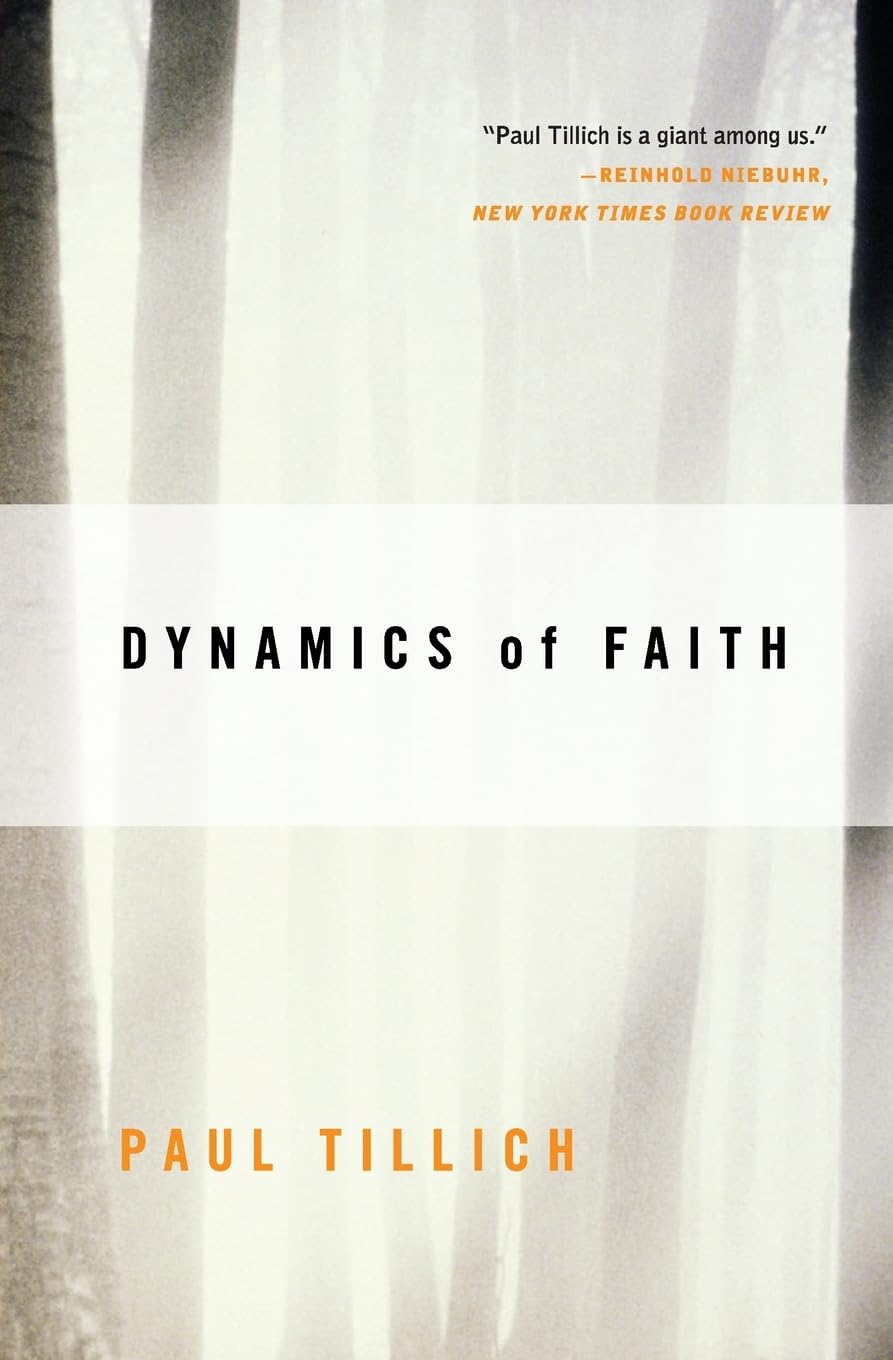
Dynamics of Faith (Perennial Classics)

Description:

One of the greatest books ever written on the subject, Dynamics of Faithis a primer in the philosophy of religion. Paul Tillich, a leading theologian of the twentieth century, explores the idea of faith in all its dimensions, while defining the concept in the process.

This graceful and accessible volume contains a new introduction by Marion Pauck, Tillich's biographer.


Editorial Reviews

From the Back Cover

One of the greatest books ever written on the subject, Dynamics of Faithis a primer in the philosophy of religion. Paul Tillich, a leading theologian of the twentieth century, explores the idea of faith in all its dimensions, while defining the concept in the process.

This graceful and accessible volume contains a new introduction by Marion Pauck, Tillich's biographer.

About the Author

Paul Tillich (1886-1965), one of the great theologians of the twentieth century, taught at Union Theological Seminary, New York, and then at the University of Chicago and Harvard University.

Reviews:

5.0 out of 5 stars Powerful Analysis of the Spiritual Experience

W.A. · April 18, 2007

What is so valuable about this book is its power to clarify and organize the various issues surrounding the spiritual experience. Here are some of Tillich's ideas:Faith as Ultimate Concern. Faith is the centered movement of the whole personality toward our ultimate concern, which is God. That concern alone gives life ultimate meaning and significance.God. God is not a being, acting in time and space, dwelling in a special place, affecting the course of events and being affected by them like any other being in the universe. Such literalism deprives God of ultimacy. It draws him down to the level of the finite and conditional. There are two elements in the notion of God:1. Our personal experience of the holy, an awareness of the presence of the divine.2. The acceptance of the symbols. All the qualities we attribute to God--such as power, love, justice--are symbols taken from our daily experience, and are not information about what God did or will do. If faith calls God "almighty," it uses the human experience of power in order to symbolize the content of its infinite concern, but it does not describe a highest being who can do as he pleases. God is a symbol of God.Discussions about the existence or nonexistence of God are meaningless. The right question is which of the innumerable symbols of faith are most adequate to the meaning of faith, or which symbols of ultimacy express the ultimate without idolatrous elements.Symbols. The holy can never be experienced or expressed directly but can only be experienced and expressed symbolically, through words, rituals, and objects. The symbol is not holy itself, but it points to the holy. Symbols cannot be invented; they grow out of the individual or collective unconscious and cannot function without being accepted by the unconscious dimension of our being. They grow when the situation is ripe for them, and they die when the situation changes.Myths. Myths are symbols of faith combined in stories about divine-human encounters. The fundamental creation of every religious community is a myth that functions as the symbolic expression of ultimate concern. Myth cannot be replaced by philosophy or by an independent code of morals. It keeps faith alive.Atheism. Atheism can only mean the attempt to remove any ultimate concern--to remain unconcerned about the meaning of one's existence. Indifference toward the ultimate question is the only imaginable form of atheism. Perhaps no one can be an atheist.Idolatrous Faith. Making a nation or success one's ultimate concern is idolatry, as is making Jesus or the God of the Old Testament an ultimate concern. Idolatry elevates finite realities to the rank of ultimacy.Risk, Doubt, Courage. There is always a risk that what one has considered a matter of ultimate concern will prove to be a matter of preliminary and transitory concern. If one becomes aware that one has devoted one's life to an idolatrous concern, the meaning of one's life breaks down; the reaction is despair. We always risk making this mistake. A consequence of the risk of faith is doubt. To affirm our faith in spite of our doubt requires courage.Community. Only as a member of a community of faith (even if in isolation or expulsion) can man actualize his faith. The community creates the language of symbol and myth, which cannot be fully understood outside of the community. Without symbol and myth, there is no act of faith, no religious experience.Creeds. Every community of faith tries to formulate the content of its faith in a creed. The purpose of the creed is to protect members of the community from idolatrous concern, which destroys the center of the personality. However, a community's creed must never exclude the presence of doubt. The community of faith that demands unquestioning surrender to its creed as formulated by the religious authorities has become static. The fight against the idolatrous implication of this kind of static faith was waged first by Protestantism and then, when Protestantism itself became static, by the Enlightenment.Protestant Principle. No creedal expression of the ultimate concern of the community--whether in liturgy, doctrine, or ethical precept--is ultimate. Rather, its function is to point to the ultimate which is beyond all of them. No church or person is infallible. No church has the right to put itself in the place of the ultimate. Its truth is judged by the ultimate. No truth or faith can be rejected, no matter what form it may appear in the history of faith, and no truth of faith is ultimate except the one that no man possesses it. This is the "Protestant principle."What Faith Is Not. Faith is not intellectual; it is not belief; and it is not a matter of will. Faith has no connection with theoretical knowledge, whether it is a knowledge on the basis of immediate, prescientific or scientific evidence, or whether it is on the basis of trust in authorities who themselves are dependent on direct or indirect evidence. Faith is not belief, which is knowledge with a low degree of probability. Faith is not a matter of will. No arguments for belief, no command to believe, and no will to believe can create faith.Types of Faith. Every faith is either an ontological or moral type of faith. The ontological type of faith is concerned with the sense of the presence of the holy here and now. There are three types of ontological faith: sacramental faith, mystical faith, and humanism. Moral types of faith are characterized the idea of the law. Again there are three types of moral faith: Juristic (developed in Talmudic Judaism and Islam), conventional (most prominent in Confucianist China), and ethical (represented by the Jewish prophets). As Protestantism developed, it became more and more a representative of the moral type of ultimate concern. In this way it lost many of the ritual traditions of the Catholic churches, as well as a full understanding of the presence of the holy in sacramental and mystical experiences.Reason. There can be no conflict between reason and faith as ultimate concern. Reason conflicts with faith only when the faith is idolatrous.Scientific Truth. Scientific truth and the truth of faith belong to different dimensions of meaning. Science has no right and no power to interfere with faith. Nor can theologians use the latest physical or biological or psychological discoveries to confirm faith.Historical Truth. Faith cannot be shaken or confirmed by historical research. Whether Moses actually existed or whether the New Testament miracle stories actually happened or whether the presently used edition of the Koran is identical with the original text are questions of historical truth, not of the truth of faith.Philosophical Truth. Philosophical truth consists in true concepts concerning the ultimate; the truth of faith consists in true symbols concerning the ultimate.Conventional Faith. Many people have a conventional faith, a traditional attitude without tensions. Their faith is dead. They have no doubt and need no courage to practice this faith. But their faith can come alive again through contact with religious symbols.Integration of the Personality. The integration of the personality can be brought about only by faith. The life of faith can be the way of discipline which regulates the daily life; it can be the way of meditation and contemplation; or it can be the way of concentration on ordinary work, on a special aim or on another human being.Faith, Love, and Action. Faith implies love, which is the desire to be reunited with the divine. The immediate expression of love is action. Faith implies love and is the expression of love in action. While it is true that no human action can produce reunion with God, there is no faith without love and no love without works.Religious Tolerance. All religions try to express the same ultimate concern; they conflict only about the proper expression of this ultimate concern. Most communities of faith are tolerant of each other. Some important exceptions, however, are the Roman Church's assertion that it alone possesses the truth and Protestant fundamentalism's disdain of all other forms of Christianity and religion.

5.0 out of 5 stars Theology, Phenomenology, Ontology...

J.M.M. · March 24, 2025

Tillich’s Dynamics of Faith could be read as a companion piece to his “existential theological” study, The Courage to Be. There is the undeniable influence of both Heidegger and Jaspers guiding Tillich’s interpretation, or better, his “Destruktion” of both the understanding and living reality of faith.Finitude-infinity, subject-object divide, ek-stasis, courage, anxiety, doubt, love (agapē), conscious intentionality, attunement (befindlichkeit), and “ultimate concern” (Sorge) are all issues that Tillich approaches with care and presents with a pristine sense of scholarly clarity.The accessibility of the reading makes it a perfect introduction to Tillich’s theology, yet despite the approachability of his writing, readers will encounter a depth to his interpretation that is transformative.Here, the idea and practice (immersion in!) faith situate a person within the “back-and-forth” of certainty of task (concern) and the perpetual questioning and doubting of that task, demonstrating that “faith” is a radically dynamic way of Being-in-the-world.For me, the most interesting chapter (Three) focuses on “faith and symbols,” and Tillich’s re-reading of the symbols and function of mythology was highly enlightening, indeed, had I read this book when teaching, it would have changed my approach to the ancient philosophical issue of the historical, cultural, intellectual, and spiritual transformation in Greece from “mythos-and-Logos.”To say, as he does, that Christianity is a “broken myth,” simply indicates that it embraces the power of myth as myth and its accompanying symbols as holding the power to move us and direct us in ways that outstrip other forms of “communication.”I also note that Chapter Five, “Truth and Faith” provides an excellent analysis of the “criteria” for establishing the so-called truth or validity of faith and sets its “criteria for correctness” (verificatipon principle) apart from other modes and grades of “knowledge,” or the ways in which we can be said to know and experience the world.I highly recommend this book for all interested in theology and Continental (phenomenology) philosophy – Tillich, although a Protestant philosopher and theologian, might be read as contributing in unique ways the growing contemporary tradition of what is now known as “progressive” Christianity.Dr. James M. MagriniFormer: Philosophy/College of DuPage

Five Stars

J.P. · September 25, 2017

a really good book and in perfect condition

Four Stars

R.D.M.G.S. · May 22, 2015

Excellent material, wonderful explanation of biblical themes!

Dynamics of Faith (Perennial Classics)

Product ID: U0060937130
Condition: New

4.5

AED7186

Price includes VAT & Import Duties
Type: Paperback
Availability: In Stock

Quantity:

|

Order today to get by 7-14 business days

Delivery fee of AED 20. Free for orders above AED 200.

Returns & Warranty policies

Imported From: United States

At BOLO, we work hard to ensure the products you receive are new, genuine, and sourced from reputable suppliers.

BOLO is not an authorized or official retailer for most brands, nor are we affiliated with manufacturers unless specifically stated on a product page. Instead, we source verified sellers, authorized distributors or directly from the manufacturer.

Each product undergoes thorough inspection and verification at our consolidation and fulfilment centers to ensure it meets our strict authenticity and quality standards before being shipped and delivered to you.

If you ever have concerns regarding the authenticity of a product purchased from us, please contact Bolo Support. We will review your inquiry promptly and, if necessary, provide documentation verifying authenticity or offer a suitable resolution.

Your trust is our top priority, and we are committed to maintaining transparency and integrity in every transaction.

All product information, images, descriptions, and reviews originate from the manufacturer or from trusted sellers overseas. BOLO is not affiliated with, endorsed by, or an authorized retailer for most brands listed on our website unless stated otherwise.

While we strive to display accurate information, variations in packaging, labeling, instructions, or formulation may occasionally occur due to regional differences or supplier updates. For detailed or manufacturer-specific information, please contact the brand directly or reach out to BOLO Support for assistance.

Unless otherwise stated, all prices displayed on the product page include applicable taxes and import duties.

BOLO operates in accordance with the laws and regulations of United Arab Emirates. Any items found to be restricted or prohibited for sale within the UAE will be cancelled prior to shipment. We take proactive measures to ensure that only products permitted for sale in United Arab Emirates are listed on our website.

All items are shipped by air, and any products classified as “Dangerous Goods (DG)” under IATA regulations will be removed from the order and cancelled.

All orders are processed manually, and we make every effort to process them promptly once confirmed. Products cancelled due to the above reasons will be permanently removed from listings across the website.

More from this brand

Similar items from “Christianity”

Dynamics of Faith (Perennial Classics)

Product ID: U0060937130
Condition: New

4.5

Dynamics of Faith (Perennial Classics)-0
Type: Paperback

AED7186

Price includes VAT & Import Duties
Availability: In Stock

Quantity:

|

Order today to get by 7-14 business days

Delivery fee of AED 20. Free for orders above AED 200.

Returns & Warranty policies

Imported From: United States

At BOLO, we work hard to ensure the products you receive are new, genuine, and sourced from reputable suppliers.

BOLO is not an authorized or official retailer for most brands, nor are we affiliated with manufacturers unless specifically stated on a product page. Instead, we source verified sellers, authorized distributors or directly from the manufacturer.

Each product undergoes thorough inspection and verification at our consolidation and fulfilment centers to ensure it meets our strict authenticity and quality standards before being shipped and delivered to you.

If you ever have concerns regarding the authenticity of a product purchased from us, please contact Bolo Support. We will review your inquiry promptly and, if necessary, provide documentation verifying authenticity or offer a suitable resolution.

Your trust is our top priority, and we are committed to maintaining transparency and integrity in every transaction.

All product information, images, descriptions, and reviews originate from the manufacturer or from trusted sellers overseas. BOLO is not affiliated with, endorsed by, or an authorized retailer for most brands listed on our website unless stated otherwise.

While we strive to display accurate information, variations in packaging, labeling, instructions, or formulation may occasionally occur due to regional differences or supplier updates. For detailed or manufacturer-specific information, please contact the brand directly or reach out to BOLO Support for assistance.

Unless otherwise stated, all prices displayed on the product page include applicable taxes and import duties.

BOLO operates in accordance with the laws and regulations of United Arab Emirates. Any items found to be restricted or prohibited for sale within the UAE will be cancelled prior to shipment. We take proactive measures to ensure that only products permitted for sale in United Arab Emirates are listed on our website.

All items are shipped by air, and any products classified as “Dangerous Goods (DG)” under IATA regulations will be removed from the order and cancelled.

All orders are processed manually, and we make every effort to process them promptly once confirmed. Products cancelled due to the above reasons will be permanently removed from listings across the website.

Description:

One of the greatest books ever written on the subject, Dynamics of Faithis a primer in the philosophy of religion. Paul Tillich, a leading theologian of the twentieth century, explores the idea of faith in all its dimensions, while defining the concept in the process.

This graceful and accessible volume contains a new introduction by Marion Pauck, Tillich's biographer.


Editorial Reviews

From the Back Cover

One of the greatest books ever written on the subject, Dynamics of Faithis a primer in the philosophy of religion. Paul Tillich, a leading theologian of the twentieth century, explores the idea of faith in all its dimensions, while defining the concept in the process.

This graceful and accessible volume contains a new introduction by Marion Pauck, Tillich's biographer.

About the Author

Paul Tillich (1886-1965), one of the great theologians of the twentieth century, taught at Union Theological Seminary, New York, and then at the University of Chicago and Harvard University.

Reviews:

5.0 out of 5 stars Powerful Analysis of the Spiritual Experience

W.A. · April 18, 2007

What is so valuable about this book is its power to clarify and organize the various issues surrounding the spiritual experience. Here are some of Tillich's ideas:Faith as Ultimate Concern. Faith is the centered movement of the whole personality toward our ultimate concern, which is God. That concern alone gives life ultimate meaning and significance.God. God is not a being, acting in time and space, dwelling in a special place, affecting the course of events and being affected by them like any other being in the universe. Such literalism deprives God of ultimacy. It draws him down to the level of the finite and conditional. There are two elements in the notion of God:1. Our personal experience of the holy, an awareness of the presence of the divine.2. The acceptance of the symbols. All the qualities we attribute to God--such as power, love, justice--are symbols taken from our daily experience, and are not information about what God did or will do. If faith calls God "almighty," it uses the human experience of power in order to symbolize the content of its infinite concern, but it does not describe a highest being who can do as he pleases. God is a symbol of God.Discussions about the existence or nonexistence of God are meaningless. The right question is which of the innumerable symbols of faith are most adequate to the meaning of faith, or which symbols of ultimacy express the ultimate without idolatrous elements.Symbols. The holy can never be experienced or expressed directly but can only be experienced and expressed symbolically, through words, rituals, and objects. The symbol is not holy itself, but it points to the holy. Symbols cannot be invented; they grow out of the individual or collective unconscious and cannot function without being accepted by the unconscious dimension of our being. They grow when the situation is ripe for them, and they die when the situation changes.Myths. Myths are symbols of faith combined in stories about divine-human encounters. The fundamental creation of every religious community is a myth that functions as the symbolic expression of ultimate concern. Myth cannot be replaced by philosophy or by an independent code of morals. It keeps faith alive.Atheism. Atheism can only mean the attempt to remove any ultimate concern--to remain unconcerned about the meaning of one's existence. Indifference toward the ultimate question is the only imaginable form of atheism. Perhaps no one can be an atheist.Idolatrous Faith. Making a nation or success one's ultimate concern is idolatry, as is making Jesus or the God of the Old Testament an ultimate concern. Idolatry elevates finite realities to the rank of ultimacy.Risk, Doubt, Courage. There is always a risk that what one has considered a matter of ultimate concern will prove to be a matter of preliminary and transitory concern. If one becomes aware that one has devoted one's life to an idolatrous concern, the meaning of one's life breaks down; the reaction is despair. We always risk making this mistake. A consequence of the risk of faith is doubt. To affirm our faith in spite of our doubt requires courage.Community. Only as a member of a community of faith (even if in isolation or expulsion) can man actualize his faith. The community creates the language of symbol and myth, which cannot be fully understood outside of the community. Without symbol and myth, there is no act of faith, no religious experience.Creeds. Every community of faith tries to formulate the content of its faith in a creed. The purpose of the creed is to protect members of the community from idolatrous concern, which destroys the center of the personality. However, a community's creed must never exclude the presence of doubt. The community of faith that demands unquestioning surrender to its creed as formulated by the religious authorities has become static. The fight against the idolatrous implication of this kind of static faith was waged first by Protestantism and then, when Protestantism itself became static, by the Enlightenment.Protestant Principle. No creedal expression of the ultimate concern of the community--whether in liturgy, doctrine, or ethical precept--is ultimate. Rather, its function is to point to the ultimate which is beyond all of them. No church or person is infallible. No church has the right to put itself in the place of the ultimate. Its truth is judged by the ultimate. No truth or faith can be rejected, no matter what form it may appear in the history of faith, and no truth of faith is ultimate except the one that no man possesses it. This is the "Protestant principle."What Faith Is Not. Faith is not intellectual; it is not belief; and it is not a matter of will. Faith has no connection with theoretical knowledge, whether it is a knowledge on the basis of immediate, prescientific or scientific evidence, or whether it is on the basis of trust in authorities who themselves are dependent on direct or indirect evidence. Faith is not belief, which is knowledge with a low degree of probability. Faith is not a matter of will. No arguments for belief, no command to believe, and no will to believe can create faith.Types of Faith. Every faith is either an ontological or moral type of faith. The ontological type of faith is concerned with the sense of the presence of the holy here and now. There are three types of ontological faith: sacramental faith, mystical faith, and humanism. Moral types of faith are characterized the idea of the law. Again there are three types of moral faith: Juristic (developed in Talmudic Judaism and Islam), conventional (most prominent in Confucianist China), and ethical (represented by the Jewish prophets). As Protestantism developed, it became more and more a representative of the moral type of ultimate concern. In this way it lost many of the ritual traditions of the Catholic churches, as well as a full understanding of the presence of the holy in sacramental and mystical experiences.Reason. There can be no conflict between reason and faith as ultimate concern. Reason conflicts with faith only when the faith is idolatrous.Scientific Truth. Scientific truth and the truth of faith belong to different dimensions of meaning. Science has no right and no power to interfere with faith. Nor can theologians use the latest physical or biological or psychological discoveries to confirm faith.Historical Truth. Faith cannot be shaken or confirmed by historical research. Whether Moses actually existed or whether the New Testament miracle stories actually happened or whether the presently used edition of the Koran is identical with the original text are questions of historical truth, not of the truth of faith.Philosophical Truth. Philosophical truth consists in true concepts concerning the ultimate; the truth of faith consists in true symbols concerning the ultimate.Conventional Faith. Many people have a conventional faith, a traditional attitude without tensions. Their faith is dead. They have no doubt and need no courage to practice this faith. But their faith can come alive again through contact with religious symbols.Integration of the Personality. The integration of the personality can be brought about only by faith. The life of faith can be the way of discipline which regulates the daily life; it can be the way of meditation and contemplation; or it can be the way of concentration on ordinary work, on a special aim or on another human being.Faith, Love, and Action. Faith implies love, which is the desire to be reunited with the divine. The immediate expression of love is action. Faith implies love and is the expression of love in action. While it is true that no human action can produce reunion with God, there is no faith without love and no love without works.Religious Tolerance. All religions try to express the same ultimate concern; they conflict only about the proper expression of this ultimate concern. Most communities of faith are tolerant of each other. Some important exceptions, however, are the Roman Church's assertion that it alone possesses the truth and Protestant fundamentalism's disdain of all other forms of Christianity and religion.

5.0 out of 5 stars Theology, Phenomenology, Ontology...

J.M.M. · March 24, 2025

Tillich’s Dynamics of Faith could be read as a companion piece to his “existential theological” study, The Courage to Be. There is the undeniable influence of both Heidegger and Jaspers guiding Tillich’s interpretation, or better, his “Destruktion” of both the understanding and living reality of faith.Finitude-infinity, subject-object divide, ek-stasis, courage, anxiety, doubt, love (agapē), conscious intentionality, attunement (befindlichkeit), and “ultimate concern” (Sorge) are all issues that Tillich approaches with care and presents with a pristine sense of scholarly clarity.The accessibility of the reading makes it a perfect introduction to Tillich’s theology, yet despite the approachability of his writing, readers will encounter a depth to his interpretation that is transformative.Here, the idea and practice (immersion in!) faith situate a person within the “back-and-forth” of certainty of task (concern) and the perpetual questioning and doubting of that task, demonstrating that “faith” is a radically dynamic way of Being-in-the-world.For me, the most interesting chapter (Three) focuses on “faith and symbols,” and Tillich’s re-reading of the symbols and function of mythology was highly enlightening, indeed, had I read this book when teaching, it would have changed my approach to the ancient philosophical issue of the historical, cultural, intellectual, and spiritual transformation in Greece from “mythos-and-Logos.”To say, as he does, that Christianity is a “broken myth,” simply indicates that it embraces the power of myth as myth and its accompanying symbols as holding the power to move us and direct us in ways that outstrip other forms of “communication.”I also note that Chapter Five, “Truth and Faith” provides an excellent analysis of the “criteria” for establishing the so-called truth or validity of faith and sets its “criteria for correctness” (verificatipon principle) apart from other modes and grades of “knowledge,” or the ways in which we can be said to know and experience the world.I highly recommend this book for all interested in theology and Continental (phenomenology) philosophy – Tillich, although a Protestant philosopher and theologian, might be read as contributing in unique ways the growing contemporary tradition of what is now known as “progressive” Christianity.Dr. James M. MagriniFormer: Philosophy/College of DuPage

Five Stars

J.P. · September 25, 2017

a really good book and in perfect condition

Four Stars

R.D.M.G.S. · May 22, 2015

Excellent material, wonderful explanation of biblical themes!

More from this brand

Similar items from “Christianity”