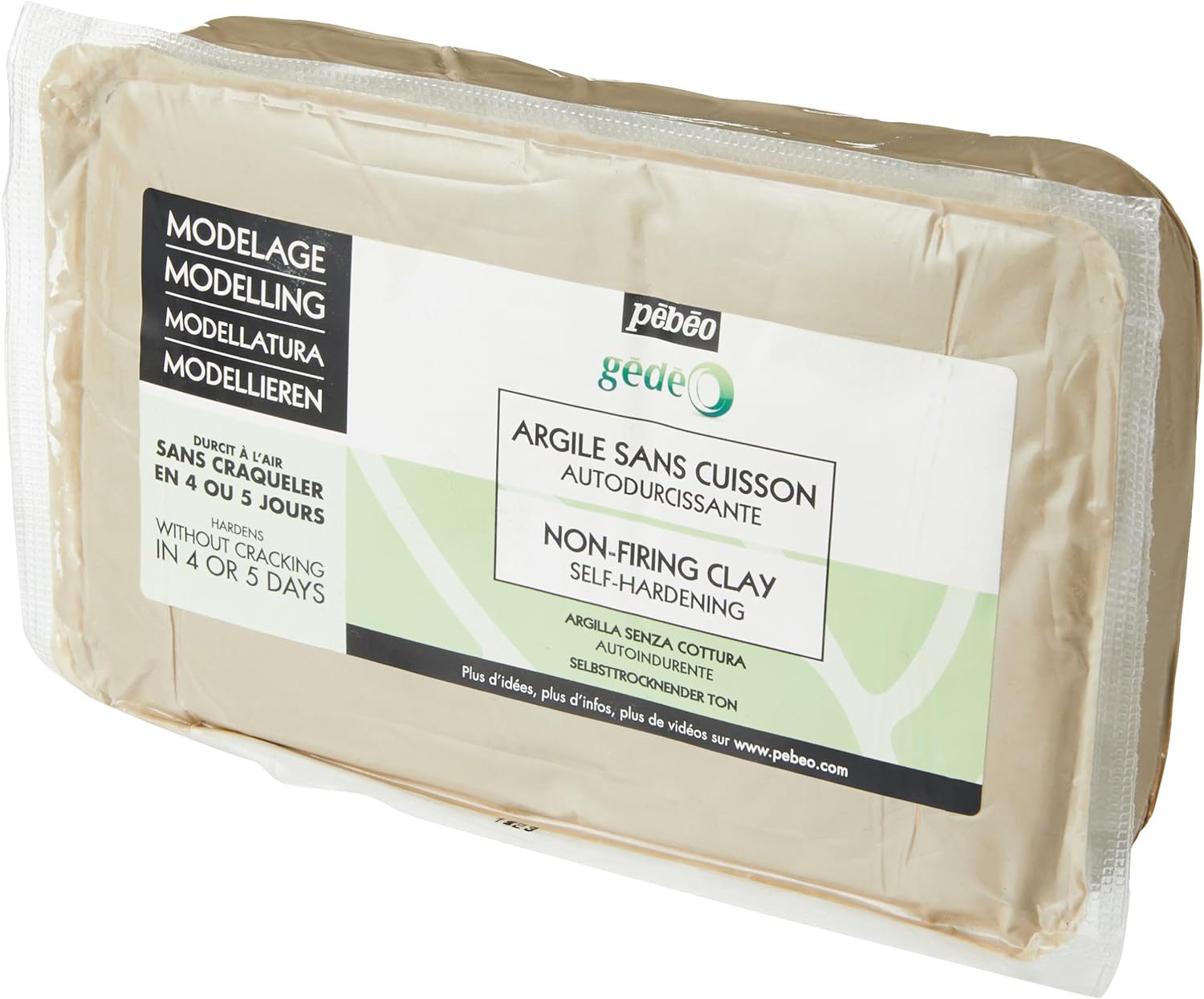
Description:
Reviews:
5.0 out of 5 stars its clay
(function() { P.when('cr-A', 'ready').execute(function(A) { if(typeof A.toggleExpanderAriaLabel === 'function') { A.toggleExpanderAriaLabel('review_text_read_more', 'Read more of this review', 'Read less of this review'); } }); })(); .review-text-read-more-expander:focus-visible { outline: 2px solid #2162a1; outline-offset: 2px; border-radius: 5px; } Gay Head cliffs in Martha's Vineyard consist almost entirely of clay.Clay is a finely-grained natural rock or soil material that combines one or more clay minerals with possible traces of quartz (SiO2), metal oxides (Al2O3 , MgO etc.) and organic matter. Clay deposits are mostly composed of phyllosilicate minerals containing variable amounts of water trapped in the mineral structure. Clays are plastic due to particle size and geometry as well as water content, and become hard, brittle and non-plastic upon drying or firing.[1][2][3] Depending on the soil's content in which it is found, clay can appear in various colours from white to dull grey or brown to deep orange-red.Electron microscope photograph of smectite clay – magnification 23,500×Although many naturally occurring deposits include both silts and clay, clays are distinguished from other fine-grained soils by differences in size and mineralogy. Silts, which are fine-grained soils that do not include clay minerals, tend to have larger particle sizes than clays. There is, however, some overlap in particle size and other physical properties. The distinction between silt and clay varies by discipline. Geologists and soil scientists usually consider the separation to occur at a particle size of 2 µm (clays being finer than silts), sedimentologists often use 4–5 μm, and colloid chemists use 1 μm.[1] Geotechnical engineers distinguish between silts and clays based on the plasticity properties of the soil, as measured by the soils' Atterberg limits. ISO 14688 grades clay particles as being smaller than 2 μm and silt particles as being larger.Mixtures of sand, silt and less than 40% clay are called loam. Loam makes good soil and is used as a building material.FormationDeforestation for clay extraction in Rio de Janeiro, Brazil. The picture is of Morro da Covanca, Jacarepaguá.Clay minerals typically form over long periods of time as a result of the gradual chemical weathering of rocks, usually silicate-bearing, by low concentrations of carbonic acid and other diluted solvents. These solvents, usually acidic, migrate through the weathering rock after leaching through upper weathered layers. In addition to the weathering process, some clay minerals are formed through hydrothermal activity. There are two types of clay deposits: primary and secondary. Primary clays form as residual deposits in soil and remain at the site of formation. Secondary clays are clays that have been transported from their original location by water erosion and deposited in a new sedimentary deposit.[4] Clay deposits are typically associated with very low energy depositional environments such as big lakes and marine basins.GroupingDepending on the academic source, there are three or four main groups of clays: kaolinite, montmorillonite-smectite, illite, and chlorite. Chlorites are not always considered to be a clay, sometimes being classified as a separate group within the phyllosilicates. There are approximately 30 different types of "pure" clays in these categories, but most "natural" clay deposits are mixtures of these different types, along with other weathered minerals.Varve (or varved clay) is clay with visible annual layers, which are formed by seasonal deposition of those layers and are marked by differences in erosion and organic content. This type of deposit is common in former glacial lakes. When fine sediments are delivered into the calm waters of these glacial lake basins away from the shoreline, they settle to the lake bed. The resulting seasonal layering is preserved in an even distribution of clay sediment banding.[4]Quick clay is a unique type of marine clay indigenous to the glaciated terrains of Norway, Canada, Northern Ireland, and Sweden. It is a highly sensitive clay, prone to liquefaction, which has been involved in several deadly landslides.Historical and modern usesClay layers in a construction site. Dry clay is normally much more stable than sand with regard to excavations.Clay used to form tiles and other ceramic products.Bottle stopper made of clay, 14th centuryClays exhibit plasticity when mixed with water in certain proportions. However, when dry, clay becomes firm and when fired in a kiln, permanent physical and chemical changes occur. These changes convert the clay into a ceramic material. Because of these properties, clay is used for making pottery, both utilitarian and decorative, and construction products, such as bricks, wall and floor tiles. Different types of clay, when used with different minerals and firing conditions, are used to produce earthenware, stoneware, and porcelain. Prehistoric humans discovered the useful properties of clay. Some of the earliest pottery shards recovered are from central Honshu, Japan. They are associated with the Jōmon culture and deposits they were recovered from have been dated to around 14,000 BC.[6]Clay tablets were the first known writing medium.[7] Scribes wrote by inscribing them with cuneiform script using a blunt reed called a stylus. Purpose-made clay balls were also used as sling ammunition.Clays sintered in fire were the first form of ceramic. Bricks, cooking pots, art objects, dishware, smoking pipes, and even musical instruments such as the ocarina can all be shaped from clay before being fired. Clay is also used in many industrial processes, such as paper making, cement production, and chemical filtering. Until the late 20th century, bentonite clay was widely used as a mold binder in the manufacture of sand castings.Clay, being relatively impermeable to water, is also used where natural seals are needed, such as in the cores of dams, or as a barrier in landfills against toxic seepage (lining the landfill, preferably in combination with geotextiles).[8] (See puddling.)Studies in the early 21st century have investigated clay's absorption capacities in various applications, such as the removal of heavy metals from waste water and air purification.[9][10]Medical useTraditional uses of clay as medicine go back to prehistoric times. An example is Armenian bole, which is used to soothe an upset stomach. Some animals such as parrots and pigs ingest clay for similar reasons.[11] Kaolin clay and attapulgite have been used as anti-diarrheal medicines.As a building materialClay as the defining ingredient of loam is one of the oldest building materials on Earth, among other ancient, naturally-occurring geologic materials such as stone and organic materials like wood.[12] Between one-half and two-thirds of the world's population, in both traditional societies as well as developed countries, still live or work in buildings made with clay, often baked into brick, as an essential part of its load-bearing structure. Also a primary ingredient in many natural building techniques, clay is used to create adobe, cob, cordwood, and rammed earth structures and building elements such as wattle and daub, clay plaster, clay render case, clay floors and clay paints and ceramic building material. Clay was used as a mortar in brick chimneys and stone walls where protected from water.
5.0 out of 5 stars Good product.
Easy to mould, dries quite quick.
4.0 out of 5 stars Good value
This was quite hard to use but good value for money
5.0 out of 5 stars Dense clay, easy drying
It's not like the clay I used in school and it's not polymer - it's like a cross between both.It's quite dense and you have to be strong to handle large amounts at once. If rolled too thin it will break when drying, so I used large chunks.It dried easily, was easy to wash from my hands. If you are a total beginner willing to make a mess maybe opt for something more cheap. This is a higher quality product.Also have to store in a damp plastic bag when not in use so it doesn't dry out!
5.0 out of 5 stars Potty for clay!
I have just bought myself a mini potter’s wheel and wasn’t sure what clay to use with it so I got this. I do pottery at a class but I haven’t got a kiln at home so air dry seemed the way forward.It works amazingly well and now wish I could get it in bigger bags! I made the little vase and when it had dried I coloured it with a rose gold chrome pen and it looks amazing! So glad I got this clay, it is so nice to work with!
5.0 out of 5 stars Good
Good
3.0 out of 5 stars A Decent Product with Some Caveats
I recently purchased this product, and while it has its merits, there are a few important considerations to keep in mind.The clay, when wet, is easy to work with and mold into various shapes and designs. It's pliable and great for creative projects. However, once it dries, it has a tendency to shrink and may develop cracks, which can be a bit frustrating. The extent of shrinking and cracking seems to be more noticeable when working with larger or thicker pieces, so be prepared for that.Another important point to note is the drying time. While the product claims a fast drying time, in reality, it varies significantly depending on the thickness of the material you're working with. Thicker pieces can take well over 24 hours to dry completely. So, if you're in a hurry to finish your project, you might want to consider a different product with a quicker drying time.In summary, this product is decent for creative projects, but you need to be prepared for the possibility of shrinking and cracking during the drying process. Also, keep in mind that drying times can be longer than advertised, especially for thicker pieces. If you're patient and plan accordingly, it can still be a useful addition to your art supplies.
4.0 out of 5 stars Good quality
Clay is perfect for moulding.
Perfect for beginners
(function() { P.when('cr-A', 'ready').execute(function(A) { if(typeof A.toggleExpanderAriaLabel === 'function') { A.toggleExpanderAriaLabel('review_text_read_more', 'Read more of this review', 'Read less of this review'); } }); })(); .review-text-read-more-expander:focus-visible { outline: 2px solid #2162a1; outline-offset: 2px; border-radius: 5px; } Came quicker than expected perfectly intact. Clay is perfect for beginners, drys really quickly so make sure to have a spray bottle if you want to keep it sculptable.
Genial
Arcilla de muy buena calidad, la usamos para un par de proyectos del cole de mi hijo
Kul till pyssel
Rolig för att pyssla med
Excellent, tenue parfaite
The media could not be loaded. Cette argile est excellente. Ma fille l'utilise pour ses petites créations, et c'est très facile à utiliser, pas de craquements, et souple.
Einfach
Schneller Versand.Einfache Verarbeitung.
Visit the PEBEO Store
Gedeo 1.5 Kg Air Drying Clay ,Grey,766302
AED24041


Quantity:
Order today to get by 7-14 business days
This item qualifies for free delivery
Imported From: United Kingdom
At BOLO, we work hard to ensure the products you receive are new, genuine, and sourced from reputable suppliers.
BOLO is not an authorized or official retailer for most brands, nor are we affiliated with manufacturers unless specifically stated on a product page. Instead, we source verified sellers, authorized distributors or directly from the manufacturer.
Each product undergoes thorough inspection and verification at our consolidation and fulfilment centers to ensure it meets our strict authenticity and quality standards before being shipped and delivered to you.
If you ever have concerns regarding the authenticity of a product purchased from us, please contact Bolo Support. We will review your inquiry promptly and, if necessary, provide documentation verifying authenticity or offer a suitable resolution.
Your trust is our top priority, and we are committed to maintaining transparency and integrity in every transaction.
All product information, images, descriptions, and reviews originate from the manufacturer or from trusted sellers overseas. BOLO is not affiliated with, endorsed by, or an authorized retailer for most brands listed on our website unless stated otherwise.
While we strive to display accurate information, variations in packaging, labeling, instructions, or formulation may occasionally occur due to regional differences or supplier updates. For detailed or manufacturer-specific information, please contact the brand directly or reach out to BOLO Support for assistance.
Unless otherwise stated, all prices displayed on the product page include applicable taxes and import duties.
BOLO operates in accordance with the laws and regulations of United Arab Emirates. Any items found to be restricted or prohibited for sale within the UAE will be cancelled prior to shipment. We take proactive measures to ensure that only products permitted for sale in United Arab Emirates are listed on our website.
All items are shipped by air, and any products classified as “Dangerous Goods (DG)” under IATA regulations will be removed from the order and cancelled.
All orders are processed manually, and we make every effort to process them promptly once confirmed. Products cancelled due to the above reasons will be permanently removed from listings across the website.
Similar suggestions by Bolo
More from this brand
Similar items from “Clay”
Share with
Or share with link
https://www.bolo.ae/products/KO005FOT8X2
Visit the PEBEO Store
Gedeo 1.5 Kg Air Drying Clay ,Grey,766302


AED24041
Quantity:
Order today to get by 7-14 business days
This item qualifies for free delivery
Imported From: United Kingdom
At BOLO, we work hard to ensure the products you receive are new, genuine, and sourced from reputable suppliers.
BOLO is not an authorized or official retailer for most brands, nor are we affiliated with manufacturers unless specifically stated on a product page. Instead, we source verified sellers, authorized distributors or directly from the manufacturer.
Each product undergoes thorough inspection and verification at our consolidation and fulfilment centers to ensure it meets our strict authenticity and quality standards before being shipped and delivered to you.
If you ever have concerns regarding the authenticity of a product purchased from us, please contact Bolo Support. We will review your inquiry promptly and, if necessary, provide documentation verifying authenticity or offer a suitable resolution.
Your trust is our top priority, and we are committed to maintaining transparency and integrity in every transaction.
All product information, images, descriptions, and reviews originate from the manufacturer or from trusted sellers overseas. BOLO is not affiliated with, endorsed by, or an authorized retailer for most brands listed on our website unless stated otherwise.
While we strive to display accurate information, variations in packaging, labeling, instructions, or formulation may occasionally occur due to regional differences or supplier updates. For detailed or manufacturer-specific information, please contact the brand directly or reach out to BOLO Support for assistance.
Unless otherwise stated, all prices displayed on the product page include applicable taxes and import duties.
BOLO operates in accordance with the laws and regulations of United Arab Emirates. Any items found to be restricted or prohibited for sale within the UAE will be cancelled prior to shipment. We take proactive measures to ensure that only products permitted for sale in United Arab Emirates are listed on our website.
All items are shipped by air, and any products classified as “Dangerous Goods (DG)” under IATA regulations will be removed from the order and cancelled.
All orders are processed manually, and we make every effort to process them promptly once confirmed. Products cancelled due to the above reasons will be permanently removed from listings across the website.
Description:
Reviews:
5.0 out of 5 stars its clay
(function() { P.when('cr-A', 'ready').execute(function(A) { if(typeof A.toggleExpanderAriaLabel === 'function') { A.toggleExpanderAriaLabel('review_text_read_more', 'Read more of this review', 'Read less of this review'); } }); })(); .review-text-read-more-expander:focus-visible { outline: 2px solid #2162a1; outline-offset: 2px; border-radius: 5px; } Gay Head cliffs in Martha's Vineyard consist almost entirely of clay.Clay is a finely-grained natural rock or soil material that combines one or more clay minerals with possible traces of quartz (SiO2), metal oxides (Al2O3 , MgO etc.) and organic matter. Clay deposits are mostly composed of phyllosilicate minerals containing variable amounts of water trapped in the mineral structure. Clays are plastic due to particle size and geometry as well as water content, and become hard, brittle and non-plastic upon drying or firing.[1][2][3] Depending on the soil's content in which it is found, clay can appear in various colours from white to dull grey or brown to deep orange-red.Electron microscope photograph of smectite clay – magnification 23,500×Although many naturally occurring deposits include both silts and clay, clays are distinguished from other fine-grained soils by differences in size and mineralogy. Silts, which are fine-grained soils that do not include clay minerals, tend to have larger particle sizes than clays. There is, however, some overlap in particle size and other physical properties. The distinction between silt and clay varies by discipline. Geologists and soil scientists usually consider the separation to occur at a particle size of 2 µm (clays being finer than silts), sedimentologists often use 4–5 μm, and colloid chemists use 1 μm.[1] Geotechnical engineers distinguish between silts and clays based on the plasticity properties of the soil, as measured by the soils' Atterberg limits. ISO 14688 grades clay particles as being smaller than 2 μm and silt particles as being larger.Mixtures of sand, silt and less than 40% clay are called loam. Loam makes good soil and is used as a building material.FormationDeforestation for clay extraction in Rio de Janeiro, Brazil. The picture is of Morro da Covanca, Jacarepaguá.Clay minerals typically form over long periods of time as a result of the gradual chemical weathering of rocks, usually silicate-bearing, by low concentrations of carbonic acid and other diluted solvents. These solvents, usually acidic, migrate through the weathering rock after leaching through upper weathered layers. In addition to the weathering process, some clay minerals are formed through hydrothermal activity. There are two types of clay deposits: primary and secondary. Primary clays form as residual deposits in soil and remain at the site of formation. Secondary clays are clays that have been transported from their original location by water erosion and deposited in a new sedimentary deposit.[4] Clay deposits are typically associated with very low energy depositional environments such as big lakes and marine basins.GroupingDepending on the academic source, there are three or four main groups of clays: kaolinite, montmorillonite-smectite, illite, and chlorite. Chlorites are not always considered to be a clay, sometimes being classified as a separate group within the phyllosilicates. There are approximately 30 different types of "pure" clays in these categories, but most "natural" clay deposits are mixtures of these different types, along with other weathered minerals.Varve (or varved clay) is clay with visible annual layers, which are formed by seasonal deposition of those layers and are marked by differences in erosion and organic content. This type of deposit is common in former glacial lakes. When fine sediments are delivered into the calm waters of these glacial lake basins away from the shoreline, they settle to the lake bed. The resulting seasonal layering is preserved in an even distribution of clay sediment banding.[4]Quick clay is a unique type of marine clay indigenous to the glaciated terrains of Norway, Canada, Northern Ireland, and Sweden. It is a highly sensitive clay, prone to liquefaction, which has been involved in several deadly landslides.Historical and modern usesClay layers in a construction site. Dry clay is normally much more stable than sand with regard to excavations.Clay used to form tiles and other ceramic products.Bottle stopper made of clay, 14th centuryClays exhibit plasticity when mixed with water in certain proportions. However, when dry, clay becomes firm and when fired in a kiln, permanent physical and chemical changes occur. These changes convert the clay into a ceramic material. Because of these properties, clay is used for making pottery, both utilitarian and decorative, and construction products, such as bricks, wall and floor tiles. Different types of clay, when used with different minerals and firing conditions, are used to produce earthenware, stoneware, and porcelain. Prehistoric humans discovered the useful properties of clay. Some of the earliest pottery shards recovered are from central Honshu, Japan. They are associated with the Jōmon culture and deposits they were recovered from have been dated to around 14,000 BC.[6]Clay tablets were the first known writing medium.[7] Scribes wrote by inscribing them with cuneiform script using a blunt reed called a stylus. Purpose-made clay balls were also used as sling ammunition.Clays sintered in fire were the first form of ceramic. Bricks, cooking pots, art objects, dishware, smoking pipes, and even musical instruments such as the ocarina can all be shaped from clay before being fired. Clay is also used in many industrial processes, such as paper making, cement production, and chemical filtering. Until the late 20th century, bentonite clay was widely used as a mold binder in the manufacture of sand castings.Clay, being relatively impermeable to water, is also used where natural seals are needed, such as in the cores of dams, or as a barrier in landfills against toxic seepage (lining the landfill, preferably in combination with geotextiles).[8] (See puddling.)Studies in the early 21st century have investigated clay's absorption capacities in various applications, such as the removal of heavy metals from waste water and air purification.[9][10]Medical useTraditional uses of clay as medicine go back to prehistoric times. An example is Armenian bole, which is used to soothe an upset stomach. Some animals such as parrots and pigs ingest clay for similar reasons.[11] Kaolin clay and attapulgite have been used as anti-diarrheal medicines.As a building materialClay as the defining ingredient of loam is one of the oldest building materials on Earth, among other ancient, naturally-occurring geologic materials such as stone and organic materials like wood.[12] Between one-half and two-thirds of the world's population, in both traditional societies as well as developed countries, still live or work in buildings made with clay, often baked into brick, as an essential part of its load-bearing structure. Also a primary ingredient in many natural building techniques, clay is used to create adobe, cob, cordwood, and rammed earth structures and building elements such as wattle and daub, clay plaster, clay render case, clay floors and clay paints and ceramic building material. Clay was used as a mortar in brick chimneys and stone walls where protected from water.
5.0 out of 5 stars Good product.
Easy to mould, dries quite quick.
4.0 out of 5 stars Good value
This was quite hard to use but good value for money
5.0 out of 5 stars Dense clay, easy drying
It's not like the clay I used in school and it's not polymer - it's like a cross between both.It's quite dense and you have to be strong to handle large amounts at once. If rolled too thin it will break when drying, so I used large chunks.It dried easily, was easy to wash from my hands. If you are a total beginner willing to make a mess maybe opt for something more cheap. This is a higher quality product.Also have to store in a damp plastic bag when not in use so it doesn't dry out!
5.0 out of 5 stars Potty for clay!
I have just bought myself a mini potter’s wheel and wasn’t sure what clay to use with it so I got this. I do pottery at a class but I haven’t got a kiln at home so air dry seemed the way forward.It works amazingly well and now wish I could get it in bigger bags! I made the little vase and when it had dried I coloured it with a rose gold chrome pen and it looks amazing! So glad I got this clay, it is so nice to work with!
5.0 out of 5 stars Good
Good
3.0 out of 5 stars A Decent Product with Some Caveats
I recently purchased this product, and while it has its merits, there are a few important considerations to keep in mind.The clay, when wet, is easy to work with and mold into various shapes and designs. It's pliable and great for creative projects. However, once it dries, it has a tendency to shrink and may develop cracks, which can be a bit frustrating. The extent of shrinking and cracking seems to be more noticeable when working with larger or thicker pieces, so be prepared for that.Another important point to note is the drying time. While the product claims a fast drying time, in reality, it varies significantly depending on the thickness of the material you're working with. Thicker pieces can take well over 24 hours to dry completely. So, if you're in a hurry to finish your project, you might want to consider a different product with a quicker drying time.In summary, this product is decent for creative projects, but you need to be prepared for the possibility of shrinking and cracking during the drying process. Also, keep in mind that drying times can be longer than advertised, especially for thicker pieces. If you're patient and plan accordingly, it can still be a useful addition to your art supplies.
4.0 out of 5 stars Good quality
Clay is perfect for moulding.
Perfect for beginners
(function() { P.when('cr-A', 'ready').execute(function(A) { if(typeof A.toggleExpanderAriaLabel === 'function') { A.toggleExpanderAriaLabel('review_text_read_more', 'Read more of this review', 'Read less of this review'); } }); })(); .review-text-read-more-expander:focus-visible { outline: 2px solid #2162a1; outline-offset: 2px; border-radius: 5px; } Came quicker than expected perfectly intact. Clay is perfect for beginners, drys really quickly so make sure to have a spray bottle if you want to keep it sculptable.
Genial
Arcilla de muy buena calidad, la usamos para un par de proyectos del cole de mi hijo
Kul till pyssel
Rolig för att pyssla med
Excellent, tenue parfaite
The media could not be loaded. Cette argile est excellente. Ma fille l'utilise pour ses petites créations, et c'est très facile à utiliser, pas de craquements, et souple.
Einfach
Schneller Versand.Einfache Verarbeitung.
Similar suggestions by Bolo
More from this brand
Similar items from “Clay”
Share with
Or share with link
https://www.bolo.ae/products/KO005FOT8X2