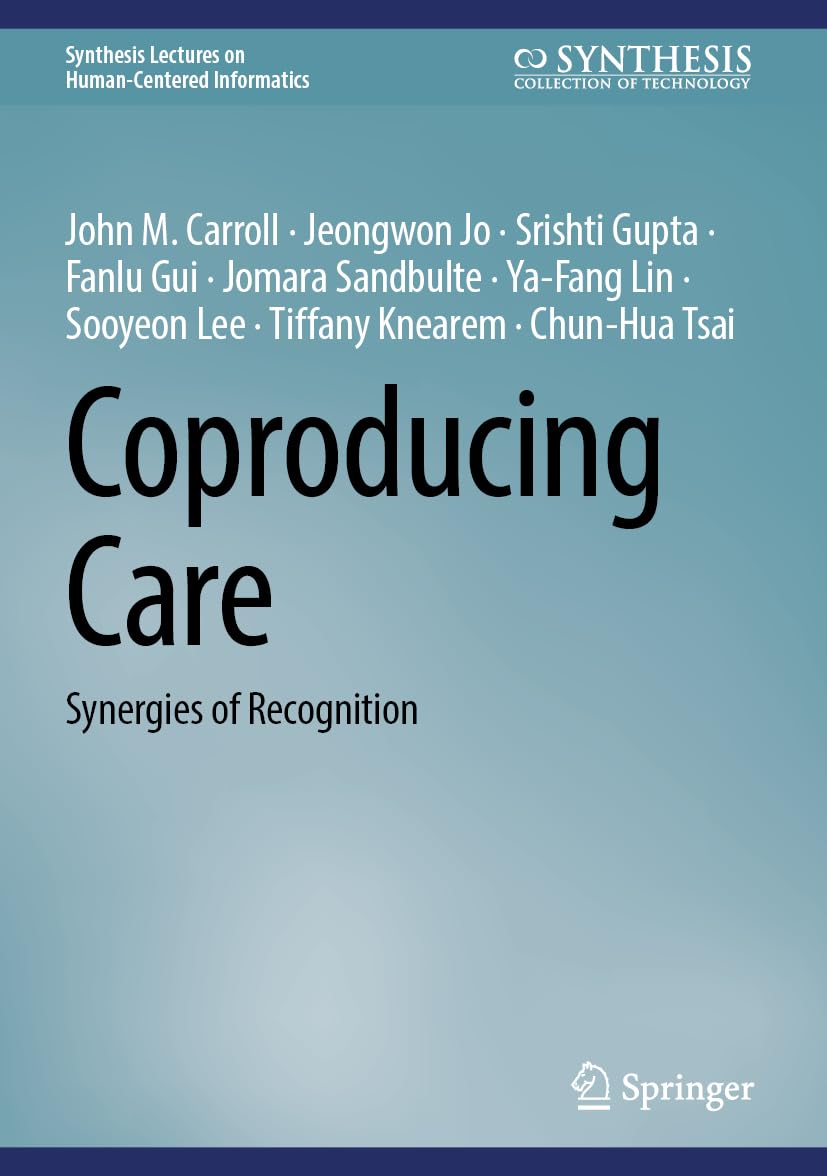
Description:
From the Back Cover
This book explores research around reciprocal participation in care activities across a variety of everyday settings from the perspective of HCI researchers. It challenges traditional conceptions of caregiving in which care is provided and received and highlights the synergistic outcomes that can be obtained when all participants are active contributors. Through diverse case studies, including family and local community dynamics, the book illustrates how coproduction can enhance the efficacy of care while also increasing the personal empowerment, community engagement, and social capital of those receiving, providing, and designing care services. The research posits that recognizing and leveraging the capacities of all stakeholders, including marginalized members, can lead to more effective and inclusive care system design and implementation. The book suggests that coproduction can reshape how care is perceived and delivered, and it proposes research practices for HCI practitioners and beyond for designing to facilitate such coproduction of care.
Seven case studies relating to a wide range of coproducing care situations are examined, including examining how stakeholders with different capacities coproduced overall well-being and childcare support in family dynamics and relating to local water quality, volunteer efforts, disaster relief programs, food security initiatives, and even beer-brewing events with collective settings. The book provides a comprehensive framework for understanding coproduced care, highlighting its benefits in fostering equality and agency among individuals and generating synergistic collective outcomes as a contrast to the traditional care delivery.
In addition, this book:
- Provides a comprehensive framework for understanding coproduced care in contrast to the traditional care delivery model
- Emphasizes recognizing stakeholder needs and contributions to leverage the capacities of otherwise marginalized groups
- Explores care coproduction through case studies to showcase effective practices to maximize positive well-being outcomes
About the Author
John M. Carroll is Distinguished Professor Emeritus of Information Sciences and Technology at the Pennsylvania State University. His research is in methods and theory in human–computer interaction, particularly as applied to Internet tools for collaborative learning and problem solving, and design of interactive information systems. His books include Toward a Structural Psychology of Cinema (Mouton, 1980), What’s in a Name? (W. H. Freeman, 1985), The Nurnberg Funnel (MIT, 1990), Scenario-Based Design (McGraw Hill, 1995), Making Use (MIT, 2000), Usability Engineering (Morgan-Kaufmann, 2002, with M.B. Rosson), Rationale-Based Software Engineering (Springer, 2008, with J. Burge, R. McCall and I. Mistrik), The Neighborhood in the Internet (Routledge, 2012), and Innovative Practices in Teaching Information Sciences and Technology (Springer, 2014). Carroll serves on several advisory and editorial boards for journals, handbooks, and series. He is Editor of the Synthesis Lectures on Human-Centered Informatics. In 2021, he received Pioneer in HCI Award from IFIP TC13.
Jeongwon Jo is Ph.D. Candidate at the College of Information Science and Technology at Pennsylvania State University. She is Human–Computer Interaction (HCI) Researcher with a focus on community resilience, social computing, and online-mediated support. Her work appeared in leading computer-supported cooperative work and community informatics venues, including ACM CHI, ACM CSCW, ACM GoodIT, C&T, and iConference. She is interested in understanding how existing digital systems for peer-to-peer support misalign with the values of users and marginalized populations and redesigning them for more ethical directions.
Srishti Gupta received her Ph.D. in 2023 from the College of Information Sciences and Technology at Pennsylvania State University, where she was a member of the Collaboration and Innovation Lab led by Dr. John M. Carroll. She is currently a Visiting Assistant Professor at the University at Albany, State University of New York. Previously, she worked as a UX Researcher at the Healthcare Innovation and Technology Lab (HITLAB), a health informatics research lab based in New York City. Dr. Gupta’s research lies at the intersection of Human-Centered AI, Sustainable HCI, and Social Computing. Her projects have included community-based environmental monitoring, emergency management in Indigenous communities, managing uncertainty in rare diseases, and improving learning and social outcomes for neurodiverse students.
Fanlu Gui is UX Researcher. She received her Ph.D. in informatics from the Pennsylvania State University. Her research has focused on exploring the use of technology to support community engagement in both local communities and online exercise groups. Her work has been published in venues such as the International Journal of Human-Computer Studies and the GROUP conference.
Jomara Sandbulte is Assistant Professor at the University of Minnesota at Duluth: Swenson College of Science and Engineering, Department of Computer Science. She received her Ph.D. in information sciences and technology at the Pennsylvania State University. She is Human–Computer Interaction (HCI) Researcher with an expertise in health informatics. Sandbulte’s work explores how technology can be used to support individuals’ health and well-being by examining existing systems and building alternatives. Her research has shed important light on health informatics in HCI and design research, and it has appeared in leading computing venues including the International Journal of Human-Computer Interaction (IJHCI) and the EAI International Conference on Pervasive Computing Technologies for Healthcare (PervasiveHealth). Prior to graduate school, she has worked in industry developing mobile devices solutions at Samsung Research, Latin America.
Ya-Fang Lee is Passionate HCI Researcher and Ph.D. Student at Penn State University, mentored by Prof. John Carroll. Her research intersects computer-mediated communication and ubiquitous computing, focusing on creating supportive systems through qualitative research and design methodologies. Committed to social and environmental sustainability, her objectives include designing technological innovations that enhance mental wellness, motivate individuals toward their long-term goals, and encourage prosocial behaviors. Specifically, Ya-Fang's work on everyday technology aims to leverage professional and social support to facilitate positive behavioral changes and strengthen close relationships.
Sooyeon Lee, Ph.D., is Assistant Professor in the Department of Informatics in the Ying Wu College of Computing at New Jersey Institute of Technology (NJIT). She received her B.S. summa cum laude from the Pennsylvania State University and her Ph.D. in information sciences and technology from the Pennsylvania State University. Lee performs research on accessible AI technology, AI-powered assistive technology, and Human–AI collaboration/interaction for the community of the blind and deaf and hard of hearing users. Her goal is to empower and augment capabilities and promote inclusive experiences in both personal and social spaces through new technologies. Her work has been published in top-tier human–computer interaction and computing accessibility journals and conferences, including ACM Conference on Human Factors in Computing Systems (CHI), ACM SIGACCESS Conference on Computers and Accessibility (ASSETS), and ACM SIGCHI Conferences on Computer-Supported Cooperative Work and Social Computing (CSCW).
Tiffany Knearem received her Ph.D. in information sciences and technology from Pennsylvania State University in 2021, advised by Dr. John M. Carroll. Her dissertation focused on understanding and enabling community innovation through information and communication technologies, specifically, community-based care during COVID-19. She is an Affiliated Assistant Professor at MBZUAI and a User Research Consultant, formerly of Google and Meta. Her recent research interests span topics of human-AI alignment, AI-supported design workflows and community informatics. Prior to her career in research, she taught English abroad in Japan through the Japan Exchange and teaching Program (JET). Her undergraduate background lies in the humanities, having received dual Bachelor of Arts degrees in Psychology and East Asian Languages and Cultures from the University of Kansas.
Chun-Hua Tsai is Assistant Professor in the Department of Information Systems and Quantitative Analysis (ISQA) at the College of Information Science & Technology, University of Nebraska at Omaha (UNO). He obtained Ph.D. from the University of Pittsburgh. His research focuses on the convergence of HCI, IUI, and AI. He strives to develop transparent and trustworthy AI systems using data-driven and human-centered computing approaches. By utilizing mixed methods, he investigates user interactions and experiences with AI-driven systems, aiming to design solutions that enhance human-AI interaction and empower non-expert users and marginalized groups. Broadly, his research generates insights into how users engage with AI systems and provides practical recommendations for designing controllable and explainable AI mechanisms, fostering meaningful interactions with AI systems.
Details:
Visit the Springer Store
Coproducing Care: Synergies of Recognition (Synthesis Lectures on Human-Centered Informatics)
AED37151
Quantity:
Order today to get by 7-14 business days
This item qualifies for free delivery
'%3e%3crect%20x='0.599609'%20width='22.4'%20height='16'%20fill='%230A17A7'/%3e%3cpath%20fill-rule='evenodd'%20clip-rule='evenodd'%20d='M-0.426196%20-1.53223L9.1335%204.91587V-1.06506H14.4668V4.91648L24.0263%20-1.53147L25.2193%200.237148L17.6615%205.33494H23.0002V10.6683H17.6618L25.2187%2015.7655L24.0258%2017.5341L14.4668%2011.0865V17.0683H9.1335V11.0871L-0.425634%2017.5348L-1.61858%2015.7662L5.93947%2010.6683H0.600172V5.33494H5.93977L-1.61914%200.236387L-0.426196%20-1.53223Z'%20fill='white'/%3e%3cpath%20d='M15.5332%205.06615L25.6655%20-1.59961'%20stroke='%23DB1F35'%20stroke-width='0.533333'%20stroke-linecap='round'/%3e%3cpath%20d='M16.6094%2010.9578L25.6924%2017.0801'%20stroke='%23DB1F35'%20stroke-width='0.533333'%20stroke-linecap='round'/%3e%3cpath%20d='M7.00176%205.04727L-2.47266%20-1.33789'%20stroke='%23DB1F35'%20stroke-width='0.533333'%20stroke-linecap='round'/%3e%3cpath%20d='M8.02936%2010.8842L-2.47266%2017.8486'%20stroke='%23DB1F35'%20stroke-width='0.533333'%20stroke-linecap='round'/%3e%3cpath%20fill-rule='evenodd'%20clip-rule='evenodd'%20d='M0.599609%209.6H10.1996V16H13.3996V9.6H22.9996V6.4H13.3996V0H10.1996V6.4H0.599609V9.6Z'%20fill='%23E6273E'/%3e%3c/g%3e%3c/svg%3e) Imported From: United Kingdom
Imported From: United Kingdom
At BOLO, we work hard to ensure the products you receive are new, genuine, and sourced from reputable suppliers.
Every product in the BOLO catalogue is sourced through our Verified Global Supply Network of verified sellers, authorized distributors or directly from the manufacturer.
Each product undergoes thorough inspection and verification at our consolidation and fulfilment centers to ensure it meets our strict authenticity and quality standards before being shipped and delivered to you.
If you ever have concerns regarding the authenticity of a product purchased from us, please contact Bolo Support. We will review your inquiry promptly and, if necessary, provide documentation verifying authenticity or offer a suitable resolution.
Your trust is our top priority, and we are committed to maintaining transparency and integrity in every transaction.
While we strive to display accurate information, variations in packaging, labeling, instructions, or formulation may occasionally occur due to regional differences or supplier updates. For detailed or manufacturer-specific information, please contact the brand directly or reach out to BOLO Support for assistance.
Unless otherwise stated, all prices displayed on the product page include applicable taxes and import duties.
BOLO operates in accordance with the laws and regulations of United Arab Emirates. Any items found to be restricted or prohibited for sale within the United Arab Emirates will be cancelled prior to shipment. We take proactive measures to ensure that only products permitted for sale in United Arab Emirates are listed on our website.
All items are shipped by air, and any products classified as “Dangerous Goods (DG)” under IATA regulations will be removed from the order and cancelled.
All orders are processed manually, and we make every effort to process them promptly once confirmed. Products cancelled due to the above reasons will be permanently removed from listings across the website.
More from this brand
Similar items from “Preventive Medicine”
Share with
Or share with link
https://www.bolo.ae/products/K3032043034
Visit the Springer Store
Coproducing Care: Synergies of Recognition (Synthesis Lectures on Human-Centered Informatics)
AED37151
Quantity:
Order today to get by 7-14 business days
This item qualifies for free delivery
Imported From: United Kingdom
At BOLO, we work hard to ensure the products you receive are new, genuine, and sourced from reputable suppliers.
Every product in the BOLO catalogue is sourced through our Verified Global Supply Network of verified sellers, authorized distributors or directly from the manufacturer.
Each product undergoes thorough inspection and verification at our consolidation and fulfilment centers to ensure it meets our strict authenticity and quality standards before being shipped and delivered to you.
If you ever have concerns regarding the authenticity of a product purchased from us, please contact Bolo Support. We will review your inquiry promptly and, if necessary, provide documentation verifying authenticity or offer a suitable resolution.
Your trust is our top priority, and we are committed to maintaining transparency and integrity in every transaction.
While we strive to display accurate information, variations in packaging, labeling, instructions, or formulation may occasionally occur due to regional differences or supplier updates. For detailed or manufacturer-specific information, please contact the brand directly or reach out to BOLO Support for assistance.
Unless otherwise stated, all prices displayed on the product page include applicable taxes and import duties.
BOLO operates in accordance with the laws and regulations of United Arab Emirates. Any items found to be restricted or prohibited for sale within the United Arab Emirates will be cancelled prior to shipment. We take proactive measures to ensure that only products permitted for sale in United Arab Emirates are listed on our website.
All items are shipped by air, and any products classified as “Dangerous Goods (DG)” under IATA regulations will be removed from the order and cancelled.
All orders are processed manually, and we make every effort to process them promptly once confirmed. Products cancelled due to the above reasons will be permanently removed from listings across the website.
Description:
From the Back Cover
This book explores research around reciprocal participation in care activities across a variety of everyday settings from the perspective of HCI researchers. It challenges traditional conceptions of caregiving in which care is provided and received and highlights the synergistic outcomes that can be obtained when all participants are active contributors. Through diverse case studies, including family and local community dynamics, the book illustrates how coproduction can enhance the efficacy of care while also increasing the personal empowerment, community engagement, and social capital of those receiving, providing, and designing care services. The research posits that recognizing and leveraging the capacities of all stakeholders, including marginalized members, can lead to more effective and inclusive care system design and implementation. The book suggests that coproduction can reshape how care is perceived and delivered, and it proposes research practices for HCI practitioners and beyond for designing to facilitate such coproduction of care.
Seven case studies relating to a wide range of coproducing care situations are examined, including examining how stakeholders with different capacities coproduced overall well-being and childcare support in family dynamics and relating to local water quality, volunteer efforts, disaster relief programs, food security initiatives, and even beer-brewing events with collective settings. The book provides a comprehensive framework for understanding coproduced care, highlighting its benefits in fostering equality and agency among individuals and generating synergistic collective outcomes as a contrast to the traditional care delivery.
In addition, this book:
- Provides a comprehensive framework for understanding coproduced care in contrast to the traditional care delivery model
- Emphasizes recognizing stakeholder needs and contributions to leverage the capacities of otherwise marginalized groups
- Explores care coproduction through case studies to showcase effective practices to maximize positive well-being outcomes
About the Author
John M. Carroll is Distinguished Professor Emeritus of Information Sciences and Technology at the Pennsylvania State University. His research is in methods and theory in human–computer interaction, particularly as applied to Internet tools for collaborative learning and problem solving, and design of interactive information systems. His books include Toward a Structural Psychology of Cinema (Mouton, 1980), What’s in a Name? (W. H. Freeman, 1985), The Nurnberg Funnel (MIT, 1990), Scenario-Based Design (McGraw Hill, 1995), Making Use (MIT, 2000), Usability Engineering (Morgan-Kaufmann, 2002, with M.B. Rosson), Rationale-Based Software Engineering (Springer, 2008, with J. Burge, R. McCall and I. Mistrik), The Neighborhood in the Internet (Routledge, 2012), and Innovative Practices in Teaching Information Sciences and Technology (Springer, 2014). Carroll serves on several advisory and editorial boards for journals, handbooks, and series. He is Editor of the Synthesis Lectures on Human-Centered Informatics. In 2021, he received Pioneer in HCI Award from IFIP TC13.
Jeongwon Jo is Ph.D. Candidate at the College of Information Science and Technology at Pennsylvania State University. She is Human–Computer Interaction (HCI) Researcher with a focus on community resilience, social computing, and online-mediated support. Her work appeared in leading computer-supported cooperative work and community informatics venues, including ACM CHI, ACM CSCW, ACM GoodIT, C&T, and iConference. She is interested in understanding how existing digital systems for peer-to-peer support misalign with the values of users and marginalized populations and redesigning them for more ethical directions.
Srishti Gupta received her Ph.D. in 2023 from the College of Information Sciences and Technology at Pennsylvania State University, where she was a member of the Collaboration and Innovation Lab led by Dr. John M. Carroll. She is currently a Visiting Assistant Professor at the University at Albany, State University of New York. Previously, she worked as a UX Researcher at the Healthcare Innovation and Technology Lab (HITLAB), a health informatics research lab based in New York City. Dr. Gupta’s research lies at the intersection of Human-Centered AI, Sustainable HCI, and Social Computing. Her projects have included community-based environmental monitoring, emergency management in Indigenous communities, managing uncertainty in rare diseases, and improving learning and social outcomes for neurodiverse students.
Fanlu Gui is UX Researcher. She received her Ph.D. in informatics from the Pennsylvania State University. Her research has focused on exploring the use of technology to support community engagement in both local communities and online exercise groups. Her work has been published in venues such as the International Journal of Human-Computer Studies and the GROUP conference.
Jomara Sandbulte is Assistant Professor at the University of Minnesota at Duluth: Swenson College of Science and Engineering, Department of Computer Science. She received her Ph.D. in information sciences and technology at the Pennsylvania State University. She is Human–Computer Interaction (HCI) Researcher with an expertise in health informatics. Sandbulte’s work explores how technology can be used to support individuals’ health and well-being by examining existing systems and building alternatives. Her research has shed important light on health informatics in HCI and design research, and it has appeared in leading computing venues including the International Journal of Human-Computer Interaction (IJHCI) and the EAI International Conference on Pervasive Computing Technologies for Healthcare (PervasiveHealth). Prior to graduate school, she has worked in industry developing mobile devices solutions at Samsung Research, Latin America.
Ya-Fang Lee is Passionate HCI Researcher and Ph.D. Student at Penn State University, mentored by Prof. John Carroll. Her research intersects computer-mediated communication and ubiquitous computing, focusing on creating supportive systems through qualitative research and design methodologies. Committed to social and environmental sustainability, her objectives include designing technological innovations that enhance mental wellness, motivate individuals toward their long-term goals, and encourage prosocial behaviors. Specifically, Ya-Fang's work on everyday technology aims to leverage professional and social support to facilitate positive behavioral changes and strengthen close relationships.
Sooyeon Lee, Ph.D., is Assistant Professor in the Department of Informatics in the Ying Wu College of Computing at New Jersey Institute of Technology (NJIT). She received her B.S. summa cum laude from the Pennsylvania State University and her Ph.D. in information sciences and technology from the Pennsylvania State University. Lee performs research on accessible AI technology, AI-powered assistive technology, and Human–AI collaboration/interaction for the community of the blind and deaf and hard of hearing users. Her goal is to empower and augment capabilities and promote inclusive experiences in both personal and social spaces through new technologies. Her work has been published in top-tier human–computer interaction and computing accessibility journals and conferences, including ACM Conference on Human Factors in Computing Systems (CHI), ACM SIGACCESS Conference on Computers and Accessibility (ASSETS), and ACM SIGCHI Conferences on Computer-Supported Cooperative Work and Social Computing (CSCW).
Tiffany Knearem received her Ph.D. in information sciences and technology from Pennsylvania State University in 2021, advised by Dr. John M. Carroll. Her dissertation focused on understanding and enabling community innovation through information and communication technologies, specifically, community-based care during COVID-19. She is an Affiliated Assistant Professor at MBZUAI and a User Research Consultant, formerly of Google and Meta. Her recent research interests span topics of human-AI alignment, AI-supported design workflows and community informatics. Prior to her career in research, she taught English abroad in Japan through the Japan Exchange and teaching Program (JET). Her undergraduate background lies in the humanities, having received dual Bachelor of Arts degrees in Psychology and East Asian Languages and Cultures from the University of Kansas.
Chun-Hua Tsai is Assistant Professor in the Department of Information Systems and Quantitative Analysis (ISQA) at the College of Information Science & Technology, University of Nebraska at Omaha (UNO). He obtained Ph.D. from the University of Pittsburgh. His research focuses on the convergence of HCI, IUI, and AI. He strives to develop transparent and trustworthy AI systems using data-driven and human-centered computing approaches. By utilizing mixed methods, he investigates user interactions and experiences with AI-driven systems, aiming to design solutions that enhance human-AI interaction and empower non-expert users and marginalized groups. Broadly, his research generates insights into how users engage with AI systems and provides practical recommendations for designing controllable and explainable AI mechanisms, fostering meaningful interactions with AI systems.
Details:
More from this brand
Similar items from “Preventive Medicine”
Share with
Or share with link
https://www.bolo.ae/products/K3032043034